


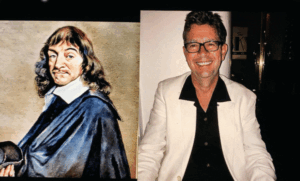
Welcome to an academic blog dedicated to exploring René Descartes’s theory of ideas, authored by Dr. David C. Ring , an emeritus professor of philosophy who retired in 2015 from Orange Coast College in Costa Mesa, CA. Dr. Ring holds a B.A. in philosophy from Cornell University (1974) and an M.A. (1980) and Ph.D. (1987) in philosophy from the University of Wisconsin-Madison. His dissertation, titled “Material Falsity, Objective Reality, and Representation in Descartes’s Theory of Ideas,” was supervised by Dr. Terry Penner.
Dr. Ring’s fascination with Descartes began during his undergraduate studies in philosophy at Cornell University, where he attended a Descartes course taught by esteemed Wittgenstein scholar Norman Malcolm (1911–1990). His teaching career commenced as a teaching assistant at the University of Wisconsin-Madison while working on his Ph.D. Dr. Ring went on to teach a range of philosophy courses in introduction to philosophy, ethics, critical thinking, symbolic logic, history of early modern philosophy (Descartes through Kant), and epistemology at various institutions, including the University of Texas at Austin, Southern Methodist University, the University of Texas at Arlington, North Carolina State University, California State University Long Beach, Pasadena City College, Long Beach City College, and Cerritos College. He spent the last sixteen years of his career at Orange Coast College, ultimately becoming a full professor and chair of the Philosophy department.
Dr. Ring is currently an affiliate at Northern Arizona University. In Fall 2025, he is assisting via ZOOM in Professor George Rudebusch’s senior capstone seminar on Plato’s dialogue “Theaetetus” incorporating AI.
This blog delves into Descartes’s theory of ideas, critically examining different interpretations and defending specific understandings, particularly concerning material falsity, objective reality, and representation in Cartesian ideas. It also explores Descartes’s views on various types of mental states and their representational natures.
During Dr. Ring’s dissertation writing (1980-1987), there was a paucity of scholarly work addressing material falsity and objective reality within Descartes’s theory of ideas. Since then, there has been a surge of interest in these topics, leading to numerous insightful investigations by emerging philosophers. Despite this dedicated scholarship, a consensus on Descartes’s intentions regarding his theory of ideas has yet to be reached. Furthermore, few Cartesian commentators agree with the central thesis of Dr. Ring’s 1987 dissertation, which posits that secondary qualities, such as sensations of color, taste, warmth, or cold, lack any mental content containing objective reality.
René Descartes’s Skull
Descartes’s skull resides in Paris, France, at the Musée de l’Homme, although there is quite a bit of controversy as to whether or not it is the skull of Descartes.
Read about the history of Descartes’s skull and bones in Russell Shorto’s Descartes’ Bones. The skull may have been removed to hide evidence that Descartes had been poisoned, possibly by arsenic.


Orientation
Objective Reality
Cartesian ideas