A Hyperlinked Pictorial Bibliography in multiple languages with links to scholars, references, images, full abstracts, and published reviews
Secondary Sources
The letters above represent the first letter of people’s last names in the Secondary Sources bibliography. Click on them to go to that alphabetical section. One can quickly return by hitting the blue box up arrow  in the lower right corner, if located in the same webpage. OR, click on your browser’s back arrow located in the upper left corner to return to your previous page. Please be patient because these information rich webpages can take five seconds to load.

MacKenzie, Ann Wilbur (no known photo). “Descartes on Life and Sense.” Canadian Journal of Philosophy 19 (1989): 163–92.
MacKenzie, Ann Wilbur (no known photo). “Descartes on Sensory Representation: A Study of the Dioptrics.” Canadian Journal of Philosophy 20 (sup1), Supplementary Vol. 16: Canadian Philosophers: Celebrating Twenty Years of the CJP (January 1990): 109–47.
Alison Simmon’s
overview (2011): Fragments Cartesian sensory perception into (A) sensory perception of primary qualities (which are representational and non-phenomenal) and (B) sensations of secondary qualities (which are phenomenal and non-representational). The former aide in the search after the truth; the latter do not. Also offers a reconstruction of Cartesian representation as “range restricted natural indication” and covers issues of sensory representation.
MacKenzie, Ann Wilbur (no known photo). “The Reconfiguration of Sensory Experience.” In Reason, Will, and Sensation  , edited by John Cottingham
  , 251–72. Oxford: Clarendon Press Oxford, 1994.
Jean-Luc Marion  . On Descartes’ Passive Thought: The Myth of Cartesian Dualism.
Markie, Peter 
 . “The Cogito and its Importance.” In The Cambridge Companion to Descartes
  , edited by John Cottingham , 140–73. Cambridge: Cambridge, 1992.
Marrone, Francesco  . “Ontologia dei contenuti ideali. Essere oggettivo e realtà nel dibattito Descartes-Caterus.” [“Ontology of ideal content. Objective being and reality in the Descartes-Caterus debate.”] Quaestio 12 (2012): 25–77.
Abstract: The point of departure of this paper is a critical reconsideration of the debate on the concept of realitas obiectiva in the First Objections and Replies in Descartes’s Meditations on First Philosophy. The aim of the paper is, on the one side, to stress the role played by Descartes in the formulation of the modern concept of ‘reality’ and, on the other side, to inquire into the role that the Cartesian thought could have played in the historical formulation of the concept of intentionality too. Moving from this general perspective, the paper offers a description of the ontology of the ideal contents given by Descartes in his Meditations; then, it tries to clarify the relationship between this ontology and the doctrine of the intentionality; finally, it proposes an overall interpretation of the fundamental debate between Descartes and Caterus. The point is that the Cartesian doctrine of the realitas obiectiva marked a decisive step in the long history of the intentionality in so far as it stimulated a reflection on the ‘reality’ of the intentional objects considered as contained in the ideas.
Marrone, Francesco . Realitas Obiectiva: elaborazione e genesi di un concetto. Bari: Edizioni di pagina, 2018. [GT: Realitas Obiectiva: development and genesis of a concept]
Publisher’s Blurb: The invention of the concept of realitas obiectiva has always been associated with the name of René Descartes. By integrating this notion into the first proof of the existence of God elaborated in his Meditationes de prima philosophia, Descartes would have sanctioned, according to a widespread opinion, the irruption of the vocabulary of realitas in the framework of modern metaphysics. Thus understood, in the perspective of ordinary interpretation, the Cartesian gesture would therefore be inaugural. However fascinating, this reading does not seem sufficiently well-founded. When Descartes first used the notion of realitas obiectiva, the latter could already boast of a centuries-old history – a story that, although characterized by important mediations, leads back to Duns Scoto and the main representatives of so-called formalist Scotism. The investigation conducted here is intended to give an account of this story that is still not adequately investigated. Through an examination of the Scotist vocabulary, the volume aims to reconstruct a genealogy of the notion of realitas obiectiva that allows to identify, before and regardless of Descartes, the theoretical context within which it was actually elaborated. (Google translate)
Marrone, Francesco . “Res et realitas in Descartes : gli antecedenti scolastici del concetto cartesiano di “realitas objectiva“.” Caen, 2005. [GT: “Res et realitas in Descartes : The scholastic antecedents of the Cartesian concept of “realitas objectiva.”]
Author’s Abstract: The thesis presented examines the historical background of the realitas objectiva, its constitution, the posterity it knew in Descartes’ Meditationes. Absent from the immediate predecessors of the French philosopher, the phrase “realitas obiectiva” is present in a Scotist tradition that dates back to Ioannes Canonicus (Jean Marbres) via Martinus Meurisse, Pierre Tartaret, Antonius Trombetta, Antonius Syrectus. Chapters I and II try to explain:
(a) the notion of realitas obiectiva by an analysis of the lexical and semantic context in which it appears (realitas-formalitas-intelligibilitas);
(b) to place the notion of realitas obiectiva in the tradition in which it was invented, and
(c) to show the importance of a thinker such as Trombetta, who had the merit of ratifying, by explaining it, the vocabulary of realitas obiectiva.
In Chapter III, the author considers the first modern occurrence of the phrase in Pierre Tartaret in the context of the question of the univocity of the being, and renews the notion to its first occurrence in Ioannes Canonicus. Chapter IV considers the introduction of the vocabulary of the realitas obiectiva in the question of divine science (Meurisse), showing the relationship it has with the modern concept of ens reale. Chapter V seeks to show the permanence of the connection between realitas obiectiva and ens reale within the discussion on ens rationis and considers the posterity of the notions of realitas obiectiva in Descartes’s Meditations. (Google translate)
Maull, Nancy L.  . “Cartesian Optics and the Geometrization of Nature.” The Review of Metaphysics 32, no. 2 (December, 1978): 253–73. Reprinted in Descartes: Philosophy, Mathematics and Physics
  , edited by Stephen Gaukroger (1950– 2023)
  , 21–40. Sussex, UK: Harvester, 1980 or Englewood Cliffs, NJ: Barnes and Noble, 1980.
McRae, Robert F(orbes).  . “Descartes’ Definition of Thought.” In Cartesian Studies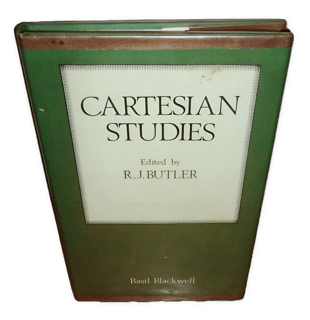
 , edited by Ronald J. Butler (no known photo), 55–70. Oxford: Blackwell, 1972.
McRae, Robert F.  “‘Idea’ as a Philosophical Term in the Seventeenth Century.” Journal of the History of Ideas, 26, no. 2 (1965): 175–90.
McRae, Robert F. “On Being Present to the Mind: A Reply.” Dialogue: Canadian Philosophical Review / Revue canadienne de philosophie 14 , no. 4 , (December 1975): 664–66. Published online by Cambridge University Press: May 5, 2010.
Menn, Stephen  . “The Greatest Stumbling Block: Descartes’ Denial of Real Qualities.” In Descartes and His Contemporaries: Meditations, Objections and Replies
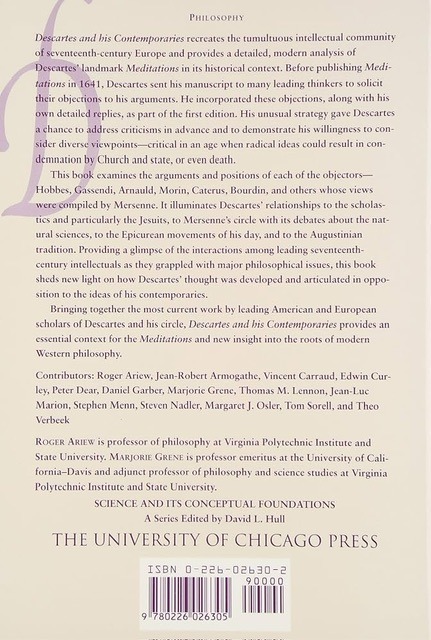 , edited by Roger Ariew
  and Marjorie Grene
  , 182–207. Chicago: University of Chicago Press, 1995.
The hyperlinked entries below are by Predrag Milidrag  and are arranged in alphabetical order by the titles of the English translations of the original Serbo-Croatian as follows (see much below for details on each).
- Read his CV.
- See his bibliography.
The blue hyperlinked titles are English translations of the original Serbo-Croatian language that you can translate into your favorite tongue using a translation program, such as Google Translate.
- “Caterus and Descartes on Ideas, Causation, and Eternal Truths ”
- “The Concept of Things (res) in Descartes”
- “Descartes on Esse Objectivum and Innate Ideas”
- “Descartes’s Idea and Representations of Things”
- “Descartes, Late Scholasticism and the History of Philosophy: The Case of the Theory of Ideas”
- “The Historians of Philosophy and Late Scholastics: The Case of Descartes’s Theory of Ideas“
- ‘Like Images of Things’: The Foundations of Descartes’s Metaphysical Theory of Ideas
- “Metaphysical Foundations of Causality and Its Universality in Descartes”
- “Objective Reality, Its Degrees and Formal Being (esse) in Descartes”
- “The Original Ambiguity/Ambivalence [bifocality] of Descartes’ Ideas”
- “The Principle of Non-Contradiction and Descartes’s God”
- “The Problem of Distinguishing Ideas of Things from Ideas of Non-things in Descartes“
- “Prolegomena for research on Descartes’ metaphysical theory of ideas (1): From substance to spirit“
- “Prolegomena for research on Descartes’ metaphysical theory of ideas (2): From spirit to ideas“
- “The Teaching of Nature and the Will in Descartes”
- “Whether and How Descartes’s Idea Represents”
Milidrag, Predrag  . “KATERUS I DEKART O IDEJAMA, UZROKOVANJU I VEČNIM ISTINAMA.” [“Caterus and Descartes on Ideas, Causation, and Eternal Truths”]. Theoria 55, no. 1 (2012): 45–69.
Summary: In the article, the writer’s objections on Caterus’s Meditations on Descartes’ understanding of the objective reality of ideas and Descartes’ First Replies are analyzed. Caterus’s critique is based on the late scholastic understanding of the act of comprehension and its objective limit (terminus) and the derived concepts of esse objectivum and realitas objectiva. Since these are external marks of the represented thing, Caterus concludes that there is no place for the question of their cause. Despite his own late scholastic background and not knowing about Descartes’ teaching on the creation of eternal truths, he realizes that for Descartes, the degree of the objective reality of ideas is an internal mark of the essence of things that requires efficient causation, equivalent to the creation of eternal truths. Against the late scholastic understanding, Descartes contrasts his new “ontology of the possible,” according to which intramental essences of things exist in the human mind, whose objective existence cannot be reduced to an external mark, and requires actual efficient causation. Hence, he asserts that the very conceivability and intelligibility of essences must have an actual efficient cause, which is equivalent to the creation of eternal truths. (Translated by Merlin using ChatGPT 4.0)
Summary: The article analyzes the objections of Johannes Caterus, the author of the First Objections on Meditations, concerning Descartes’ understanding of the objective reality of ideas, as well as Descartes’ First Replies. Caterus’ critique rests on late Scholastics understanding of the act of conceiving and its objective terminus, and subsequent notions esse objectivum and realitas objectiva. Since they are extrinsic denominations of extramental represented thing, Caterus concludes that there is no room for the question about their cause. Despite his late Scholastics background, and without knowing for Descartes’ doctrine about the creation external truths, Caterus realized that for Descartes the degree of the objective reality of ideas is intrinsic denomination of the essence of thing, that requires efficient cause and that is equivalent with the creation of eternal truths. In his response, Descartes contrasts late Scholastics understanding with his new “ontology of the possible” according to which there are intramental essences of things, with objective being (esse objectivum) which cannot be reduced to extrinsic denomination (“non nihil”) and which requires actual efficient cause. From that he concludes that very conceivability and intelligibility of essences requires efficient cause.
GT: Summary: The article analyzes the remarks of the writer of the First Remarks on the Meditations by J. Caterus on Descartes’ understanding of the objective reality of ideas, and Descartes’ First Answers. Caterus’ criticism rests on the late scholastic understanding of the act of understanding and its objective limit (terminus) and the terms esse objectivum and realitas objectiva derived from it. Since these are external marks of the thing represented, Caterus concludes that there is no room for questioning their cause. Despite his own late scholastic background and not knowing that Descartes’ teaching about the creation of eternal truths, he realizes that the degree of objective reality of ideas for Descartes is an internal mark of the essence of things that requires effective causation, and that this is equivalent to the creation of eternal truths. Descartes contrasts his new “ontology of the possible” with the late scholastic understanding, according to which the intramental essences of things exist in the human mind, whose objective existence cannot be reduced to an external label, and which requires actual effective causation. Hence, he claims that the very comprehensibility and intelligibility of essences must have an actual effective cause, which is equivalent to the creation of eternal truths.
Milidrag, Predrag  . “Pojam stvari (res) kod Dekarta.” [“The Concept of Things (res) in Descartes.”] Philosophy and Society 25, no. 3 (2014): 223–46.
Summary/Abstract: The article analyzes the meaning of the concept of res in Descartes’ metaphysics. The basic meaning is that thing is an essence that could have even real existence. Through the analysis of Descartes’ works that meaning has made more precise against the background of the rational distinction between essence and existence. The relations among the thing and the notions of reality (realitas), the degrees of reality and the modes of reality were shown. The special attention is dedicated to the relation between the thing and the causality, i.e., to the problems how the things could cause and what is the cause of things. The problem of causality is connected with Descartes’ teaching concerning the creation of eternal truths; that connection expresses the difference between his and scholastics’ concept of thing, which is obvious in his concept of the causation of the degrees of reality. At the end the late, scholastics’ notion of supertranscendental meaning of thing is shown in Descartes.
Abstract: The relationship between the concept of reality and existence is analyzed in Descartes’ metaphysics. Primarily, the concept of being as substance that can exist independently is discussed. The analysis of Descartes’ texts refines this meaning considering the rational distinction between essence and existence. The relation of objects to the concepts of reality (realitas), degrees of reality, and modes of reality is demonstrated. A special section is dedicated to the relationship between objects and causality, addressing what and how objects can cause and what causes objects, and highlighting the connection of this issue with Descartes’ doctrine of the reality of eternal truths. This connection represents a fundamental difference between Descartes’ and scholastic concepts of reality, clearly visible in his concept of degrees of reality causation. Finally, the super transcendental concept of reality in Descartes is briefly presented, against its late scholastic background.
Translated by Merlin using ChatGPT 4.0
Milidrag, Predrag  . “DEKART O ESSE OBJECTIVUM I UROĐENIM IDEJAMA” [“Descartes on Esse Objectivum and Innate Ideas”]. Belgrade Philosophical Annual 24 (2011)
  : 173–94. [NOTE: After clicking on the article title, you will get two warnings that say the connection to the article is unsafe. If you still want to read the original Serbian, approve it both times, and you can read the article.]
Abstract: The article analyses Descartes’ notion of esse objectivum against the background of his theory of ideas. The Introduction deals with the notion of idea, thing (res), being (esse) and the difference between ideas of things and ideas of beings of reason. It is argued that there are two meanings of the notion of objective being in Descartes. The first meaning comprises essences of things as represented, as well as beings of reason as represented, and it could be reduced to extrinsic denomination being-as-being-of-object-of-consciousness. Second meaning refers only to the essences of things and expresses their genuine intramental being (esse) in the intellect, whether they are represented by the ideas or not. This second sense is the basis for understanding of Descartes’ innate ideas. Finally, it is shown that, seen on this way, innate ideas are the structures of very thinking (ideas of thing or truth). Nevertheless, in Descartes’ they have to be understood as intramental essences of things (ideas of triangle or mind). The idea of God is exceptional because it functions in both ways.
Milidrag, Predrag  . “DEKARTOVA IDEA I REPREZENTACIJE STVARI.” [“Descartes’s Idea and Representations of Things”]. Filozofija i društvo/Philosophy and Society 22, no. 3 (September 16, 2011): 235–66. Belgrade, Serbia. Source is . Also available at Academia.com. Download here. Also available at
  Central and Eastern European Online Library.
Abstract: On the basis of the analysis of relevant passages from Descartes’ writings, the article shows that Descartes’ ideas represent things in mind, but that he is not a representationalist in a Malebranchean sense: in Descartes, represented object is perceived, not the very representation of that object. Hereafter, three senses of idea in Descartes were analyzed, objective, formal and material, as well as the notions conceptus formalis and conceptus objectivus of Francisco Suárez who is direct historical source of Descartes’ theory of ideas. In the conclusion the centrality of the notion of idea in formal sense in Descartes’ theory of ideas is shown, and it is claimed that the representationalism and direct realism are equivalent in Descartes. At the end, the survey of influence and transformation of understanding of ideas in early modern philosophy is presented. (bold not in original)
(GT) Summary: Based on the analysis of relevant places from Descartes’ writings, the article shows that Descartes’ ideas represent things in the spirit, but that he is not a representationalist in the Malbranchian sense: with Descartes, the represented object is perceived and not the representation of the object. After that, the three senses of idea in him are analyzed, objective, formal and material, and then the understanding of the terms conceptus formalis and conceptus objectivus in Francisco Suarez, which constitutes an immediate historical-philosophical source of Descartes’ theory of ideas. In the conclusion, the centrality of the notion of idea taken formally is highlighted and the reasons for the claim that within Decat’s theory of ideas, representationalism and direct realism are equivalent are presented. Finally, a summary overview of the influence and transformation of the understanding of ideas in early modern philosophy is given. Key words: theory of ideas, direct realism, representationalism, conceptus formalis, conceptus objectivus, Francisco Suárez, early modern philosophy.
Milidrag, Predrag  . “.
. “. “MISTORIÈARI FILOZOFIJEI KASNA SHOLASTIKA:SLUÈAJ DEKARTOVE TEORIJE IDEJA” [“The Historians of Philosophy and Late Scholastics: The Case of Descartes’ Theory of Ideas“]. Filozofija i drustvo 21 [Philosophy and Society 21], no. 1 (January 2010): 187–206.
Summary: The article delves into the evolution of historical-philosophical research on the late-scholastic sources of Descartes’ theory of ideas, critically examining the long-held belief among historians of philosophy that Descartes’ theory is fundamentally epistemological. This view, deeply rooted in neo-Kantianism, began to shift with the emergence of a new wave of scholars who explored non-metaphysical facets of Descartes’ thought, alongside novel interpretations of late scholastic philosophy. The analysis reveals the specific relevance of late scholasticism to Descartes, particularly over figures like Thomas Aquinas, and underscores Francisco Suarez’s distinct significance within the context of Descartes’ theory of ideas.
Summary (Translation of Serbo-Croatian Abstract): The article analyzes the development of the research of late scholastics sources of Descartes’ theory of ideas. In the first part, it analyzes long time dominant opinion among the historians of philosophy that Descartes’ theory of ideas is an epistemology in its essence. The reasons for abandoning of such, mainly neo-kantian image were the appearance of the new generation of the historians of philosophy that investigated the non-metaphysical areas of Descartes’ thought, as well as the new interpretations of the very late scholastics philosophy. In second part of the essay, it is shown why late scholastics is relevant for Descartes, and not, for example, Thomas Aquinas and why Francisco Suarez is especially important in the context of Descartes theory of ideas.
GT: Summary: The article analyzes the development of the historical-philosophical research of the late scholastic sources of Descartes’ theory of ideas. The first part analyzes the long-standing dominant position among historians of philosophy that Descartes’ theory of ideas is essentially epistemology. The reasons for abandoning such a picture, largely conditioned by neo-Kantianism, were the appearance of a new generation of historians of philosophy who researched non-metaphysical areas of Descartes’ thought, as well as work on late scholastic philosophy itself. In the second part, it is shown why late scholasticism is relevant for Descartes, and not, for example, Thomas Aquinas, and why Francisco Suarez stands out among late scholastic thinkers in terms of importance.
Key words: theory of ideas, late scholasticism, Francisco Suárez, Norman J. Wells, conceptus formalis.
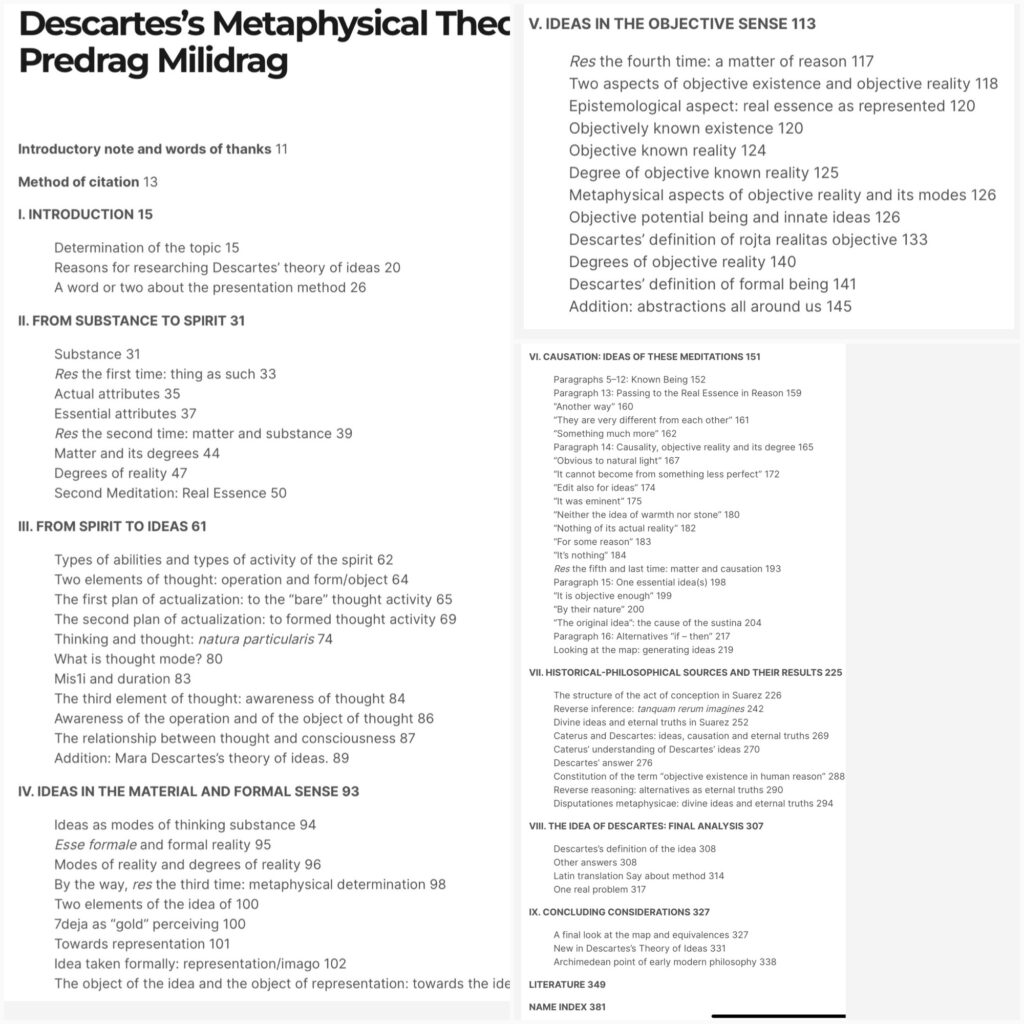
Milidrag, Predrag . Poput slika stvari“: Temelji Dekartove metafizičke teorije ideja 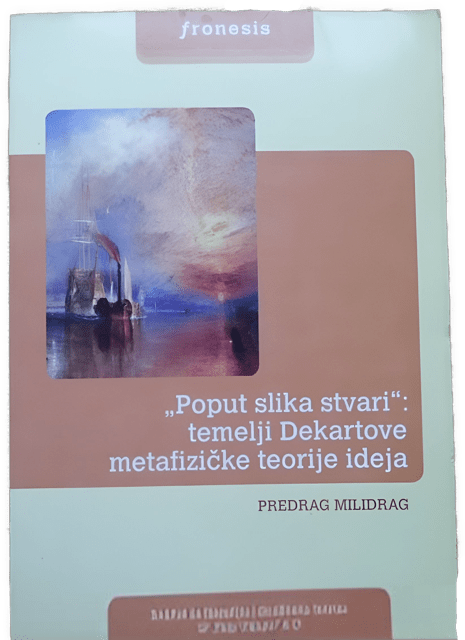 . [“‘Like Images of Things’: The Foundations of Descartes’ Metaphysical Theory of Ideas”]
 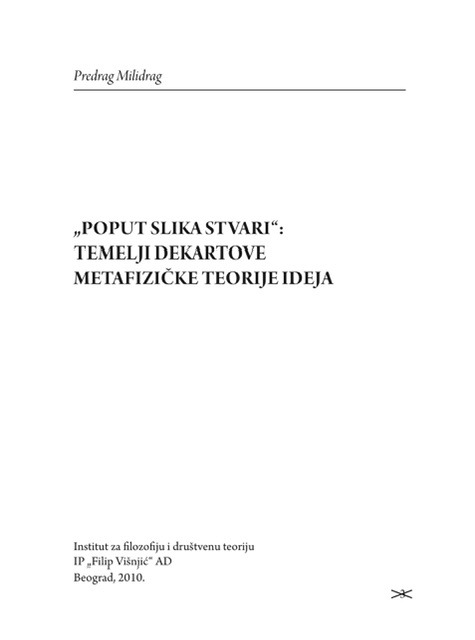 . Belgrade: Institute for Philosophy and Social Theory, IP “Filip Višnjić,” 2010. Click on the titles or the book cover to read the entire book in Serbo-Croatian. Also readable in Serbo-Croatian from Scribd or from Dokumen (it might time out) or Academia.com. See the “Table of Contents” translated into English by Google Translate below.
Milidrag, Predrag .”Metafizički temelji uzročnosti i njene univerzalnosti kod Dekarta“. U Danilo N. Basta, Časlav D. Koprivica, Bogoljub Šijaković (prir.), Filosofija u vrtlogu našega vremena. Svečanik u čast 80. rođendana akademika Mihaila Đurića, Gutenbergova galaksija, Beograd (2005): 287–310.
[“Metaphysical Foundations of Causality and Its Universality in Descartes”. U Danilo N. Basta, Časlav D. Koprivica, Bogoljub Šijaković, eds. Philosophy in the maelstrom of our time. Celebration in honor of the 80th birthday of academician Mihail Đurić. Belgrade: Gutenberg’s Galaxy (2005): 287–310.]
Milidrag, Predrag . “Objektivna stvarnost, njeni stupnjevi i formalno bivstvovanje (esse) kod Dekarta” [“Objective Reality, Its Degrees and Formal Being (esse) in Descartes”]. Philosophical Yearbook 25 (2012): 113–32.
Milidrag, Predrag  . “Izvorna dvožižnost Dekartovih ideja” [“The Original Ambiguity/ambivalence of Descartes’ Ideas”] [”The genuine bifocality of Descartes’ ideas”]. Filozofski Godišnjak 10 (1997): 87–115. [Belgrade Philosophical Annual 10 (1997): 87–115.]
Abstract: In this paper, two meanings of the notion of ‘idea’ are analyzed, as Descartes defined them in the Preface to Meditations (AT VII 8): idea in the material sense (idea as a mode of the thinking substance, representational activity and perception) and idea in the objective sense (idea as thing represented in the intellect, as form, essence and concept of the thing). In connection with the idea taken objectively there is the notion of the degrees of the objective reality, by which the ontological dependence of the essences represented by idea is expressed, the essences which have a perfection of possible formal existence. The objective reality differs from objective being: the former is a degree of perfection of essence, the latter is the way of existence of that essence. On the basis of these two meanings of idea cited above, Descartes’ idea can be defined as perception of the object and as object of perception too; these characterizations are complementary and elementary as well. They express the always actual dyadic relation at the self-conscious mind toward itself and toward the object in the consciousness. Therefore, it could be said that Descartes’ idea has [a] relational nature. All other meanings of the idea taken materially or objectively are the ways in which the mind alone understands these two elementary relations. In Descartes’ notion of ‘idea’ three kinds of causality are clearly recognizable: formal, material and efficient. Besides these, and some other scholastics sources, Descartes radically breaks with traditional platonic and scholastic basic characterization of [an] idea as [an] exemplar; in his philosophy, the essential feature of [an] idea is its representativeness.
Milidrag, Predrag  . “Princip neprotivrecnosti i Dekartov Bog.” [“The Principle of Non-Contradiction and Descartes’ God.”] Theoria 53, no. 4 (2010): 15–33. Also available at Scribd.
Abstract: The article analyzes the status of the principle of non-contradiction as an eternal truth in Descartes’ metaphysics, trying to answer whether it was also created. After distinguishing between created and uncreated eternal truths, one comes to the conclusion that the principle of non-contradiction is also a created eternal truth. He, as such, applies this to God as well, but only under his determination “the most comprehensive being.” Its more fundamental determinations, absolute that is. causa sui remain outside the domain of validity of this principle because it is about the area of the absolute identity of God’s essence and his existence. Since man can only think with the principle of incommensurability, he must also observe God’s infinity with regard to that principle. However, since the principle of negation does not apply to the absolute identity of God, human partial rationality interprets its absence as its negation, and it appears to it as self-negation. In the end, the (partial) weightiness of Leibniz’s criticism of Descartes regarding the ontological proof is shown.
NOTE: This entry is not clearly in the theory of ideas.
Milidrag, Predrag . “Problem razlikovanja ideja stvari od ideja nestvari kod Descartesa” [“The Problem of Distinguishing Ideas of Things from Ideas of Non-things in Descartes“]. Philosophical Research 32, no. 2 (2012): 261–78. Also available at Central and Eastern European Online Library.
Summary/Abstract: The paper begins with the analysis of [the] Third Meditation, and it is shown that there is no difference between any objects of the representations as such. Descartes’ understanding relies on Late Scholastics concept of simple conception. By the example of two ideas of sun and the idea of self it is shown that Descartes could argue that some ideas certainly do not represent just beings of reason, but that is not enough. Using his other writings the conclusion is that, in fact, there are two problems: how to distinguish between the essences of things from beings of reason and how to make a demarcation within very beings of reason between possible and impossible constructs. In the second part of the paper, Leibniz’s critique of Descartes’ ontological argument is analyzed. The historic cause of the problem is Descartes’ use of mutually irreconcilable concepts of human mind and divine ideas, and the cause within his metaphysics is dualism and his insufficiently clear notion of clarity and distinctness of ideas.
Author’s Abstract: The text begins with an analysis of the Third Meditation, where it is shown that there is no difference between the objects of representation as such. This understanding of Descartes relies on the late scholastic concept of simple understanding. Then, on the example of the two ideas of the sun and the idea of the Self, it was shown that Descartes can claim that some ideas certainly do not represent rational beings, but that this is not enough. On the basis of his other writings, the existence of two problems was demonstrated: distinguishing the essence of things from the being of reason and the demarcation within the being of reason between possible and impossible constructs. The second part of the text deals with Leibniz’s criticism of Descartes’ ontological proof. The historical-philosophical cause of the problem is that Descartes used mutually irreconcilable late scholastic concepts of the human spirit and divine ideas, and the cause within his metaphysics is dualism and an insufficiently thought-out criterion of clarity and [distinctness]. (Translated by Google Translate from the original Serbo-Croatian)
Milidrag, Predrag  (unknown photo source). “Prolegomena za istraživanje Dekartove metafizičke teorije ideja (1): Od supstancije do duha.” Filozofski godišnjak 12 (1999): 27–57. [“Prolegomena for research on Descartes’ metaphysical theory of ideas (1): From substance to spirit.” Philosophical Yearbook 12 (1999): 27–57.]
Abstract: The subject of this article is an analysis of the fundamental notions of Descartes’ metaphysics, which are relevant to an understanding of his theory of ideas. It begins with the notions of substance as such and thing (res) as such. The notion of thing is defined as follows: an essence with the predicate ‘the possibility of existing even outside of thinking.’ On this notion Descartes builds his notion of reality (realitas) and its degrees. The degrees of reality are defined as intrapredicate determination[s] of an essence and they refer to the degree of independence of an essence’s possible existence even outside of thinking. The degree of reality can be either substantial or modal, i.e., such can be the existence of the essences of things. After that, the place from Meditation Two is interpreted where Descartes states that the ‘I’ is a thing which is real and which is truly exists (res vera et vere existens, AT VII 25). It is done against the background of the notion of the real essence (essentia realis) in the philosophy of late Scholastics philosopher and theologian Francisco Suarez, S.J.. The conclusion is that the ‘I’ is a real essence, and that the notions of ‘thing’ and ‘real essence’ are equivalent. The real essence, which is in the thinking, is named a potential real essence, because it is in thinking and has a potentiality for existing even out of it; if it exists out of thinking the essence is actual real essence. The very actuality or non-actuality of the potentiality in question is only a characteristic (accidence) of an essence, not it’s predicate. This is a consequence of Descartes’s (as well as Suarez’s) understanding of the difference between essence and existence of being (ens), as merely a conceptual one. Therefore it is necessary to distinguish between two questions about related to the existence of the essence: if it exists actually (its accidence) and how it can exist (its predicate: whether it is substantial or modal).
Milidrag, Predrag  . “Prolegomena za istraživanje Dekartove metafizičke teorije ideja (2): Od duha do ideja.” Filozofski godišnjak 13 (2000): 40–70. [“Prolegomena for research on Descartes’ metaphysical theory of ideas (2): From spirit to ideas.” Philosophical Yearbook 13 (2000): 40–70.]
Abstract: This part of the “Prolegomena” considers Descartes’s understanding of [the] constitution of thoughts as such. Every thought as such, either some kind of volition or some idea, has three elements: the operation, the form/object, and self consciousness. The process of constitution of the thoughts is seen as the process of actualization, which could be divided into two stages. First, the thinking as a potential real essence is actualized; it does God by the preservation of the thinking substance in the existence. The result of this actualization is some ‘naked’ thinking activity, that is an operation (some substantial existing perception or volition) and it could be seen as a matter of the thoughts. Then to this ‘naked’ thinking activity something comes up (from the res or from the non-res) which could be seen as a form and it is an object of that thought. The third element of a thought, the consciousness of the thought, always carries in itself the consciousness of the operation, of the object of the thought and of the mind itself. The consciousness and the thinking do not coincide: at any time we have the consciousness of all three elements of the thought, but we need not think about all of them (at some particular time, during which we have that thought). Thanks to attention, the mind can direct itself to thinking about just one of the three elements. Everything that the mind is conscious of when it is conscious of a thought could become the object of the thinking. The actual contents of consciousness are potential objects of the thinking. Besides these problems, in this part of the “Prolegomena” the relations are considered between the thoughts and the[ir] duration, the thoughts and the thinking as an actual real essence, as well as the relation between the thoughts and thinking substance. Also, relevant passages from Arnauld’s objections and Descartes’s replies from their 1648 letters (AT V, 213–14, 221) are interpreted in the context of the relation between the thinking as an essence and the thoughts as an actualization of that essence. Finally, it is shown how the analyses from this “Prolegomena” can be used in the interpretation of [the] essential Descartes’s statements about ideas.
Milidrag, Predrag . “UČENJA PRIRODE I VOLJA KOD DEKARTA” [“The Teaching of Nature and the Will in Descartes”]. Theoria 51, no. 2 (2008): 79–98.
Abstract: The paper analyzes Descartes’ notion of learning nature as a consequence of the union of the spirit with the body, and in the context of determining the will. Also, paragraphs 3-5 of the Second Meditation are interpreted with regard to the teachings of nature that appear in them about what man is.
Milidrag, Predrag . “Da li i kako Descartesova ideja ‘reprezentuje‘” [“Whether and How Descartes’s Idea ‘Represents‘”]. ODJEK – Revija za umjetnost, nauku i društvena pitanja 63, no. 3  (2010): 14–27. [Echo — Review for art, science and social issues 63, no. 3 (2010): 14–27.]
- Read an English translation primarily done by ChatGPT 4.0 under Merlin
 with additional corrections using Google translate
  .
.
Moran, Dermot  . “Descartes on the Formal Reality, Objective Reality, and Material Falsity of Ideas: Realism through Constructivism?.” In Realism, Science, and Pragmatism
 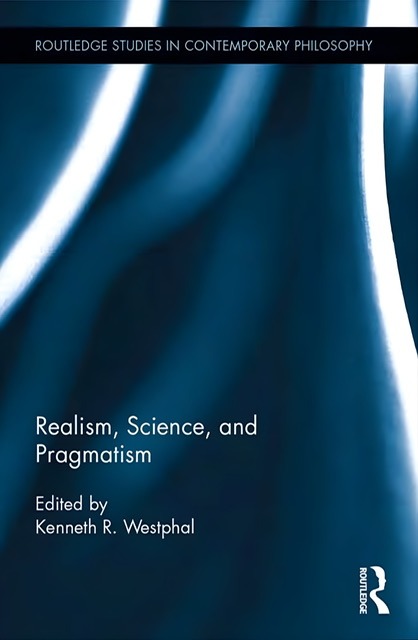 , edited by Kenneth R. Westphal
  , 67–92. New York & London: Routledge, 2014.
Mori, Gianluca 

 . “Hobbes, Descartes, and Ideas: A Secret Debate.” Journal of the History of Philosophy 50, no. 2 (2012): 197–212.
Morris, Katherine J.  . “Intermingling and Confusion.” International Journal of Philosophical Studies 3 (1995): 290–97.
Myrdal, Peter  and Arto Repo
  . “Ideas and Reality in Descartes” (ultimate version). “Ideas and Reality in Descartes” (penultimate version). In Mind, Body, and Morality: New Perspectives on Descartes and Spinoza
  , edited by Martina Reuter (no known photo) and Frans Svensson
  . London: Routledge, 2019. Read the editor’s “Introduction” to the book, or a partial version with hyperlinks.
Author’s Abstract: This chapter explores some key issues within Descartes’s theory of cognition. The starting-point is a recent interpretation, according to which Descartes is part of a tradition of theorizing about human cognition, beginning from the idea that we are in principle capable of articulating or grasping the basic order of reality. Earlier readings often take Descartes to question whether we have any cognitive access to reality at all. On the new reading, Descartes instead defends a robust conception of our cognitive relation to reality—our cognition needs to be “determined by reality” as John Carriero puts it. One important element of Carriero’s interpretation is that Descartes’s notion of idea is to be understood along the lines of the Aristotelian doctrine of formal identity between cognizer and cognized. Here it is argued that retaining the latter doctrine faces some difficulties, given the novel conception of the structure of reality defended by Descartes. This chapter proposes that he needs an alternative account of what it is for a cognizer to be determined by reality. Attending to some important differences between the innate idea of extension and that of God, the chapter concludes that Descartes may not have a fully worked-out account of his own. Considering some of the problems inherent in his views can, however, shed light on the, from our contemporary perspective, peculiar role both Spinoza and Leibniz give to God in accounting for cognition.

Nadler, Steven  . Arnauld and the Cartesian Philosophy of Ideas
 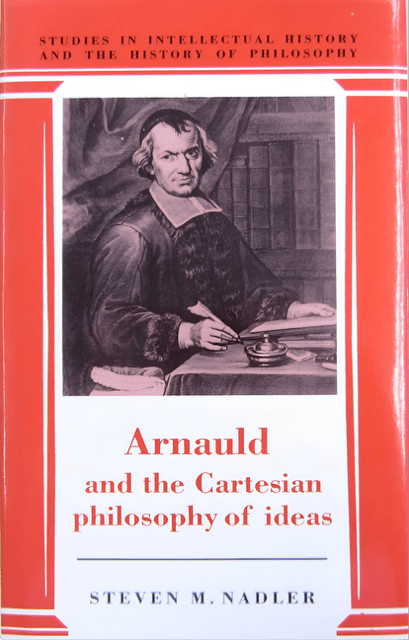 . Manchester: Manchester University Press, 1989.
Nadler, Steven  , ed. Causation in Early Modern Philosophy: Cartesianism, Occasionalism, and Preestablished Harmony
  . University Park, PA: Pennsylvania State University Press, 1993.
Nadler, Steven  .”The Doctrine of Ideas.” In The Blackwell Guide to Descartes’ Meditations.
  , edited by Stephen Gaukroger
  , 86–103. Malden, MA: Blackwell Publishing, 2006. See basic information at “The Doctrine of Ideas” in The Blackwell Guide to Descartes’ Meditations.
Nadler, Steven  . “Occasionalism and the Mind-Body Problem.” In Occasionalism: Causation Among the Cartesians
 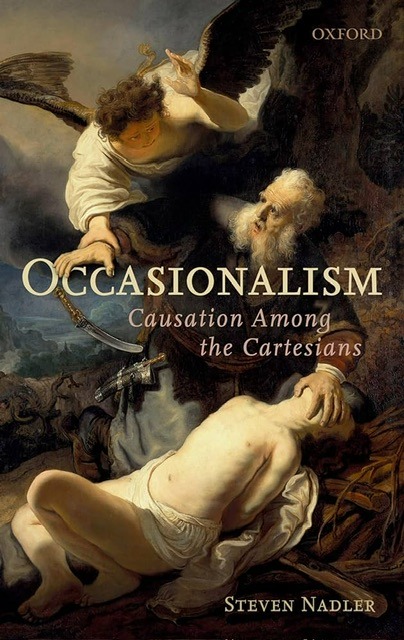 , edited by Steven Nadler
  , 6–28. New York: Oxford University Press, December 2010.
Nelson, Alan  . “Descartes’s Ontology of Thought,” Topoi 16 (1997): 163–78.
- See his updated to May 2024 CV.
Nelson, Alan . “The Falsity in Sensory Ideas: Descartes and Arnauld.” In Interpreting Arnauld  , edited by Elmar J. Kremer
  , 13–32. Toronto: University of Toronto Press, 1996.
Nelson, Alan . “The Structure of Cartesian Sensations.” Analytic Philosophy 54, no. 1 (March 2013): 107–16.
Newman, Lex . “Descartes’ Rationalist Epistemology.” In A Companion to Rationalism
 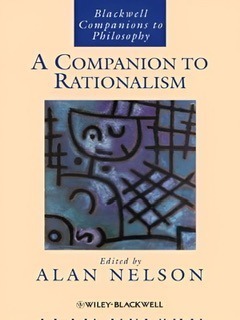 , edited by Alan Nelson , 179–204. Oxford, UK: Blackwell, 2005.
Newman, Lex. “Ideas, Pictures, and the Directness of Perception in Descartes and Locke.” Philosophy Compass 4, no. 1 (2009): 134–54.
Abstract: How are we to understand philosophical claims about sense perception being direct versus indirect? There are multiple relevant notions of perceptual directness, so I argue. Perception of external objects may be direct on some notions, while indirect on others. My interest is with the sense in which ideas count as perceptual mediators in the philosophy of Descartes and Locke. This paper has two broader aims. The first is to clarify four main notions of perceptual directness. The second is to support my contention that in the texts characterizing ideas as immediate objects of perception, Descartes and Locke are invoking the notion of directness I call ‘objectual’. This notion is modeled on the way a picture mediates perception of the pictured object. The upshot of my account is that—with respect to the objectual notion of directness—Descartes and Locke each hold an indirect theory of perception.
Newman, Lex. “Sensory Doubts and the Directness of Perception in the Meditations.” Midwest Studies in Philosophy 35 (2011): 205–22.
Newman, Lex. “Theories of Ideas.” In The Routledge Companion to Seventeenth Century Philosophy  , edited by Dan Kaufman
  , 195–223. London: Routledge Publishing, 2017.
Newman, Lex. “Unmasking Descartes’s case for the Bête Machine doctrine.” Canadian Journal of Philosophy 31, no. 3 (2001): 389–426.
Nolan, Lawrence  . The Cambridge Descartes Lexicon
  . Cambridge, UK: Cambridge University Press, 2016.
Nolan, Lawrence  . “Descartes on What We Call ‘Color’.” In Primary and Secondary Qualities: The Historical and Ongoing Debate
  , edited by Lawrence Nolan , 81–108. New York: Oxford University Press, 2011.
Nolan, Lawrence  , ed. Primary and Secondary Qualities: The Historical and Ongoing Debate . New York: Oxford University Press, April 2011.
- See Matthew Stuart’s
 Review. British Journal for the History of Philosophy 20, no. 3 (2012): 640–42.
Nolan, Lawrence  and John Whipple
  . “The Dustbin Theory of Mind: A Cartesian Legacy?.” In Oxford Studies in Early Modern Philosophy
  , vol. 3, ch. 2, edited by Daniel Garber
  and Steven Nadler , 33–55. Oxford: Clarendon Press, 2006.
Normore, Calvin  . “Meaning and Objective Being: Descartes and His Sources.” In Essays on Descartes’ Meditations
  , edited by Amélie O. Rorty
  , 223–41. Berkeley: University of California Press, 1986.
Normore, Calvin . “The Matter of Thought.” In Representation and Objects of Thought in Medieval Philosophy  , edited by Henrik Lagerlund
  , 117–33. Burlington, VT: Ashgate Publishing Co., 2007.

Olgiati, Francesco 
 . Cartesio. Milano: Società Editrice “Vita E Pensiero”, 1934.
- See especially pp. 316–18 for connections between Suarez and Descartes on the objective reality of ideas.
O’Neil, Brian E. (no known photo) Epistemological Direct Realism in Descartes’ Philosophy 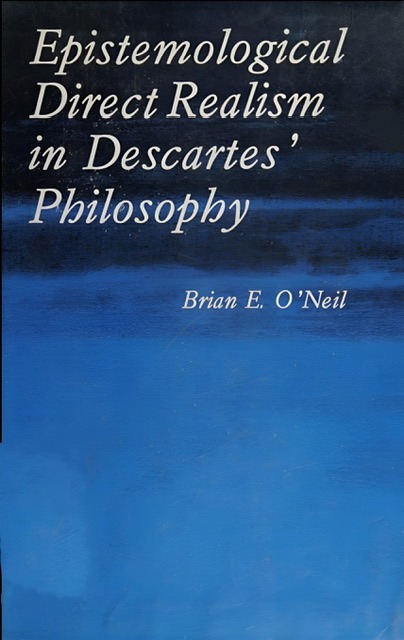 . Albuquerque, NM: University of New Mexico Press, 1974.
Ortín Nadal, Anna Pilar . “Descartes on the Distinction between Primary and Secondary Qualities.” British Journal for the History of Philosophy 27, no. 6 (2019): 1113–34.
Abstract: Descartes did not use the terms ‘primary’ and ‘secondary’ qualities, but a similar distinction emerges from his texts: certain qualities of objects (such as size and shape) are intrinsic properties of matter, whereas others (like colours and smells) are products of the interaction with a perceiver. A common interpretation states that the division between primary and secondary qualities is explained by the way in which we are acquainted with them: an idea of a primary quality is similar to its physical causes, and it is clearly and distinctly perceived by the intellect. An idea of a secondary quality is dissimilar to its physical causes and it is obscurely and confusedly perceived by the senses. This view receives the name of ‘bifurcation reading’ (Simmons, Alison, “Descartes on the Cognitive Structure of Sensory Experience.” Philosophy and Phenomenological Research, LXVII, no. 3 (November 2003)). While it integrates well some textual occurrences, it creates a problematic fragmentation within single acts of perception. This paper contends that this reading is incorrect. It presents several arguments for the claim that the distinction of qualities is due to the different ways in which our ideas of them misrepresent their physical causes. Then, Descartes’ dissimilarity thesis between physical objects and our ideas of them remains a structural feature of his theory of sensory perception and not a local phenomenon affecting only ideas of secondary qualities.
Ortín Nadal, Anna Pilar  . “Descartes on Natural Signs and the Case of Sensory Perception.” Journal of Modern Philosophy 6 (2024): 77–87. Download it directly. Also here.
Abstract: Descartes used the notion of sign to describe three phenomena: language, the external movements of the passions, and sensory perception. For this, he appealed to conventional, external, and natural signs respectively. A systematic treatment of signs as proper components of Descartes’ considered views is extremely rare and, specifically, natural signs are often deemed as a figure of speech with no appreciable place within his thought. The objective of this paper is to counter this view and present two related points: first, Descartes’ identification of brain states with signs established by nature in the Treatise on Light (AT XI.4/G.4) amounts to a genuine attempt at understanding the causal structure of sensory perception. This is supported by Descartes’ consistent usage of the notion of sign for capturing the activities exclusive to embodied minds. Second, by reconstructing a taxonomy of signs this paper aims at rehabilitating the notion of sign as a Cartesian technical notion. It is rather perplexing that, even though Descartes made regular use of this notion in three distinct contexts, there is no general understanding of it as a term that merits rational reconstruction. This paper revises this omission with the case of sensory perception at the centre.
- 1. Preliminaries: What is the Problem?
- 2. A Taxonomy of Signs
- 3. Natural Signs in Focus
- 4. The Linguistic Model
- Conceptual integration
- Mental activity
- Use of analogy
- Explanatory depth
- Concluding remarks
- Notes
- Acknowledgements
- Competing Interests
- References
Ortín Nadal, Anna Pilar . “Mental activity in Descartes’ causal-semantic model of sensory perception.” PhD diss, Philosophy, The University of Edinburgh, July 2018.
Abstract: The aim of this thesis is to defend a reading of Descartes’ theory of sensory perception in which, against a widespread interpretation, the mind is not a passive receiver of inputs from the environment, but an active decoder of neural information that contributes to the representational content of ideas. I call this the ‘mental activity thesis’ and, in the overall picture, I identify it as one of the philosophical implications of the seventeenth-century scientific revolution. Within Descartes’ dualism, to offer a theory of sensory perception amounts to describing the interplay between the natural world, the brain, and the mind. Given his mechanistic, micro-corpuscular conception of matter, Descartes developed detailed physiological descriptions of the interaction between external objects and the brain. He envisaged it as an isomorphic relation in which the characteristics of objects are transmitted through the nerves to the brain as patterns of geometrically reduced properties. This process is often read as culminating with the mind being passively affected by a corporeal isomorph. Descartes’ doctrine becomes elusive in its mental phase, but the passivity reading, so I contend, remains inadequate. I argue for the mental activity thesis through four claims.
First, I subscribe the known view that Descartes is concerned about a version of the mind-body problem that is not equivalent to the problem of substance interaction. It is rather a problem of dissimilarity between mental representations and mechanistic explanations. The question is how the qualitative character of sensory experiences can arise from the quantitative notions of physical science. As a way of emphasising the weight that the problem of dissimilarity has for Descartes’ philosophical decisions, I show that it motivates a metaphysically interesting distinction between types of causes for the case of brain-mind interaction.
Second, I defend the position that, despite not holding a perfectly unambiguous doctrine, Descartes’ introduction of natural signs is the closest that he got to formulating a full-fledged theory of sensory perception. The appeal to natural signs has been normally deemed as metaphorical in the literature. I argue that, on the contrary, it is possible to reconstruct a causal story for brain-mind interaction along the lines of a semantic model based on Descartes’ identification of neural events with natural signs. A causal-semantic model emerges as a charitable, plausible reading that reveals the mind as an active interpreter.
Third, in light of the mental activity thesis, I read Descartes’ late appeal to the innateness of all ideas (notably in the Comments on a Certain Broadsheet) as a strategy to account for a type of representational content needed for sensory ideas that, while produced by the mind, is different from that of his paradigmatic innate ideas. I assist Descartes in exploring how the category of innateness captures mental activity within a causal-semantic theory.
Fourth, in the course of this argumentation, and for further support, I address the role of the distinction between primary and secondary qualities in Descartes’ theory. I tackle a pervasive objection stemming from his alleged association of the perception of primary qualities with the intellect. By reassessing Descartes’ views on mental activity, this interpretation aims at a lucid description of sensory perception that goes beyond the rigid rationalism that is often credited to him.
O’Toole, Frederick J. (no known photo). “Descartes’ Problematic Causal Principle of Ideas.” Journal of Philosophical Research 18 (1993): 167–91.
Author’s Abstract: There is a virtual consensus among commentators on Descartes that the causal principle by which he relates the objective reality of his ideas to the formal reality of their causes is indefensible. In particular, Descartes’ claim that this principle follows from the general principle which states that the cause must contain at least as much reality as the effect has been examined and rejected as logically implausible. I challenge this view by showing that there is a logically plausible derivation of the causal principle of ideas from the general causal principle. This result has important implications due to the crucial role the causal principle of ideas plays in Descartes’ first a posteriori argument for the existence of God.

Pasnau, Robert  . “Descartes and the Possibility of Enlightened Freedom.” Res Philosophica 94, no. 4 (2017): 499–534.
Pasnau, Robert  . Theories of Cognition in the Later Middle Ages
  . Cambridge: UK: Cambridge University Press, 1997.
Patterson, Sarah  . “Clear and Distinct Perception.” In A Companion to Descartes
  , edited by Janet Broughton
  and John Carriero
  , 216–34. Oxford: Blackwell, 2008. Also in Wiley’s Online Library.
Patterson, Sarah . “Descartes on the Errors of the Senses.” Royal Institute of Philosophy Supplement 78 (2016): 73–108.
Abstract: Descartes first invokes the errors of the senses in the Meditations to generate doubt; he suggests that because the senses sometimes deceive, we have reason not to trust them. This use of sensory error to fuel a sceptical argument fits a traditional interpretation of the Meditations as a work concerned with finding a form of certainty that is proof against any sceptical doubt. If we focus instead on Descartes’s aim of using the Meditations to lay foundations for his new science, his appeals to sensory error take on a different aspect. Descartes’s new science is based on ideas innate in the intellect, ideas that are validated by the benevolence of our creator. Appeals to sensory error are useful to him in undermining our naïve faith in the senses and guiding us to an appreciation of innate ideas. However, the errors of the senses pose problems in the context of Descartes’s appeals to God’s goodness to validate innate ideas and natural propensities to belief. A natural tendency to sensory error is hard to reconcile with the benevolence of our creator. This paper explores Descartes’s responses to the problems of theodicy posed by various forms of sensory error. It argues that natural judgements involved in our visual perception of distance, size and shape pose a problem of error that resists his usual solutions.
Paul, Elliot Samuel 
 . “Cartesian Clarity.” Philosophers Imprint 20, no. 19 (June 2020): 1–28.
Paul, Elliot Samuel  . “Cartesian Intuition.” British Journal of the History of Philosophy, 31, no. 4 (2022): 693–723.
Paul, Elliot Samuel  . “Descartes’s Anti-Transparency and the Need for Radical Doubt.” Ergo, 5, no. 41 (2018): 1083–129. Also available ERGO.
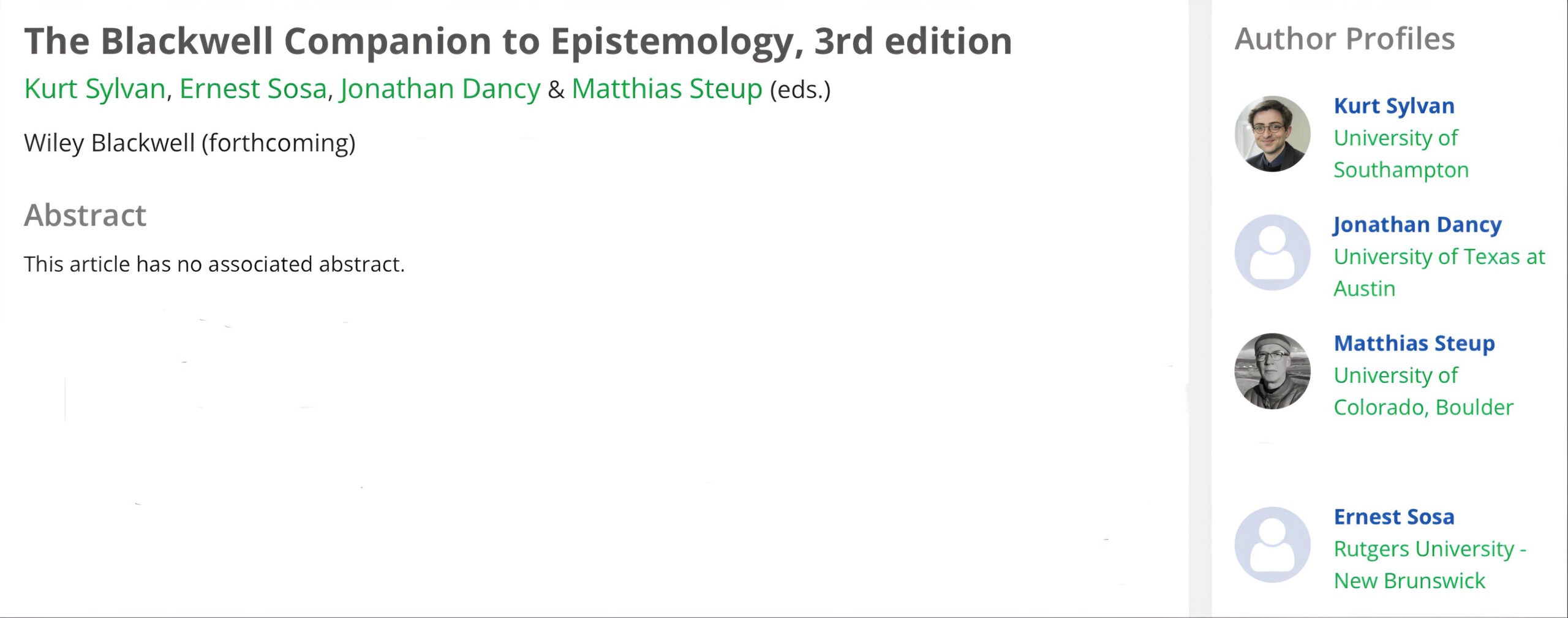
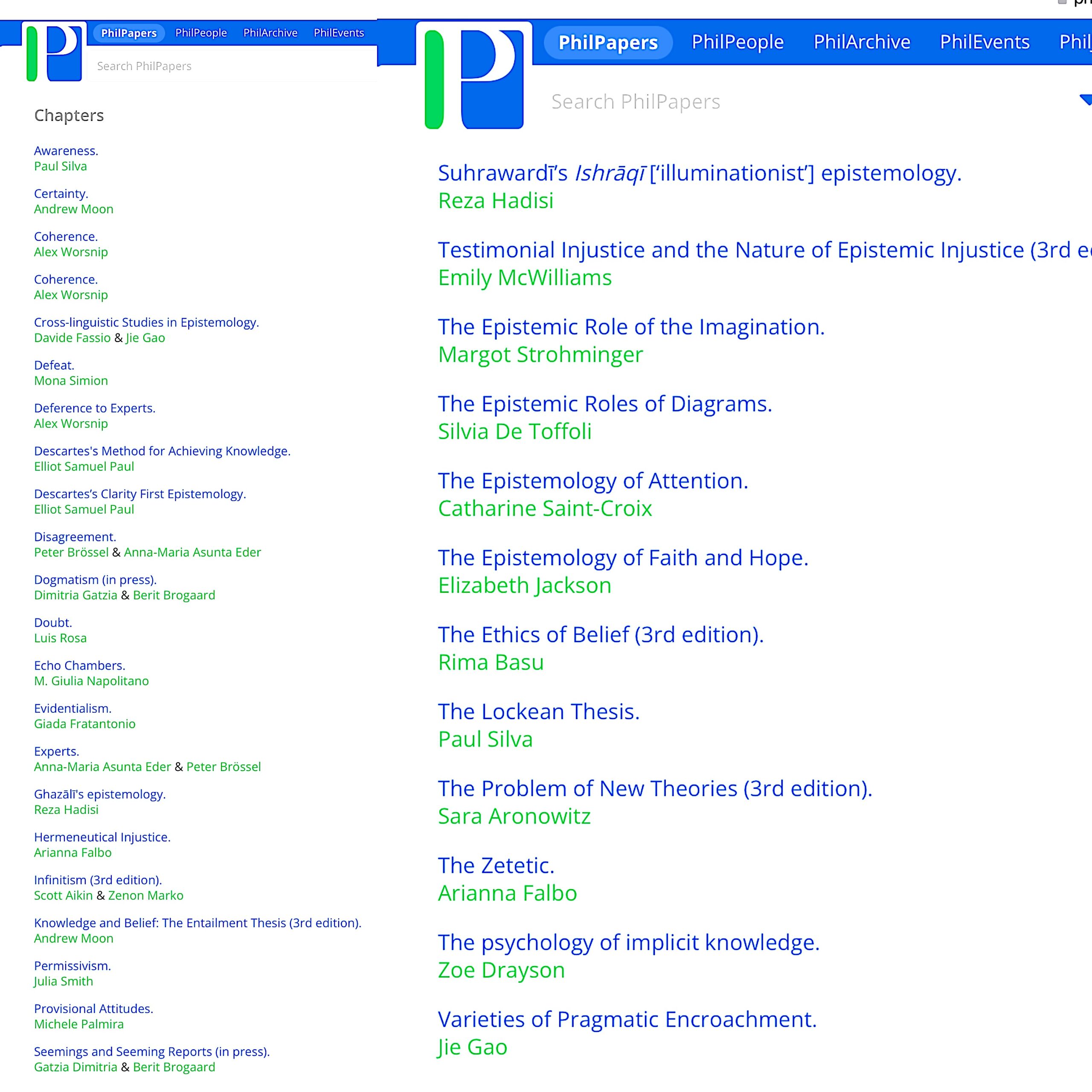
Paul, Elliot Samuel  . Forthcoming. “Descartes’s Clarity First Epistemology.” In The Blackwell Companion to Epistemology, 3rd Edition, edited by Kurt Sylvan
  , Ernest Sosa
  , Jonathan Dancy
  , and Matthias Steup
  . Hoboken, NJ: Wiley Blackwell, 2025. All chapters are listed below in the screen capture from PhilPapers.
Percival, Ray Scott 


 . “Descartes’ Model of Mind.” In The Encyclopedia of Clinical Psychology
  , edited by Robin L. Cautin
 and Scott O. Lilienfeld
  . New Jersey: Wiley-Blackwell (2015): 852–58.
Abstract: René Descartes was an advocate of a particular form of dualist interactionism, in which the influential materialism of his day played a large role. Descartes argued that there was both mind and body and that these interacted with one another. Materialism, which had received a boost in the seventeenth century with the rise of Galileo’s (1564–1642) approach to science, is the doctrine that everything is composed of matter or body and that this fills parts or perhaps the whole of space. Different parts of the world interact by one body pushing another body, making the whole world a clockwork mechanism in which all explanation is based on action by contact and push. Descartes’ model of mind was an answer to the question how does the mind fit into such a machinelike world.
KEYWORDS: Aristotle; Galileo; history of science; materialism; self and identity; dualism; hallucinations; interactionism; methodology; mind.
Perler, Dominik  . “Essentialism and Direct Realism: Some Late Medieval Perspectives.” Topoi 19, no. 2 (2000): 111–22.
- See his publications updated June 2024.
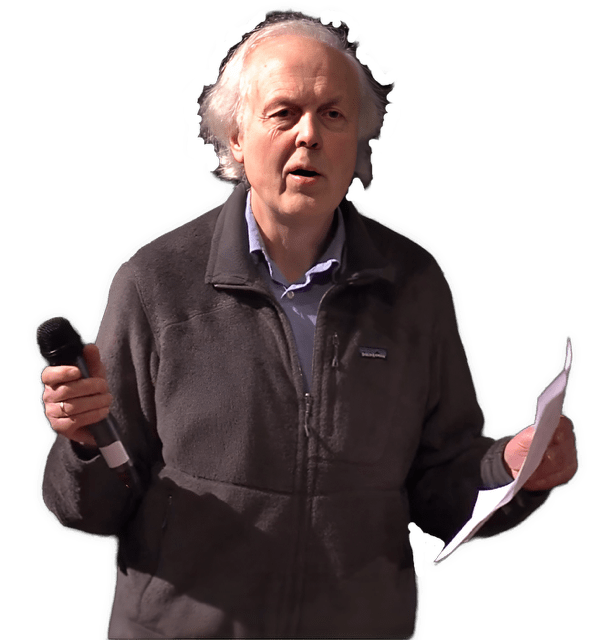
- Dominik Perler is a Swiss philosopher. He was born in Freiburg in Üechtland. Perler studied philosophy at the Universitys of Fribourg, University of Bern and University of Göttingen. After finishing his PhD thesis at the University of Fribourg in 1991, Perler was a visiting scholar at Cornell University and at UCLA.
Perler, Dominik  . “Inside and Outside the Mind: Cartesian Representations Reconsidered.” In Perception and Reality: From Descartes to the Present
  , edited by Ralph Schumacher
  69–87. Paderborn, Deutschland: Mentis, 2004.
Perler, Dominik  . Repräsentation bei Descartes [GT: Representation in Descartes]
  . Frankfurt am Main: Klostermann, 1996.
Publisher’s Abstract: Descartes’ theory of ideas has repeatedly been presented in recent research as the starting point of the modern “way of ideas,” which leads to a fateful representationalism because Cartesian ideas seem to be something like mental objects in an “inner arena.” Since we only have immediate access to these mental objects, we can only infer the existence of external objects, but we can never recognize them directly. We are always trapped in our inner arena.
Against this widespread view, this study argues that Descartes’s theory of ideas is to be understood within the framework of a theory of intentionality: ideas are nothing more than intentional acts, which are normally directed at external objects and have these objects as their content. In Cartesian ontology, there is no place for mysterious inner objects that slide, as it were, between the mind and the outer objects. Of course, the questions immediately arise (i) how mental acts can be directed at objects at all, (ii) how the content of these acts is to be determined and (iii) how we can gain a correct knowledge of the outside world by means of intentional acts. [Translated from German to English by Google Translate with minor editing]
- Read Erwin Tegtmeier’s
 “Dominik Perler: Repräsentation bei Descartes (Book Review)” in German. Zeitschrift für Philosophische Forschung 52, no. 1, (January 1, 1998): 149–53.
Perler, Dominik . “Spiegeln Ideen die Natur? Zum Begriff der Repräsentation bei Descartes” [”Do ideas reflect nature? On the concept of representation in Descartes”]. Studia Leibnitiana 26, no. 2 (1994): 187–209. https://www.jstor.org/stable/40694271.
Perler, Dominik  . “Things in the Mind: Fourteenth-Century Controversies over ‘Intelligible Species’.” Vivarium 34, no. 2 (1996): 251–63.
Perler, Dominik  . “What Am I Thinking About? John Duns Scotus and Peter Aureol on Intentional Objects.” Vivarium 32, no. 1 (1994): 72–89.
Perler, Dominik  . “What Are Intentional Objects?” A Controversy among Early Scotists”. In Ancient and Medieval Theories of Intentionality, edited by Dominik Perler. Leiden: Brill (2001): 203–26.
Perler, Dominik and Johannes Haag  . Ideen. Repräsentationalismus in der frühen Neuzeit. 2 vols.
  Berlin and New York: de Gruyter, 2010.
Pessin, Andrew  . “Descartes’s Nomic Concurrentism: Finite Causation and Divine Concurrence.” Journal of the History of Philosophy 41, no. 1 (January 2003): 25–49.
Pessin, Andrew . “Descartes’s Theory of Ideas.” The Stanford Encyclopedia of Philosophy, edited by by Edward N. Zalta  , 2007. http://plato.Stanford.edu/archives/spr2007/entries/descartes-ideas.
Pessin, Andrew . “Mental Transparency, Direct Sensation, and the Unity of the Cartesian Mind.” In Topics in Early Modern Philosophy of Mind  , edited by Jon Miller
  , 1–37. Dordrecht: Springer Verlag, 2008.
- Read Jon Miller’s Introduction by clicking on .pdf button on right side. Miller’s first paragraph gives an overview of Pessin’s arguments.
Alison Simmon’s overview (2011): Nice treatment of other positions, and then argues that sensations do represent, and do so intrinsically (not based on, e.g., their causal or functional relations to the environment); they represent in virtue of their objective reality, but don’t reveal to us from the inside what they represent because of their obscurity and confusion.


Radner, Daisie M. (no known photo). “Thought and Consciousness in Descartes.” Journal of the History of Philosophy 26, no. 3 (July 1988): 439–52.
Rickless, Samuel C.  . “The Cartesian Fallacy Fallacy.” Nous 39 (2005): 315–17.
Ring, David Carleton 
 . “Material Falsity, Objective Reality, and Representation in Descartes’s Theory of Ideas.” PhD diss., University of Wisconsin-Madison, 1987. Downloadable from BooksClub.Online, although never authorized by the author. Dissertation director: Terry Penner
  .
.
Author’s Abstract: Descartes introduces the theory of the material falsity of an idea in the Third Meditation. What is the purpose of this theory? Descartes also claims that his ideas of the secondary quality sensations are obscure and confused ideas. What justifies this claim and what is its significance? The dissertation focuses on the problem of explaining the constraints on any possible interpretation of the theory of material falsity as well as defending the view that what makes the secondary quality sensations materially false is their lack of what Descartes calls objective reality. In order to orient the reader to the concerns of Descartes as well as the historical and philosophical assumptions made both by Descartes and his opponents, the dissertation has an extensive number of appendices that supply this essential contextual information. In the Appendices, I discuss Descartes’s goals in philosophy as well as the historical context in which he worked out his solutions. The appendices also consider in detail the Cartesian theory of substance, Descartes’s theory of ideas, and the theory of objective reality. The theory of ideas is the keystone to understanding Descartes’s philosophy. In the Third Meditation Descartes maintains that the sensations of heat and of cold “are so little clear and distinct that [he] cannot say regarding them whether cold is only a privation of heat, or whether it is a real quality, or neither.” I argue that as a consequence, the secondary quality sensations, like those of coolness, can have no objective reality. A secondary quality sensation lacks objective reality because otherwise the person who had it would be able to tell, contrary to Descartes’s assertion, what that sensation represents. That these sensations lack objective reality explains why Descartes believes that such ideas are materially false. This interpretation can also be used to explain why Descartes is justified in believing that such ideas are obscure and confused. My interpretation of the theory of material falsity has major ramifications for many areas of Descartes’s philosophy but especially for understanding: How Descartes can justifiably reject Aristotelian physics, the theory of clear and distinct versus that of obscure and confused ideas, his theory of error, and the foundations of Cartesian physics and knowledge of the physical world.
Rocha, Ethel  . “Innate Ideas and the idea of God in Descartes’s Fifth Meditation.” Cahiers du Séminaire québécois en philosophie moderne / Working Papers of the Quebec Seminar in Early Modern Philosophy
  , no. 1 (2015): 46–51.
Author’s Abstract: In this article I examine the concept of innate idea as present in Descartes’s argument in the Fifth Meditation in order to show its fundamental role in enabling the distinction between ideas of essences produced by the mind and ideas of true and immutable essences. Besides showing that, this analysis has, I suggest, the advantage of avoiding difficulties concerning the whole of the Cartesian system, since it harmonizes the Fifth Meditation with the Meditations as a whole, in considering it as possessing not only an ontological dimension, as traditionally understood, but also, and essentially, an epistemic dimension like all the others.
Rocha, Ethel  . “Idéias dos Sentidos Segundo Descartes.” Cadernos de História E Filosofia da Ciéncia 19, no. 1 (2009): 115–29. [“Ideas of the Senses According to Descartes.” Notebooks of History and Philosophy of Science 19, no. 1 (2009): 115–29.]
Author’s Abstract: The purpose of this article is to examine the concept of material falsity of ideas introduced by Descartes in the Third Meditation of Metaphysical Meditations. The hypothesis to be defended is that what determines the material falsity of the ideas is the fact that they involve a contradiction in their representative content. That is, in place of the traditional interpretation according to which what characterizes materially false ideas is the fact that they involve a categorical error when displaying modes of the soul as if they were modes of extension, it will be argued that what characterizes certain ideas as materially false is the fact that they intend to exhibit something that at the same time is a mode of the soul and a mode of extension, that is, something that is a mode of two distinct substances that therefore exclude each other, thus engendering a contradiction
Rodis-Lewis, Geneviève  . “Le développement de la pensée de Descartes”
  [The Development of the Thought of Descartes] . Paris: Librarie Philosophique J. Vrin, 1997.
Rodis-Lewis, Geneviève  . Descartes: His Life and Thought
 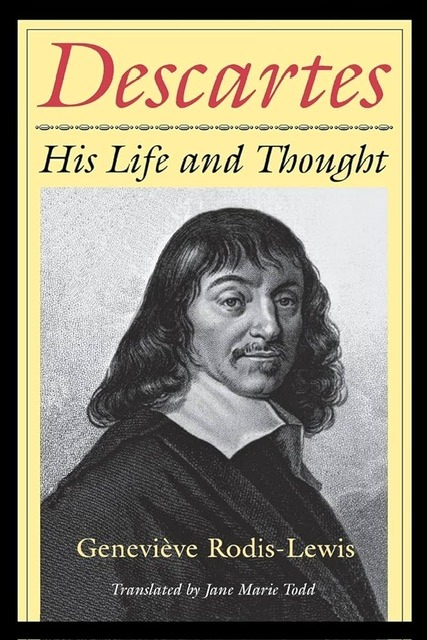 . Translated by Jane Marie Todd
  . Ithaca and London: Cornell University Press, 1998. Originally published in French under the title Descartes, Biographie. Paris: Calmann-Levy, 1995. Partially available from Google Books.
Rodis-Lewis, Geneviève  . L’Oeuvre de Descartes
  . Vrin: Paris, 1971.
Rorty, Amélie Oksenberg  . “Cartesian Passions and the Union of Mind and Body.” In Essays on Descartes’ Meditations , edited by Amélie Oksenberg Rorty , 513–34. Berkeley: University of California Press, 1986.
Rorty, Amélie Oksenberg , ed. Essays on Descartes’ Meditations . Berkeley: University of California Press, 1986.
Rozemond, Marleen  . Descartes’s Dualism
  . Cambridge, MA: Harvard University Press, 1998.
Rozemond, Marleen  . “Descartes on Mind-Body Interaction: What’s the Problem?.” Journal of the History of Philosophy 37, no. 3 (1999): 435–67.
Rozemond, Marleen . “The Nature of the Mind.” In The Blackwell Guide to Descartes’ Meditations , edited by Stephen Gaukroger , 48–88. Oxford, UK: Wiley-Blackwell, 2006. See basic information at “The Nature of the Mind” in The Blackwell Guide to Descartes’ MeditationI.
https://ndl.ethernet.edu.et/bitstream/123456789/8564/1/28.pdf.pdf


Schectman, Anat 
 . “Descartes’ Argument for the Existence of the Idea of an Infinite Being.” Journal of the History of Philosophy 52, no. 3 (July 2014): 487–517.
Schmal, Dániel  . “Virtual reflection: Antoine Arnauld on Descartes’ Concept of Conscientia. British Journal for the History of Philosophy 28, no. 4 (2020): 714–34.
Abstract: Although Descartes has often been portrayed as the father of the modern concept of mind, his approach to consciousness is notoriously problematic. What makes it particularly hard to assess his role in the development of the theories of consciousness is the difficulty of clarifying the kind of consciousness he might have in mind when using the associated Latin terms (conscius, cogitatio, conscium esse, etc.). In this article, I analyse Antoine Arnauld’s early interpretation of the passages in Descartes that refer to the issue of consciousness. I argue for two separate but interconnected claims. Firstly, I show that when Arnauld sets out to make a case for Descartes’ concept of cogitatio, he reads the central passages in light of some scholastic theories of cognition, in particular, the concept of ‘reflexio virtualis’ which, far from being a Cartesian invention, comes from the late scholastic discourse. Secondly, I argue that by talking about virtual reflection Arnauld provides an interpretation of Descartes’ views in terms of the intrinsic structure of the first-order thought—a reading which is still plausible, even by our contemporary standards.
Schmal, Dániel  . “Intellectual Memory and Consciousness in Descartes’s Philosophy of Mind.” Societate si Politica (2018): 28–49. Also, readable at Academia.com.
Abstract: Although Descartes’s ideas regarding consciousness and memory have been studied extensively, few attempts have been made to address their systemic relations. In order to redress this deficiency, I argue in favor of three interrelated theses. The first is that intellectual memory has a crucial role to play in Descartes’s concept of consciousness, especially when it comes to explaining higher forms of consciousness. Second, the connection between memory and consciousness has been obscured by the fact that intellectual memory, taken as a subject in its own right, was relatively neglected in Descartes’s philosophy: By and large, his views on the matter remained within the limits of late scholastic Scotism. Third, what makes the question of intellectual memory so fascinating in Descartes is not some ground-breaking insight into its nature; rather, it is his gradual recognition of the role that intellectual memory plays in the constitution of higher forms of consciousness. With these arguments, and relying on Descartes’s 1648 correspondence with Antoine Arnauld, where he progressed beyond the substance-based approach to the self, I try to show that he deserves to be credited with a more prominent status in the history of the self and personhood than has previously been the case.
Schmaltz, Tad M.  . “Deflating Descartes’s Causal Axiom.” Oxford Studies in Early Modern Philosophy 3 , Ch. 1, edited by Daniel Garber and Steven Nadler, 1–31. Oxford: Clarendon Press, 2006.
Schmaltz, Tad M.  . Descartes on Causation
  . Oxford: Oxford University Press, 2008.
Schmaltz, Tad M. . “Descartes on Innate Ideas, Sensation, and Scholasticism: the Response to Regius.” In Studies in Seventeenth-Century European Philosophy  Oxford Studies in the History of Philosophy, vol. 2, edited by Michael A. Stewart (no known photo), 33–73. Oxford: Clarendon Press, 1997.
Schmaltz, Tad M. . “Malebranche’s Cartesianism and Lockean Colors.” History of Philosophy Quarterly 12 (1995): 387–403.
Schmaltz, Tad M. . Malebranche’s Theory of the Soul: A Cartesian Interpretation. 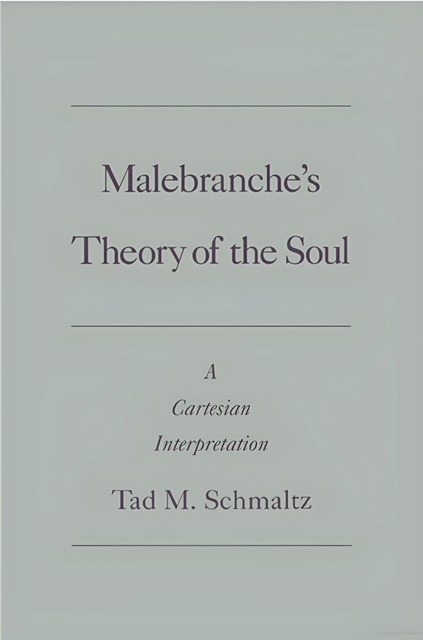 . New York: Oxford University Press, 1996.
Schmaltz, Tad M. . Radical Cartesianism: The French Reception of Descartes 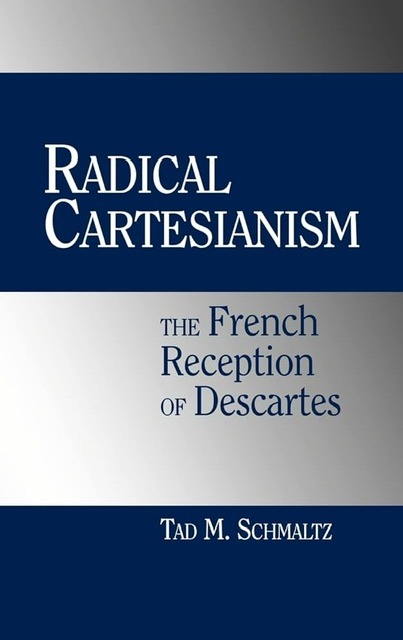 . Cambridge: Cambridge University Press, 2002.
Schmaltz, Tad M. . “Sensation, Occasionalism and Descartes’ Causal Principles.” In Minds, Ideas and Objects: Essays on the Theory of Representation in Modern Philosophy  , edited by Phillip D. Cummins (no known photo) and Günter Zöller
  , 37–55. Atascadero, CA: Ridgeview, 1992.
Schmitter, Amy Morgan  . “Descartes, Representation and the Intelligibility of Sense-Perception.” Preliminary draft.
- Read her C.V. to September 2016.
Schmitter, Amy Morgan  . Descartes’s Representation of the Self. PhD diss., University of Pittsburgh, 1993.
Author’s Abstract: While Descartes’s status as a “representationalist” is often a subject of vehement debate, what exactly he means by “representation” is not. I look to Descartes’s early work to show that he first conceives of representation through signification, in which the sign and the signified are isomorphic; on this view, relations of representation can be arbitrary and are to be distinguished from relations of resemblance. I then examine images to show the possibility of an image constructing a relation to its viewer, or “subject-position,” in which that subject-position fails to display the attributes of extended things. Such a construction might be applied to the “I” of the Meditations–distinct from all extended substances, it nonetheless has direct access to them through its non-objectified sense-ideas. On this basis, I propose a “model” of representation for ideas: an idea represents its object O to a subject-position S through a vehicle of representation X under some relation R. I argue that this model can explain the uses Descartes makes of “represent,” particularly for ideas. But it must be understood properly: Descartes comes to conceive of the vehicle of representation simply as the form taken by the direct interaction of the mind and the things objectively present to it–but a form that can take on a life of its own, giving rise to the possibilities of clarity and distinctness or of confusion in ideas. But what is truly novel about Descartes’s conception is the mind’s ability to form higher-order representations that represent the conditions of representation itself, thereby achieving certainty for some mental representations without starting from any incorrigible, immediate perceptions. This possibility is realized most clearly in the understanding of my nature as a thinking and representing being, where I can represent myself as the subject-position distinct from all extended things, but also can represent myself as joyfully and representatively united with a body all my own.
Schmitter, Amy Morgan  . “Formal Causation and the Explanation of Intentionality in Descartes.” The Monist 79, no. 3, Causality Before Hume (July 1996): 368–87.
Schmitter, Amy Morgan  . “The Passionate Intellect: Reading the (Non-) Opposition of Intellect and Emotion in Descartes.” In Persons and Passions: Essays in Honor of Annette Baier
 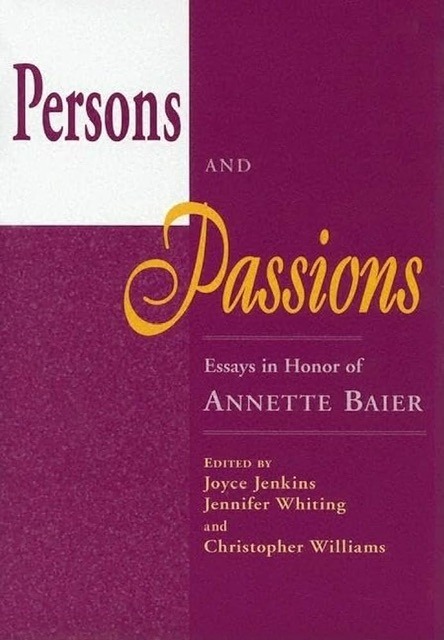 , edited by Joyce L. Jenkins (no known photo), Jennifer Whiting
  , and Christopher Williams
  . Notre Dame, IN: University of Notre Dame Press (2005): 48–82.
Schmitter, Amy Morgan  . “Representation, Self-Representation, and the Passions in Descartes.” Review of Metaphysics 48 (1994): 331–58.
Schmitter, Amy Morgan  . “The Third Meditation on Objective Being: Representation and Intentional Content.” In The Cambridge Companion to Descartes’ Meditations
  , edited by David Cunning
  . Cambridge, UK: Cambridge University Press (2014): 149–67. Download it directly here.
Schouls, Peter Arthur  . Descartes and the Enlightenment
  . Montreal: McGill-Queen’s University Press, 1989.
Schumacher, Ralph , ed. Perception and Reality: From Descartes to the Present. Paderborn: Mentis, 2004.
Scribano, Emanuela 
 . Descartes et les vraies et fausses idées.” Archives de Philosophie 64, no. 2 (2001): 259–78.
Author’s Abstract: In the Third Meditation (TM), Descartes introduces the doctrine of the “material falsehood” of ideas. In the Fourth Objections, Arnauld criticizes this doctrine which later disappears from Descartes’s works. Recent interpretations have focussed on the coherence of the theory and compatibility between the wording of the TM and the Replies. Here, the topic is picked up again, bringing in the Scholastic debate on truth and falsehood. The presentation of Descartes’s doctrine in the TM proves to be incompatible with that of the replies to Arnauld, suggesting an incompatibility of the two formulations of the doctrine of the “material falsehood” of ideas. Yet, the reason for Descartes’s change of mind cannot be explained by the sole power of this criticism, since the conceptual framework of the Scholastic doctrine of representation offers Descartes the tools to defend his own doctrine without modifying it. Hence, the suggestion to look for the reasons of that change elsewhere, namely in Descartes’s will to avoid the dangerous consequences for the foundations of science implied by the TM’s formulation of the doctrine of the “material falsehood” of ideas.
Scribano, Emanuela  . Descartes in Context: Essays
 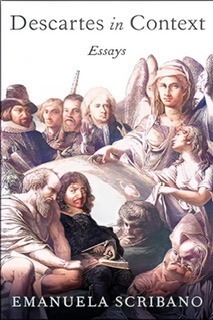 . New York: Oxford University Press, 2023.
Secada, Jorge 
 . Cartesian Metaphysics: The Scholastic Origins of Modern Philosophy
  . Cambridge: Cambridge University Press, 2000.
Secada, Jorge , Travis Tanner  , and Cecilia Wee (no known photo), eds. The Cartesian Mind
 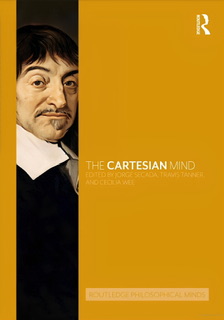 . London: Taylor & Francis, September 3, 2025.
| Publisher: | Taylor & Francis |
|---|---|
| Publication date: | 09/03/2025 |
| Series: | Routledge Philosophical Minds |
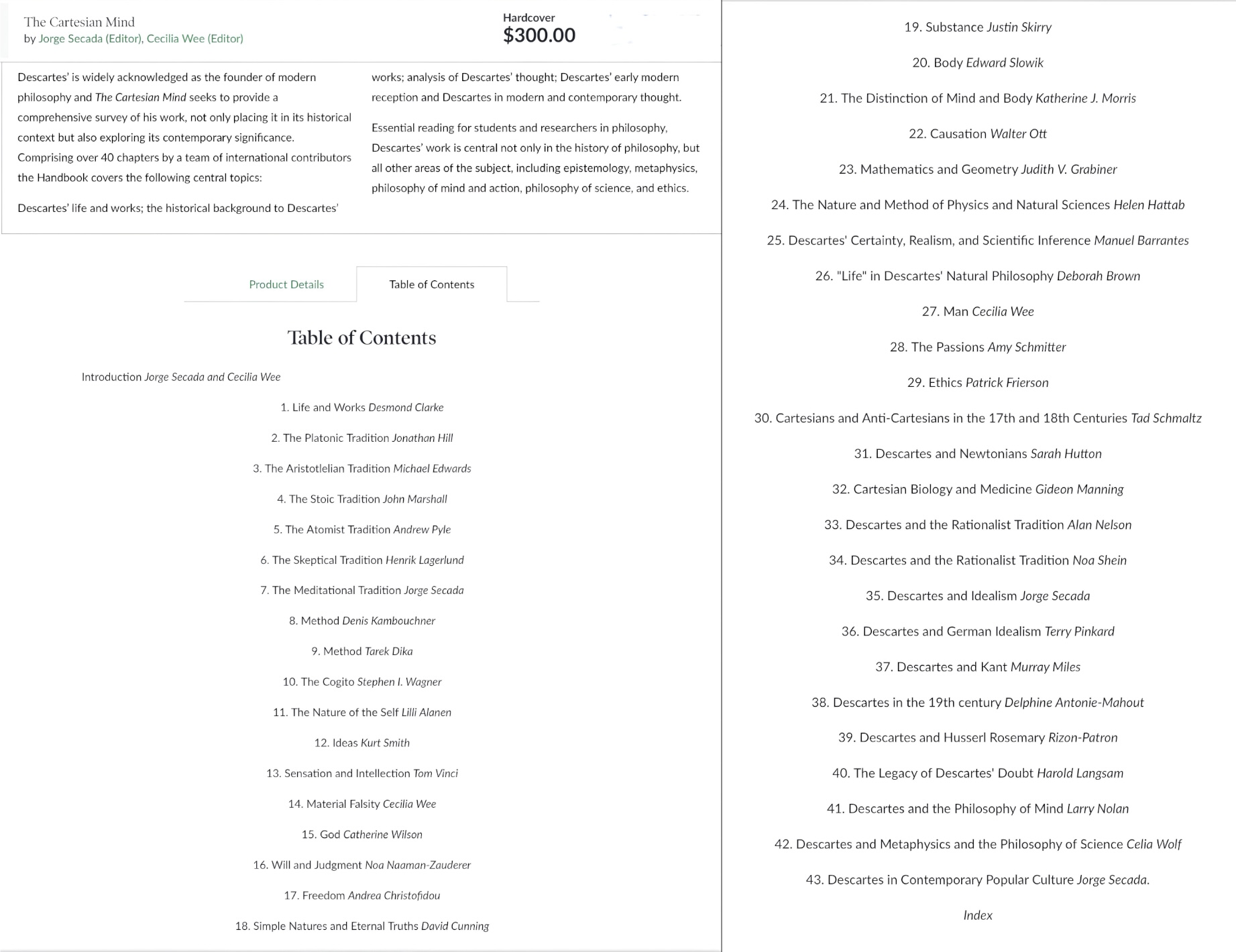
.
Sellars, Wilfrid  . “Being and Being Known.” Proceedings of the American; Catholic Philosophical Association 34 (1960): 28–49.
- See “The Philosophical Works of Wilfrid Sellars” compiled by Pedro Amaral
 and Jeffrey Sicha (no known photo) in Journal for General Philosophy of Science / Zeitschrift für allgemeine Wissenschaftstheorie 22, no. 1 (1991): 187–193.
 - See “Bibliography of Wilfrid Sellars” (in alphabetical order of abbreviations) compiled by Andrew Chrucky
 with numerous hyperlinked articles.
 - See seven hundred twenty-one (721) papers written on Sellars, edited by Willem A. DeVries
 .
.
Sellars, Wilfrid  . “Berkeley and Descartes: Reflections on the Theory of Ideas.” In Studies in Perception: Interpretation in the History of Philosophy and Science
 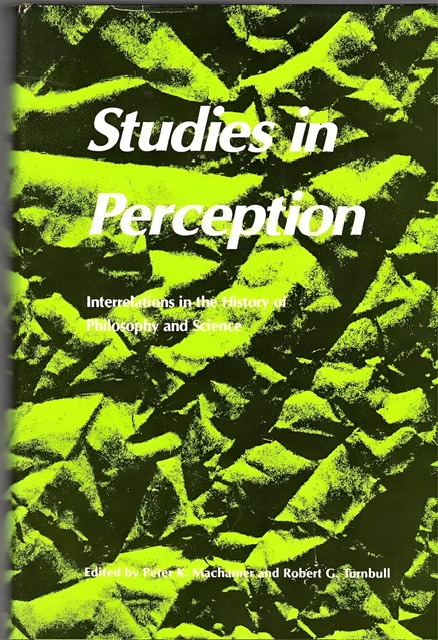 , edited by Peter K. Machamer
  and Robert G. Turnbull (no known photo), 259–311. Columbus, OH: Ohio State University Press, 1977.
Sellars, Wilfrid  . “Empiricism and the Philosophy of Mind.” In Minnesota Studies in the Philosophy of Science, Vol. I., edited by Herbert Feigl
 and Michael Scriven
  , 253–329. Minneapolis, MN: University of Minnesota Press, 1956.
Sellars, Wilfrid  . Kant and Pre-Kantian Themes: Lectures by Wilfrid Sellars
 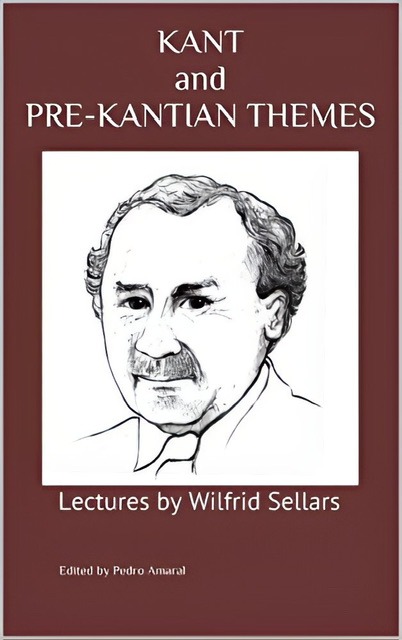 . Edited by Pedro V. Amaral . Atascadero, CA: Ridgeview, 2002.
Sellars, Wilfrid.. Kant’s Transcendental Metaphysics: Sellars’ Cassirer Lectures Notes and Other Essays 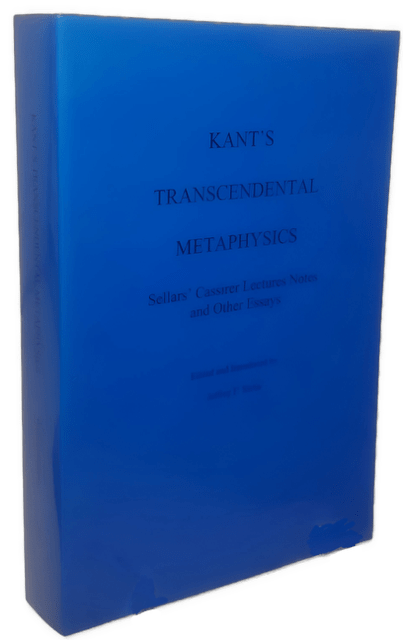 . Edited by Jeffrey F. Sicha (no known photo). Atascadero, CA: Ridgeview, 2002.
Sellars, Wilfrid . “Philosophy and the Scientific Image of Man.” In Frontiers of Science and Philosophy  , edited by Robert G. Colodny
  , 35–78. Pittsburgh: University of Pittsburgh Press, 1962. Reprinted in Science, Perception and Reality
 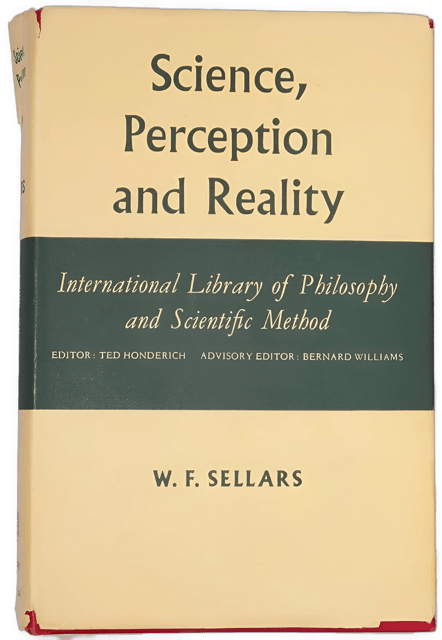 , London: Routledge and Kegan Paul, 1963. A collection of some of Sellars’s lectures and articles from 1951 to 1962. See screen capture for reproduced titles. Also available at Internet Archive.

Sellars, Wilfrid  . Science and Metaphysics: Variations on Kantian Themes
 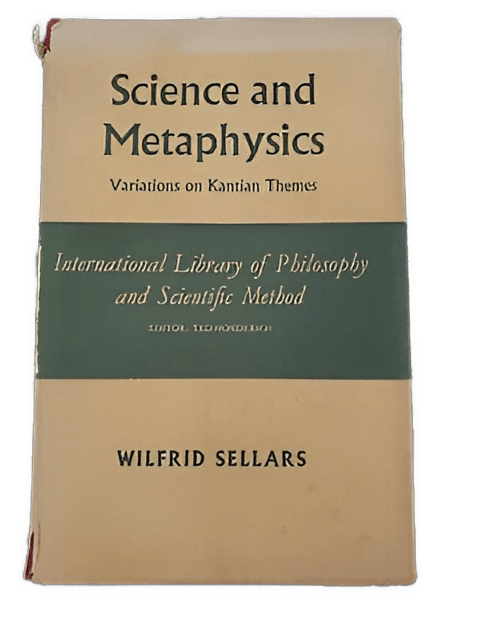 . The John Locke Lectures for 1965–66. London: Routledge & Kegan Paul, 1968.
Sencerz, Stefan S. 

 . “Descartes on Sensations and Animal Minds.” Philosophical Papers 9 (1990): 119–41.
Sepper, Dennis L. 
 . Descartes’s Imagination: Proportion, Images, and the Activity of Thinking
 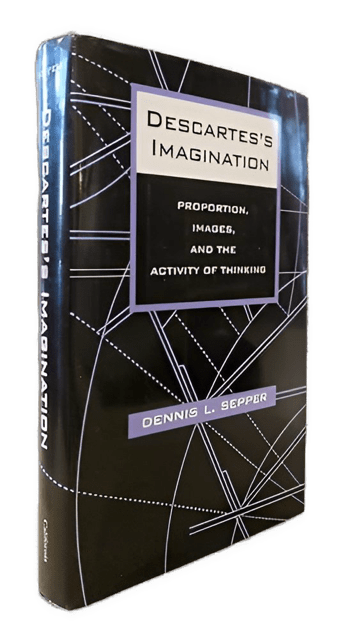 . Berkeley, CA: University of California Press, 1996.
Septeyi, Dymtro 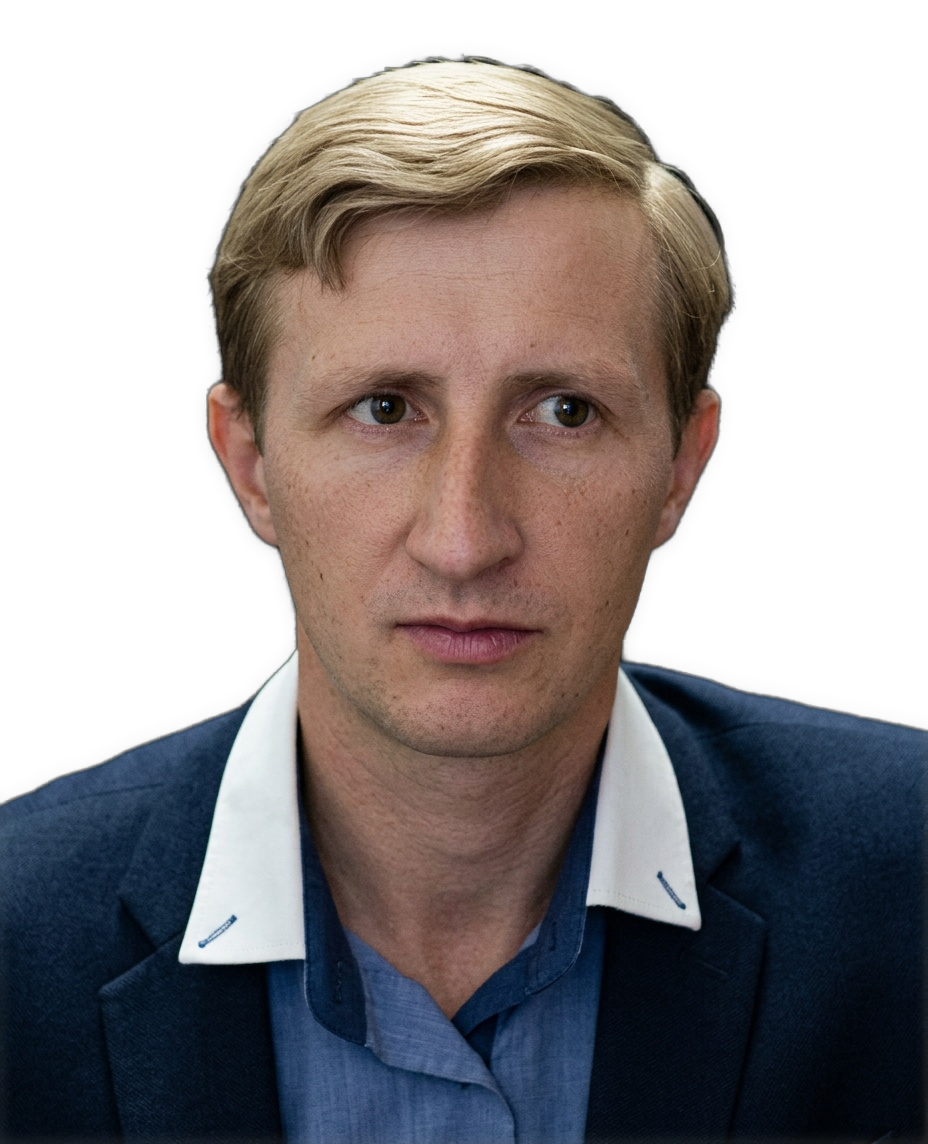 . “Mind-body Interaction, Physical Causation, and the Natures of Substances in Descartes’s philosophy.” In Actual Problems of Mind/Spirituality 23
  , edited by Yaroslav V. Shramko
  , 64–83. Kryvyi Rih, UKR(aine): KDPU, 2022.
Abstract: The article discusses the problem of the compatibility of Descartes’s doctrine of interactionist substance dualism with his claims about the law of the conservation of the quantity of motion, about the way God maintains the world in existence, and about minds and bodies having only properties that are modes of thinking or extension respectively. The case is made that although there seem to be prima facie conflicts, they can be neutralised as merely apparent. The position that mental states cause some motions in the brain is consistent with Descartes’s postulation of the existence of the law of conservation of the quantity of motion, insofar as it derives from God’s immutability whereas souls are not immutable, as well as with the laws of conservation established by Newtonian physics, insofar as they don’t prohibit purely redistributive changes and are established only for physical interactions. Descartes’s interactionism does not conflict with his statements about the way God maintains the world in existence, if the latter are construed in the sense that God preserves motion in the world by preserving the laws of nature, and the conservation of the world by God is a continuation of the initial act of creation. The principle that all properties of a substance are modes of its main attribute agrees with substance dualism and interactionism, if we admit that Descartes’s ontology of the world includes, besides substances of two kinds with their main attributes and modes of those attributes, something more—irreducible sui generis entities, such as the substantial union of body and soul and/or psychophysical laws of nature.
Septeyi, Dymtro . “The Problem of Mind–Body Interaction in the Causal Principle of Descartes’s Third Meditation.” Sententiae 40, no. 1 (April 2021): 28–43.
Abstract: The article analyses recent English publications in Cartesian studies that deal with two problems: (1) the problem of the intrinsic coherence of Descartes’s doctrine of the real distinction and interaction between mind and body and (2) the problem of the consistency of this doctrine with the causal principle formulated in the Third Meditation. The principle at issue is alternatively interpreted by different Cartesian scholars either as the Hierarchy Principle, that the cause should be at least as perfect as its effects, or the Containment Principle, that the cause should contain all there is in its effects. The author argues that Descartes’s claim (in his argument against the scholastic doctrine of substantial forms) that it is inconceivable how things of different natures can interact does not conflict with the acknowledgement of interaction between things of different natures in the case of soul and body. The case is made that Cartesian mind-body interaction can agree with both the Hierarchy Principle and the Containment Principle, because the Principle is about total and efficient cause, whereas in the interaction, mental and brain states are only partial (and plausibly, in the case of brains states, occasional) causes. In particular, in the case of the causality in the brain-to-mind direction, the mind is conditioned by brain states to form the corresponding specific ideas on the basis of its innate general ideas of movements, forms, colours, etc. Eventually, for Descartes, the most natural way to deal with worries about the possibility of mind-brain interaction is to rely on God’s omnipotence, which certainly enables Him to arrange for such interaction.
Shapiro, Lionel  . “Intentionality Bifurcated: A Lesson from Early Modern Philosophy?. In Contemporary Perspectives on Early Modern Philosophy: Nature and Norms in Thought” (Studies in History and Philosophy of Science, Vol. 29), edited by Martin Lenz
  and Anik Waldow
  , 39–51. Dordrecht: Springer, June, 2013.
Shapiro, Lionel  . “Objective Being and ‘Ofness’ in Descartes.” Philosophy and Phenomenological Research 84, no. 2 (2012): 378–418.
Shapiro, Lisa Caryn . “Cartesian Passions as Representational Mental States.” Unpublished draft manuscript. Do not cite.
- Available at Lisa Shapiro’s personal website.
- See her Simon Frazier University Philosophy department website.
Shapiro, Lisa  . “Descartes’s Passions of the Soul.” Philosophy Compass 1, no. 3
  (2006): 268–78.
Abstract: While Descartes’s Passions of the Soul has been taken to hold a place in the history to human physiology, until recently philosophers have neglected the work. In this research summary, I set Descartes’s last published work in context and then sketch out its philosophical significance. From it, we gain further insight into Descartes’s solution to the Mind–Body Problem—that is, to the problem of the ontological status of the mind–body union in a human being, to the nature of body–mind causation, and to the way body-caused thoughts represent the world. In addition, the work contains Descartes’s developed ethics, in his account of virtue and of the passion of générosité in particular. Through his taxonomy of the passions and the account of their regulation, we also learn more about his moral psychology.
Shapiro, Lisa  . “Descartes’ Passions of the Soul and the Union of Mind and Body. Archiv für Geschichte der Philosophie 85, no. 3 (2003): 211–48.
Shapiro, Lisa  . “How We Experience the World: Passionate Perception in Descartes and Spinoza.” In Emotion and Cognitive Life in Medieval and Early Modern Philosophy
  , edited by Martin Pickavé
  and Lisa Shapiro
  , 193–216. New York: Oxford University Press, 2012.
Shapiro, Lisa . “Memory in the Meditations.” Res Philosophica 92, no. 1 (2015): 41–60.
Author’s Abstract: This paper considers just how memory works throughout the Meditations to adduce Descartes’s conception of memory. Examining the meditator’s memory at work raises some questions about the nature of Cartesian memory and its epistemic role. What is the distinction between remembering and repeating a thought? If remembering is not simply repeating a thought, then what is involved in properly remembering? Can we remember properly while adding or shifting content, say, in virtue of articulating relations between ideas? If so, what is the relation between remembering and reasoning, since both would then involve relations of ideas? These questions become salient in considering the meditator’s creative recollections in the Third and especially the Sixth Meditations. After briefly considering what Descartes does say about memory, I consider two other strategies for addressing those questions: an analogy with innate ideas, and attending to the role that other thinkers play in one’s own recollections.
Shapiro, Lisa . “What are Passions Doing in the Meditations?” In Persons and Passions: Essays in Honor of Annette Baier  , edited by Christopher Williams
  , Jennifer Whiting
  , and Joyce Lynn Jenkins (no known photo), 14–32. Notre Dame: University of Notre Dame Press, 2005.
Sievert, Donald  . “Sellars and Descartes on the Fundamental Form of the Mental.” Philosophical Studies 37, no. 3 (1980): 251–57.
Simmons, Alison  . “Are Cartesian Sensations Representational?,” Noûs 33, no. 3 (1999): 347–69.
Abstract: Takes on the question whether, what and how secondary quality sensations and bodily sensations represent anything in the corporeal world in the context of Descartes’ theory of sensory perception. I argue that Descartes has pressing philosophical motivation to argue that these sensations do indeed represent something in the corporeal world; they are more than mere window dressing of the mind. In response to the pressure, Descartes offers the beginnings of what I call a “bio-functional” account of sensory representation that builds on his claim in the Sixth Meditation that the senses are directed to self-preservation.
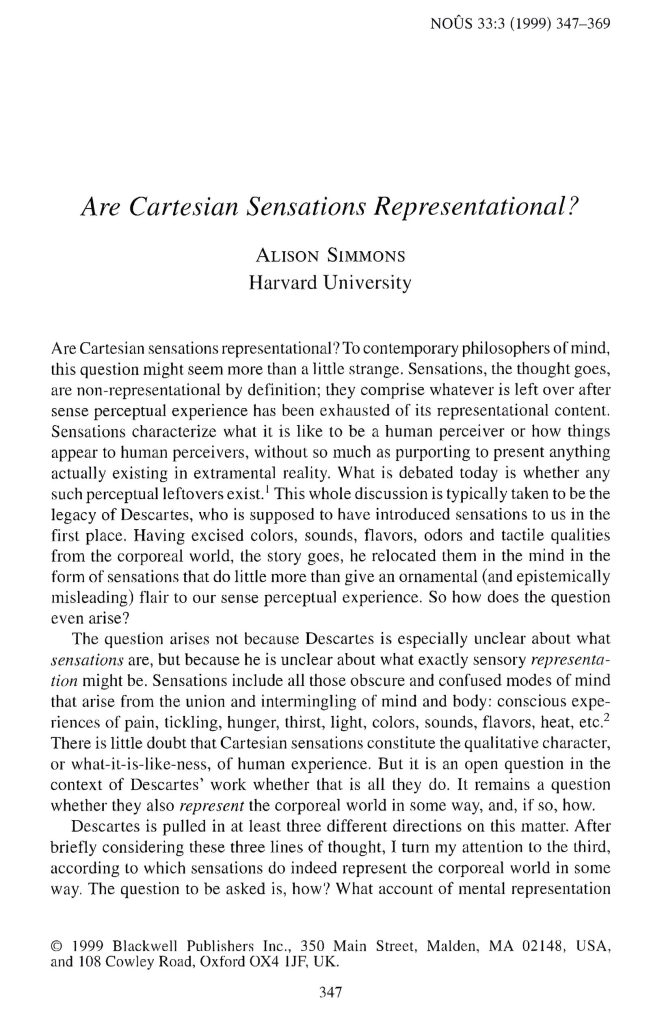
Simmons, Alison . “Cartesian Consciousness Reconsidered.” Philosopher’s Imprint 12, no. 2 (January 2012): 1–21. Also readable at Michigan Publishing.
Abstract: Descartes (in)famously revolutionized our conception of the mind by identifying consciousness as the mark of the mental: all and only thoughts are conscious. Today the idea that all thoughts are conscious seems hopelessly naïve or blindly dogmatic. Empirical psychologists, psychiatrists, and zombie-loving philosophers all embrace the existence, or at least the possibility, of unconscious thoughts. But Descartes faces a problem more serious than being snubbed by today’s intellectuals: in his own work on the mind, Descartes himself seems to posit a whole host of unconscious thoughts. Something is not as it seems. Either Descartes is remarkably inconsistent, or his claim that all thought is conscious is more nuanced than it appears. In this paper I argue that while Descartes was indeed unwavering in his commitment to the conscious mark, he distinguished different types and degrees of consciousness that make for a rather rich cognitive psychology, one that is capable of accommodating a range of phenomena that others might be tempted to identify as unconscious.
Simmons, Alison  . “Descartes on the Causal Structure of Cognition.” In Causation and Cognition: Perspectives on Early Modern Philosophy
  , edited by Sebastian Bender
  and Dominik Perler . New York: Routledge (2019/2020): 39–60.
Abstract: The causal structure of Cartesian cognition involves the complex interplay of world, human bodies, and human minds. While Descartes explicitly overhauls the metaphysics of mind and body, he says little about the metaphysics of causation that allows these substances to interact with and change each other. What little he does say raises puzzles. This chapter explores the causal structure of Cartesian cognitoin in general and the causal structure of sensory cognition in particular.
Simmons, Alison  . “Descartes on the Cognitive Structure of Sensory Experience.” Philosophy and Phenomenological Research 67, no. 3 (January 2003): 549–79.
Abstract: Descartes is often thought to bifurcate sensory experience into two distinct cognitive components: the sensing of secondary qualities and the more or less intellectual perceiving of primary qualities. A closer examination of his analysis of sensory perception in the Sixth Replies and his treatment of sensory processing in the Dioptrics and Treatise on Man tells a different story. I argue that Descartes offers a unified cognitive account of sensory experience according to which the senses and intellect operate together to produce a fundamentally imagistic representation of the world in both its primary and secondary quality aspects. At stake here is not only our understanding of the cognitive structure of sensory experience but the relation of sense and intellect more generally in the Cartesian mind. The deep bifurcation in the Cartesian mind is not between the sensory perception of primary and secondary qualities but between sensory perception and purely intellectual perception.
Alison Simmon’s overview (2011): Argues against the (then) prevailing view that primary quality perception is somehow more intellectual than secondary quality perception, and that, as a result, sensory experience is curiously “bifurcated” into an intellectual and sensory component. Explores along the way some of the details of Descartes’ account of sensory processing.
Simmons, Alison  . “Explaining Sense Perception: A Scholastic Challenge.” Philosophical Studies 73, no. 2/3 (March 1994): 257–75.
Abstract: Explores the philosophical foundations of the “species” theory of sensory perception as develops in late scholastic (16th c.) Jesuit philosophers. I argue that the species theory is a philosophically and textually well-motivated interpretation (and development) of Aristotle’s cryptic claim that sensory perception occurs by the “reception of form with its matter.”
Simmons, Alison  . “Guarding the Body: A Cartesian Phenomenology of Perception.” In Contemporary Perspectives on Early Modern Philosophy Essays in Honor of Vere Chappell
  , edited by Paul Hoffman
  , David Owen
  , and Gideon Yaffe
  , 81–113. Peterborough, Ontario: Broadview Press, 2008.
Abstract: Although Descartes and Malebranche both routinely criticize the senses for misrepresenting the material world to us, they just as routinely insist that the senses represent the material world in a way that is especially conducive to self-preservation. What is it about sensory representation that is supposed to make it so conducive to self-preservation? And why do these thinkers suggest that the senses can do a better job of this than even their cherished intellects?
Simmons, Alison  . “Making Sense: The Problem of Phenomenal Qualities in Late Scholastic Aristotelianism and Descartes.” PhD diss., University of Pennsylvania, 1994. Major advisor: Gary Hatfield
  .
.
Abstract: It is no surprise that the phenomenal qualities of our sensory experience pose recalcitrant philosophical problems for a physical materialist metaphysics. The colors of flowers as we experience them by sight, the taste of a ripe peach, and the smell of fresh-cut grass are undeniably part of the experienced world; yet in their phenomenal mode, they do not seem well-placed in the physicist’s world of particles and energy fields. It seems, prima facie, that the metaphysical programs found in earlier science and philosophy were better suited to accommodate these qualities: in the hylomorphic world of the Aristotelians, colors were “real qualities” existing as such in flowers; in the dualistic world of Descartes, colors were displaced from things like flowers to the immaterial mind of the perceiver. The dissertation argues that this intuition about our philosophical heritage is both philosophically confused and historically inaccurate. It betrays a misconception about phenomenal qualities and the problems they pose which results from a failure to distinguish phenomenal qualities from a special subset of sensible qualities that we have come to call “secondary” qualities. Disentangled from the primary-secondary quality distinction, phenomenal qualities include all sensible qualities insofar as they form the experiential contents of our sensory perceptions. So considered, phenomenal qualities invite difficult questions about the representational nature and ontological status of our sensory experience even within the Aristotelian and Cartesian metaphysics. By examining Descartes’ and the Aristotelians’ theories of sense perception with a focus on these questions we achieve a better understanding of “the problem” of phenomenal qualities, better interpretations of these historical theories of sense perception, and suggestions for reshaping the problem space within which we think philosophically about phenomenal qualities today
Simmons, Alison  . “Mind-Body Union and the Limits of Cartesian Metaphysics.” Philosophers’ Imprint 17, no. 14 (July 2017), 1–36.
Simmons, Alison . “Modernizing the Mind.” In Cartesianism and Philosophy of Mind  , edited by Vili Lähteenmäki
  , Jani Sinokki
  , and Oberto Marrama
  (London: Routledge, 2026). With Matthias Somers. You can read the first five pages of this paper by clicking on the hyperlink, then clicking on the publisher’s webpage on Preview Book.
Abstract: It’s often said that Descartes invented the modern mind. But what is the Cartesian mind? And how new or modern is it? The first question is harder to answer than you might think and so, therefore, is the second. Descartes tells us that the mind is a thinking thing. But what, exactly, is Cartesian thought? Against more popular interpretations, we argue that Cartesian thought is best understood as object consciousness.
Simmons, Alison  . “Representation.” In The Cambridge Descartes Lexicon , edited by Lawrence Nolan , 645–55. New York: Cambridge University Press, 2015.
Alison Simmon’s summary
- [The plural of the singular ‘apparatus’ (sometimes spelled and pronounced apparātus) can be apparatuses, or even just apparatus (sometimes spelled and pronounced apparātūs)!]
Simmons, Alison  . “Spatial Perception from a Cartesian Point of View.” Philosophical Topics 31 (2003): 395–423.
Abstract: Descartes’ proposal in the Sixth Meditation that sensory perception serves as a guide for self-preservation is typically taken to be an ad hoc way of finding a place for secondary quality sensations and bodily sensations. Malebranche, I argue, understands the proposal to be a way of re-conceiving sensory experience as a whole, spatial perception included. This paper examines Malebranche’s case for maintaining that spatial perception is directed to self-preservation. As I interpret it, his argument turns on the fact that spatial perception has a bodily phenomenology; that is, it represents the spatial properties of objects in a way that involves the perceiver’s own body. First, it represents objects egocentrically, as they are spatially related to the perceiver’s own body. Second, bodily awareness often figures into spatial perception. Third, the representational limits of spatial perception reflect the bodily processes on which it depends. All three of these facts about spatial representation through the senses pose problems, from a Cartesian point of view, for the natural philosopher seeking an accurate depiction of the material world. All three, however, prove advantageous to the human being trying to survive in that world.
Sinokki, Jani and Vili Lähteenmäki. “Representation and objective reality.” In Cartesianism and Philosophy of Mind , edited by Vili Lähteenmäki , Jani Sinokki , and Oberto Marrama (London: Routledge, 2026), 23–42.
ABSTRACT: This chapter investigates Descartes’ theory of ideas by focusing on the distinctions he draws between different functions. It argues that Descartes is committed to a dual function of ideas: unifying the mind with its object and providing psychological and epistemic access to that object. Drawing on an analysis of Descartes’ terminology—especially his use of the terms “material,” “objective,” and “formal”—this chapter reconstructs a trichotomy underlying his conception of ideas. It aims to show how each term corresponds to a distinct perspective: ideas as mental operations, as unifications with objects, and as representations subject to truth and falsity. This framework is used to reinterpret Descartes’ responses to critics such as Arnauld and Desgabets and to reassess Margaret Wilson’s influential claim that Descartes’ view collapses into incoherence. This chapter ultimately defends the coherence of Descartes’ position by distinguishing misrepresentation from misattribution and by showing how the special status of the cogito reveals a case in which representation and objective reality converge, eliminating the possibility of error.
Skirry, Justin  . Descartes and the Metaphysics of Human Nature
  . London: Thoemmes-Continuum Press, 2005.
Publisher’s Abstract: The traditional account of mind/body union attributed to Descartes supposes that the immaterial, thinking mind and the material, non-thinking body interact by means of efficient causation – that the mind causes events in the body, e.g., the voluntary raising of an arm, and vice versa, e.g., the visual sensation of a tree. But this gives rise to a notorious philosophical how can this causal interaction occur between the spiritual mind and the physical body since they have absolutely nothing in common and cannot come into contact with one another? Justin Skirry’s book shows how Descartes in fact avoids this enormous problem. Skirry argues, through a critical re-examination of Cartesian metaphysics, that the union of mind and body is not, as most scholars have always maintained, constituted by efficient causal interaction for Descartes, because this would not result in one, complete human nature but in an aggregate of two numerically distinct natures. Descartes argues in the 6th Meditation and elsewhere that mind/body union is constituted by what the scholastics called a ‘substantial union’, i.e., the union that form (mind) has with matter (body). This substantial union produces a whole that is more than the sum of its parts; the capacity for modes of sensation and voluntary bodily movement are emergent properties of the whole, substantially united mind and body. Therefore, the ‘Cartesian’ problem of mind-body efficient causal interaction is avoided altogether, since efficient causal occurrences between mind and body play no role in explaining the existence of these modes.
Slater, Lauren 
 . “Reading the Signs of my Body: Berkeley and Descartes on Signs and Sensations.” In Berkeley’s Doctrine of Signs
  , edited by Manuel Fasko
  and Peter West
  . 161–83. Also downloadable from De Gruyter.
Slater, Lauren  . “Word Made Flesh: Sensory Ideas as Meanings of Bodily Signs in Descartes.” PhD diss., Birkbeck University of London, 2020.
Smith, Kurt D. . “A Defense of Cartesian Clarity and Distinctness,” in The Battle of the Gods and Giants Redux: Papers Presented to Thomas M. Lennon Series: Brill’s Studies in Intellectual History, Volume: 248
  , edited by Patricia Easton
  and Kurt Smith
  . Leiden: Brill, 80–105.
Smith, Kurt . “The Descartes Dictionary”  . London & New York: Bloomsbury Academic, 2015. See the first 26 pages with missing pages 14–15 and 21–22.
[NOTE: See especially the below titles at the indicated page numbers.]
- “Ideas (as a component of the metaphysics)” (10–12)
- ”Ideas (as a component of the epistemology)” (12–13)
- Material falsity of ideas at the second paragraph (15–16)
- ”Clarity and Distinctness / Obscurity and Confusion” (56–64)
- ”Conscience/Conscious” (66)
- ”Emotion (L. affectus, commotiones; F. affection, commotion, émotion)” (72–74)
- ”Faculty (L. falcultatum; F. falculty)” (81–82)
- ”Falsity, Formal/ Material (L. formalem falsitatem, formalizer falsa/falsitatem materialem, materialiter falsa; F. formelle fausseté/faussetté materielle)” (82–85)
- ”Formal/Objective Reality (L. realitatem formalem/realitatem objectivam; F. realité formelle)“ (85–87)
- ”Formal/Eminent“ (87–89)
- ”Idea (L. idea; F. idée)“ (92–96)
- ”Idea, Adequate/Inadequate“ (96–97)
- ”Idea, Primary“ (97)
- ”Imagination” (98–99)
- ”Innate“ (100–101)
- ”Intellect“ (101–103)
- ”Intuition“ (103)
- ”Material/Objective“ (104–106)
- ”Mind/Soul (L. mente/anima; F. esprit/fame)“ (106–108)
- ”Passion“ (110–111)
- ”Sensation (L. sensus; F. sentimens)“ (114–115)
- ”Thought (L. cogitationes; F. pensée)“ (116–117)
- ”Understanding, the (L. intellectus, intellectionem; F. [faculté de] conseuoir)“ (119)
- ”Will“ (121)

Smith, Kurt  . “Descartes on Ideas.” In The Cartesian Mind, edited by Jorge Secada and Cecilia Wee (no known photo). London: Routledge (August 1, 2025): Ch. 12.
Smith, Kurt . “Descartes’ Ontology of Sensation,” Canadian Journal of Philosophy, 35, no. 4 (December 2005): 563–84.
Smith, Kurt D(wayne)  . “Descartes on Representation, Ideas, and Sensations [see the TOC & the first fourteen pages at ProQuest].” PhD diss., The Claremont Graduate University
  , 1998.
Abstract: At the heart of Descartes’s philosophy lies his theory of ideas. It binds together his metaphysics and epistemology. The Cartesian theory of ideas explains the nature of representation and misrepresentation. It also supports Descartes’s accounts of truth and falsity, the external truths, and the true and immutable natures–all vital components of the Cartesian philosophical project. To misunderstand this theory is to misunderstand Cartesian thought. ;Important recent commentaries on Descartes’s thought have forwarded the view that the Cartesian theory of ideas as presented in the Third Meditation is internally inconsistent. This line of criticism follows a tradition of commentary initiated by Antoine Arnauld . Arnauld maintained that the notion of material falsity, the falsity of ideas, is inconsistent with certain foundational principles that underlie the theory, namely, the principles that something cannot come from nothing and that there can be no more objective reality in an idea than there is formal reality in its cause. If this long-standing tradition of criticism is correct, then the whole of Descartes’s philosophy is threatened. I take the problem of the notion of material falsity primarily as an occasion to re-evaluate the traditional interpretation of the Cartesian theory of ideas. I challenge the traditional view, and I offer a new interpretation of this theory. As developed in this essay, my new interpretation is primarily a response to Arnauld’s criticism. However, this new interpretation also provides solutions to problems raised by other recent commentators who have followed in Arnauld’s footsteps. I show not only that the notion of material falsity is consistent with the foundational principles that underlie the theory, but also that this notion is a vital part of the theory.
- Kurt Smith is now an emeritus professor (2022) at Bloomsburg Commonwealth University
 .
. - See his PhilPapers bibliography.
Smith, Kurt D.. “Descartes’s Theory of Ideas.” In The Stanford Encyclopedia of Philosophy (Fall 2021 Edition), edited by Edward N. Zalta . First published March 14, 2007; substantive revision August 3, 2021. Archived here.
Smith, Kurt D. . “A General Theory of Cartesian Clarity and Distinctness Based on the Theory of Enumeration in the Rules.” Dialogue: Canadian Philosophical Review / Revue canadienne de philosophie
  40, no. 2 (2001): 279–310. Also at Academia.com.
SUMMARY: The concepts of “clear” and “distinct” are among the most important in Cartesian theory of knowledge. It is not surprising, therefore, that there are some divergences in how these concepts should be understood. However, until recently, researchers have not paid much attention to these divergences, even though some of them are quite remarkable. For instance, some interpretations of the theory argue that the coercion of the will is a hallmark of clear and distinct ideas, while others reject this notion. Some also contend that clarity and distinctness are susceptible to degrees, while others disagree. My objective in this paper is to outline a general theory that can account for this variety of interpretations of clarity and distinctness, which is rooted in the Cartesian corpus. I call this theory “general” in the sense that the various interpretations mentioned relate to it as species to a genus. My reconstruction of this general theory is supported textually by the entirety of the Cartesian corpus. However, most of my efforts are devoted to tracing the theory in a text that was one of Descartes’ earliest writings (even though he left it unpublished): the Rules for the Direction of the Mind.
Smith, Kurt D.  . Matter Matters: Metaphysics and Methodology in the Early Modern Period
  . Oxford: Oxford University Press, 2010.


Smith, Kurt D.  . “Occasionalism: Causation Among the Cartesians by Steven Nadler. (Oxford UP, 2011 (Book Review).” The Philosophical Quarterly 62, no. 248 (July 2012): 643.
Smith, Kurt D. . “Rationalism and Representation.” In A Companion to Rationalism , edited by Alan Nelson , 206–23. Oxford, UK: Blackwell, 2005.
Summary: This chapter contains sections titled: The Falsity Inherent in Sensory Ideas. Descartes, Arnauld, and the Notion of Material Falsity. Some Leading Interpretations. A New Interpretation. Conclusion.
Smith, Kurt D.  . “Simply Descartes”
  . http://simplycharly.com, 2018.
- Read an interview with Kurt Smith about Simply Descartes at
 .
.
Smith, Kurt . This is Modern Philosophy: An Introduction  . (This Is Philosophy series Book 18). Wiley-Blackwell Publishing, 2023.
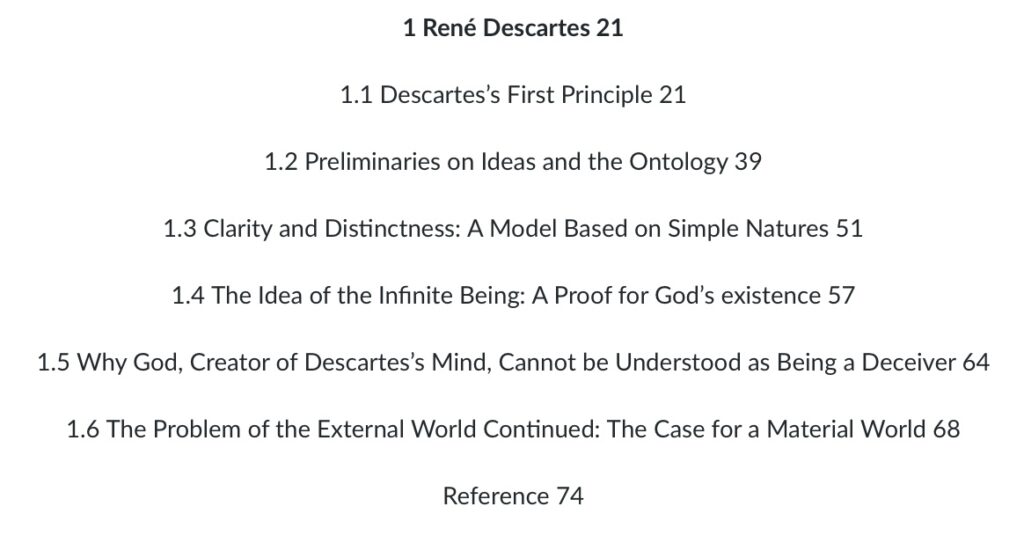
- See especially the sections with these titles and page numbers:
- “I.2 Ideas, Propositions, and Beliefs” (5–10)
- “1.5 Descartes’ First Principle” (22–23)
- ”1.23 Descartes’ First Principle” (32) is used for visual identification.”
- ”1.34 Descartes’ First Principle” (38–39)
- All of “1.2 Preliminaries on Ideas and the Ontology,” 1.35–1.63 (39–51)
- ”1.4 The Idea of the Infinite Being: A Proof for God’s existence” at 1.80–1.81 (63–64)
Smith, Nathan  and Jason Taylor
  , eds. Descartes and Cartesianism
  . Cambridge, UK: Cambridge Scholars Publishing, 2005.
Smith, Norman Kemp  (1872–1958). Studies in the Cartesian Philosophy
  . New York: Macmillan Company Publishing, 1902. See relevant content listings from excerpted screenshots below from the Table of Contents.
Smith, Norman Kemp 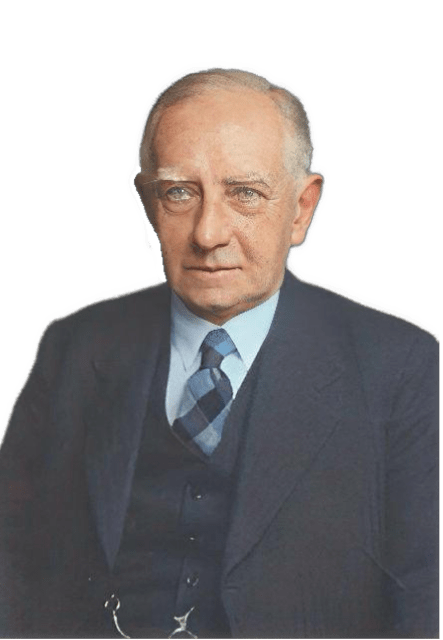 . New Studies in the Philosophy of Descartes
 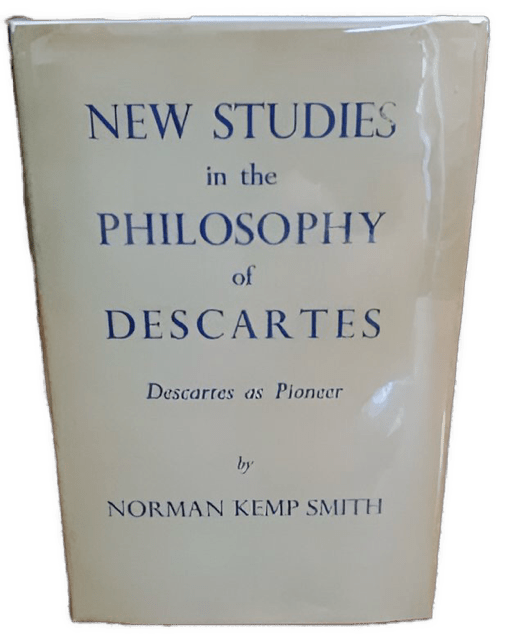 . London: Macmillan & Co., 1952/1963. See especially the contents of screenshot pages below.
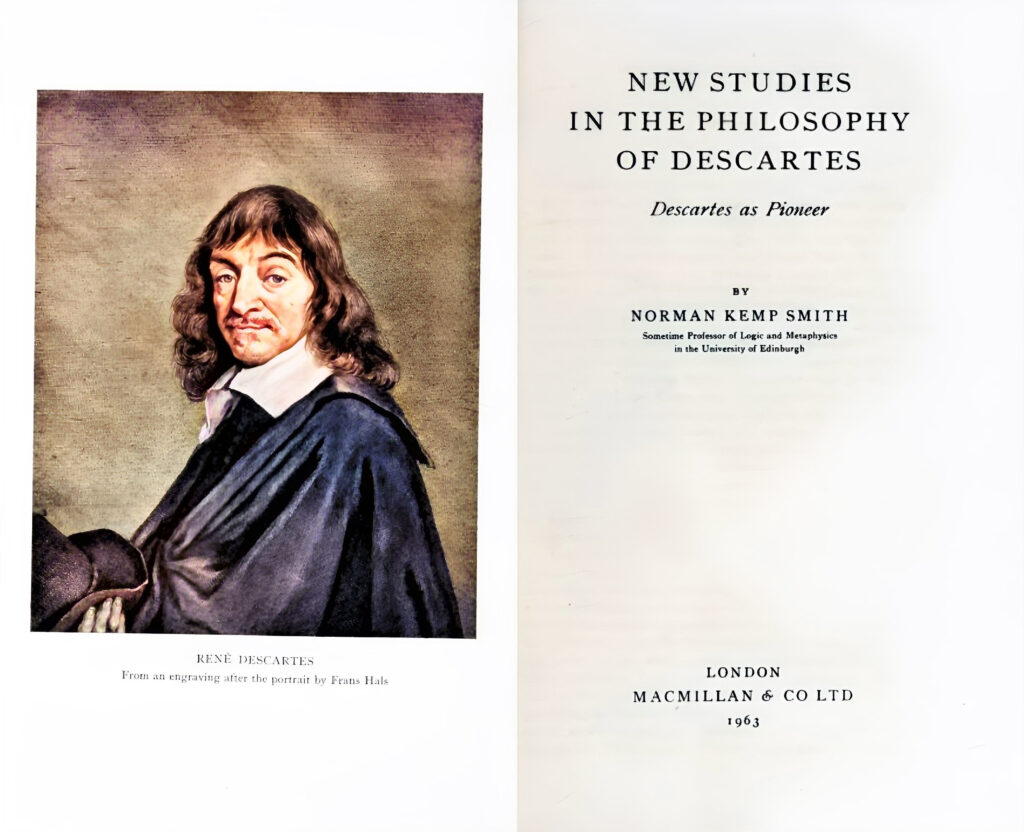
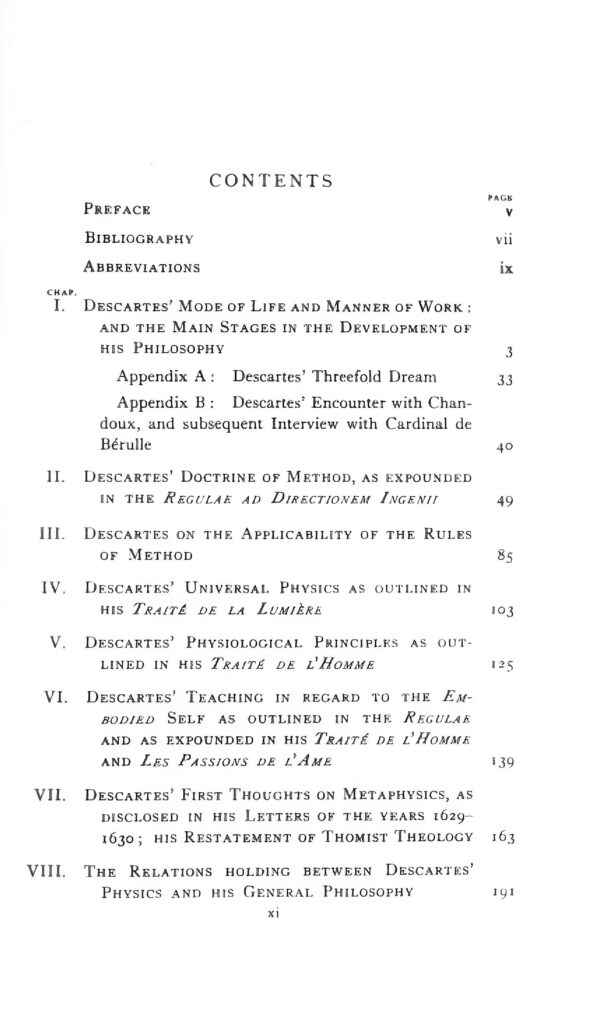
Smith (now Brassfield), Shoshana Rose  . “Clearness and Distinctness in Descartes’s Philosophy.” PhD diss. University of California, Berkeley, Spring, 2005. Dissertation advisors: Janet Broughton and Hannah Ginsborg.
Stewart, Michael A(lexander) (no known photo), ed. Studies in Seventeenth-Century European Philosophy  . New York: Oxford University Press, 1997.
Stich, Stephen  , ed. Innate Ideas
  . Berkeley, CA: University of California Press, 1975.
- Read John Tienson’s
 Review. Noûs 12, no. 3 (September, 1978): 337–43.
Strawson, Galen 

 . “Descartes’s Mind.” In Descartes and Cartesianism: Essays in Honour of Desmond Clarke
  , edited by Stephen Gaukroger and Catherine Wilson
  , 57–78. Oxford: Oxford University Press, 2017. Download at Academia.edu.
Sun, Vanessa  . “Descartes’s Transformation of the Sensory Perceptional Model in Medieval Philosophy.” Included in the 25th World Philosophy Conference. Also available at Academia.com.
Summary: People generally accept the popular interpretation of Descartes’ philosophy, which suggests that Descartes not only discovered the principles of optics but also applied them to explain our mechanical and physiological processes of visual perception using his innovative, pure science. Furthermore, his philosophy completely rejected the “species” theory, an intermediary tool in the human brain that aids in our understanding of things, which ancient philosophers and their medieval successors created. This theory was central to intentionality theories in the Middle Ages. He ultimately demonstrated that his new cognitive model consists of pure reason and pure intellectual intuition. This model is solely constructed from the “clearest ideas” directly provided to the human mind through the illumination of Nature’s Light to the process of human meditation. This paper aims to correct the oversimplified understanding of the interpretation mentioned above. I will attempt to prove step by step that, in the complex narrative surrounding philosophical truth, Descartes revisited the fundamental and core issue of the human sensory perception mechanism, which implies a new level of understanding. For Descartes, as we all know, the essence of human sensation and perception is also attributed solely to pure reason, significantly separating him from traditional philosophers. However, this distinction is still deeply intertwined with the mind-body identity issues, which have always been central to intentional theories among academic philosophers in the Middle Ages.


Tipton, Ian  . “‘Ideas’ and ‘Objects’: Locke on Perceiving ‘Things’.” In Minds, Ideas, and Objects: Essays on the Theory of Representation in Modern Philosophy , edited by Phillip D. Cummins (no known photo) and Günter Zöller
  , 97–110. Atascadero, CA: Ridgeview Publishing Company, 1992.


Van de Pitte, Frederick (no known photo). “Descartes’ Innate Ideas.” Kant-Studien 76 (1985): 362–84.
Verbeek, Theo 

 . Descartes and the Dutch: Early Reactions to Cartesian Philosophy 1637–1650
  . Carbondale: Southern Illinois University Press, 1994.
Vinci, Tom C. 
 . Cartesian Truth
  . New York: Oxford University Press, 1994.
- See especially Ch. 7 “The Janus‐Faced Theory of Ideas of the Senses“
Abstract: The leading idea of this [seventh] chapter is that, for Descartes, intellectual ideas make it obvious what metaphysical category the properties they disclose to the mind fall into but not whether they are actually exemplified; sensations make it obvious whether the properties they disclose to the mind are exemplified but not what their metaphysical category is. This idea is worked out through a discussion of three stages in the development of Descartes’s doctrine of the material falsity of sensory ideas, the core concept of his error explanation of the senses. Material falsity is a set of three defects that sensations have in comparison with intellectual ideas, ideas that fully discharge the role, which Descartes assigns to ideas in his philosophical system. The first stage, reflected in Meditation III, identifies material falsity with two defects: nonrepresentation and misrepresentation ; the second stage, reflected in the Reply to Arnauld, identifies material falsity with obscure ideas ; the third stage, reflected in the Principles of Philosophy I, sees the terminology of material falsity disappear and the terminology of clear but not distinct ideas appear. Other topics discussed include a special application of the rule of truth and skepticism.

Von Wright, George Henrik 

 . In the Shadow of Descartes: Essays in the Philosophy of Mind
  . Berlin: Springer Verlag, 1998. (Click on book cover for preview).
Voss, Stephen  , ed. Essays on the Philosophy and Science of René Descartes
  . Oxford: Oxford University Press, 1993.

Wagner, Stephen I. “Descartes on the Power of ‘Ideas’.” History of Philosophy Quarterly 13, no. 3 (1996): 287–97.
Abstract: This paper spells out the implications, for Descartes’s theory of ideas, of my earlier paper, “Descartes’s Wax: Discovering the Nature of Mind.” I show that my reading of the wax investigation provides a number of clarifications of Descartes’s Meditation III discussion of ideas. My reading of Meditation III provides a ground, internal to the Meditations for Descartes’s claims about objective reality, the causal laws, material falsity and the idea of God. I show that Descartes’s claims and conclusions regarding these issues is strengthened by the perspective I have provide
Wee, Cecila Teck Neo (no known photo). “Animal Sentience and Descartes’s Dualism: Exploring the Implications of Baker and Morris’s Views.” British Journal for the History of Philosophy 13, no. 4 (2005): 611–26.
Wee, Cecilia (no known photo). “Descartes’ Infallibility Thesis.” Philosophical Inquiry, 25, nos. 1/2 (Winter 2003): 59–70.
Wee, Cecilia Teck Neo (no known photo). “Material Falsity in Descartes’s Meditations.” PhD diss., University of Pittsburgh, 1994. Major Adviser: Annette C.(laire) Baier (1929–2012) 

 .
.
Wee, Cecilia (no known photo). Material Falsity and Error in Descartes’s Meditations 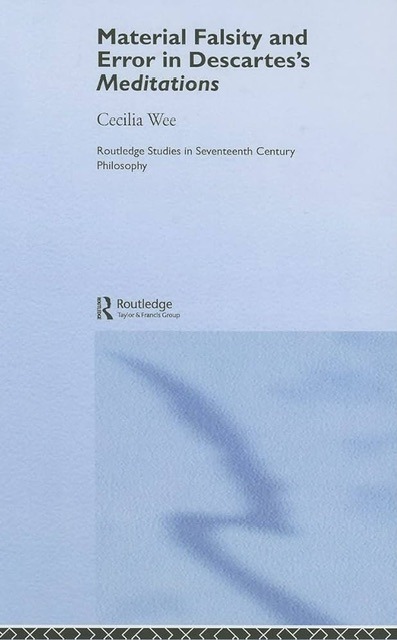
 . New York: Routledge, 2006.
- Read the opening of the book through page eight.
- Download a sample from Amazon.com of the book through part of Ch. 2 or from Google Books.
- Read Raffaella De Rosa’s
 “Review of Cecilia Wee’s Material Falsity and Error in Descartes’s Meditations.” Journal of the History of Philosophy 46, no. 4 (October 2008): 641–42. See below.
This book aims to overturn the common view of materially false ideas (MFIs), which is that Descartes’s discussion in Meditation Three generates confusion about his views on truth and falsehood and is irrelevant to the rest of the argument in the Meditations.
After introducing MFIs and then criticizing previous interpretations, Wee provides her own account in chapter three. Since a proper understanding of why MFIs fail in their representational function allows Wee to revisit their role in the Meditations, this chapter occupies a central place in the book. She attributes to Descartes two theories of representation, the “Accurate Causal Account” (ACP) and the “Alternative Account” (AA). According to ACP, “an idea represents truly only if (1) the idea comes from the cause from which it purports to come, and (2) the idea accurately represents that cause” (39–40). According to AA, an idea is true “if it represents a thing with objective being (and contains objective reality)” (47).
Since Descartes, in Meditation Three, is “unable to determine the causes of his . . . ‘adventitious’ ideas, far less to determine whether his ideas accurately represent their causes” (40), the claim that MFIs “represent no-things as things” is to be explained in light of AA as follows: “Under AA, all ideas purport to represent a ‘real’ thing. . . . False ideas are . . . those which purport to represent a thing with objective being but really do not do so” (49). However, the problem with Wee’s account is that since AA is based on the notion of objective reality, either these ideas fail to have objective reality, and then also fail to purport to represent, or else they do exhibit objective reality, and therefore represent something real. In either case, no account is provided of how MFIs purport to represent what they do not.
After the proof of a benevolent God, ACP can be reinstated to explain MFIs in Meditation Six and the Fourth Replies. On ACP, MFIs are ideas that represent correctly what their causes are but “mis-represent them” (52). For example, “the idea of the sun as very small is false because, although it represents correctly what its cause is—the sun—it does not [End Page 641] accurately portray that cause” (51). There are, however, problems with this explanation. If the idea represents its correct object in virtue of “coming from” it (as ACP suggests), how can it also misrepresent it? Matters are complicated by how ACP is said to account for MFIs in the Fourth Replies. There, the idea of cold is materially false because it refers cold to the external world while, in fact, it is the idea of the sensation of cold. But if the idea of cold is the idea of a sensation, why does it refer cold to an external world? Saying that cold is mistakenly referred to an external world because the idea is obscure and confused (55) does not answer the original question.
In chapter four, Wee argues that MFIs are crucial to the arguments of Meditations Three and Six. First, she contends that the ideas of size and shape that Descartes introduces in the context of the discussion of MFIs in Meditation Three are clear and distinct sensory ideas (CDSIs), and since the proof of the existence of material things in Meditation Six is based on CDSIs, the discussion of MFIs is crucial to the argument of Meditation Six (81–94). Second, she interprets Descartes’s claim that MFIs “arise from nothing—that is, they are in me only because of a deficiency and lack of perfection in my nature” (30)—as saying that MFIs are due to the lack of perfection of always having ideas that accurately represent states of affairs. Understanding deficiency as a lack of perfection allows Descartes “to argue from his own recognized imperfection to the existence of a completely perfect God” (108).
Wee’s discussion of CDSIs [clear and distinct sensory ideas] is very interesting but it obscures her account of the mechanism of false representation.
642 JOURNAL OF THE HISTORY OF PHILOSOPHY 46:4 OCTOBER 2008 (scroll down to read p. 642)
Sensory ideas of size and shape represent their correct causes because of their conformity to geometrical laws. This is inconsistent with ACP. Since these ideas do not purport to come from their causes in virtue of a causal connection with them, ACP does not count as a theory of representation. Moreover, claiming that MFIs are caused by a defect in my nature conflicts with Wee’s previous claim that, along the lines of ACP, MFIs are said to misrepresent their correct external causes. But Wee denies that there is a tension: “My false idea of the sun would have an existing cause insofar as it ‘comes from’ the sun itself. . . . However . . . this idea fails to represent accurately the sun … due to my own deficiency as a thinking thing.” (104) Besides the fact that, by Wee’s own account, the idea of the sun is a derivative idea based on the immediate clear and distinct sensory ideas of sizes and shapes that one recognizes to conform to geometrical laws (87), no explanation is provided of how a deficiency in our nature obscures the idea.
In chapter five, Wee argues that the account of deficiency as a lack of perfection in Meditation Three is crucial to understand both Descartes’s defense of his theodicy and his ethics. Our own imperfections make us aware that the question of why God has given us ideas that lead us astray cannot be answered “beyond the fact . . . that these imperfections contribute to the overall perfection of [a wider] order” (139). Finally; “cognizance that there is a divine order . . . enables the human agent to recognize that she is part of a larger God-given whole. This recognition forms a crucial part of Descartes’s ethics, for it requires of the agent that she acts at least partially for the good of her community” (151).
Despite these deficiencies, this book remains an important contribution to Descartes scholarship, returning MFIs to the central place in Descartes’s philosophy that they deserve.
Wells, Norman J.  . “Descartes and the Coimbrans on Material Falsity.” Modern Schoolman 85 (2008): 271–316.
Wells, Norman J.  “Descartes and the Scholastics Briefly Revisited.” The New Scholasticism 35, 2 (1961): 172–90.
Wells, Norman J. . “Descartes and Suarez on Secondary Qualities: A Tale of Two Readings.” The Review of Metaphysics 51, no. 3 (1998): 565–604.
Wells, Norman J.  . “Descartes’ Idea and its Sources.” American Catholic Philosophical Quarterly 67, no. 4 (1993): 513–35.
Wells, Norman J. “Material Falsity in Descartes, Arnauld, and Suarez.” Journal of the History of Philosophy 22 (1984): 25–50.
Wells, Norman J. “Objective Being: Descartes and His Sources.” The Modern Schoolman 45, no. 1 (1967–1968): 49–61.
Wells, Norman J. . “Objective Reality of Ideas in Arnauld, Descartes, and Suarez.” In The Great Arnauld and Some of His Philosophical Correspondents, edited by by Elmar J. Kremer . Toronto: University of Toronto Press, 1994.
Wells, Norman J. . “Objective Reality of Ideas in Descartes, Caterus, and Suarez.” Journal of the History of Philosophy 28, no. 1 (1990): 33–61.
Williams, Bernard . Descartes: The Project of Pure Enquiry. Hassocks, Sussex: Harvester Press, 1978.


Williston, Byron  and André Gombay
  , eds. Passion and Virtue in Descartes
  . Amherst, MA: Humanity Books (Prometheus), 2003.
- Introduction / Byron Williston
- Pt. 1. The Passions of the Soul
- 1. The Structure of The Passions of the Soul and the Soul-Body Union / Lisa Shapiro
- Pt. 2. What Are Cartesian Passions?
- 2. Traces of the Body: Cartesian Passions / Deborah Brown
and Calvin Normore
- 3. The Intentionality of Cartesian Emotions / Lilli Alanen
- 4. On Sensory-Motor Mechanisms in Descartes: Wonder versus Reflex / Jean-Marie Beyssade
- 5. Descartes on the Unity of the Self and the Passions / Deborah Brown
and Ronald de Sousa
- 6. The Function of the Passions / Daisie Radner (no known photo)
- Pt. 3. Descartes’s Moral Philosophy
- 7. Descartes’s Morale par Provision (from his book Descartes’s Moral Theory, 11–33) / John Marshall
- 8. Careerist Emotions / André Gombay
- 9. The Passions and Freedom of Will / Paul Hoffman
- 10. The Cartesian Sage and the Problem of Evil / Byron Williston





Wilson, Catherine.  . Descartes’ Meditations: An Introduction
  . Cambridge: Cambridge University Press, 2003.
Wilson, Margaret Dauler  . “Confused Ideas.” Rice Institute Pamphlet – Rice University Studies, 63, no. 4, 1977. Rice University: https://hdl.handle.net/1911/63299. In Ideas and Mechanism: Essays on Early Modern Philosophy, Ch. 22, 322–35. Princeton: Princeton University Press, 1999.
Wilson, Margaret Dauler 
 . Descartes
  . London and Boston: Routledge and Kegan Paul, 1978. Later published in the Taylor & Francis e-Library in 2005. Read the entire book at the Internet Archive.
Wilson, Margaret D.  . “Descartes on the Perception of Primary Qualities.” In Essays on the Philosophy and Science of Rene Descartes , edited by Stephen Voss, 162–76. Oxford, UK: Oxford University Press, 1993. Also in Ideas and Mechanism: Essays on Early Modern Philosophy
  , 26–40. Princeton, NJ: Princeton University Press, 1999.
Wilson, Margaret D.  . “Descartes on the Representationality of Sensation.” In Ideas and Mechanism: Essays on Early Modern Philosophy , Ch. 5, 69–83. Princeton: Princeton University Press, 1999.
Alison Simmon’s overview (2011): Landmark article trying to sort out what mental (and especially sensory) representation might amount to in Descartes; distinguishes two kinds of representationality, which she calls “presentational” and “referential.” The article also dives into the labyrinth of Descartes’ treatment of material falsity in the Fourth Replies.
- Also in Central Themes in Early Modern Philosophy, edited by Jan A. Cover
 and Mark Kulstad
 , 1–22. Cambridge, MA: Hackett Publishing Co., 1990.
- Read
 Michael Della Rocca’s Review of Wilson’s collected essays.
Wilson, Margaret Dauler  . “Descartes on Sense and ‘Resemblance’.” In Ideas and Mechanism: Essays on Early Modern Philosophy , 10–25. Princeton, NJ: Princeton University Press, 1999. Reprinted in Reason, Will, and Sensation: Studies in Descartes’s Metaphysics , edited by John Cottingham , 209–28. New York: Oxford University Press, 1994.
Wilson, Margaret D.  . “History of Philosophy in Philosophy Today; and The Case of the Sensible Qualities.” Philosophical Review 101, no. 1 (1992): 191–243.
Wilson, Margaret Dauler  . Ideas and Mechanism: Essays on Early Modern Philosophy . Princeton, N.J.: Princeton University Press, 1999.
Wolf-Devine, Celia  . Descartes on Seeing: Epistemology and Visual Perception
  . Carbondale, IL: Southern Illinois University Press, 1993.
Wolf-Devine, Celia . “Descartes’ Theory of Visual Spatial Perception.” In Descartes’ Natural Philosophy  , edited by Stephen Gaukroger , John Schuster
  , John Sutton
  , 506–23. New York: Routledge, 2011.
Wolf-Devine, Celia . “The Role of Inner Objects in Perception.” In Descartes’ Natural Philosophy , edited by Stephen Gaukroger , John Schuster , and John Sutton , 557–68. New York: Routkedge, 2000.
Wykstra, Stephanie Larsen (no known photo). “A Defense of Cartesian Certainty.” PhD diss., Rutgers University, 2008. Dissertation Director: Ernest Sosa .


Yolton, John W.  . “Mirrors and Veils, Thoughts and Things: the Epistemological Problematic.” In Reading Rorty: Critical Responses to ‘Philosophy and the Mirror of Nature’, edited by Alan R. Malachowski
  , Jo Burrows (no known photo), and Richard Rorty
  , 58–73. Oxford, UK: Oxford, 1990.
- Read Review of Reading Rorty by Imre Szeman (no known photo) in Surfaces 2, 1992 (Proceedings of the confederence “Rethinking Culture”). Also readable here.
Yolton, John W.  . “On Being Present to the Mind: A Sketch for the History of an Idea.” Dialogue 14, no. 3 (1975): 373–88.
- See Robert F. McRae’s “On Being Present to the Mind: A Reply.” Dialogue: Canadian Philosophical Review / Revue canadienne de philosophie 14 , no. 4 , (December 1975): 664–66. Published online by Cambridge University Press: May 5, 2010.
Yolton, John W.  . Perception and Reality: a History from Descartes to Kant
  . Ithaca, NY: Cornell University Press, 1996. See especially 183–214.
Yolton, John W. . Perceptual Acquaintance: From Descartes to Reid  . Minneapolis, MN: University of Minnesota Press, 1984.
Yolton, John W. . “Perceptual Cognition with Descartes.” In Studia Cartesiana 2, 63–83. Amsterdam: Quadratures, 1981.
Yolton, John W. . “Representation and Realism: Some Reflections on the Way of Ideas.” Mind 96, no. 383 (July 1987): 318–30.
Yolton, John W. . “Review of Stephen Nadler, Arnauld and the Cartesian Philosophy of Ideas.” Journal of Philosophy 88 (1991): 109–12.
Yolton, John W. . “The Way of Ideas: a Retrospective.” Journal of Philosophy 87 (1990), 510–16.
Yu, Kevin (no known information or photo). “Descartes on Sensation: Motion as Environmental Signs.” Writing sample.

Zhang, Weite  . “Descartes’ Doctrine of Clear and Distinct Perception: A Systematic Clarification. PhD diss., Heidelberg University, 2016. Dissertation advisor: Andreas Kemmerling
  . Published under Aachen: Shaker Verlag, 2016.
Abstract: This book attempts to contribute a historical and interpretive study of Descartes’ epistemology. It provides a systematic and exhaustive clarification of the mysterious and puzzling doctrine of “clear and distinct perception” and illuminates the relationships between this doctrine and four other central notions: “truth,” “metaphysical doubt,” “(metaphysical) certainty,” and “knowledge.” Roughly speaking, a clear and distinct perception is a pure understanding, an intellectual perception, or a mental intuition in which a purified and attending mind has a simple mental intuition of a simple proposition or a necessary deduction (i.e., a complex mental intuition) from such simple propositions to a complex proposition. A simple proposition can be regarded as a necessary conjunction of simple ideas. Descartes’ composition theory of ideas, which supposes that all ideas are composed of simple ideas, provides a crucial basis for clear and distinct perception. Descartes’ doctrine of clear and distinct perception is an attempt at mathematizing epistemology and is the main content of his new “method” (for truth and knowledge), which he sought throughout his life. This book attempts to shape a new image of Descartes’ epistemology.
Zupko, Jack  . “What Am I? Descartes’s Various Ways of Considering the Self.” In Journal of the History of Philosophy 31, no. 4 (1993): 493–518.

Secondary Sources
Number of Bibliographic entries in Secondary Sources (A–Z) is over 400.