

A Hyperlinked Pictorial Bibliography in multiple languages with links to scholars, references, images, full abstracts, and published reviews

Secondary Sources
The letters above represent the first letter of people’s last names in the Secondary Sources bibliography. Click on them to go to that alphabetical section. One can quickly return by hitting the blue box up arrow  in the lower right corner, if located in the same webpage. Otherwise, use the buttons to switch between relevant webpages. Please be patient because these information rich webpages can take five seconds or more to load.
Number of Bibliographic entries in Secondary Sources (A–Z) is over 420.
NOTE: The DTOI bibliography covers multifaceted aspects of René Descartes’s theory of ideas, with a specific emphasis on their representational features and properties, especially regarding thoughts, ideas, volitions, passions, imaginations, memory, pains, or sensations, and their objective reality or material falsity. Accordingly, it tends not to include such topics as the epistemology of the role of God in the certainty of thoughts or on a divine guarantee for the truth of clear and distinct ideas because these, while mildly relevant, focus too much on Cartesian foundational metaphysics. While doubt and skepticism are crucial in Descartes’s philosophy, particularly in establishing the grounds for his epistemic inquiries, they generally do not directly contribute to a focused understanding of the ontological, epistemological, or representational aspects of ideas.

Adams, Marilyn McCord  . William Ockham. Vols. 1–2. South Bend, IN: University of Notre Dame Press, 1987.
Adams, Robert Merrihew  . “Where Do Our Ideas Come From? Descartes vs. Locke.” In Innate Ideas
  , edited by Stephen Stich
  , 71–87. Berkeley, CA: University of California Press, 1975.
Alanen, Lilli  . “Cartesian Ideas and Intentionality.” In Language, Knowledge and Intentionality: Perspectives on the Philosophy of Jaakko Hintikka
  , edited by Leila Haaparanta
  , Martin Kurtsch
  and Ilkka Niiniluoto
  . Helsinki, FI: Acta Philosophica Fennica 49 (1990): 344–69.

- Lilli Alanen’s bibliography.
- Lilli Alanen’s publications (updated to 2018).
Alanen, Lilli  . “Descartes, Conceivability, and Logical Modality.” In Thought Experiments in Science and Philosophy
  , edited by Tamara Horowitz
  (1950–2000) and Gerald J. Massey
  , 65–84. Lanham: MD, Rowman-Littlefield, 1991.
Alanen, Lilli  . Descartes’s Concept of Mind
  . Cambridge, “MA: Harvard University Press, 2003.
- See Desmond M. Clarke’s
 Review. Notre Dame Philosophical Reviews, January 11, 2004.
 - See John Cottingham’s
 Review. International Philosophical Quarterly 44, no. 4 (December 2004): 594–96.
 - See Nicholas Jolley’s
 Review. The Philosophical Review 114, no. 1 (January 2005): 118–22.
Alanen, Lilli  . “Descartes’s Dualism and the Philosophy of Mind.” Revue de Métaphysique et de Morale 94, no. 3 (1989): 391–413.
Alanen, Lilli . “Descartes on the Will and the Power to Do Otherwise.” In Emotions and Choice From Boetius to Descartes  , edited by Henrik Lagerlund
  and Mikko Yrjönsuuri
  , 279–98. Boston and Dordrecht: Kluwer, 2002.
Alanen, Lilli . “Descartes on the Essence of Mind and the Real Distinction between Mind and Body” and “On the Role and Nature of Descartes’ First Principle.” In Studies in Cartesian Epistemology and Philosophy of Mind  , Acta Philosophica Fennica 33 (1982): 9–103 and 105–70. Helsinki: Philosophical Society of Finland, 1982.
Alanen, Lilli . “The Intentionality of Cartesian Emotions.” In Passion and Virtue in Descartes  , edited by Byron Williston
  and André Gombay

 107–27. Amherst, MA: Humanity Books, 2003.
Alanen, Lilli . “The Nature of the Self.” In The Cartesian Mind  , edited by Jorge Secada
  , Travis Tanner
  , and Cecilia Wee (no known picture). Abingdon: Routledge, January 6 or 9, 2025 or September 3. 2025 (Routledge).
Publisher’s overview: Descartes’ is widely acknowledged as the founder of modern philosophy and The Cartesian Mind seeks to provide a comprehensive survey of his work, not only placing it in its historical context but also exploring its contemporary significance. Comprising over 40 chapters by a team of international contributors the Handbook covers the following central topics: Descartes’ life and works; the historical background to Descartes’ works; analysis of Descartes’ thought; Descartes’ early modern reception and Descartes in modern and contemporary thought. Essential reading for students and researchers in philosophy, Descartes’ work is central not only in the history of philosophy, but all other areas of the subject, including epistemology, metaphysics, philosophy of mind and action, philosophy of science, and ethics.
Alanen, Lilli  . “Reconsidering Descartes’s Notion of the Mind-Body Union.” Synthese 106, no. 1 (January 1996): 3–20.
Alanen, Lilli . “The Role of Will in Descartes’ Account of Judgment.” In Descartes’ Meditations: A Critical Guide
  , edited by Karen Detlefsen
  , 176–99. New York: Cambridge University Press, 2012.
Alanen, Lilli . “The Second Meditation and the Nature of the Human Mind.” In The Cambridge Companion to Descartes’ Meditations  , edited by David Cunning
  , 88–106. Cambridge: Cambridge University Press, 2014. Also readable from the University of Athens.
Alanen, Lilli  . “Self-Awareness and Cognitive Agency in Descartes’s Meditations.” Philosophical Topics 44, no. 1 (Spring 2016): 3–26.
Alanen, Lilli  . “Sensory Ideas, Objective Reality, and Material Falsity.” In Reason, Will and Sensation: Studies in Descartes’s Metaphysics
  , edited by John Cottingham , 229–50. Oxford: The Clarendon Press, 1994.
Alanen, Lilli  . “Thought-Talk: Descartes and Sellars on Intentionality.” American Philosophical Quarterly 29, no. 1 (January 1992): 19–34.
Alanen, Lilli . “Une certain faussete materielle: Descartes et Arnauld sur l’origine de l’erreur dans la perception sensorielle.” In Descartes. Objecter et Répondre  , edited by Jean-Marie Beyssade
  , Jean-Luc Marion
  , and Lia Levy
  , eds., 205–30. Paris: Presses Universitaires de France (PUF), 1994.
Alquié, Ferdinand  . La découverte métaphysique de l’homme chez Descartes
  . Paris: PUF, 2000.
Angelini, Elisa. Le idee e le cose. La teoria della percezione di Descartes.  Pisa: Edizione ETS (Series: Philosophica), 2007. English translation of title: Ideas and things. The theory of perception of Descartes.
- Read Emiliano Ferrari’s
 Review.
Anscombe, G. E. M  . “The Intentionality of Sensations: A Grammatical Feature.” In Vision and Mind: Selected Readings in the Philosophy of Perception
  , edited by Alva Noë
  and Evan Thompson
  , 55–75. Cambridge, Mass.: The MIT Press, 2002. Pages missing from Google Books Preview: 58–59, 65–66, 72–73.
Aquila, Richard E.  . “The Content of Cartesian Sensation and the Intermingling of Mind and Body.” History of Philosophy Quarterly 12, no. 2, Studies on Descartes (April 1995): 209–26.
Aquila, Richard E. . “Brentano, Descartes and Hume on Awareness.” Philosophy and Phenomenological Research 35 (1974): 223–39. Also, partially available.
351
Arbini, Ronald (no known photo). “Did Descartes Have a Philosophical Theory of Sense Perception.” Journal of the History of Philosophy 21, no. 3 (July 1983): 317–37.
Ariew, Roger  . Descartes and the Last Scholastics
  . Ithaca, NY: Cornell University Press, 1999.
Ariew, Roger . Descartes Among the Scholastics  . Leiden, The Netherlands: Koninklijke Brill NV, 2011.
Ariew, Roger . “Descartes and Scholasticism: The Intellectual Background to Descartes’ Thought.” In The Cambridge Companion to Descartes  , edited by John Cottingham , 58–90. Cambridge: Cambridge University Press, 1992. Revised version in Descartes and the Last Scholastics
  , edited by Roger Ariew , 7–35. Ithaca: Cornell University Press, 1999.
Ariew, Roger , Dennis Des Chene  , Douglas M. Jesseph
  , Tad M. Schmaltz
  , Theo Verbeek
  , eds. Historical Dictionary of Descartes and Cartesian Philosophy
  , 2nd ed. Lanham, Maryland: Rowman & Littlefield Publishers, 2015. First edition published in 2003. Clicking on the title permits reading up to p. 103 (missing: xv–xvi, 2–3, 9–10, 16–17, 23–34, 30–31, 37–38, 44–45, 51–52, 58–59, 65–66, 72–73, 79–80, 86–87, 93–94, 100–1) with 105 to 387 not shown.
Ariew, Roger and Marjorie Grene  . The Cartesian Destiny of Form and Matter.” Early Comparative Philosophy Science and Medicine 3 (1997): 300–25.
Ariew, Roger and Marjorie Grene  , eds. Descartes and His Contemporaries: Meditations, Objections, and Replies
  . Chicago: University of Chicago Press, 1995.
Ariew, Roger and Marjorie Grene  . “Ideas, In and Before Descartes.” Journal of the History of Ideas, 56, no. 1 (1995): 87–106.
Ashworth, E. J. (Earline Jennifer)  . “Descartes’ Theory of Objective Reality.” New Scholasticism 45 (1975): 331-40.
Atherton, Margaret 
 . “Green Is like Bread: The Nature of Descartes’ Account of Color Perception.” In Perception and Reality: From Descartes to the Present
  , edited by Ralph Schumacher
 , 27–42. Paderborn: Mentis, 2004.
Ayers, Michael Richard  . “Ideas and Objective Being.” In The Cambridge History of Seventeenth-Century Philosophy
  vol. 2, edited by Daniel Garber
  and Michael Ayers
 , 1062–107. Cambridge: Cambridge University Press, 2000.

Bailey, D. T. J.  “Descartes on the Logical Properties of Ideas.” British Journal of the History of Philosophy 14, no. 3 (2006): 401–11.
Baker, Gordon P.  and Katherine J. Morris
  . Descartes’ Dualism
  . London: Routledge, 1996.
- See Steven Nadler’s
 Review. Philosophical Books 38, no. 1 (1997): 157–69.
Baker, Gordon P.  and Katherine J. Morris
  . “Descartes Unlocked.” British Journal for the History of Philosophy 1, no. 1 (1993): 1–27.
Barth, Christian
. “Consciousness in Early Modern Philosophy: Remarks on Udo Thiel’s Account.” Kant-Studien 107, no. 3 (2016): 515–25.
Abstract: This commentary on Udo Thiel’s rich and inspiring book The Early Modern Subject consists of three parts. The first part expresses agreement with Thiel’s claim that the early modern philosophers use terms such as “conscientia,” “conscience,” “consciousness,” and “Bewusstsein” in order to refer to forms of “relating to one’s own self”. However, Thiel’s additional claim that the early modern philosophers were not much concerned with object consciousness is found wanting. The second part takes issue with Thiel’s understanding of the way in which René Descartes’s psychological usage of the term “conscientia” is innovative. It is argued that Descartes does not arrive at the psychological meaning of the term by abstraction from its moral meaning. Instead, Descartes only widens the application of the term in one of its established ancient meanings. The third part presents objections to Thiel’s higher-order reading of Cartesian conscientia.
Barth, Christian  . “Descartes on Intentionality, Conscientia, and Phenomenal Consciousness.” Studia Philosophica 75 (2016): 17–32. http://doi.org/10.24894/StPh-en.2016.75003
Barth, Christian  . Intentionalität und Bewusstsein in der frühen Neuzeit: Die Philosophie des Geistes von René Descartes und Gottfried Wilhelm Leibniz
  [Academia English translation: Intentionality and Consciousness in the Early Modern Period: The Philosophy of the Mind by René Descartes and Gottfried Wilhelm Leibniz]. Frankfurt am Main: Vittorio Klostermann, 2017.
Barth, Christian . “Leibnizian Conscientia and its Cartesian Roots.” Studia Leibnitiana 43, no. 2 (2011): 216–36.
Barth, Christian . “Sellars on Descartes.” In Sellars and the History of Modern Philosophy  , edited by Luca Corti
  and Antonio M. Nunziante
  , 15–35. New York, NY: Routledge, 2019. Also available at Academia.com after searching for the title. Also at PhilArchive.org.
Benejam, Antoni Gomila 


 . “La Teoria de las Ideas de Descartes.” Teorema XVI, no. 1 (1996): 47–69. Also available here.
Abstract: Against standard readings of Descartes as philosophy of mind’s “villain”, because of his dualism (Ryle), his subjectivism (followers of the second Wittgenstein), or his individualism (Burge), this paper tries to point out his most valuable legacy, his representationalism, through a reconstruction of his notion of “idea” as a natural sign. To this end, attention is paid not only to the Meditations, but also to his scientific works, as they are the key to the rejection of the usual reading of “idea” as an incorporeal image.
Bennett, Jonathan  . “Descartes’ Theory of Modality.” The Philosophical Review 103, no. 4 (1994): 639–67.
Bennett, Jonathan  . Locke, Berkeley, Hume: Central Themes
 . Oxford: Clarendon Press, 1971.
- Read Stephen Rappaport’s (no known photo) critical Review. Journal of the History of Philosophy 12, no. 1 (January 1974): 117–20.
Ben-Yami, Hanoch  . “The Development of Descartes’ Idea of Representation by Correspondence.” In Reading Descartes: Consciousness, Body, and Reasoning
  , edited by Andrea Strazzoni
  and Marco Sgarbi
  . Firenze, IT: Firenze University Press (2023): 41–57. Also downloadable from Research Gate.
Ben-Yami, Hanoch . Descartes’ Philosophical Revolution: A Reassessment  . Hampshire: Palgrave, 2015.

Ben-Yami, Hanoch . “Word, Sign and Representation in Descartes.” Journal of Early Modern Studies 10, no. 1 (2021): 29–46.
Abstract: In the first chapter of his The World, Descartes compares light to words and discusses signs and ideas. This made scholars read into that passage our views of language as a representational medium and consider it Descartes’ model for representation in perception. I show, by contrast, that Descartes does not ascribe there any representational role to language; that to be a sign is for him to have a kind of causal role; and that he is concerned there only with the cause’s lack of resemblance to its effect, not with the representation’s lack of resemblance to what it represents. I support this interpretation by comparisons with other places in Descartes’ corpus and with earlier authors, Descartes’ likely sources. This interpretation may shed light both on Descartes’ understanding of the functioning of language and on the development of his theory of representation in perception.
Beyssade, Jean-Marie . “La classification cartésienne des passions.” Revue Internationale de Philosophie 37, no. 146 (1983): 278–87.
Beyssade, Jean-Marie . “Descartes on Material Falsity.” In Minds, Ideas and Objects. Essays on the Theory of Representation in Modern Philosophy  vol. 2 of the North American Kant Society Studies in Philosophy, edited by Phillip D. Cummins (no known photo) and Guenter Zoeller
  , 5–20. Atascadero, CA: Ridgeview Press, 1992.
Beyssade, Jean-Marie . La Philosophie Première de Descartes: Le temps et la cohérence de la métaphysique  . [Descartes’ First Philosophy: Time and the Coherence of Metaphysics]. Paris: Flammarion, 1979.
Beyssade, Jean-Marie and Jean-Luc Marion (eds.). Descartes: objecter et répondre  , edited by Jean-Marie Beyssade and Jean-Luc Marion, 187. Paris: Presses Universitaires de France, 1994.
Bolton, Martha

 . “Confused and Obscure Ideas of Sense.” In Essays on Descartes’ Meditations
  , edited by Amélie O. Rorty
  , Ch. 16., 389–403. Berkeley, CA: University of California Press, 1986.
Boyle, Deborah A.  . Descartes on Innate Ideas
  . London: Continuum, 2009.
Boyle, Deborah A.  . “Descartes on Innate Ideas.” The Modern Schoolman 78 (November 2000): 35–50.
Boyle, Deborah A. . “Descartes’ Natural Light Reconsidered.” Journal of the History of Philosophy 37, no. 4 (October 1999): 601–12. Complete article at Muse.
Broughton, Janet  and John Carriero
  eds. A Companion to Descartes
  . Malden, MA: Blackwell, 2008.
Broughton, Janet . Descartes’s Method of Doubt  . Princeton: Princeton University Press, 2003.
Broughton, Janet  . “Self-Knowledge.” In A Companion to Descartes
  , edited by Janet Broughton and John Carriero , 179–95. Malden, MA: Blackwell, 2008.
Brown, Deborah J.  . “Being, formal versus objective.” In The Cambridge Descartes Lexicon
  , edited by Lawrence Nolan
  , 60–65. Cambridge, UK: Cambridge University Press, 2016.
Brown, Deborah J. . Descartes and the Passionate Mind
  . Cambridge: Cambridge University Press, 2006.
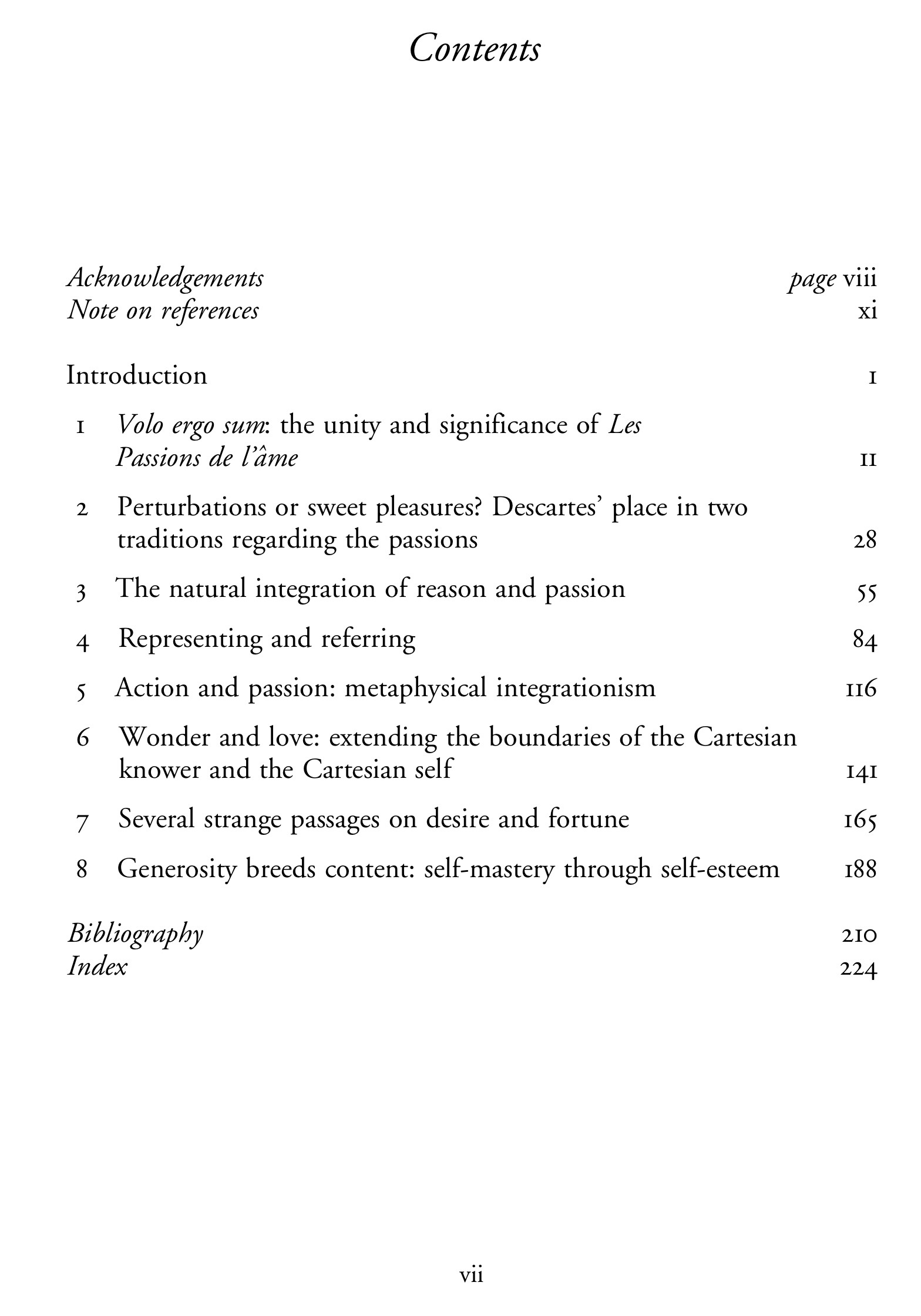
- Read Sean Greenberg’s Review.
 Journal of the History of Philosophy 45, no. 3 (July 2007): 499–500.
 - Read Lisa Shapiro’s Review.
 Notre Dame Philosophical Reviews, March 4, 2007.
 - Read Tom Sorell’s
 Review. Philosophical Books Vol. 49, no. 1 (January 2008): 47–59.
 - Read Tatiana Patrone‘s
 Review. Metapsychology Online Reviews 11, no. 5 (2007).
 - Read Amy Morgan Schmitter’s
 Review: “Descartes’s Peepshow.” Canadian Journal of Philosophy 40, no. 3, September 2010, 485–508.
Brown, Deborah J.  . “Descartes on True and False Ideas.” In A Companion to Descartes , edited by Janet Broughton and John Carriero
  , 196–215. Malden, MA: Blackwell, 2008.
Brown, Deborah J. .“Passion.” In The Cambridge Descartes Lexicon , edited by Lawrence Nolan  , 563–69. Cambridge, UK: Cambridge University Press, 2016.
Brown, Deborah J.  . “Objective Being in Descartes: That Which We Know, or That By Which We Know.” In Representation and Objects of Thought in Medieval Philosophy
  , edited by Henrik Lagerlund , 135–53. Burlington, VT: Ashgate Publishing Co., 2007. Also here.
Brown, Gregory A. 
 . “Vera Entia: The Nature of Mathematical Objects in Descartes.” Journal of the History of Philosophy 18, no. 1 (1980): 23–37.
Buroker, Jill Vance 

 . “Descartes on Sensible Qualities.” Journal of the History of Philosophy 29, no. 4 (October 1991): 585–611.
Butler, Ronald J(oseph). (no know photo), ed. Cartesian Studies  . Oxford: Blackwell, 1972.


Carriero, John . Between Two Worlds: A Reading of Descartes’s Meditations. . Princeton, N.J.: Princeton University Press, 2009.
Carriero, John . “The Second Meditation and the Essence of Mind.” In Essays on Descartes’ Meditations , edited by Amélie Oksenberg Rorty  , 199–221. Berkeley, CA: University of California Press, 1986.
Carriero, John  . “Sensation and Knowledge of Body in Descartes’ Meditations.” In Descartes’ Meditations: A Critical Guide , edited by Karen Detlefsen , 103–26. New York: Cambridge University Press, 2013.
Carriero’s Abstract: Descartes is often thought to embrace some form of “indirect realism” in the Meditations, at least when it comes to sensory cognition. Broadly, there are two main grounds for attributing such a position to him. First, in the Meditations, Descartes presents an argument for the existence of bodies. But what else could the purpose of this argument be, if not to get us from an inner world of our sensory ideas to an outer world of bodies? (Kant, for one, seems to have understood Descartes as having set some such problem for himself.) Second, Descartes denies in the Meditations that sensory ideas resemble things in bodies. This, on its face, would seem to make for a gap between our sensory cognition of features of bodies and the features themselves. Although for many years I read the Meditations in this way, I have come to think better of it. In the Third Meditation, Descartes sketches a “pre-critical” conception of sensory cognition, that is, the conception of the senses that he takes the meditator to have entered the Meditations with. This conception has affinities with an Aristotelian “realist” account of sensation. In the Sixth Meditation he presents his own theory of the senses. While there are important differences between the earlier position and the later one, I have come to think that it is easy to exaggerate the differences and that the new position is better seen as a modification of the Aristotelian “realist” picture than its abandonment.
Publisher’s overview:
In “Sensation and knowledge of body in Descartes’ Meditations,” John Carriero argues it is a mistake to interpret Descartes as having radically revised his view about sensation from a naive, pre-critical direct realism to a considered and philosophically grounded indirect realism. Carriero takes Descartes to have only modified his initial position while remaining within the confines of a broadly Aristotelian direct realist framework of sense perception. According to Carriero, direct realism involves a lack of mediation, a sharing of form between cognizer and cognized (105). Indirect realism, on the other hand, is exemplified by causal covariance (114). To support what we might call his “modification without change of framework” reading, Carriero points to the similarities between Descartes’ two positions: the “spontaneous impulse” of Meditation III is very close to Meditation VI; and in both cases, sensations come to the mediator willy-nilly. Moreover, Carriero contends that apparent dissimilarities between Descartes’ naive and his considered views can be accounted for in terms of a stretching of the direct realist framework. Carriero makes a case for interpreting Descartes’ concept of sensation in terms of shared structure, as opposed to the Aristotelians’ identity of form.
Carriero, John , ed. Early Modern Philosophy Reconsidered: Essays in Honor of Paul Hoffman  . Midwest Studies in Philosophy, vol. 35, edited by Peter A. French
  and Howard K. Wettstein
  . Boston: Blackwell Publishing, 2011.

Caruso, Gregg D.  . “Sensory States, Consciousness, and the Cartesian Assumption.” In Descartes and Cartesianism
  , edited by Nathan Smith
  and Jason Taylor
  , 177–99. Cambridge Scholars Press, 2005. Click below on Author’s Abstract or Editor’s Introduction for the source of the quotation.
Author’s Abstract: One of the central assumptions made in much of contemporary philosophy of mind is that there is no appearance-reality distinction when it comes to sensory states. On this assumption, sensory states simply are as they seem: consciousness is an intrinsic property of sensory states—that is, all sensory states are conscious—and the consciousness of one’s own sensory states is never inaccurate. For a sensation to be felt as pain, for example, is for it to be pain. This assumption, which I call the Cartesian assumption, can be seen everywhere from the standard arguments against physicalism—such as those advanced by Kripke, Nagel, and Levine—to current theorizing about consciousness. I here argue that this assumption is false and that it goes wrong in two ways. I further argue that the appeal of the Cartesian assumption is due to a commitment many still have to a poorly motivated and misguided Cartesian model of consciousness and its relation to mental states. As an alternative to this Cartesian concept of mind, I argue for a theory of consciousness which claims that the “phenomenal character” of a sensation or perception—the “what it’s like” to have that sensation—is determined by the content of a higher-order thought one has of that sensory state.
Editor’s Introduction: In “Sensory States, Consciousness, and the Cartesian Assumption,” Gregg Caruso approaches the res cogitans from the concerns of contemporary philosophy of mind, investigating, specifically, the relationship between sensation and consciousness. Carouso challenges, the assumption, which he calls the “Cartesian assumption,” that the range of sensation is co-extensive with consciousness: to have a sensation is to be aware of having a sensation. With examples from both ordinary experience and cognitive science, Carouso argues that this assumption can be undermined in two ways. First, we can have real sensations, which do not appear to us as sensations. Second, we can appear to have sensations which are not really sensations for us. Caruso concludes by offering an alternative theory of mind, the HOT (Higher Order Thought) model, which he believes more adequately represents the variety of our experience.
Chamberlain, Colin  . “Not a Sailor in His Ship: Descartes on Bodily Awareness.” In The Routledge Handbook to Bodily Awareness
  , edited by Adrian J(ohn). T(etteh). Alsmith (no known photo) and Matthew R. Longo
  , 83–94. London: Routledge, 2022.
Author’s Abstract: Despite his reputation for neglecting the body, Descartes develops a systematic account of bodily awareness. He holds that in bodily awareness each of us feels intimately connected to our body. We experience this body as inescapable, as infused with bodily sensations and volitions, and as a special object of concern. This multifaceted experience plays an ambivalent role in Descartes’s philosophy. Bodily awareness is epistemically dangerous. It tempts us to falsely judge that we cannot exist apart from our bodies. But bodily awareness isn’t all bad for Descartes. It helps us stay alive. Descartes also appeals to bodily awareness as a corrective to overly disembodied conceptions of the self.
Chamberlain, Colin  . “What Am I? Descartes’s Various Ways of Considering the Self.” Journal of Modern Philosophy 2, no. 1 (2020): 1–30.
Author’s Abstract: In the Meditations and related texts from the early 1640s, Descartes argues that the self can be correctly considered as either a mind or a human being, and that the self’s properties vary accordingly. For example, the self is simple considered as a mind, whereas the self is composite considered as a human being. Someone might object that it is unclear how merely considering the self in different ways blocks the conclusion that a single subject of predication—the self—is both simple and composite, which is contradictory. In response to this objection, this paper develops a reading of Descartes’s various ways of considering the self. I argue that the best reading of Descartes’s qualified claims about the self, i.e., about the self qua mind or the self qua human being, presupposes an account of the unqualified self, that is, of the self simpliciter. I argue that the self simpliciter is not a mind, and that it is not a human being either. This result might suggest the pessimistic conclusion that Descartes’s view of the self is incoherent. To avoid this result, I introduce a new metaphysical account of the Cartesian self. On my view, the self is individuated by a unified mental life. The self is constituted by the beings that jointly produce this mental life, and derives its unity from it.
Chappell, Vere  . “Descartes’ Ontology.” Topoi 16, (1997): 111–27.
Chappell, Vere  . “The Theory of Ideas.” In Essays on Descartes’ Meditations , edited by Amélie Oksenberg Rorty
  , 177–98. Berkeley: University of California Press, 1986.
Chávez-Arvizo, Enrique  . “The History Corner—Descartes’ Concept of Sense-Perception: A Tribute in his Fourth Centenary.” Cogito 10, no. 1 (1996): 15–21.
Chignall, Andrew  . “Descartes on Sensation: A Defense of the Semantic-Causation Model.” Philosopher’s Imprint 9, no. 5 (June 2009): 1–22.
Abstract: Descartes’s lack of clarity about the causal connections between brain states and mental states has led many commentators to conclude that he has no coherent account of body-mind relations in sensation, or that he was simply confused about the issue. In this paper I develop what I take to be a coherent account that was available to Descartes, and argue that there are both textual and systematic reasons to think that it was his considered view. The account has brain states serving as occasions for the mind to produce in itself the sensations that it takes these brain states to signify. The relation between body and mind on this model is thus neither a standard efficient-causal relation, nor an occasionalist one, but rather a semantic-causal relation (i.e. a non-standard efficient causal relation that goes by way of natural signification). At the end of the paper I argue that the model does not undermine Descartes’ commitment to the self-transparency of the mind.
Clarke, Desmond  . Descartes’s Theory of Mind
  . Oxford: Clarendon Press, 2003.
- Read Enrique Chávez-Arvizo’s Review. Journal of the History of Philosophy 43, no. 1 (January 2005): 116–17.
Clemenson, David Lee (no known photo). “Descartes’ Direct Realisms.” Unpublished manuscript, presented at the APA Pacific Division meeting, San Francisco, CA 2005.
Abstract: Yolton, Nadler, et al. claim that Descartes considered ideas of corporeal things to be (normally) acts rather than objects of perception. They also claim that Descartes cannot have held that (A) ideas can be really identical to mental modes on the one hand and to physical objects on the other. In this paper I argue that, on any plausible direct realist reading of Cartesian idea theory, proposition (A) is entailed by certain remarks in the Meditations. Fortunately for any future direct realist reading of Cartesian idea theory, (A) does not (as might be thought) obviously contradict Cartesian dualism. Just as being identical to a statue does not entail being necessarily statue-shaped (in spite of the fact that of necessity statues are statue-shaped), being identical to a mental mode does not entail being necessarily in the mind (in spite of the fact that of necessity mental modes are in the mind).
Clemenson, David L. (no known photo). Descartes’ Theory of Ideas  . London: Continuum, 2007.
- Read Dan Kaufman’s
 Review. Notre Dame Philosophical Reviews, March 6, 2008.
Clemenson, David L. (no known photo). “Review of Raffaella De Rosa’s Descartes and the Puzzle of Sensory Representation.” Notre Dame Philosophical Reviews. 2010.
Clemenson, David L. (no known photo). “Seventeenth Century Scholastic Philosophy of Cognition and Descartes’ Causal Proof of God’s Existence.” PhD diss., Harvard University, 1991. Available at ProQuest Dissertation Express, UMI publication number 9131929.
Clemenson, David L. (no known photo). Species, Ideas and Idealism: The Scholastic and Cartesian Background of Berkeley’s Master Argument. PhD diss., Rice University, Houston, TX, August, 2000. Major adviser: Mark Kulstad  .
.
Cook, Monte  . “Descartes’ Alleged Representationalism.” History of Philosophy Quarterly 4, no. 2 (April, 1987): 179–95.
Costa, Michael J. (no known photo). “What Cartesian Ideas are Not.” Journal of the History of Philosophy 21, no. 4 (1983): 537–49.
Author’s Abstract: IT IS CLEAR that Descartes uses the term ‘idea’ in a number of different senses. One recent commentator, Anthony Kenny, claims that Descartes’s failure to identify clearly these different senses is not only confusing to the reader, it is also a major source of confusion in Descartes’s thought. Failure to keep track of “the ambiguity leads Descartes into inconsistencies and vitiates some of his arguments.” There is some justification for Kenny’s position. One certainly wishes that Descartes had kept better track of his uses of the term ‘idea,’ and it may be that his failure to do so is an occasional course of equivocation. Still, I think that Kenny distorts the nature of the ambiguity in Descartes’s use of ‘idea.’ Kenny virtually ignores a sense of ‘idea’ that, as I shall show, is very important to a proper understanding of Descartes’s thought; and Kenny reads a sense of ‘idea,’ in which it denotes an immaterial image or phenomenal object, that I claim is not present in Descartes’s thought. The sense of ‘idea’ that Kenny virtually ignores is that in which it is used to denote what Descartes often calls an “image in the corporeal imagination.” This ‘image’ is corporeal not only in the sense that it is an image of an extended object, but also in the sense that the image is itself corporeal and extended. The image is made up of material particles in a certain arrangement. In modern parlance, what Descartes refers to as an “image in the corporeal imagination” is a brain state.
Cottingham, John  . “A Brute to the Brutes: Descartes’ Treatment of Animals.” Philosophy 53 (1978): 551–59.

- See John Cottingham’s CV.
- See a comprehensive John Cottingham bibliography.
Cottingham, John  , ed. The Cambridge Companion to Descartes. Cambridge: Cambridge University Press, 1992.
- Read Marleen Rozemond’s
 Review. Journal of the History of Philosophy, 32, no. 4 (April, 1994): 304–6. Also available here.
Cottingham, John  . Descartes
  . Oxford: Basil Blackwell, 1986.

- Read Lilli Alanen’s Review, The Journal of Philosophy 86, no. 1 (January, 1989): 44–49.
- Read Peter J. Markie’s
 Review, The Review of Metaphysics 41, no. 2 (December 1987): 380–81. To see next page, click on >> Next Article in the upper right corner.
Cottingham, John ed. Descartes  . New York: Oxford University Press, 1998.
Introduction, John Cottingham
I. Descartes and the Metaphysics of Doubt, Michael Williams
II. The Cogito and its Importance, Peter Markie
III. Clearness and Distinctness in Descartes, Alan Gewirth
IV. Foundationalism, Epistemic Principles and the Cartesian Circle, James Van Cleve
V. Descartes on the Will, Anthony Kenny
VI. Descartes’ Theory of Modality, Jonathan Bennett
VII. The Epistemological Argument for Mind-Body Distinctness, Margaret Wilson
VIII. Descartes and the Unity of Human Being, Geneviève Rodis-Lewis
IX. Descartes’ Theory of the Passions, Stephen Gaukroger
X. Descartes’ Treatment of Animals, John Cottingham
XI. Descartes, Method and the Role of Experiment, Daniel Garber
XII. Descartes’ Concept of Scientific Explanation, Desmond Clarke
XIII. Force (God) in Descartes’ Physics, Gary HatfieldNotes on the Contributors
Bibliography
Table of Citations of Descartes’ Works
Index


Cottingham, John  . “Descartes on Colour.” Proceedings of the Aristotelian Society, n.s. 90, no. 3 (1989–90): 231–46.
Cottingham, John . A Descartes Dictionary  . Cambridge, MA: Blackwell Publishing, 1993. Also available in full at Dirzon.com.
- See Jill Vance Buroker’s Review. International Journal of Philosophical Studies 35, no. 3 (July 1994): 175–77.
Cottingham, John . “Descartes [and the Problem of Consciousness].” Consciousness and the Great Philosophers: What would they have said about our mind-body problem?  , edited by Stephen Leach
  and James Tartaglia
  . London: Routledge (2016): 63–72.
Cottingham, John . “Descartes on Thought.” Philosophical Quarterly, 28, no. 112 (July, 1978): 208–14.
Cottingham, John . “Intentionality or Phenomenology: Descartes and the objects of thought.” In History of the Mind-Body Problem  , edited by Tim Crane

 and Sarah Patterson
 , 132–48. London: Routledge, 2000.
Cottingham, John . “An Interview with John Cottingham.” Cogito 10, no. 1 (Spring 1996): 5–15.
Cottingham, John , ed. Reason, Will, and Sensation: Studies in Descartes’ Metaphysics . Oxford: Clarendon Press, 1994.
- Read Laura Keating’s
 Review on two pages, 613 and 614. Journal of the History of Philosophy 34, no. 4, October 1996.
 - Read Alison Simmons’s
 Review. The Philosophical Review 105, no. 4 (October, 1996): 536–38.
Cottingham, John . “Selection and Interpretation in Descartes: A Reply to Baker and Morris.” International Journal of Philosophical Studies 2, no. 1 (1994): 122–29.
Cover, Jan A.  and Mark Kulstad
  eds. Central Themes in Early Modern Philosophy: Essays Presented to Jonathon Bennett
  . Cambridge, MA: Hackett Publishing Co., 1990.
Cronin, Timothy J. Objective Being in Descartes and in Suarez.  Rome: Gregorian University Press, 1966. Volume 154 of Analecta Gregoriana. Series Facultatis philosophicae. Sectio A.N. 10.
Cronin, Timothy J. “Objective Reality of Ideas in Human Thought: Descartes and Suarez.” In Wisdom in Depth: Essays in Honor of Henri Renard, S. J.  , edited by Vincent F. Daues
  , Maurice Holloway (no known photo), and Leo J. Sweeney (no known photo), 68–79. Milwaukee, WI: The Bruce Publishing Co., 1966.
Cummins, Phillip (no known photo) and Guenter Zoeller  , eds. Minds, Ideas, and Objects: Essays on the Theory of Representation in Modern Philosophy . North American Kant Society Studies in Philosophy, Vol. 2. Atascadero, CA: Ridgeview Publishing Company, 1992.
Cunning, David . Argument and Persuasion in Descartes’ Meditations  . Oxford: Oxford University Press, 2010.
- Read Catherine Wilson’s
 Review. Notre Dame Philosophical Reviews, October 25, 2010.
 - Read Deborah Boyle’s Review. Philosophy in Review, 2011.
- Read Tom Vinci’s
 Review. Journal of the History of Philosophy 49, no. 4 (October, 2011): 497–98.
Cunning, David  ed. The Cambridge Companion to Descartes’ Meditations . Cambridge: Cambridge University Press, 2014. Also readable from the University of Athens.
Cunning, David  . Descartes
  . New York: Routledge, 2024.
Cunning, David . “Descartes on the Dubitability of the Existence of Self.” Philosophy and Phenomenological Research 74 (2007): 113–33.
Cunning, David . “Descartes on Sensations and Ideas of Sensations.” In An Anthology of Philosophical Studies, vol. I [or An Anthology of Philosophical Studies]  , edited by Patricia Hanna
  , Adrianne Leigh McEvoy
  , and Penelope Voutsina
  , 17–32. Athens, Greece: Atiner Publishing, 2006.
Author’s Abstract: In this paper I sketch and defend three theses. The first is that for Descartes there is a distinction between a sensation and an idea of a sensation. Sensations are qualia, and ideas of sensations are ideas of qualia. The second thesis is that ideas of sensations are ideas and so have objective reality and are representational. A Cartesian sensation is a mode of mind but not an idea. If it is representational, it is not representational in virtue of having objective reality but in virtue of something else. The third thesis is that some of the confusion surrounding the issue of Cartesian sensations is due to Descartes’ sometimes interchangeable use of the language of ‘sensations’ and the language of sensory ‘ideas’.
Cunning, David . “True and Immutable Natures and Epistemic Progress in Descartes’ Meditations.” InBritish Journal for the History of Philosophy 11, no. 2 (2003): 235–48.
Curley, Edwin M.  . Descartes Against the Sceptics
  . Cambridge, MA: Harvard University Press, 1978.
Curley, Edwin M.  . “Analysis in the Meditations: The Quest for Clear and Distinct Ideas.” In Essays on Descartes’ Meditations , edited by Amélie Oksenberg Rorty , 153–76. Berkeley, CA: University of California Press, 1986.
Curley, Edwin M.  . “The Cogito and the Foundations of Knowledge.” In The Blackwell Guide to Descartes’ Meditations
  , edited by Stephen Gaukroger
  , 30–47. Malden, MA: Blackwell Publishing, 2006.


Dalbiez, Roland 


 . “Les sources Scolastiques de la theorie cartesienne de l’etre objectif a propos du ‘Descartes’ de M. Gilson” [”The Scholastic Sources of the Cartesian Theory of Objective Being in relation to Mr. Gilson’s ‘Descartes’”]. Revue d’Histoire de la Philosophie 34 (1929): 64–72.
Dardis, Anthony  . “Is More Objective Reality Really Something More?.” Rhema. November 11, 2023.
Della Rocca, Michael  . “Judgment and Will.” In The Blackwell Guide to Descartes’ Meditations , edited by Stephen Gaukroger , 142–59. Malden, MA: Blackwell Publishing, 2006.
Della Rocca, Michael . “Taking the Fourth: Steps toward a New (Old) Reading of Descartes.” Midwest Studies in Philosophy 35 (2011): 93–110. Reprinted in Early Modern Philosophy Reconsidered , edited by Peter A. French  , 221–39. London: Wiley-Blackwell, 2011.
De Rosa, Raffaella . “Cartesian Sensations.” Philosophy Compass 4,
  no. 5 (September 2009): 780–92.
Abstract: Descartes maintained that sensations of color and the like misrepresent the material world in normal circumstances. Some prominent scholars have argued that, to explain this Cartesian view, we must attribute to Descartes a causal account of sensory representation. I contend that neither the arguments motivating this reading nor the textual evidence offered in its support is sufficient to justify such attribution. Both textual and theoretical reasons point in the direction of an (at least partial) internalist account of Descartes’ views on sensory representation.
De Rosa, Raffaella  . “Descartes and the Curious Case of the Origin of Sensory Ideas.” Philosophy and Phenomenological Research (2017): 1–20. Also available at Academia.com.
De Rosa, Raffaella  . Descartes and the Puzzle of Sensory Representation
  . New York: Oxford University Press, 2010.
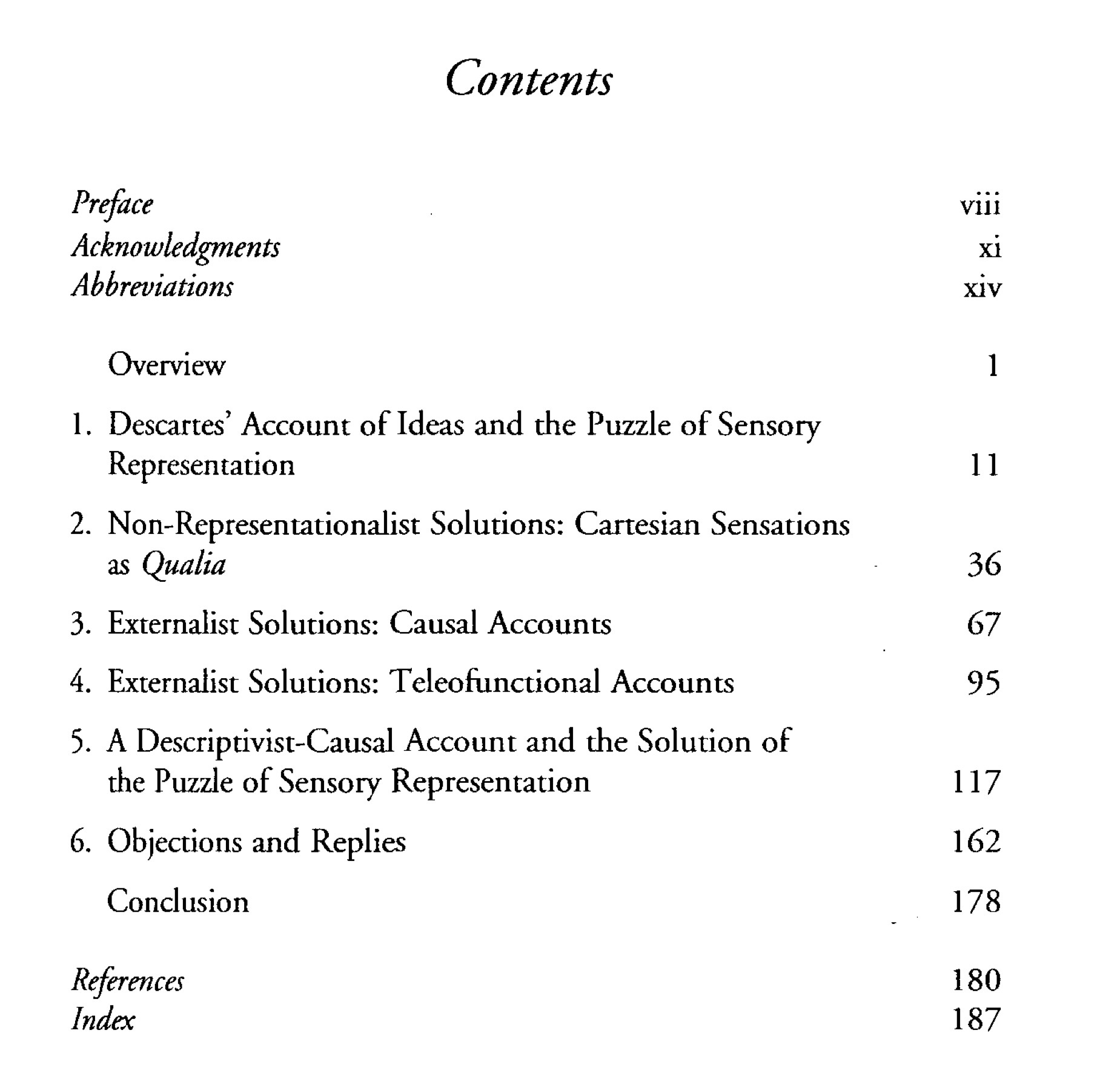
- Read De Rosa’s summer striped application to the National Endowment for the Humanities Division of Research Programs with the Project Title: Descartes’ Theory of Sensory Representation that resulted in her book Descartes and the Puzzle of Sensory Representation.
- Read David L. Clemenson’s (no known photo) Review in Notre Dame Philosophical Reviews, 2010.
- Read Elliot Samuel Paul’s
 and John Ross Morrison’s
  Review in Mind, 2010.
 - Read Kurt Smith’s
 Review in Philosophy in Review XXX (2010), no. 5.
De Rosa, Raffaella  . “Descartes on Sensory Misrepresentation: The Case of Materially False Ideas.” History of Philosophy Quarterly 21, no. 3 (2004): 261–80.
De Rosa, Raffaella . “Material Falsity and Error in Descartes’s Meditations (Review of Wee 2006). Journal of the History of Philosophy 46, no. 4 (2008): 641–42.
De Rosa, Raffaella  . “The Myth of Cartesian Qualia.” Pacific Philosophical Quarterly 88 (2007): 181–207.
Abstract: The standard view of Cartesian sensations (SV) is that they present themselves as purely qualitative features of experience (or qualia). Accordingly, Descartes’ view would be that in perceiving the color red, for example, we are merely experiencing the subjective feel of redness rather than seeming to perceive a property of bodies. In this paper, I establish that the argument and textual evidence offered in support of SV fail to prove that Descartes held this view. Indeed, I will argue that there are textual and theoretical reasons for believing that Descartes held the negation of SV. Qualia aren’t Descartes’ legacy.
De Rosa, Raffaella  . “René Descartes: Sensory Representations.” Oxford Bibliographies. Last reviewed: July 24, 2019. Last modified: July 28, 2015.
De Rosa, Raffaella . “Replies to Vinci and Nelson.” Analytic Philosophy 54, no. 1 (March 2013): 117–28.
Opening paragraphs: In my Replies, I will focus on, and respond to, three main lines of criticisms emerging from both Thomas Vinci’s and Alan Nelson’s commentaries (although, on occasion, I may intersperse these replies with more specific responses to distinct points):
Criticism 1: Color sensations, and the like, are still not representational;
Criticism 2: Even if we concede that the texts discussing material falsity testify that Descartes held that sensations are misrepresentations (and so are representational),1 Descartes’ view in these texts is that ideas of secondary qualities are materially false because they represent a non-thing (i.e., a sensation) as a (material) thing rather than representing material things as resembling a color sensation (which is what I claim);
Criticism 3: The fusion of an intellectual and phenomenal component is crucial to my descriptivist-causal account but raises a host of related worries: don’t qualia end up being constitutive parts of a more complex mental state? How is reference to particular material objects explained? Is the spatial articulation contained in sensory ideas due to the intellect or to the imagination?
Criticisms 1 and 2 are expressed in Vinci’s first three remarks (although Nelson himself, I take it, would be sympathetic to some aspects of these criticisms); and they take issue with two pivotal theses of my book, viz., (i) that Cartesian sensations are representational and (ii) that they are misrepresentational (as Vinci puts it). Although I defend (i) and (ii) extensively in the book (see especially Chapters 1 and 2), Vinci attacks some of the arguments offered in the book and provides additional evidence for his criticism. So, I begin my replies by explaining why, in my view, despite Vinci’s remarks, Cartesian sensations are still misrepresentational.2
1. The texts where Descartes discusses material falsity are Meditation Three and the Fourth Replies. Notice that agreeing that Descartes may have held that sensations are misrepresentations in the above texts is compatible with maintaining that he abandoned this view altogether in later writing such as the Principles. This is in fact Vinci’s view. See Vinci (1998), chapter 7.
2. I would like to clarify that my claim that for Descartes “representation is primarily presentation of an object to the mind in so far as representing something consists of putting the mind in cognitive content with extra-mental reality” (See De Rosa (2010), p. 12) has to be understood in the context of my discussion of ideas of secondary qualities. Descartes classifies the latter among ideas of body (see De Rosa (2010), p. 24). But I do not deny that, for Descartes, we can have ideas about ideas or sensations. Neither do I deny either Wilson’s or Vinci’s claims that the “as if-image” property of ideas, for Descartes, consists in making things (whatever their nature) cognitively accessible. This is clearly indicated, for example, in De Rosa (2010), p. 32 fn 33 (where I define the notion of referential content) and p. 56 (where I claim that presenting an object to the mind is enough to classify a mental state as representative).
De Rosa, Raffaella . “Review of Cecilia Wee’s Material Falsity and Error in Descartes’s Meditations.” Journal of the History of Philosophy 46, no. 4 (2008): 641–42.
De Rosa, Raffaella. “A Teleological Account of Cartesian Sensations?.” Synthese (2007): 311–36.
Abstract: Alison Simmons, in Simmons (1999), argues that Descartes in Meditation Six offered a teleological account of sensory representation. According to Simmons, Descartes’ view is that the biological function of sensations explains both why sensations represent what they do (i.e., their referential content) and why they represent their objects the way they do (i.e., their presentational content). Moreover, Simmons claims that her account has several advantages over other currently available interpretations of Cartesian sensations. In this paper, I argue that Simmons’ teleological account cannot be sustained for both theoretical and textual reasons and that it does not have the advantages it is claimed to have.
Des Chene, Dennis . “Material Falsity.”  Philosophical Fortnights website. June 18, 2005 in History of Philosophy · Metaphysics & Epistemology · Reading Notes
- Read his CV.
Detlefsen, Karen  . Descartes’ Meditations: A Critical Guide , edited by Karen Detlefsen
  . New York: Cambridge University Press, 2013.
- See the Table of Contents with author’s names and paper titles.
- Read Michael Della Rocca’s
 Review, Notre Dame Philosophical Reviews, September 3, 2014.
 - Read Andreea Mihali’s
 Review, Dialogue 4 (2013): 1–3.
Review by Jean-Pascal Anfray
:
This volume presents itself, at least in its title, as a “guide” to the Meditationes and contains a series of articles signed by some of the best specialists in the Anglo-American field. The eleven essays that compose it are distributed in four sections which, without being directly identifiable to the particular Meditations, focus on specific issues emanating from the Cartesian text. Unlike other English-language introductions or guides (see for example the Blackwell Guide published by St. Gaukroger, Malden, 2006, BC XXXVII, 3.1.6; or the Introduction to Meditations of C. Wilson, Cambridge, 2003, BC XXXIV, 3.1.133), he thus focuses, more than on the Cartesian text, on a choice of themes related to it. Mobilizing a research methodology that wants to reconcile a “philosophical” approach and a reading that inserts philosophical works into their cultural and historical environment, this volume is a significant testimony to the philosophical problems that, in the Meditationes, are of most interest to the Anglo-American public. The book is composed of four sections.
(1) In a first section, devoted to skepticism, the article by T. Lennon and M. Hickson (“The Skepticism of the First Meditations”, pp. 9–24) discuss the problem of doubt and its extension. According to the A., the First Meditation meets requirements of rationality that, on the one hand, invalidate the figures of fools and the evil genius, but at the same time make it possible not to invalidate the cogito; from the presupposition (everything to be demonstrated) that the truth of the cogito requires the divine guarantee, they conclude that this knowledge does not fall into doubt, because doubting it would be unreasonable. D. Brown’s essay (“Descartes and content skepticism”, pp. 25–42) examines D.’s relationship with ancient skepticism, arguing that the novelty introduced in the Meditationes would be what the A. calls a “content skepticism”, that is, the invalidation of the very content of our representation in its conditions of possible veracity. This type of skepticism—which the A. identifies in the figure of the deceiving God (a little awkwardly referred to as “demon hypothesis”) and in the thesis of materially false ideas—still leaves room, according to D. Brown, for residual skepticism in the Meditations.
(2) The second section of the volume, focusing on substance and cause, opens with D. Garber’s article on the progressive development of the substance conception of the Meditationes at the Quartae Responsiones (“Descartes against materialists: how Descartes’ confrontation with materialism shaped his metaphysics”, pp. 45–63): A. insists on the role played by Hobbes’ objections for overcoming the ousiology proposed in the Meditationes and in the Secundae Responsiones: it was the IIIae Objectiones that would have pushed D. to develop the theory of the main attribute proposed for the first time in Arnauld. The analysis, precise and subtle, contributes significantly to highlighting an aspect that the critical literature has noticed in recent years: the maturation in progress of Cartesian metaphysics, from the composition of the Meditationes, to the Responsiones to finally reach the formulations of the Principia. Mr. Bolton’s essay (“Thinking: the nature of Descartes’ mental substance”, pp. 64–81) deals with the constitution of the substance, and in particular its relationship with its modes. The problem of the status of the thinking substance as such, that is, its distinction from its particular determinations, is addressed through an examination of the discussions that took place in the 17th century (Arnauld, Malebranche, Leibniz). According to the A., D.’s conception is part of a Neoplatonic matrix diffused in the 17th century, according to which an intrinsically indetermined being in a particular aspect can, under this same aspect, be determined by virtue of certain states he assumes. However, it will be regretted that this solution is proposed without any historical discussion both on Neoplatonism in the classical age and on the relationship between this current and D. The contribution of T. Schmaltz (“Causation and causal axioms”, pp. 82–100) deals with the three axioms on the cause set out in the Rationes more geometrico (AT VII 164-165): the author shows that their application in the Meditationes is subject to variations in relation to the contexts and that the Cartesian conception of causality is modified and clarified in the transition from the Meditationes to the Responsiones (one of the most significant examples is that of the causa sui, conceived in Meditation III under the model of efficiency, and then in the Quartae Responsiones under that of the formal cause).
(3) The third section opens with the article by J. Carriero (“Sensation and knowledge of body in Descartes’ Meditations”, 103–26), which discusses the validity of the thesis attributing to D. an indirect realism about sensitive knowledge: according to Carriero (who develops here lines of reflection from his Between Two Worlds, Princeton, 2008, BC XL, 3.1.32), the Cartesian thesis on the relationship between the ideas of the senses and the objects represented by them would still be marked by a direct realism: on the basis of this interpretation, the direct causal link between things and the ideas of the senses would still be respected, but not in terms of Resemblance between the idea and its cause. The direct link between the idea and material things would not be broken, but conceived from a distance that makes it impossible to interpret the qualities of objects on the basis of the sensitive, obscure and confused ideas that we have of them.
The case of material falsity in relation to the status of the representation is the subject of the article of G. Hatfield (“Descartes on sensory representation, objective reality, and material falsity”, 127–50). According to the A., the resemblance between the idea and its object is the paradigm from which D. thinks the representative status of the idea; the A. then questions the status of materially false ideas: they would not have, according to their own phenomenon, a representative status. But if we admit (as D. does in Dioptrics) that colors depend on the surface of material things that reflect light rays, then, according to Hatfield, we can admit that these ideas are, although in an obscure and confused way, representations of external things. This would make it possible to read more coherently the Cartesian theory of the idea, within which the case of materially false ideas would constitute only a borderline case.
(4) The last section, devoted to the human being, opens with the essay by K. Detlefsen (“Teleology and nature in Descartes’ Sixth Meditation”, 153–75) on the use of teleological arguments in the Sixth Meditation (cf. AT VII, 82–85). From a “conceptual background” concerning the differences between the Platonic and Aristotelian approach to teleological arguments (but again without any reference to the status of this type of argument in the 17th century), the A. proposes to consider the relationship between the mind and the body not according to a hylemorphic model, but from a relationship of satisfaction in which the soul recognizes a value proper and intrinsic to the body. L. Alanen’s essay (“The role of will in Descartes’ account of judgement”, 176–99) focuses on the will and on the relationship between indifference and determination towards the good in the voluntary act: the thesis defended consists in showing that the operation of the will is articulated in two moments: the pursuit of the good and the true fact, in itself, the object of a determination; and it is from this determination that the will is inclined towards the good. The A. concludes his analysis by highlighting the proximity—but also the distance—between the conceptions of D. and Spinoza. In his intervention (“God and meditation in Descartes’ Meditations”, 200–25), J. Secada proposes to show the relationship between the meditative style of the Cartesian work and the knowledge of God, which is one of its main objects. Reading the Meeitations as a “therapeutic manual,” it distances itself from any reading that insists on the formal aspect of the Cartesian argumentation: the validity of the theology of Meditations depends less on a series of arguments than on the contemplation of the idea of God, the real difficulty being in the discovery of this same idea. By considering Cartesian meditation as an “intellectual mysticism” (p. 211), he emphasizes that the meditative trial leads not only to the knowledge of some truths, but also to the highest happiness that can be enjoyed in this life (AT VII 52). The last essay, due to L. Shapiro (“Cartesian selves”, 226–42), proposes to take a closer look at the Cartesian conception of the self. According to the A., although valid, the thesis that makes the Cartesian subject consist of being a substance that thinks proves to be too poor and limited: if we consider that the meditative path contributes in an essential way to the constitution of the self, then, for the understanding of it, we will have to take into account the psychological determinations intrinsically involved in the exercise of meditation. The two main components, required for the ego to meditate well, are, according to Shapiro, the role of memory, which guarantees the unity in time of thought that meditates; the exercise of intellectual virtue that directs the subject towards the search for truth. The integration of these two elements allows, according to the A., a more complex and richer understanding, in which the psychological and personal dimension becomes an essential and constitutive factor of the self.
These studies are, in different capacities, original and well inserted in the context of the Anglo-American debate, of which they represent an important focus. Nevertheless, it seems legitimate to ask, precisely, to what extent the horizon of this context is essential for their understanding, whether it constitutes a merit or a limit: it all depends on what the reader asks of a “critical guide” of Meditations. In any case, it is significant that the bibliography is almost entirely in the English language, except in a few rare cases. The very choice of sections that divide the volume seems to put the interpretative perspective in the foreground in relation to the textual data, but this is a deliberate and conscious choice of the publisher.
Detlefsen, Karen . “Teleology and Natures in Descartes’ Sixth Meditation.” In Descartes’ Meditations: A Critical Guide , edited by Karen Detlefsen , 153–75. New York: Cambridge University Press, 2013.
Dicker, Georges  . Descartes: An Analytical and Historical Introduction
  . Oxford: Oxford University Press, 1993.
Doig, James C.  . “Suarez, Descartes, and the Objective Reality of Ideas.” The New Scholasticism 51, no. 3 (1977): 350–71.
Doney, Willis (no known photo). Descartes: A Collection of Critical Essays  . New York: Random House, 1967.
Downing, Lisa  . “Sensible Qualities and Material Bodies in Descartes and Boyle.” In Primary and Secondary Qualities: The Historical and Ongoing Debate
  , edited by Lawrence Nolan
  , 109–35. Oxford: Oxford University Press, 2011.
Alison Simmons’s overview (2015): Lisa Downing’s fine contribution, “Sensible Qualities and Material Bodies in Descartes and Boyle,” gets at some of the deepest issues in Descartes’s metaphysics and epistemology. She reconstructs three arguments that he might offer in defense of his thesis that our ideas of sensible qualities don’t represent anything in bodies: first, because on inspection it turns out that they don’t represent anything at all; second, because we can’t manage to conceive of how these qualities inhere in bodies; and, third, because we can’t conceive of these qualities as determinations of the essence of bodies. Downing argues that these arguments aren’t sound. Her evaluations are fair, reasonable, and, I think, right, but they aren’t obviously right. I can imagine someone reading her paper and deciding to take up the mantle of Cartesian metaphysics.
Doyle, John  . “Prolegomena to a Study of Extrinsic Denomination in the Work of Francis Suarez.” Vivarium XXII, no. 2, 121–60.

Patricia Easton  . “Decoding Descartes’ ‘myth’ of mind.” In Philosophy of Mind: The Key Thinkers
  . Edited by Andrew Bailey
  . New York: Bloomsbury Academic, 2013, 17–36.
Edberg, Walter  . “The Fifth Meditation.” The Philosophical Review 99 (1990): 493–533.
Eshleman, Matthew C. 
 . “The Cartesian Unconscious.” History of Philosophy Quarterly 24, no. 2 (April 2007): 169–87 or 297–315.

Field, Richard W.  . “Descartes on the Material Falsity of Ideas.” The Philosophical Review 102, no. 3 (July 1993): 309–33.
Filho, Raul Landim 

 . “Descartes: Ideia e Representação: Um caso enigmático: As Ideias Materialmente Falsas Ideia e Representação” [Academia English translation: “Descartes: Idea and Representation: An Enigmatic Case: The Materially False Ideas and Representation“]. Analytica 20, no. 1 (2016): 11–40. Downloadable and copyable version.
Original Portugese Abstract: Os aspectos centrais da noção de ideia cartesiana (operação mental representativa, ser objetivo, realidade objetiva e objeto) parecem ser postos em questão pela noção de ideia materialmente falsa: ideia sensível, obscura e confusa que representa “uma não-coisa como se fosse uma coisa.” Estas ideias seriam falsas representações, pois nada representariam, ou seriam representações equivocadas? Para responder a esta pergunta, o artigo analisa os textos canônicos das Meditações Metafísicas sobre esse tema e as objeções de Arnauld; extrai e interpreta as articulações desse debate e conclui que as ideias sensíveis obscuras e confusas, isto é, as ideias materialmente falsas, têm como conteúdo sensações ou, elas próprias, são sensações. Em razão de serem intencionais, as sensações são consideradas ideias de objetos, mas, em razão da sua natureza, elas não são conformes aos objetos de que são ideias. Portanto, elas têm uma função referencial, mas não seriam representativas de seus objetos.
Published English Abstract: The central aspects of the cartesian notion of idea (representative mental operation, objective being, objective reality, and object) seem to be called into question by the notion of materially false idea: a sensible, obscure and confused idea that represents “a non-thing as a thing.” Would these ideas be false representations, because they would not represent anything, or would they be misrepresentations? In order to answer this question, I analyze the canonical texts of metaphysical meditations on this theme and also the objections of Arnauld. I draw the articulations of this debate and interpret them. I then conclude that obscure and confused sensitive ideas, that is to say, materially false ideas, either have as their content sensations or are themselves sensations. Because they are intentional, sensations are considered as ideas of objects, but, due to their nature, they are not in accordance with the objects of which they are ideas. Therefore, they have a referential function, but they are not representative of their objects. [bold not in original]
Google Translation Abstract: The central aspects of the notion of a Cartesian idea (representative mental operation, objective being, objective reality, and object) seem to be questioned by the notion of materially false idea[s]: a sensible, obscure, and confused idea that represents “a non-thing as if it were a thing.” Are these ideas false representations because they represent nothing, or are they misrepresentations? To answer this question, the article analyzes the canonical texts of the metaphysical meditations on this subject and Arnauld’s objections; it extracts and interprets the articulations of this debate and concludes that the obscure and confused sensible ideas, that is, the materially false ideas, have sensations as their content or are sensations themselves. Because they are intentional, sensations are considered ideas of objects, but due to their nature, they do not conform to the objects of which they are ideas. Therefore, they have a referential function, but would not be representative of their objects. [bold not in original]
Merlin/ChatGPT 4.0 Translation Abstract: The central aspects of the Cartesian idea (representative mental operation, objective being, objective reality, and object) seem to be questioned by the notion of materially false idea: a sensible, obscure, and confused idea that represents “a non-thing as if it were a thing” (represent non-things as things). Would these ideas be false representations, as they would represent nothing, or would they be misrepresentations? To answer this question, the article analyzes the canonical texts of the metaphysical meditations on this subject and Arnauld’s objections; it extracts and interprets the articulations of this debate and concludes that the sensible, obscure, and confused ideas, i.e., the materially false ideas, have sensations as their content or are sensations themselves. Because they are intentional, sensations are considered ideas of objects, but due to their nature, they do not conform to the objects they are ideas of. Therefore, they have a referential function but would not be representative of their objects. [bold not in original]
Filho, Raul Landim . “Ideia, Ser Objetivo e Realidade Objetiva nas “Meditações” de Descartes” [Academia English translation: “Idea, Objective Being and Objective Reality in Descartes’ ‘Meditations’.”] Kriterion: Philosophy Magazine 55 (2014): 669-90.
Filho, Raul Landim . “Idée et Répresentation” [”Idea and Representation”]. In Descartes: Objecter et répondre 

 (1994): 187–203. Another English translation by Google Translate.
Flage, Daniel E. 
 , and Clarence A. Bonnen (no known photo). Ch. 2 “Analysis: the Clarification of Ideas.” In Descartes and Method: A Search for a Method in the Meditations
  , 45–71. London and New York: Routledge, 1999.
Abstract of Ch. 2: If Descartes chooses analysis as his method, then analysis applies equally to all types of inquiry. In the last chapter we discussed how analysis proceeded in the search for natural laws. Since clear and distinct ideas represent the essences of things (AT 7: 78, CSM 2: 54), and since “according to the laws of true logic, we must never ask about the existence of anything until we first understand its essence” (AT 7: 107-8, CSM 2: 78), a clear and distinct idea is prior in the epistemic order to any judgments one might make regarding the existence of a thing of a specific kind. Thus the method of analysis is germane to finding clear and distinct ideas, or, as we shall show, how ideas are clarified.
Table of Contents of book
Part I Descartes’s Method
1. Analysis: The Search for Rules
2. Analysis: The Clarification of Ideas
3. Causation
Part II Descartes’s Meditations on First Philosophy
4. Meditation I: Doubts and Suppositions
5. Meditation II: The Beginning of the Ascent
6. Meditation III: Reaching the Peak, or Variations on the Existence and Idea of God
7. Meditation IV: Truth and Falsity: Reflections from the Summit
8. Meditation V: The Beginning of the Descent
9. Meditation VI: The World Restored
10. Circles
Frankfurt, Harry 

 . Demons, Dreamers and Madmen: the Defense of Reason in Descartes’ Meditations. Indianapolis: Bobbs-Merrill, 1970.
- Read David H(awley). Sanford’s
 (1937–2022)
  Review. The Philosophical Review 82, no. 1 (January, 1973): 120–24.

Garber, Daniel  . Descartes Embodied: Reading Cartesian Philosophy through Cartesian Science
  . Cambridge: Cambridge University Press, 2001.
Garber, Daniel  . Descartes’ Metaphysical Physics
  . Chicago: University of Chicago Press, 1992.
Garber, Daniel . “Descartes and Occasionalism.” In Causation in Early Modern Philosophy: Cartesianism, Occasionalism, and Preestablished Harmony  , edited by Steven Nadler, 9–26. University Park, PA: Pennsylvania State University Press, 1993.
Garber, Daniel  . “Formes et qualités dans les ‘Sixièmes Réponses‘.” In Descartes: Objecter et répondre , edited by Jean-Marie Beyssade , Jean-Luc Marion , and Lia Levy
  , 449-69.
Actes du colloque ‘Objecter et répondre’ organisé par le Centre d’études cartésiennes à la Sorbonne et à l’Ecole normale supérieure du 3 au 6 octobre 1992, à l’occasion du 350 anniversaire de la seconde édition des Meditationes. Paris: Presses Universitaires de France, 1994. [Proceedings of the symposium ‘Objections and Answers’ organized by the Center for Cartesian Studies at the Sorbonne and the Ecole Normale Supérieure from October 3 to 6, 1992, on the occasion of the 350th anniversary of the second edition of the Meditations. Paris: Presses Universitaires de France, 1994.]
Reprinted in English as “Forms and Qualities in the Sixth Replies” in Descartes Embodied: Reading Cartesian Philosophy through Cartesian Science , edited by Daniel Garber  , 257–73. London: Cambridge University Press, 2001.
Garber, Daniel and Michael Richard Ayers , eds. The Cambridge History of Seventeenth-Century Philosophy . Cambridge: Cambridge University Press, 1998.
Garber, Daniel and Stéphane Bornhausen (no known photo). La Physique Métaphysique de Descartes  . Paris: Presses Universitaires de France, 1999.
García, Claudia Lorena  . “Atomism and Substances in Descartes.” Criticism 29, 1997.
García, Claudia Lorena  . “Descartes: las ideas y su falsedad” [“Descartes: Ideas and their Falsity” – translated]. Diánoia 40, no. 40 (1994): 123–42.
García, Claudia Lorena . “Descartes: Ideas and the Mark of the Mental.” Philosophiegeschichte und logische Analyze [History of Philosophy & Logical Analysis] 3, no. 1 (2000): 21–53. Also available at Academia.com.
García, Claudia Lorena  . “Descartes: Innate Ideas, Faculties, and Scholastic Causes.” History of Philosophy and Logical Analysis 3, no. 1 (2000): 21–53. doi:10.30965/26664275-00301004.
García, Claudia Lorena  . “Descartes: La Imaginación El Mundo Físico” [“Descartes: the Imagination and the Physical World” – untranslated]. Diánoia, 41 (1995): 65–82.
García, Claudia Lorena  . “Descartes: La teoría de las ideas y el cambio científico.” en Cuadernos de Filosofía (Universidad de Buenos Aires) 45 (1999): 24–55. [“Descartes: The Theory of Ideas and Scientific Change” – untranslated]. Cuadernos de Filosofía (University of Buenos Aires) 45 (1999): 24–55.]
Garcia, Claudia Lorena . “Descartes y Suárez: sobre la falsedad no judicativa.” Analogía Filosófica 12, no. 2 (1998): 125–50. In Francisco Suarez (1548–1617): Tradição e Modernidade
  , edited by Antonio Martins, 187–206. Lisbon: Philosophy Center of the University of Lisbon, 1999.
García, Claudia Lorena  . “The Falsity of Non-Judgmental Cognitions in Descartes and Suarez.” The Modern Schoolman, 77 (2000): 199–216.
García, Claudia Lorena  . “Ideas innatas, esencias y verdades eternas en Descartes” [“Innate Ideas, Essences and Eternal Truths in Descartes” – untranslated]. Latin American Journal of Philosophy (Argentina) 23, no. 2 (1997): 273–93.
García, Claudia Lorena . “El innatismo de Descartes: esencias y contenidos” [”Descartes’ innatism: essences and contents”]. Diánoia Revista de filosofía (1998): 63–83.
García, Claudia Lorena . “Transparency and Falsity in Descartes’ Theory of Ideas.” International Journal of Philosophical Studies 7, no. 3 (1999): 349–72.
Abstract: Here I develop an interpretation of Descartes’ theory of ideas which differs from the standard reading in that it incorporates a distinction between what an idea appears to represent and what it represents. I argue that this interpretation not only finds support in the texts but also is required to explain a large number of assertions in Descartes which would otherwise appear irremediably obscure or problematic. For example, in my interpretation it is not puzzling that Descartes responds to Arnauld’s difficulty concerning the notion of material falsity by drawing a distinction between that to which an idea conforms (that of which the idea truly is) and that to which it refers. Furthermore, my interpretation also explains how Descartes can intelligibly reject the view that saying that something is clear and distinct is equivalent to saying that it is obvious. Finally, I argue that my interpretation allows Descartes’ view that we have some sort of internal access to the objects actually represented by an idea.
Gaukroger, Stephen ed.  . The Blackwell Guide to Descartes’ Meditations . Malden, MA: Blackwell Publishing, 2006.
Gaukroger, Stephen . Descartes: An Intellectual Biography  . Oxford: Clarendon Press, 1995.
Gaukroger, Stephen , ed. Descartes: Philosophy, Mathematics and Physics  . Sussex: Harvester, 1980.
Gaukroger, Stephen . Descartes’ System of Natural Philosophy  . Cambridge, UK: Cambridge Univversity Press, 2002.
- Read Ed Slowik’s Review, Notre Dame Philosophical Reviews, September 1, 2002.
- Read Margaret J. Osler’s Review, Journal of the History of Philosophy 41, no. 4, October 2003, 558–59.
Gaukroger, Stephen. “Introduction: the Background to the Problem of Perceptual Cognition.” In Antoine Arnauld: On True and False Ideas, translated by Stephen Gaukroger , 1–41. Manchester, UK: Manchester Press, 1990.
Gaukroger, Stephen , John A. Schuster, and John Sutton (eds.). Descartes’ Natural Philosophy  . New York: Routledge, 2000.
Gaukroger, Stephen , and Catherine Wilson (eds.). Descartes and Cartesianism: Essays in Honour of Desmond Clarke  . Oxford: Oxford University Press, 2017.
- See a preview at Google books.
- Download at Academia.edu.
- Read a Review by Marcy P. Lascano

 . Notre Dame Philosophical Reviews, September 22, 2017.
Gewirth, Alan 
 . “Clearness and Distinctness in Descartes.” Philosophy 18, no. 69 (April 1943): 17–36. Published online by Cambridge University Texts, 2009.
Gilson, Etienne 

 . Etudes Sur le Role de la Pensees Medievale dans la Formation du Systeme Cartesien. Paris: J. Vrin, 1930.
- See especially p. 32ff below on some of the Scholastic origins relating to Descartes’s philosophy.1 The footnotes have been renumbered from the original articles in the running numerical order. The Merlin with ChatGPT translation begins at the top of page thirty-two.
32 MEDIEVAL SOURCES OF SOME CARTESIAN DOCTRINES:
to recognize that it does not hold its existence from itself and that it is not sufficient for its own perfection, and that no creature, for that matter, is self-sufficient. Far from being self-sufficient, since man, who is superior to them, nevertheless finds himself imperfect in his degree, recognizing himself as weak and frail in the knowledge of truth as in the love of good. Hence, man easily persuades himself that he needs some higher nature from which he draws his origin and by which he is ruled and governed. Considered from this aspect, the knowledge of God presents itself even to the common people with a certain practical and moral evidence, sufficient to oblige him not only to give his assent to this truth: that God is, but also to render worship to Him. And this at the same time allows us to understand what we read among the doctors of an innate knowledge that we would have of God’s existence.1
Undoubtedly, it would reasonably be contested that we are dealing here with a declared innatism; nonetheless, in Suarez’s doctrine, we have a more flexible and conciliatory conception of the sources of our belief in God than that of St. Thomas. The way is open to accommodations, and the breach is made; all innatism will pass through.
Indeed, multiple causes seem to have contributed to determining in the early years of the 17th century a revival of Platonic innatism. It is quite true that even within Aristotelian scholasticism and, as we have just seen, in the philosophy and theology of the Jesuits in particular, a movement had long been taking shape in this direction. To seek with some historians2 the immediate origin of Platonism and Augustinism, which will receive their full development after 1650, would be to exaggerate its importance; however, it has rightly been noted that it is one of the precursors of signs. Thereby,
FOOTNOTE 1. “There are many things that immediately incline to assenting to that truth; many, I say, not only metaphysical or physical but also moral; and not only external but also internal. For if man reflects upon himself, he recognizes that he is not from himself, nor sufficient for his own perfection… Whence, with the easiest business, man persuades himself that he needs a higher nature from which he draws his origin and by which he is ruled and governed… Hence, this knowledge seems mainly to have been through human faith, especially among the common people, rather than through evidentness of the thing; nevertheless, it seems to have been with a certain practical and moral evidence, which could suffice to oblige assent to this truth, that God exists, as well as to worship Him. And according to this, everything that is said by the Doctors about the naturally incited knowledge of God is easily understood.” (Suarez, Metaphysical Disputations, 29, 3, 36)
FOOTNOTE 2. Lechner, p. 533.
[Page 33]: The Augustinianism of the Oratory, as it will manifest in Thomas, in du Harnel, and Malebranche, is announced; but before reaching this point, Platonism and innate ideas will have traversed the Meditations.
Thus, Descartes may have been influenced, from his stay at La Flèche, by a current of ideas favorable to innatism. However, it is difficult to think that the philosopher did not encounter this doctrine a few years later, and perhaps even as soon as he left college, in an explicit form, self-aware, and claiming either to complete the Thomistic doctrine of knowledge or even to replace it. This second attitude seems to have been that of moralists who, since the beginning of the 17th century, were working to revitalize Stoicism by Christianizing it. It is known that Descartes was acquainted with their doctrine and was strongly influenced by it; this is decisively attested to by his correspondence with Princess Elizabeth.3 But how not to believe that he encountered in someone like Justus Lipsius, for example, the doctrine of innate ideas that Stoicism brought with it? Could this morality not have contributed to introducing into Descartes’ mind a doctrine that presented itself as being in close connection with it? Certain details of terminology would invite such a thought; but this innatism, which he encountered among Stoics, albeit Christianized, he could also encounter in Catholicism, among orthodox theologians who were not without authority. Let us go further: Descartes could not fail to encounter the doctrine of innate ideas at every turn, so abundantly did it germinate around him, in the philosophical and theological environment where we find him around the year 1628.
Among the first theologians won over to this doctrine whom Descartes frequented, we must count Cardinal de Bérulle, founder of the Oratory, and his disciple Father Gibieuf. It is well known what close relations Descartes maintained with them for some time4; it is hard to believe that the spiritual director of the young philosopher did not make some efforts to incline his penitent’s thoughts towards a doctrine dear to his heart. De Bérulle was a Platonist5; not merely in an indirect manner and by a few accidental reflections, but all the more; so
FOOTNOTE 3. Cf. F. Strowski, Pascal and His Times, I, p. 113–20 (3rd ed. 1909).
FOOTNOTE 4. We allow ourselves to refer to our work: The Freedom in Descartes and Theology, Part I, ch. iv.
FOOTNOTE 5. Ibid. Studies on Medieval Thought.
[Page 34]: More resolutely, perhaps, than he was spontaneously and instinctively. Yet, one could not be a Platonist without holding the doctrine of innate ideas to be true. Descartes may have been reminded by his spiritual director that the grace of God has willed us to be happier than Plato and his disciples, since we are “raised in a better school, taught a higher philosophy, enlightened by a far more luminous Sun and endowed by it with an infused light that is supernatural and divine.”6 The profession of Christianity, as Bérulle conceived it, “is an art of painting, which teaches us to paint, but within ourselves and not on an external canvas; and to paint a single object there.” This object is none other than the sun of the intelligible world, Jesus Christ, and there is no need for us to go outside of ourselves to form its image: “we must spend our lives in this beautiful and noble exercise, in which we express and form within ourselves him whom the eternal Father expressed within himself and expressed to the world and in the womb of the Virgin by the new mystery of the Incarnation. And in this noble and divine exercise, our soul is the worker, our heart the canvas, our mind the brush, and our affections the colors that should be used in this divine art, and in this excellent painting.”7 Better yet, it is Jesus himself who will come to paint himself in us; who, having descended into us, will rise in our soul to the remembrance of himself: “for entering the world to save the world and dying for our offenses, he wished to unite himself to human nature. . . And he now rises and addresses his Father God in this memorable prayer, asking to be established in the usage, exercise, and possession of the splendor and clarity due to him, and of which he has the principle in himself, divinely and personally united to his humanity. Just as the reasonable soul, if it existed before the body, according to the opinion of the Platonists, being infused into the body of the little child, which has the life of the soul, and not the light of the soul; and being obscured in its intellectual light, and as if buried within infancy, and stripped for a time of this light and knowledge of its state, it would undoubtedly rise to its author who infused it into this body, and would ask to be fully established in the usage, exercise, and actuality of its knowledge and of its own light due to its essence.”8
FOOTNOTE 6. De Bérulle, Complete Works (Migne, Paris, 1856), col. 284.
FOOTNOTE 7. Ibid., col. 287.
FOOTNOTE 8. Ibid., col. 105. (Click on the footnote number to see the Merlin with ChatGPT 4.0 translation from the original French into English.)
Gorham, Geoffrey 


 . “Descartes on the Innateness of All Ideas.” Canadian Journal of Philosophy 32, no. 3 (2002): 355–88.
Graham, Claire (no known photo). “Descartes’ Imagination: Unifying Mind and Body in Sensory Representation.” PhD diss., Durham: Durham University, 2013. Available at CORE – Aggregating the World’s Open Access Research Papers. Also downloadable.
Greenberg, Sean 

 . “Descartes on the Passions: Function, Representation and Motivation.” Noûs 41 no. 4 (2007): 714–34.
Alison Simmon’s overview (2011): Challenges the (relatively new) assumption that Cartesian passions are representational states, arguing that Descartes conceives of them as motivational states, arguing that while the passions do respond to representations, they function to focus the attention of the mind on thing represented by the senses and to motivate choice and action.
Grene, Marjorie . Descartes.  Brighton, Sussex, UK: The Harvester Press, 1985.
- Read Jonathan Westphal’s scathing Review in Mind 97, no. 385 (January 1988): 133–34.
Grene, Marjorie 
 . Descartes Among the Scholastics (Aquinas Lecture)
  . Milwaukee: Marquette University Press, 1991.
Gueroult, Martial 
 . Descartes jjnhselon L’Ordre des Raisons. Vol 1: The Soul and God (first five Meditations) (1952) and Vol. 2: The Soul and Body (Sixth Meditation) (1968). Paris: Aubier, 1952 & 1968. Translated by Roger Ariew as Descartes’ Philosophy Interpreted According to the Order of Reasons, Vol. 1: The Soul and God and Descartes’ Philosophy Interpreted According to the Order of Reasons, Vol. 2: The Soul and the Body. Minneapolis, MN: University of Minnesota Press, 1984.
- Read John Cottingham’s . “Review of Vol I.,” Analytic Philosophy 26, no. 3 (July 1985): 140–43.
- Read Donald Sievert’s
 “Review of Vol. I.,” Teaching Philosophy 9, no. 1 (March 1986): 81–84.

Haag, Johannes 
 . “Sinnliche Ideen. Descartes über sinnliche und begriffliche Aspekte der Wahrnehmung.” In Sehen und Begreifen: Wahrnehmungstheorien in der frühen Neuzeit
  , edited by Dominik Perler
  and Markus Wild
  , 95–121. Berlin: de Gruyter, 2007.
Hamelin, Octave  (1856–1907). Le Système de Descartes
  2nd edition. Paris: F. Alcan, 1921.


Le Système de Descartes
- Readable and downloadable Spanish edition of El Sistema de Descartes from Dokumen.
- For remarks on the Scholastic origins of the objective reality of ideas, see especially pp. 186ff below.

Translated by Merlin with ChatGPT 4.0: . . . it seems that adventitious ideas are powerless, which leads Descartes to turn to innate ideas. Secondly, when he turns to innate ideas, he once again combats sensible realism, recognizing that such realism cannot be justified by [the] natural light. We must keep this second point in mind.
Descartes thus embarks on a new path. He explicitly indicates this with a characteristic transition whose importance cannot be overstated: “But another way presents itself to investigate whether among the things of which I have ideas in me, there are any that exist outside of me” (C. 272 [405] [G §10]). This new path is no longer that of adventitious ideas, nor, undoubtedly, of realism. There are two types of reality to distinguish in the idea as an idea. First, the idea is a mode of thinking, a fact of thought, an exercise of our faculty of thinking. As such, as a fact, it has a formal or actual reality, for act or fact, it’s the same thing. Secondly, the idea represents or is supposed to represent an object, and this act of conceiving which is the idea is at the same time the conception of something; in other words, the idea has content. This content is, in its way, something real. Insofar as the idea contains it, it has an objective reality. Descartes borrows these terms precisely from the School and they are very clear. The objective reality of the idea is certainly in the representative if one admits that the representative is the container of the representation; but it is in the representative what it contains, and thus it is opposite to the subject and on the side of the object: which makes it very aptly named objective. The objective reality of ideas, Descartes continues, is not the same in all ideas, but each idea has its proper degree of objective reality. The richer the content of the idea is in terms of the number or importance of characteristics, the more the idea has objective reality, and notably, among ideas, those that represent substances to me are undoubtedly something more, and contain in themselves, so to speak, more objective reality, that is, they participate by representation in more degrees of being or perfection than those that represent only modes or accidents. (C. 272 [4012] [G. §10]). We must not let this comparison and this union under the same genus with a simple difference of degree, of substantial reality and the reality of attributes or qualities pass unnoticed—it is the prelude to the ontological proof.
Each idea has a formal reality and a certain degree of objective reality. The formal reality of the idea wants to be explained, and we explain it by saying that we ourselves are the cause of it as we exercise our faculty of thinking. But the objective reality also requires an explanation; for, “imperfect as this manner of being by which a thing is objectively or by representation in the intellect through its idea may be, it cannot be said nevertheless that this manner and way of being is nothing, nor consequently that this idea takes its origin from nothing.” (C. 274 seq. [4116] [G. S 14]).
Now, what must a cause or reason be to be explanatory? This is what [the] natural light teaches us: or, in other words, it is what we can discern from the consideration of one of these pure and simple ideas, one of those simple natures that doubt does not touch, from the consideration of the idea of the cause: “ . . . and it is manifest through natural light that there must be at least as much reality in the efficient and total cause as in its effect: for where can the effect draw its reality from if not from its cause; and how could this cause communicate it to him if it did not have it in itself? And from there it follows not only . . .
Hanson, John Arndt 
 . “Descartes on Representation, Presentation, and the Real Natures.” PhD diss in Philosophy, Program in History and Philosophy of Science, University of Notre Dame, December 2021.
Author’s Abstract: This dissertation concerns two controversial aspects of Descartes’ philosophy. The first is the meaning of the distinction between the material and objective senses of the word “idea.” The second is an alleged tension between the Fifth Meditation’s claim that the real natures are mind-independent and the claim of the Principles that universals are mind-dependent.
In the first chapter, I take up the material sense, and argue against those interpretations which see it as a category for the contentless ontology of ideas. I argue that the textual evidence points to the material sense being Descartes’ category for phenomenological description of how things seem to be to a given mind when it has a given idea. In particular, I argue that he deploys the material sense in his discussions of abstractions and that this points to the material sense being a category for content that lacks existential implication for the extramental world.
In the second chapter, I take up the ontology of the real natures, and suggest that there is no tension between the Fifth Meditation and the Principles because Descartes accepts two things under the term “nature,” namely, universals and individual essences. I suggest Descartes is committed to Platonism about individual essences in the Fifth Meditation, and that in the Principles he is concerned only with universals, about which he is a conceptualist. I further suggest that individual essences play key roles in both singular and universal thought.
In the third chapter, I take up the objective sense, and the widespread interpretation of this sense of ideas as concerning current presentational or phenomenological content. I suggest that this account struggles with cases where there is stability in the object of thought paired with changes in the associated phenomenology. I propose that we ought to reject a straightforward equation of the objective sense with current presentational content, and instead adopt a scheme according to which what has objective being in an idea is the sum total of thinkable, essential features of the object, and that when an idea is clear and distinct, what we perceive has objective being in the idea. [bold and bold italic not in original]
Harrison, Peter  . “Descartes on Animals.” Philosophical Quarterly 42 (1992): 291–327.
Hatfield, Gary Carl  . “The Cognitive Faculties.” In The Cambridge History of Seventeenth-Century Philosophy , edited by Daniel Garber
  and Michael Ayers , 953–1002. Cambridge: Cambridge University Press, 1998.
Hatfield, Gary Carl . Ch. 14: “Descartes.” In The Cambridge History of French Thought. Edited by Michael Moriarty  and Jeremy Jennings
  . Cambridge: Cambridge University Press (2019): 124–34.
Hatfield, Gary  . Descartes and the Meditations
  . New York: Routledge, 2003.
- Read his CV through 2016.
- See his publications, talks, and lectures (since 2004).
- See Hatfield’s Home Page.
Hatfield, Gary  . “Descartes’ Naturalism About the Mental.” In Descartes’ Natural Philosophy
  , edited by Stephen Gaukroger , John A. Schuster
  , and John Sutton
  , 630–58. New York: Routledge, 2000.
Hatfield, Gary . “Descartes: New Thoughts on the Senses.” British Journal for the History of Philosophy 25, no. 3 (2016): 443–64.
ABSTRACT: Descartes analysed the mind into various faculties or powers, including pure intellect, imagination, senses, and will. This article focuses on his account of the sensory power, in relation to its Aristotelian background. Descartes accepted from the Aristotelians that the senses serve to preserve the body by detecting benefits and harms. He rejected the scholastic Aristotelian sensory ontology of resembling species, or ‘forms without matter’. For the visual sense, Descartes offered a mechanistic ontology and a partially mechanized account of sensory processes, including some previously ascribed to judgement. He did this in the context of his theory of brain signs that prompt sensations. The article contends that Descartes’s use of the sign-relation was modelled on standard discussions of non-resembling signs in commentaries on Aristotle’s De interpretatione. It follows three uses of the sign-relation: brain states that cause colour sensations; brain states that cause experiences of spatialized contents, such as shapes; and brain states that realize a ‘natural geometry’. It argues that Descartes’s natural geometry does not involve mental operations but physiological mechanisms that co-vary with the distance to seen objects. While retaining the language of sensory powers, Descartes offered a partial mechanization of those powers.
Hatfield, Gary  . “Descartes’ Physiology and its Relation to his Psychology.” In The Cambridge Companion to Descartes , edited by John Cottingham . Cambridge: Cambridge University Press (1992): 335–70.
Hatfield, Gary  . “Descartes on Sensory Representation, Objective Reality, and Material Falsity.” In Descartes’ Meditations: A Critical Guide , edited by Karen Detlefsen .Cambridge University Press: February 5, 2013.
Abstract: This chapter considers Descartes’ systematic doctrines on the nature of the mind and its ideas. It combines Descartes’ statements on sensation and perception for hints about how to apply such principles. Outside the Meditations and Principles, Descartes discusses the anatomy, physiology, and mental operation of the senses in the Dioptrics and Passions. Descartes further develops the notion of ideas as images by explaining that differences in the objective reality of ideas amount to differences in what those ideas represent. The author favors an interpretation in which, for Descartes, all sensory ideas represent by resemblance, different kinds of sensory ideas vary in cognitive value, externalization arises through spatial localization, and, with sensory ideas of color and the like, as materially false they do not intrinsically misrepresent but afford occasion for false judgments, which arise as merely apparent, and so not actually legitimate, teachings of nature.
Hatfield, Gary . “Did Descartes Have a Jamesian Theory of the Emotions?.” Philosophical Psychology 20 (2007): 413–40.
Hatfield, Gary . “L’Homme in Psychology and Neuroscience.” In Descartes’ Treatise on Man and Its Reception  , edited by Stephen Gaukroger and Delphine Antoine-Mahut
  . New York: Springer (2016): 269–85.
Hatfield, Gary Carl . “First Philosophy and Natural Philosophy in Descartes*.” In Philosophy, Its History and Historiography, edited by A(lan). J(ohn). Holland (no known photo), 149–64. Dordrecht: D. Reidel Publishing, 1985.
Opening two paragraphs: Descartes was both metaphysician and natural philosopher. He used his metaphysics (among other things) to ground portions of his physics (or natural philosophy, or science of nature). However, as should be a commonplace but is not, he did not think he could spin all of his physics out of his metaphysics a priori, and in fact he both emphasized the need for appeals to experience in his methodological remarks on philosophizing about nature and constantly appealed to experience in describing his own philosophy of nature. It remains unclear exactly what he took to be amenable to empirical support, and how his appeal to experience was squared with his notorious demand for absolute certainty in matters philosophical.
It is illuminating to consider Descartes’ exploits in physics and metaphysics against the background of scholastic Aristotelianism. By focusing on what was novel in Descartes from this perspective, there emerges a different than usual picture of his work and its significance. For, while it may be that to the present-day philosophical mind the most troublesome and perplexing side of Descartes’ dualistic ontology is the purported existence of a special mind-stuff, when Descartes first proposed his division of creation into mind and matter, the most troublesome claim for his scholastic audience would have been the conception of matter as a substance whose sole essence is extension. Descartes not only promoted the existence of such a substance, but he contended that all of nature is nothing but passive, inert, extended substance, thus denying in one fell swoop the scholastic Aristotelian conception of nature as populated with active principles and substantial forms. This radical rejection of the scholastic ontology not only embodied a substantively new conception of nature; it carried with it a new conception of the relationship among the three traditional branches of theoretical philosophy—physics, mathematics, and metaphysics—as well as a new ideal of ‘scientific’ reasoning about natural things.
Hatfield, Gary . “Mental Acts and Mechanistic Psychology in Descartes’ Passions.” In Descartes and the Modern  , edited by Neil Robertson
  , Gordon McOuat
  , and Tom C. Vinci . Newcastle upon Tyne: Cambridge Scholars Publishing (2007): 49–71.
Abstract: This chapter examines the mechanistic psychology of Descartes in the Passions, while also drawing on the Treatise on Man. It develops the idea of a Cartesian “psychology” that relies on purely bodily mechanisms by showing that he explained some behaviorally appropriate responses through bodily mechanisms alone and that he envisioned the tailoring of such responses to environmental circumstances through a purely corporeal “memory.” An animal’s adjustment of behavior as caused by recurring patterns of sensory stimulation falls under the notion of “learning,” behavioristically conceived. Indeed, Descartes’s animal-machine hypothesis may well be a distant ancestor to Watsonian behaviorism, via T. H. Huxley (1884). The final two sections of the chapter take stock of what psychological capacities Descartes ascribed to mind, body, or both, and consider those capacities that we might now plausibly construe as being explicable by nonmentalistic mechanisms as opposed to those that at present remain unreducedly mentalistic. This chapter derives from a lecture delivered at the University of King’s College (Halifax, Nova Scotia) as part of a year-long series on Descartes and the Modern. The lecture series was co-sponsored by the programs in History of Science and Early Modern and Contemporary Studies.
Hatfield, Gary . “The Passions of the Soul and Descartes’s Machine Psychology.” Studies in History and Philosophy of Science Part A 38, no. 1 (2007): 1–35.
Hatfield, Gary Carl . “Rationalist theories of sense perception and mind-body relation.” In A Companion to Rationalism (Blackwell Companions to Philosophy)  , edited by Alan Nelson
  . Blackwell Publishing (2005): 31–60.
Abstract: This chapter compares rationalist theories of sense perception to previously held theories of perception (especially of vision) and examines rationalist accounts of sensory qualities and sensory representation, of the role of the sense-based passions in guiding behavior, of the epistemological benefits and dangers of sense perception, and of mind–body relations. Each section begins with Descartes, the first major rationalist of the seventeenth century. The other major rationalists, Malebranche, Spinoza, and Leibniz, and also lesser known figures such as Pierre Regis, Jacques Rohault, and Antoine Le Grand, were well acquainted with Descartes’ work. Indeed, the first three were each deeply influenced by Descartes in their early years before developing their own philosophical systems, and the latter three were all advocates of Descartes’ philosophy (perhaps with slight revision). Each of the major rationalists, while sharing some positions in common, developed a distinctive metaphysics of perception and of the mind–body relation. Earlier sections chart these differences and a final section sums up common features and touches on the continuing significance of their views.
Hatfield, Gary Carl  “René Descartes.” In The Blackwell Guide to the Modern Philosophers—From Descartes to Nietzsche
  , edited by Steven M. Emmanuel. Malden, Mass.: Wiley-Blackwell (1991): 1-27.
Summary: Descartes is the most notorious of modern philosophers. His philosophical teachings have been so influential that they cannot be avoided, whether one agrees with them or not. The extreme skeptical doubt brought on by the “evil deceiver” can seem easy to dismiss, or hard to shake. Descartes’s way out of this skepticism, through the famous phrase “I think, therefore I am,” finds many uses in one-line humor. It seems funny that anyone would need to prove that they exist – especially to themselves. His theory that mind and body are independent substances, which is known as “mind-body dualism,” has provoked the greatest philosophical response. Few now accept the philosophical theory that mind is a substance independent of body. But Descartes is still much invoked in the philosophy of mind, as hero or villain, by those who admire or disparage his realism about the mental. Some blame him for many modern ills, contending that his dualism caused thinkers to devalue the body and emotions. Others find cause to celebrate his high achievements in mathematics, natural philosophy (or natural science), and metaphysics.
Hatfield, Gary . “Rethinking Descartes on the Senses.” Presentation talk at the 2014 South Central Seminar in Early Modern Philosophy.
Abstract: Since the time of Berkeley, a predominant interpretation of Descartes’ theory of vision is that it begins with a bare sensation in two-dimensions, with the third dimension being inferred by unnoticed or habitual processes of reasoning. There have been various challenges to this view, including my own recent argument that, in the Treatise on Man, Descartes developed a sophisticated account of a physiological mechanism to “compute” the results of what he terms “natural geometry.” Accordingly, the triangle of convergence (involving the two eyes focused on a distant point) does not involve mental computation but physiomechanical computation. Without attributing representations to the bodily states, he treats them as informational in a Gibsonian sense: certain bodily states are correlated with distal states of affairs, and they produce in the mind a representation of that state of affairs-in this case, of a location in space at a distance. Thus, in at least some cases, depth and distance are phenomenally immediate sensory representations and not the product of mental inference. In this talk, I will extend this sort of account to other areas of Descartes’ theory of visual perception, including the perception of colors in bodies and of the potential benefits and harms of external objects. Drawing on the Treatise and the Passions, I will suggest that Descartes envisioned, in these cases, brain states that correlate with external states of affairs such as physical color in bodies and potentially beneficial or harmful properties of bodies, and that these brain states then cause mental representations of surface colors, things that are edible, dangerous animals, and the like.
Hatfield, Gary . Routledge Philosophy Guidebook to Descartes and the Meditations  . New York: Routledge, 2014.
Hatfield, Gary . “Transparency of the Mind: The Contributions of Descartes, Leibniz, and Berkeley to the Genesis of the Modern Subject.” In Departure for Modern Europe: A Handbook of Early Modern Philosophy (1400–1700)  , edited by Hubertus Busche
  , 361–75. Hamburg: Felix Meiner Verlag, 2001. Also readable at Academia.com.
Abstract: The chapter focuses on attributions of the transparency of thought to early modern figures, most notably Descartes. Many recent philosophers assume that Descartes believed the mind to be “transparent”: since all mental states are conscious, we are therefore aware of them all, and indeed incorrigibly know them all. Descartes, and Berkeley too, do make statements that seem to endorse both aspects of the transparency theses (awareness of all mental states; incorrigibility). However, they also make systematic theoretical statements that directly countenance “unnoticed” thoughts or mental states, that is, thoughts or mental states of which the subject is unaware and has no knowledge.
Descartes, having identified the essence of mind with thought or representation, distinguishes bare states of mind from states of which we have reflective awareness, thereby providing a theoretical tool for understanding both his seeming endorsement of transparency and his actual denial of it: Descartes distinguished between a basic perceptual state, or a basic awareness, and reflectively conscious states that involve explicit noticing and cognizing on the part of the subject.
Leibniz (as is better known) directly endorsed a similar distinction between bare perception and reflective consciousness, using the term “perception” for the first and “apperception” for the second. In these cases, bare perceptions are not transparently available to the subject, and so in fact the subject does not have knowledge, hence does not have incorrigible knowledge, of all its occurrent mental states. This chapter gives evidence to support these claims; elaborates the complex psychology of the subject found in Descartes and other early moderns; and notes some ways in which these early moderns contributed to the genesis of the modern subject.
Finally, it compares McDowell’s conception of the Cartesian mind with the conceptions of mind found in the writings of Descartes, Berkeley, and Leibniz, finding that his characterization caricatures the positions of early modern philosophers. McDowell’s characterization has four elements: consciousness as essence of mind; intentionality as exclusively mental; the veil of perception; and the transparency of mind. Only the second point, about intentionality, fully fits Descartes. As a consequence of his own misdirection, McDowell misses the actual basis of his difficulty in connecting mind with world, which arises from a point of agreement between him and Descartes: the removal of intentionality from material sensory systems. But whereas Descartes could relocate (nonconceptual) sensory intentionality in mental states, McDowell is left to account for it with his overly cognitivized scheme of perceptual content as exclusively conceptual. (Paper first given at the European Society for Early Modern Philosophy, 2007.)
Hausman, David  and Alan Hausman (no known photo). Descartes’s Legacy: Mind and Meaning in Early Modern Philosophy
  . Toronto: University of Toronto Press, 1997. Also available at Internet Archive
  .
.
Hausman, David and Alan Hausman (no known photo). “Descartes’s Secular Semantics.” Canadian Journal of Philosophy 22, no. 1, March, 1992, 81–104.
Heller, Mark  . “Painted Mules and the Cartesian Circle.” Canadian Journal of Philosophy, 26, no. 1 (1996): 29–55.
Hennig, Boris  . “Cartesian Conscientia.” British Journal for the History of Philosophy 15, no. 3 (2007): 455–84. Also readable here.
Hennig, Boris  . “Conscientia bei Descartes.” Zeitschrift für philosophische Forschung 60, no. 1 (Jan.–Mar., 2006): 21–36.
Hennig, Boris  . “‘Insofar as’ in Descartes’ Definition of Thought.” Studia Leibnitiana 43, no. 2 (2011): 145–59. Read the Abstract in English.
Hight, Marc A.  . Idea and Ontology. An Essay in Early Modern Metaphysics of Ideas
  . University Park, The Pennsylvania State University Press, 2008.
- See the Table of Contents with opening paragraphs.
- Especially see Ch. 2 “Descartes” pp. 37–54 whose opening is shown below:
“Conventional wisdom, like the early modern tale, holds René Descartes responsible for effecting a revolutionary break from the Scholastic tradition, particularly in the theory of ideas. Although he applied the term “idea” in a new way and built an innovative mechanistic theory of perception that capitalizes on this new use, it is not at all obvious that Descartes advanced a new and clear theory of the ontological status of ideas. We are, in the main, still in familiar conceptual territory. He tells Hobbes in the Third Replies that “I used the word ‘idea’ because it was the standard philosophical term . . . “
Hoffman, Paul David  . “Cartesian Passions and Cartesian Dualism.” Pacific Philosophical Quarterly 71, no. 4 (December 1990): 310–33.
Hoffman, Paul  . “Descartes.” In A Companion to the Philosophy of Action, Chapter 59, edited by Timothy O’Connor and Constantine Sandis. Oxford: Blackwell Publishing (2010): 481–89.
Hoffman, Paul  . “Descartes on Misrepresentation.” Journal of the History of Philosophy 34, no. 3 (July 1996): 357–81. Also downloadable from
  .
.
Abstract: I examine Descartes’s theory of cognition, taking as a starting point his account of how misperception is possible. In the Third Meditation Descartes introduces the hypothesis that there are ideas (such as the idea of cold) which seem to be of something real but which in fact represent nothing (if, for example, cold is a privation or absence of heat, rather than the presence of a positive quality). I argue, against Margaret Wilson, that Descartes does not think there are any such ideas and that he introduces the hypothesis only in order to formulate an objection to his argument for the existence of God. I argue further that while he agrees with Arnauld in accepting the Aristotelian account of cognition according to which the very objects in the world that we perceive exist in the soul or its ideas objectively, he still has a satisfactory response to Arnauld’s objection that since an idea can represent only what it appears to be of, all error must reside solely in our judgment. I claim that Arnauld’s objection that an idea represents what it appears to be of is based on the assumption that an idea appears to be of what exists in it objectively. But Descartes makes room for the possibility of misrepresentation by distinguishing between what exists objectively in an idea and what that idea appears to be of. First, he thinks that it is at least coherent to suppose that an idea lacking objective reality could appear to be of something in virtue of its material reality. Since an idea lacking objective reality would not represent any thing that exists in the world, Descartes concedes that it would not misrepresent any actually existing thing, but it could still appear to be of some thing and in that way misrepresent the way the world is. Second, there is reason to claim that like some of his Aristotelian predecessors Descartes holds that what exists in the soul objectively can appear to be other than it is. This interpretation has the implication that Descartes’s theory of ideas, in contrast to sense datum theories, is not driven by the motive of finding some entity which is exactly as it appears to serve as the object of immediate awareness
Hoffman, Paul . “Direct Realism, Intentionality and the Objective Being of Ideas.” Pacific Philosophical Quarterly, 83 (2002): 163–79. Also downloadable from .
Hoffman, Paul. . Essays on Descartes  . New York: Oxford University Press, 2009. Also downloadable from .
- Read Amy Morgan Schmitter’s
 Review. Norte Dame Philosophical Reviews, September 25, 2009.
 - See Marleen Rozemond’s
 Review. The Philosophical Review 122, no. 1 (January 2013): 122–25.
Hoffman, Paul . “The Passions and Freedom of the Will.” In Essays on Descartes, (Oxford: Oxford University Press, 2009), 210–36. Also published in Passion and Virtue in Descartes , edited by Byron Williston and André Gombay , 261–99. New York: Humanity Books, 2003.
Hoffman, Paul . “St. Thomas Aquinas on the Halfway State of Sensible Being.” The Philosophical Review XCIX, 1, 73–92, 1990.
Hoffman, Paul . “Three Dualist Theories of the Passions.” Philosophical Topics 19, no. 1 (Spring 1991): 153–201. An excerpt of just the Descartes part of this paper is in Hoffman’s collection, Essays on Descartes . New York: Oxford University Press (2009): 179–95.
- Also downloadable from .
Hoffman, Paul  . “The Unity of Descartes’s Man.” Philosophical Review 95, no. 3 (1986): 339–70.
Holbrook, Daniel (no known photo). “Descartes on Mind-Body Interaction.” Southwest Philosophical Studies 14 (1992): 74–83.
Hooker, Michael Kenneth (1945–1999)  ed. Descartes: Critical and Interpretive Essays
  . Baltimore: Johns Hopkins University Press, 1978.
Huemer, Michael  . “On Objective Being in the Intellect.” Unpublished graduate seminar paper, Rutgers University, 1996.
ChatGPT 4o Summary: Michael Huemer, in his paper “Descartes: Objective Being,” explores Descartes’s concept of ideas as they exist in the intellect, particularly the notion of “objective being.” Huemer identifies a distinction Descartes makes between two senses of ideas: ideas in the material sense (ideasm), which are operations of the intellect, and ideas in the objective sense (ideaso), which are the things represented by these operations.
Huemer critiques three interpretations of Descartes’s notion of objective being:
- Literal Existence Interpretation (a): This interpretation suggests that the sun, as a physical object, literally exists in the mind when thought about. Huemer argues that this aligns with Descartes’s idea of objective being as a lower-grade form of existence, distinct from formal, physical existence. This interpretation, while initially counterintuitive, fits Descartes’s metaphysics, where objects can exist in various grades of being.
- Representationalism (b): Huemer describes representationalism as the view that perception is always indirect; we are directly aware of mental phenomena (ideas) that represent external objects. He links this interpretation to Descartes’s Meditations, arguing that Descartes adopts a form of representationalism where ideas resemble external objects. Huemer points out problems with this interpretation, such as the impossibility of ideas resembling physical objects due to their fundamentally different natures.
- Metaphorical Existence Interpretation (c): This view suggests that objective being in the intellect is metaphorical and just means being thought of or understood. Huemer attributes this reading to Arnauld, who saw objective being as no more than an expression of the intellect’s awareness of an object without invoking a third entity between the mind and the object. Huemer argues that this view fails to account for Descartes’s project in the Meditations, which relies on the presence of a mediating object to differentiate between knowledge of mind and knowledge of bodies.
Huemer ultimately defends the Literal Existence Interpretation, claiming that Descartes’s metaphysics allows for objects to exist in the mind in a diminished, objective mode of being. This interpretation resolves several puzzles in Descartes’s philosophy:
- It explains why Descartes would say the sun exists in the intellect but only objectively, aligning with his idea of varying grades of existence.
- It provides a framework for understanding how ideas can represent external objects while avoiding the pitfalls of traditional representationalism.
- It supports Descartes’s Ontological Argument by suggesting that God’s existence in the mind can still be considered a form of real existence, allowing for meaningful discourse on God’s perfection even under atheistic assumptions.
- It makes sense of Descartes’s need for arguments proving the existence of external objects, as perception only confirms their attenuated existence in the mind, necessitating further proof of their external reality.
Huemer’s analysis challenges common readings of Descartes, arguing that Descartes indeed believed in the literal but diminished existence of objects in the intellect, a position that offers a coherent, albeit complex, interpretation of Descartes’s notion of objective being.
Humber, James M. (no known photo). “Recognizing Clear and Distinct Perceptions.” Philosophy and Phenomenological Research 41, no. 4 (June 1981): 487–507.
Hwang, Joseph W.(ook)  . “Descartes and the Aristotelian Framework of Sensory Perception”. Midwest Studies in Philosophy 35 (2011), 111–48.
Hwang, Joseph W.(ook) . Descartes and the Metaphysics of Sensory Perception. Ph.D. diss. UCLA 2008.
Abstract: The primary aim of my dissertation is to give a comprehensive account of Descartes’ view on sensory perception. In the dissertation, I examine his views in relation to scholastic views on sensation, his own mechanistic science, and other related issues such as the mind-body union. I argue that the view on sensory perception adopted by Descartes is a scholastic view that has been tailored to fit his physics, and that his view on sensation in general can be understood only by taking seriously his scholastic roots and by appreciating the importance of his physics.
Hwang, Joseph W.(ook) . “Perceiving Ideas.” Archiv für Geschichte der Philosophie  100, no. 3 (2018): 286–310.
Abstract: At the heart of Descartes’s theory of cognition is the act of perceiving an idea. However, it remains unclear what precisely an idea is, what the act of perceiving ideas amounts to, and how that act contributes to the formation of cognition under Descartes’s view. In this paper, I provide an account of perceiving ideas that clarifies Descartes’s notion of an idea and explains the fundamental role that the perceiving of ideas occupies in his theory of cognition. At the end of the paper, I will address an issue that arises regarding the objective reality of ideas and the unity of mind.


James, Susan . Action and Passion
  . New York: Oxford University Press, 1997.
Jan, Matija  . “VROJENOST JASNIH IN RAZLOČNIH IDEJ” [“The Innateness of Clear and Distinct Ideas”]. Platforma 3 Zbornik študentk in študentov Podiplomske šole ZRC SAZU [Platform 3 Proceedings of the ZRC SAZU Graduate School]. First edition, first printing Ljubljana 2022.
Matija Jan  . “Narava idej pri Descartesu” [”The Nature of Ideas in Descartes”]. Filozofski vestnik [Philosophical Bulletin] XLIII, Številka [no.] 1, (2022): 21–48. doi: 10.3986/fv.43.1.02*.
Abstract: The article defines the problem of the nature of ideas in Descartes’s philosophy according to the ontology of substances. First, it illuminates Descartes’s relation to antecedent theories of ideas (as platonic forms or as corporal images) and demonstrates that, in opposition to them, Descartes conceives ideas as modes of thinking substance. Then, it develops two possible explanations of his theory. The first one understands an idea as a complex consisting of perception and its necessary internal object, which enables the representation of external objects. The second one understands it as an act with intrinsic representative structure. By using Arnauld’s analysis of Descartes’s texts, it demonstrates that in accordance with the second model, an idea is a singular mode of thinking substance, which should at the same time be understood as an act of mind and as a representation of objects.
Jolley, Nicholas  . The Light of the Soul: Theories of Ideas in Leibniz, Malebranche, and Descartes
  . Oxford: Clarendon Press, 1990.
Jolley, Nicholas  . Causality and Mind: Essays on Early Modern Philosophy
  . Oxford: Oxford University Press, 2013.
Jorgensen, Larry M. 
 . “2.1 Descartes on Consciousness.” In “Seventeenth-century Theories of Consciousness,” Stanford Encyclopedia of Philosophy (Spring 2020 Edition), edited by Edward N. Zalta
  , 2020.

Kaufman, Dan  . “Descartes on the Objective Reality of Materially False Ideas.” Pacific Philosophical Quarterly 81, no. 4 (2000): 385–408.
Kaufman, Dan, ed. 
 The Routledge Companion to Seventeenth Century Philosophy
  . New York: Routledge, 2018.
Keating, Laura . “Mechanism and the Representational Nature of Sensation in Descartes.” Canadian Journal of Philosophy 29 (1999): 411–30.
Kemmerling, Andreas  . “Cartesische Ideen” [”Cartesian Ideas” translated by Merlin With ChatGPT]. Archiv für Begriffsgeschichte 36 (1993): 43–94.
Kemmerling, Andreas . “’As It Were Pictures’: On the Two-Faced Nature ofCartesian Ideas.” In Perception and Reality: From Descartes to the Present , edited by Ralph Schumacher  , 43–68. Paderborn, DE: Mentis, 2004.
Kemmerling, Andreas . René Descartes: Meditationen Uber Die Erste Philosophie  . Volume 37 of the Classics Auslegen series. Berlin: Akademie Verlag, 2009.
Overview: With his six Meditations Descartes tries to give modern science a suitable metaphysical foundation. He considered the school philosophy of his time based on Aristotle to be wrong in central points. Worse still: Since scholastic teachings were woven deep into the theologies of that time, they were also an obstacle to scientific progress and a threat to free research. This was clear to Descartes since the condemnation of Galileo and the burning of his writings in 1633. It required a new metaphysics that was able to substantiate the new science without questioning the Christian faith. In the autumn of 1639, he began working on this work. Half a year later it was completed. It finally appeared in the summer of 1641, extended by a number of objections from other scholars and his own responses to them. The Meditations are undoubtedly a milestone and a masterpiece of Western philosophy. Through it, Descartes became the ‘father of modern philosophy’—and epistemology became the fundamental discipline of philosophy for centuries. To this day, no classical work is better suited to experience for yourself what philosophical thinking is—and how it works—in dealing with the argumentation processes of a classic. The nine chapters of this comment are original contributions. They should accompany students and lecturers during reading and help to increase the intellectual pleasure in the depth (and also beauty) of the Meditations. With contributions from: Lilli Alanen, Gary Hatfield, Andreas Hüttemann, Andreas Kemmerling, Tobias Rosefeldt, Andreas Schmidt and Hans-Peter Schütt. (Translation from German into English done by Google translate)
Contents: [NOTE: Click on “Contents” for page numbers of articles. After clicking on titles below, the German is on the left with the English translation on the right.]
- “Einleitung” [”Introduction“] — Andreas Kemmerling
- “Erste Meditation: Strategischer Zweifel” [“First Meditation: Strategic Doubt“] — Dominik Perler
- “Zweite Meditation: Die Existo und die Natur des Geistes” [“Second Meditation: The Cogito and the Nature of the Mind“] — Andreas Kemmerling
- “Dritte Meditation: Gott und die Idee des Geiste” [“Third Meditation: God and the Idea of the Mind“] — Andreas Schmidt
- “Vierte Meditation: The Metaphysics of Error and Will” — Lilli Alanen
- “Fünft Meditation: Descartes’ ontologischer Gottesbeweiss” [”Fifth Meditation: Descartes’ Ontological proof of God“] — Tobias Rosefeldt
- “Sechste Meditation: Mind-Body Relation, External Objects, and Sense Perception” — Gary Hatfield
- “Die Stellung die Meditationen im Gesamtwerk Descartes’” [“The Position of the Meditations in the Complete Work of Descartes.“] — Hans-Peter Schütt (no known photo)
- “Die Grundlegung der Cartesischen Physik in den Meditationen,” [“The Foundation of Cartesian Physics in the Meditations“] — Andreas Hüttemann
- “Zur Wirkungsgeschichte der kartesianischen Meditationen” [“On the History of the Influence of the Cartesian Meditations“] — Hans-Peter Schütt (no known photo)


Kendrick, Nancy  . “Why Cartesian Ideas of Sense are Innate.” The Southern Journal of Philosophy, Vol. 38, No. 3 (September 2000), pp. 413-428.
Kenny, Anthony John Patrick  . ”Descartes on Ideas.” In Descartes: A Collection of Critical Essays, , edited by Wilis Doney, 227–49. New York: Random House, 1967.
Kenny, Anthony John Patrick . Descartes: A Study of his Philosophy  . New York: Random House, 1968. Also, Descartes: A Study of His Philosophy. South Bend, Ind.: St. Augustine’s Press, 1968.
King, Peter 

 . “Rethinking Representation in the Middle Ages.” In Representation and Objects of Thought in Medieval Philosophy , edited by Henrik Lagerlund , 83–102. Aldershot: Ashgate, 2005. Also see “Rethinking Representation in the Middle Ages.”
Kremer, Elmar Joseph  , ed. Interpreting Arnauld
  . Toronto and Buffalo: University of Toronto Press, 1996.
- Read Lisa Jeanne Downing’s
 Review, Journal of the History of Philosophy 37, no. 2, (April 1999): 367–68.
Kuczynski, John-Michael  . Guide to Descartes’ Meditations
  , 2017.
Kukla, André 
 and Joel Walmsley
 . Mind: A Historical and Philosophical Introduction to the Major Theories
  . Indianapolis: Hackett, 2006.

Lagerlund, Henrik , ed. Representation and Objects of Thought in Medieval Philosophy. Aldershot: Ashgate, 2005.
Lähteenmäki, Vili  . “Orders of Consciousness and Forms of Reflexivity in Descartes.” In Consciousness: From Perception to Reflection in the History of Philosophy
  , edited by Sara Heinämaa
  , Vili Lähteenmäki, and Pauliina Remes
  . New York: Springer (2007): 177–201.

Landucci, Sergio  . La Mente in Cartesio
  . Milan: Franco Angeli, 2002.
Larmore, Charles  . “Descartes’ Empirical Epistemology.” In Descartes: Philosophy, Mathematics and Physics , edited by Stephen Gaukroger , 6–22. Sussex: Harvester, 1980.
Lennon, Thomas Michael  . “The Inherence Pattern and Descartes’ Ideas.” Journal of the History of Philosophy, 12 (1974): 43–52.
Lennon, Thomas Michael . “Representationalism, Judgment and Perception of Distance: Further to Yolton and McRae.” Dialogue 19, no. 1 (1980): 151–62.
Levy, Lia  . “Notas sobre o conceito de atenção em Descartes” [“Notes on the concept of attention in Descartes“].
  Modernos e Contemporâneos 1, no. 2 (July/Dec. 2017): 46–56.
Google Translate Abstract: This article seeks to highlight the exegetical advantages of a broader study on the concept of attention in Descartes’ philosophy and preliminarily advance some hypotheses about its meaning and function. More precisely, an approximation of the concepts of attention and time is suggested, so that the first would be defined – not as an incommunicable subjective experience, or as a quality of that experience – but in relation to the Cartesian concept of duration, both in its connection with the human mind and independently of this connection. Attention would not primarily designate a dispositional psychological state (which would dispose the mind to knowledge). On the contrary, the concept of attention could assume this derived sense only to the extent that it is conceived as a certain configuration of the existence of the soul, which is properly a temporal duration.
Abstract: This text aims to show the importance and the exegetical benefits of a study about the sense and the role of attention in Descartes’ philosophy. There will also be a preliminary suggestion on some hypothesis about this theme. I propose that attention means primarily, for Descartes, a configuration of the mind’s temporal duration and, therefore, a metaphysical notion and not just a psychological one.
Levy, Lia  . “Sujeito e Representação: o Conceito Cartesiano de idéia.” In Verdade, Conhecimento e Ação. Ensaios em Homenagem a Guido Antônio de Almeida e Raul Landim Filho
  , [“Subject and Representation: the Cartesian Concept of Idea.” In Truth, Knowledge and Action. Essays in Tribute to Guido Antônio de Almeida and Raul Landim Filho], edited by Edgar Marques
  , Ethel Rocha,
 , Marcos A. Gleizer
  , Lia Levy , and Ulysses Pinheiro
  , 233–46. Sao Paulo: Edições Loyola, 1999.
Abstract: The Cartesian notion of idea is the focal point of this paper, which aims to determine whether this concept entails (a) the proposition that ideas are the immediate objects of perception, or (b) the proposition that ideas are the immediate perception of objects, or (c) both. Merely examining the Cartesian texts raises this question, as there are passages that seem to support all these positions. This discussion is not original, as it delves into one of the key questions that Cartesian philosophy posed to the philosophical discourse on the problem of knowledge in the seventeenth century and beyond, an inquiry that continues to reverberate in contemporary commentaries and studies on these theories. The hypothesis that I propose to defend is as follows: once the foundational principle of clarity and distinctness is established, it is necessary to affirm that the subject perceives the objects represented in the ideas that serve as the basis for true judgments, without excluding the proposition that the subject also perceives the ideas themselves. In other words, it is essential to consider that the Cartesian concept of idea encompasses both the object immediately perceived and, in certain cases, the immediate perception of the object.
LoLordo, Antonia
 . “Descartes and Malebranche on Thought, Sensation, and the Nature of the Mind.” Journal of the History of Philosophy 43 (2005): 387–402.
LoLordo, Antonia . “Theories of Sense Perception.” In The Routledge Companion to Seventeenth Century Philosophy , edited by Dan Kaufman . London: Routledge, 2017:
LoLordo, Antonia . Chapter 3, “Descartes’ Philosophy of Mind and Its Early Critics.” In Philosophy of Mind in the Early Modern and Modern Ages: The History of the Philosophy of Mind, volume 4  , edited by Rebecca (Becko) Copenhaver
 . London: Taylor & Francis, 2018.

- 1The footnotes have been renumbered from the original articles in the running numerical order. The Merlin with ChatGPT translation begins at the top of page thirty-two.
32 MEDIEVAL SOURCES OF SOME CARTESIAN DOCTRINES:
to recognize that it does not hold its existence from itself and that it is not sufficient for its own perfection, and that no creature, for that matter, is self-sufficient. Far from being self-sufficient, since man, who is superior to them, nevertheless finds himself imperfect in his degree, recognizing himself as weak and frail in the knowledge of truth as in the love of good. Hence, man easily persuades himself that he needs some higher nature from which he draws his origin and by which he is ruled and governed. Considered from this aspect, the knowledge of God presents itself even to the common people with a certain practical and moral evidence, sufficient to oblige him not only to give his assent to this truth: that God is, but also to render worship to Him. And this at the same time allows us to understand what we read among the doctors of an innate knowledge that we would have of God’s existence.1
Undoubtedly, it would reasonably be contested that we are dealing here with a declared innatism; nonetheless, in Suarez’s doctrine, we have a more flexible and conciliatory conception of the sources of our belief in God than that of St. Thomas. The way is open to accommodations, and the breach is made; all innatism will pass through.
Indeed, multiple causes seem to have contributed to determining in the early years of the 17th century a revival of Platonic innatism. It is quite true that even within Aristotelian scholasticism and, as we have just seen, in the philosophy and theology of the Jesuits in particular, a movement had long been taking shape in this direction. To seek with some historians2 the immediate origin of Platonism and Augustinism, which will receive their full development after 1650, would be to exaggerate its importance; however, it has rightly been noted that it is one of the precursors of signs. Thereby,
FOOTNOTE 1. “There are many things that immediately incline to assenting to that truth; many, I say, not only metaphysical or physical but also moral; and not only external but also internal. For if man reflects upon himself, he recognizes that he is not from himself, nor sufficient for his own perfection… Whence, with the easiest business, man persuades himself that he needs a higher nature from which he draws his origin and by which he is ruled and governed… Hence, this knowledge seems mainly to have been through human faith, especially among the common people, rather than through evidentness of the thing; nevertheless, it seems to have been with a certain practical and moral evidence, which could suffice to oblige assent to this truth, that God exists, as well as to worship Him. And according to this, everything that is said by the Doctors about the naturally incited knowledge of God is easily understood.” (Suarez, Metaphysical Disputations, 29, 3, 36)
FOOTNOTE 2. Lechner, p. 533.
[Page 33]: The Augustinianism of the Oratory, as it will manifest in Thomas, in du Harnel, and Malebranche, is announced; but before reaching this point, Platonism and innate ideas will have traversed the Meditations.
Thus, Descartes may have been influenced, from his stay at La Flèche, by a current of ideas favorable to innatism. However, it is difficult to think that the philosopher did not encounter this doctrine a few years later, and perhaps even as soon as he left college, in an explicit form, self-aware, and claiming either to complete the Thomistic doctrine of knowledge or even to replace it. This second attitude seems to have been that of moralists who, since the beginning of the 17th century, were working to revitalize Stoicism by Christianizing it. It is known that Descartes was acquainted with their doctrine and was strongly influenced by it; this is decisively attested to by his correspondence with Princess Elizabeth.3 But how not to believe that he encountered in someone like Justus Lipsius, for example, the doctrine of innate ideas that Stoicism brought with it? Could this morality not have contributed to introducing into Descartes’ mind a doctrine that presented itself as being in close connection with it? Certain details of terminology would invite such a thought; but this innatism, which he encountered among Stoics, albeit Christianized, he could also encounter in Catholicism, among orthodox theologians who were not without authority. Let us go further: Descartes could not fail to encounter the doctrine of innate ideas at every turn, so abundantly did it germinate around him, in the philosophical and theological environment where we find him around the year 1628.
Among the first theologians won over to this doctrine whom Descartes frequented, we must count Cardinal de Bérulle, founder of the Oratory, and his disciple Father Gibieuf. It is well known what close relations Descartes maintained with them for some time4; it is hard to believe that the spiritual director of the young philosopher did not make some efforts to incline his penitent’s thoughts towards a doctrine dear to his heart. De Bérulle was a Platonist5; not merely in an indirect manner and by a few accidental reflections, but all the more; so
FOOTNOTE 3. Cf. F. Strowski, Pascal and His Times, I, p. 113–20 (3rd ed. 1909).
FOOTNOTE 4. We allow ourselves to refer to our work: The Freedom in Descartes and Theology, Part I, ch. iv.
FOOTNOTE 5. Ibid. Studies on Medieval Thought.
[Page 34]: More resolutely, perhaps, than he was spontaneously and instinctively. Yet, one could not be a Platonist without holding the doctrine of innate ideas to be true. Descartes may have been reminded by his spiritual director that the grace of God has willed us to be happier than Plato and his disciples, since we are “raised in a better school, taught a higher philosophy, enlightened by a far more luminous Sun and endowed by it with an infused light that is supernatural and divine.”6 The profession of Christianity, as Bérulle conceived it, “is an art of painting, which teaches us to paint, but within ourselves and not on an external canvas; and to paint a single object there.” This object is none other than the sun of the intelligible world, Jesus Christ, and there is no need for us to go outside of ourselves to form its image: “we must spend our lives in this beautiful and noble exercise, in which we express and form within ourselves him whom the eternal Father expressed within himself and expressed to the world and in the womb of the Virgin by the new mystery of the Incarnation. And in this noble and divine exercise, our soul is the worker, our heart the canvas, our mind the brush, and our affections the colors that should be used in this divine art, and in this excellent painting.”7 Better yet, it is Jesus himself who will come to paint himself in us; who, having descended into us, will rise in our soul to the remembrance of himself: “for entering the world to save the world and dying for our offenses, he wished to unite himself to human nature. . . And he now rises and addresses his Father God in this memorable prayer, asking to be established in the usage, exercise, and possession of the splendor and clarity due to him, and of which he has the principle in himself, divinely and personally united to his humanity. Just as the reasonable soul, if it existed before the body, according to the opinion of the Platonists, being infused into the body of the little child, which has the life of the soul, and not the light of the soul; and being obscured in its intellectual light, and as if buried within infancy, and stripped for a time of this light and knowledge of its state, it would undoubtedly rise to its author who infused it into this body, and would ask to be fully established in the usage, exercise, and actuality of its knowledge and of its own light due to its essence.”8
FOOTNOTE 6. De Bérulle, Complete Works (Migne, Paris, 1856), col. 284.
FOOTNOTE 7. Ibid., col. 287.
FOOTNOTE 8. Ibid., col. 105. ↩︎