

A Hyperlinked Pictorial Bibliography in multiple languages with links to scholars, references, images, full abstracts, and published reviews

NOTE: One quickly navigates within and amongst the DTOI bibliographies by clicking on the green, yellow, or blue rounded corner rectangular-shaped labeled buttons, then scrolling down or clicking on an alphabetical by the first letter of a last name category button. One quickly returns to the very top of a bibliography by clicking on this  blue up-arrow box in the lower right corner of your screen. When already near the top of the webpage, the blue up-arrow box is invisible. Scroll the screen slightly up or down to make the up-arrow visible in the lower right corner. Boo!
For example, to see entries for Jonathan Bennett  and then Margaret Wilson
 , first click on the relevant button category, say the Secondary Sources (A–L) button, then the first letter of a last name, in this case, the B button scrolling down to Bennett, then jump back to the top of the page using the up-arrow button in the lower right corner, then click on the Secondary Sources (M–Z) button or even just the W button for Wilson, then scroll down to the last name of Wilson in alphabetical order.
Be patient because there is often a five-second delay while these heavy information-rich webpages load after clicking a button.
Click on any image to see its source on the internet. Some photos are mirror reversed for interest.

Primary Sources
St. Thomas Aquinas (1225–1274)


 [ST] Summa Theologica
  . Translated by Fathers of the English Dominican Province. Allen, TX: Christian Classics, 1948/1981.
[SCG] Summa Contra Gentiles 
 . Books I-IV. Translated by Vernon J. Bourke
  . Notre Dame and London: University of Notre Dame Press, 1975.
Aristotle (384–322 BC)


(The middle Aristotle is not animated, but you might think so. Aristotle on the left says you won’t, but one on the right says let’s think about it and investigate instead.)
De Anima (“On the Soul“). In Introduction to Aristotle . 2nd ed., edited by Richard McKeon
  and translated by J. A. Smith
  , 153–247. Chicago: University of Chicago Press, – 1947.
Antoine Arnauld (1616–1698)


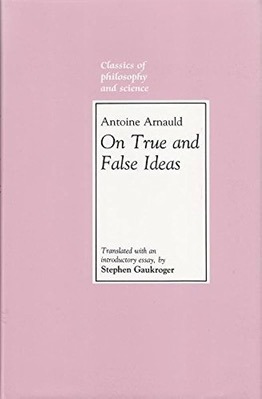
Borrow the Internet Archive’s copy of On True and False Ideas (St. Martens Press, 1990)
On True and False Ideas. English translation and introductory essay by Stephen Gaukroger  . Manchester and New York: Manchester University Press, 1990.
“Chs. 4 & 5.” English translation of On True and False Ideas.
Des vraies et des fausses idées. French translation, presentation, and notes by Denis Moreau  . Paris: Librairie philosophique J. Vrin, 2011.

Arnauld, Antoine. The Art of Thinking: Port-Royal Logic  , translated by James Dickhoff (no known photo) and Patricia James (no known photo). New York: Library of Liberal Arts, 1964.
St. Augustine of Hippo (354–430)


City of God (De Civitate Dei)  . Translated by Henry Bettenson (no known photo). London: Penguin, 1984.
On Free Choice of the Will (De Libero Arbitrio)  . Translated by Anna S. Benjamin (no known photo) and L. H. Hackstaff (no known photo). New York: Macmillan, 1964.
- Read S. L. Greenslade’s
 (1905–1977) Review.

René Descartes (1596–1650)

Latin & Non-English
Online editions:
- Descartes – Œuvres, éd. Adam et Tannery, VII.djvu
- Internet Archive has over 180 Descartes books in various languages.
- French Meditations and Discourse,
 online French text of the six Meditations and the Discourse (from the Association de Bibliophiles Universels, http://abu.cnam.fr/).
- French Dioptrics, online French text of La dioptrique (from Les classiques des sciences sociales, University of Quebec at Chicoutimi).
- French Discourse and Meditations, online French text of the Discourse and six Meditations plus the first three Objections and Replies, from the edition of Descartes’ works by Victor Cousin
 (Project Gutenburg).
- Rene Descartes, Meditationes de prima philosophia. Meditationen fiber die Grundlagen der Philosophie [Published in 1913] (Philosophische Bibliothek 250 a [Universal Library No. 250 a]). Based on the editions of Artur Buchenau
 (1879–1946) republished by Luder Gabe. Reviewed by Hans Gunter Zekl. Hamburg: Felix Meiner, 1977. [See screenshot below for all available download formats available at Project Gutenberg .
Artur Buchenau’s “Forward” to the 1913 edition translated into English:
The present, benevolent edition of the “Meditations” is intended for seminar use at universities as well as for private studies. The older Latin editions of this work, which is still fresh for young people today, have become quite rare, the French translations alone are not enough, and so far the expensive editions of Adam-Tannery (Oeuvres de Descartes Volume VII, Paris: Leopold Cerf, 1904) and Güttler (2. Edition, Munich:Beck, 1912) [not available?].
The title of the first edition of “Meditations” (1641) is in full: Renati Des-Cartes, Meditationes de prima philosophia in qua Dei existentia et animae immortalitas demonstratur, Paris, Apud Michaelem Soli, via Jacobaea sub signo Phoenicis. MDCXLI. Cum Priuilegio et Approbatione.
The text of this first edition is based here and the page numbers of the original in the margin included in square brackets [ ] have been attached, so that in the future this (today very rare) edition can be quoted throughout. The title of the second edition (1642) is: Renati Des-Cartes Meditationes de prima philosophia in quibus Dei existentia, et animae humanae a corpore distinctio demonstratur. His adjunctae sunt variae objectiones doctorum virorum in istas de Deo et anima demonstrationes cum responsionibus Authoris. Secunda editio septimis objectionibus antehac non visis aucta. Amstelodami apud Ludovicum Elzevirium 1642.
Since Descartes did not read the printed sheets himself in the first edition—Mersenne took care of the printing—it contains several errors, which have been improved in the second edition. The variants of the two editions are listed below in the notes, and it has been decided on a case-by-case basis and the reading has been included, which appeared to be the more correct one according to linguistic and factual points of view.
The first French translation of the work appeared in 1647. Their full title is: Les Meditations Metaphysiques de René Des-Cartes, Touchant La Premiere Philosophie, dans lesquelles l’existence de Dieu, et la distinction réelle entre l’âme et le corps de l’homme, sont demonstrées. Traduites du Latin de l’Auteur par M. le D. D. L.N.S. Et les objections faites contre ces Méditations par diuerses personnes tres-doctes, auec les réponses de l’Auteur. Translated by Mr. C. L. R. A Paris. Chez la Veuve Jean Camusat. MDCXLVII. Avec privilège du roy.
The translator was the friend of Descartes, the Duke of Luynes, while the objections and replies were transmitted by Clerselier. Descartes looked through the translations and was so pleased that he explained that some passages in the French text were better than his own, corresponding Latin text. Probably various additions and improvements in detail come from Descartes himself, who, as is easy to understand, have directly entered them in the manuscript presented to him. I have compared the Luynes translation exactly with the Latin texts and recorded all the important deviations in the notes, in which I have otherwise worked hard in the greatest brevity, since after my detailed comment on the meditations (explanations on the meditations on the basis of the “Objections et Responsiones” and the correspondence) it is not necessary for a more precise explanation, I also do not want to anticipate the seminar work. Incidentally, this commentary is to appear soon in a new edition, this time it will be preceded by the complete translation of the “Objections and Replies.” I hereby meet a wish that has been expressed many times, and the fact that such a complete German edition can be brought today should probably be regarded as a pleasing sign of the times, which shows how much Descartes’ studies have increased in the last decade. To facilitate the further deepening of the same is the purpose and task of the present edition.
Berlin, in July 1913. Dr. Artur Buchenau.

- Rene Descartes, Meditationes de Prima Philosophia. Meditationen über die Erste Philosophie. Lateinisch/Deutsch (Universal-Bibliothek Nr. 2888 [Universal Library No. 2888]). Translated and edited by Gerhart Schmidt (1925–2017). Stuttgart: Philipp Redam, 1986.
- Rene Descartes, Erste Meditation, 62–75, Lateinisch / Deutsch, Meditationes de Prima Philosophia. Meditationen über die Erste Philosophie. Lateinisch/Deutsch (Universal-Bibliothek Nr. 2888 [Universal Library No. 2888]). Translated and edited by Gerhart Schmidt (1925–2017). Stuttgart: Philipp Redam, 1986.
- Latin Meditations, online Latin text of the six Meditations (from The Latin Library, Classics Page, Neo-Latin, Descartes).
- Meditation III in Latin at the LatinLibrary.
- Latin Meditations, online Latin text of the six Meditations, ed. Artur Buchenau. Leipzig: Felix Meiner, 1913 (from Project Gutenburg).
- Latin, French, and English Meditations, Latin text of the six Meditations, plus the 1647 French translation and the 1901 John Veitch
 translation into English (Wright State University).
- French and English Passions (1649/1650), side by side (Descartes Web Project, Claremont Graduate University).
- See Project Gutenberg for multiple formats of download.
The following provide access to digital photographic reproductions of many additional texts:
- An Analytic Bibliography of On-Line Neo-Latin Texts, has links to more than 46,000 neo-Latin texts, including many by Descartes (Dana F. Sutton
 ).
).
- Gallica, a search engine for the large digital collection at Bibliothèque Nationale de France.
Corpus Descartes

f
Presentation of the Corpus Descartes
Online edition of Descartes’ works and correspondence [in French 🇫🇷; English translation provided here by Google translate.]
This site offers the online edition of Descartes’ works and correspondence directed by Vincent Carraud (EA 2129, University of Caen Normandy then Centre d’Études Cartesiennes, University Paris-Sorbonne). This edition was carried out in collaboration with the Centro interdipartimentale di Studi su Descartes e il Seicento of the Università del Salento (directed by Giulia Belgioioso), the Centre d’Études Cartesiennes de Paris-Sorbonne (directed by Jean-Luc Marion) and the COnstraints, Data mining and Graphs (CoDaG) team (directed by Patrice Enjalbert) of the Groupe de recherche en informatique, image, automatique et instrumentation (GREYC) of the University of Caen Normandie, in collaboration with the company Noopsis.
The texts of the corpus
[NOTE: Bizzarely, if you click on any of the hyperlinks (the Xml below) to the documents below the text contains no paragraph breaks and the entire document is all smushed together. ]
The corpus is organized into four parts:
- The transcription of the works published by Descartes, in the language in which he published them:
Discourse of the method to conduct one’s reason well, and seek the truth in the sciences. Plus The Dioptric. The Meteors. And Geometry. Which are essays of this method (1637);
[Xml]
Renati Des-Cartes, Meditations de Prima Philosophia, in quibus Dei existentia, et animae humanae à corpore distinctio, demonstrantur. His adjunctæ sunt variæ objectiones doctorum virorum in istas de Deo et anima demonstrations; Cum Responsionibus Authoris. Secunda editio septimis objectionibus antehac non visis aucta (1642);
[Xml]
Epistola Renati Des-Cartes ad celeberrimum Virum D. Gisbertum Voetium. In qua examinantur duo libri, nuper pro Voetio Ultrajecti simul editi, unus de Confraternitate Marianâ, alter de Philosophiâ Cartesianâ (1643);
[Xml]
Renati Des-Cartes, Principia philosophiae (1644);
[Xml]
Notae in program quoddam sub finem Anni 1647 in Belgio editum, cum hoc Titulo: Explicatio Mentis humanae, sive Animae rationalis, ubi explicatur (1648);
[To be published]
The Passions of the Soul (1649).
[Xml]
- The transcription of the translations of his works that were seed during his lifetime:
Renati Des-Cartes, Specimina philosophiae: seu Dissertatio de methodo recte regendae rationis, and veritatis in scientiis investigandae: Dioptrice, and Meteora. Ex Gallico translata, and ab Auctore perlecta, variisque in locis emendata (1644);
[To be published]
René Des-Cartes’ Metaphysical Meditations concerning the First Philosophy, in which the existence of God, and the real distinction between the soul and the body of man are demonstrated. Translated from the Author’s Latin by M. D. D. L. N. S., and the objections made against these meditations by various very learned people, with the author’s answers, translated by M. C. L. R. (1647);
[Xml]
The Principles of Philosophy, written in Latin, by René Descartes. And translated into François by one of his Friends (1647);
[Xml]
Geometria, à Renato Des Cartes anno 1637 Gallicè edita; nunc autem cum notis Florimondi de Beaune, in curia Blaesensi Consiliarii Regii, in linguam Latinam versa, et commentariis illustrated, operaâ atque studio Francisci in Schooten, Leydensis, in Academiâ Lugduno-Batavâ, Matheseos Professoris, Belgicè docentis (1649).
[To be published]
- The edition of works and letters published after the death of Descartes:
Grouping of so-called youth works: Olympica, Experimentata, Cogitationes privatae, Studium bonae mentis, Fragment Cartesius and The Search for Truth;
[To be published]
Ballet Of the Birth of Peace (1649);
[To be published]
Compendium Musicae (1650);
[To be published]
Passiones animae per Renatum Descartes: Gallicè ab ipso conscriptaee, nunc autem in exterorum gratia Latina civitate donatae, ab H. D.M. I. V. L (1650);
[Xml]
Renatus Descartes, de Homine, figuris and latinitate donatus a Florentio Schuyl …;
[Xml]
L’Homme de René Descartes and a Treatise on the formation of the fetus of the same author, with the remarks of Louys de La Forge …;
[To be published]
The World of Mr. Descartes, or the Treatise on Light …;
[To be published]
Regulae ad directionem ingeniei (1701).
[Xml]
- The transciption of the Clerselier edition of the Letters of Mr Descartes1:
Letters from Mr. Descartes where several beautiful questions concerning morality, physics, medicine and mathematics are dealt with. New edition, revev and avgmente. Volume One (1663);
[Xml]
Letters from Mr. Descartes where several beautiful difficulties affecting his other Works are explained. Novvelle edition, revev and correct. Volume Two (1666);
[Xml]
Letters from Mr. Descartes where he answers several difficulties that have been proposed on Diopters, Geometry, and several other subjects. Third and last Volume (1667).
[Xml]
Scientific annotation
The annotation of this edition is being carried out via the collaborative annotation tool developed as part of the l’ANR2. Produced by specialists in Descartes’ work, it is available in four types of notes: 1) philological, 2) interpretative: historical or philosophical, 3) bibliographic, 4) varia. This annotation will make it possible to record over time the progress made from the point of view of the textual history of Cartesianism. Its publication, and, if necessary, the correction of transcription errors, will provide the basis for the next editions of the Corpus Descartes.
- The Centro du studi su Descartes e il Seicento published the first full Italian translation, with the original texts opposite, of the French and Latin letters of René Descartes, Tutte le lettere 1619-1650, G. Belgioioso (ed.), Milan, Bompiani (Il Pensiero Occidentale), 2009.
- Developed by SAIC-CERTIC.
Meditationes de Prima Philosophia (Latin edition)  . Curated by Artur Buchenau (1879–1946). Leipzig, DE: C. Grumbach, 1913.
Œuvres Complètes de René Descartes is a complete new edition of the entire, philosophical and scientific corpus of Descartes, created by the Connaught Descartes Project at the University of Toronto (headed by André Gombay
 ). See content listings in screen capture below.

- See the original Latin text of 1641
 at the Trilingual edition by David B. Manley (no known photo) and Charles S. Taylor
  (1998).
- The Trilingual edition can be downloaded from Wright State University Libraries, or from DocPlayer in four formats: WORD, PNG, TXT, or JPG. Also a download button from Wayne State University.
Project Gutenberg has a French, German, and Finnish translation of the Meditations, as well as several Discourse on the Method.
French edition in French language (Paris, 1724). Text drawn up by Victor Cousin  , Levrault, 1824, volume I of the Meditations.
Œuvres de Descartes, Text drawn up by Victor Cousin , volume I. Leipzig: Levrault, 11 volumes, 1824–1826.
Principles of Philosophy, Letter to Voetius, Apology, Notes Against a Program in Latin from AT 1905 edition. See screenshot below for title page.

Adam & Tannery
(An animated enhanced colorized .gif of Paul Tannery (1843–1904). There are no extant photographs of Charles Adam (1857–1940))
[AT] Oeuvres de Descartes  12 volumes. Edited by Charles Adam (no known image) and Paul Tannery (pictured)
  . Paris: initially published in 1897–1913 then revised in 1964–1978; Paris: Librairie Philosophique J. Vrin, 1996. This edition originally published in 1904. References are to volume and page number. For available contents see screenshot below with titles of works.
Oeuvres de Descartes  edited by Charles Adam and Paul Tannery, Paris: Léopold Cerf, 1897–1913, 13 volumes; new revised edition, Paris: Vrin-CNRS, 1964–1974. The new, revised edition of the original series (13 volumes), originally published at the turn of the century (Paris: L. Cerf, 1897–1913), is Oeuvres de Descartes. Publiees par Charles Adam & Paul Tannery. Paris: Librairie Philosophique J. Vrin and Le Centre National de la Recherche Scientifique, 1964-1976 (13 Volumes: 1–11 contain Descartes’ writings, vol. 12 contains Adam’s “Vie et Oeuvres de Descartes,” and volume 13 contains biographical material, correspondence and indices).
[AT]. Oeuvres de Descartes. Published by Charles Adam and Paul Tannery. Cerf, 1897–1913. 13 vols. Reprinted: Vrin, 1957–58.
Vol. 1–5: Correspondence 1622–50, with index. [Supplements in vols. 7, 8, 10, 13.]
Vol. I: Correspondence (April 1622–February 1638) (French).
Vol. IV: Correspondence (July 1643–April 1647). [Latin]. Located at the Smithsonian’s
Biodiversity Heritage Library.
Vol. V: Correspondence (May 1647–February 1650). Also here (1903). Also available at the Smithsonian’s
Vol. 6: Discours de la Methode DM, Dioptrique, Meteores, Geometrie [French, Latin] (1902). Also available at the Smithsonian’s
Vol. 7: MEDITATIONES DE PRIMA PHILOSOPHIA VII. Meditations on First Philosophy [Latin]. Letter to Dinet.(1904). Also available at the Smithsonian’s
Vol. 8: Principles of Philosophy PP [Latin]. Polemical writings. Also here. Also available at the Smithsonian’s
Vol. 9: Meditations on First Philosophy MM, Principles of Philosophy PP [both French] (1904). In Latin. In French (3rd ed. 1973). Also available at the Smithsonian’s

Vol. 10: Early and undated writings. PHYSICO-MATHEMATICA, COMPENDIUM MUSICE, REGULE AD DIRECTIONEM INGENII, RECHERCHE DE LA VERITÉ, SUPPLÉMENT A LA CORRESPONDANCE [Latin] (1974). Also available at the Smithsonian’s
Vol. 11: Le Monde. Passions of the Soul. Scientific writings. Projects. LE MONDE, DESCRIPTION DU CORPS HUMAIN, PASSIONS DE L’AME, ANATOMICA, VARIA. [Latin]. Also available at the Smithsonian’s
f
Vol. 12: Charles Adam, “Vie et Oeuvres de Descartes.” (no. 121) [French]. Also here. Also here.
Vol. 13: Supplement: Correspondence, Biographical material. Indices.
The Adam-Tannery edition, commonly cited AT, is accepted as the definitive text of Descartes’s writings and supersedes even the original editions. Indispensable introductions; textual and explanatory notes; Tannery’s important mathematical annotations. Descartes’s orthography (discussed in AT I, lvix-cv) is preserved or conjecturally restored. The translations of main works are those authorized by Descartes himself. The text of the “Correspondence” is authoritative, but dating and identification of correspondents have been considerably revised (Ch. Adam in RPFE ns: 1933, 373–401; see also no. 79).
Edition lacks: most of the correspondence with Huygens (no. 81); Naissance de la paix (no. 78); seven letters (no. 124, v. 2, 169-73; Eur 1937, 406-14; no. 38, p. 71-85, 109-11); “Stammbuchblatt” (K 40:1935, 264-69). However, the marginal notes, supposedly by Descartes, in a London copy of Galileo’s “Systema mundi” are definitely not in his hand (L. Roth, “Falsa Cartesiana,” RPFE 105: 1928,149–50 — [A new edition of AT, to include all material now lacking, is being prepared by B. Rochot.]


Descartes’s Meditations are at Meditationes de prima philosophia, Oeuvres de Descartes Vol. VII, 1–90, edited by Charles Adam and Paul Tannery. Paris: Librairie Philosophique J. Vrin, 1983 (First Edition: 1904).
Click on screenshot below to access the displayed hyperlinks to those documents. To return to DTOI BIBLIOGRAPHY, click on your back arrow where they might look like this  or this
  , or likely this
  .
.

[AT] Œuvres de Descartes/Édition Adam et Tannery, edited by Charles Adam (no known image) and Paul Tannery  . Paris: Librairie Philosophique J. Vrin, 1897–1913. See hyperlinked screenshot below for contents.
- To read the contents, click first on the screenshot, then on the desired Tome volume in Roman numerals which takes you to a Wiki page. In the left column of that new page, click on the Internet Archive hyperlink.
- The Latin has archaic printing and subsequently the text extraction is poor. Translation programs cannot get appropriate transcriptions with recognizable and properly spelled Latin words.

Click on the screenshot,
 or even easier, just click on this Internet Archive or the hyperlink in the box below.
Descartes — Œuvres, tome VII: Meditationes de prima philosophia, edited by Charles Adam (no known image) and Paul Tannery , VII. Paris: 1897–1910 and 1964–1978; Paris: Librairie Philosophique J. Vrin, 1996. Latin text.

Also available to read at BnF Gallica  Oeuvres de Descartes. [Volume 7] / publ. par Victor Cousin… ; [et précédées de l’éloge de René Descartes par Thomas] in Latin.
Jonathan Bennett

Early Modern Texts translated by Jonathan Bennett  (1930–2024) with over thirty different sections of Descartes’s writings (see screen capture below for contents) available over the internet for the general public. Click the hyperlinks or anywhere on the screenshot below to go to Bennett’s translations into English of Early Modern Texts by Descartes. To return to the DTOI Primary Sources Bibliography, click on your browser’s back arrow in the upper left corner where it might look like this , or this , or likely this .

John J. Blom
Descartes: The Essential Writings  . Translated and with introductions and a concordance (conceptual index) by John J.(oseph) Blom (no known photo). New York: Harper Torchbooks, 1977.
- Blom taught philosophy at Columbia University, Manhattanville College, and Hunter College of CUNY.
Desmond M. Clarke


Meditations and Other Metaphysical Writings  . Translated by Desmond M. Clarke. London: Penguin, 2000.
CSM & K


(Pictured left to right: John Cottingham, Robert Stoothoff, Dugald Murdoch, Anthony Kenny)
Descartes: Selected Philosophical Writings 
 First Edition. Translated by John Cottingham, Robert Stoothoff, and Dugald Murdoch. Cambridge: Cambridge University Press, 1988. Includes the Discourse on the Method and Meditations and substantial extracts from the Regulae, Dioptrics, Principles, Objections and Replies, Comments on a Broadsheet, and Passions of the Soul.


[CSM] The Philosophical Writings of Descartes, Vol. I  , Vol. II
  . Edited and translated by John Cottingham, Robert Stoothoff, Dugald Murdoch. New York: Cambridge University Press, 1984, 1985. Only partial excerpts included in book preview. Read the complete Volume I or the complete Internet Archives Vol. II.
- See a complete Cottingham translation of just the Meditations on First Philosophy.
- First Meditation with notes by Jeffrey Kaplan

- Second Meditation
- Third Meditation or Third Meditation
- Fourth Meditation
- Fifth Meditation
- Sixth Meditation
- Second (complete) and Sixth Meditation (incomplete)
- Second, Fourth, and Sixth Meditation
- Meditations on First Philosophy with selections from the Objections and Replies
 2nd ed. Edited and translated by John Cottingham
  . New York: Cambridge University Press, 1996. This source contains a readable version of Bernard Williams’s
  “Introductory Essay.”
The Philosophical Writings of Descartes, vol. 2, translated by John Cottingham  . A complete edition that is fully copyable to paste into documents. See contents in screenshot below.

[CSMK] The Philosophical Writings of Descartes, Vol. III  . Edited and translated by John Cottingham, Robert Stoothoff, Dugald Murdoch, and Anthony Kenny. New York: Cambridge University Press, 1991. References are to volume and page number. These three CSM volumes are the standard edition of Descartes’s writings and correspondences and they are also often cited with the AT volume and page number.
Donald A. Cress 

Discourse on Method and Meditations on First Philosophy  4th edition. Translated by Donald A. Cress. Indianapolis, IN: Hackett Publishing Company, 1998. See Internet Archives Cress translation, 3rd edition, 1993. Also available at VDOC.PUB. Also see the 3rd edition (1993) at Scholar.WorldLib.site.
Haldane & Ross


(All pictures are of Elizabeth Sanderson Haldane. There are no extant photographs of G. R. T. Ross. The fifth photograph is also available at the Library of Congress (LOC) Public Domain Archive. Click on any image for its source.)


Haldane and Ross at Internet Archives’s The Philosophical Works of Descartes, Vol. I and Vol. 2. Translated by Elizabeth S. Haldane (1862–1937) and G. R. T. (George Robert Thomson) Ross (no known image) (1874–1959). Cambridge: Cambridge University Press, 1911.
- 1911 edition of The Philosophical Works of Descartes (Cambridge University Press), translated by Elizabeth Sanderson Haldane
 at the Wayback Machine.
- A searchable Google digitized version from the University of Michigan of Volume One and Volume Two at HathiTrust.
- A clean but non-cut-and-paste version of the 1911 edition.
- Also copyable from the public domain version of the screen capture below.
- See other searchable editions.
- A skinny version of the Meditations on First Philosophy (1911 edition), including the Translator’s Note, Dedication, Preface to [the] Reader, Synopsis, and all six Meditations in copyable format.
- A 2017 e-book by Yogebooks.
- This file is of the 1911 edition of The Philosophical Works of Descartes (Cambridge University Press), translated by Elizabeth Sanderson Haldane
 , including the Prefatory Note, Preface to the Reader, Synopsis, and all six Meditations in copyable format.

Discourse on the Method and Meditations on First Philosophy  , edited by David Weissman
  and translated in 1911 by Elizabeth Sanderson Haldane
  and G. R. T. Ross. New Haven: Yale University Press, 1996.
Internet Archives selected Descartes’s writings (see screenshot below for contents). Translated by Haldane and Ross (1901) with The Geometry translated by David Eugene Smith  and Marcia L. Latham. Also, The Geometry.


George Heffernan 
Meditations on First Philosophy — A Bilingual Edition. Introduced, edited, translated, and indexed by George Heffernan  . Notre Dame: University of Notre Dame Press, 1990. The book has Descartes’s Latin on every left page with Heffernan’s English translations on the right page.
- Read the full version at the Internet Archive.
- See a preview (ends in the middle of the Second Meditation) of Meditations on First Philosophy — A Bilingual Edition at Google books.

Ian C. Johnston 
Discourse on Method  . Translated by Ian Johnston
  . Revised May 2010.
Meditations on First Philosophy 
 . Translated from the 1641 Latin edition into English by Ian Johnston, 2012. Clicking on the book cover hyperlinks to the book cover then click on the right arrow to advance the pages to the rest of the book.
- Fully copyable at web.viu.ca.
- Also available at johnstoniatexts.com.
Norman Kemp Smith


Descartes: Philosophical Writings  . Selected and translated by Norman Kemp Smith. New York: The Modern Library (Random House), 1958.

Laurence Julien Lafleur
Discourse on Method  . Translated with an Introduction by Laurence J. Lafleur (no available photo). New York: MacMillan, 1956. Originally published: Indianapolis: Bobbs-Merrill, 1950.
René Descartes: Meditations  . Translated, with an Introduction, by Laurence J. Lafleur (no known photo). New York: The Liberal Arts Press, 1951.

William Molyneux


Six Metaphysical Meditations Wherein it is Proved That there is a GOD. And that Man’s MIND is really distinct from his BODY, including Thomas Hobbes’s Third Objections with Descartes’s answers. Translated by William Molyneux (1656–1698) and first published in 1680 in the United Kingdom by B. G. for Benj. Tooke at the Ship in St. Pauls Church-yard.
Michael Moriarty


Meditations on First Philosophy With Selections from the Objections and Replies  . Translated with an Introduction and Notes by Michael Moriarty. New York: Oxford University Press, 2008.
- Also available here.
John Veitch 
Meditations on First Philosophy  . Translated by John Veitch (1901) now in the public domain; also in CSM II.
Meditations on First Philosophy 1901 Veitch translation  at
at  WikiSource in the public domain. Complete and copyable.
Discourse on Method and Meditations on First Philosophy  . Translated by John Veitch (1901). Project Gutenberg. Release date June 28, 1995 (eBook #59). Updated May 13, 2022. Produced by Ilana and Greg Newby.
See John Veitch’s 1901 translation of Descartes’s Meditations in a copyable format.

All of John Veitch’s works with hyperlinks to digitized copies as listed below from the Online Books Page.

- Also available at EddieJackson.net.
- A copyable version one can copy/paste from the ClassicalLibrary.org.
- HTML edition of Descartes’s Meditations translated by John Veitch from the 1901 publication courtesy of David B. Manley (no known photo) and Charles S. Taylor at the Wright State University.
The Online Library of Liberty  where they have the Veitch translation
  available for download in five different formats (see screenshot below).

Non-Meditations
Comments on a Certain Broadsheet
[Comments] “Comments on a Certain Broadsheet” in CSM I.
Conversation with Burman
Descartes’ Conversation with Burman  . Translated and edited by John Cottingham
  . Oxford: The Clarendon Press, 1976.
- Read John Roger’s
 (1938–2022) Review. International Philosophical Quarterly, 1977: 332–33.
- Read Christopher J. Clay’s (no known photo) Review in International Philosophical Quarterly 17, no. 4, December, 1977: 496–97.
Conversation with Burman. Translated by Jonathan Bennett at EarlyModernTexts.com, 2017.
Correspondence
The Correspondence of René Descartes 1643. Edited by Theo Verbeek  , Erik-Jan Bos
  , and Jeroen M. M. van de Ven (no known photo), 2003. Download it.
- Also viewable at cloudfront.net.
The Correspondence between Descartes and Henricus Regius. Dr. (Erik-Jan) J. J. F. M. Bos . PhD diss., Utrecht University Repository, 2002. Download it.
Abstract: In 1638 the Dutch philosopher and physician Henricus Regius (1598–1679) introduced himself to René Descartes (1596–1650), allegedly because he owed his appointment as professor of theoretical medicine at Utrecht University to his being a Cartesian. During the following years Regius established himself as the main advocate of Cartesianism at Utrecht. In fact, he was the first university professor to teach Cartesian ideas and to publish a number of disputations, which provide a fairly complete picture of Cartesian natural philosophy. Apart from De Vrijer s theological thesis of 1917 little has been done so far to establish the significance of Regius work or study the way in which he took up Descartes ideas and amalgamated them with his own. Although the necessary sources have become available in the past decades, there is as yet no comprehensive study on Regius and his relation to Descartes. A major obstacle to this enterprise is the defective state of the available editions of the Descartes Regius correspondence. For a clear understanding of the relation between Descartes and Regius, and for an objective and thorough assessment of Regius philosophical and medical concepts, a critical edition of the correspondence between Descartes and Regius is an essential prerequisite. It is here where the problems arise. The actual text of the letters which were exchanged between Descartes and Regius is unknown. In 1657, Claude Clerselier published 18 minutes of Descartes part of the correspondence. All that remains of Regius letters to Descartes are abstracts and quotations in Adrien Baillet s biography, published in 1691. In 1973, Esze published two unknown letters of Descartes to Regius. The order of the letters as they were published in the editions of Adam/Tannery (1964–1971: AT), Adam/Milhaud (1936–1963), Rodis-Lewis (1959) and Bordoli (1997) is based on that of Clerselier, but since the rediscovery of Regius disputations Physiologia (1641) scholars have contested the dates of various letters. However, none of the editors so far has extensively used Regius disputations as a means to arrive at a more exact date. The aim of my research is to provide a critical reconstruction of the correspondence between Descartes and Regius. The most dramatic differences with previous editions concern Descartes part of the correspondence. I have discovered that several letters as published by Clerselier consist in fact of fragments of many more letters. Further, I have revised almost every date established by AT, either narrowing them down or giving the letters an altogether new place in the correspondence. One of the most interesting features of the present edition is that it points out the many reoccurring passages from Descartes letters in Regius Physiologia (the complete text of the first three disputations of the Physiologia is given in an appendix). As regards Regius letters to Descartes, in many cases I have been able to establish their precise date. Moreover, in clearing Baillet s at times confused way of presentation, I have arrived at an order of Regius letters and their context which sharply contrasts with the standard view. In addition, my examination of Baillet s biography has yielded several passages relevant to Regius letters which are not found in AT. Finally, the use of the many available sources, both published and unpublished, has resulted in a comprehensive historical annotation, conspicuously absent in AT, on the specific Dutch and especially Utrecht context of the relation between Regius and Descartes.
Descartes: Philosophical Letters. Translated and edited by Anthony Kenny  . Minneapolis: University of Minnesota Press, 1981. Original hardback edition by Oxford University Press, 1970.
Dioptrics Geometry Meterology
[Dioptrics] “Dioptrics” in CSM I.
- Gary Hatfield
 in his fourth footnote (in The Blackwell Guide to the Modern Philosophers: From Descartes to Nietzsche, edited by Stephen M. Emmanuel, Oxford: Blackwell Publishers, 2001, 24–25), states:
The title of this work in French is La Dioptrique, which is properly translated as “Dioptrics,” although some translations render it as “Optics.” The ancient science of dioptrics studied vision through refracted rays, and was normally joined with “optics,” or the science of vision through direct rays, and “catoptrics,” the science of vision through reflected rays, as in a mirror. In his work entitled Dioptrics, Descartes covered all three areas, but the focus was on refracted light, vision aided by lenses, and normal human vision. Descartes may have chosen the title to advertise his important result published therein (the sine law of refraction), as well as his account of lenses (which operate through refraction), including a description of the telescope, which had only recently been invented.
Discourse on the Method

[Discourse] Discourse on Method, Optics, Geometry, and Meteorology. Translated by Paul J. Olscamp  . Indianapolis: Bobbs-Merrill, 1965.
[Discourse] Discourse on Method. Translated by Ian Johnston , revised May, 2010.
[Discourse] Discourse on Method  . Translated with an Interpretive Essay by Richard Kennington. Edited with an Introduction, Glossary, and Notes by Pamela Kraus and Frank Hunt. Indianapolis: Focus Publishing (an imprint of Hackett Publishing Company, 2007.
[Discourse in German]
Objections & Replies
[Replies] “Objections and Replies.” Translated by Jonathan Bennett  ; also in CSM II.
- Read the Third and Fourth Objections and Replies translated by Jonathan Bennett.
Meditations, Objections, and Replies. Edited and translated by Roger Ariew  and Donald A. Cress . Indianapolis: Hackett Publishing Company, 2006.
- Read an excerpt of the first two Meditations and an incomplete Third on pp. 9–20.
Passions of the Soul

The Passions of the Soul. Translated by Jonathan Bennett . http://earlymoderntexts.com, 2017.
The Passions of the Soul. Translated by Stephen H. Voss  . Indianapolis: Hackett Publishing Co., 1989. Digitized at Internet Archive in 2022.
Principles of Philosophy
[Principles] Preview (pages 1-57, 248–49) a new 2023 translation of the Principles of Philosophy by Blair Reynolds.
[Principles] Principles of Philosophy  . Translated by Valentine Rodger Miller and Reese P. Miller. Dordrecht, the Netherlands: Kluwer Academic Publishers, 1991.
[Principles] Principles of Philosophy  . Translated by Jonathan Bennett ; also in CSM I.
[Principles] Downloadable ebook text as a zip file or plain text by Project Gutenberg Release #4391 “Selections from the Principles of Philosophy” by René Descartes. Translated by John Veitch  .
.
[Principles] Principia philosophiae . Latin edition.
Preview by René Descartes 1722. Friderici Knochii & filii Collection. Book from the collections of National Central Library of Rome in Latin.
Regulae
[Rules for the Direction of the Mind/Regulae] “Rules for the Direction of the Mind” (1954). Translated by Elizabeth Anscombe and Peter Thomas Geach.
[Rules/Regulae] “Rules for the Direction of the Mind.” Translated by George Heffernan in a bilingual edition, 1998.
[Rules/Regulae] Translated by Haldane and Ross
[Rules/Regulae] Read a copyable cut/paste John Veitch translation (1901) of the Regulae at ClassicalLibrary.org.
Also available at CSM I.
Regulae ad Directionem Ingenii,  (1907), in Latin. Edited by Artur Buchenau.
Treatise on/of Man
[Treatise] Treatise on Man  (hardcover)
  (Kindle edition). Translated by Tim Newcomb
  .
.
Abstract: A new 2023 translation directly from the original manuscripts into English of Descartes’ famous 1622 Treatise on Man (sometimes translated “Treatise of Man”). This edition contains a new introduction and afterword from the translator, as well as a timeline of Descartes’ life and summaries of each of his works. Here, Descartes explores the nature of human beings, their place in the world, and how they interact with their environment. It is significant because it established the idea of dualism, the belief that the mind and body are separate entities. This idea has had a profound significant impact on both philosophy and psychology, as it directly influenced Freud.
[Treatise] Treatise of Man. Translation and commentary by Thomas Steele Hall. Cambridge: Harvard University Press. 1972. Treatise of Man: French Text with Translation and Commentary, trans. Thomas Steele Hall, René Descartes. Cambridge, Mass.: Newcomb Livraria Press, 1972.
Abstract: A translation by Thomas Steele Hall, an historian of physiology, of the 1664 edition of Descartes’ L’Homme (ed. Claude Clerselier). Includes an introduction, review of Descartes’ physiology, a synopsis of the first French edition, bibliographical materials (editions and sources of L’Homme), and extensive interpretive notes. Also incorporates the French text of 1664 of L’Homme. Forward by I. B. Cohen.
- Read Lester Snow King’s
 (1908–2002) Review. Isis 64, no. 1 (1973): 127–28. To read second page, click on NEXT ARTICLE.
- Read William F. Bynum’s
 Review. The British Journal for the History of Science 7 , no. 2 (July 1974): 189–90.
[Treatise] “Treatise of Man; Formation of the fetus; Treatise on Light” in French.
Descartes’ Meditations: Background Source Materials. Translated and edited by Roger Ariew , John Cottingham  , and Tom Sorell
  . Cambridge: Cambridge University Press, 1998.
 Gallica – the BNF digital library. Listed under René Descartes, there are 1, 426 pages each holding 15 entries for a total of 21,390 items.
Maison d’Être Philosophy Bookstore — René Descartes. Lists many Cartesian works with hyperlinks and book covers.
Nicolas Malebranche (1638–1715)


(Believe it or not, but the middle Malebranche is not animated, although you might see him move!)
Elucidations of The Search After Truth. Edited and translated by Thomas Lennon  , in The Search after Truth, edited and translated by Thomas Lennon and Paul Olscamp
  . Cambridge: Cambridge University Press, 1997.
The Search after Truth. Edited and translated by Thomas Lennon and Paul Olscamp . Cambridge: Cambridge University Press, 1997.
Francisco Suárez (1548–1617)


[DM] Disputationes Metaphysicae. In Opera Omnia. Edited by Abbot Charles Berton. Paris: Vives, 1856-66, Vols. 25–26.

[DM] Disputationes Metaphsicae. 2 Vols. Georg Olms: Hildesheim, 1965.
“On Efficient Causality.” Metaphysical Disputations 17, 18 & 19. Translated by Alfred J. Freddoso 
 . New Haven and London: Yale University Press, 1994.
“On Beings of Reason.” Metaphysical Disputations 54. Translated by John P. Doyle (no known photo). Milwaukee: Marquette University Press, 1995.
“On Real Relation.” Metaphysical Disputations 67. Translated from the Latin, with an Introduction and Notes by John P. Doyle (no known photo). Milwaukee, WI: Marquette University Press, 2006.
