



TOPIC: Who are the readers philosophers and historians of philosophy write to and for?
AP (Actu Philosophia): I will therefore ask you a final question, which is also that of my master, Ruedi Imbach
: for whom does the philosopher write and for whom does the historian of philosophy write? And maybe even what does the historian of philosophy write for?
DK (Denis Kambouchner)
: If we are to conclude with a word, and of course without closing anything, I would be inclined to emphasize that we must not overestimate our influence as philosophers and a fortiori historians of philosophy, which is in any case the most modest, nor resign ourselves to writing and publishing for small circles of initiates. There is in any case, even in our specialties, a whole range of genres and registers, which is not fully fixed and can always be enriched. It seems essential to me both never to give in to anything in terms of rigor and accuracy, and to maintain a relatively broad ideal of communication, in other words to address us, to use a Cartesian expression, to all those who take care to educate themselves. This means—and I see our eminent friend Ruedi Imbach, whom I also want to greet, tell you something quite similar—that we can be scholastic in some of our productions, if necessary poetic in others, but never esoteric. As for the “for what” . . . Does the search for a trade with the great intelligences of the past really need justification? Increasing our intelligence of things to all remains the most noble task. (bold not in original)
(“Entretien avec Denis Kambouchner: Autour de Descartes n’a pas dit (partie II)” [“Interview with Denis Kambouchner: Around Descartes did not say (part II)”]. Posted on by Thibaut Gress.)
- Read Andrea Mihali’s
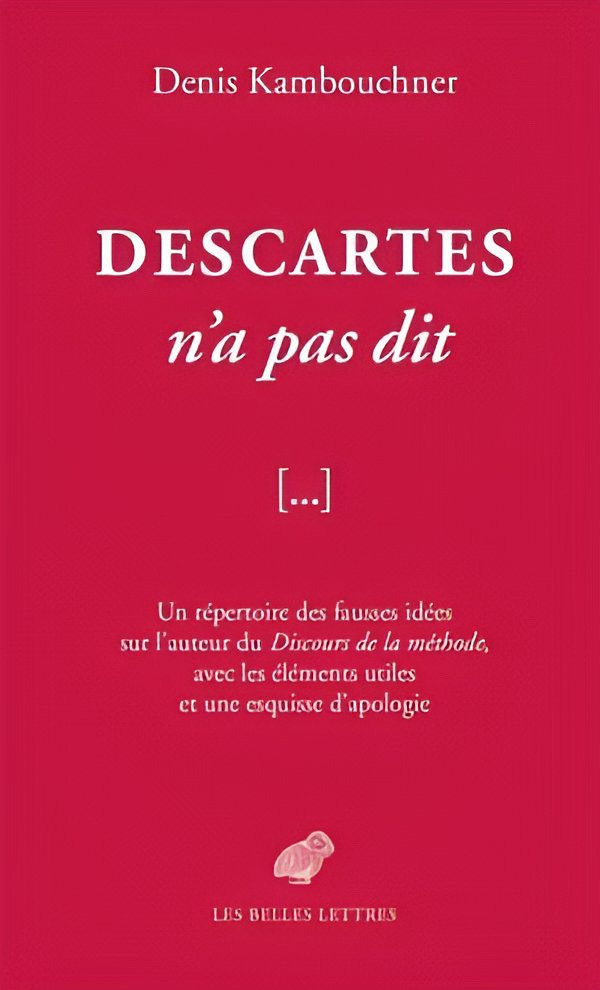
 Review of Descartes n’a pas dit: Un répertoire des fausses idées sur l’auteur du Discours de la méthode, avec les éléments utiles et une esquisse d’apologie [”Descartes did not say: A repertoire of false ideas about the author of the Discourse of the method, with the useful elements and a sketch of apology”] by Denis Kambouchner. Paris: Les Belles Lettres, 2015.
TOPIC: Why do history of philosophy?
Abstract: This paper advances the view that the history of philosophy is both a kind of history and a kind of philosophy. Through a discussion of some examples from epistemology, metaphysics, and the historiography of philosophy, it explores the benefit to philosophy of a deep and broad engagement with its history. It comes to the conclusion that doing history of philosophy is a way to think outside the box of the current philosophical orthodoxies. Somewhat paradoxically, far from imprisoning its students in outdated and crystallized views, the history of philosophy trains the mind to think differently and alternatively about the fundamental problems of philosophy. It keeps us alert to the fact that latest is not always best, and that a genuinely new perspective often means embracing and developing an old insight. The upshot is that the study of the history of philosophy has an innovative and subversive potential, and that philosophy has a great deal to gain from a long, broad, and deep conversation with its history. [Bold not in original]
(”The Benefit to Philosophy of the Study of Its History” by Maria Rosa Antognazza (1964–2023), British Journal for the History of Philosophy 23, no. 1 (2015): 161–84. Published online: November 5, 2014)
TOPIC: How innovative was Descartes’s theory of ideas relating thoughts to their objects?
“The epistemological debates of the seventeenth century no doubt supplied the seed-bed of later idealism, but there was no sudden, radical departure, least of all by Descartes, from traditional frameworks for dealing with the relation between thought and its objects. As his own explanations emphasise, Descartes’s use of the old term ‘idea’ was only mildly innovative.”
(Michael Richard Ayers  . “Ideas and Objective Being.” In The Cambridge History of Seventeenth-Century Philosophy
  vol. 2, edited by Daniel Garber
  and Michael Ayers
 , 1062–107. Cambridge: Cambridge University Press, 2000.
TOPIC: Philosophers say the darndest things.
“But I had been taught, even in my college days, that there is nothing imaginable so strange or so little credible that it has not been maintained by one philosopher or other, . . . . “
(René Descartes  “Discourse on the Method,” Part II, fourth paragraph)
TOPIC: What is the status of Descartes’s views on sensations?
“The major early moderns wrote few ex professo works on sensation and sensory qualities (Berkeley’s An Essay Towards a New Theory of Vision is a notable exception). As a rule, their views must be pieced together from isolated passages in diverse publications, private papers, and letters. In most cases, these passages are not easily reduced to a clear and coherent doctrine. This is certainly true of Descartes’ diverse remarks on sensation.”
David L. Clemenson (no known photo), “Review of Descartes and the Puzzle of Sensory Representation” by Raffaella De Rosa
  . Oxford: Oxford UP, 2010.
TOPIC: Descartes on the infinite, the indefinite, and God.
Nancy Kendrick  . “Why Hume’s Counterexample is Insignificant and Why It is Not.” British Journal for the History of Philosophy 17, no. 5 (2009): 955–79. Published online: January 21, 2010. Cite this article.
17Descartes says in the Third Meditation:
[T]hough it is true that there is a gradual increase in my knowledge, and that I have many potentialities which are not yet actual, this is all quite irrelevant to the idea of God, which contains absolutely nothing that is potential; indeed, this gradual increase in knowledge is itself the surest sign of imperfection. What is more, even if my knowledge always increases more and more, I recognize that it will never actually be infinite, since it will never reach the point where it is not capable of a further increase; God, on the other hand, I take to be actually infinite, so that nothing can be added to his perfection. (CSM II, 32)
(The Philosophical Writings of Descartes, 3 vols, edited and translated by John Cottingham, Robert Stoothoff, Dugald Murdoch, and (for vol. 3) Anthony Kenny.
18Also in the Third Meditation, Descartes says:
And I must not think that, just as my conceptions of rest and darkness are arrived at by negating movement and light, so my perception of the infinite is arrived at not by means of a true idea but merely by negating the finite. On the contrary, I clearly understand that there is more reality in an infinite substance than in a finite one, and hence that my perception of the infinite, that is God, is in some way prior to my perception of the finite, that is myself. (CSM II, 31)
19In the First Set of Replies, Descartes says:
Now I make a distinction here between the indefinite and the infinite. I apply the term ‘infinite,’ in the strict sense, only to that in which no limits of any kind can be found; and in this sense God alone is infinite. But in cases like the extension of imaginary space, or the set of numbers, or the divisibility of the parts of a quantity, there is merely some respect in which I do not recognize a limit; so here I use the term ‘indefinite’ rather than ‘infinite,’ because these items are not limitless in every respect. (CSM II, 81)
In a letter of 1649 to More, he says
it is not a matter of affected modesty, but of necessary caution, to say that some things are indefinite rather than infinite. God is the only thing I positively understand to be infinite. As to other things like the extension of the world and the number of parts into which matter is divisible, I confess I do not know whether they are absolutely infinite; I merely know that I know no end to them, and so, looking at them from my own point of view, I call them indefinite.(CSMK, 364)
See Nancy Kendrick , “Uniqueness in Descartes ‘Infinite’ and ‘Indefinite’,” History of Philosophy Quarterly 15, no. 1 (1998): 23–35; and Margaret Dauler Wilson  , “Can I be the Cause of My Idea of the World? (Descartes on the Infinite and Indefinite),” in Essays on Descartes’ Meditations
  , edited by Amélie Oksenberg Rorty
  , 339–58.
TOPIC: Cartesian representation, resemblance, & correspondence between color and geometric figures.
Ben-Yami, Hanoch  . “The Development of Descartes’ Idea of Representation by Correspondence.” In Reading Descartes: Consciousness, Body, and Reasoning
  . Firenze, IT: Firenze University Press (2023): 41–57.
Abstract of “Development”: Descartes was the first to hold that, when we perceive, the representation need not resemble what it represents but should correspond to it. Descartes developed this ground-breaking, influential conception in his work on analytic geometry and then transferred it to his theory of perception. I trace the development of the idea in Descartes’ early mathematical works; his articulation of it in Rules for the Direction of the Mind; his first suggestions there to apply this kind of representation-by-correspondence in the scientific inquiry of colours; and, finally, the transfer of the idea to the theory of perception in The World.
“In my book, Descartes’ Philosophical Revolution: A Reassessment (Ben-Yami 2015), I have shown in some detail that Descartes was the first thinker to hold a theory of representational perception with all the following characteristics:
- When we see colours, we are immediately aware of ideas of colour in our mind.
- The colour in the things we see causes our idea of colour.
- The idea of colour represents the colour in seen things.
- The colour in seen things does not resemble the idea of colour.
- The representation, when adequate, is so because it corresponds with what it represents.”
(Ben-Yami, Development, opening paragraph, 41)“Whatever the reasons for the Regulae’s suggested scheme of representation of colours are, we have here a representation of qualitative, sensory qualities by geometric figures. This representation is supposed to be by means of some correspondence, obviously without resemblance, between the properties of the representing medium and what is represented. Accordingly, while writing [the] Rules, motivated by his ideal of mathematical physics and consequent representational methodology, Descartes conceived of a systematic correspondence between colours and geometric figures and properties, which enables the one to represent the other.”
(Ben-Yami, Development, 52)