NOTE: For many of the following, there is the presumption of “for Descartes” added to each question.
- Aesthetic and Ethical questions
- Clear and distinct and obscure and confused questions
- Epistemological questions
- Material falsity questions
- Advanced questions on material falsity
- Metaphysical and Ontological questions
- Mind questions
- Idea questions
- Objective reality questions
- Advanced questions about the objective reality of an idea
- Passions questions
- 11.1 The passions
- 11.2 Passionate representation
- Primary quality questions
- Representation questions
- Secondary quality questions
- Sociological questions
1. Aesthetic and Ethical questions
- How does moral or ethical knowledge fit into Descartes’s theory of ideas?
- How does Descartes’s theory of ideas address the nature and perception of good?
- How do freedom and will interact in the theory of ideas in Descartes’s philosophy?
- How does Descartes’s theory of ideas address the nature and perception of evil?
- How does Descartes’s theory of ideas address the nature and perception of beauty?
- Does Descartes’s account of error imply an ethical obligation to manage one’s imaginative and sensory “inputs” (e.g., attention discipline) as a form of intellectual virtue?
- In what sense, if any, do aesthetic judgments (beauty/ugliness) purport to represent features of objects rather than features of the mind-body union?
2. Clear and distinct and obscure and confused questions
- What does Descartes mean when he refers to what has traditionally been translated as clear and distinct (L: clara et distincta; F: clare et distincte) ideas that Jonathan Bennett
 claims is poorly translated and recommends instead ‘vivid’ and ‘clear’ respectively? Bennett explains on page nine:
“Before we move on, a translation matter should be confronted. It concerns the Latin adjectives
clarus and distinctus
the corresponding French adjectives
clair and distinct
and the corresponding English adjectives
‘vivid’ and ‘clear’.
Every other translator of this work into English has put ‘clear’ and ‘distinct’ and for a while the present translator in cowardly fashion followed suit. But the usual translation is simply wrong, and we ought to free ourselves from it. The crucial point concerns clarus (and everything said about that here is equally true of the French clair). The word can mean ‘clear’ in our sense, and when Descartes uses it outside the clarus et distinctus phrase, it seems usually to be in that sense. But in that phrase he uses clarus in its other meaning—its more common meaning in Latin—of ‘bright’ or ‘vivid’ or the like, as in clara lux = ‘broad daylight.’ If in the phrase clarus et distinctus Descartes meant clarus in its lesser meaning of ‘clear,’ then what is there left for ‘distinctus’ to mean?
Descartes doesn’t explain these terms here, but in his Principles of Philosophy 1:45–46 he does so—in a manner that completely condemns the usual translation. He writes:
‘I call a perception claram when it is present and accessible to the attentive mind—just as we say that we see something clare when it is present to the eye’s gaze and stimulates it with a sufficient degree of strength and accessibility. I call a perception distinctam if, as well as being clara, it is so sharply separated from all other perceptions that every part of it is clarum. The example of pain shows that a perception can be clara without being distincta but not vice versa. When for example someone feels an intense pain, his perception of it is clarissima, but it isn’t always clear, because people often get this perception muddled with an obscure judgment they make about something that they think exists in the painful spot . . . . ‘ and so on.
Of course he is not saying anything as stupid as that intense pain is always clear! His point is that pain is vivid, up-front, not shady or obscure. And for an idea to be distincta is for every nook and cranny of it to be vivid; which is not a bad way of saying that it is in our sense ‘clear’.”1René Descartes, Meditations on First Philosophy, Third Meditation, translated by Jonathan Bennett, 2017, 9. (formatting, bold, and italic all in original)
- How do contemporary philosophers, psychologists, and cognitive and computer scientists understand such contrasts as clear/distinct or vivid/clear nowadays?
- What are the differences between being clare (clear/vivid) versus distincte (distinct/clear) for an idea?
- Are obscure and confused ideas in any way epistemologically useful?
- What makes an idea obscure and confused?
- How are the mental contents of one’s secondary quality sensations clear and distinct or confused and obscure?
- Are there degrees of clarity and distinctness in ideas?
- Does Descartes’s theory allow for the transition of ideas from being obscure and confused to clear and distinct?
- Can obscure and confused ideas become clear and distinct ones?
- Are clear and distinct ideas ever obscure and confused?
- How does Descartes reconcile the possibility of clear and distinct ideas becoming obscure and confused, or vice-versa?
- How does Descartes’s method of doubt contribute to the formation of clear and distinct ideas?
- How are clear and distinct ideas related to innate ideas?
- What role do clear and distinct ideas play in proofs for God’s existence?
- How does Descartes justify the reliability of clear and distinct ideas?
- Do clear and distinct ideas guarantee their truth?
- Can a clear and distinct idea ever be false for Descartes? Why not?
- Can a deceptive god make clear and distinct ideas suspect to doubt?
- For Descartes, are clear and distinct ideas innate?
- Can your mind cause clear and distinct ideas?
- According to Descartes, do all humans have the same capacity to form clear and distinct ideas?
- How does Descartes differentiate between a clear and distinct idea and a deeply ingrained belief?
- What role does attention play in converting an idea from merely clear to clear-and-distinct, and what would count as textual evidence for that role?
- Is “obscure and confused” best treated as (a) low determinacy of the extra-mental representatum (see 2.1), (b) low phenomenological vividness, or (c) both—and which reading best fits Descartes’s official definitions? For this question: the point is to disambiguate two importantly different notions that “obscure and confused” can suggest in Descartes: (a) semantic/intentional underdetermination, i.e., the idea fails to fix a determinate extra-mental representatum [A representatum (see 2.1) is the item—whether an object, property, event, or state of affairs—that a representation is about and that it presents as its intentional object, i.e., what is represented (as opposed to the representans, the representing vehicle)] as what it is strictly “of” (no determinacy), versus (b) phenomenological dimness, i.e., the experience is faint, blurred, or hard to notice (low vividness), versus (c) a combination. The question is significant because many sensory states are vivid and striking yet still “obscure and confused” about bodies, which favors reading (a) over (b): the obscurity/confusion is often best located in what the idea determines about its object (or fails to determine), not in the sheer liveliness of the felt episode.
- Are there ideas that are maximally vivid yet still “very obscure and confused” with respect to their extra-mental reference—and are sensations Descartes’s paradigm case?
- Once God’s non-deceptiveness is established, does Descartes allow any residual rational doubt about clear-and-distinct perceptions as such, or only about one’s memory of having perceived clearly and distinctly?
3. Epistemological questions
- Are all ideas innate?
- Does Descartes’s theory of ideas offer any insights into the nature of reasoning and logical thinking?
- How does Descartes define perception and how does this concept fit within his theory of ideas?
- What is Descartes’s position on awareness of all innate ideas?
- Does Descartes support an incorrigibility thesis that there are mental states about which it is impossible to be mistaken about them?
- What are the three grades of materially false ideas? Examples of the three grades from least materially false to more materially false are (A) confused non-sensory intellectual ideas of idolators about god, (B) secondary quality sensations such as those of color, taste, or warmth and coolness, (C) confused ideas of hunger and thirst such as the sensation of thirst when one has dropsy.
- How does Descartes account for erroneous ideas in his theory?
- How does Descartes’s theory of ideas interact with his skepticism?
- How does Descartes use his theory of ideas to justify belief in the external world ?
- How does Descartes’s theory of ideas contribute to the cogito (“I think, therefore I am”) argument?
- In Descartes’s theory, what are the consequences of an idea failing to accurately represent reality?
- How does the concept of the “evil genius/demon” interact with Descartes’s theory of ideas?
- How does Descartes deal with knowing the self through ideas?
- How does the theory of ideas contribute to Descartes’s understanding of truth and falsity?
- Does Descartes’s theory of ideas allow for an understanding of our own ignorance or lack of knowledge?
- How does Descartes’s theory of ideas account for sensory illusions or hallucinations?
- How does the concept of causality fit into Descartes’s theory of ideas?
- How does Descartes’s theory of ideas deal with the question of personal identity?
- How does Descartes’s theory of ideas account for the possibility of self-deception?
- What is the role of the body in Descartes’s theory of ideas?
- Does Descartes’s theory of ideas account for the ability to form new ideas through experience?
- How does the concept of doubt factor into Descartes’s theory of ideas?
- Does Descartes’s theory of ideas suggest a particular epistemological method?
- How does Descartes’s theory of ideas distinguish between different types of knowledge (e.g., empirical, a priori)?
- How does Descartes’s theory of ideas handle the problem of other minds?
- What role does the concept of ‘perfection‘ play in Descartes’s theory of ideas?
- How does Descartes’s theory of ideas address the nature of contradiction or inconsistency within ideas?
- Does the concept of analogy or metaphor function in Descartes’s theory of ideas?
- How does Descartes’s theory of ideas handle truth versus illusion?
- Does Descartes’s theory of ideas consider the role of emotional states in the formation and interpretation of ideas?
- Is there room in Descartes’s theory of ideas for handling perceptual relativity, which is the phenomenon where the perception of an object or event varies depending on the observer’s perspective, sensory apparatus, or context?
- How does Descartes’s theory of ideas address the differences between potentiality versus actuality?
- What differentiates between ideas that arise from the imagination and those that arise from the intellect?
- Is there anything in Descartes’s theory of ideas that addresses temporal succession in thought?
- Is there anything in Descartes’s theory of ideas to deal with the problem of induction, which questions how and whether inductive reasoning, which involves making generalizations based on specific observations, can justify the belief that the future will resemble the past or that unobserved instances will be like observed ones?
- What in Descartes’s theory of ideas establishes the reliability of mathematics?
- What accounts for the mind’s ability to focus or attend to certain ideas over others?
- How does Descartes address the question of whether ideas can exist independently of the mind?
- How does Descartes account for the mind’s ability to form false ideas despite the existence of a non-deceptive God?
- What contributions from Descartes’s theory of ideas helps establish epistemic certainty?
- Does Descartes reconcile the existence of different perspectives and interpretations of the same idea?
- How should Descartes distinguish illusion (misleading sensory deliverance) from error (misjudgment), and where exactly does the will enter?
- What is the epistemic status of mathematical imagination (diagram-based reasoning) within Descartes’s theory of ideas?
- How does Descartes’s account of the “natural light” relate to the ontology of ideas: is the natural light a faculty, a standard, or a special class of intellectual ideas? For this question: the issue is how to locate Descartes’s “natural light” within his theory of ideas and cognitive powers: whether it should be treated primarily as (a) a faculty or power of the intellect (a source of certain cognitions), (b) a normative standard for evident truth (a mark by which some perceptions are self-certifying), or (c) a special class of intellectual ideas or intellectual perceptions whose content is grasped with such transparency that error is excluded so long as assent tracks them. The question matters because each option yields a different ontology of certainty: a faculty-reading emphasizes psychological capacity, a standard-reading emphasizes epistemic normativity, and a special-content-reading emphasizes a distinctive kind of internally articulated idea (with stable idea-r-int/OR-content) that functions as the paradigm of clear-and-distinct cognition.
- Does Descartes’s method allow knowledge of bodies prior to proving God (e.g., as hypotheses or probable beliefs), or is it strict suspension of assent? For this question: the issue is whether Descartes’s method requires a strict moratorium on any knowledge of corporeal things until God’s existence and non-deceptiveness are established (so that one must suspend assent to all body-directed claims), or whether it permits an intermediate epistemic status—e.g., conjecture, hypothesis, or probable belief grounded in sensory appearances and mathematical-physical reasoning—short of knowledge but still rationally usable in inquiry. The question matters because it forces a three-way distinction often blurred in readings of Descartes: (i) psychological inevitability of believing bodies exist, (ii) methodological permission to use body-hypotheses in science, and (iii) the conditions for knowledge (scientia) as opposed to well-supported opinion prior to the theological guarantees.

4. Material Falsity questions
- What makes an idea be materially false?
- What characteristics do materially false ideas exhibit?
- How does Descartes distinguish between material and formal falsity in ideas?
- Does the theory of materially false ideas challenge the certainty of Descartes’s cogito ergo sum principle?
- Do materially false ideas compromise Descartes’s concept of God as a non-deceptive entity?
- Can materially false ideas ever be clear and distinct?
- How do materially false ideas affect Descartes’s mind-body dualism?
- How are materially false ideas related to innate ideas?
- Does the notion of material falsity impact Descartes’s view on the reliability of innate knowledge?
- Do materially false ideas establish the fallibility of human reason?
- How is material falsity involved in Descartes’s objective reality proof for the existence of God?
- Is there any contradiction in the existence of material falsity of ideas and the perfection of God?
- How might materially false ideas contribute to illusion or error?
- How can materially false ideas exist in a perfect being, according to Descartes?
- How do materially false ideas relate to the reliability of clear and distinct perception?
- How does the theory of the material falsity of a secondary quality sensation help Descartes justify that sensations are epistemically defective and unreliable?
- How is the existence of materially false ideas consistent with Descartes’s omnibenevolent God?
- Can Descartes’s theory of material falsity help account for cognitive biases?
- How do materially false ideas factor into Descartes’s method of systematic doubt?
- For what purposes does Descartes supply a theory of materially false ideas?
- Do materially false ideas affect Descartes’s ontological argument for the existence of God?
- How does Descartes’s theory of material falsity interact with his theory of innate ideas and ideas of sensation?
- Given that there are materially false ideas outside secondary-quality sensation cases (e.g., chimerical beings, “false gods”), what unifies the class of material false ideas? For this question: the issue is what principled feature makes a diverse set of candidates—secondary-quality sensations, chimerical constructions, and “false god” ideas—count as materially false as ideas, rather than merely being associated with later false judgments. The question presses for a unifying criterion that does not collapse material falsity into falsity of objectively real content: the unity would instead lie in a shared “matter for error” profile, i.e., a kind of idea that, by its internal structure (e.g., low determinacy, confused composition, or phenomenal positivity inviting projection), intrinsically inclines the mind to treat what is not in reality as if it were a thing, or to take the idea as if it were an internally object-specifying representation when it is not.
- What makes an idea be materially false when it contains objectively real content? For this question: the issue is how material falsity could apply in cases where an idea is not “empty” but includes genuinely objective representational content (OR) and thus internally represents some representatum-type. The question asks what, beyond the presence of OR, generates the “matter for error”: for example, whether the idea’s OR-content is embedded in a confused or unstable composite that encourages the mind to posit more than is internally represented, or whether the idea contains a mis-packaging that makes a non-thing seem to be a thing (e.g., attributing substantial status where only a mode is represented), so that the falsity lies not in the existence of objective content as such, but in how that content is structured, combined, or naturally construed in a way that predictably inclines misjudgment.
- What is the cleanest criterion for distinguishing “material falsity” from “errors of nature”? For this question: the issue is how to separate two phenomena that both involve misleading appearances: “material falsity,” which is a defect attributable to certain ideas as ideas because they supply “matter for error” (they intrinsically dispose the mind to mis-take what is not in bodies as if it were there), versus “errors of nature,” where a sensory or appetitive signal is causally produced in a way that is maladaptive or misleading for the composite (e.g., pathological cases) even if the idea’s representational status is not being misapplied as an account of external essences. The question seeks a criterion that does not reduce both to bad outcomes: it asks whether the dividing line is chiefly (i) a representational misuse condition (treating a low-content signal as if it were idea-r-int), (ii) a teleological malfunction condition (nature’s guidance system misfires relative to bodily welfare), or (iii) a principled combination of the two.
- What is the exact explanatory role of material falsity in Descartes’s system: why is it needed in addition to the will-based theory of judgmental error? For this question: the issue is why Descartes needs “material falsity” at all if he already holds that strict falsity and error arise from the will’s assent. The question targets the distinctive explanatory job material falsity performs: it is meant to explain how some ideas, even prior to any judgment, are intrinsically apt to occasion error—because their structure (e.g., sensory phenomenal positivity plus underdetermination about bodies) provides “matter for error” and naturally inclines the mind toward a specific misjudgment (especially projecting sensory qualities onto bodies). Without material falsity, Descartes risks treating all errors as equally downstream of will alone and loses the resources to explain why certain ideas are systematically hazardous, why the same kinds of mistakes recur across persons, and how God can be non-deceptive while still allowing ideas whose phenomenology predictably tempts misjudgment.
- How does material falsity interact with the causal-adequacy constraint on ideas (if material falsity is not falsity of objective content)? For this question: the “causal-adequacy constraint” is Descartes’s principle that there must be at least as much reality in the total and efficient cause as in the effect, applied in Meditation III to ideas by treating an idea’s “objective reality” (i.e., the reality of its internally represented representatum (see 2.1)) as something that likewise requires an adequate cause. The relevance is that if material falsity is not falsity of objectively real representational content, then materially false ideas (especially sensory ones) need not violate causal adequacy, because the causally constrained item is whatever objective content (if any) the idea contains, whereas material falsity can instead consist in the idea’s low-determination phenomenology and its intrinsic propensity to be mis-taken as if it had richer internal content than it does.
- Descartes allows for “degrees” of material falsity. Are they degrees of determinacy or degrees of inclination toward misjudgment? For this question: “Degrees of determinacy” was meant as a content-structural parameter: how far a sensory episode (or sensory-idea package) fixes a determinate representatum (see 2.1) (or determinate extra-mental correlate) as opposed to leaving that correlate radically underdetermined. The suggestion was not that Descartes explicitly theorizes a scalar “material falsity metric,” but that his materials tempt (and arguably support) a graded reconstruction: the less an episode determines what it is “of” (in the strict internal sense), the more it functions as “subject-matter for error,” and so the more apt it is to be called materially false. High determinacy (idea-r-int / idea-or present): the thought contains a comparatively determinate representatum “in” the intellect, so that what is being thought is fixed in a way that can be assessed for adequacy and used in inference. Paradigm: intellectual ideas of geometrical natures (extension, figure), or at least ideas whose content is conceptually articulated enough to function in demonstrations. Low determinacy: the episode is vivid and phenomenally positive yet fails to fix any determinate representatum-type as internally represented. It may still be externally representational as a lawful sign, but what it is “of” in the strict sense is not determined by anything in the experience itself. “Determinacy” is low because the mental state does not supply an internally object-specifying content because it does not contain any objective reality content. The mind is then prone to supply one by habitual projection—precisely the space where Descartes locates “matter for error.” Determinacy explains why the idea is so easily misused as if it were an internally representational idea with OR (because nothing in it internally fixes a strict representatum (see 2.1)). Inclination explains how strongly the idea actually pushes the mind to make that misuse (because of phenomenological positivity, salience, and entrenched habits).
5. Advanced questions on material falsity
- Why is the category of material falsity so important to Descartes’s philosophy? [Deborah J. Brown’s answer: “My sense is that Descartes wants something like a category of vacuous ideas, in which to place at least some ideas coming from the senses, the point being to completely undermine the Scholastics’ trust in the senses. If some sensory ideas are materially false, and if all sensory ideas are so confused and obscure that we cannot tell from them which are true and which are false, there would be no reason to trust any of them. . . . By comparison, the claim that some ideas of sensible qualities might represent nothing at all, and do so in a way that makes it seem as if they do represent something real and positive, poses a much deeper threat to Scholastic theories committed to sensation as a basic mode of acquaintance with the natural world.” (Descartes and the Passionate Mind, Ch. 4 “Representing and Referring,” Cambridge University Press (December 2009): 93–94.)]
- What does Descartes mean when he claims a coolness sensation has something positive as its underlying subject?
- What makes a coolness sensation materially false?
- What is the connection between a coolness sensation with a positive underlying subject and that coolness sensation’s material falsity?
- What is the positive aspect of a coolness sensation that that sensation has as its underlying subject?
- What is obscure about a coolness sensation that makes it be materially false?
- What are the objects or things represented by materially false ideas?
- In what sense do materially false ideas fail to represent such objects?
- How exactly does such failure in representation lead to the making of false judgments, and hence to error?
- Given that Descartes claim that materially false ideas “represent nothing or a non-thing as if a thing (L: cum non rem tanquam rem repraesentant], what is the non-thing found in a materially false cold sensation?
- How is a materially false idea ‘representing’ this non-thing?
- How does a cold sensation represent anything as if it were a thing when what it represents is not a thing?
- What is this thing offered in the ‘as if a thing’?
- How does a cold sensation ‘present its content to a mind’?
- How should one disambiguate “represents a non-thing as a thing” (non rem tanquam rem repraesentant) into (a) internal representational content (objective reality), vs (b) phenomenological “as-if” presentation plus propensity to mistake the sensation as internally representing? For this question: the goal is to prevent a category mistake in reading non rem tanquam rem repraesentant: it can be taken (a) as attributing to the idea a false internally object-specifying content (i.e., objective reality that represents a non-thing as if it were a thing), or (b) as attributing to the sensory episode no such false objective content, but rather a phenomenally positive “as-if” presentation whose low determinacy about bodies, together with entrenched habits, makes it naturally apt to be misconstrued as if it were an internally representing idea. The disambiguation matters because option (a) pushes toward “built-in misrepresentation” in the sensation (raising God-deceiver pressure), whereas option (b) preserves the thesis that material falsity is “matter for error” and a propensity profile, not falsity in objective content.
- Can the same sensory episode be (i) non-representational internally, yet (ii) externally representational as a lawful sign—without collapsing into equivocation on “representation”? For this question: the issue is whether Descartes can coherently allow two levels of “representation” within a single sensory episode without merely equivocating: (i) internal representation, where the episode contains an internally object-specifying representatum (see 2.1) as objectively real content (idea-r-int/OR), versus (ii) external representation, where the episode functions as a law-governed sign or correlate of bodily configurations that help cause it (idea-r-ext) even though it does not contain those configurations as internal content. The question matters because it tests whether “representation” can be defined univocally at a higher level (as intentional directedness) while still recognizing two distinct mechanisms—content-containment vs lawful signification—so that denying OR in secondary-quality sensation does not force the implausible claim that sensations are “not representational at all.”
- What, exactly, is the “subject-matter for error” in the sensation: is it best modeled as no determination of extra-mental representatum (see 2.1) rather than hidden or minimal objective reality content? For this question: the issue is how to model Descartes’s claim that certain sensations “provide subject-matter for error” without positing that they contain hidden or “minimal” objectively real content that is itself false. The question proposes an alternative diagnosis: the “subject-matter for error” is the sensation’s intrinsic low determinacy about any extra-mental representatum (it does not internally fix what in bodies it is of), combined with its phenomenological positivity, which naturally invites the mind to supply an internally object-specifying interpretation (projecting a positive quality into bodies). On this model, the danger lies in underdetermination plus projection-pressure, not in occult objective content lurking within the sensation.
- How should Descartes’s account of privation/negation be integrated into material falsity without making God a deceiver? For this question: the issue is how to reconcile three commitments: (i) privations/negations are not positive natures in things, (ii) certain sensory ideas (e.g., cold) are materially false and often invite a privation reading, and (iii) God is not a deceiver. The question asks for an integration strategy that avoids treating the sensation as containing false internally object-specifying content: the sensation can be a phenomenally positive mode that does not internally determine an extra-mental representatum, yet it can still dispose the mind to construe that positivity as if it were the representation of a positive quality in bodies (or, in the privation case, to oscillate between “absence” and “positive quality” without determinately representing either). Material falsity is then explained as “matter for error” arising from underdetermination and projection-habit, while God’s non-deceptiveness is preserved because the sensory system is teleologically ordered for the good of the composite, and the error arises from misusing sensory deliverances as disclosures of external essences rather than as guides to benefit/harm.
- Does Descartes need a semantic theory of sensory terms (“cold,” “heat,” “color”) to explain why the mind is inclined to project sensory phenomenology onto bodies? For this question: the issue is whether Descartes can explain the systematic tendency to treat sensory qualities as if they were properties in bodies purely by his psychology and teleology of sensation (habit, childhood prejudice, the senses’ benefit/harm function), or whether he also needs an explicit semantics of sensory terms—an account of what words like “cold,” “heat,” and “red” mean and how they latch onto causes or occasions of sensations. The question matters because the projection error is reinforced and stabilized by language: if ordinary sensory terms are semantically tied to external bodies in an uncritical way, they can pressure the intellect to treat a mere sensory mode as if it were an internally object-specifying representation; conversely, if Descartes can supply a disciplined semantic regimentation (e.g., sensory terms as naming our sensations, or as naming bodily causes only in a derivative, sign-based way), then the propensity to project phenomenology onto bodies can be explained—and counteracted—without attributing OR-content to the sensations themselves.
- How can materially false ideas be possible if ideas are never false in themselves?
- What, if anything, do materially false ideas represent, and how do they represent it?
6. Metaphysical and Ontological questions
- How should the mind be understood in relation to Descartes’s ontology of substances and modes of substances?
- How is it possible for an idea to exist without containing any objective reality?
- How does Descartes define “primary quality sensations” and are these always clear and distinct according to his theory?
- Do any primary quality sensations exhibit extension?
- How does the concept of substance factor into Descartes’s theory of ideas?
- Is it possible for an idea to be of something that it does not represent?
- Clarify Descartes’s definition of sensory ideas and how these relate to his overall theory?
- How does Descartes’s theory of ideas distinguish between the internal and external world?
- How does Descartes’s theory of ideas relate to his conception of the self or ego?
- Does Descartes’s theory of ideas allow for the existence of subconscious or unconscious ideas?
- How does Descartes address the possibility of infinite ideas within his theory?
- How does Descartes’s theory of ideas relate to his view on dreams and dreaming?
- How does the concept of time factor into Descartes’s theory of ideas?
- How does Descartes account for the existence of universal ideas in his theory?
- How does the concept of being or existence function within Descartes’s theory of ideas?
- How does Descartes distinguish between privations and negations?
- How does Descartes’s theory of ideas relate to his understanding of the mind-body problem?
- How does the concept of innate ideas contribute to Descartes’s theory of ideas?
- How does Descartes’s theory of ideas handle abstraction and general ideas?
- How do Descartes’s ideas about the difference between animals and humans impact his theory of ideas?
- How does Descartes’s dualism contribute to or influence his theory of ideas?
- How does the imagination factor into Descartes’s theory of ideas?
- How does the concept of space factor into Descartes’s theory of ideas?
- How does the concept of non-existence figure into Descartes’s theory of ideas?
- How does Descartes’s theory of ideas treat the concept of the infinite?
- How does Descartes’s theory of ideas consider the role of ambiguity and vagueness in human thought?
- What role does God play in Descartes’s theory of ideas?
- How do Descartes’s ideas relate to his notion of substance dualism?
- How does Descartes reconcile the existence of innate ideas with empirical evidence of learning?
- How does Descartes’s theory of ideas account for the unity of consciousness within his theory of ideas?
- What does Descartes claim about the potential infinite divisibility of matter?
- What does Descartes state the mind’s capacity to have ideas and its capacity for action?
- How does Descartes account for the mind’s ability to focus or attend to certain ideas over others?
- How does Descartes’s theory of ideas address the potential for non-human minds or artificial intelligence?
- What is the ontological status of the representatum (see 2.1) “in” the intellect: is it best understood as a mode of the mind, an intentional object, or something sui generis?
- How should one regiment the relation between “objective being” and “objective reality” so that (a) objective being is a mode of presence, while (b) objective reality is a comparative measure?
- Does Descartes’s causal-adequacy principle require that objective reality be intrinsic to an idea, or can it be a relational property relative to a representatum-type? For this question: the “causal-adequacy principle” is Descartes’s principle that there must be at least as much reality in the total and efficient cause as in the effect, applied in Meditation III to ideas by treating an idea’s “objective reality” (i.e., the reality of its internally represented representatum (see 2.1)) as something that likewise requires an adequate cause.
- How does Descartes’s ontology of modes constrain what an idea can represent: can an idea represent a substance without itself being substance-like?
- What is the metaphysical difference between an idea of a privation and an idea with merely negative content (negation), and why does Descartes care? For this question: the issue is how Descartes distinguishes (i) an “idea of a privation,” where the mind takes something to be an absence in a subject that ought to have a perfection (a defect relative to a nature), from (ii) an idea with merely negative content (a bare negation), which is simply the thought of “not-F” without any commitment to defect or lack relative to a due perfection. The question matters because privation is tied to Descartes’s accounts of error and imperfection: treating something as a privation can implicate norms about what a thing’s nature requires, whereas mere negation does not. In the material-falsity context, the distinction helps explain why some sensory ideas tempt the mind toward “privation” talk (and associated metaphysical assumptions) even when the sensation itself does not internally determine any extra-mental representatum; Descartes cares because confusing privation with mere negation can either inflate ontology (positing “negative entities”) or mislocate the source of error and defect.
- How do essence and existence relate in the ontology of ideas: can one have an idea with objectively real representational content of an essence that is not instantiated? For this question: the issue is whether Descartes allows idea-r-int/OR-content to be of an essence as such (a determinate representatum “in” the intellect) without requiring that essence to be instantiated in reality, and how that bears on his essence–existence distinctions. The question matters because Descartes plainly treats some ideas as having determinate intellectual content even when their objects may not exist extra-mentally (e.g., merely possible natures, mathematical essences, and chimerical compositions), yet he also uses causal-adequacy reasoning that links OR to an adequate cause. The question asks how to reconcile those: whether OR tracks essence-content independently of instantiation, while existence-claims require further warrant, so that one can possess an internally object-specifying idea of a non-instantiated essence without thereby being committed to its real existence.
6. Methodological questions
- Methodological ?
- What is the intellect?
- What are sensory ideas?
- What is perception?
- What is the essence of thought?
- What does it mean for all ideas to be of something?
- What makes an idea be the form of a thought?
- How does Descartes define the relationship between the form of a thought and an idea?
- How does consciousness enter into Descartes’s theory of ideas?
- Are there any mental states that a mind is not immediately aware of?
- How does Descartes conceptualize the intellect in relation to his theory of ideas?
- How does Descartes articulate the essence of thought in his philosophical framework?
- How does consciousness fit within Descartes’s theory of ideas?
- Does Descartes acknowledge mental states that a mind is not immediately aware of in his theory?
- What is the difference between a Cartesian thought and a Cartesian idea?
- How does Descartes’s theory of ideas address the phenomenon of mental images?
- How does Descartes’s theory of ideas account for the perception of pain and pleasure?
- How does Descartes’s theory of ideas deal with the concept of memory?
- How does Descartes’s theory of ideas account for the perception of emotion?
- How does Descartes’s theory of ideas handle the concept of illusion or misperception?
- How does Descartes’s theory of ideas account for the existence and nature of complex ideas?
- Does Descartes’s theory of ideas provide any insights into the nature of creativity?
- How does Descartes’s theory of ideas account for the phenomenon of synesthesia, which concerns how and why certain individuals experience a cross-wiring of sensory modalities, leading to questions about the nature of perception, the subjectivity of sensory experiences, and the relationship between sensory input and conceptual understanding?
- How does Descartes’s theory of ideas relate to his understanding of reason and rationality?
- Does Descartes’s theory of ideas allow for the possibility of conflicting ideas co-existing within a single mind?
- How does the concept of subjectivity versus objectivity figure into Descartes’s theory of ideas? For this question: the issue is to prevent anachronism and equivocation by separating Descartes’s technical uses of “objective” (objective being/reality, i.e., the way a representatum is present in an idea and the degree of that represented content) from modern talk of “objective” as mind-independent and “subjective” as merely private or perspectival. The question asks how, in Descartes, (i) ideas are always formally real as modes of the subject’s mind, while (ii) some ideas additionally contain objectively real representational content (idea-r-int/OR) that is assessable by standards of clarity/distinctness and causal adequacy; and it probes how sensory states can be “subjective” in the sense of being phenomenal modes tied to the mind-body union while still being “objective” only in the Cartesian technical sense when (and only when) they internally determine a representatum rather than merely functioning as law-governed signs.
- Does Descartes’s theory of ideas offer any insights into the nature of human judgment?
- Does Descartes’s official definition of thought entail that every occurrent mental episode is conscious, or only that it is immediately accessible?
- How should we distinguish first-order awareness from reflection in Descartes without importing a modern higher-order theory?
- What is the role of memory in preserving the epistemic force of past clear-and-distinct perceptions?
- How does Descartes’s account of attention function as a control mechanism over the order and salience of ideas?
- Are there principled limits, in Descartes, on what the imagination can supply to the intellect (e.g., geometrical reasoning), and how does that bear on certainty?
- What are ideas?:
- Are ideas objects of mental activities?
- Are they vehicles of such activities?
- Or, are they nothing other than these activities themselves?
- Are ideas mental images of things?
- Or, something other than images, perhaps mental words or sentences?
- Or, something entirely unique and incomparable?
- Are there material ideas?
- What is the ontology of ideas?
- What do ideas represent?:
- Do they represent non-mental entities?
- Or, again just ideas?
- Do all ideas represent?
- How do ideas represent?:
- because of causal connections?
- due to similarity?
- a result of divine establishment?
- Or, is representation simply part of the essence of an idea, so it is simply true by definition?
- How should “idea” be disambiguated into strict vs broad senses, and what textual constraints govern that disambiguation?
- What criteria do we have for the identity and difference of ideas?
- How do we distinguish the idea of a square and the idea of a triangle from the idea of a triangle in a square?
- How do we know that the contents of an idea are immutable through our changing awareness?
- How do we distinguish the case of enlarging our knowledge of an idea :from that of making deductions from an idea or from that of acquiring a new idea?
- How does being unaware of an idea we have differ from having a disposition to acquire that idea?
- Is the doctrine of the objective being of ideas a completely original position of Descartes?
- Or is it true that Descartes simply borrowed a term from the Scholastics, whereas the nature and the employment of objective being are wholly original?
- Is it true that there is both a borrowing of a term and an identity of doctrine in Descartes and in his Scholastic source?
- Or is it that the relation between Descartes and his source in regard to the doctrine of objective being is yet more complicated?
- If this doctrine of Descartes is taken from the Scholastics, does It have the same meaning and the same role In Descartes* system?
- What is required for an idea to have objective reality?
- Is it the nature of ideas to contain objective reality, or is it the nature of objective reality that it must be the content of an idea?
- How does Descartes explain the existence of ideas that lack objective reality?
- How does Descartes’s theory distinguish between formal and objective reality?
- How does Descartes’s concept of objective reality relate to his theory of mind-body dualism?
- Does Descartes’s theory of objective reality help account for illusion and error?
- Can subjective experiences have objective reality in Descartes’s theory?
- What is the relationship between the objective reality of an idea and its clarity and distinctness?
- How does Descartes’s theory of objective reality support the existence of innate ideas?
- How does Descartes explain the infinite amount of objective reality in his idea of God?
- Is there a hierarchy of ideas based on their objective reality in Descartes’s philosophy? Answer: Three grades for ideas: of modes, of finite substances, or of an infinite substance.
- What is the role of God in the theory of objective reality of ideas?
- Does Descartes’s theory of objective reality support his argument for the existence of an external physical world 🌎🌍🌏?
- How does the objective reality of ideas make possible the ideas of non-existent things?
- How does Descartes’s theory of objective reality relate to perception?
- Does Descartes’s theory of objective reality assume that ideas are mental representations of the external world?
- How does Descartes’s theory of objective reality account for abstract ideas?
- Is objective reality solely a characteristic of ideas or can it be a property of physical things? Answer: Descartes holds that objective reality only exists in a mind. Physical objects are non-mental things and so cannot have an intellect requiring a mental substance within which to inhere. Therefore, it is metaphysically impossible for objective reality to be found in a physical object.
- How does Descartes’s theory of objective reality account for ideas about non-existent entities?
- How does Descartes’s theory of objective reality account for the concept of self?
- Can ideas with objective reality be false according to Descartes’s theory?
- What cognitive requirements must be satisfied for someone to be aware of the objective reality of an idea?
- Does Descartes’s theory of objective reality relate to his method of doubt?
- Can the objective reality of an idea change over time?
- How is Descartes’s idea of God explained by the objective reality of an idea?
- Is objective reality an inherent part of all ideas?
- What is the role of the intellect when aware of the objective reality of an idea?
- Can ideas that are not clear and distinct have objective reality?
- How does Descartes’s theory of objective reality deal with contradictory ideas?
- What is the relationship between the objective reality of an idea and its existential instantiation?
- What is the role of language in determining the objective reality of an idea?
- Is the objective reality of an idea dependent on language?
- Is there a place for the objective reality of negative ideas in Descartes’s philosophy?
- Are there objectively real contents corresponding to privations (e.g., blindness), and if not, how can we explain apparently meaningful privative thought?
- What is the difference between (a) an idea’s having objective reality and (b) the mind’s being entitled to infer an external cause from that idea?
- Can two numerically distinct ideas have the same degree of objective reality while differing radically in clarity/distinctness? Why or why not?
- How does the lack of causality between ideas and things because of occasionalist considerations affect the theory of the objective reality of an idea?
- Does the objective reality of infinite substances differ from that of finite, created substances in this one essential?
- Are there two doctrines of objective reality with one for infinite substances, and another for finite substances regarding their objective reality and the requirements of a cause?
- Does Descartes’s proof of God’s existence using the alleged infinite amount of objective reality in his idea of God require that this amount of objective reality is ontologically distinct from the finite mode of mind that is his idea of God?
- Does the causal-adequacy argument require that objective reality be ontologically “less perfect” than the formally real idea-mode that contains it—and if so, how is that coherent? For this question: the “causal-adequacy argument” is Descartes’s principle that there must be at least as much reality in the total and efficient cause as in the effect, applied in Meditation III to ideas by treating an idea’s “objective reality” (i.e., the reality of its internally represented representatum (see 2.1)) as something that likewise requires an adequate cause.
- Is objective reality best modeled as (a) a constituent of the idea, (b) the objectively existing representatum (see 2.1) “in” the intellect, or (c) a measure defined over representational content-types?
- How should one treat cases where the same object is thought under different formal conceptions: does objective reality track the object, the conception, or both?
- Do scholastic species-theories help or hinder a clean account of objective reality in Descartes, and why? For this question: “Scholastic species-theories” refers to the Scholastic doctrine of intentional species (sensible and intelligible species) as likenesses received in a cognitive power that make an object intentionally present to that power. The relevance is that species-theory can function as a historical foil for Descartes’s talk of “objective being/reality”: it helps insofar as it prevents a crude “relocation” picture (as if the external thing must be literally inside the mind) and keeps fixed the problem of intentional presence without material transport. But it hinders a clean Cartesian account if it is imported as metaphysics rather than as foil, because it tempts (i) reification of objective reality representational mental content into an intermediary entity in addition to the mental act, (ii) a default resemblance model of representation, and (iii) the illicit inference from vivid sensory phenomenology to internally object-specifying content (idea-r-int/OR), especially in secondary-quality cases. The upshot: species-theory is useful only under strict quarantine—as a contrast class that clarifies what Descartes is rejecting—otherwise it obscures OR by smuggling in a “content-carrier” ontology and a likeness semantics foreign to Descartes’s most important constraints.
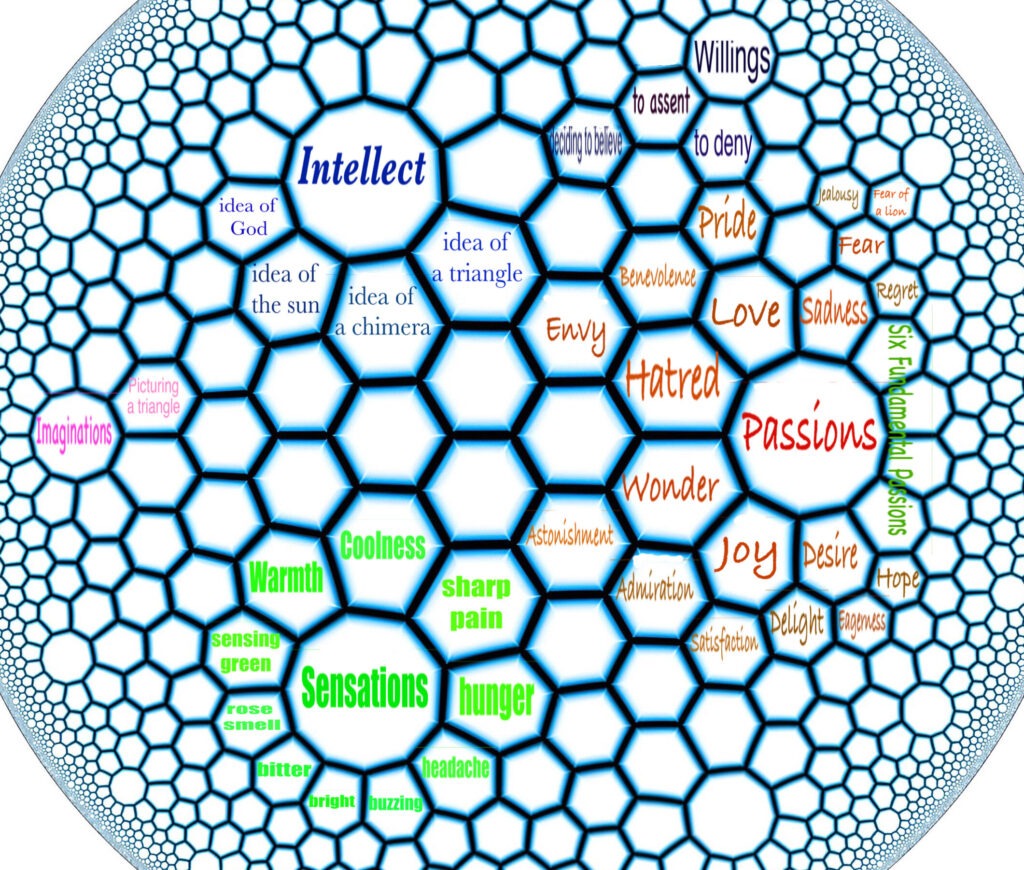
- What are the passions of the soul? What are their natures?
- What is the process by which the passions arise?
- How are they related to the rest of the contents of the human mind?
- What are the functions of the passions in human life?
- How (if at all) does thinking of the passions in the context of the mind-body union help to understand them, or the union itself?
- Does Descartes’s analysis of the passions undercut his dualism?
- How do the passions contribute to people’s benefit, and, if not careful, prevent minds from recognizing it?
- How can the passions be regulated rationally?
- How do the passions affect people’s freedom?
- Do passions have aboutness in the same sense as intellectual ideas, or is their directedness primarily evaluative (good/bad for me) rather than object-specifying?
- Can a passion be “materially false” in any serious sense, or does material falsity apply only to sensory ideas (and why)?
- How does Descartes explain passionate conflict (simultaneous motivational pulls) without positing multiple centers of agency in the mind?
- Are the passions ever representational states?
- If so, what do the passions represent and how do they do so?
- If not, what functions do they serve?
- If passions represent, do they represent (a) external situations, (b) bodily states, (c) value-relations to the self, or (d) some hybrid package?
- Can passionate representation be purely idea-r-ext (sign-based) without idea-r-int content, and what would be the best Descartes-style argument either way?
- What distinguishes a passion’s representing from merely causing (e.g., causal arousal without intentional content)?
- Are all primary quality sensations clear and distinct?
- Can primary quality sensations of extended space, or of color (that must appear extended to be visible), have formally real extension? Why, or why not?
- What is Descartes’s characterization of the perception of primary qualities?
- Does Descartes think primary-quality perception is ever sensory in a robust way, or is it largely intellectualized (geometry of extension)?
- Are primary-quality perceptions representational by resemblance, by lawful sign, or by intellectual containment of essence—and does Descartes commit to a single model?
- How should we treat the “geometry of vision” in Descartes: is it an account of representation or merely a causal account of sensory stimulation? For this question: “the geometry of vision” refers to Descartes’s mathematically framed optics, i.e., his use of geometrical principles (rays, angles, refraction, projection, perspective, retinal image formation) to explain how light and bodily structures determine the patterns of stimulation delivered to the eyes, optic nerves, and brain. The relevance is that this optics can be read in two very different ways: either as a theory of representation (explaining how visual experience represents spatial features of bodies), or as a purely causal story about sensory stimulation (explaining how corporeal motions produce visual sensations without those sensations containing internally object-specifying content). The question presses where, if anywhere, Descartes thinks the transition occurs from geometrically describable causal transmission to genuine representational content—especially whether visual experience itself is idea-r-int (with OR) or instead primarily idea-r-ext (a law-governed sign of bodily configurations).
- How do ideas represent and what is required?
- Do all ideas represent?
- If not all ideas represent, which ones do not?
- Are there different ways that ideas can represent? Does Descartes propose different modes or mechanisms of representation in his theory of ideas?
- Are there any examples of Cartesian ideas that do not “represent”?
- What criteria does Descartes use to determine whether an idea accurately represents something?
- Does Descartes acknowledge the potential for obscure and confused ideas to accurately represent reality?
- Can obscure and confused ideas fail to misrepresent?
- What kinds of representations does Descartes recognize? Answer: representation by means of intellectual content by means of the objectively real essences of things and representing by being a non-resembling sign (especially, secondary quality sensations (SQS)) or possibly resembling (especially, primary quality sensations (PQS)) something other than itself.
- What is Descartes’s theory with textual evidence of how it is possible for signs to be representational?
- What is the cleanest Descartes-compatible taxonomy of representation: idea-r-int (objective reality) vs idea-r-ext (lawful sign)—and what texts most constrain it?
- Can representation be purely causal (tracking) without any internally contained representatum, or does Descartes require more than tracking for genuine representation?
- How does Descartes’s rejection of resemblance-as-necessary reshape the standard early modern picture-theory of representation?
- What is the role of God (or nature) in establishing representational relations: constitutive, enabling, or merely background-metaphysical? For this question: the issue is whether, for Descartes, representational relations (an idea’s being “of” something) depend on God (or “nature”) in a strong, constitutive way (God fixes the intentional order and the content–object mapping), in a weaker, enabling way (God creates and conserves minds, bodies, and laws so that ideas can reliably correlate with their causes), or only as a background guarantee (God’s non-deceptiveness underwrites trust in our cognitive faculties when properly used without directly determining representational content). The question matters because different answers yield different models of sensory “aboutness”: on a constitutive reading, God would be part of what makes an idea count as representing this rather than that; on an enabling/sign-reading, God underwrites lawful correlations (idea-r-ext) without conferring internally object-specifying OR-content; on a merely background reading, God chiefly secures epistemic entitlement and norms of use (e.g., when assent is appropriate) rather than content-fixation.
- Are all secondary quality sensations obscure and confused?
- Are all secondary quality sensations that are obscure and confused inherently misrepresenting?
- If secondary quality sensations lack any objective reality what qualifies them to be classified as ideas?
- How does Descartes define “secondary quality sensations,” and does he consider all such sensations to be inherently obscure and confused?
- Is there a distinction between a secondary quality sensation being “obscure and confused” and “misrepresenting” in Descartes’s theory?
- How does Descartes justify classifying secondary quality sensations as ideas even when they lack any objective reality?
- Can a secondary-quality sensation be clear-and-distinct qua sensation while lacking any objective reality—how should that be stated without contradiction?
- If secondary-quality sensations are externally representational signs, what exactly is the external correlate: bodily surface states, neural states, or “union states” of the composite?
- How does Descartes explain cross-person variability (one person’s pain threshold, color discrimination) while maintaining reliable sign-functions?
- What is the precise role of teleology in the semantics of secondary-quality sensation: does teleology explain normativity (proper function) without supplying objective content?
- How does Descartes deal with the possibility of linguistic and cultural influences on the formation of ideas?
- How does Descartes account for the genesis and development of ideas throughout a person’s life in his theory?
- How does Descartes’s theory of ideas account for the changeability and evolution of ideas over time?
- How does Descartes explain the epistemic force of custom, upbringing, and “prejudices of childhood” in shaping what we take our ideas to represent?
- What is Descartes’s method for de-conditioning socially inherited representational habits (especially the projection of sensory qualities onto bodies)? For this question: the target is Descartes’s practical method for undoing entrenched childhood-and-culture “prejudices” that train us to treat sensory phenomenology (colors, tastes, heat/cold, pains) as if it were a faithful description of mind-independent properties in bodies. The question asks what procedures Descartes actually recommends for breaking that habit—e.g., methodological doubt and suspension of assent; isolating what is grasped clearly and distinctly (extension, figure, motion) from what is merely delivered confusedly by the senses; re-educating attention to separate the sensory mode from the intellectual judgment it naturally occasions; and substituting a mechanistic-physiological understanding of sensation (as bodily stimulation and law-governed correlation) for the naive resemblance/projection model.
- How should we treat testimony and authority in Descartes’s theory of ideas: as sources of ideas, or only as causes of assent? For this question: the issue is whether, for Descartes, testimony and authority function primarily as (a) genuine sources of ideas and cognitive contents (supplying new idea-r-int materials to the intellect), or instead as (b) social-psychological causes that move the will toward assent (producing belief without improving the clarity, distinctness, or internal determinacy of the underlying ideas). The question matters because Descartes’s method typically treats deference to authority as a chief engine of “prejudices”: it can generate confident assent where the ideas themselves are obscure and confused, thereby entrenching socially inherited projections (especially in sensory matters) rather than furnishing the sort of internally articulated intellectual content that could ground knowledge.
- Does Descartes have resources to explain conceptual change across generations (scientific revolutions) in terms of changes in the intellectual content of ideas? For this question: the issue is whether Descartes can explain large-scale historical shifts in science (e.g., replacement of Aristotelian forms/qualities with mechanistic extension-and-motion frameworks) as genuine changes in the intellectual content of ideas—i.e., alterations in what is internally represented, how concepts are articulated, and what is taken to be clear and distinct—rather than merely as shifts in vocabulary, pedagogy, or institutional authority. The question probes what in Descartes’s system could drive such change: methodical critique of inherited prejudices, the re-education of attention toward clear-and-distinct natures, the development of mathematically structured conceptions in physics, and the gradual abandonment of sensory-projection habits that previously shaped communal theorizing.
- What is the relationship between language learning and idea acquisition for Descartes: does language merely label prior ideas, or can it restructure cognitive contents? For this question: the issue is whether, in Descartes’s theory of ideas, language is chiefly a system of conventional signs that merely attaches names to pre-existing ideas (so that words mainly affect communication and the will’s readiness to assent), or whether linguistic practice can actively reshape the mind’s ideas by reorganizing attention, carving new conceptual distinctions, and stabilizing complex intellectual contents into usable idea-r-int structures. The question matters because Descartes repeatedly treats ordinary language as a vehicle of prejudice (it encourages projecting sensory terms onto bodies), yet scientific language and mathematical symbolism seem to support the opposite effect, i.e., the disciplined formation and maintenance of clearer, more determinate intellectual ideas.
- 1René Descartes, Meditations on First Philosophy, Third Meditation, translated by Jonathan Bennett, 2017, 9. ↩︎
7. Mind questions
8. Idea questions
9. Objective Reality questions
10. Advanced questions about the objective reality of an idea
11. Passions
11.1 The Passions:
11.2 Passionate Representation:

12. Primary quality questions
13. Representation questions
14. Secondary quality questions
15. Sociological questions