


[NOTE: See Glossary below for definition of all technical terms. Hyperlinks are in magenta or blue or underlined blue hyperlinks. Click a hyperlinked technical term, then click the blue circle with a white up-arrow  in the lower-right corner to jump back to the top of the post. Also see “DTOI & Non-DTOI Baselines For AI Models.” For more Cartesian glossary entries consult The Cambridge Descartes Lexicon.]
A DTOI-style “satisfying answer” to the low-determination question
The core move is to deny that “material falsity” is a predicate that applies only where a Cartesian strict idea contains a representatum. On the DTOI baseline, in the secondary quality instances, material falsity is instead a property of certain idea-s (sensation) episodes precisely because they are empty of content with respect to essences while still being phenomenally positive and teleologically action-guiding. Their “falsity” is therefore not content-falsity (false objective reality) but error-matter: they furnish the mind with the kind of experiential “stuff” that naturally leads it to treat what is not in bodies as if it were there.
Put as a compact thesis for the material falsity of SQ-sensationss:
MF on DTOI = (phenomenal positivity + underdetermined extra-mental reference + built-in inclination to reclassify the sensation as idea-r-int) → “non-thing as thing,” without any internally false represented object.
That already supplies the satisfying answer: low determination is not a bug that blocks material falsity; it is one of the enabling conditions of material falsity—because it is exactly what makes the idea apt to be mistakenly upgraded into an object-specifying representational item.
Step 1: Re-state the problem in the right register
The “low-determination question” can be posed in a misleading way:
How can an idea be called false if it does not determinately specify any object?
On DTOI, this assumes (wrongly) that falsity here must be like propositional falsity, i.e., failure of a determinate content to match reality. But Descartes’s “material falsity” is not introduced to capture a mismatch between a determinate represented object and the world. It is introduced initially with. secondary quality sebsations to capture how certain sensory modes can be the source of error even though, strictly speaking, error is in judgment.
So the question becomes:
How can a sensory mode that lacks idea-r-int nevertheless be intrinsically error-prone in a way that warrants calling it “materially false”?
This is the question Descartes can answer satisfyingly, on DTOI terms.
Step 2: The DTOI taxonomy does the heavy lifting
Use the baseline labels:
- idea-m: the mental mode itself (formally real episode).
- idea-s: a sensory idea (a sub-type of idea-m).
- idea-r-int/ idea-or: internal representation (objective reality, object contained intentionally).
- idea-r-ext: external representation (law-governed sign of bodily configuration, without objective-reality content).
Now the key constraints:
- Cold-as-sensation is idea-s (thus idea-m) but not idea-r-int.
It has formal reality as an occurrent conscious mode; it does not, as such, contain an object with objective reality. - Cold-as-sensation can still be idea-r-ext.
It can function as a law-governed sign of some bodily condition, while remaining internally non-object-specifying. - Material falsity targets a characteristic failure mode: mistaking idea-s for idea-r-int.
The sensory mode is naturally apt to be taken as if it disclosed a body-quality resembling its phenomenal character.
This is the “satisfying answer” architecture: material falsity is the mark of a systematic pressure to misclassify the epistemic kind of the state.
Step 3: Why no OR-content underdetermination is compatible with “non-thing as thing”
Under-determination means: from within the sensory episode alone, nothing fixes whether what is “out there” is a privation, a positive quality, a bodily configuration, or something else. The episode is silent (or radically underdeterminate) about extra-mental essences.
But that is compatible with the episode doing something else that is robust and stable:
- It presents a positive phenomenal character (the “cold feel” as a conscious qualitative presence).
- It inclines the mind toward a default construal: that what is presented phenomenally is also present in the body.
So the “non-thing as thing” structure can be captured without any determinate object-content:
- The “thing” is the phenomenally positive cold-as-felt (a real mode of mind).
- The “non-thing” (in the relevant external register) is whatever the world lacks that the mind is tempted to posit—e.g., a positive cold-quality in bodies that resembles the phenomenal cold.
Because the episode does not determinately specify the external story, it is especially apt to be filled in by habit. That is exactly how a no OR-content state can be “materially false”: not by containing a false object, but by being the kind of state that supplies a stable invitation to posit one.
Step 4: Cold sensation as the model case
On the DTOI baseline, the cold case is explained by a three-layer account.
(A) The episode (idea-s as idea-m)
A cold sensation is a conscious mode with formal reality and a distinctive phenomenal positivity. It is “something” in experience—enough to guide avoidance/withdrawal.
(B) The lawful link (idea-r-ext)
That same episode is reliably correlated (lawfully connected) with certain bodily micro-configurations that tend to produce tissue stress, heat-loss conditions, etc. This is the sense in which it “represents the external” without containing it.
(C) The characteristic error-profile (material falsity)
Because the episode is vivid and positive in experience, it naturally tempts the mind to treat it as if it were idea-r-int of an external positive quality like itself.
Material falsity is exactly the label for that error-profile prior to any explicit judgment: the sensory mode is constituted so as to provide “matter” for the specific, recurrent mistake of projection (taking the phenomenal positivity to be a body-quality).
That makes material falsity compatible with low determination:
- the sensation does not fix a determinate representatum (see 2.1) [the object or state of affairs that is being represented] internally.
- It is half of a dual relationship that defines a representation:
- Representatum (see 2.1): The “thing” the representation stands for or refers to (e.g., a physical object, a property, or a causal process).
- Representans (see 2.1): The “device” or medium that does the representing internally;
- yet it has a stable phenomenal character that systematically prompts a determinate kind of misinterpretation.
Step 5: Why this counts as a genuinely “satisfying” answer in Descartes’s own terms
A satisfying answer must meet three Cartesian constraints simultaneously:
- Preserve the formal/objective distinction.
MF must not require that the sensation contain objective-reality content that is false. - Explain why the senses are not designed to reveal essences.
Sensations should be adequate for guiding the composite, not for metaphysical disclosure of body-properties. - Explain why error is common without making God a deceiver.
The state must be naturally fitted to the creature’s preservation while being liable to misuse when treated as an essence-revealer.
The DTOI answer meets all three:
- The cold sensation’s teleological role is secured at the level of idea-r-ext and phenomenal guidance.
- Its liability to mislead is secured at the level of a built-in inclination to upgrade it into idea-r-int.
- Material falsity is precisely the name for that liability, not for an internally false content.
So the “low-determination” feature is not an obstacle; it is part of the explanation: because the sensory state does not itself determine the extra-mental kind, the mind’s habitual “upgrade” mechanism has room to operate—and that room is the birthplace of material falsity.
One sharpened formulation to add to the DTOI baseline (if desired)
MF-LD (low-determination thesis): A sensory idea can be materially false even when it lacks any determinate representatum objectively in the intellect because material falsity is not falsity of objective content but the intrinsic propensity of a phenomenally positive, extra-mentally underdeterminate sensory mode to be misconstrued as idea-r-int, thereby inclining the mind to treat what is not in bodies as if it were there.
That is the satisfying answer: material falsity is the metaphysical-epistemic name for a predictable misuse of a teleologically well-designed no OR-content signal.
DTOI Glossary Definitions, Contrasts, And Examples
Table of Glossary Contents found below
Scroll down to get to the relevant glossary entry
Term DTOI label / abbreviation | Definition in the DTOI baseline | Contrasts / Exclusions | Textual Anchors / Diagnostic Examples |
Idea (broad sense) “idea” (broad/wide) | Any occurrent mode of thought immediately present in consciousness (sensing, imagining, willing, judging as a mode). Broad-idea status does not entail internal object-specification (idea-r-int) or objective reality (OR). | Not restricted to image-like ideas (tanquam rerum imagines; as if an image) or to object-containing contents (OR/OB). | “I use the word ‘idea’ to mean everything that can be in our thought. And I distinguish three kinds.” (Letter to Mersenne, 16 June 1641, AT III 383, CSMK III 183; bold not in origiinal) 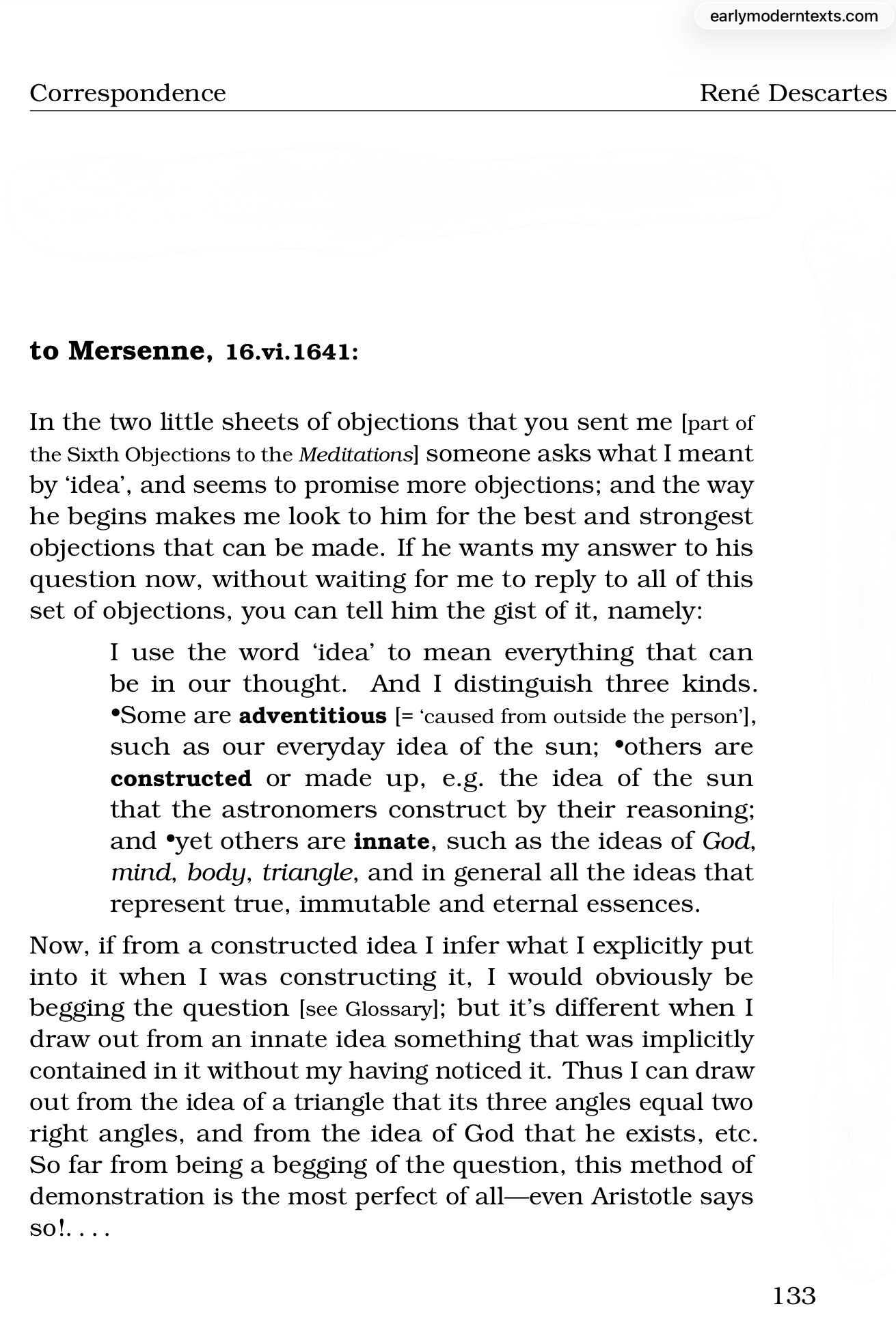 “; by ‘idea’ I mean in general everything that is in our mind when we conceive something, no matter how we conceive it.” (Letter to Mersenne, July 1641, AT III 393, CSMK III 185; bold not in original) 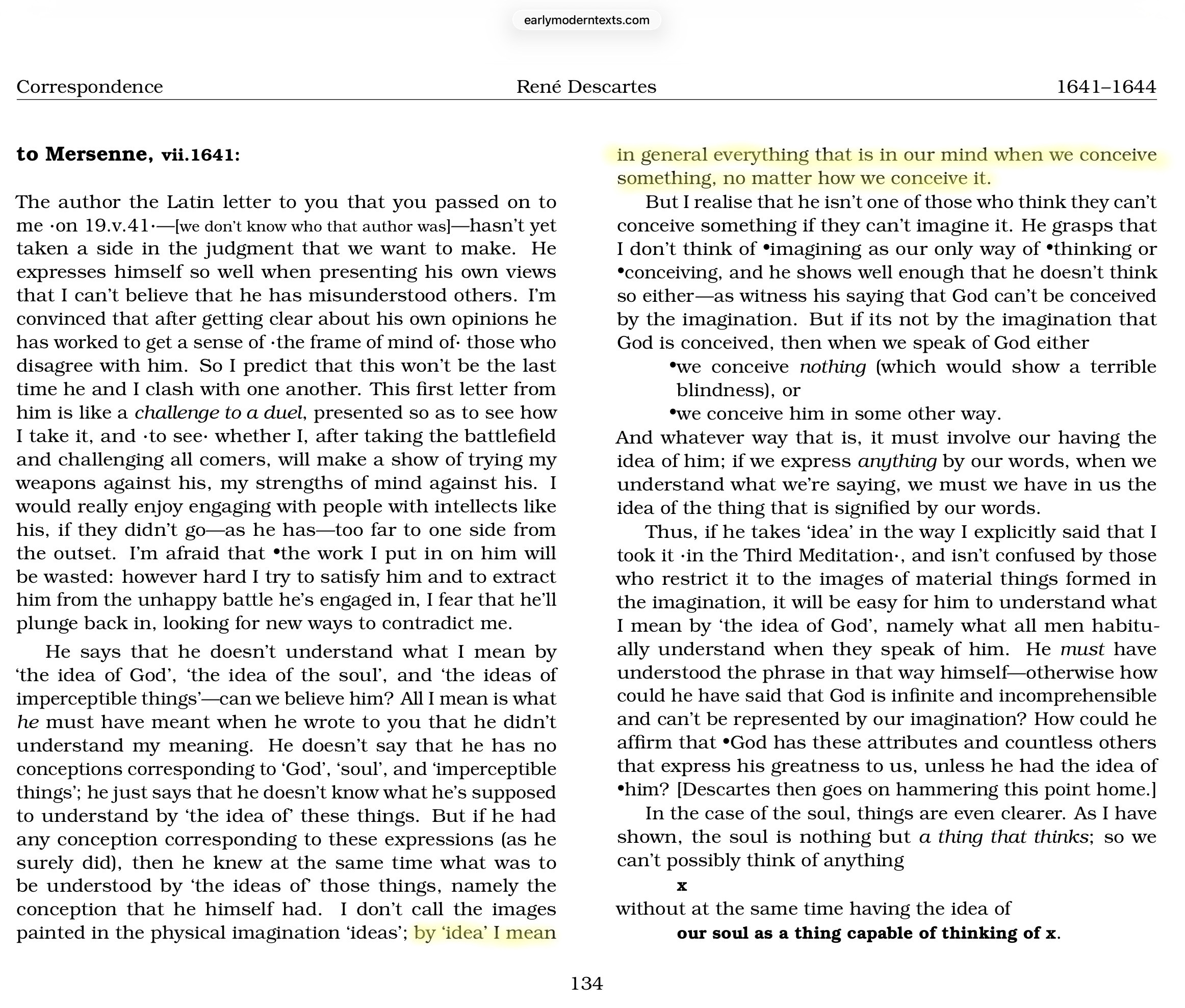 “But I make it quite clear in several places throughout the book, and in this passage in particular, that I am taking the word ‘idea’ to refer to whatever is immediately perceived by the mind. For example, when I want something, or am afraid of something, I simultaneously perceive that I want, or am afraid; and this is why I count volition and fear among my ideas.” (Third Replies: AT VII 181; CSM II 127; bold not in original) 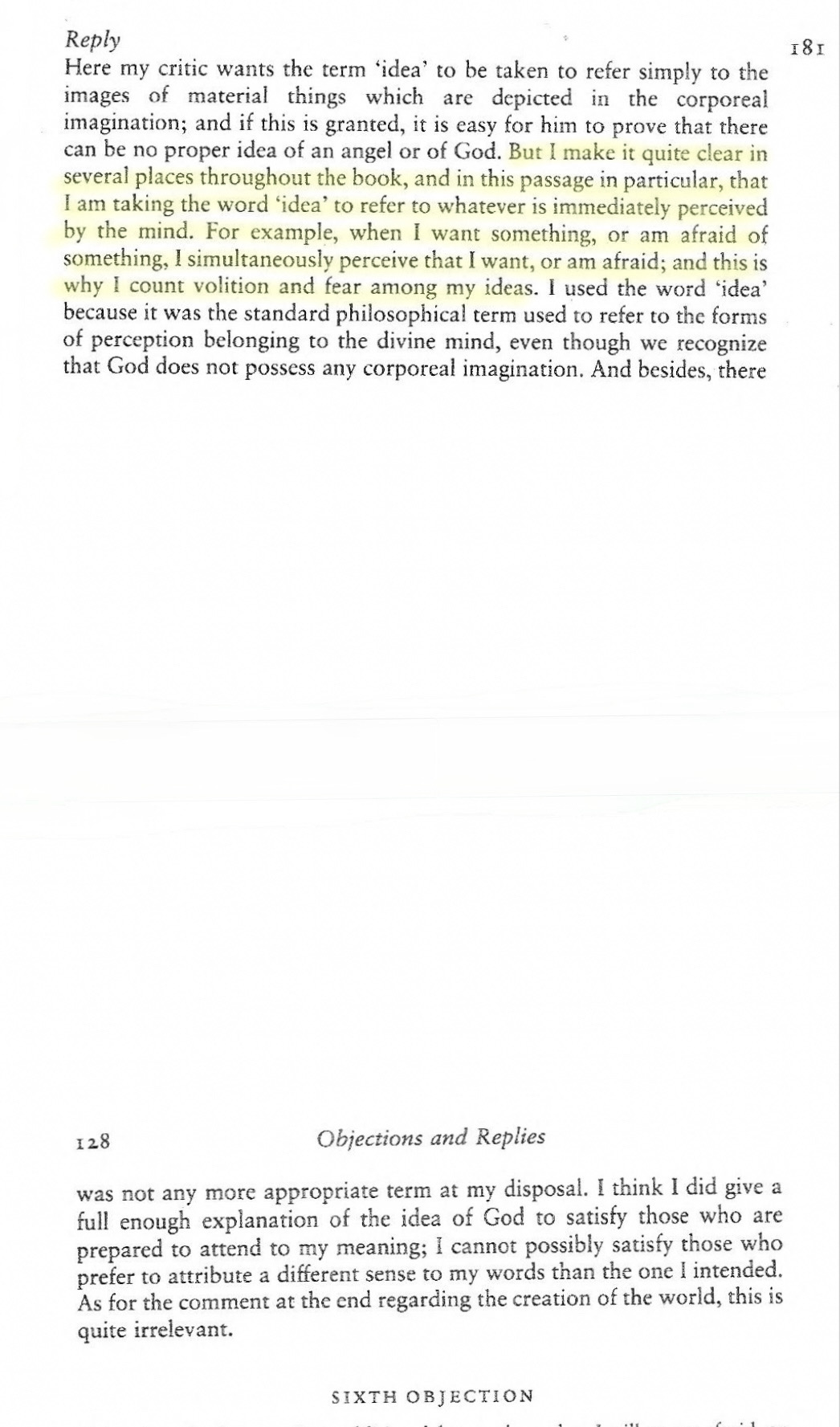 “Idea. I understand this term to mean the form of any given thought, immediate perception of which makes me aware of the thought.” (Second Replies, AT VII 160–61; CSM II 113; bold not in original) 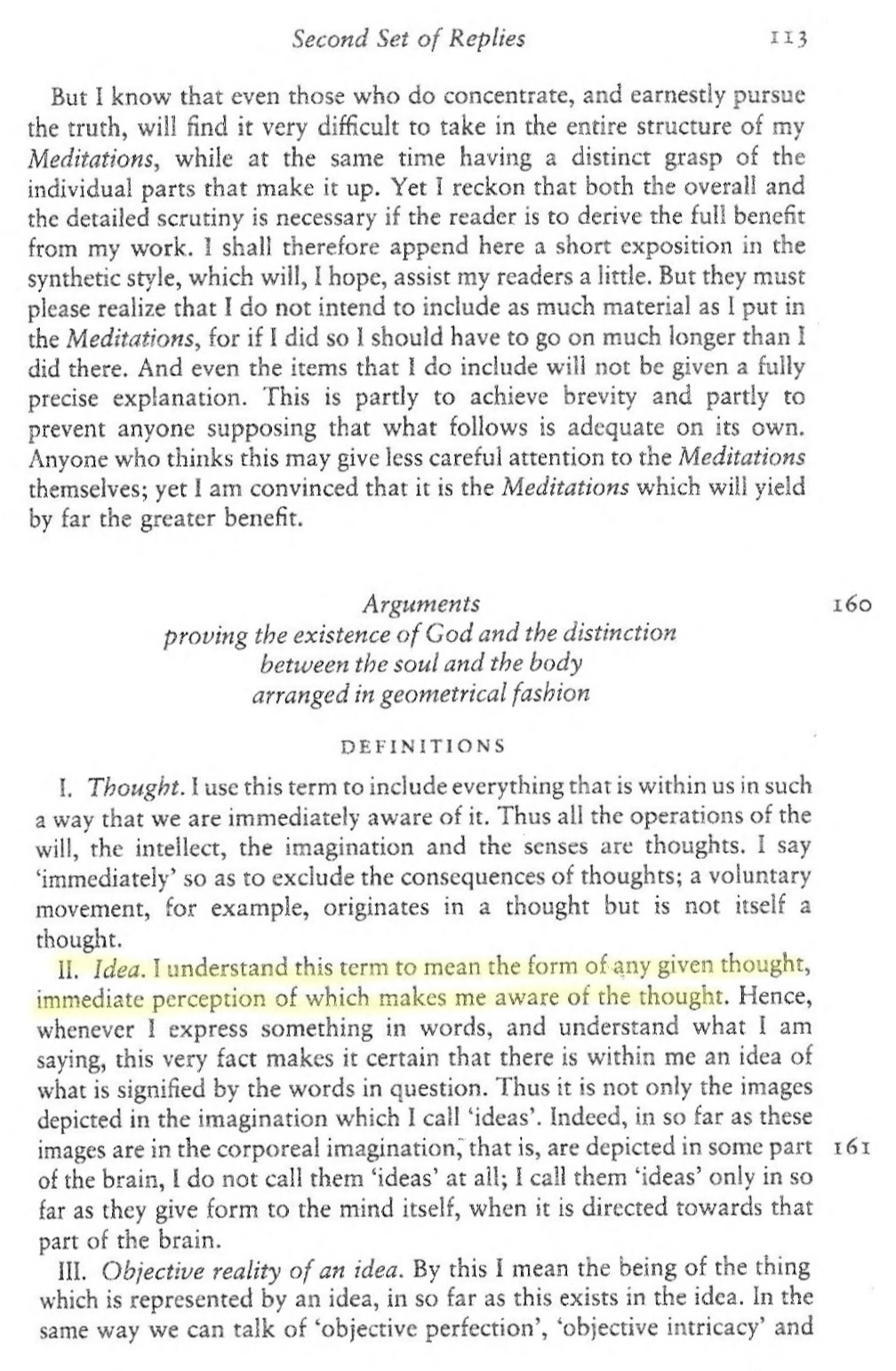 “Confused ideas which are made up at will by the mind, such as the ideas of false gods, do not provide as much scope for error as the confused ideas arriving from the senses, such as the ideas of colour and cold (if it is true, as I have said, that these ideas do not represent anything real).” (AT VII 234; CSM II 163) 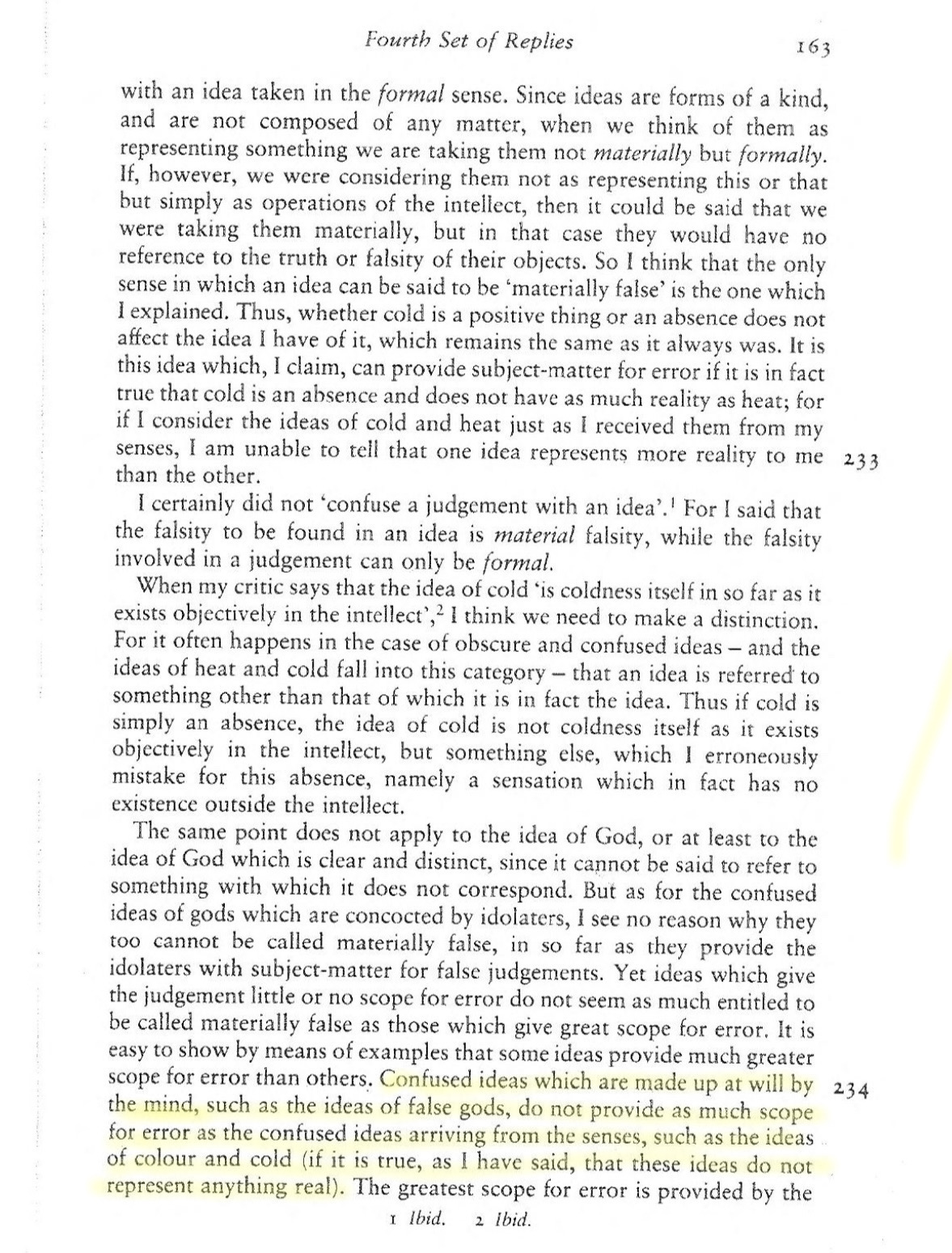 Descartes labels sensations as ideas here no question. A sensation of cold counts as an “idea” in this broad sense even if it lacks objectively real content. |
Idea (strict sense) “idea” (strict/narrow) | An idea that functions tanquam rerum imagines (“as if an image of a thing”) and that contains a determinate representatum (see 2.1) with objective being (OB) and therefore contains objective reality (OR) of some degree or order. | Not every broad-sense idea is a strict-sense “idea.” | “Some of my thoughts are as it were the images of things, and it is only in these cases that the term ‘idea’ is strictly appropriate—for example, when I think of aman, or a chimera, or the sky, or an angel, or God.“ (Third Med.: AT VII 37; CSM II 25) Clear intellectual idea of triangle, God, extension: candidates for strict-sense ideas. |
Idea as a mode of mind idea-m | The occurrent mental episode itself: a mode/act of a finite mind with formal reality as long as it occurs. “Idea” in the material sense names the operation/modification, irrespective of whether (and how) it represents. | Not identical with OR or OB; not itself a distinct “object in the intellect.” Having formal reality as an occurrent act does not by itself guarantee internal object-specification (idea-r-int). | A pain episode as such: a formally real mode (idea-m), even if it lacks internal object-specifying content. |
Sensory idea idea-s | A sensory mode arising from mind–body union: sensations, appetites, and passions insofar as they are sensory/union-born deliverances. idea-s is restricted to sensation-like consciousness (including imagination insofar as it presents sensory-like imagery). On the DTOI baseline, idea-s can be vivid and even clear and distinct qua sensation while lacking internally object-specifying representation (no idea-r-int/OR); nonetheless, it can still function as external representation (idea-r-ext), i.e., a law-governed sign of bodily configurations. | Not a non-sensory intellectual idea (idea-i). Not automatically idea-r-int: sensory presentation does not entail internal object-specification of a determinate representatum (see 2.1). Not “objective” in the modern mind-independent sense. | Cold, pain, color; thirst. Seeing Leo the lion as a perceptual episode is idea-s (sensory), even if one also forms an intellectual judgment about Leo. |
Purely (non-sensory) Intellectual idea idea-i | A non-sensory intellectual idea: an idea-m (formal mode of mind) whose form is intellection (conceptual understanding) rather than sensory presentation or imagination. Idea-i can internally specify a determinate representatum (see 2.1) (idea-r-int), thereby presenting it with objective being (OB) and measurable objective reality (OR). The representatum may be singular (e.g., Leo) or universal (e.g., triangle); OR is measured by the representatum’s ontological rank/order (mode / finite substance / infinite substance), not by “type” as species or kind. Intellectual ideas are not automatically clear and distinct: they can be obscure/confused when they are composites without a distinctly grasped essence. | Excludes sensations and sensory-like imagination (those are idea-s). Mixed cases (a sensory episode plus an intellectual construal/judgment) should be treated as a package (idea-s + idea-i overlay), not as a single pure idea-i. | Thinking of Leo as a particular finite corporeal substance (non-sensory intellection) is idea-i. A chimera-like concept (winged horse) can be idea-i yet confused as a composite. |
Internal representation idea-r-int | The representational role/relation in which an idea-m is internally object-specifying, i.e., it determines a definite representatum as present objectively in the intellect (OB). Internal representation can be singular or universal in reference; its OR is measured by the representatum’s ontological rank/order. | Not mere causal correlation (idea-r-ext); not mere mentality (idea-m); not a detachable intra-mental “content-entity.” | A clear idea of body as extended is internally object-specifying (idea-r-int), hence has OB and OR. |
Objective reality OR / idea-or | Objective reality is the internally contained representational content of a Cartesian strict idea: the representational presence in the intellect of the idea’s representatum, considered as a substance, principal attribute, true and immutable nature, or mode. The representatum, insofar as it possesses objective being in the idea, has a determinate ontological rank. That rank determines both the degree of objective reality contained in the idea and the amount of formal or eminent reality required of its adequate cause. Objective reality / objectively real representational content: the representational presence of a representatum (see 2.1)—the item represented—in a Cartesian strict idea. The representatum is contained in the idea as represented or as conceived, not as the formally existing thing itself. Objective reality exists only in and through a formally real idea, since the idea and its representational content are real modifications of mind; but it is not the idea considered merely as such a modification. It is the idea considered according to what it represents. Objective reality is therefore dependent on the idea’s formal reality without being reducible to it: two ideas may be alike as finite mental modes while differing in what they contain objectively, including the decisive case in which Descartes’s finite idea of God contains infinite substance objectively without containing God formally in the mind. OR presupposes OB (objective being) and its degree is determined by the ontological rank of the representatum, as an infinite substance, finite substance, principal attribute, true and immutable nature, or mode. | Not mind-independent “objective facts”; not mere vividness of sensation; not reducible to idea-r-ext. | The idea of God has greater OR than the idea of a finite substance because its representatum (see 2.1) is of higher ontological rank. |
Objective being OB | Objective being (OB): the mode of being possessed by a representatum insofar as it is objectively contained in a Cartesian strict idea. Objective being is neither the formal reality of the idea considered as a mode of thought nor the formal existence of the representatum outside the intellect. It is the representatum’s being-in-the-idea as represented and therefore applies only where a Cartesian strict idea contains a representatum. Objective being must therefore be distinguished from mere conceivability, intelligibility, propositional content, and clear perception. A common notion or eternal truth may be conceived or clearly perceived without thereby being a single representatum objectively contained in a strict idea. Objective being is the distinctive mode of being possessed by the representatum when it is objectively contained in a Cartesian strict idea. Because the representatum possesses objective being within the idea, it also possesses an ontological rank. That ontological rank determines the degree of objective reality contained in the idea and therefore the amount of formal or eminent reality required of the idea’s adequate cause. | Not formal reality (FR) of the mental episode; not mind-independent existence; not mere causal correlation (idea-r-ext). Distinct from OR: OB answers how the representatum (see 2.1) is in the intellect (objectively), whereas OR answers how much/of what order. | Diagnostic: if a determinate representatum (see 2.1) is present only as intentionally “in” thought (not as an external thing, not as the act itself), it is present with OB. Example: the sun exists objectively in the intellect in the idea of the sun, though not formally in the intellect as it does in the sky. |
External representation idea-r-ext | Law-governed signification: a sensory state functions as a reliable sign/correlate of bodily configurations that cause it, without internally object-specifying those configurations as a determinate representatum (see 2.1) present with OB (and thus without OR). This is genuine “representation” in the semiotic/teleological register, not in the strict OR/OB register. | Not internal object-specification (idea-r-int/OR/OB); does not require resemblance. | Cold sensation lawfully correlates with certain bodily states even if it contains no OR-content. |
Formal Being/ Formal reality FB/FR | The reality a thing has by existing as the kind of thing it is; can apply to mental modes as their real existence in the mind. | Often said to contrast with objective reality (OR; representational being) as distinct from formal reality. It remains controversial whether when an idea contains objective reality, it has it as a formally real objective reality representational content of an idea. | “And this is transparently true not only in the case of effects which possess actual or formal reality, . . . .” (Third Med.: AT VII 41; CSM II 28; bold not in original) The sensation of cold has FR as a mode of mind. |
Material falsity MF | Not propositional falsity in an idea; the idea’s intrinsic tendency to provide “subject-matter for error,” commonly by inclining the mind to treat what is not in the universe as if it were. | Not “inherent misrepresentation” in the sensation; not equivalent to nonexistence of the object. | “But as for the confused ideas of gods which are concocted by idolaters, I see no reason why they too cannot be called materially false, in so far as they provide the idolaters with subject-matter for false judgements. Yet ideas which give the judgement little or no scope for error do not seem as much entitled to be called materially false as those which give great scope for error, It is easy to show by means of examples that some ideas provide much greater scope for error than others. Confused ideas which are made up at will by the mind, such as the ideas of false gods, do not provide as much scope for error as the confused ideas arriving from the senses, such as the ideas of colour and cold (if it is true, as I have said, that these ideas do not represent anything real). The greatest scope for error is provided by the ideas which arise from the sensations of appetite. Thus the idea of thirst which the patient with dropsy has does indeed give him subject-matter for error, since it can lead him to judge that a drink will do him good, when in fact it will do him harm.” (Fourth Replies: AT VII 233–34; CSM II 163–64; bold not in original) Cold sensation: phenomenally positive, underdeterminate about existence, invites projection of “cold in bodies.” |
MF by inclination MF-inclination | MF can be prior to explicit judgment because the idea’s structure can already supply “matter for error.” | Does not posit hidden OR-content; does not locate falsity in a false internal object. | Dropsical thirst inclines judging drink beneficial when it is harmful. |
Degrees of MF MF-degree | MF varies with how much “occasion for error” the idea supplies; appetite states can be highest, whim-of-imagination fictions often lowest. | Rejects “all fictions equally MF.” | Santa-type ideas usually low unless credulously treated as real; dropsy high. |
Presentation presentation | First-order phenomenology: the idea is immediately present as an experience of its own qualitative character. | Not identical with representation of an external quality. | Cold presents “cold-feel” without thereby internally representing “cold-quality in bodies.” |
Representation representation | Either (a) internal representation (idea-r-int/OR/OB) or (b) external representation (idea-r-ext signhood), depending on context. | Avoids collapsing representation into mere “being present to mind.” | Sensations may be representational in sense (b) while lacking (a). |
No OR-content underdetermination underdetermination | Sensory episodes often fail to fix a determinate extra-mental referent or essence; multiple external hypotheses fit the same experience. | Not “hidden content”; not a defect in vividness. | A cold sensation’s content does not determine whether the external is privation, positive property, or neither. |
Epistemic upgrade “upgrade” | The mind’s habitual move from sign/presentation to treating the state as if it were internal representation of an external quality or rank. | Not required for the sensation to occur; explains the error-profile. | Treating warmth-feel as revealing a warmth-quality in bodies. |
Kind-mistake pressure “non-thing as thing” pressure | The structural tendency of some ideas (especially sensory) to be taken as disclosing a bodily quality of the same kind as what is phenomenally presented. | Not mere nonexistence; not resemblance mandated by bodies. | Projecting phenomenal cold into bodies as a positive quality. |
Teleology of the senses teleology | Sensations are for guiding the composite toward benefit/harm, not for revealing essences of bodies; misuse generates MF. | Opposes “sensation as essence-disclosure.” | Pain guides withdrawal; cold warns; thirst guides drinking. |
Sensitive appetite appetite | Subclass of sensory ideas that strongly directs action (thirst, hunger, etc.). | Not reducible to intellectual judgment; high “occasion for error.” | Dropsical thirst: appetite signal miscalibration. |
Clear and distinct C&D vivid and clear (Jonathan Bennett) | A cognitive status that blocks MF when the idea is clear in the relevant respect; mis-taking pressure is absent. | Not the same as vivid sensory phenomenology. | Clear idea of God is not MF; vivid pain can still be MF-relevant. |
Obscure and confused O&C | A status associated with underdetermination and susceptibility to mis-taking; central to MF conditions for sensory ideas. | Not dim phenomenology; not evidence of hidden OR-content. | Vivid cold is still obscure/confused about bodies. |
“Minimal OR” minimal OR | A rejected interpretive posit that sensations contain a thin sliver of OR-content. | Either collapses into determinate OR (resemblance drift) or becomes too thin to be OR at all. | Using Med. VI “idea of sensible things” language to infer OR in the sensation itself. Textual anchor often misused to motivate ‘minimal OR’ in sensation: “Now there is in me a passive faculty of sensory perception, that is, a faculty for receiving and recognizing the ideas of sensible objects; but I could not make use of it unless there was also an active faculty, either in me or in something else, which produced or brought about these ideas. . . . So the only alternative is that it is in another substance distinct from me—a substance which contains either formally or eminently all the reality which exists objectively in the ideas produced by this faculty (as I have just noted).” (Med. VI, para. 10; AT VII 79; CSM II 55) 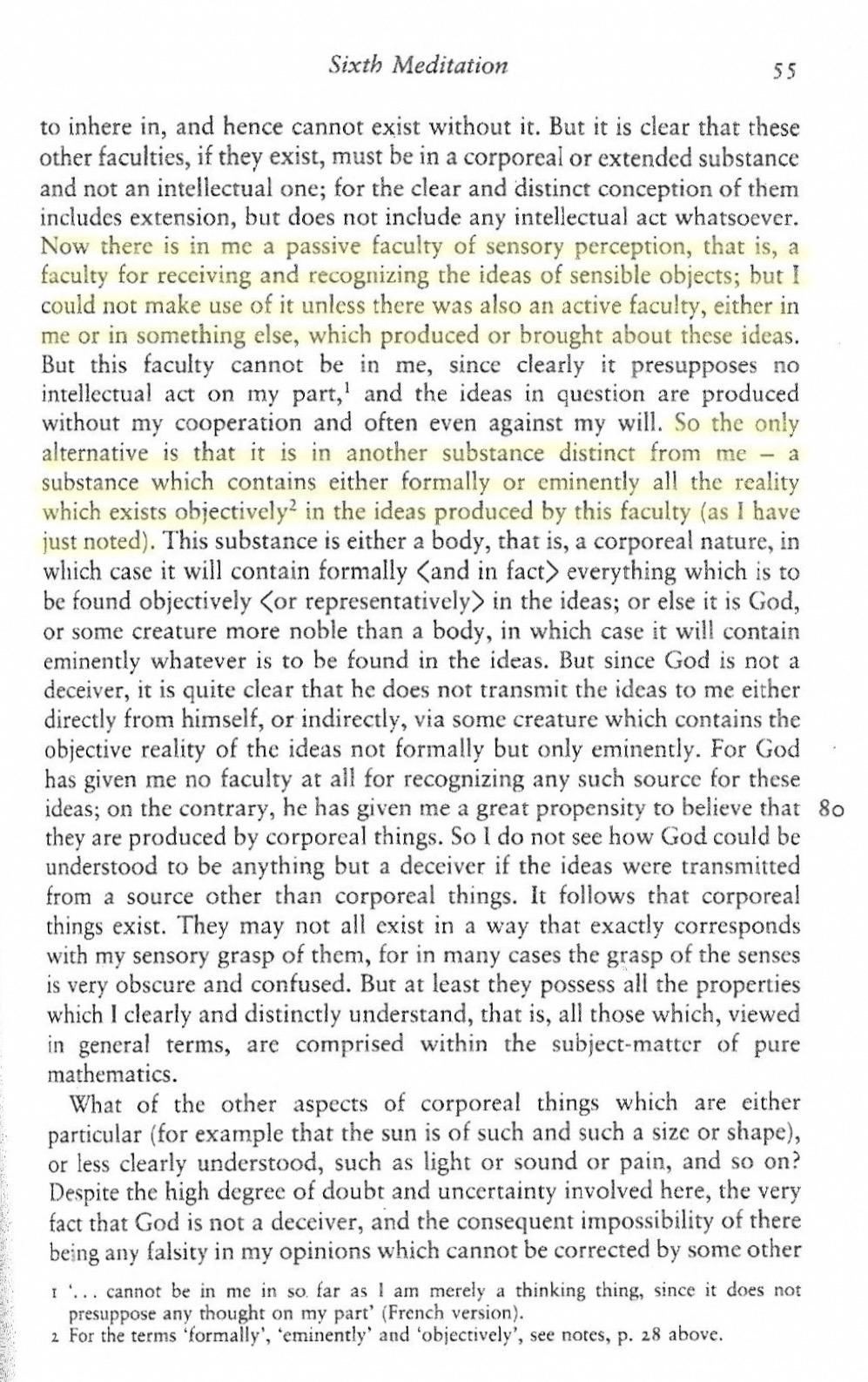 |
Level distinction: sensation vs package level distinction | Object-talk can attach to a broader package (sensation + habitual construal + causal entitlement) without implying OR-content in the bare sensation. | Blocks reading object-language as direct evidence of OR in sensation. | “Idea of a sensible thing” belongs to the composite package, not to cold-feel alone. |
Broad vs strict “idea” distinction broad/strict wide/narrow | Methodological guardrail: identify whether “idea” is being used for any conscious mode (broad/wide) or for object-containing representational content (strict/narrow). | Prevents equivocating from “it’s an idea” to “it has OR.” | Cold is broad-sense idea; not strict-sense object-containing content. |
Sign-function without resemblance signhood | Sensory signs can correlate with bodily states without resembling them; representation-by-sign does not require similarity. | Rejects resemblance requirement for sensory representationality. | Color-feel correlates with surface microstructure without resembling it. |
E1 Cold sensation case Third Meditation, introduction of “material falsity” using heat/cold: AT VII 43–44; CSM II 30. Third Meditation, later backward reference to the heat/cold example (God-idea cannot be materially false “as I noted a little earlier about heat and cold”): AT VII 46; CSM II 31–32. Fourth Replies (Replies to Arnauld, “DE DEO”): AT VII 233–34; CSM II 163. | The control case in which Descartes uses the “cold” discussion (in his reply to Arnauld) to deny that cold is contained in the sensation objectively (no idea-r-int / idea-or in the sensation itself). E1 therefore functions as the DTOI constraint: a secondary-quality sensation, taken strictly as an idea-s mode, does not internally specify “cold” as an object-type with objective reality; any object-fixing content must come from an added intellectual/conceptual layer (packaging) rather than from the sensation. | Excludes (the target mistake): reading the cold sensation as if it contains “cold” as objective being in the intellect (internal OR-content). E1 blocks the move: “sensation of cold ⇒ cold is objectively in the idea.” Contrast with E2 (false idolater’s god idea): E2 is an intellectual/composite case (not sensory) in which the idea can have idea-r-int (object-specifying content) and yet be called materially false because it supplies error-matter via a rank-mistake or illicit “upgrade” (finite/imperfect package treated as a genuine deity). E1 and E2 differ in idea-type: E1 denies OR-content in the sensation; E2 can involve OR-content in an intellectual idea while still being MF in the relevant sense. Contrast with E3 (dropsical thirst): E3 is an appetitive/sensory case where the state functions teleologically (action-guiding) but becomes miscalibrated in pathology, yielding a strong occasion for error. E1 and E3 differ in mechanism-shape: E1 concerns secondary-quality projection temptations; E3 concerns teleological misfire under abnormal bodily conditions. | Quick diagnostic: Does Descartes explicitly deny that the sensible quality (cold) is “in the idea objectively”? If yes, classify under E1: the sensation itself lacks idea-r-int. Example: In replying to Arnauld’s “cold as privation” worry, Descartes blocks attributing objective cold-content to the sensation; any object-directed “cold-in-body” construal belongs to an intellectualized construal, not to the sensory mode as such. |
E2 “Idea of a false god” case had by idolaters Fourth Replies, AT VII 233–34; CSM II 163. | Composite idea (often idea-i/composite) that can be materially false by underwriting rank-mistakes and false judgments, even if it has internal representational structure. | MF does not reduce to “object doesn’t exist.” | “Jupiter as God” functions as material for false worship-judgments. |
E3 Dropsical thirst case Sixth Meditation, AT VII 84–85; CSM II 59. Fourth Replies, AT VII 234; CSM II 164. | Appetite idea-s with high occasion for error; MF explained by teleological signal miscalibration and action-guiding pressure. | Does not require OR-content; not merely “a false judgment” story. | Thirst inclines drinking though harmful. |
Table of Core DTOI Theses Explained
Core DTOI thesis | Expanded Elaboration | What It Rules Out | Main Explanatory Payoff | Paradigm Cases / Diagnostics |
1) MF = “error-matter,” not false objective content | What this says: Material falsity is not propositional falsity “inside” an idea. It is a feature of certain ideas qua mental episodes that supply subject-matter for error before any explicit judgment. How it fits Descartes’s architecture: Strict truth/falsity belongs to judgments; MF explains why some ideas nevertheless deserve the label “false” because they are intrinsically apt to occasion erroneous judgment, without containing a false represented object. Mechanism: MF attaches to an idea’s functional + phenomenological profile (its built-in tendency to be misused), not to a false internal representatum (see 2.1). | Treating MF as false OR-content (idea-r-int/idea-or) in sensations; treating MF as covert propositional content. | Explains how an idea can be “false” while preserving the judgment-centered account of strict falsity and avoiding any “God built false contents into the mind” pressure. | Cold as phenomenally positive but not internally object-specifying; dropsy as action-guiding signal that misleads; idolater as an idea used as the basis for false judgments. |
2) Low-determination enables MF | What this says: Extra-mental underdetermination does not block MF; it often enables it. A state can be thin/underdeterminate about bodily essences and still be MF because MF tracks an idea’s propensity to be mis-taken, not its success at determinate object-specification. Why this answers the low-determination question: Underdetermination leaves “room” for habitual completion: the mind is tempted to upgrade a phenomenal/sign state into a world-disclosing, object-containing representation. Key point: MF is not “determinately represents X falsely,” but “invites an illegitimate construal of itself as if it represented X.” | “No determinate object → no falsity”; the assumption that falsity requires determinate representational content. | Makes no OR-content sensory episodes intelligible as systematic sources of error without attributing to them hidden OR-content. | Cold: underdetermines whether the external is privation/positive/neither, yet its phenomenal positivity invites projection into bodies. Diagnostic: does the episode fail to fix extra-mental essence while still pressing toward an external-quality construal? |
3) Two representational modes: idea-r-int (OR) vs idea-r-ext (lawful sign) | What this says: “Representation” is not univocal. • idea-r-int / idea-or: internal representation, i.e., an idea contains an object-type as objective reality (strict representational content). • idea-r-ext: external representation, i.e., a state functions as a law-governed sign of bodily configurations without containing those configurations as OR-content. Why this matters: Sensory/appetitive ideas can be world-informative as signs while lacking OR-content; MF arises when a sign/presentation is treated as internal representation. | Unitary “representation” doctrine; the slide from “mental” to “objectively real content.” | Preserves both: (a) teleological usefulness of sensation, and (b) denial that secondary-quality sensation contains internally object-specifying content. | Cold/pain/color: typically idea-r-ext (sign) or bare presentation, not idea-r-int (internal representation). Thirst: idea-r-ext; (natural sign) pathology alters reliability. Diagnostic: is the state best typed as sign/presentation rather than OR-content? |
4) MF is a kind-mistake pressure (“non-thing as thing”) | What this says: The “non-thing as thing” structure is best read as a kind-mistake pressure: the episode’s phenomenal positivity and guidance-role incline the mind to posit in bodies something of the same kind as what is presented in experience. Crucial refinement: The state “presents” phenomenal positivity; MF occurs when that positivity is misclassified as a representation of a positive external quality that resembles it. The falsity is in the invited reclassification, not in an internally false content. Non-deceiver payoff: Locating the problem in misclassification/overreach keeps deception out of the sensory mode itself. | MF = mere nonexistence; MF requires resemblance as a truth condition; MF as built-in misrepresentation in the sensation. | Explains why projection and resemblance-errors are central to MF, while keeping the sensory system teleologically well-designed. | Cold as external positive quality: the paradigm kind-mistake. Diagnostic: does the episode invite treating phenomenal positivity as a bodily quality “like itself”? |
5) Degrees of MF track “occasion for error” | What this says: MF is not flat. It varies with the idea’s propensity to occasion error, especially the extent to which it is action-directing and urgent. Ranking rationale: Appetite-states can be maximally MF because they guide action in survival contexts; when miscalibrated they supply maximal “matter for error.” Imagination-fictions often supply little occasion unless credulously uptaken as disclosures of reality. DTOI implication: “Fiction” alone is not a sufficient condition for MF; what matters is the error-profile (how the idea functions in guiding assent/action). | “All fictions equally MF”; collapsing appetite misfires and secondary-quality projection into one undifferentiated class. | Explains why dropsy can be a high-occasion case while Santa/Easter-bunny ideas are typically low-occasion, without changing the core MF mechanism. | Dropsical thirst: strong MF (high occasion). Cold: moderate MF (projection). Santa/Easter-bunny/tooth-fairy: typically weak MF or not properly MF unless treated as real. Diagnostic: how much does the state press toward assent/action and thus toward error? |
6) Non-sensory MF: only where confusion invites misuse; clear intellectual ideas are not MF | What this says: MF can occur outside bare sensation, but only in the presence of confusion/unstable packaging that invites mis-taking. A clear and distinct intellectual idea does not invite the relevant misclassification and thus is not MF. Integrating E2 (idolater): A composite intellectual/imaginative “false god” can contain internal representational structure (idea-r-int) and still be MF because it supplies matter for false judgments via a metaphysical rank-mistake (finite/imperfect package treated as genuine deity). Key boundary: MF is compatible with idea-r-int in confused composites; MF is not compatible with vivid-and-clear intellectual cognition in the relevant respect. | “Clear-and-distinct ideas can be MF”; restricting MF to sensation only; treating idolater-cases as MF merely because the object is unreal. | Unifies sensory and non-sensory cases at the level of misuse-profile, while preserving the special status of clear intellectual cognition. | Idolater’s god idea: candidate MF via rank-mistake pressure. Clear idea of God: not MF. Diagnostic: is there confusion/instability that invites a wrong “upgrade” or rank-ascription, or is the cognition clear in the relevant respect? |
Core DTOI thesis | Expanded Elaboration | What It Rules Out | Main Explanatory Payoff | Paradigm Cases / Diagnostics |
7) Keep levels distinct: the bare sensation vs the “idea of a sensible thing” package | What this says: Descartes’s object-talk (“idea of sensible things,” “objective being,” “represents”) can attach to a broader package (sensation + habitual construal + causal entitlement) without implying that the sensation itself contains idea-r-int/idea-or. How it fits the cold constraint: The sensation can remain a sensus (idea-m/idea-s) while object-language belongs to the mind’s interpretive/conceptual add-on, the part that upgrades the episode into an object-directed “idea of a thing.” | Reading any “object” language in sensory contexts as direct evidence of idea-r-int inside the sensation. | Explains how Descartes can speak as if we have “ideas of sensible things” while preserving the thesis that secondary-quality sensations lack objective reality as internally contained content. | Diagnostic: Does the passage’s object-language track the composite package (sensation + construal) rather than the bare phenomenal episode? Case: cold sensation vs “cold in the body.” |
8) Strict vs broad “idea”: sensation is an idea in the broad sense without being image-like or object-containing | What this says: Descartes’s term “idea” has a broad sense (any immediate mode of awareness) and a stricter representational sense (idea as object-containing content). Sensations belong securely to the broad category while often lacking strict representational content. DTOI implication: Being an “idea” does not automatically confer idea-r-int/idea-or. That inference is the main source of “minimal OR in sensation” errors. | Conflating “idea” with “idea-as-image,” or treating “idea” as always implying objective reality content. | Stabilizes vocabulary: sensations can be genuine ideas and yet fail to be internally representational. This allows MF to be explained functionally rather than by positing hidden contents. | Case: cold/pain/color as ideas (broad) yet not idea-r-int. Diagnostic: Is “idea” being used merely to mark immediate awareness, or to ascribe object-containing content? |
9) Presentation ≠ representation: sensory phenomenology presents itself; MF arises when that presentation is treated as external disclosure | What this says: A sensation can be a vivid presentation of its own phenomenal character without being a representation of an external property resembling it. MF arises when the mind treats the presented phenomenal positivity as if it were an internally object-specifying representation of a bodily quality. Key point: MF is anchored in the mismatch between (a) what the sensation presents (its feel) and (b) what the mind is tempted to treat it as representing (a similar quality in bodies). | “If it is presented to consciousness, then it represents an external thing with objective reality.” | Clarifies the non-deceiver strategy: the sensory system can be reliable as a guide to benefit/harm without being a veridical mirror of bodily qualities. | Case: cold seems to “be in the hand,” yet the world does not contain “phenomenal cold” as a positive quality. Diagnostic: Does the state invite projection of phenomenal character into bodies? |
10) MF is pre-judgmental, but not “inherent misrepresentation” | What this says: MF can be prior to explicit judgment because the idea’s structure can already supply “matter for error.” That does not mean the idea contains false, object-specifying content. The mistake is an upgrade or misclassification pressure that is built into how the episode naturally functions in human cognition. Non-deceiver payoff: If the falsity were intrinsic representational falsity, God would be implicated. On DTOI, the idea is teleologically appropriate; the misuse lies in treating it as essence-revealing. | Any account that treats MF as the sensation itself internally representing a false object (or representing “a privation” as if it were “a thing”). | Explains how Descartes can assign MF to sensory modes while maintaining that strict falsity requires judgment, and while preserving divine non-deception. | Case: cold materially false before reflective endorsement. Diagnostic: Is the “error” located in a built-in invitation to mis-take, not in false OR-content? |
11) Reject “minimal OR” in secondary-quality sensation | What this says: “Minimal OR” collapses into either: (a) a determinate internal content that reintroduces the resemblance/projection error, or (b) a content too thin to be OR at all. On DTOI, the best stable reading is: secondary-quality sensations lack idea-r-int/idea-or; any external directedness is idea-r-ext (lawful sign) or belongs to the broader package-level construal. Structural point: OR tracks determinate object-type content; “thin OR” that fixes no determinate representatum (see 2.1) is just formal reality plus causal dependence. | Hybrid views that preserve OR in sensations “in a very thin way” to save causal arguments, while still denying resemblance. | Keeps the formal/objective distinction sharp; blocks drift toward hidden-content models of sensory obscurity; safeguards the explanatory role of idea-r-ext. | Case: cold/color/pain: either sign-only or bare presentation, not OR-content. Diagnostic: Does the proposal smuggle resemblance-like “qualitative in body” content back in under “minimal OR”? |
12) Teleology is the governing constraint: sensations are for benefit/harm guidance, not essence-disclosure | What this says: Descartes’s most stable account of sensation is teleological: sensations guide the composite toward what preserves it. When we misuse them as if they disclosed the natures of bodies, they generate systematic error and thus qualify as MF (in the error-matter sense). DTOI integration: Teleology explains why idea-r-ext suffices for “aboutness” and why MF is predictable when sensations are treated as idea-r-int. | Any reading that makes sensation primarily an epistemic faculty for discovering bodily essences or qualitative structure in bodies. | Unifies the cold case, the dropsy case, and the “projection” diagnosis under a single explanatory principle: proper function vs misapplication. Meditation VI gives the governing principle: sensory perceptions are “specifically given by nature for signifying to the mind what things are beneficial or harmful,” and error arises when they are misused “as if they were reliable criteria for immediately discerning the essence of bodies.” (p. 58) The cold case fits because, being “obscure and confused,” it gives an “occasion to judge that there is a positive entity out there,” i.e., it invites an illegitimate upgrade from guidance-sign to essence-disclosure. (pp. 149–150) The “projection” diagnosis is just this misuse made explicit: the habitual judgment that bodies contain something “altogether similar” to the ideas of heat, whiteness, etc. (p. 58) Dropsy is the same structure at maximal intensity, since appetite-ideas supply the “greatest” occasion for error by inclining one to judge drink beneficial when it is harmful. (p. 150) Thus cold, projection, and dropsy unify under one teleological rule: proper function as benefit/harm signification vs misapplication as essence-detection. (p. 58) | Case: dropsy as a teleological signal misfire; cold as a beneficial warning misused as a body-quality detector. Diagnostic: Is the error explained by misapplication of a guidance system rather than by false internal contents? |