



NOTE: Several Cartesian commentators falsely claim that for Descartes sensations are not ideas. As a broad claim this is clearly false as supported by the quotations below. What is true is that sensations are not ideas in the strict sense of being as if an image of a thing (tanquam rerum imagines), although this is disputed by Lilli Alanen below.
Paul Hoffman (“Descartes on Misrepresentation,” Journal of the History of Philosophy 34, no. 3 (July 1996): 357–81) even goes so far as to claim secondary quality sensations, such as that of coolness, are not even materially false by presenting a non-thing as if a thing! (see p. 358 where he asserts “I will argue that, contrary to her [Margaret D. Wilson’s] reading, Descartes does not believe that our ideas of light, colors, cold, heat and the like represent what is not a thing as if it were a thing. They are not materially false in that sense.” bold not in original)
We definitely know this is wrong since Descartes explicitly claims such sensations are his paradigm examples of materially false ideas in the Third Meditation precisely because they present a non-thing as if a thing [non rem tanquam rem repraesentant], and most definitely in his Fourth Replies to Arnauld:
“So I think that the only sense in which an idea can be said to be ‘materially false‘ is the one which I explained. Thus, whether cold is a positive thing or an absence does not affect the idea I have of it, which remains the same as it always was. It is this idea [a cold sensation] which, I claim, can provide subject-matter for error if it is in fact true that cold is an absence and does not have as much reality as heat; for if I consider the ideas of cold and heat just as I received them from my senses, I am unable to tell that one idea represents more reality to me than the other. (AT VII 232–33; CSM II 163; bold not in original)
“For I said that the falsity to be found in an idea is material falsity, while the falsity involved in a judgement can only be formal. . . . For it often happens in the case of obscure and confused ideas—and the ideas of heat and cold fall into this category—that an idea is referred to something other than that of which it is in fact the idea. Thus if cold is simply an absence, the idea of cold is not coldness itself as it exists objectively in the intellect, but something else, which I erroneously mistake for this absence, namely a sensation which in fact has no existence outside the intellect. . . . But as for the confused ideas of gods which are concocted by idolaters, I see no reason why they too [along with cold sensations!] cannot be called materially false, in so far as they provide the idolaters with subject-matter for false judgements.” (AT VII 233; CSM II 163; bold and italic not in original)
“Confused ideas which are made up at will by the mind, such as the ideas of false gods, do not provide as much scope for error as the confused ideas arriving from the senses, such as the ideas of color and cold (if it is true, as I’ve said, that these ideas do not represent anything real).” (AT VII 234; CSM II 163; bold and italic not in original)
Many of the quotations in this note below are translated by Jonathan Bennett  from his earlymoderntexts.com. The AT and CSM references are supplied for ease of looking them up in those other sources.
The main broad-sense texts for the wide sense of an idea are these.
First, the June 16, 1641 letter to Mersenne states the point in the bluntest possible way:
“I use the word ‘idea’ to mean everything that can be in our thought. And I distinguish three kinds.” (Letter to Mersenne, 16 June 1641, AT III 383, CSMK III 183)
That text is already enough to show that Descartes is there using idea far more widely than the strict Meditation III sense of thoughts that are “as it were images of things.” Second, if sensations did not count as being ‘in our thought’ then a perceiver could not be aware of them. Since perceiver are aware of their sensations, they are in a perceiver’s thoughts, so qualify as ideas
Second, in the July 1641 correspondence with Mersenne, Descartes makes the same point even more explicitly, while also distancing himself from a merely imagistic conception of ideas:
“I don’t call the images painted in the physical imagination ‘ideas’; by ‘idea’ I mean in general everything that is in our mind when we conceive something, no matter how we conceive it.” (Letter to Mersenne, July 1641, AT III 393, CSMK III 185)
That passage is especially important because it directly opposes the narrow reading that would equate ideas only with imaginative images.
Third, in the Second Replies, Definition II, Descartes gives the official definition that underwrites the broader usage:
“Idea. I understand this term to mean the form of any given thought, immediate perception of which makes me aware of the thought.” (Second Replies, AT VII 160–61, CSM II 113; bold not in original)
This definition is broader than the strict Meditation III usage because it defines an idea through its role as the immediately perceived form of a thought, not as an image-like representational item only. One is immediately aware of one’s own sensations, therefore that immediate perception of the sensation is an idea of the sensation.
Fourth, in the Replies to the Third Objections against Hobbes, Descartes explicitly includes volitions and fears among his ideas:
“I am taking the word ‘idea’ to refer to whatever is immediately perceived by the mind. For example, when I want something, or am afraid of something, I simultaneously perceive that I want, or am afraid; and this is why I count volition and fear among my ideas.” (Replies to the Third Objections, AT VII 181, CSM II 127–28)
This is one of the strongest texts for the broad sense, because willing and fearing are plainly not ideas in the strict image-like sense of Meditation III, yet Descartes here counts them among his ideas.
Fifth, in the Replies to the Fifth Objections against Gassendi, Descartes explicitly contrasts his own broad use with Gassendi’s narrow one:
“you restrict the term ‘idea’ to images depicted in the imagination, whereas I extend it to cover any object of thought.” (Replies to the Fifth Objections, AT VII 366, CSM II 253; bold not in original)
That line is probably the cleanest anti-narrowness text in the entire corpus. It shows that Descartes knew perfectly well that some readers wanted to confine idea to imaginative images, and that he expressly rejected that restriction. A sensation is an object of thought so counts as an idea.
So, if the question is where Descartes uses idea in the wide or broad sense, the core passages are:
- Letter to Mersenne, 16 June 1641 — AT III 383 / CSMK III 183
- Letter to Mersenne, July 1641 — AT III 393 / CSMK III 185
- Second Replies, Definition II — AT VII 160–61 / CSM II 113
- Replies to the Third Objections — AT VII 181 / CSM II 127–28
- Replies to the Fifth Objections — AT VII 366 / CSM II 253
The most decisive among them, in my [ChatGPT 5.4 Thinking] judgment, are the Hobbes and Gassendi replies, because there Descartes is not merely defining the term; he is defending its broad use polemically against objectors who wanted to narrow it.
I would use the following bibliography-reference style entries in the far-right “Reference” column. I am preserving the table order and regularizing each entry into a consistent author-title-publication format. I also corrected two entries where the table appears bibliographically off: Brown’s chapter should be 196–215, not 191–206, and Guéroult’s Descartes selon l’ordre des raisons should be Paris: Aubier, 1953, not Vrin 1952. The table’s current reference column begins at “Reference” and then proceeds through Alanen, Bolton, Brown, Carriero, and the later entries in the order below.
Bibliography-style references for the table
Alanen, Lilli. “Sensory Ideas, Objective Reality and Material Falsity.” In Reason, Will and Sensation: Studies in Descartes’s Metaphysics, edited by John Cottingham, 229–250. Oxford: Clarendon Press, 1994.
Bolton, Martha Brandt. “Confused and Obscure Ideas of Sense.” In Essays on Descartes’ Meditations, edited by Amélie Oksenberg Rorty, 389–403. Berkeley: University of California Press, 1986.
Brown, Deborah J. “Descartes on True and False Ideas.” In A Companion to Descartes, edited by Janet Broughton and John Carriero, 196–215. Malden, MA: Blackwell, 2008.
Carriero, John. Between Two Worlds: A Reading of Descartes’s Meditations. Princeton: Princeton University Press, 2009.
Cook, Monte L. “The Alleged Ambiguity of ‘Idea’ in Descartes’s Philosophy.” The Southwestern Journal of Philosophy 6, no. 1 (Winter 1975): 87–94.
Cunning, David. “Descartes on Sensation and Ideas of Sensation.” In An Anthology of Philosophical Studies, vol. 1, edited by Patricia Hanna, Adrianne Leigh McEvoy, and Penelope Voutsina, 17–32. Athens: ATINER Publishing, 2006.
Des Chene, Dennis. Physiologia: Natural Philosophy in Late Aristotelian and Cartesian Thought. Ithaca: Cornell University Press, 1996.
De Rosa, Raffaella. Descartes and the Puzzle of Sensory Representation. Oxford: Oxford University Press, 2010.
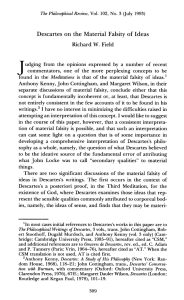
Field, Richard W. “Descartes on the Material Falsity of Ideas.” The Philosophical Review 102, no. 3 (July 1993): 309–333.
Garber, Daniel. Descartes Embodied: Reading Cartesian Philosophy through Cartesian Science. Cambridge: Cambridge University Press, 2001.
García, Claudia Lorena. “Descartes: Ideas and the Mark of the Mental.” International Journal of Philosophical Studies 7, no. 3 (1999): 349–372.
Greenberg, Sean. “Descartes on the Passions: Function, Representation, and Motivation.” Noûs 41, no. 4 (2007): 714–734.
Guéroult, Martial. Descartes selon l’ordre des raisons. Vol. 1, L’âme et Dieu. Paris: Aubier, 1953.
Haag, Johannes. “Sinnliche Ideen: Descartes über sinnliche und begriffliche Aspekte der Wahrnehmung.” In Sehen und Begreifen: Wahrnehmungstheorien in der frühen Neuzeit, edited by Dominik Perler and Markus Wild, 95–121. Berlin and New York: Walter de Gruyter, 2008.
Hatfield, Gary. “Descartes on Sensory Representation, Objective Reality, and Material Falsity.” In Descartes’ Meditations: A Critical Guide, edited by Karen Detlefsen, 127–150. Cambridge: Cambridge University Press, 2013.
Hoffman, Paul. “Descartes on Misrepresentation.” Journal of the History of Philosophy 34, no. 3 (July 1996): 357–381.
Marion, Jean-Luc. On Descartes’ Passive Thought: The Myth of Cartesian Dualism. Translated by Christina M. Gschwandtner. Chicago and London: University of Chicago Press, 2018. Originally published as Sur la pensée passive de Descartes. Paris: Presses Universitaires de France, 2013.
Moran, Dermot. “Descartes on the Formal Reality, Objective Reality, and Material Falsity of Ideas: Realism through Constructivism?” In Realism, Science, and Pragmatism, edited by Kenneth R. Westphal, 67–92. New York and London: Routledge, 2014.
Nelson, Alan. “The Falsity in Sensory Ideas: Descartes and Arnauld.” In Interpreting Arnauld, edited by Elmar J. Kremer, 13–32. Toronto: University of Toronto Press, 1996.
Newman, Lex. “Descartes on Unknown Faculties and Our Knowledge of the External World.” The Philosophical Review 103, no. 3 (July 1994): 489–531.
Nolan, Lawrence. “The Ontological Status of Cartesian Natures.” Pacific Philosophical Quarterly 78 (1997): 169–194.
Normore, Calvin G. “Meaning and Objective Being: Descartes and His Sources.” In Essays on Descartes’ Meditations, edited by Amélie Oksenberg Rorty, 223–241. Berkeley: University of California Press, 1986.
Ortín Nadal, Anna Pilar. “Descartes on the Distinction between Primary and Secondary Qualities.” British Journal for the History of Philosophy 27, no. 6 (2019): 1113–1134.
Perler, Dominik. Repräsentation bei Descartes. Frankfurt am Main: Vittorio Klostermann, 1996.
Ring, David Carleton. Material Falsity, Objective Reality, and Representation in Descartes’s Theory of Ideas. Ph.D. diss., University of Wisconsin–Madison, 1987.
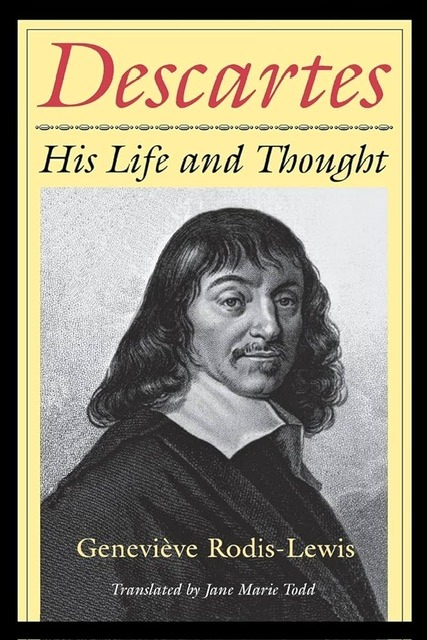
Rodis-Lewis, Geneviève. Descartes: His Life and Thought. Translated by Jane Marie Todd. Ithaca and London: Cornell University Press, 1998. Originally published as Descartes: Biographie. Paris: Calmann-Lévy, 1995.
Rozemond, Marleen. Descartes’s Dualism. Cambridge, MA: Harvard University Press, 1998.
Schmaltz, Tad M. Descartes on Causation. Oxford: Oxford University Press, 2008.
Schmitter, Amy M. “Representation, Self-Representation, and the Passions in Descartes.” The Review of Metaphysics 48, no. 2 (December 1994): 331–357.
Scribano, Emanuela. “Descartes et les fausses idées.” Archives de Philosophie 64, no. 2 (2001): 259–278.
Scribano, Emanuela. Descartes et les fausses idées. Paris: Vrin, 2006.
Simmons, Alison. “Are Cartesian Sensations Representational?” Noûs 33, no. 3 (1999): 347–369.
Smith, Kurt. “Descartes’s Ontology of Sensation.” Canadian Journal of Philosophy 35, no. 4 (December 2005): 563–584.
Wee, Cecilia. Material Falsity and Error in Descartes’s Meditations. London: Routledge, 2006.
Wilson, Catherine. Descartes’s Meditations: An Introduction. Cambridge: Cambridge University Press, 2003.
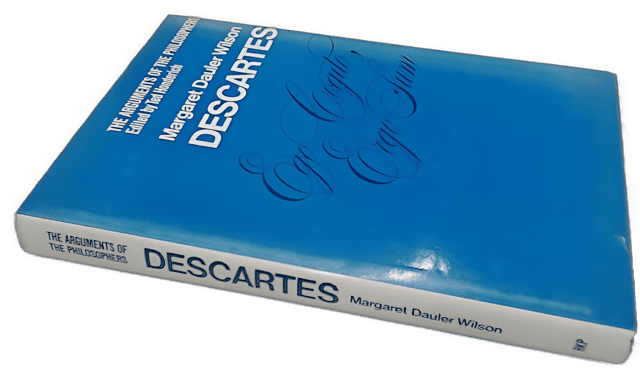
Wilson, Margaret Dauler. Descartes. London and Boston: Routledge & Kegan Paul, 1978. Later published in the Taylor & Francis e-Library, 2005.
|
|
Accepts SQ-sensations lack OR(Yes or No)—— Position (P:)&Objections (O:) |
|
Reference |
|---|---|---|---|
|
|
Yes: Her overall position basically supports that Cartesian secondary quality sensations have no objectively real representational content (OR) (even though she denies it). (LA1) (LA5–8) No: However, she still states that sensations contain OR. (LA2) (LA3) (LA4) —— P: Descartes’s secondary-quality sensations (heat, cold, color, etc.) are not intrinsically false “sensations stricto sensu,” yet they are the paradigmatic locus of material falsity because their content is intrinsically opaque and indeterminate: one cannot “spell out” what they contain objectively, so their “objective reality or representativeness” is “problematic,” i.e., it does not yield any determinate, analyzable objective representational content of real qualities in bodies. At the same time, they remain teleologically and pragmatically representational as “natural signs” that reliably track bodily/environmental variations; they “point to or evoke” external things without “represent[ing], objectively, a fully or uniquely specified particular.” O: My only objection is she doesn’t straightforwardly deny that SQ-sensations lack any objectively real representational content. Besides that, her position agrees with my interpretation in my DTOI & NOn-DTOI Baseline for AI Models, “How My DTOI Baseline Accounts for Material Fslsity,” and “DTOI Baseline 2026.” |
(LA1) “Thought, in Descartes’s wide sense of the word, covers any conscious mental states, including emotions, feelings, and sense perceptions, and it is also used coextensively with idea and perception as general terms to cover both the acts and the objects of awareness. There is thus a sense of idea in which sensations, feelings, and passions, although in so far as they depend on the mind-body union they are said to be confused and obscure thoughts, can be called ideas.” (230) [So, Alanen accepts sensations are ideas] (LA2)”Differently from Beyssade and Wilson, I take materially false ideas to be complex ideas involving unnoticed judgements.” (230) (LA3) “Differently from Normore, I take this to be a general feature of Cartesian ideas: ideas are representative—that is, they have objective being by their very nature—and as such they are always about or of something even when, as is the case with sensory ideas, there is no telling what thing they are of or about. Sensory ideas, as I understand it, hence also belong to the class of ideas in the restricted, proper sense of the term. ” (234) (LA4) “Material falsity, I contend, is not due to a lack of objective reality.” (236) (LA5) “it is confused, as opposed to being distinct, when it is not possible to tell or spell out exactly (analytically) what the idea contains objectively and how its content is delimited from ideas of other things.” (242) (LA6) “The content of sensory ideas, on the contrary, is and remains opaque, no matter how much we try to analyse or specify it.” (242) (LA7) “they [sensations] still have an important pragmatic function: they function as natural signs indicating both the presence of and variations in external things …” (242) (LA8) “It does commit him, however, to the view that the objective reality or representativeness of sensations is problematic, because of their intrinsic opacity, or confusion, which hinders us from determining what formal reality they represent objectively or are ideas of. They are, one could say, indeterminate by their very nature.” (246)
|
“Sensory Ideas, Objective Reality and Material Falsity.” In Reason, Will and Sensation: Studies in Descartes’s Metaphysics |
|
|
Yes: An individual cold sensation does not designate any representatum (see 2.1) so has no internally specifying objective reality content. No: Whatever objective-reality-bearing representational content there is attaches to the complex sensory episode: the pattern represents bodies and their variations, and the qualitative elements function as differentiating components within that representational whole. So, on her view, the objective reality bearing representational content is located at the level of the complex experiential unit. —— P: Bolton’s interpretation is a qualified representationalism: sensory ideas are inherently obscure/confused, so they “provide material for error” without being intrinsically deceptive, and Arnauld’s “phantom object” worry is defused by locating error in mistaken assumptions about a sensory idea’s representational device rather than in a divergence between what it exhibits and what it is of. Her signature thesis is holism about sensory content (MB2): an isolated cold sensation is not an internally object-fixing, determinate objective reality bearer, but a component within a broader experiential pattern that represents bodies and bodily “variations” (without resemblance). Hence whatever objective reality bearing representational content there is attaches to the complex sensory episode (the pattern), not to the cold sensation taken on its own. (MB1) O: If “objective reality” is, by definition, an idea’s internally contained objectively real representatum (item represented), then Bolton’s pattern-holism cannot underwrite objective reality in a cold sensation without either (i) inflating objective reality into merely a total perceptual state, which collapses into lawful causal dependence plus discriminability (i.e., a sign-function, not Meditation III OR), or (ii) relocates the object-fixing work to an implicit intellectual idea/judgment that “bodily variations answer to these sensory differences,” in which case the alleged sensory objective reality is really carried by a non-sensory intellectual idea-that piggybacks on sensation. Lacking a bridge principle explaining how a holistic sensory pattern contains internal bodily variation objectively—rather than merely being caused by it—her view is unstable: it either slides into intellectualization or becomes a sign-theory in disguise, both of which concede, in effect, that the cold sensation itself has no strict OR-content.
|
(MB1) “When taken as elements in a more complex experience, perceptions of heat and the like have a representative character they lack when considered apart.” (399) (MB2) “But in order to play this role, ideas of heat, colors, and so on, do not need to be individual representations of bodies. It is critical to identify what the unit of representation is; it is not isolated ideas of color or heat, but a complex pattern in which these ideas are elements.” (399) |
“Confused and Obscure Ideas of Sense.” In Essays on Descartes’ Meditations
Ch. 16, Berkeley, CA: University of California Press, 1986, 389–403. |
|
|
No. —— P: What is objectively present is the sensation itself. (DJB1, DJB2) O: Brown’s claim that it is the ‘sensation itself’ that is ‘objectively present’ (DJB1, DJB2) is incoherent since the sensation itself is not an internal representation of anything but a presentation or exhibition of a sensation. |
(DJB1) “Materially false ideas, like all ideas, have objective reality, . . . . In the case of the idea of cold it is only ‘the sensation itself’ which inheres objectively in the intellect.” (207) (DJB2) “When I refer cold to the ice, it seems as if what is present to mind is really in the ice no less than is its shape, which I also refer to the ice, but all that is objectively present in the first idea is a feeling, whereas a shape is objectively present in the second.” (209) (DJB3) ” . . . referring is a matter of compounding one idea, in this case a sensation, with another idea, an idea of a particular material substance, which, through (a possibly habitual) causal association, is confused as being the proper subject of the mode. Because I typically have a sensation of cold when in contact with ice, a natural compounding or con-fusing (fusing together) of the ideas of cold and ice occurs habitually within my mind and the complex as a whole represents a non-thing as a thing just as the willful compounding of two true ideas into an idea of a winged horse represents a non-thing (no true and immutable nature) as a thing (AT VII: 117–18; CSM II: 83). We might call this compounding of ideas a judgment of sorts, since it occurs within the intellect and it is up to the intellect to separate out the components if it is to obtain clarity and distinctness, but if this compounding is a judgment, it is logically prior to the kind of judgment we make in assenting to propositions such as ‘this ice (really) is cold’ . . . .” (209–10)
|
“Descartes on True and False Ideas.” In A Companion to Descartes  |
|
|
No. —— P: Carriero’s unified position on ideas, objective reality, and sensations is as follows: all ideas, including sensory ideas, are structures existing objectively in the mind—an idea is fundamentally a form or structure, a “reality,” existing objectively in the mind (JC1: 19), and this applies universally across intellectual, imaginative, and sensory ideas, all of which exhibit or present reality to the mind such that the reality contained in the thing being thought of exists objectively in the idea (JC2: 158). Sensory ideas specifically transmit corporeal structure from bodies to mind, such that sensory cognition involves the existence of corporeal structure in the mind and the structure found objectively in sensory ideas is obscure and confused (JC1: 20); even when obscure and confused, the bodily structure remains objectively present, though in a deficient epistemic mode. The absence of resemblance does not diminish objective reality: sensory ideas do not resemble sensible forms but rather present corporeal reality obscurely and confusedly (JC3: 159), and lack of formal identity with the sensory form in the body does not entail lack of objective reality, since some single structure exists both formally in the body and objectively in the idea. Finally, materially false sensory ideas retain objective reality through “relative nonbeing”: when Descartes suggests sensory ideas might be of nonbeing, Carriero reads this as relative nonbeing—absence of motion, not motion itself—with enough corporeal structure to exist objectively in the idea, so even defective sensory ideas do not lack objective reality. (JC1: 20) (dokumen.pub) O: Carriero conflates physiological transmission of bodily structure to the brain with the metaphysical-epistemic claim that a sensation contains an objectively real representatum [item represented]. If ideas function by making reality “available to the mind,” as Carriero claims, then sensory ideas presenting no cognitively determinate content fail to present objective reality representations at all; the assertion that particles exist objectively in the idea of cold while remaining entirely inaccessible to cognition is metaphysically inert—indistinguishable from the absence of OR—and Carriero cannot have both full OR and complete cognitive inaccessibility. Textually, Descartes’s Fourth Replies explicitly denies that the “idea of cold” is the quality “existing objectively in the intellect,” recasting it as a mere sensus—a sign, not an internal representation—and Meditation VI supports at most lawful causal correspondence and action-guiding signification, not internally object-fixing content. Carriero’s claim that a “confused microtexture” exists objectively in the sensation generates a fatal dilemma: if indeterminate, the alleged OR collapses into mere formal/causal dependence (making OR idle and indistinguishable from its absence); if determinate, sensations become quasi-intellectual detectors of microphysics, contradicting both his own claim that sensory ideas are obscure and confused and the teleological framework that makes the senses instruments of bodily preservation, not metaphysical knowledge. Either Carriero’s OR is explanatorily inert, or he has smuggled intellectual content into sensation against his own framework and against Descartes’s text. The more coherent position: secondary quality ideas have defective representational content because they lack adequate objective reality, not because they obscurely present a present structure.
|
(JC1) Introduction: “So the term idea carries with it overtones of a thing’s structure. I believe that this overtone continues with Descartes, so that for him, too, an idea is some form or structure—some “reality”—existing objectively in the mind (hence Descartes denies that the idea of nothing [in Conversation with Burman] is an idea in the proper sense [AT V 153; CSMK III 338]). . . . Now, one might agree with what I have just claimed with respect to intellectual ideas but harbor doubts about whether this could be right about sensory ideas. . . . However, I think it is the same story with sensory ideas. They, too, involve the existence of structure (presumably some corporeal configuration) in the mind. What Descartes says about sensory ideas is that the structure (the “reality”) that is found objectively in them is obscure and confused. . . . (One can raise questions about defective ideas, e.g., materially false ideas; even these, I think, should be measured against a paradigm of an idea as an imported reality.)” (19–20) (JC2) Chapter Three (I): “That is, all ideas—whether purely intellectual (such as my idea of myself or of God) or imaginative (such as my idea of a chimera or my visualization of a triangle) or sensory (such as my idea of greenness)—exhibit or present reality to the mind: the reality contained in the thing that is being thought of exists objectively in the idea.” (158) (bold and italic not in original) (JC3) “For the moment, however, it is important to note his deep allegiance to an Aristotelian way of thinking about sensory cognition as a matter of structure (reality) making its way from the world (where it exists formally) into the mind (where it exists objectively) as well as his important departure from the way in which Aristotelians worked out this basic idea. In Descartes’s view, the structure that exists in the mind and the world is not sensible form, there is no formal identity between the sensory idea and the thing sensed, and sensory ideas do not resemble sensible forms, but rather, in certain respects, present corporeal reality obscurely and confusedly.” (159) |
Between Two Worlds: A Reading of Descartes’s Meditations
Princeton: Princeton University Press, 2009. |
|
|
No. —— P: Accepts both a strong universal thesis: every idea contains OR (VC2) and the weaker universal representationsl thesis in a universal two-aspect model: every material idea stands in a necessary representational relation (to an idea with OR.)(VC0) (VC1) |
(VC0) “From now on I shall abbreviate ‘idea in the material sense’ and ‘idea in the objective sense’ to ‘ideam’ and ‘ideao,’ respectively. Ideasm and ideaso, furthermore, are related, in that the latter are things represented by the former.” (178)
|
“The Theory of Ideas.” In Essays in Descartes’ Meditations
edited by Amélie Oksenberg Rorty, 177–98. Los Angeles: University of California Press, 1986.
|
|
|
No. —— P: Cook interprets Cartesian ideas as inherently representative acts of thought whose representational content consists in their objective reality. An idea’s being an act and its being an image are two features of the same idea, not two distinct meanings of “idea.” As he states, “to be of something and to have objective reality are inseparably connected” (p. 90). On this account, sensations, insofar as they are ideas, must likewise contain objective reality. Cook’s position therefore commits him to rejecting the claim that all secondary quality sensations lack objective reality, even though he does not explicitly discuss that implication in this article. O: Cook explicitly holds in (MC1) that “to be of something and to have objective reality are inseparably connected” (90). But this alleged necessary connection conflates an idea’s ofness with its possession of objective reality. A cold sensation can be of its own formally real phenomenal content without containing any additional objectively real content. Its ofness therefore does not by itself establish that it contains OR. To exclude this possibility, Cook must show why formally real phenomenal content cannot suffice for sensory ofness. Merely identifying ofness with objective reality does not establish that it cannot.
|
(MC1) “Objects have various degrees of formal reality and can be ranked in terms of their formal reality, but only ideas have objective reality—to be of something and to have objective reality are inseparably connected.” (90) (MC2) “There is something about a thought that makes it of a particular object; this something is called its ‘objective reality.’ So far as thoughts have objective reality they are like images and are ideas.” (92) (MC3) “Specifically, I shall argue that Descartes means to say not that the word ‘idea’ is ambiguous, but that ideas have two features-that they are both acts of understanding and images.” (89) (MC4) “And my argument will support the Arnauldian interpretation, which identifies ideas with acts of thought.” (89) (MC5) “Arnauld took the fact that all thoughts are of something to entail that all acts of thought are inherently representative—that they are, in other words, ideas.” (88)
|
“The Alleged Ambiguity of ‘Idea’ in Descartes’ Philosophy,” The Southwestern Journal of Philosophy 6, no. 1 (Winter, 1975), 87-94. |
|
|
Yes. ——
P: Cunning’s interpretive position is that Descartes draws a strict distinction between sensations (mind-dependent qualia, i.e., mere modes of mind) and ideas of sensations (genuinely representational ideas that take those qualia as their objects). Sensations themselves are not ideas “in Descartes’s strict sense,” and so they do not represent in virtue of containing objective reality. By contrast, ideas of sensations do have objective reality and represent sensations as qualia. Secondary-quality “representation” (if conceded at all) is therefore not an internal, objective-reality-bearing idea-int-r relation but an alternative kind of representational link (a sign-like role) that does not amount to objective representational content. The upshot is that cold as a sensation contains no objectively real representational content about bodies; objective reality enters only at the level of an idea of that sensation. O: Cunning has a strong tendency to go so far as to claim that sensations are not ideas. This bold-faced claim is false since sensations are ideas in the wide sense.
|
SQ-sensations are broad sense ideas and are themselves materially false prior to any formal judgment. For a defense, see my post “What Makes An Idea Materially False In Descartes’s Theory Of Ideas?: Why Mere Error-Causation Is Insufficient, Why The Three Main Cases Form An Analogical Unity, And Why Hoffman Mislocates The Relevant Non-Thing With ChatGPT 5.4 Thinking.”] |
“Descartes on Sensation and Ideas of Sensation.” In An Anthology of Philosophical Studies, vol. I [or An Anthology of Philosophical Studies] |
|
|
Accepts the weaker universal representational thesis.
|
(MDR1) “And, for Descartes, all ideas are representations; they are of things or at least they purport to be of things.” (“Judgment and Will,” 146) |
“Judgment and Will.” In The Blackwell Guide to Descartes’ Meditations
edited by Stephen Gaukroger, 142–59. Malden, MA: Blackwell Publishing, 2006. |
|
|
No. —— P: Sensations are modes of the mind-body union with objective reality as confused perceptions. O: C |
“Sensations… involve objective reality derived from corporeal causes.” |
Physiologia: Natural Philosophy in Late Aristotelian and Cartesian Thought
|
|
|
No. P: Sensations are representational with objective reality. O: C |
“According to Simmons, Descartes’ view is that the biological function of sensations explains both why sensations represent what they do…” (55–58) |
Descartes and the Puzzle of Sensory Representation.  |
|
|
Yes. —— P: Sensations like cold lack objective reality as representational content (i.e., they are non-representational mental modes) but that materially false ideas (which are non-sensory intellectual) have representational content that purports reality yet lacks it due to inherent contradiction. Hence, Descartes’s talk of “referring” sensations to external things is a later, optional, reflective judgment. O: C |
“According to this understanding of the nonrepresentational status of sensations, the idea of cold that Descartes suspects of being materially false, and which he classifies in the Third Meditation as an idea representing corporeal things, could not be identified as a sensation, for the simple reason that sensations, of themselves, do not represent corporeal things, and so cannot represent sense qualities as the properties of corporeal things. It is clearly Descartes’s view, expressed in his response to Arnauld and the passage just quoted from the Sixth Replies, that . . . . the idea of cold that he identifies for Arnauld is not a sensation, but rather an idea of the intellect that represents a sensation as a possible corporeal mode.” (328–29) |
“Descartes on the Material Falsity of Ideas.”
|
|
|
No. —— P: Sensations represent objective reality obscurely. O: C |
“Critics… objected that Cartesians have as much reason to say that they know their sensations through a clear idea.” |
Descartes Embodied: Reading Cartesian Philosophy through Cartesian Science. |
|
|
Yes.Rejects the strong universal thesis. —— P: Sensory ideas lack positive objective reality (agreeing with Wilson on sensible qualities). O: C |
(CLG1) “Moreover, concerning obscure and confused ideas—some of which are false—one often cannot begin to tell what they represent.” (3) “In her Descartes, 114, Margaret Wilson agrees that, according to Descartes, our ideas of sensible qualities lack objective reality in the sense that they…”
|
“Descartes: Ideas and the Mark of the Mental.” History of Philosophy & Logical Analysis 3, no. 1 (2000): 21–53. “Transparency and Falsity in Descartes’s Theory of Ideas.” International Journal of Philosophical Studies 7, no. 3 (1999): 349–72.
|
|
|
No. —— P: Sensations represent objective reality functionally. O: C |
“Just as thoughts are representational… they are also conscious, by their nature.” |
“Descartes on the Passions: Function, Representation and Motivation.” Noûs 41 (2007): 714–34. |
|
|
No. —— P: Sensations have minimal objective reality (zero for privations like cold). O: C |
“[Material falsity] arises solely from the obscurity of the idea although this obscurity is in the idea itself.” (321) |
Descartes selon L’Ordre des Raisons . Vol 1: The Soul and God (first five Meditations) (1952). Paris: Vrin (on material falsity). |
|
|
No. —— P: Materially false ideas possess objective reality (as representations of non-beings). O: C |
“Descartes on the Formal Reality, Objective Reality, and Material Falsity of Ideas.” |
Repräsentation bei Descartes [GT: Representation in Descartes] |
|
|
No. —— P: Sensory ideas possess objective reality and represent by resemblance (material falsity occasions judgment error). O: C |
“With sensory ideas of color and the like, as materially false they do not intrinsically misrepresent but afford occasion for false judgments.” (Third paragraph)
|
“Descartes on Sensory Representation, Objective Reality, and Material Falsity.” In Descartes’ Meditations: A Critical Guide. |
|
|
No. —— P: Sensations as ideas have objective reality but lead to misrepresentation. O: C |
“In 3rd Med., for example, Descartes is primarily troubled by his inability to tell exactly how much reality (or what being) is contained in his sensations.”
|
“Descartes on Misrepresentation.” Journal of the History of Philosophy 34, no. 3 (July 1996): 357–81. Also downloadable from |
|
|
Maybe Yes. —— P: Cartesian sensations are “passive thoughts” of the mind–body union: what “comes to me” in sensation “affects my flesh (the union)” and is “first related to it as pain or as pleasure (as hunger or thirst) well before it can be assigned to things as sensible qualities … according to the sole criterion of convenience or inconvenience” (64); thus “the first relation that I maintain with what affects me falls under convenient or inconvenient use and not knowledge” (64). Marion therefore distinguishes, on the one hand, pain/pleasure/thirst/hunger, which “cannot be objectified” and “can be related only to me, but never directly to objects” (63), and, on the other hand, color/heat/cold, which “concern me” as I sense them yet “can also be related to the things, at least according to common consciousness” (63). Even so, because the sensory mode is structured primarily as affection and practical guidance rather than object-constitution, neither kind—considered precisely as sensation—supplies internally object-fixing, i.e., objective-reality, representational content.
O: C |
“on the one hand ‘perceptiones doloris, titillationis, sitis, famis— perceptions of pain, pleasure, thirst, hunger,’ that is, sensation that cannot be objectified and that can be related only to me, but never directly to objects; and on the other hand ‘perceptiones . . . colorum, soni, saporis, odoris, caloris, frigoris, & similium— colours, sound, taste, smell, heat, cold, and the like’ … which concern me or can be related to me as I sense them, but can also be related to the things, at least according to common consciousness …” (63) “perception (cogitatio) that comes to me and affects my flesh (the union) is first related to it as pain or as pleasure (as hunger or thirst) well before it can be assigned to things as sensible qualities (soon called secondary), according to the sole criterion of convenience or inconvenience.” (64) “the first relation that I maintain with what affects me falls under convenient or inconvenient use and not knowledge.” (64) “The ego does not constitute the world as a total object, it receives it as an affection …” (198) |
On Descartes’ Passive Thought: The Myth of Cartesian Dualism. Sur la pensée passive de Descartes (Paris: PUF, 2013) |
|
|
No. —— P: S. O: C |
“Descartes on the Formal Reality, Objective Reality, and Material Falsity of Ideas: Realism through Constructivism?.” In Realism, Science, and Pragmatism edited by Kenneth R. Westphal |
|
|
|
Accepts both the strong universal thesis (SN1–2) and the weaker universal representational thesi.(SN3). Nadler treats objective reality and representational content as essential to every idea.
|
(SN1) “We can say, in fact, that for Descartes objective reality is a defining feature of the mind’s ideas: ‘Some of my thoughts are as it were images of things, and it is only in these cases that the term “idea” is strictly appropriate.’ It is essential to an idea that it has a representational content that it displays to the mind. ‘The objective mode of being belongs to ideas by their very nature.’ (Meditation III, AT VI: 42)” (92)
|
“The Doctrine of Ideas.” In The Blackwell Guide to Descartes’ Meditations edited by Stephen Gaukroger, 86–103. Malden, MA: Blackwell Publishing, 2006.
|
|
|
No. —— P: Sensory ideas have objective reality (of non-things) but are materially false. O: C |
“The falsity in sensory ideas… [arises from] representing non-things as things [while possessing objective being].” |
“The Falsity in Sensory Ideas: Descartes and Arnauld.” In Interpreting Arnauld
Toronto: University of Toronto Press, 1996, 13–32. |
|
|
No. —— P: Sensations have objective reality but are subject to doubt. O: C |
“Knowledge of the nature of reality derives from ideas of the intellect, not the external senses.” |
“Descartes on Unknown Faculties and Our Knowledge of the External World.” The Philosophical Review 103 (1994): 489–531. |
|
|
No. —— P: Sensations have objective reality as representational ideas. O: C |
“The objective reality of the idea of nothing, for example, is ‘nothing.’ So according to formal reality, the idea of nothing is ‘an idea’…” (extended to sensory ideas) |
“The Ontological Status of Cartesian Natures.” Pacific Philosophical Quarterly 78 (1997): 169–194. |
|
|
Yes. —— P: M O: C |
“Meaning and Objective Being: Descartes and His Sources.” In Essays on Descartes’ Meditations |
|
|
|
No. —— P: Fff O: C |
“Descartes on the Distinction between Primary and Secondary Qualities.” British Journal for the History of Philosophy 27, no. 6 (2019): 1113–34. |
|
|
|
No. —— P: Materially false ideas possess objective reality (as representations of non-beings). O: C |
Repräsentation bei Descartes [GT: Representation in Descartes] |
|
|
|
Yes. —— P: Descartes’s secondary-quality sensations (warmth, cold, color, taste, etc.) lack any objective-reality representational content in the strict Scholastic–Cartesian sense. They do not internally fix a determinate representatum (see 2.1) in bodies. Their phenomenal positivity is compatible with—and helps explain—their being “obscure and confused,” since (as Descartes insists) one cannot tell from the sensation itself whether cold is a privation, a real quality, or neither. [tam parum clarae et distinctae sunt, ut ab iis discere non possim, an frigus sit tantum privatio caloris, vel calor privatio frigoris, vel utrumque sit realis qualitas, vel neutrum.] (AT VII 44; CSM II 30) Precisely because they contain no internally object-specifying content, they provide “matter for error” and so can be called materially false. They incline the mind to project the sensation’s phenomenal content onto the ice cube, even though the sensation itself contains no objectively real representational content. O: A major objection lobbied against Ring’s position is that all ideas by definition must contain objective reality. This objection fails to recognize that Descartes has two understandings of ideas: a strict sense where every idea does contain objective reality and a wider sense where they may not. |
“Material Falsity, Objective Reality, and Representation in Descartes’s Theory of Ideas.” PH.D. diss. University of Wisconsin-Madison, 1987, 1–403. Also sourced at Internet Archive OpenLibrary.
|
|
|
|
No. —— P: Sensations possess objective reality as modes of mind representing bodily effects. O: C |
“Ideas of sensations… have objective reality dependent on the union.” |
|
|
|
No. —— P: Sensations are modes with objective reality dependent on body. O: C |
“The second thesis is that ideas of sensations are ideas and so have objective reality.” (189) |
Descartes’s Dualism |
|
|
No. —— P: Sensations have objective reality, caused by bodies. O: C |
“According to Descartes, we know by the natural light that ‘in order for an idea to contain such and such objective reality, it must surely derive it from some cause’.” (43–44) |
Descartes on Causation |
|
|
No. —— P: Fff O: C |
||
|
|
No. —— P: False sensory ideas have objective reality but represent nothing positive (non-things). O: C |
“Misconceptions… represent beings that cannot exist outside of thought [yet possess objective being].” |
Descartes et les vraies et fausses idées.” Archives de Philosophie 64, no. 2 (2001): 259–78. Descartes et les fausses idées. Paris: Vrin, 2006 (trans. versions available). |
|
|
No. —— P: Sensations are representational and thus possess objective reality. O: C |
“Just as thoughts are representational (in Descartes’s lingo, they have “objective reality”) “by their nature”…” |
“Are Cartesian Sensations Representational?,” Noûs 33, no. 3 (1999): 347–69. |
|
|
Maybe Yes. —— P: Sensations are not ideas, hence lack objective reality as representational content. O: C |
“I believe that Descartes held [ideas are representational] and [sensations are not representational], and will argue that he did not hold [sensations are ideas].” (563) |
“Descartes’ Ontology of Sensation,” Canadian Journal of Philosophy, 35, no. 4 (December 2005): 563–84. |
|
(no known photo) |
No. —— P: Sensations lack objective reality in materially false ideas, leading to error. O: C |
“Descartes is merely using the… sense in which the characteristics of healthy urine resemble those of a healthy body.” (on material falsity implying deficient objective reality) (97) |
Material Falsity and Error in Descartes’s Meditations
|
|
|
No. —— P: S. O: C |
|
|
|
|
Yes. —— P: Sensations lack objective reality (materially false). O: C |
“our ideas of sensible qualities lack objective reality—i.e., are materially false in the sense that they ‘fail to exhibit to us any possibly existent quality in an intelligible manner.'” (114) |
Descartes |

 Supporting Quotations








 ,
,


 , ,
, ,






 , edited by







 ,
,
















See E. Gilson, Index scolastico-cartsien (New York: Burt Franklin Reprint, 1912), 48-49; Discours de la methode: Texte et commentazre (Paris: J. Vrin, 1947), 321;
G. Rodis-Lewis in her edition of Meditationes de Prima Philososophia (Paris: J. Vrin, 1953), 41 n. 1; L’oeuure de Descartes (Paris: J. Vrin, 1971), 53~ n. 8;
J. Collins, Modern European Philosophy (Milwaukee: Bruce, 1954), 165;
T.J. Cronin, S.J., Objecttve Being in Descartes and Suarez (Rome: Gregorian University Press, 1966); “Objective Reality of Ideas in Human Thought: Descartes and Suarez,” Wisdom in Depth: Essays in Honor of Henri Renard, SJ., eds. V. F. Daues, S.J., M. R. Holloway, S.J., L. Sweeney, S.J. (Milwaukee : Bruce, 1966), 68-79;
L. Gilen, S.J., “Uber die Beziehungen Descartes zur zeitgenossischen Scholastik,” Scholastik 32 (1957): 41-66;
Ronald Dalbiez, “Les sources scolastiques de la theorie cartesienne de l’&re objectif,” Revue d’histoire de la philosophie 3 (1929): 464-72;
J. Owens, C.S.S.R., in The Cambridge History of Late Medieval Philosophy, eds. N. Kretzmann, A. Kenny, J. Pinborg (Cambridge University Press, 1982), 459;
G. Nuchelmans, Judgment and Proposition from Descartes to Kant (Amsterdam: North Holland Publishing Co., 1983), 36-54.
Oeuvres de Descartes, ed. C. Adam et P. Tannery, 11 vols. (Paris: J. Vrin, 1897-1909; hereafter cited according to volume, page and line), Praefatio ad Lectorem, AT 7: 8. 19–251 “Sed respondeo hic subesse aequivocationem in voce ideae: sumi enim potest vel materialiter, pro operatione intellectus, quo sensu me perfectior dici nequit, vel objective, pro re per istam operationem repraesentata, quae res, etsi non supponatur extra intellectum existere, potest tamen me esse perfectior ratione suae essentiae.”