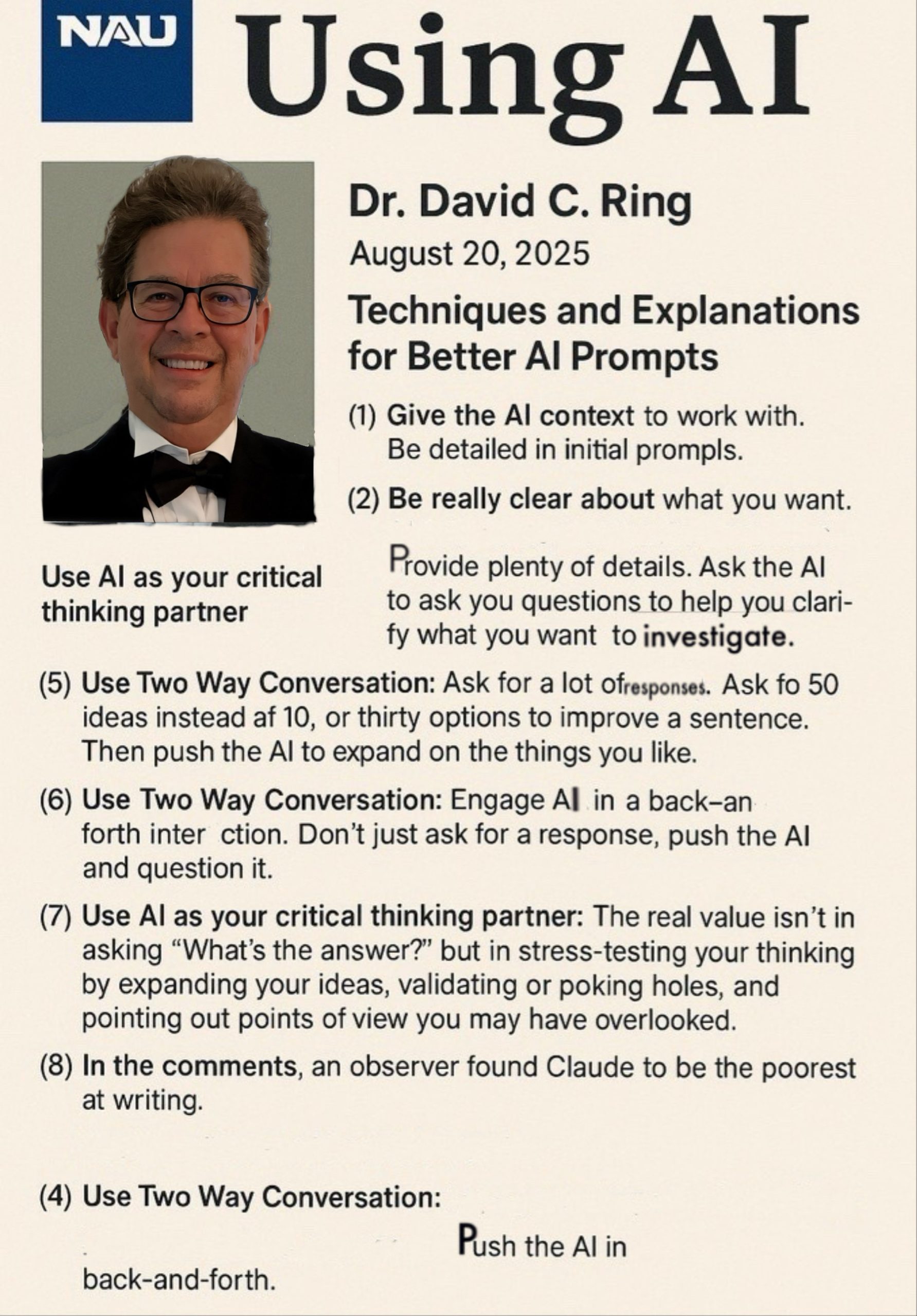
Techniques and Explanations for Better AI Prompts
- “You’re using ChatGPT wrong. Here’s how to prompt like a pro. Smarter prompts lead to smarter responses.” Explains mulitple techniques for improving your AI prompts.
- “Using AI right now: A Quick Guide.” Considers which AI model is best for your purposes focusing on Claude, ChatGPT, OR Gemini. Author prefers the non-free ChatGPT o3, Claude 4 Opus, or Gemini 2.5 Pro for serious work. Pick a system and resign yourself to paying the $20/month (the free versions are demos, not tools).
- (1) Give the AI context to work with. Be detailed in your initial prompts.
- (2) Be really clear about what you want. Be detailed about what you want in initial prompt and provide plenty of details. Ask the AI to ask you questions to help you clarify what you want.
- (3) Give it step-by-step directions an approach, called Chain-of-Thought prompting.
- (4) Ask for a lot of things. Ask for 50 ideas instead of 10, or thirty options to improve a sentence. Then push the AI to expand on the things you like.
- (5) Use branching to explore alternatives. Claude, ChatGPT, and Gemini all let you edit prompts after you have gotten an answer. This creates a new “branch” of the conversation. You can move between branches by using the arrows that appear after you have edited an answer. It is a good way to learn how your prompts impact the conversation.
- (6) Use Two Way Conversation: Engage the AI in a back-and-forth interaction. Don’t just ask for a response, push the AI and question it.
- (7) Use AI as your critical thinking partners. The real value isn’t in asking “What’s the answer?” but in stress-testing your thinking by expanding your ideas, validating or poking holes, and pointing out points of view you may have overlooked.
- (8) In the comments, an observer found Claude to be the poorest at writing.
- Reviews different AI models.
- How to cite AI in your paper. Most useful is Chicago Manual of Style.
- Suggested video’s and resources.
- Questions for students using AI.
- What does responsible AI-use mean to you?
- What skills does a person need to be able to use AI ethically and effectively? How would you define AI-literacy?
- How (if at all) do you think AI should be incorporated into your college curriculum?
- Have you used AI tools to help you learn or master new content? Share how you’ve leveraged these tools to help you learn.
- In what ways do you see AI becoming relevant for your chosen career path or area of interest? How has this changed your perception of what skills you need to develop in order to succeed in your chosen career?
- In your own use of AI tools what capacities and limitations have you noticed? What have you found that AI tools do really well and what shortcomings have you discovered?
- What troubles you about AI? Do you have any concerns you’ve been grappling with? Jumping off points for discussion could include data privacy, algorithmic bias, labor, the digital divide, etc.
- QUESTIONS TO ASK AI after writing your first draft
- Summarize and critically analyze my paper.
- How can I improve my Introduction and my Final Conclusion sections?
- What is the weakest point or argument in my paper?
- What objections are there to the points made in my paper?
- How can I strengthen my arguments?
- How might I improve this paper?
- What would be a good thing to add to my paper?
- What is the best part of my paper and explain why?
- Point out where there are any grammatical, punctuation, or spelling mistakes in my paper.
- Write a one-paragraph Abstract for my paper suitable for a professional philosophy journal.
- Suggest possible qualifications that makes my paper more nuanced and thoroughly covers the issues, arguments, and objections.
8. GPT-5’s Ethics Guidelines for Using It in Philosophical Research
9. Limitations of current AI models: “The Fever Dream of Imminent Superintelligence Is Finally Breaking” by Gary Marcus, New York Times, September 3, 2025.
10. “Should I Use ChatGPT to Write My Papers?,” Timothy Aylsworth & Clinton Castro, Philosophy & Technology 37 (2024):117
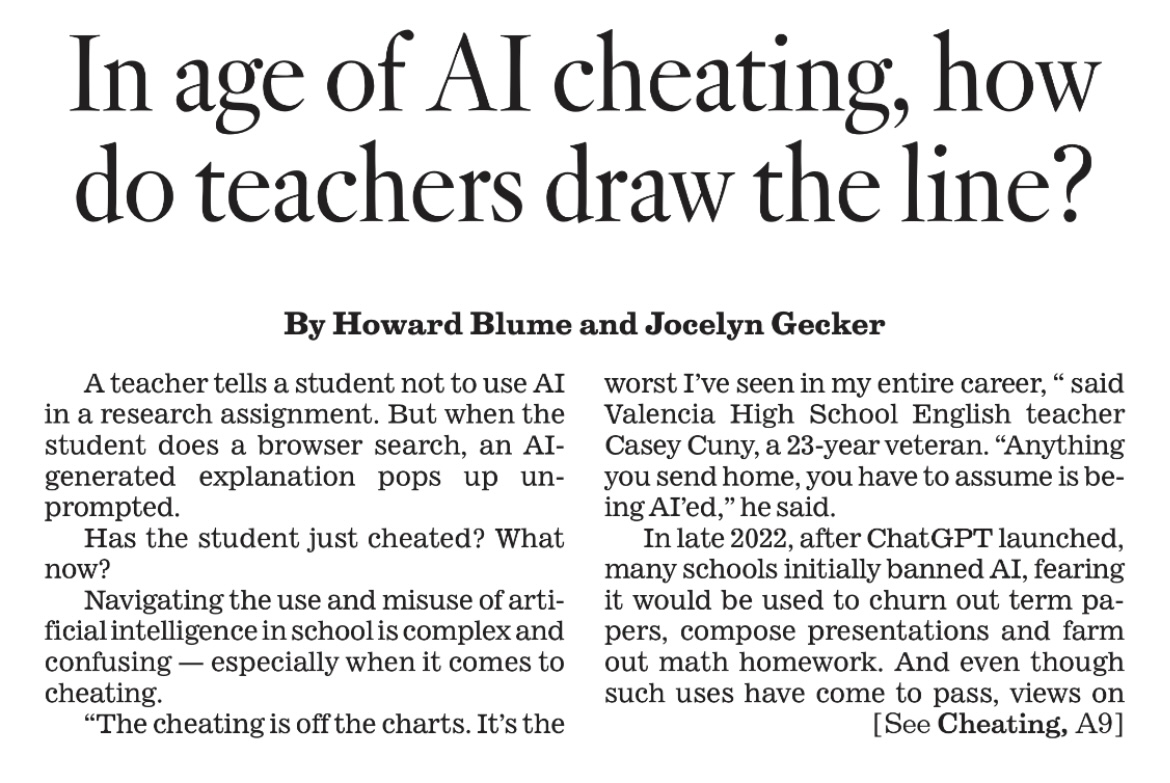
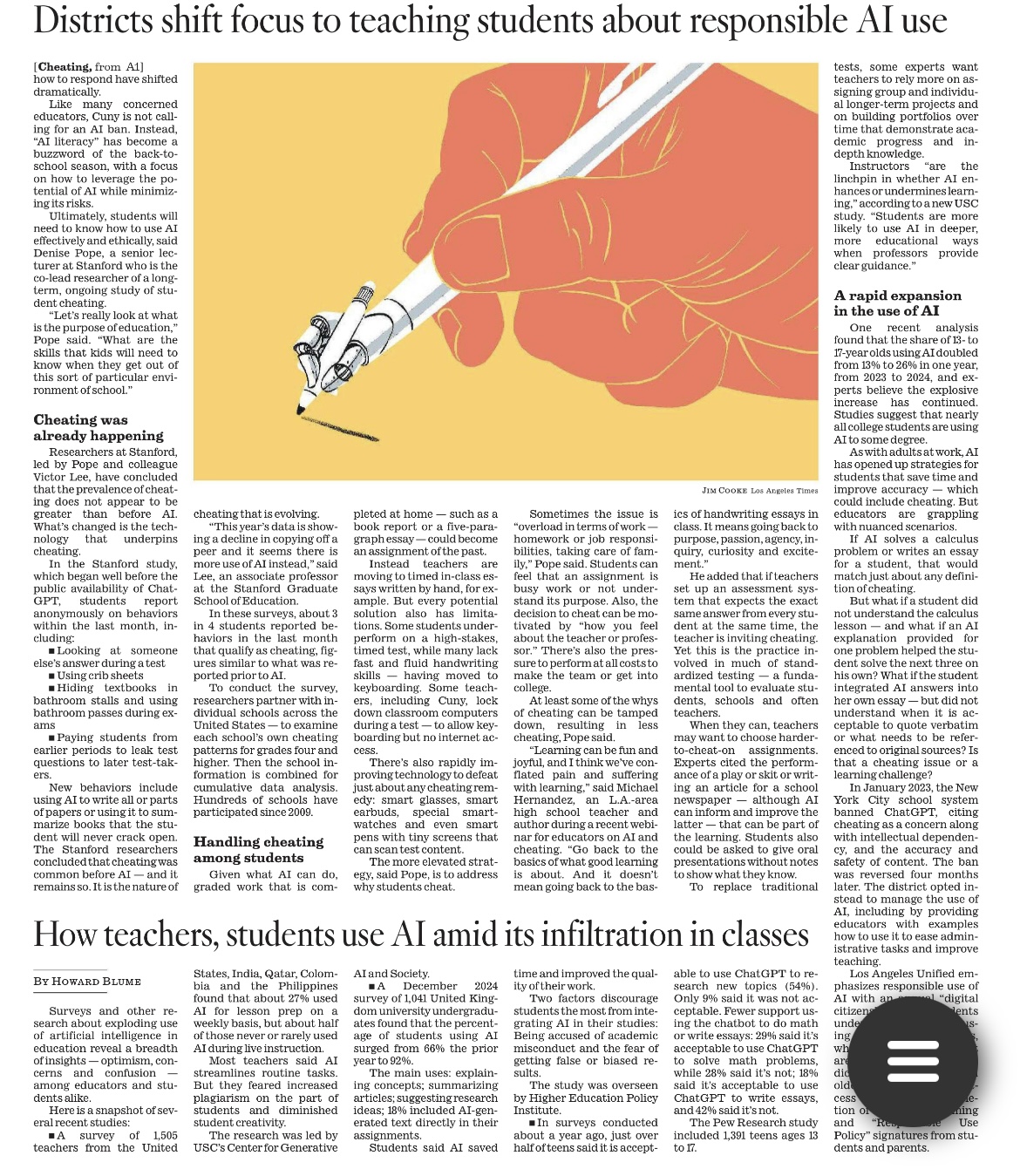
11. Los Angeles Times, September 25, 2025:
12. ”Magical Thinking on AI: A Response to Thomas Friedman’s Recent Al Columns in the New York Times” by Melanie Mitchell , September 15, 2025.
13. “Artificial intelligence learns to reason,” Melanie Mitchell, March 20, 2025.