


Translated by ChatGPT 5.1 from Ukrainian into American English
Sententiae 38:2 (2019), 112–115
https://doi.org/10.22240/sent38.02.112
ISSN 2075-6461. Sententiae, Volume 38, no. 2 (2019): 112–15.
CONTEMPORARY GLOBAL DESCARTES STUDIES
Review of Nadler, Steven. et al. (2019). The Oxford Handbook of Descartes and Cartesianism 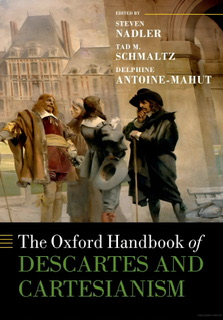 . Oxford: Oxford University Press
[Edited with sections deleted; bold and bold italic not in original]
The editors set themselves the goal of presenting the Cartesian century in all its rich diversity. They aim to offer a multifaceted picture of the development of thought, focusing not only on Descartes’s own doctrine but also on the fate of this doctrine within seventeenth‑century Cartesianism, on its reception in various countries, and on the critical re‑interpretations it underwent at the time—re‑interpretations that, in fact, shaped the face of contemporary philosophy. This points to the triumph of new approaches to the study of Descartes’s philosophy that became decisive after the 1950s (in particular, they can be formulated in the form of four “Marion principles,” which underlie the methodological conception of, among other things, the journal Sententiae itself and which, we are convinced, possess universal applicability in contemporary history‑of‑philosophy research).
Already in 2007, Jean‑Luc Marion, in outlining the main tendencies in Descartes scholarship, concluded that even then the chief tendency was its globalization. Today this process has only intensified. Marion noted a kind of “international division of labor” in Descartes studies, inasmuch as new research centers brought with them problematics that had been practically absent in the French research milieu. As a result, a fruitful international research context has arisen. According to Marion, Anglo‑American philosophers contributed issues of dualism, language, and the status of ideas (Cartesian topics in general became one of the reference points for analytic philosophy); Italian scholars contributed questions concerning mathesis and natural philosophy; and German scholars contributed criticism, the transcendental, and questions concerning being and the structure of metaphysics. Of course, these themes do not remain isolated within the contexts in which they first appear. They spread into other contexts, becoming the subject of productive international discussions.
From 1960 to 1996, the number of recorded publications in Descartes studies amounted to 4,402, of which 1,745 were in English versus 1,334 in French. Since then, the global annual number of such publications has steadily increased. The number of English‑language researchers of Descartes (primarily in the United States, Canada, and the United Kingdom) has long exceeded the number of those studying Cartesianism in France. However, this is not a matter of shifting some “geographical center” of discovery in this field away from France toward the Anglo‑Saxon world; rather, it is a matter of the formation of international research networks that are progressively losing the very notion of a “center.” Whereas in the 1970s the major discoveries in Descartes scholarship were, as a rule, made only in France (or in research groups tied to the French tradition and oriented toward publishing their results in French—Italians, Dutch, and so on), today English‑language literature dominates this area.¹
The French themselves increasingly participate in large international (and, indeed, English‑language) research projects, since this is the shortest path to recognition beyond the borders of their own country. Of course, among national research communities of Descartes scholars the French one is still the strongest in terms of content and the most numerous (although there are not significantly fewer Descartes scholars in the United States), but even so, it already constitutes a minority compared to the worldwide community of those who study Descartes and Cartesianism.
. . . . The contributors do not include Jean‑Luc Marion, today’s leading Descartes specialist, nor Vincent Carraud, Jean‑Marie Beyssade, Kim Sang Ong‑Van‑Cung, and other well‑known French researchers. Yet among the contributors there are also several authoritative American scholars who are absent.
In my view, the main factor in this list is not so much the statistics as the geography: an English‑language handbook—a project of a world‑famous British publisher (and thus intended for use anywhere in the world where people can read English)—written by representatives of eight countries. Another feature of globalization is also worth noting: the English‑language authors, who dominate this project, are historians of philosophy in a fully traditional sense. They are not oriented, as one might have expected, toward so‑called “analytic history of philosophy.” Instead, they know Latin and French well, they actively consult original texts² and earlier research traditions—in other words, they correspond rather poorly to the model of “rational reconstruction” described by Rorty.
It is also worth mentioning the new approach to textbooks in the history of philosophy that has become nearly dominant in today’s academic world. Of course, both new and old “single‑author” textbooks continue to be published, marked by varying degrees of compilatory character. Unsurprisingly, the main criticism of textbooks has focused precisely on their typically derivative nature, since it is unlikely that one, two, or even three authors can be equally strong specialists not only in world philosophy as a whole but even, for example, in such a fragment as “modern philosophy.” As a result, they often reproduce ideas, stereotypes, and clichés that circulated before them.
Part II. & III. omitted:
I. Descartes
Han van Ruler, “A Philosopher Who Challenges Philosophers: The Life and Works of Descartes.”
Roger Ariew, “What Did Descartes Read? His Intellectual Background.”
Theo Verbeek, Erik‑Jan Bos, “The Correspondence and Correspondents of Descartes.”
Lex Newman, “Descartes on the Method of Analysis.”
Lawrence Nolan, “Descartes’s Metaphysics.”
Gary Hatfield, “Mind and Psychology in Descartes.”
Helen Hattab, “Descartes’s Physics: Mechanical but Not Mechanistic.”
Sébastien Maronne, “Descartes’s Mathematics.”
Gideon Manning, “Descartes and Medicine.”
Scott Ragland, “Descartes on Freedom.”
Denis Kambouchner, “Descartes and the Passions.”
Igor Agostini, “Descartes’s Philosophical Theology.”
Laurence Renault, “Descartes’s Moral Philosophy.”
Delphine Antoine‑Mahut, “Descartes, Politics, and ‘Real Men’.”
Frédéric de Buzon, “The Compendium of Music and Descartes’s Aesthetics.”
¹ I would emphasize that what is at issue here is not merely a wave of publications but intellectual leadership as such. Naturally, important discoveries in Descartes studies had already been made earlier by English‑language philosophers (for example, Denis Kambouchner has shown that the priority of English‑language philosophers in studying the Meditations as meditations—as a sequence of spiritual exercises practiced by the Jesuit order and serving as a model for the very genre of metaphysical Meditations proposed by Descartes—remained unchallenged from the 1960s up to the work of Christian Belin, the first of whose studies was published in 2000). But today, if you want to learn about the year’s main discoveries in Descartes scholarship, it does not matter from which body of research you begin—English‑language or French‑language: both are absolutely indispensable for such an analysis. English‑language studies have now reached a level that guarantees a high degree of argumentative rigor and originality (for example, among this year’s works one should single out Samuel Stoner’s article, which originally identifies Descartes’s Evil Genius with the Meditator of the First Meditation in order to explain why the Evil Genius is “almost omnipotent” rather than fully omnipotent (the imagination easily allows us to portray him in any way we like) and why he does not doubt the truths of logic and mathematics [Stoner 2019]. One should also mention the long‑running discussion in English‑language literature on Descartes’s so‑called “trialism” (a notion introduced by John Cottingham in 1985), in particular its criticism in the work of Lawrence Nolan (“Cartesian Trialism on Trial: The Conceptualist Account of Descartes’ Human Being“), Marleen Rozemond (Descartes’ Dualism 1998), Dan Kaufman (“Descartes on Composites, Incomplete Substances, and Kinds of Unity” 2008), and Eugenio E. Zaldivar (“Was Descartes a Trialist?” MA Thesis, University of Florida, 2005). Cottingham explains and defends his trialism interpretation in “Descartes, the Synoptic Philosopher” 2006 (an overview published as Chapter 1 of Cartesian Reflections 2006). [References added.]
² Such recourse has become commonplace in English‑language research. For a Descartes study—even in such a citadel of the “analytic spirit” as Mind—it is now entirely natural to set as its goal the elucidation of Descartes’s use of the verbs cognoscere, scire, and the noun scientia “as three distinct epistemic levels” within the unfolding of the meditative process [see Clark 2019]. This means that the era of citing Descartes exclusively from English translations is receding into the past, and I hope irreversibly.
³ Required especially for those just beginning to study Descartes. Naturally, not even the best textbook can replace the primary texts. However, when approaching those texts, a beginner who is familiar with a modern‑type textbook will save a great deal of time, already having a general picture and not having to reinvent the wheel at every step. And when it comes to scholars and experts, reading such textbooks is important for them as well, since it gives them an opportunity to assess their own approaches against the background of a synthesized presentation by leading participants in contemporary debates. Textbooks of the new type now function as carriers of theses in scholarly discussion rather than as repositories of worn‑out clichés.