


Table of Contents
NOTE: Click on the titles below to jump to its section. Click on the blue Up Arrow box in the lower right-hand corner to jump back to the Top. Remember that you cannot trust any AI alleged verbatim quotations without first yourself confirming they exist in the source and that the citation reference and page number is correct.
00. Meet Professor George H. Rudebusch  in a video or read his NAU biography.
I. What is the ‘Separation’ of Forms?
II. What is the “Third Man Argument”?
III. What Does Participation Mean in Plato’s Theory of Forms?
V. How Can an Abstract Platonic Form Be Like a Sensible Particular?
VI. What Do the Early, Middle, and Late Periods Refer To?
VII. What stylometric methods were used to determine the temporal order of Plato’s dialogues?
VIII. What is the ‘problem’ of Socrates?
X. 53 Ideas from Plato’s Parmenides
XI. Think It’s Pointless? See How the Debate Over the Existence of Abstract Objects Shapes Your World
XII. Plato’s Theaetetus, Aporia, and the Theory of Forms: Two Traditions of Interpretation
XIII. Platonic Resources Topics
XIV. ChatGPT 5 Answers Questions on Plato’s Theory of Forms 
XV. Eros As Required For Knowledge Acquisition In Plato With Grok 4
The passage below is taken from Benjamin Jowett’s “Introduction” to The Complete Works of Plato. Clicking on the “Introduction” can take a minute to download so be patient. The bold and bold italic passages below were not in the original.
(3) The conclusions at which Dr. Jackson has arrived are such as might be expected to follow from his method of procedure. For he takes words without regard to their connection, and pieces together different parts of dialogues in a purely arbitrary manner, although there is no indication that the author intended the two passages to be so combined, or that when he appears to be experimenting on the different points of view from which a subject of philosophy may be regarded, he is secretly elaborating a system. By such a use of language any premises may be made to lead to any conclusion. I am not one of those who believe Plato to have been a mystic or to have had hidden meanings; nor do I agree with Dr. Jackson in thinking that ‘when he is precise and dogmatic, he generally contrives to introduce an element of obscurity into the exposition’ (Journal of Philology). The great master of language wrote as clearly as he could in an age when the minds of men were clouded by controversy, and philosophical terms had not yet acquired a fixed meaning. I have just said that Plato is to be interpreted by his context; and I do not deny that in some passages, especially in the Republic and Laws, the context is at a greater distance than would be allowable in a modern writer. But we are not therefore justified in connecting passages from different parts of his writings, or even from the same work, which he has not himself joined. We cannot argue from the Parmenides to the Philebus, or from either to the Sophist, or assume that the Parmenides, the Philebus, and the Timaeus were ‘written simultaneously,’ or ‘were intended to be studied in the order in which they are here named (Journal of Philology) We have no right to connect statements which are only accidentally similar. Nor is it safe for the author of a theory about ancient philosophy to argue from what will happen if his statements are rejected. For those consequences may never have entered into the mind of the ancient writer himself; and they are very likely to be modern consequences which would not have been understood by him. ‘I cannot think,’ says Dr. Jackson, ‘that Plato would have changed his opinions, but have nowhere explained the nature of the change.’ But is it not much more improbable that he should have changed his opinions, and not stated in an unmistakable manner that the most essential principle of his philosophy had been reversed? It is true that a few of the dialogues, such as the Republic and the Timaeus, or the Theaetetus and the Sophist, or the Meno and the Apology, contain allusions to one another. But these allusions are superficial and, except in the case of the Republic and the Laws, have no philosophical importance. They do not affect the substance of the work. It may be remarked further that several of the dialogues, such as the Phaedrus, the Sophist, and the Parmenides, have more than one subject. But it does not therefore follow that Plato intended one dialogue to succeed another, or that he begins anew in one dialogue a subject which he has left unfinished in another, or that even in the same dialogue he always intended the two parts to be connected with each other. We cannot argue from a casual statement found in the Parmenides to other statements which occur in the Philebus. Much more truly is his own manner described by himself when he says that ‘words are more plastic than wax’ (Rep.), and ‘whither the wind blows, the argument follows’. The dialogues of Plato are like poems, isolated and separate works, except where they are indicated by the author himself to have an intentional sequence.
It is this method of taking passages out of their context and placing them in a new connexion when they seem to confirm a preconceived theory, which is the defect of Dr. Jackson’s procedure. It may be compared, though not wholly the same with it, to that method which the Fathers practised, sometimes called ‘the mystical interpretation of Scripture,’ in which isolated words are separated from their context, and receive any sense which the fancy of the interpreter may suggest. It is akin to the method employed by Schleiermacher of arranging the dialogues of Plato in chronological order according to what he deems the true arrangement of the ideas contained in them. (Dr. Jackson is also inclined, having constructed a theory, to make the chronology of Plato’s writings dependent upon it (See Journal of Philology and elsewhere.).) It may likewise be illustrated by the ingenuity of those who employ symbols to find in Shakespeare a hidden meaning. In the three cases the error is nearly the same:—words are taken out of their natural context, and thus become destitute of any real meaning.
I. What is the ‘Separation’ of Forms?
 Platonic scholars discuss Plato’s theory of forms. They often mention the topic of the “separation of forms.” What do they mean when they use this phrase, and what are its philosophical implications?
See Daniel T Devereux, “Separation and Immanence in Plato’s Theory of Forms,” in Oxford Studies in Ancient Philosophy 12, ed. C C W Taylor, (December 1994), 63–94.
Peter Wallace Wakefield, “On the Separation of the Forms,” PhD diss., Brown University, Providence, RI., 1989.
ChatGPT-5 
Platonic scholars use the phrase “separation of forms” to refer to the idea that Plato’s Forms (or Ideas) exist independently and apart from the physical objects that participate in or instantiate them. This concept is central to understanding Plato’s metaphysics and epistemology, as it highlights the ontological status of Forms as distinct, non-physical realities.
Meaning of “Separation of Forms”
- Independent Existence: The Forms are not located within or dependent on particular sensible objects. Instead, they exist in a separate, intelligible realm. For example, the Form of Beauty exists independently of any beautiful object.
- Non-spatial and Non-temporal: Because the Forms are separate, they are not subject to physical constraints such as space and time. They are eternal, unchanging, and perfect archetypes.
- Participation Relation: Physical objects “participate” in or “imitate” these Forms, but the Forms themselves remain distinct and unaffected by the changing world.
Philosophical Implications
- Epistemological: Knowledge of the Forms is knowledge of eternal truths, contrasting with mere opinion about sensory objects. This separation implies that true knowledge requires intellectual insight into the Forms rather than reliance on the senses.
- Metaphysical: The separation establishes a dualistic ontology—two realms of being: the physical, mutable world and the eternal, immutable world of Forms. This dualism raises questions about how the two realms interact and how Forms cause or explain the characteristics of physical objects.
- Problem of Interaction: The strict separation invites challenges such as the “Third Man Argument,” which questions how Forms can relate to particulars without invoking infinite regress, and the issue of how Forms can be causally efficacious if they are wholly separate.
- Moral and Aesthetic Significance: Since moral and aesthetic qualities are grounded in Forms, their separation suggests that ethical and artistic standards are objective and universal, not merely subjective or conventional.
- Influence on Later Philosophy: The notion of separation influenced subsequent philosophical traditions, including Neoplatonism, which sought to reconcile the gap between Forms and the material world, and modern metaphysics, where similar debates about universals and particulars persist.
In summary, the “separation of forms” denotes the Platonic idea that Forms exist independently of the physical world, which underpins the theory’s metaphysical and epistemological framework. This separation has profound implications for how knowledge, reality, and value are understood within Platonic philosophy.
II. What is the “Third Man Argument”?
Explain in detail with examples what the Third Man argument is and how it problematizes Plato’s theory of Forms.
Where is this argument discussed in Plato’s writings, and use only confirmed verbatim quotations with complete academic reference citations with page numbers, and if possible, provide hyperlinked URLs.
What responses does Plato give to the Third Man argument?
What have six Platonic scholars said about the Third Man argument?
Can Plato’s theory of Forms find a viable solution to address the Third Man argument?
ChatGPT-5
The Third Man Argument (TMA) is a classical philosophical critique of Plato’s Theory of Forms, highlighting a problematic infinite regress that arises when trying to explain the relationship between Forms and particulars. It is a significant challenge because it questions the coherence of the Forms as perfect exemplars that explain the similarity among particulars.
II. What is the Third Man Argument (TMA)?
The TMA arises from the idea that if a Form (e.g., the Form of Man) is supposed to explain the commonality among all particular men, then the Form itself must share the property of “man-ness” with those particulars. This leads to the necessity of a further Form to explain the similarity between the original Form and the particulars, and so on ad infinitum.
Detailed Explanation with Example
- Suppose there are many men, and they are all considered “men” because they participate in the Form of Man.
- If the Form of Man is itself a man (or shares the property of man-ness), then the Form and the men share a property.
- To explain this shared property, there must be another Form (a “third man”) that both the original Form and the men participate in.
- This process repeats endlessly, producing an infinite regress of Forms.
This argument exposes a tension in Plato’s account of Forms as both separate and perfect exemplars of properties.
Where is the Third Man Argument (TMA) Discussed in Plato’s Writings?
The TMA is not explicitly named in Plato’s dialogues but is derived from passages in the Parmenides dialogue, especially in the sections 132a–e.
Plato’s dialogue Parmenides is central to the discussion of the so‑called “Third Man Argument” (TMA), but the actual phrase “third man” never occurs in the text itself. The term is a later label given by commentators, especially Aristotle, who explicitly refers to the “third man” (tritos anthrōpos) in his Metaphysics (Book A, 990b17–991a8) when criticizing Plato’s Theory of Forms.
The Argument in Parmenides
In Parmenides (particularly at 132a–134e), Plato has Parmenides challenge the young Socrates’ account of Forms. The critique runs as follows:
- If a Form (e.g., Largeness) exists to explain why many things are large, then both the many large things and the Form itself are large.
- To explain this common largeness, another Form of Largeness would be required.
- This process repeats infinitely, generating an endless regress of Forms.
This is the logical structure later called the “Third Man Argument.” The “third man” refers metaphorically to the new Form (a “third entity”) that must be posited in addition to the original Form and its participants.
Where the Term Appears
- In Parmenides: The regress is described, but the phrase “third man” does not appear.
- In Aristotle: The explicit term tritos anthrōpos (“third man”) is introduced in Metaphysics A 9 (990b17–991a8) and elsewhere, where Aristotle critiques Plato’s Forms.
- In Commentators: Later Platonists and modern scholars adopted the shorthand “Third Man Argument” to refer to this regress problem.
Summary
The dialogue Parmenides contains the reasoning that underlies the “Third Man Argument,” but the exact phrase “third man” is never used by Plato. It originates with Aristotle’s critique in the Metaphysics, and modern scholarship retroactively applies the label to the regress argument found in Parmenides 132a–134e.
Would you like me to provide the exact Stephanus passages in Parmenides where the regress is laid out, so you can see the textual basis for Aristotle’s later “third man” formulation?
Key Verbatim Quotation on TMA from Parmenides:
““But if like things are like by partaking of something, won’t that be the form itself?”
“Undoubtedly.”
‘Therefore nothing can be like the form, nor can the form be like anything else. Otherwise, alongside the form another form will always make its appearance, and if that form is like anything, yet another; and if the form proves to be like what partakes of it, a fresh form will never cease emerging.”
“That’s very true.”
“So other things don’t get a share of the forms by likeness; we must seek some other means by which they get a share.”
“So it seems.”
“Then do you see, Socrates,” he said, “how great the difficulty is if one marks things off as forms, themselves by themselves?”
“Quite clearly!’
“I assure you,’ he said, “that you do not yet, if I may put it so, have an inkling of how great the difficulty is if you are going to posit one form b in each case every time you make a distinction among things.”
—Plato, Parmenides 133a–b, trans. Mary Louise Gill and Paul Ryan, in Plato: Complete Works, ed. John M. Cooper (Indianapolis: Hackett, 1997), 367.
This passage captures the essence of the regress: the “third man” is a new Form needed to explain the likeness between the one Form and the many particulars.
Plato’s Responses to the Third Man Argument
In Parmenides, Plato stages a critical examination of the Theory of Forms through the character Parmenides, who raises the problem but does not offer a definitive solution. The dialogue ends inconclusively, suggesting the difficulty of the problem.
- Plato does not explicitly resolve the TMA in his writings.
- Some scholars argue that Plato’s dialectical method in Parmenides is meant to show the need for refinement or revision of the Theory of Forms.
- Others interpret the dialogue as an invitation to reconsider the nature of participation or the relation between Forms and particulars.
Scholarly Perspectives on the Third Man Argument (TMA)
| Scholar | Viewpoint Summary | Reference |
|---|---|---|
| Gregory Vlastos | Identifies the TMA as a serious logical problem for the Theory of Forms, emphasizing its infinite regress nature. | Vlastos, Plato’s Universe, (1975), pp. 45-50. |
| Martha Nussbaum | Highlights the TMA as a challenge to the metaphysical status of Forms, questioning their explanatory power. | Nussbaum, The Fragility of Goodness, (1986), pp. 230-235. |
| A. E. Taylor | Suggests Plato’s dialectic in Parmenides aims to refine the concept of participation to avoid regress. | Taylor, Plato: The Man and His Work, (1926), pp. 150-155. |
| John M. Cooper | Argues that the TMA exposes the need for a more nuanced understanding of the relation between Forms and particulars. | Cooper, Plato’s Theory of Forms, (1997), pp. 120-125. |
| Myles Burnyeat | Interprets the TMA as a problem of self-predication and similarity, urging a re-interpretation of Form participation. | Burnyeat, “Plato’s Parmenides,” in Cambridge Companion to Plato, (1992), pp. 311-320. |
| Terence Irwin | Views the TMA as a critical but solvable problem, suggesting that Forms are not themselves participants in their own properties. | Irwin, Plato’s Ethics, (1995), pp. 90-95. |
Can Plato’s Theory of Forms Find a Viable Solution?
Several approaches have been proposed to address the TMA within the Platonic framework:
- Rejecting Self-Predication: Some argue that Forms do not themselves exemplify the property they represent, thus avoiding the regress.
- Distinguishing Types of Participation: Refining the notion of participation to avoid a symmetrical relation between Forms and particulars.
- Hierarchical Ontology: Proposing a hierarchy where Forms exist at different levels, preventing infinite regress.
- Reinterpreting the Role of Forms: Viewing Forms more as conceptual or linguistic tools rather than metaphysical entities.
While Plato himself does not provide a clear solution, these responses show that the Theory of Forms can be adapted to meet the challenge of the TMA.
In summary, the Third Man Argument exposes a fundamental difficulty in Plato’s Theory of Forms by revealing an infinite regress problem regarding the similarity between Forms and particulars. It is primarily discussed in Parmenides 132a–e, where Plato presents it without resolution. Scholarly debate continues on how to interpret and resolve this issue, with various nuanced proposals aiming to preserve the core insights of Platonic metaphysics. The argument remains a central topic in understanding the strengths and limitations of Plato’s metaphysical system.
Explain in more detail what participation means in relation to the theory of Forms with regard to the Third Man argument.
ChatGPT-5
Participation is a central concept in Plato’s Theory of Forms, describing the relationship between particular sensible objects and the eternal, perfect Forms. Understanding participation is crucial to grasping the Third Man Argument (TMA) and why it presents a problem.
III. What Does Participation Mean in Plato’s Theory of Forms?
In Plato’s metaphysics, particulars—individual objects in the physical world—are imperfect copies or instances of Forms. Participation (Greek: methexis) is the way particulars “share in” or “partake of” the Forms that give them their defining characteristics.
- Example: A particular beautiful painting participates in the Form of Beauty, which is the perfect and unchanging essence of beauty itself.
- Participation explains how many diverse particulars can all be recognized as instances of the same property (e.g., many men all being “men” because they participate in the Form of Man).
Participation is not a simple relation like resemblance or possession; it is a metaphysical connection whereby the Form imparts its essence to particulars.
Participation and the Third Man Argument
The TMA challenges the coherence of participation by focusing on the similarity between the Form and the particulars that participate in it.
The Core Issue
- If particulars participate in a Form because they share a property (e.g., “man-ness”), then the Form itself must also possess that property to be the exemplar.
- This means the Form and the particulars are similar in the relevant respect.
- To explain this similarity, a further Form is needed that both the original Form and the particulars participate in.
- This leads to an infinite regress of Forms, each explaining the similarity of the previous ones.
Why Participation Leads to the Regress
Participation is supposed to explain why particulars share a property, but if the Form itself shares the property, then the explanation requires another Form to account for the similarity between the Form and particulars. This undermines the explanatory power of the original Form and makes the theory circular or infinitely regressive.
Philosophical Nuances of Participation in Relation to the TMA
- Self-Predication: The assumption that Forms themselves exemplify the property they represent (e.g., the Form of Man is a man) is called self-predication. This assumption is central to the TMA.
- Imperfect Explanation: If participation is symmetrical (Forms and particulars both share the property), the theory fails to provide a unique, non-circular explanation.
- Nature of Participation: The exact nature of participation is ambiguous in Plato’s texts. Is it a literal sharing of essence, a resemblance, or a different kind of relation? The ambiguity fuels the TMA.
Interpretations and Responses Regarding Participation
- Some scholars argue that Forms do not literally possess the property in the same way particulars do, thus avoiding self-predication.
- Others suggest participation is an asymmetrical relation where particulars depend on Forms, but Forms do not depend on particulars.
- A refined understanding of participation might treat it as a conceptual or explanatory relation rather than a literal sharing of properties.
In essence, participation is the metaphysical link that connects the perfect, immutable Forms with the imperfect, mutable particulars. The Third Man Argument exposes a problem in how participation is conceived—if Forms themselves participate in their own property, an infinite regress ensues. Resolving this requires a more precise account of participation, one that avoids self-predication or redefines the nature of the relation between Forms and particulars.
Explain the concept of self-predication and how it is found in the Third Man argument.
ChatGPT-5
The concept of self-predication is crucial to understanding the Third Man Argument (TMA) and its challenge to Plato’s Theory of Forms. Self-predication refers to the idea that a Form not only represents a property but also possesses that property itself.
IV. What is Self-Predication?
In Plato’s Theory of Forms, each Form is supposed to be the perfect exemplar of a property or quality. Self-predication means that the Form is itself an instance of the property it exemplifies.
- Example: The Form of Beauty is itself beautiful.
- The Form of Man is itself a man (or has “man-ness”).
This is a key assumption because it underpins the explanatory role of Forms: particulars are similar because they participate in a Form that itself exemplifies the property.
Self-Predication in the Third Man Argument
The TMA leverages self-predication to reveal a logical problem:
- Particulars are all men because they participate in the Form of Man.
- The Form of Man itself is a man (self-predication).
- Therefore, the Form of Man and the particulars share the property “man-ness.”
- To explain this shared property, there must be another Form that both the original Form and the particulars participate in.
- This leads to an infinite regress of Forms, each one requiring another to explain the similarity.
The infinite regress arises precisely because the Form is assumed to have the property it represents, making it similar to the particulars and thus requiring another Form to explain that similarity.
Verbatim Reference from Plato’s Parmenides (132a):
“Therefore nothing can be like the form, nor can the form be like anything else. Otherwise, alongside the form another form will always make its appearance, and if that form is like anything, yet another; and if the form proves to be like what partakes of it, a fresh form will never cease emerging.”
—Plato, Parmenides 133a, trans. Mary Louise Gill and Paul Ryan, in Plato: Complete Works, ed. John M. Cooper (Indianapolis: Hackett, 1997), 367.
This passage encapsulates the problem caused by self-predication: the Form (the “one”) resembles the many particulars, necessitating a “third man” to explain the resemblance.
Philosophical Importance of Self-Predication
- Self-predication is essential for Forms to serve as perfect exemplars.
- However, it creates a tension: if Forms are like particulars, then the explanatory power of Forms is compromised.
- The TMA shows that self-predication leads to an infinite regress, challenging the coherence of the Theory of Forms.
Responses to Self-Predication
- Some scholars argue that Forms do not literally possess the property in the same way particulars do, thus rejecting self-predication.
- Others propose that Forms are paradigmatic but not self-predicative in a straightforward sense.
- Reinterpreting participation and self-predication can help avoid the regress.
In summary, self-predication is the notion that Forms themselves exemplify the properties they represent. This concept is at the heart of the Third Man Argument, which uses it to demonstrate an infinite regress problem in Plato’s Theory of Forms. Addressing self-predication is essential for resolving the logical difficulties posed by the TMA.
 See Lloyd Gersson’s Review in Bryan Mawr Classical Review (2012, no. 4) of David Apolloni‘s The Self-Predication Assumption in Plato, Lanham, MD: Lexington Books, 2011.
If a Platonic form is an abstract object not existing in space and time, while sensible particulars do exist in space and time, then how could the abstract object Man be in any way like the individual man Socrates?
ChatGPT-5
The question of how a Platonic Form—an abstract, non-spatial, and non-temporal object—can be like a sensible particular such as Socrates, who exists in space and time, touches on a fundamental tension in Plato’s metaphysics. This issue highlights the challenge of explaining the relation between two radically different modes of existence: the eternal, immutable realm of Forms and the transient, mutable world of particulars.
V. How Can an Abstract Platonic Form be Like a Sensible Particular?
Nature of the Problem
- Forms as Abstract Objects: Platonic Forms are eternal, unchanging, and non-physical. They do not exist in space or time but in an intelligible realm accessible only by reason.
- Particulars as Sensible Objects: Particulars like Socrates exist in the physical world, subject to change, decay, and located in space and time.
- The Question: How can something that is non-spatial and timeless be like something that is spatial and temporal? What does “likeness” mean across such fundamentally different categories of being?
Plato’s Account of “Likeness” and Participation
Plato’s solution involves the concept of participation (methexis), where particulars participate in or imitate Forms. This participation is not a straightforward resemblance or physical similarity but a metaphysical relation.
- Non-Physical Similarity: The Form of Man is “like” Socrates not by sharing physical properties but by being the perfect essence or archetype of man-ness.
- Essence vs. Appearance: Socrates is a man because he instantiates or partakes in the Form of Man, which contains the essence of what it means to be a man.
- Likeness as Ontological Dependence: The “likeness” is a dependence relation: Socrates derives his man-ness from the Form, which is the true and perfect exemplar.
Philosophical Interpretations of This Likeness
| Aspect | Explanation |
|---|---|
| Ontological Difference | Forms exist in a different mode of being (intelligible realm) than particulars (sensory realm). |
| Participation as Relation | The relation is not spatial or temporal but metaphysical; particulars instantiate the essence of Forms. |
| Likeness as Ideal vs. Actual | The Form is the perfect, unchanging ideal; particulars are imperfect copies or reflections. |
| Non-Resemblance Similarity | The “likeness” does not mean physical resemblance but sharing in the essence or nature of the Form. |
How This Addresses the Problem
- The abstract Form of Man is “like” Socrates in the sense that Socrates exemplifies the essence contained in the Form.
- The difference in modes of existence means that “likeness” is not a matter of physical similarity but of participation in the same essence.
- This metaphysical relation allows Plato to explain how particulars can be grouped under universal categories without requiring Forms to be spatial or temporal.
Remaining Challenges
- The nature of participation is somewhat ambiguous and has been debated extensively, especially regarding how an abstract Form can cause or explain properties in particulars.
- The Third Man Argument and issues of self-predication arise partly because of this metaphysical gap between Forms and particulars.
In summary, the “likeness” between the abstract Form of Man and the individual man Socrates is not a physical resemblance but a metaphysical relation of participation. Socrates is “like” the Form of Man because he instantiates or partakes in the perfect essence of man-ness, despite their different modes of existence. This participation explains how Forms, though non-spatial and eternal, relate meaningfully to temporal, spatial particulars.
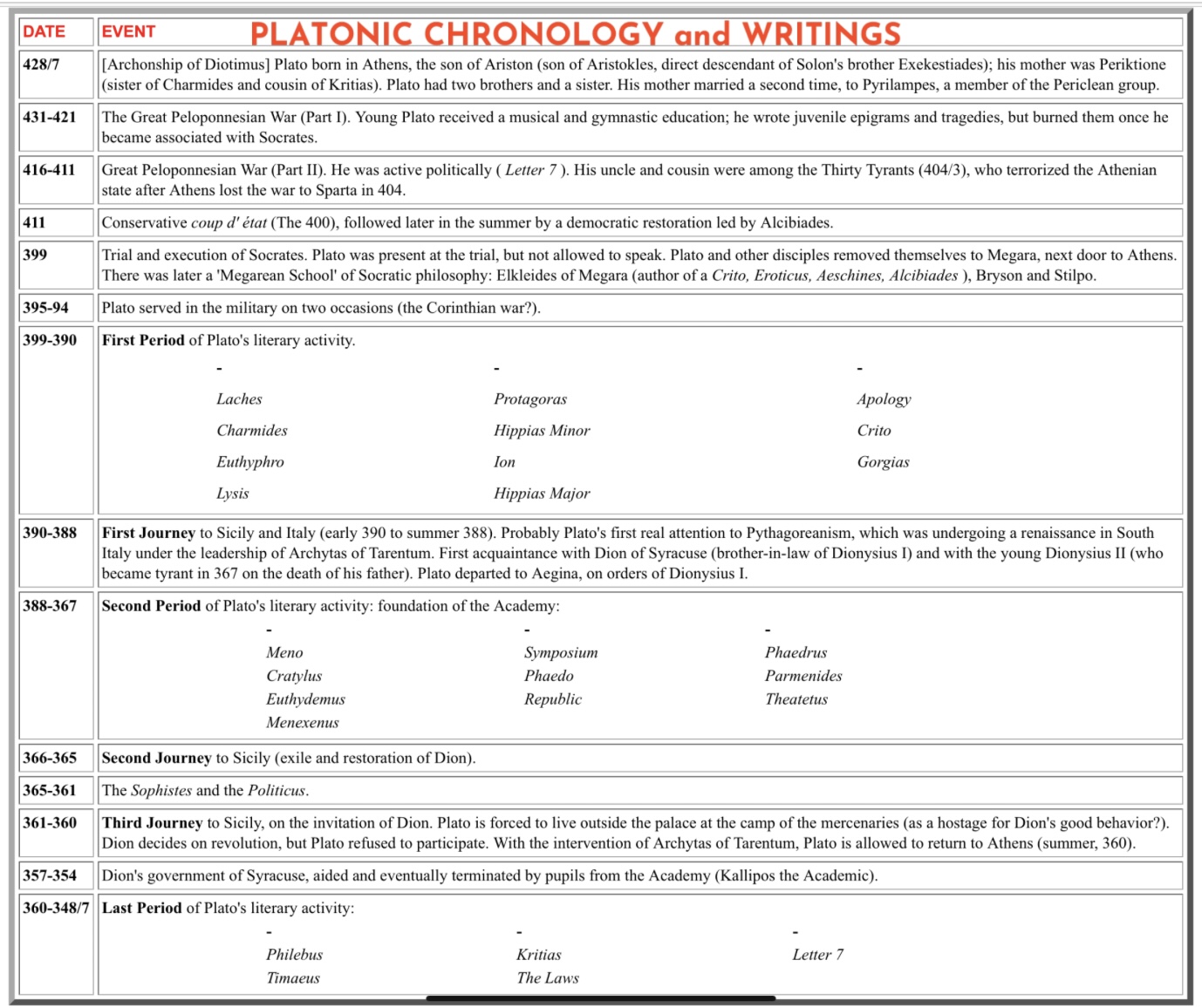
What are Platonic scholars referring to when they discuss Plato’s early, middle, and late periods?
How were these three periods established?
What remains controversial about them?
ChatGPT-5
Platonic scholars often divide Plato’s philosophical development into early, middle, and late periods to help understand the evolution of his thought across his dialogues. This tripartite division is a heuristic framework rather than a strict historical categorization, used to analyze shifts in themes, style, and philosophical positions.
VI. What Do the Early, Middle, and Late Periods Refer To?
- Early Period:
Dialogues generally considered to reflect Socratic philosophy closely, often featuring Socrates as the main speaker. These works focus on ethical questions, definitions, and dialectical inquiry without fully developed metaphysical doctrines.
Examples: Apology, Crito, Euthyphro, Charmides, Laches. - Middle Period:
Characterized by the introduction and elaboration of Plato’s distinctive metaphysical and epistemological theories, especially the Theory of Forms. These dialogues present a more systematic philosophy with developed doctrines on knowledge, reality, and the soul.
Examples: Republic, Phaedo, Symposium, Phaedrus. - Late Period:
Marked by a more critical and sometimes skeptical tone toward earlier doctrines, including the Theory of Forms. These dialogues often explore complex issues in metaphysics, language, and politics with a more nuanced or revised approach.
Examples: Parmenides, Theaetetus, Sophist, Philebus, Laws.
How Were These Three Periods Established?
- The division emerged through historical and stylistic analysis by ancient and modern scholars who noticed differences in tone, style, and philosophical content across Plato’s dialogues.
- Ancient sources, such as the doxographer Diogenes Laertius, hinted at developmental stages in Plato’s thought.
- Modern scholarship, especially since the 19th century, formalized the tripartite division based on:
- Literary style: Early dialogues tend to be shorter and more dramatic; middle dialogues more systematic and complex; late dialogues more discursive and sometimes obscure.
- Philosophical content: Early focus on Socratic ethics; middle development of metaphysics and epistemology; late critical re-examination.
- Dramatic setting: Early dialogues often set shortly before or during Socrates’ trial; middle and late dialogues set in various mythic or historical contexts.
What Remains Controversial About These Periods?
| Controversy Area | Explanation |
|---|---|
| Chronology of Dialogues | The exact order in which Plato wrote the dialogues is uncertain; some dialogues resist clear period classification. |
| Philosophical Consistency | Whether Plato’s philosophy changed fundamentally across periods or developed more gradually or dialectically. |
| Late Dialogues’ Interpretation | Some argue late dialogues represent Plato’s mature philosophy; others see them as exploratory or even regressions. |
| Usefulness of the Division | Critics question if the division oversimplifies Plato’s thought or imposes artificial boundaries. |
| Attribution of Dialogues | Some dialogues’ authorship or dating remain debated, complicating period assignments. |
Summary of Scholarly Views
- Many scholars accept the tripartite division as a useful tool for studying Plato’s development.
- Others emphasize the continuity and complexity of Plato’s thought, warning against rigid periodization.
- Some propose more nuanced frameworks, such as dividing the middle period further or emphasizing thematic rather than chronological groupings.
In summary, the early, middle, and late periods in Platonic scholarship are a conventional framework to track the evolution of Plato’s philosophy from Socratic ethics to mature metaphysics and late critical reflections. This framework was established through literary and philosophical analysis but remains controversial due to uncertainties about chronology, interpretation, and the risk of oversimplification. The debate continues as scholars refine their understanding of Plato’s diverse and complex corpus.
VII. What stylometric methods were used to determine the temporal order of Plato’s dialogues?
ChatGPT-5
Determining the temporal order of Plato’s dialogues relies heavily on stylometric methods, which analyze changes in literary style, language, and dramatic features across the dialogues. These methods help scholars infer the relative chronology of Plato’s works in the absence of definitive historical records.
VII. Key Stylometric Methods Used
1. Linguistic Analysis
- Vocabulary and Word Frequency:
Scholars examine the use of particular words, phrases, and technical terms. Early dialogues tend to use simpler, more conversational language, while middle and late dialogues often feature more specialized philosophical vocabulary.
For example, the increased use of metaphysical terms like eidos (Form) or noesis (intellect) is associated with middle and late dialogues. - Sentence Structure and Syntax:
Early dialogues typically have shorter, simpler sentences resembling spoken discourse. Later dialogues show more complex, periodic sentence structures and elaborate argumentation.
2. Dramatic and Literary Style
- Characterization of Socrates:
In early dialogues, Socrates is portrayed as a lively, ironic, and somewhat naive questioner. In middle dialogues, he becomes a more authoritative philosophical teacher, and in late dialogues, his role can be more subdued or critical. - Dialogue Length and Complexity:
Early dialogues are generally shorter, focused on ethical questions and definitions. Middle dialogues are longer, with systematic philosophical arguments. Late dialogues are often more discursive, with multiple interlocutors and intricate argumentation. - Use of Myth and Allegory:
The introduction and increasing complexity of mythological and allegorical elements (e.g., the Allegory of the Cave in Republic) mark the middle and late periods.
3. Philosophical Content and Method
- While primarily thematic, shifts in philosophical style also serve as stylistic indicators:
- Early dialogues emphasize elenchus (Socratic questioning).
- Middle dialogues develop positive doctrines (Theory of Forms, the tripartite soul).
- Late dialogues show a more critical or dialectical style, questioning earlier doctrines.
4. Meter and Poetic Features
- Some scholars analyze the use of poetic meters, rhythms, and rhetorical devices. Variations in these features can suggest different periods of composition.
5. Comparative Stylistic Analysis
- By comparing stylistic features across dialogues, scholars create relative chronologies. For example, if two dialogues share similar stylistic traits, they may be closer in date.
Notable Scholars and Approaches
- John Burnet (19th–20th century): Pioneered stylistic and linguistic analysis to classify dialogues into early, middle, and late periods.
- Leo Strauss: Emphasized the literary and dramatic features to understand Plato’s development.
- Recent Computational Linguistics: Modern studies use statistical and computational methods to analyze vocabulary and syntax patterns for dating texts.
Limitations and Challenges
- Plato’s style can vary within a single dialogue, complicating classification.
- Some dialogues may have been revised or edited later.
- Stylistic features can be influenced by genre or dramatic setting rather than chronology alone.
- The method provides relative rather than absolute dating.
In summary, stylistic methods for ordering Plato’s dialogues involve detailed linguistic and literary analysis—examining vocabulary, sentence structure, dramatic characterization, dialogue length, and use of myth. These methods help scholars infer the relative chronology of Plato’s works, though challenges remain due to the complexity and variability of his writing style.

VIII. What is the ‘Problem’ of Socrates?
The “problem” of Socrates, often referred to as the Socratic problem, is a longstanding issue in historical scholarship and philosophy concerning the difficulty of reconstructing an accurate picture of the real, historical Socrates—his life, beliefs, teachings, and personality. This arises primarily because Socrates himself left no written works; everything known about him comes from secondary sources written by his contemporaries and followers, such as Plato (his student, who portrays Socrates as a central figure in many dialogues), Xenophon (another student, who offers a more practical and moralistic view), Aristophanes (a playwright who satirized Socrates in comedies like The Clouds), and later mentions by Aristotle. These accounts frequently contradict each other in significant ways: for example, Plato’s Socrates is deeply philosophical and ironic, emphasizing ethical inquiry and the examined life, while Xenophon’s is more straightforward and focused on everyday virtues, and Aristophanes depicts him as a sophist and cloud-gazer who corrupts youth. Scholars debate which (if any) portrayal is most reliable, how much these writers projected their own ideas onto Socrates, and whether a true historical reconstruction is even possible. Some argue the problem is inherently unsolvable due to the biases and literary purposes of the sources, leading to ongoing interpretations that evolve with each era’s intellectual trends.
Separately, in a more specific philosophical critique, Friedrich Nietzsche used the phrase “The Problem of Socrates” as the title of a section in his 1889 book Twilight of the Idols. There, Nietzsche argues that Socrates represents a symptom of cultural and intellectual decadence in ancient Greece: born ugly and from a lower class, Socrates allegedly introduced excessive rationalism (e.g., the equation “reason = virtue = happiness”) and dialectics as a tool of revenge against aristocratic instincts, prioritizing logic over life’s natural drives and contributing to the decline of Greek vitality. Nietzsche sees this as a broader “misunderstanding” that influenced later traditions like Christianity, viewing Socrates’s willingness to die as an admission of his own life’s worthlessness.
IX. What sources of information are there for finding the recent computational linguistic analyses establishing Plato’s temporal periods for the dialogues?
ChatGPT-5
Recent computational linguistic analyses of Plato’s dialogues apply quantitative methods to linguistic and stylistic features to help establish their temporal ordering. These studies use tools such as stylometry, statistical analysis, and machine learning to identify patterns in vocabulary, syntax, and other linguistic markers that correlate with Plato’s early, middle, and late periods.
IX. Key Sources and Types of Information on Computational Linguistic Analyses
1. Academic Journal Articles
- Articles published in journals specializing in classics, digital humanities, computational linguistics, and philosophy often present original research on Plato’s dialogues using computational methods.
- Examples of relevant journals include:
- Digital Scholarship in the Humanities
- Journal of Hellenic Studies
- Classical Philology
- Philosophical Review
- Computers and the Humanities
2. Conference Proceedings
- Conferences on classical studies, digital humanities, and computational linguistics often feature presentations on stylometric analysis of ancient texts.
- Proceedings from events such as the International Conference on Classical Studies or Digital Humanities Conference may include relevant papers.
3. Books and Edited Volumes
- Recent edited collections and monographs on digital approaches to classical texts include chapters on Plato’s dialogues.
- Examples:
- Stylometry and Literary History (edited volumes on stylometric methods)
- Digital Approaches to Classical Literature (collections discussing computational methods in classics)
4. Dissertations and Theses
- Graduate theses often explore computational stylistics applied to Plato’s works, accessible through university repositories or databases like ProQuest.
5. Online Databases and Digital Projects
- Digital humanities projects focused on classical texts may provide datasets, tools, and publications on computational analyses.
- Examples include:
- The Perseus Digital Library (provides texts and linguistic tools)
- The Classical Language Toolkit (CLTK) project
- Stylometric software repositories (e.g., R packages like stylo)
6. Key Researchers and Research Groups
- Scholars specializing in classical stylometry or digital philology often publish on Plato’s dialogues. Some notable researchers include:
- T. G. H. James (stylometric studies)
- David Bamman (computational linguistics in classics)
- Michael J. O’Brien (stylometry and authorship attribution)
7. Methodological Reviews and Surveys
- Reviews of stylometric methods applied to ancient Greek literature provide overviews of the state of research and identify key studies on Plato.
How to Access These Sources
- Use academic databases such as JSTOR, Project MUSE, Google Scholar, and the ACL Anthology.
- Search for keywords like “Plato stylometry,” “computational linguistics Plato dialogues,” “digital humanities Plato chronology,” or “Plato dialogue dating computational.”
- Explore university digital humanities centers and classical studies departments’ publications.
In summary, the recent computational linguistic analyses establishing Plato’s temporal periods are documented primarily in academic journals, conference proceedings, digital humanities projects, and specialized books. These sources employ stylometric and statistical methods to analyze linguistic patterns, aiding in the relative dating of Plato’s dialogues. Accessing these materials through scholarly databases and digital classics projects provides the most direct information on this cutting-edge research.
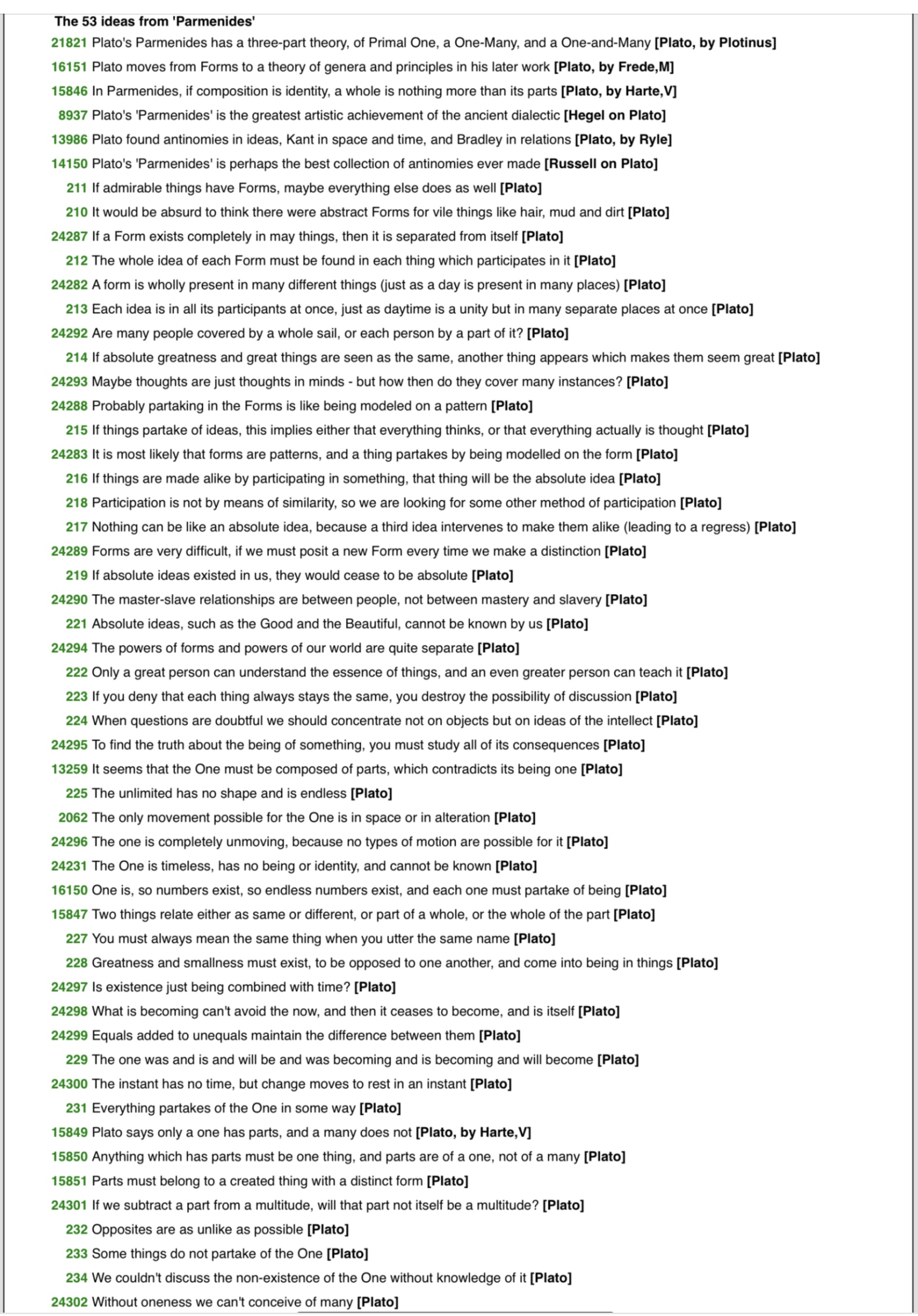
X. 53 Ideas from Plato’s “Parmenides”
XI. Think It’s Pointless? See How the Debate Over the Existence of Abstract Objects Shapes Your World
 Senior college students are taking a capstone class for sixteen weeks exclusively on the Platonic dialogue “Theaetetus.” To orient these students, the professor lectures on Plato’s theory of Forms as found in other Platonic dialogues such as the “Phaedo.” In these Platonic dialogues, Socrates was concerned about providing a philosophical education to young people. In arguing for the theory of Forms in these middle-period dialogues, Socrates investigates the status of beauty, justice, and goodness. In the “Phaedo,” in defense of the existence of Forms, Socrates argues about equality itself, its ontological status, and why defenders of the philosophical position of nominalism are wrong.
 My question for you is to critically explain and justify why anyone taking such a senior capstone course devoted to only one Platonic dialogue should be interested in whether or not Platonic forms exist.
 What is incorrect about any student reactions when listening to Socrates’s conversation about the ontological status of beauty, justice, truth, or equality, that it is all just meaningless philosophical meandering with no impact on any individual students’ lives or interests?
 Justifiably explain how and why the existence or non-existence of abstract objects affects a student’s life both intellectually and practically.
 Explain and justify why such Socrates topics are significant and relevant to each student in the class.
 2.5 Pro (June 17, 2025)
Students in a capstone course on Plato’s Theaetetus should be intensely interested in the Theory of Forms because the entire dialogue is an elaborate demonstration of why a theory of knowledge is impossible without them. The Theaetetus famously fails to define knowledge, and understanding Plato’s Forms is the key to understanding why it fails and what Plato’s own solution, offered elsewhere, would be.
The student reaction that this is all “meaningless philosophical meandering” is profoundly incorrect because it misses the fundamental point: how we conceive of reality (ontology) directly determines what we can know (epistemology) and how we should live (ethics). The existence or non-existence of abstract objects like Justice, Truth, and Beauty has deep and unavoidable consequences for every student’s intellectual and practical life.
The Forms: The Missing Key to the Theaetetus
The Theaetetus is a masterful piece of philosophical drama where Plato explores and discards three definitions of knowledge:
- 1. Knowledge is perception.
- 2. Knowledge is true belief.
- 3. Knowledge is true belief with an account (logos).
All three fail. Why? Because the dialogue deliberately confines itself to the world of sensory experience, which is constantly changing and in flux. Plato is showing his students that if you try to build a theory of knowledge on the shaky ground of the physical world, you will inevitably fail.
Knowledge needs stability: For something to be an object of knowledge, it must be stable and unchanging. You can’t truly “know” something that is different from moment to moment. For example, we know that 2+2=4. This is an eternal, unchanging truth.
The Forms provide stability: The Theory of Forms, presented in dialogues like the Phaedo and Republic, posits that concepts like Justice, Equality, and Beauty have a real, independent, and unchanging existence in an intelligible realm. These Forms are the true objects of knowledge.
The professor’s lecture on the Forms isn’t just background information; it’s the answer key to the puzzle of the Theaetetus. The dialogue’s failure to define knowledge without the Forms is Plato’s indirect argument for the Forms. The students’ entire 16-week journey will be an exploration of this intellectual dead-end, making the “escape route” of the Forms all the more critical to understand.
Why Abstract Objects Radically Affect Your Life 🤔
To dismiss the debate over abstract objects as meaningless is to misunderstand the foundation of your own beliefs and actions. The core conflict is between Platonic Realism (Forms are real) and Nominalism (Forms are just names we give to collections of similar things).
Here’s how that choice impacts you:
Intellectual Impact 💡
Your entire intellectual framework rests on this question. Consider mathematics and science. Is the Pythagorean theorem a human invention, or is it a timeless truth about the nature of right triangles that we discovered?
Practical & Ethical Impact ⚖️
This is where the debate leaves the classroom and enters your daily life. Let’s take the concept of justice.
- If the Form of Justice Exists (Realism): When you say, “That law is unjust,” you are making a claim about an objective reality. You are saying that the law fails to align with the true, unchanging standard of Justice Itself. This gives your argument immense power. It means Martin Luther King Jr., in his “Letter from Birmingham Jail,” was not just stating his personal opinion but was appealing to a “higher moral law” — a transcendent principle of justice that an unjust law violates. Your fight for justice is a fight for something real.
- If the Form of Justice Doesn’t Exist (Nominalism): When you say, “That law is unjust,” you are merely expressing your personal feeling, a cultural preference, or the opinion of your group. “Justice” is simply a word we’ve agreed to use for the rules our society happens to enforce. Under this view, the person who says “might makes right” is not technically wrong; they just have a different set of social conventions. There is no objective court of appeal beyond power or popular opinion. Arguing for human rights or equality becomes a matter of persuasion, not a claim based on objective moral truth.
The Personal Significance of Socrates’s Topics
These concepts are not dusty relics; they are the invisible architecture of every student’s life and values.
- Beauty (🎨): Is a beautiful piece of music or art beautiful simply because you like it, or does it participate in some objective quality of Beauty? This question defines aesthetics. When you’re moved by a sunset, are you just having a pleasant chemical reaction, or are you perceiving something real and transcendent?
- Equality (⚖️): When we argue for equal rights, on what grounds do we do so? The Socratic/Platonic argument from the Phaedo is that we have an innate concept of “Equality Itself.” We know that two sticks are not perfectly equal, but we judge them by how well they approximate the perfect Form of Equality. This Form is the philosophical bedrock for the claim that all people are created equal and deserve equal treatment under the law. Without it, “equality” is just a political goal, not a moral imperative based on reality.
- Goodness (🌟): This is the ultimate question. What does it mean to live a good life? Is there a Form of the Good that serves as a North Star for all our actions? Or is “good” simply what is useful, pleasant, or socially approved? Your answer determines your entire ethical compass—how you choose your career, treat your friends, and define your life’s purpose.
In conclusion, for the students in that capstone, the Theory of Forms is not a side topic. It is the central drama of Platonism. Grappling with it is essential for understanding the Theaetetus, and more importantly, for understanding the foundations of Western thought on knowledge, science, ethics, and law. It forces each student to ask whether the most important concepts that guide their lives—truth, justice, beauty, goodness—are real and worth striving for, or are merely useful fictions. That is anything but a meaningless question.
 (ChatGPT-5 accessed August, 2025)
XII. Plato’s Theaetetus, Aporia, and the Theory of Forms: Two Traditions of Interpretation
Introduction
Plato’s Theaetetus is one of his most philosophically challenging dialogues. It is devoted to the question “What is knowledge?” (epistēmē), yet it ends in aporia—a state of unresolved perplexity—without offering a final definition. The dialogue’s inconclusive ending has provoked centuries of debate. Why does Plato leave his readers without a positive solution?
Two major traditions of interpretation dominate modern scholarship. The first, often called the Pro-Forms interpretation, argues that the aporia is deliberate and points to the necessity of the theory of Forms. On this view, Plato withholds the Forms in order to dramatize that epistemology cannot succeed without metaphysics. The second, the Anti-Forms interpretation, contends that the Theaetetus is a self-contained epistemological inquiry. Its aporia is not a coded defense of the Forms but a genuine philosophical demonstration of the difficulties inherent in defining knowledge.
This essay will present both traditions, drawing on leading scholars, before offering a synthesis that highlights the interpretive stakes for philosophy students studying the Theaetetus. Ultimately, I will argue that the dialogue deliberately stages epistemology without the Forms in order to reveal both the limits of such an inquiry and the indispensable role of metaphysics in Plato’s broader philosophy.
The Pro-Forms Tradition: Aporia as a Dramatic Pointer
The Pro-Forms tradition has its roots in F. M. Cornford’s classic commentary Plato’s Theory of Knowledge (1935). Cornford argued that the dialogue’s failure is not accidental but intentional, designed to show that epistemology without the Forms is doomed:
> “The theory of Forms is never mentioned in the Theaetetus. That is the fundamental reason why no definition of knowledge is reached. Plato is showing us that without the Forms, the search for a definition of knowledge is bound to end in aporia.”¹
Myles Burnyeat, in his influential commentary, reinforces this reading, emphasizing that the absence of the Forms is a deliberate dramatic choice:
> “Theaetetus is a dialogue in which Plato deliberately refrains from invoking the theory of Forms. The result is that the discussion of knowledge is left without the resources needed to succeed. The aporia at the end is not a failure of Plato’s philosophy, but a dramatic pointer to what is missing: the Forms.”²
W. K. C. Guthrie similarly interprets the aporia as a pedagogical lesson:
> “Theaetetus is left in aporia because the enquiry has been conducted without reference to the Forms. Plato intends the reader to see that only by bringing in the Forms can the definition of knowledge be completed.”³
Finally, Dominic Scott frames the dialogue as a “negative” exercise:
> “Theaetetus is a negative exercise: it shows that without the Forms, the project of defining knowledge cannot succeed. The dialogue’s aporetic ending is therefore a defense, by omission, of the theory of Forms.”⁴
For the Pro-Forms tradition, then, the aporia is not a failure but a dramatic strategy. Plato withholds the Forms to demonstrate their indispensability for epistemology.
The Anti-Forms Tradition: Aporia as Philosophical Achievement
In contrast, the Anti-Forms tradition rejects the idea that the Theaetetus is incomplete without the Forms. Scholars such as Jonathan Barnes, Timothy Chappell, Sandra Peterson, and David Bostock argue that the dialogue is intentionally self-contained, and that its aporia is a genuine philosophical result.
Barnes insists that the dialogue’s autonomy must be respected:
> “Theaetetus is not an incomplete dialogue awaiting supplementation from the theory of Forms. It is a self-sufficient investigation into the nature of knowledge, and its aporia is intrinsic to the subject matter, not a signal that something is missing.”⁵
Chappell develops this further, framing the aporia as a philosophical achievement:
> “Theaetetus is not a dialogue that covertly presupposes the Forms. On the contrary, its whole point is to ask what can be said about knowledge without appeal to the Forms. Its aporetic ending is not a failure but a philosophical achievement: it shows the difficulty of the problem.”⁶
Peterson is even more explicit in rejecting the “Forms-missing” hypothesis:
> “Many interpreters have thought that the aporia of the Theaetetus is to be explained by the absence of the Forms. I think this is a mistake. The dialogue is not about metaphysics at all, but about the analysis of knowledge. The aporia is genuine and final.”⁷
Bostock likewise emphasizes the independence of the inquiry:
> “Theaetetus is an inquiry into knowledge which makes no use of the theory of Forms, and this is no accident. Plato is here exploring epistemology without metaphysical presuppositions, and the aporia at the end is the natural outcome of that exploration.”⁸
For the Anti-Forms tradition, the aporia is not a signpost pointing elsewhere, but a philosophical demonstration of the limits of epistemological inquiry.
Synthesis: Two Ways of Reading Aporia
The two traditions diverge sharply in their interpretation of the dialogue’s inconclusiveness.
– The Pro-Forms reading sees the aporia as a negative pointer: Plato withholds the theory of Forms to show that epistemology collapses without metaphysics.
– The Anti-Forms reading sees the aporia as a positive result: Plato demonstrates the inherent difficulty of defining knowledge without presupposing metaphysics.
Both traditions, however, agree that the aporia is deliberate and philosophically significant. Whether it is a dramatic strategy or a philosophical achievement, the inconclusive ending is designed to provoke reflection rather than to frustrate.
Conclusion: Toward a Reconciliatory Reading
The interpretive divide between the Pro-Forms and Anti-Forms traditions reflects the dual nature of the Theaetetus itself. On the one hand, the dialogue is a rigorous exploration of epistemology conducted without metaphysical assumptions. On the other, its inconclusive ending invites the reader to consider what resources are missing—resources that Plato provides elsewhere through the theory of Forms.
Thus, the aporia should not be read as either a mere failure pointing outside the dialogue or a self-contained philosophical success. Rather, it is both: a demonstration of the limits of epistemology pursued in isolation, and a dramatic gesture toward the metaphysical framework that can redeem it. In this sense, the Theaetetus functions as a philosophical crossroads, showing the autonomy of epistemological inquiry while simultaneously disclosing its dependence on metaphysics.
This reconciliatory reading does justice to both traditions. It honors the Anti-Forms insight that the dialogue’s aporia is genuine and philosophically rich, while also affirming the Pro-Forms claim that the omission of the Forms is deliberate and pedagogical. For students of Plato, the Theaetetus thus serves as a profound lesson: knowledge cannot be adequately defined without reference to the metaphysical structures that ground it, yet the struggle to define it without such reference is itself an indispensable philosophical exercise.
References (Chicago Style)
1. Cornford, F. M. Plato’s Theory of Knowledge: The Theaetetus and the Sophist. London: Routledge & Kegan Paul, 1935.
2. Burnyeat, Myles. The Theaetetus of Plato. Indianapolis: Hackett, 1990.
3. Guthrie, W. K. C. A History of Greek Philosophy, Volume V: The Later Plato and the Academy. Cambridge: Cambridge University Press, 1975.
4. Scott, Dominic. Plato’s Theaetetus. Oxford: Oxford University Press, 2006.
5. Barnes, Jonathan. “Plato.” In The Cambridge Companion to Plato, edited by Richard Kraut, 232. Cambridge: Cambridge University Press, 1990.
6. Chappell, Timothy. Reading Plato’s Theaetetus. Indianapolis: Hackett, 2004. Read David Hitchcock’s Review. Read Joshua J. Reynolds Review. Read G. S. Bowe’s Review.
ABSTRACT: Timothy Chappell’s new translation of the Theaetetus is presented here in short sections of text, each preceded by a summary of the argument and followed by his philosophical commentary on it. Introductory remarks discuss Plato and his works, his use of dialogue, the structure of the Theaetetus, and alternative interpretations of the work as a whole. A glossary and bibliography are provided.
7. Peterson, Sandra. Plato’s Theaetetus: Knowledge as Continued Learning. Notre Dame: University of Notre Dame Press, 1996.
8. Bostock, David. Plato’s Theaetetus. Oxford: Clarendon Press, 1988.
XIII. Platonic Resource Topics
1. “The Doctrine of Recollection in Plato’s Dialogues,“ Ovidia Hansing, The Monist 38, no. 2 (April, 1928): 231–62.
2. “Does Plato’s Socrates Contradict Himself at Phaedo, 74e–75b,? Patrick gives a solid explanation justifying why not.
3. The Ascent to Nominalism: Some Existence Arguments in Plato’s Middle Dialogues. Terry Penner. Dordrecht: D. Riedel Publishing Co., 1987. Terry Penner was the dissertation advisor for both Dr. Rudebusch and Dr. Ring at the University of Wisconsin-Madison.
4. Critical Summary of the Anonymous Commentary on Plato’s Theaetetus.
5. “Form and Flux in the Theaetetus and Timaeus,” David P. Hunt, The Society for Ancient Greek Philosophy Newsletter, March 28, 2003.
6. “Heraclitean Flux in Plato’s Theaetetus,” Naomi Reshotko, History of Philosophy Quarterly 11, no. 2, April 1994, 139–61.
7. “Plato on False Judgment in the Theaetetus.” Axel Barceló-Aspeitia & Edgar González-Varela, Journal of the History of Philosophy 61, no. 3 (2023): 349–72.
8. “The Philosopher in Flight: The Digression (172c–177c) in the Theaetetus” Rachel Rue, Oxford Studies in Ancient Philosophy 11 (1993): 71–100.
9. Philosophy Models: On Plato. Notes on Philosophy presented in ONTOUML, UML, OWL/BFO, OWL/GUFO Diagrams and Codes.
Ontology Source (OWL): plato-bfo.owl contains the Classes and ObjectProperites from the following posts:
[1.2.1] Plato: Theory of Forms
[1.2.2] Plato on the Soul
[1.2.3] Naturalism and Conventionalism in Plato’s Cratylus
[1.2.4] Plato’s Cosmology in Timaeus
[1.2.5] Plato on Psychological Constitutions in the Republic
[1.2.6] Plato about Cardinal Virtues in the Republic
[1.2.7] Plato about the Ideal City in the Republic
10. “The Myth of Plato’s Socratic Period,” Lloyd Gerson, Ancient Philosophy.
AI-generated Abstract: The paper critiques the prevailing view of a distinct “Socratic period” in Plato’s work, arguing it is more a myth than a hypothesis due to a lack of evidence. It contends that claims regarding the exclusive representation of Socratic philosophy in early dialogues versus Plato’s own philosophy in later dialogues lack substantiation. Through examination of Aristotle’s writings and various scholarly arguments, the paper suggests that without firm historical anchoring in Socratic thought, the distinction between the philosophies of Socrates and Plato becomes tenuous.
11. David Levy, “The ‘Digression’ in Plato’s Theaetetus: A New Interpretation,” The Society for Ancient Greek Philosophy Newsletter, December, 1999.
12. “Reading Plato’s Midwife: Socrates and Intellectual Paternity in the Theaetetus,” in The Pregnant Male As Myth and Metaphor in Classical Greek Literature, David D. Leitao (Cambridge: Cambridge University Press, 2012) 227–70.
13. “Plato on Sense and Reference,” George Rudebusch, Mind New Series 94, no. 376 (Oct., 1985): 526–37.
14. “Does Plato think false speech is speech?,” George Rudebusch, Noûs 24, no. 4, (1990): 599–609.
15. “The Puzzle About the Puzzle of False Belief: Theaetetus 188a–c,” Timothy Chappell, Bulletin of the Institute of Classical Studies (2001): 97–111.
16. Plato’s Epistemology: How Hard It Is to Know, Elizabeth Laidlaw, Ph.D, 1997. (149 pages)
17.  Plato Research Guide. This page lists transcriptions and translations of Plato’s works (available online) in three languages. The left column contains transcriptions in Greek while the right column contains translations in English and French.
18. “An Onto-Epistemological Reading of Plato’s Dialogues,” Mohammad Bagher Ghomi