Main banner for DTOI with title and URL centered and identical color Descartes torso and heads facing each other on either side of title on a rich dark blue background.

Sinokki’s Hybrid Third Way and the Restriction of Objective Reality: Support for a Non-Universal Reading
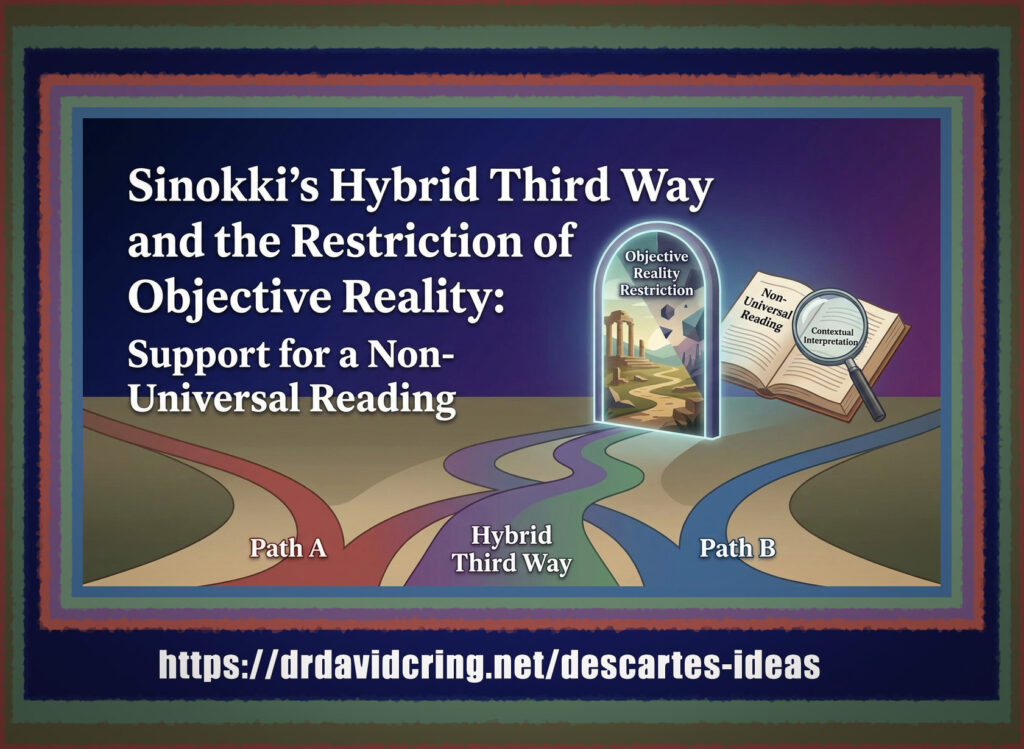
A colorful graphic titled “Sinokki’s Hybrid Third Way and the Restriction of Objective Reality: Support for a Non-Universal Reading” illustrates three winding paths labeled Path A, Hybrid Third Way, and Path B, leading to an illuminated archway marked “Objective Reality Restriction” with a landscape scene and an open book with a magnifying glass labeled “Non-Universal Reading” and “Contextual Interpretation,” along with the URL https://drdavidcring.net/descartes-ideas at the bottom.

Jani Sinokki develops a hybrid “third alternative” account of Descartes’s ideas and objective reality [in Ch. 3: Descartes’ Metaphysics of Thinking. PhD diss., University of Turku, 2016, Chapter 3 and in his Topoi article: “Having a Cake and Eating It Too? Direct Realism and Objective Identity in Descartes.” Topoi 43 (2024): 87–99. https://doi.org/10.1007/s11245-023-09981-8 that rejects both strong veil-of-ideas indirect […]

Do Cartesian Sensations Have Objective Reality?: Strict Ideas, Broad Ideas, and Material Falsity in Descartes’s Theory of Ideas
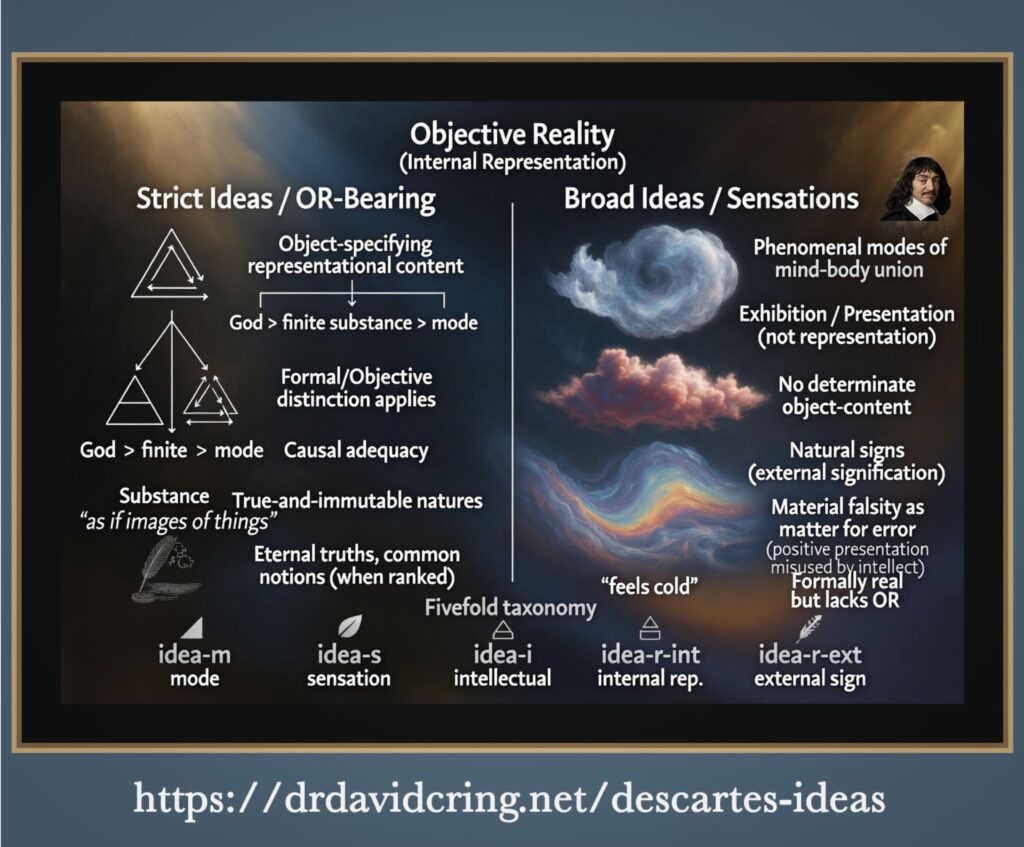
A detailed informational graphic titled “Objective Reality (Internal Representation)” divides Descartes’ ideas into “Strict Ideas / OR-Bearing” on the left, featuring hierarchical diagrams and concepts such as God, finite substances, modes, causal adequacy, eternal truths, and common notions, and “Broad Ideas / Sensations” on the right, illustrated with swirling clouds and explanations of phenomenological modes, natural signs, material falsity, and lack of objective reality, with a fivefold taxonomy of idea types at the bottom and the URL https://drdavidcring.net/descartes-ideas below.

[NOTE: Words in magenta or blue underlined are clickable hyperlinks.] Abstract This post defends a negative answer to the title question. Cartesian sensations, at least secondary-quality sensations such as cold, heat, color, taste, odor, and pain, should not be understood as containing objective reality representational content. [See my “Challenging The Standard Interpretation of Cartesian Ideas With Grok3.”] They are genuine […]