


[NOTE: Words in magenta or blue underlined are clickable hyperlinks.]
Abstract
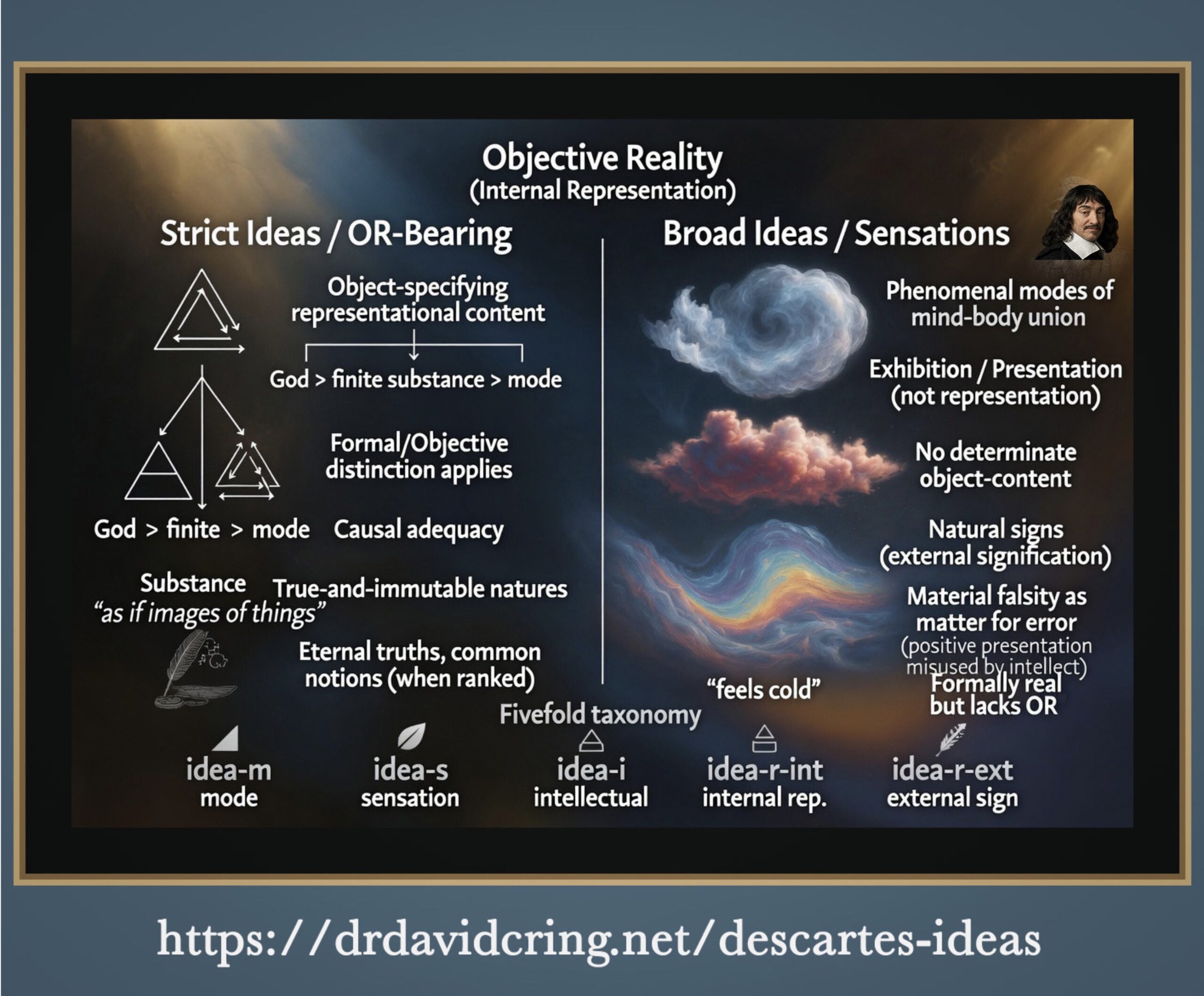
 This post defends a negative answer to the title question. Cartesian sensations, at least secondary-quality sensations such as cold, heat, color, taste, odor, and pain, should not be understood as containing objective reality representational content. [See my “Challenging The Standard Interpretation of Cartesian Ideas With Grok3.”] They are genuine Cartesian ideas in a broad sense because they are modes of thought or forms of consciousness, but they are not strict ideas in the sense relevant to objective reality. Objective reality belongs to ideas insofar as they internally represent an object as the thing thought of. A sensation of cold, by contrast, immediately presents or exhibits a phenomenal mode of the mind-body union. It can be vivid, affective, practically useful, and even clear and distinct when considered merely as a sensation,1Click on the supporting hyperlinked textual references in magenta, black font, or blue underlined below:
Vivid: Sixth Meditation (AT VII 74–80; CSM II 51–55) for the involuntary and phenomenologically forceful character of sensation.
Clear and distinct as sensations: Principles I.68 (AT VIIIA 33–34; CSM I 218)
Practical usefulness and affective role: Sixth Meditation (AT VII 83–87; CSM II 57–60).
yet it lacks determinate representational content of the sort proper to a strict idea, that is, content specifying a thing, mode, or true nature, but only an obscure and confused phenomenal mode. The resulting view is not anti-representational in every sense. Sensations can still function as natural signs, lawfully coordinated with configurations of matter in motion and with the body’s condition. The crucial distinction is between internal representation by objective reality and external signification by causal correlation. Once that distinction is made, Descartes’s doctrine of material falsity becomes more coherent: a cold sensation can present a non-thing as if a thing without containing a false objectively real representational content caused by God.2See my post “Presentation Without Representation: Material Falsity, Availability of Ideational Content, and Internal/External Representation in Descartes.” The real error arises when the intellect takes the sensory presentation as a guide to the intrinsic nature of body. This preserves Descartes’s non-deceptive God,3See “Proving God is not a Deceiver Because Sensations Lack Objectively Real Contents.”
his account of the mind-body union, and the textual contrast between strict ideas and broader modes of thought.
Some of the linked DTOI materials used in this post
- “DTOI & Non-DTOI Baselines for AI Models”
- “Proving that Cold Sensations Do Not Have Any Objective Reality to Bing’s Copilot”
- “How Cartesian Cold Sensations Are or Are Not Representational with Scholar GPT”
- “Proving Sensations are Ideas with No Objective Reality to ScholarGPT”
- “ScholarGPT (January 2025) Asserts Independently that a Cold Sensation Lacks Objective Reality”
- “Privations, Sensations, and Objective Reality”
- “Proving God is not a Deceiver Because Sensations Lack Objectively Real Contents”
- “Alison Simmons on Sensations as Representations and Objective Reality”
- “Critiquing Raffaella De Rosa on Sensory Misrepresentation”
1. The thesis
The core DTOI claim is that Descartes’s theory of ideas becomes more coherent if one rejects the universal objective-reality thesis. The universal thesis says that every Cartesian idea, merely by being an idea, contains objective reality. That thesis is too coarse. It is defensible only for strict ideas—ideas that are as if images of things [tanquam rerum imagines]. It is not defensible for every mode of thought that Descartes is willing to count as an idea in a wider sense.4See “Strict And Broad Ideas In DTOI.”
Sensations, especially secondary-quality sensations, belong to that wider class.
A sensation of cold is formally (i.e., actually) real as a mental mode. It is a real modification of the mind-body union. It has phenomenological positivity: it feels chilly; pain hurts; red appears redly. But none of that shows that the sensation contains objective reality. Objective reality is not the mere reality of a mental event. It is the idea’s internal representational being—the represented item as existing objectively in the intellect. Treating every conscious episode as objectively real content collapses the formal/objective distinction (Third Med.: AT VII 40–42; CSM II 27–29 & Second Replies, Definitions III–IV: AT VII 161; CSM II 113–14) and converts every affective or sensory modification into an intellectual representation.
The better view is therefore this: strict ideas contain objective reality; broad ideas need not. Sensations are ideas in the broad sense, not because they contain object-specifying OR, but because they are modes of consciousness immediately present to the mind. Some sensations can also be representational in a different sense: they can function as natural signs. A cold sensation may lawfully indicate a state of the skin, nerves, brain, or surrounding bodies. It does not follow that the cold sensation internally represents cold as an objectively real content. This distinction between internal representation and external signification is the argumentative center of the DTOI position. See one of the baseline statements in DTOI & Non-DTOI Baselines for AI Models.
The argument proceeds as follows. Section 2 examines the textual and phenomenological considerations that have led many readers to assume that all ideas, including sensations, must contain objective reality. Section 3 clarifies the meaning of objective reality as internal, object-specifying representational content and introduces the distinction between strict ideas and broad-sense ideas. Sections 4 and 5 develop phenomenological and textual arguments, centered on the example of cold, to show that sensations lack this kind of content. Section 6 reconsiders material falsity in light of this distinction, arguing that it can be explained without attributing false objective reality representational content to sensations. Section 7 offers a positive account of how sensations nevertheless function as natural signs. Sections 8 and 9 address objections and outline the explanatory advantages of the view, and the final sections consider what would refute the position and summarize the results.
2. Why the universal OR inference looks tempting
The universal OR inference looks tempting because Descartes often speaks as if ideas, precisely as ideas, are representational items. In the Third Meditation, he contrasts ideas considered merely as modes of thought with ideas considered according to what they represent. When ideas are considered merely formally, they are all modes of thought and do not differ in degree of formal reality. But when they are considered objectively, they differ according to the reality of what they represent: substance-ideas contain more objective reality than mode-ideas, and the idea of God contains more objective reality than finite substance-ideas.
This naturally encourages a universal inference:
- Every Cartesian idea is an idea.
- Ideas, by their nature, have objective being.
- Objective being is the represented object as it exists in the intellect.
- Therefore every Cartesian idea contains objective reality.
The temptation is strengthened by Descartes’s own vocabulary. He says that “the objective mode of being belongs to ideas by their very nature” (AT VII 42; CSM II 29). Taken in isolation, this sounds like a universal doctrine: wherever there is an idea, there is objective reality. It is therefore easy to conclude that sensory ideas must contain objective reality too, even if their objective reality is obscure, confused, minimal, or indeterminate.
A second source of temptation is Descartes’s image-language. In the Third Meditation, he first introduces ideas as “as if images of things” (AT VII 37; CSM II 25). If ideas are as if images of things, and if sensations are ideas, then sensations may appear to be as if images of things as well. A cold sensation would then be an obscure image of cold; a color sensation an obscure image of color; a pain sensation an obscure image of bodily damage or disturbance. On this reading, sensation is still representational, only badly so.
A third source is material falsity. Descartes’s claim that the idea of cold can be materially false appears, at first glance, to require that the cold sensation represent cold as something in bodies. Otherwise, one may ask, how could the idea itself be false even materially? If falsehood requires misrepresentation, and misrepresentation requires representational content, then materially false sensory ideas must contain objective reality. This is the route taken by many Cartesian commentators as can be seen at my post “A Hyperlinked Pictorial Table Of Cartesian Commentators On The Objective Reality Contents Of Secondary Quality Sensations.” For example, Cecilia Wee points out:
“To begin with, Descartes specifically mentions in (1) that material falsity ‘occurs in ideas when they represent no things as things’. This suggests that materially false ideas do have a specific representational content, that they represent no things as things. So such ideas are materially false because they represent falsely, not because one does not know what they represent to the mind.” and “Yet the most natural reading of TMD [Third Meditation discussion] is the one that sees Descartes as holding that a materially false idea is one that somehow falsely represents.” (Material Falsity and Error in Descartes’ Meditations, 23 & 24)
A fourth source is ordinary phenomenology. Cold feels as if it is in the ice; heat feels as if it is in the fire; color appears as if it is spread over the surface of bodies; pain seems located in the foot, tooth, or hand. These sensory episodes are not phenomenologically neutral. They seem world-directed. They seem to put us in contact with bodily things and their qualities. It is therefore natural to say that they represent those qualities by containing objective reality.
A fifth source is Descartes’s doctrine that sensations are useful for the preservation of the embodied human being. If pain, hunger, thirst, heat, cold, color, odor, and taste guide action, then they seem to have intentional or representational significance. Pain directs the mind toward bodily injury; thirst directs it toward drink; cold directs it toward bodily danger or environmental condition. Since sensations guide the embodied human being, it is tempting to infer that they must represent what they guide us toward.
These considerations explain why the universal OR inference is not foolish. It is generated by real textual and philosophical pressures. Descartes does connect ideas with objective being; he does use image-language; he does treat cold as materially false; he does assign sensations practical and bodily significance. The mistake is not in noticing these pressures. The mistake is in moving too quickly from them to the stronger thesis that every Cartesian idea, including every sensation, contains objective reality. See my post “Condensation: Why Objective Reality Cannot Be Descartes’s Theory Of Thought: Burman, Common Notions, And The Failure Of The Strict Idea Model.”
The DTOI interpretation blocks that move by distinguishing two senses of idea. Strict ideas are internally object-specifying and contain objective reality. Broad ideas are modes of thought or forms of consciousness and need not contain objective reality. Sensations fall under the broad sense. They are genuine thoughts, genuine conscious modes, and genuine features of the mind-body union; but their sensory positivity is not, merely as such, objective being in the intellect.
Thus the universal OR inference is tempting because it begins from genuine Cartesian materials. It fails because it ignores Descartes’s own distinction between ideas considered as object-representing and thoughts considered more broadly as conscious modes.
3. Objective reality is internal representational content
Objective reality, as used in Descartes’s causal argument, is not mental existence as such. A mental episode has formal reality because it is a real mode of thinking substance. An idea has objective reality only insofar as it carries its own irreducible and determinate representatum. This requirement distinguishes strict ideas from two other kinds of mental states. First, it sets them apart from sensations and appetites, which occur merely as undifferentiated phenomenal modes and lack any internally object-fixing content. Second, it distinguishes them from fictional or composite entities, such as the chimera, where the apparent object is merely an arbitrary imaginative recombination of contents supplied by other ideas. In the case of a chimera, for example, the objective reality resides in the constitutive elements, such as the head of a lion or the body of a goat, etc. rather than in the composite fiction itself.
The idea of God, the idea of a triangle, the idea of a substance, and the idea of extension are paradigm cases because each presents its own determinate content that is not reducible to such recombination. Their ontological standing is a further question. Descartes may classify what they represent as infinite substance, finite substance, or mode, but that later classification into an ontological rank is not what first makes their content objectively real. The object can be interrogated: What is represented? What kind of thing is it? What degree of reality would its cause require?
Cold sensation does not behave this way. When the mind has a cold sensation, there is a definite conscious occurrence, but there is no determinate object-content answering the question: what is the sensation representing as its objectively real item? Is it a positive quality in the body? A privation? A mere phenomenal state? A neural condition? A practical sign of danger? The sensory episode itself does not decide. As Descartes puts it in Meditation Three:
“For example, the ideas which I have of heat and cold contain so little clarity and distinctness that they do not enable me to tell whether cold is merely the privation of heat or vice versa, or whether both of them are real qualities, or neither is.” (AT VII 43–44; CSM II 30)
That underdetermination is not a defect in an otherwise identifiable objective content; it is evidence that the episode is not an internal representation of the OR-bearing kind.
The point is not that the sensation is nothing. It is something: a formally real mode. Nor is the point that sensations are causally useless. They are extremely useful. The point is narrower and more important: their usefulness does not require objective reality. The DTOI baseline is therefore best expressed by a fivefold taxonomy: idea-m (idea as a mental modification), idea-s (sensory idea, i.e. sensation), idea-i (non-sensory purely intellectual), idea-r-int (internal mental representation), and idea-r-ext (externally representational signatory idea via nomic causation). A sensation is an idea-m and an idea-s; it may also be idea-r-ext as a sign; but it is not thereby idea-r-int, because it lacks internally contained objective reality.
4. The phenomenological argument: exhibition/presentation is not internal representation
The first positive argument against sensory OR is phenomenological. A representation of pain does not hurt. A representation of cold is not chilly. A representation of red does not itself have to appear redly. But a pain sensation hurts; a cold sensation feels cold; a red sensation presents red phenomenology. These episodes do not primarily stand before the mind as contains internal representata (representations). They are ways the mind-body union is modified.
This matters because objective reality belongs to the idea’s object as represented. A geometrical idea of a triangle presents a nature that can be analyzed by the intellect. It does not become triangular in the manner in which a drawn triangle has three sides on a surface. A sensation, by contrast, contains its qualitative character formally as an experienced mode. Its positive character is its mode of occurrence, not a represented object over and above the occurrence. To say that cold sensation represents cold by objective reality risks duplicating the sensation: first the felt cold, and then an inner represented cold. But the felt cold is not a representation of another felt cold; it is the feeling itself.
This is why the common move from ‘the sensation has content’ to ‘the sensation has objectively real representational content’ should be resisted. There is sensory character, but sensory character is not yet object-specifying intellectual content. The former is exhibited; the latter is represented. DTOI’s distinction between presentation and representation therefore does real explanatory work. The details are developed in “Proving that Cold Sensations Do not Have Any Objective Reality” and “Proving Sensations are Ideas with No Objective Reality to ScholarGPT.”
5. The textual argument from cold
The Third Meditation cold case (AT VII 43–44; CSM II 30) is often treated as evidence that sensations contain confused OR. That is the wrong lesson. The cold sensation is obscure and confused because it does not provide determinate object-specification. Descartes cannot tell from the sensory presentation whether cold is a positive quality, a privation, or neither. If the sensation contained objective reality in the relevant sense, it should contain some determinable object as the thing represented. But the cold sensation supplies no such item. It gives the mind an obscure sensory presentation and thereby matter for error.
The Fourth Replies (AT VII 232–33; CSM II 162–63) intensify this point. Descartes distinguishes what cold would be if it existed objectively in the intellect from the sensory episode that has no being outside the intellect. The contrast should not be domesticated into a theory of minimal OR. [See my posts explaining why minimal OR is objectionable and should be rejected: “Condensation: Why Objective Reality Cannot Be Descartes’s Theory Of Thought: Burman, Common Notions, And The Failure Of The Strict Idea Model,” “From “Purely Intellectual” To Sensory Confusion, And Against “Minimal” Objective Reality,” and “Cold Sensation As The Test Case: From “Purely Intellectual” To Sensory Confusion, And Descartes Against “Minimal” Objective Reality With ChatGPT 5.2 Thinking.”] It is precisely the contrast between intellectual object-content and mere sensation. Arnauld’s objection presses Descartes: if cold is a privation, how can there be a positive idea of it? The DTOI answer is that the materially false sensory episode is not an intellectual idea of a privation with positive OR. It is a positive sensory mode that presents phenomenal cold in a way that the intellect can misuse.
This preserves the strength of Arnauld’s challenge while avoiding Arnauld’s conclusion that material falsity is incoherent. Arnauld is right that a privation cannot supply positive objective reality. But it does not follow that no sensory mode can be materially false. It follows only that the sensory case should not be construed as an intellectual representation containing positive OR of a privation. The result is defended in “Privations, Sensations, and Objective Reality” and in “Analyzing Material Falsity’s Representing A Non-Thing As A Thing With ChatGPT 4o.”
6. Material falsity without objective reality
While the cold sensation analyzed in the previous section provides the central textual case for material falsity without objective reality, Descartes’s account admits at least three structurally distinct forms of material falsity, discussed below.
Material falsity should be understood as a property of an idea insofar as its intrinsic cognitive-presentational character supplies matter for false judgment—that is, its aptitude to present a non-thing tanquam rem. It is not formal falsity, which belongs to judgment; nor is it a built-in false proposition, since sensation is not a judgment; nor does it consist in internally false objective content. [The overall issue of how to characterize the types of ideas that can be materially false is investigated and canvassed at “Deep Research Into Materially False Idea Types With Claude Opus 4.7 & ChatGPT 5.5 Thinking.] The material falsity of cold, for example, consists in the way a positive sensory presentation inclines the mind to treat what is not a positive thing in bodies as if it were one.
This account keeps two moments distinct. The sensory mode occurs first: cold is felt positively. The intellect or will may then judge that something in the external body answers to or resembles that felt positivity. The first moment supplies the matter for error; the second produces formal error. The sensation is materially false because it is intrinsically apt to be taken as a guide to a positive bodily quality—not because it already contains a false proposition or false objective content. (See my post “Proving God is Not a Deceiver Because Sensations Lack Objectively Real Contents.”)
The materially false idolater case (Fourth Replies: AT VII 233; CSM II 163), has a different structure. Here the non-thing is not a projected bodily quality but a fictitiously constituted divine pseudo-object presented as if it were genuinely divine. The idea carries determinate objective reality (it represents Zeus as a finite anthropomorphic being), but it does not carry the objective reality of genuine divinity. Its material falsity consists in presenting a non-divine object under the guise of divinity, thereby supplying matter for the false judgment that such a being is genuinely divine or worthy of worship. As I argue in “What Makes an Idea Materially False in Descartes’s Theory of Ideas?: Why Mere Error-Causation Is Insufficient, Why the Three Main Cases Form an Analogical Unity, and Why Hoffman Mislocates the Relevant Non-Thing,“ this is what distinguishes genuine material falsity from mere reference-failure.
The case of materially false dropsical thirst (Fourth Replies: AT VII 234; CSM II 164) marks yet a third structure, one that is teleological and normative rather than qualitative or object-positing. The dropsical patient’s appetite does not misrepresent water (which is real) nor project a sensible quality into an external object. Rather, it presents drinking as called for or beneficial now, when no such bodily need or fittingness actually obtains. The non-thing here is a putative bodily good or need-relation presented as really there. As with cold, the material falsity resides in the appetite itself, prior to any formal judgment.
Taken together, the three cases show that “presenting a non-thing tanquam rem” can be satisfied in distinct ways: by a projected sensible quality (as in cold), by a fictitiously constituted divine pseudo-object (as in the idolater’s idea of Zeus), and by a spurious bodily need or good (as in dropsical thirst). What must not be inferred from the shared formula is that all three carry the same kind of internally articulated false representational content.
Indeed, the deeper reason the sensory and appetitive cases resist the object-representation model is that objective reality is not, for Descartes, a universal theory of thought. As I argue in “Why Objective Reality Cannot Be Descartes’s Universal Theory of Thought: Burman, Common Notions, and the Collapse of the Strict-Idea Model” and in “More Reasons Why Objective Reality Cannot Be Descartes’s Universal Theory of Ideas,” the objective-reality apparatus is a restricted ontological measure of already-determinate representational content, not the source of aboutness as such. A cold sensation is a genuine broad-sense idea that furnishes subject-matter for error while lacking any internally object-fixing objectively real content; and the dropsical appetite, whose “content” is a normative need-relation rather than a ranked representatum, is even less assimilable to the strict-idea model. Only the idolater’s idea approaches a genuine conceptual object, and even it presents that object under a mode of pseudo-reality rather than delivering a coherent, formally existing divine referent. The material falsity of all three cases is therefore best explained not by locating false objectively real content inside the idea, but by the idea’s own aptitude to be taken as a guide to what is not—at the relevant level—a genuine thing, quality, divinity, good, or need.
Descartes’s Three Canonical Forms of Material Falsity
| Case | Non-Thing Presented | Mode of Presentation | Key Features & Context |
|---|---|---|---|
Cold Sensation Primary: (AT VII 43–44; CSM II 30) Wider Context: (AT VII 233–234; CSM II 163–164) | Positive real quality of coolness existing in the causing object | Phenomenal / sensory | Key Features: Lacks objective reality. Context: The Third Meditation gives the canonical material-falsity example: the idea of cold is obscure and confused because it may present what is not a thing as if it were a thing. In the Fourth Replies, Descartes treats sensory ideas such as color and cold as giving greater occasion for error than fabricated false-god ideas. |
False Idol / False God Primary: (AT VII 233–234; CSM II 163–164) Wider Context: (AT VII 371; CSM II 256) | Non-divine being presented as divine | Conceptual / object-positing | Key Features: Carries determinate but non-divine objective reality. Context: Descartes’s example is not Zeus specifically but the confused ideas of false gods fabricated by idolaters. Unlike cold sensation, this case involves determinate intellectual content: the mind represents something with objective reality, but falsely takes it as divine. |
Dropsical Thirst Primary: (AT VII 234; CSM II 163–164) Wider Context: (AT VII 84–90; CSM II 58–62) | Spurious bodily need or good | Normative / teleological | Key Features: Presents a false normative relation. Context: The Fourth Replies supplies the most direct material-falsity anchor, because Descartes explicitly ranks dropsical thirst as giving the greatest scope for error. The Sixth Meditation supplies the broader physiological, teleological, and theodicy context: the sensation presents drink as beneficial to the body even though, in the pathological condition, it is harmful. |
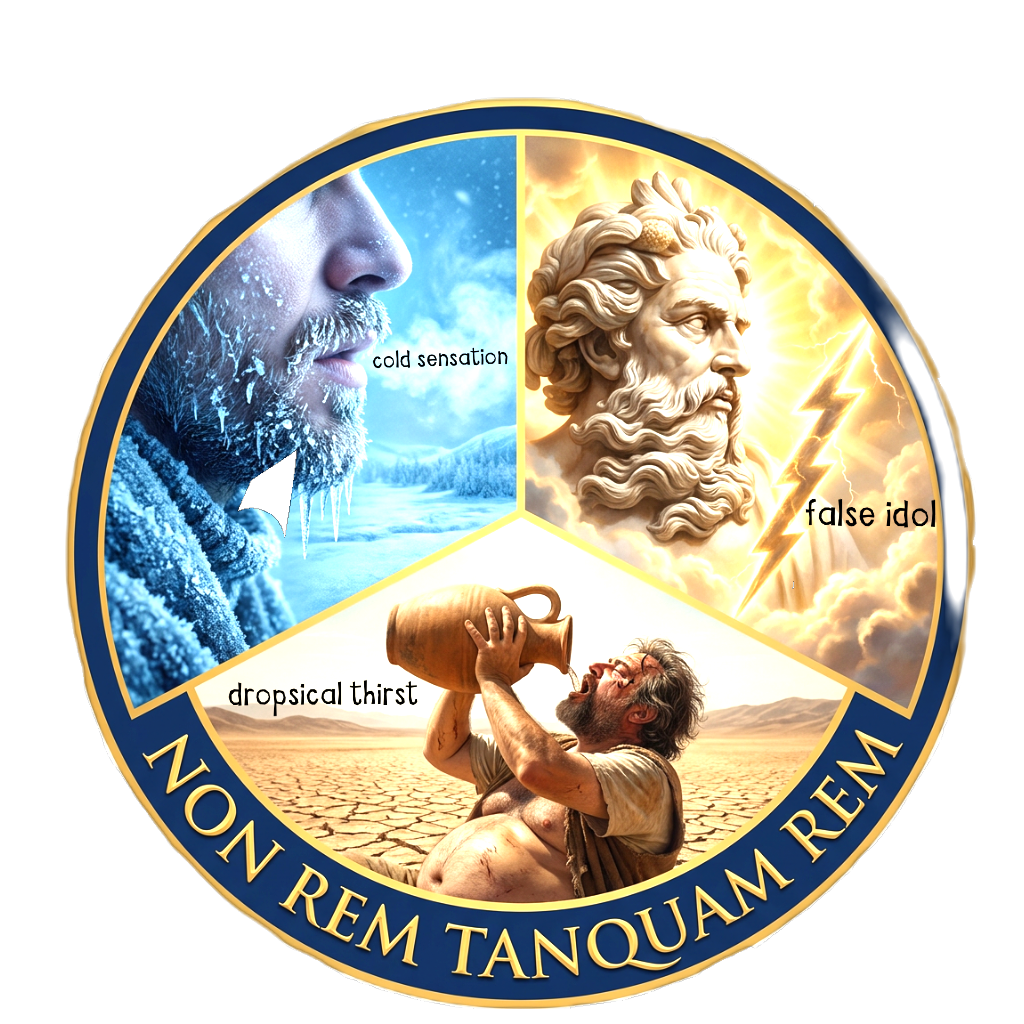 For thirty-two more types of materially false ideas , read my post “Deep Research Into Materially False Idea Types With Claude Opus 4.7 & ChatGPT 5.5 Thinking.”
7. Natural signification: representation without OR
The denial that sensations contain objective reality is not the denial that sensations have any world-directed function. This is the mistake that often makes the anti-OR reading look too austere. A cold sensation may function as a sign of a certain bodily or environmental condition. Pain may function as a sign of bodily disturbance. Color sensation may function as a sign of lawful optical and neurological arrangements. None of these sign-functions requires that the sensation contain the objectively real content of the condition signified.
The model is not resemblance but coordination. A sign need not resemble what it signifies, and it need not contain the object signified as internal content. The relation can be lawful, causal, teleological, or practical. In Cartesian physiology, bodily motions are coordinated with mental sensations by divinely instituted laws of mind-body union. The sensation can therefore be externally directed without being internally object-specifying. It can play a practical role in preserving the embodied human being without revealing the metaphysical nature of bodies.
This distinction allows DTOI to accept a corrected version of sensory representationalism. Sensations are not representational by containing OR. They are representational as natural signs. In this respect, DTOI can preserve what is attractive in teleological accounts of Cartesian sensation while denying that teleology requires objective reality. A sign theory of sensation is developed in “How Cartesian Cold Sensations are or are Not Representational,” and the relation to Alison Simmons’s account is examined in “Alison Simmons on Sensations as Representations and Objective Reality.”
8. Replies to Objections
Objection 1: If sensations are ideas, and ideas are as of things, sensations must contain objective reality. Reply: the argument trades on the strict sense of idea and applies it to the broad sense. Sensations are ideas as modes of consciousness, not necessarily as internally object-specifying representations. Their of-ness can be presentational, causal, practical, or sign-theoretic.
Objection 2: If a cold sensation has no OR, it cannot be materially false. Reply: this assumes that material falsity must be internal misrepresentation. But the cold sensation can present phenomenal positivity in a way that supplies matter for treating a non-thing as a thing. It need not contain a false objective content.
Objection 3: Obscurity and confusion imply obscure and confused content. Reply: Not always. A sensation can be obscure and confused with respect to external object-specification precisely because it lacks the relevant object-specifying content. Its obscurity is not a fog over a determinate OR-object; it is the absence of determinate OR where the intellect is tempted to expect one.
Objection 4: Sensations must represent something because they guide action. Reply: they can guide action as signs. Smoke can signify fire without containing fire. A cold sensation can guide avoidance or protection without containing the objective reality of cold as an external property.
Objection 5: The anti-OR reading makes sensations cognitively inert. Reply: No. It makes them non-purely intellectual. They are not useless; they are not empty; they are not unknowable. They are practically indispensable modes of the mind-body union. Their cognitive limitation concerns metaphysical disclosure, not physiological or practical significance.
Objection 6: De Rosa’s  misrepresentational view [“Descartes on Sensory Misrepresentation: The Case of Materially False Ideas”] better explains material falsity. Reply: it explains material falsity at the price of making sensory ideas internally represent in a systematically misleading way. The DTOI reading explains the same phenomenon without attributing false OR to God-caused sensory content. See “Critiquing Raffaella De Rosa on Sensory Misrepresentation.”
9. What the DTOI reading explains
The reading has at least seven explanatory advantages.
 First, it preserves the formal/objective distinction. A sensation’s formal reality as a mode of mind is not confused with objective reality as represented object-content.
Second, it respects the strict/broad distinction in Descartes’s use of idea.
Third, it explains why sensory qualities are obscure and confused about bodies without positing hidden conceptual content.
Fourth, it preserves material falsity as a pre-judgmental phenomenon without making sensation a false proposition.
Fifth, it preserves God’s non-deceptiveness by refusing to locate systematic false representation in God-caused sensory content.
Sixth, it accommodates the practical role of sensation by treating sensations as natural signs.
Seventh, it explains why sensations can be clear and distinct when considered merely as sensations while remaining obscure and confused when treated as guides to the intrinsic nature of body.
The last point is especially important. If clarity and distinctness always required objective reality, then a sensation considered merely as a sensation could not be clear and distinct. But Descartes’s treatment of sensory modes does not require that conclusion. The mind can clearly attend to the occurrence of pain as pain or color as color without thereby possessing an intellectual idea of the bodily property pain or color allegedly represents. Clear awareness of a mode is one thing; clear representation of an object is another.
The DTOI interpretation therefore yields a more discriminating Cartesian psychology. It allows intellectual ideas, sensory modes, volitions, emotions, judgments, and signs to occupy different explanatory roles rather than forcing all of them into the same OR-bearing mold.
10. What would refute the interpretation?
The argument is not meant to be insulated from textual defeat. It would be refuted, or at least seriously weakened, if Descartes explicitly taught that every mode of thought called an idea contains objective reality. It would also be weakened if the cold sensation were explicitly said to contain cold objectively in the intellect. It would be weakened if material falsity could be shown to require internal objective content rather than presentational matter for error. And it would be weakened if the strict/broad distinction in Descartes’s use of idea could not be maintained.
Conversely, the DTOI reading is strengthened if the textual evidence shows that Descartes uses idea both strictly and broadly; that cold sensation lacks determinate object-specification; that the cold case is best treated as a positive sensory mode rather than a positive intellectual representation of a privation; and that sensations function practically as signs without revealing the essence of body. Those are the pressure points on which the interpretation should be judged.
A scholar who rejects DTOI should therefore identify the first failed inference.
 Does the strict/broad distinction fail?
Does every idea contain OR after all?
Does sign-representation collapse into objective reality?
Does material falsity require internal misrepresentation?
Those are the right questions. The wrong question is whether sensations are ‘representational’ without qualification. They are representational as signs; they are not representational by OR.
11. Conclusion
Cartesian sensations do not have objective reality merely because they are ideas. They are ideas in a broad sense: modes of consciousness, formally real modifications of the mind-body union, immediately present to the mind. But objective reality belongs to strict ideas insofar as they contain object-specifying representational content. Secondary-quality sensations do not contain such content. They present phenomenal modes and function as natural signs; they do not internally represent cold, pain, color, taste, or odor as objective objects in the intellect.
This interpretation makes better sense of the cold case, Arnauld’s objection, the Fourth Replies, the Sixth Meditation’s account of embodied sensation, and the doctrine that God is not a deceiver. It also clarifies why materially false sensory ideas are not false judgments and not false intellectual representations. They are sensory presentations that naturally invite false judgment when the intellect treats phenomenal positivity as if it disclosed a positive feature in bodies.
The result is a sharper Cartesian theory of ideas. Not all ideas are alike. Some ideas contain objective reality; some modes are ideas only broadly; some sensory modes signify externally without representing internally. Once that architecture is in place, the problem of sensory material falsity no longer forces the interpreter to choose between Arnauldian incoherence and God-caused misrepresentation. Descartes has a third option: sensations without objective reality.
Selected DTOI post links
- DTOI & Non-DTOI Baselines for AI Models
- Proving that Cold Sensations Do not have Any Objective Reality to Bing’s Copilot
- Proving sensations are ideas with no objective reality to ScholarGPT
- How Cartesian cold sensations are or are not representational with Scholar GPT
- ScholarGPT (January 2025) asserts independently that a cold sensation lacks objective reality
- Privations, Sensations, and Objective Reality
- Proving God is not a deceiver because sensations lack objectively real contents
- Alison Simmons on sensations as representations and objective reality
- Critiquing Raffaella De Rosa on sensory misrepresentation
- Questions in Descartes’s Theory of Ideas
Primary Cartesian Citations
Meditation III on ideas, other forms of thought, objective reality, and the cold case: AT VII 36-44; CSM II 25-30. Fourth Replies on Arnauld, cold, privation, objective being, and material falsity: AT VII 206; 233-235; CSM II 145; 163-64. Sixth Meditation on sensations, mind-body union, practical guidance, dropsical thirst, and sensory error: AT VII 80-90; CSM II 55-62. Principles I.45-46 on clarity and distinctness; Principles I.68 on sensory modes considered merely as thoughts or sensations: AT VIIIa 21-22; 32-33; CSM I 207-208; 215.
Selected secondary literature
-
- De Rosa, Raffaella
 . “Descartes on Sensory Misrepresentation: The Case of Materially False Ideas.” History of Philosophy Quarterly 21, no. 3 (2004): 261-80.
- De Rosa, Raffaella
-
- Simmons, Alison
 . “Are Cartesian Sensations Representational?,” Noûs 33, no. 3 (1999): 347–69.
- Simmons, Alison
-
- Wee, Cecilia (no known photo). Material Falsity and Error in Descartes’s Meditations
 . New York: Routledge, 2006.
- Wee, Cecilia (no known photo). Material Falsity and Error in Descartes’s Meditations
-
- Wells, Norman J.
 “Material Falsity in Descartes, Arnauld, and Suarez.” Journal of the History of Philosophy 22, no. 1 (1984): 25–50.
- Wells, Norman J.
NOTES
- 1Click on the supporting hyperlinked textual references in magenta, black font, or blue underlined below:
Vivid: Sixth Meditation (AT VII 74–80; CSM II 51–55) for the involuntary and phenomenologically forceful character of sensation.
Clear and distinct as sensations: Principles I.68 (AT VIIIA 33–34; CSM I 218)
Practical usefulness and affective role: Sixth Meditation (AT VII 83–87; CSM II 57–60).
↩︎ - 2
- 3
- 4