


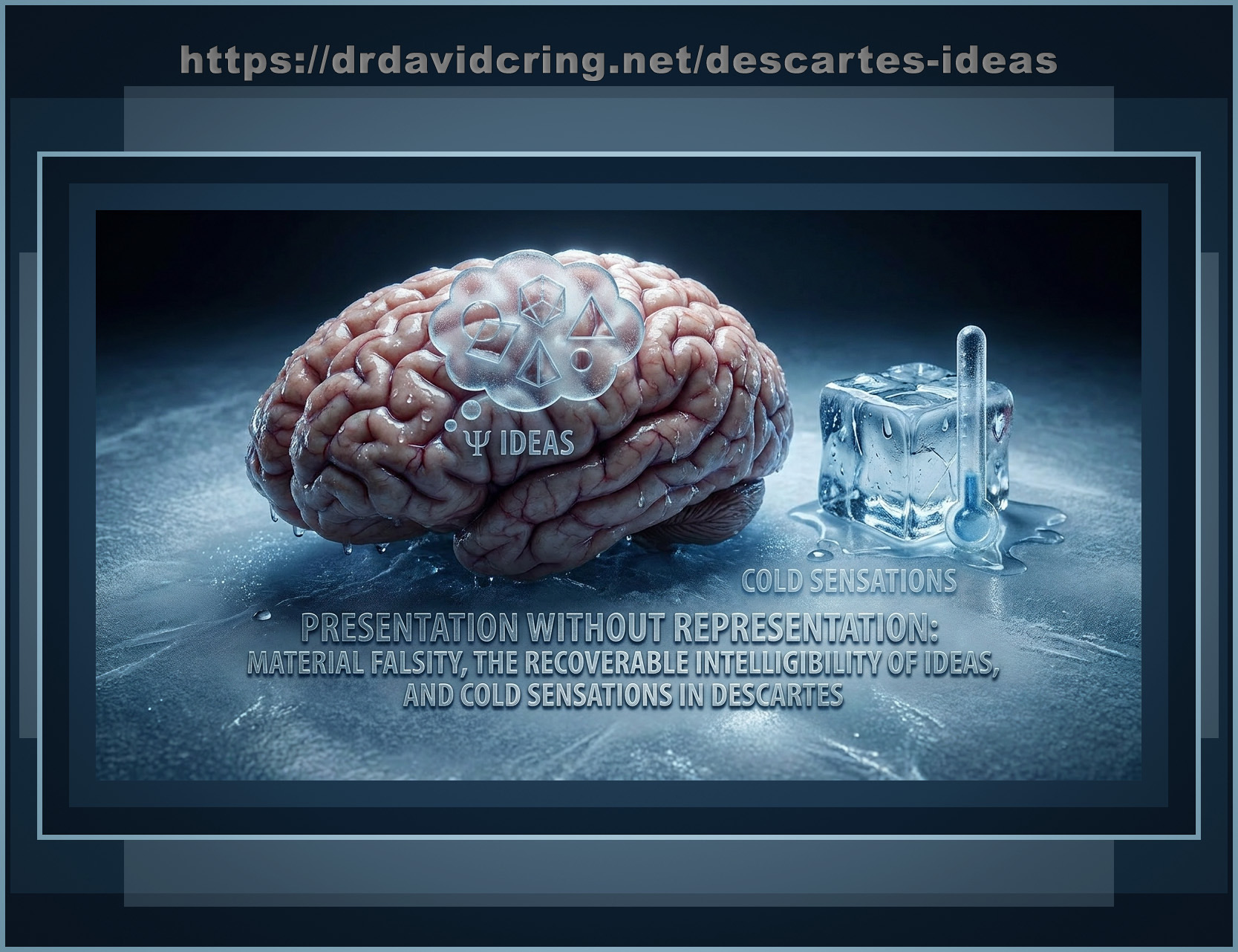
ABSTRACT
Descartes’s claim that a materially false idea “represents a non-thing as a thing” (AT VII 43; CSM II 30) has long occasioned interpretative difficulty, particularly when applied to obscure and confused sensory ideas such as the sensation of cold. Standard interpretations attempt to preserve the representational character of such ideas by attributing to them some measure of objectively real representational content, however inadequately grasped by the perceiver’s strategy I reject on the ground that certain sensory ideas possess no objectively real representational content at all.
I argue that such strategies are incompatible with a systematic constraint implicit in Descartes’s treatment of ideas, which I call the availability of ideational content. According to this interpretative constraint, absent compelling independent textual evidence, interpreters should not attribute internal ideational-representational (i.e., typically objective reality) content to an idea when that content is, in principle, permanently inaccessible to the thinker’s possible notice. The constraint does not require that every idea’s content be immediately or fully brought to clear and distinct awareness. Descartes allows that content may be implicit or initially unnoticed, as in the case of the triangle, whose demonstrable properties can subsequently be recognized even though they were not previously adverted to when the triangle was imagined (AT VII 64–65; CSM II 44–45).1Descartes writes of the triangle: “there is still a determinate nature, or essence, or form of the triangle which is immutable and eternal, and not invented by me or dependent on my mind. This is clear from the fact that various properties can be demonstrated of the triangle, for example that its three angles equal two right angles, that its greatest side subtends its greatest angle, and the like; and since these properties are ones which I now clearly recognize whether I want to or not, even if I never thought of them at all when I previously imagined the triangle, it follows that they cannot have been invented by me.” (AT VII 64–65; CSM II 44–45; bold not in original) The Fourth Replies do not independently establish the availability doctrine, but they strongly resist one principal motivation for attributing hidden positive objective content to obscure and confused sensations. There Descartes denies that the idea of cold, if cold is an absence, is coldness itself objectively in the intellect; instead, he identifies the positive item present to the mind as the sensation itself, which the mind may erroneously refer to something outside the intellect (AT VII 233–34; CSM II 163–64). The triangle therefore provides a positive model of implicit but recoverable intelligible content, whereas the cold passage, considered together with Descartes’s broader account of consciousness and ideas, leaves no adequate textual basis for postulating permanently inaccessible positive objective content within the sensation.
After a critical review of the leading positions in the recent literature, namely those of Norman J. Wells, Cecilia Wee, Amy Morgan Schmitter, Raffaella De Rosa, Alan Nelson, and Alison Simmons, I develop an alternative account according to which the sensation of cold possesses genuine phenomenal content, namely its felt qualitative character, but does not possess objectively real representational content. Material falsity is thereby relocated from objective reality content to phenomenal content and the natural judgment it occasions.
The account is completed by a dual-aspect thesis that turns on a disjunction between two mutually exclusive modes of Cartesian representation: internal representation, which is content-bearing, intrinsic to the idea, and subject to the availability doctrine, and external representation, which is sign-relational, extrinsic to the idea, and grounded in lawful causation. The sensation of cold carries phenomenal content internally and stands in an external representational relation to the physical configuration that lawfully produces it. The availability doctrine governs only internal content attributed to the idea itself. The sensation therefore satisfies the doctrine straightforwardly: its phenomenal content is immediately available to the thinker’s awareness, whereas no compelling textual basis exists for attributing to it an internal objectively real representation of a positive external quality. In fact, quite the contrary as Descartes firmly asserts that he cannot discern from considering the content if his cold sensation whether it relates to a real quality, a privation, or neither one (Third Med.: AT VII 43–44; CSM II 30 & Fourth Replies: AT VII 232–35; CSM II 162–64). Theories that lodge such content within the sensation consequently incur a burden of textual justification that, I argue, they do not discharge.
The resulting reading reconciles Descartes’s mechanistic physiology with the availability of ideational content by assigning them to different explanatory roles. The physiology is discharged by external, sign-relational representation, which links the sensation to its physical cause in the world. The appearance that these two Cartesian doctrines compete arises from an equivocation on “represent,” which conflates the internal representation of an idea’s objectively real content with the external sign-relation between a sensation and its physical causes. Once these two senses of representation are distinguished, the physiology no longer requires inaccessible content to be lodged within the idea, and the availability doctrine no longer requires the sensation to be stripped of every representational role. Because the two explanatory demands operate on different aspects of the sensation, they no longer compete.
(Android image without DTOI originally in Rolling Stone magazine, Issue 1256, MARCH 10, 2016)
1. Introduction
Few doctrines in Descartes’s theory of ideas have provoked more sustained controversy than the claim, advanced in the Third Meditation, that certain sensory ideas, paradigmatically the sensation of cold, are materially false in that they “represent a non-thing as a thing” (AT VII 43; CSM II 30). The difficulty is at once exegetical and systematic. Exegetically, Descartes’s own remarks are notoriously guarded. In the Fourth Replies he confesses that he cannot determine whether the idea of cold represents a privation, a real positive quality, or neither (AT VII 232; CSM II 162). Systematically, the doctrine appears to strain against two of Descartes’s most firmly held commitments. The first is that every idea possesses some measure of objective reality insofar as it represents something to the mind (AT VII 40; CSM II 27). The second is the availability of ideational content: no content can be posited within an idea that lies in principle beyond the thinker’s possible notice. The doctrine is a negative prohibition, not a positive achievement condition. It does not require every idea’s content to be rendered clear and distinct. It requires only that whatever is ascribed to an idea as its ideational content be, in principle, available to the thinker’s awareness in some form, however obscure.
Recent interpreters have sought various means of reconciling these commitments, generally by attributing to materially false ideas a diminished, confused, or in some sense hidden ideational-representational content. I contend that any such strategy, insofar as it lodges within the idea a content the thinker cannot in principle ever come to notice, is incompatible with the availability of ideational content. In its place, I offer an account that distinguishes two kinds of content a sensation may bear—phenomenal content, which the sensation of cold genuinely possesses, and ideational-representational (OR) content, which it lacks—and that further distinguishes two modes of Cartesian representation: internal (content-bearing, intrinsic) or external (sign-relational, extrinsic). The sensation of cold, on this account, carries phenomenal content internally, lacks objectively real representational content of a positive external quality, and stands in an external representational relation to its physical causes.
2. The Literature: Six Competing Interpretations
The problem of material falsity has generated a rich and contested body of scholarship. Six positions in particular merit sustained attention, since they mark out the principal interpretative options against which the present proposal must define itself.
 2.1 Norman J. Wells: The Suárezian Reading. Wells’s “Material Falsity in Descartes, Arnauld, and Suárez“ (Journal of the History of Philosophy 22, 1984) and the companion study “Objective Reality of Ideas in Descartes, Caterus, and Suárez” (1990) situate Descartes’s doctrine of material falsity within a broader scholastic inheritance, most immediately that of Francisco Suárez. On Wells’s reading, Descartes preserves a robust scholastic conception of objective reality, according to which the objective being of an idea is the mode of existence enjoyed by the represented object as it exists in the intellect. Materially false ideas, on this account, do possess objective reality. Their falsity consists in the fact that what they represent is not, or cannot be, an intelligible positive nature.
The interpretation faces the question raised in Section 3 below, namely how such ideational-representational content can inhabit an idea whose obscurity places its purported content beyond the thinker’s possible notice (AT VII 233; CSM II 163). The interpretation further faces a difficulty internal to its own Suárezian commitments.
Wells’s account requires that the materially false idea possess genuine objective reality—that its representatum enjoy the mode of existence a represented object has when it exists in the intellect. But objective being, on the scholastic conception Wells is at pains to preserve, is not a bare metaphysical posit; it is the mode under which the represented content is present to the intellect, and its presence there is precisely what makes the content available to reflection. Suárez himself treats the objective being of an idea as the intelligible standing of its content within the mind that entertains it, and it is on the strength of that standing that the content can be examined, compared, and judged.
If the sensory idea of cold possesses objective reality in this sense, then its representatum—the purported positive quality it presents—should be available to careful reflection in the manner of any other content enjoying objective being in the intellect. Yet Descartes’s characterization at AT VII 43–44; CSM II 30 denies exactly this: he says of the sensory ideas of cold and the like that he cannot tell whether they are ideas of things or of no things, and at AT VII 233; CSM II 163 he reaffirms that their obscurity reaches inward to what the idea exhibits, not merely outward to any extramental correlate.
Wells’s account thus faces a dilemma. If the representatum of the sensory idea genuinely enjoys objective being in the Suárezian sense, then Descartes’s obscurity claim is unintelligible, since objective being just is the mode under which content is available to the intellect. If, on the other hand, the representatum is present in some attenuated mode that falls short of ordinary objective being—present enough to be represented, obscure enough to escape reflective notice—then Wells has silently departed from the Suárezian conception he means to preserve, and the historical continuity that gives his reading its exegetical force is compromised. Either horn concedes what the availability worry requires: that the standard scholastic apparatus of objective reality cannot, without modification, accommodate the specific obscurity Descartes ascribes to the sensory ideas at AT VII 43–44; CSM II 30, hereafter TMD.
 2.2 Cecilia Wee: Referential Falsity. In Material Falsity and Error in Descartes’ Meditations (Routledge, 2006), Wee develops a referential account on which the material falsity of a sensory idea consists in its purporting to refer to a positive extramental quality when no such quality exists. Wee distinguishes the idea_m (the mental act or mode of thought that represents) from the idea_o (the res represented, i.e., the representatum of the idea_m), and argues on the strength of this distinction for what she calls the Alternative Account (AA): (1) an idea_m is true iff it represents a thing with objective being, (2) false iff it “represents no thing.” Ideas of cold, on this view, carry a referential purport directed at what the idea presents as its external cause, and their material falsity consists in the failure of that purport to secure any worldly correlate.
The account faces three connected difficulties.
First, the obscurity problem. Wee may reply that what reflection discloses is the idea’s referential purport, not the obscure object the idea purports to present: the thinker can notice, on introspection, that her idea of cold presents itself as representing a positive external quality, while the putative quality itself remains indiscernible. But this bifurcation is difficult to sustain. Descartes’s characterization at AT VII 233; CSM II 163 locates the obscurity in the idea’s representational content itself—in what the idea exhibits to the mind—not merely in the extramental correlate the idea fails to secure. If the referential purport were itself perspicuous to reflection, the idea would not be one of which Descartes says he cannot tell whether it represents something or not; it would be an idea whose representational aim is transparent and whose only defect is worldly. The obscurity Descartes ascribes to materially false ideas thus reaches inward, to the purport itself, and Wee’s account leaves unexplained how a determinate referential content can inhabit an idea whose representational aim is, by Descartes’s own testimony, not available to careful analysis.
Second, the causal equivocation in Wee’s restriction argument. Wee grounds her restriction thesis partly on the claim that some ideas_m “proceed from nothing” and therefore contain no objective reality (citing AT VII 44; CSM II 30). The inference equivocates on “coming from nothing.” Every idea_m, as a mode of a finite thinking substance, must have an efficient cause of its formal reality; Descartes’s Causal Principle does not exempt any mode of thought from the demand for a cause, and Descartes himself entertains at AT VII 44–45 that he may be the cause of the very ideas in question. What can intelligibly “come from nothing” at AT VII 44 is not the idea_m but the representatum—the objective being that would, if present, require a cause of adequate formal reality. Wee’s argument slides from a constraint on the causal grounding of representata to a conclusion about the ontological status of the mode itself, thereby attributing to Descartes the manifestly non-Cartesian view that some modes of thought are uncaused. Once the equivocation is corrected, the argument reduces to the trivial claim that ideas_m without a representatum have no OR—a definitional restatement of the restriction thesis rather than an independent argument for it.
Third, the false-idol and self-contradictory counterexamples. Wee’s AA yields the wrong verdict on the paradigmatic non-sensory cases of ideational error. The idol-worshipper’s idea has a fully determinate representatum—the deified object, with its ascribed divine attributes—and therefore genuine objective reality; yet the idea is materially defective, since what it presents as a positive nature answering to worship is no such nature. On Wee’s truth condition (the first clause (1) of her AA), however, the idea must be classified as true, because it represents a thing with objective being. Parallel difficulties beset her powerless-God argument, on which the self-contradictory character of the representatum is taken to entail that the idea_m contains no OR at all. But the powerless-God idea, considered as an idea_m, must have determinate representational content, or there would be nothing for the predicate “self-contradictory” to attach to. Both components—divinity and the negation of omnipotence—are intelligible; their conjunction is what generates the contradiction. The same holds of the chimera: lion-parts, goat-parts, serpent-parts, each a determinate representatum with its own objective standing. Contradiction is a relation among contents, not a substitute for content. Wee’s argument slides once again from the impossibility of an extramental correlate to the absence of objective reality in the idea_m, an inference the Causal Principle does not license and one Descartes plainly rejects in the Fifth Meditation’s treatment of essences with objective being.
The three difficulties are of a piece. Wee has systematically misidentified the locus of material falsity: it lies neither in the absence of a representatum (contra AA) nor in the absence of OR components (contra the powerless-God argument), but in the failure of the idea’s content—determinate but obscure—to answer to any positive nature in reality. Her referential-purport machinery captures a genuine feature of Descartes’s language of material falsity, but it cannot bear the weight of a general account: it mislabels ideas with clear representata as true, denies content to ideas whose incoherence presupposes content, and leaves the obscurity of the sensory ideas of TMD (the Third Meditation discussion at CSM II 30) unaddressed.
 2.3 Amy Morgan Schmitter: Mechanisms of Representation. Schmitter’s “Representation, Self-Representation, and the Passions in Descartes” (Review of Metaphysics 48, 1994) offers what is perhaps the most sophisticated mechanistic reading of Cartesian representation in the recent literature. She proposes that sensory ideas and passions represent in virtue of standing in the appropriate lawful causal relations to bodily and environmental states: representation is, at least for these classes of mental items, a matter of the functional role a mental item plays within a broader psychophysical economy, in addition to, or in certain cases in place of, intrinsic ideational content. The reading captures something real about the external aspect of Cartesian representation and supplies part of the historical scaffolding for the dual-aspect thesis defended in Section 5 below.
It cannot, however, bear the weight of a general account of material falsity. Mechanistic representation, considered on its own terms, is either successful or absent: the causal chain from world to sensory state either obtains or it does not, and the mental item stands in the appropriate lawful relation or fails to. What such a framework cannot deliver is the specific structure Descartes ascribes to materially false ideas at AT VII 43–44; CSM II 30—the structure of an idea that exhibits something to the mind as a positive nature when no such nature exists. Material falsity is not causal deviance and not judgmental error; it is a defect at the level of ideational content, the failure of what the idea presents to answer to any real positive quality. An idea can be materially false only if it has content that fails in this specific way, and content of that kind is precisely what a purely mechanistic account brackets in favor of causal-functional role.
Two consequences follow. First, on the mechanistic reading material falsity threatens to collapse into one of two ill-fitting categories: either mere causal misfire (the sensory state is not lawfully connected to a corresponding external quality), or judgmental error (the perceiver mistakenly judges that a positive quality corresponds to the sensation). Descartes distinguishes material falsity from both. The Fourth Replies exchange with Arnauld makes plain that material falsity is a defect in the idea itself, prior to and independent of any judgment (AT VII 231–35; CSM II 162–64); and Descartes’s insistence that even the sensory idea of cold, considered apart from judgment, “provides subject-matter for error” cannot be captured by a framework that locates all representational success or failure in the causal chain. Second, the mechanistic reading cannot honor the ideational character of the defect. Descartes’s language throughout TMD and the Fourth Replies treats materially false ideas as representers whose representata fail, not as neural or psychophysical events whose causal relations misfire. To collapse the former into the latter is to lose the very phenomenon Descartes is analyzing.
The present account therefore retains what Schmitter’s mechanism captures—that certain Cartesian mental items do stand in causal-functional relations that partly constitute their referential aspect—while insisting that this external mechanistic representation must be distinguished from internal content-bearing representation in Descartes’s strict sense. Only the latter is subject to the availability of ideational content, and only the latter can bear the specific structure of material falsity. Schmitter’s reading, illuminating as it is for the passions and for the external aspect of sensory representation, cannot on its own account for the ideational defect Descartes locates in materially false ideas; the dual-aspect thesis of Section 5 below is offered as the framework within which her mechanistic insights can be preserved without conceding the ideational phenomenon to them.
 2.4 Raffaella De Rosa: Descriptive Misrepresentation. In “Descartes on Sensory Misrepresentation: The Case of Materially False Ideas” (History of Philosophy Quarterly 21, 2004), and more expansively in Descartes and the Puzzle of Sensory Representation (Oxford, 2010), De Rosa argues for a “descriptivist” account on which sensory ideas represent their causes by way of implicit descriptive content supplied by the mind’s innate representational resources.
De Rosa is careful to distinguish her position from a bare causal-role descriptivism: the content she posits presents the cause under a determinate mechanistic mode rather than under the mere specification “whatever causes this sensation.” The idea of cold represents whatever corporeal feature answers to a determinate implicit specification—roughly, the mechanistic property of body that causes this sensation—and it is materially false because the perceiver mistakenly takes this specification to pick out a positive quality of the object.
It purchases its explanatory power at the cost of positing implicit descriptive content internal to the idea that the thinker cannot come to notice by reflection on the sensation itself. De Rosa may reply that the content is recoverable through disciplined philosophical analysis of the sort Descartes performs in the Sixth Meditation and Principles I.66–70.
But Descartes’s characterization at AT VII 43–44; CSM II 30 is stronger than a claim about pre-reflective obscurity: he says of the sensory ideas of cold and the like that he “does not even know whether they are true or false, that is, whether they are ideas of things or no things.” An ideational content that survives this degree of obscurity—recoverable only by a philosophical reconstruction the sensory idea does not itself deliver—is not ideational content in Descartes’s sense, but content the interpreter has imposed upon the idea in order to save the phenomena of representation.
 2.5 Alan Nelson: Ontology of Sensation. Nelson’s “The Falsity in Sensory Ideas: Descartes and Arnauld” (in E. Kremer, ed., Interpreting Arnauld, Toronto, 1996) and his broader ontological work on Cartesian thought take a considerably more austere line. On Nelson’s reading, obscure and confused sensations do not properly represent at all. They are non-representational modifications of the mind that come to acquire an appearance of representationality only through the mind’s own judgmental activity.
The present account converges with Nelson in denying that sensory ideas possess genuine internal ideational-representational content in Descartes’s strict sense, and shares his diagnosis that much of what looks representational in sensation is contributed by judgment. It departs, however, in two respects that mark the limits of Nelson’s austerity.
First, Nelson’s ontology leaves no room for the qualitative character of the sensation itself—what Descartes acknowledges when he insists that the sensation of cold is something rather than nothing (AT VII 44; CSM II 30), a determinate modification of the mind with its own what-it-is-likeness, even if it does not internally represent.
Second, and more consequentially, by denying sensations any representational status whatsoever, Nelson’s account cannot honor Descartes’s persistent use of representational language for sensory ideas across the Third Meditation, Sixth Meditation, and Principles I.66–70, and it cannot reconstruct the Fourth Replies claim that materially false ideas “provide subject-matter for error” prior to judgment (AT VII 231–35; CSM II 162–64). If sensations are purely non-representational, material falsity collapses into a species of formal falsity, since the whole representational dimension is relocated to judgment—precisely the collapse Descartes resists.
The dual-aspect thesis of Section 5 below preserves Nelson’s austerity about internal ideational content while supplementing it with an external sign-relational representation, on which the sensation functions as a natural sign of its bodily and environmental causes without itself possessing internal representational content. On that framework, materially false sensations can be denied strict representata without being denied representational status altogether, and the pre-judgmental character of material falsity is preserved.
 2.6 Alison Simmons: Sensations as Representations. Simmons’s “Are Cartesian Sensations Representational?” (Noûs 33, s13, 1999) offers the most influential recent defense of the thesis that Cartesian sensations are representational through and through. Simmons argues, on the strength of a teleofunctional semantics grounded in Descartes’s account of the mind-body union, that sensations represent the “biologically significant” features of the environment—what it is beneficial or harmful for the composite to pursue or avoid—and that this representational content is intrinsic to the sensation in virtue of its God-designed functional role (cf. AT VII 87; CSM II 60). On this view, the material falsity of the cold sensation does not consist in its failing to represent, but in a mismatch between its biological content and the metaphysical categories the mind is prone to impose upon it. Simmons’s account has been enormously fruitful and captures something Descartes plainly affirms in the Sixth Meditation’s discussion of the “teachings of nature.”
It faces, however, the availability worry in a form Simmons’s own resources do not clearly answer. Simmons may reply that the teleological content is available—not to detached theoretical reflection, but to the practical-embodied cognition of the composite, which registers cold-as-harmful in the very act of recoiling from it. But this reply relocates the content from the thinker qua thinker to the composite qua embodied agent, and Descartes’s availability requirement is a requirement on ideas considered as items of the intellect—content available to the res cogitans under reflection, not content registered by the composite in action. Insofar as Simmons’s teleological content is content for the composite, it is not content for the mind considered strictly as intellect, and therefore does not qualify as ideational content in the sense Descartes’s account of ideas governs. Insofar, on the other hand, as the teleological content is treated as internal ideational content of the sensation qua idea, Descartes’s obscurity claim at AT VII 43–44; CSM II 30 applies to it directly: the thinker cannot tell from the sensation itself whether it is of a thing or of no thing, still less whether it represents a biologically significant feature of the environment under a determinate teleological description. On either horn, the availability worry is confirmed: whether Simmons locates the teleological content in the composite (where it is not content for the intellect) or in the sensation qua idea (where Descartes’s obscurity claim reaches it directly), the content she posits fails to meet Descartes’s requirement that ideational content be available to the thinker under reflection.
The present account preserves what is right in Simmons’s teleology by relocating it from internal to external representation. On the dual-aspect thesis of Section 5, teleological content is a real feature of the composite’s sign-relational economy—the sensation functions as a natural sign of what is beneficial or harmful to the union—but it is not a feature of the sensation qua idea in the strict sense, and it is therefore not subject to, nor does it require satisfaction of, the availability constraint that governs ideational content proper.
2.7 The Common Presupposition. The six interpretations surveyed divide asymmetrically. Wells, Wee, Schmitter, De Rosa, and Simmons each preserve the representational character of the materially false idea by attributing to it some measure of internal ideational content—objective, referential, mechanistic, descriptive, or teleological, respectively—and thereby locate its obscurity in the perceiver’s failure to access a content the idea determinately possesses. Nelson stands as the outlier in the opposite direction, denying sensations any properly representational status at all and thereby losing the pre-judgmental character of material falsity Descartes plainly affirms. Both errors have a common source. Neither camp distinguishes representation as internal ideational content, which must be available to the thinker, from representation as an external sign-relation, which need not be. The shared presupposition of the first camp—that a determinate internal ideational content can inhabit an idea whose obscurity places that content beyond the thinker’s possible notice—is the presupposition Section 3 next calls into question, on the ground that Descartes’s own account of ideas admits no such content.
3. The Availability of Ideational Content
The doctrine I here call the availability of ideational content requires careful statement, since it is easy to overstate. Descartes plainly allows that many ideas remain obscure and confused even under the most careful reflection. The sensation of cold is precisely such an idea (AT VII 233–34; CSM II 163–64). The doctrine is therefore not the positive universal claim that every idea’s content must be capable of being brought to clear and distinct awareness. That would be an overstatement, and it is not what Descartes maintains.
The doctrine is instead a proposed negative interpretative constraint: absent compelling independent textual evidence, interpreters should not attribute internal ideational-representational content to an idea when the thinker is, in principle, incapable of ever coming to notice or recognize that content in any form. Descartes does not explicitly formulate this constraint in precisely these terms. It is a systematic inference from his definitions of thought and idea through immediate consciousness, his denial of wholly unconscious occurrent thoughts, and his treatment of implicit intellectual content as content that can subsequently be recognized or drawn out. The doctrine accordingly places a burden of proof on interpretations that locate within an idea representational content permanently inaccessible to the thinker whose idea it is.
The principal texts supporting this systematic inference are the following:
Second Replies, Definitions I–II, AT VII 160–61; CSM II 113. Descartes defines thought and idea through immediate consciousness: “I use the term ‘thought’ to include everything that is in us and of which we are immediately conscious.” He then writes: “By the name idea, I understand that form of any thought by whose immediate perception I am conscious of that same thought itself.”
”it was indeed implicitly contained in it, but previously I had not noticed it in it.” (AT VII 147; CSM II 105)Third Replies, AT VII 181; CSM II 127. Descartes defines an idea as “whatever is immediately perceived by the mind.”
Fifth Replies, AT VII 366; CSM II 253. In replying to Pierre Gassendi (1592–1655), Descartes explains that he extends the term “idea” “to cover any object of thought.”
Letter to Marin Mersenne, July 1641, AT III 393; CSMK III 185. Descartes says that “idea” denotes “in general everything which is in our mind when we conceive something, no matter how we conceive it.”
Fourth Replies, AT VII 246; CSM II 171–72. In answering Arnauld’s question whether there can be thoughts in the mind of which the mind is unaware, Descartes writes that “there can be nothing in the mind, insofar as it is a thinking thing, of which it is not aware.” He adds: “Nor can there exist in us any thought of which we are not aware at the very same moment it is in us.”
Letter to Mersenne, 16 June 1641, AT III 383; CSMK III 184. Descartes allows that something may be implicitly contained in an idea without having been noticed initially, provided that it can subsequently be recognized or drawn out.
Letter to Guillaume Gibieuf, 19 January 1642, AT III 474–78; CSMK III 201–03. Descartes maintains that one does not possess an idea without being aware of it, while distinguishing this from the fact that things may possess properties of which one has no ideas.
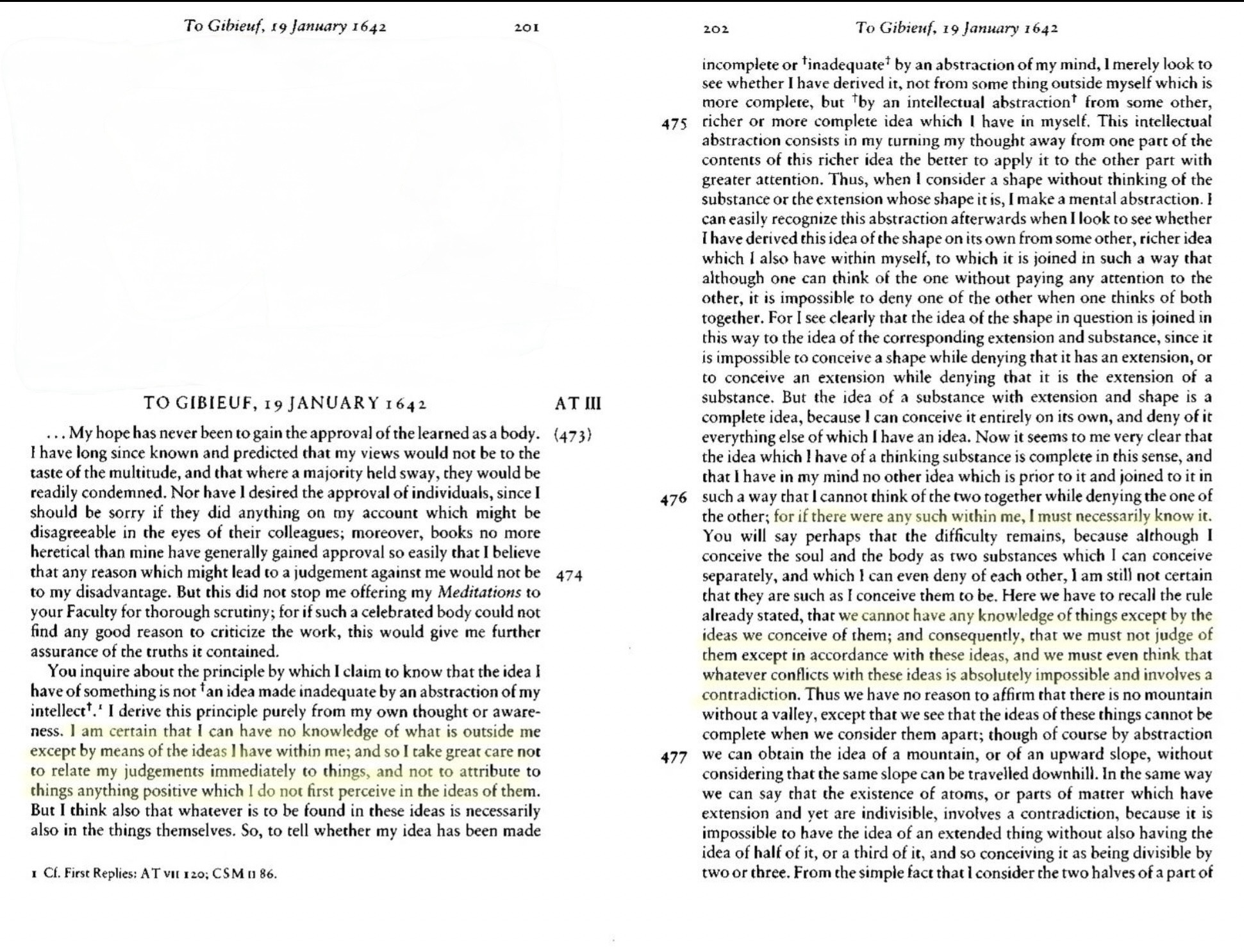
These passages establish two points especially relevant to the doctrine. First, Descartes requires an occurrent idea to be consciously present to the thinker as a mode of thought. Second, he allows intelligible implications or properties belonging to an idea to remain initially unnoticed when they can subsequently be recognized through attention, reflection, or demonstration. The passages do not by themselves establish the stronger universal proposition that every feature properly classified as an idea’s representational content must be recoverable by the thinker. The availability doctrine is therefore best presented not as an independently stated Cartesian axiom, but as a systematic interpretative inference from Descartes’s account of immediate awareness, occurrent ideas, and implicit but recoverable intellectual content.
Descartes’s treatment of the idea of the triangle helps to fix the doctrine’s positive form. In the Fifth Meditation, he insists that the geometrical properties of the triangle are not invented by the mind but discovered in its determinate nature, “even if perhaps no such figure exists, or has ever existed, anywhere outside my thought” (AT VII 64–65; CSM II 44–45). Numerous demonstrable properties of the triangle may remain initially unnoticed. They are not all explicitly enumerated in consciousness when the triangle is first conceived, but they can subsequently be recognized as following from the nature represented by the idea. The triangle therefore provides a model of implicit but recoverable intelligible content.
What matters, on the doctrine here articulated, is not that every content belonging to an idea already be explicit, nor that it be capable of being rendered clear and distinct. What matters is that it be in principle manifestable to the thinker through an appropriate operation of attention, reflection, intellectual analysis, or demonstration. Descartes plainly allows that an idea may contain intelligible content that has not yet been noticed. He does not, however, explicitly formulate the corresponding universal prohibition that an idea cannot contain content forever inaccessible to the thinker. Nevertheless, his treatment of consciousness, ideas, and implicit intellectual content jointly supports the interpretative conclusion that permanently inaccessible content should not be attributed to an idea without compelling independent textual evidence.
The doctrine, understood as this systematic interpretative constraint, distinguishes three cases. First, there is content that has already been brought to clear and distinct awareness, as in the demonstrated properties of the triangle. Second, there is content that has not yet been noticed but is in principle recoverable through further intellectual attention or demonstration, as in demonstrable properties of the triangle to which the thinker has not yet adverted. Third, there is putative internal content attributed to an idea by an interpreter even though the thinker could never come to notice or recognize it through reflection upon, or intellectual analysis of, that idea. The first two cases are securely accommodated by Descartes’s account. The exclusion of the third is not an independently stated Cartesian doctrine but the best systematic implication of his accounts of consciousness, ideas, and implicit intelligible content.
The consequence for standard representational interpretations is not a straightforward deduction from any single Cartesian text, but it is a stringent burden of explanation. The scholastic objective reality Wells attributes to the sensation, the referential intention Wee posits, the implicit description De Rosa proposes, and the teleological content Simmons treats as internal to the sensation must each be shown to qualify as content genuinely contained within the idea rather than as a relation, function, or description assigned to it from outside. If the alleged content cannot in principle become available through any reflective or intellectual examination of the sensation as an idea, then its classification as internal Cartesian ideational content requires compelling textual justification.
The Fourth Replies do not supply that justification. Descartes does not identify a determinate positive objective content hidden within the cold sensation. If cold is an absence, he denies that the idea is coldness itself objectively in the intellect and instead identifies the positive item present to the mind as the sensation itself (AT VII 233; CSM II 163). He further says that, because the idea is obscure and confused, he cannot determine whether it exhibits anything positive outside the sensation (AT VII 234; CSM II 163–64). The passage does not independently establish the availability doctrine, but it strongly resists one principal motivation for attributing hidden positive objective content to the sensation. Descartes explains the possibility of error by reference to the sensation’s obscurity and the mind’s erroneous referral of it to something outside the intellect, not by identifying a determinate objective entity concealed within the sensation.
The triangle and cold cases thus perform different argumentative roles. The triangle supplies a positive model of intelligible content that, although initially unnoticed, can subsequently be recovered through demonstration. The cold passage does not prove a general availability principle, but, considered together with Descartes’s broader account of consciousness and ideas, it leaves no adequate textual basis for postulating a permanently inaccessible positive objective content within the sensation. The purported internal content posited by standard interpretations is not merely content that the thinker has failed to notice so far. It is content for which no route of recovery from the idea itself has been identified.
Three clarifications forestall misunderstanding. First, the doctrine does not deny that obscure and confused sensations are ideas. They plainly are ideas in Descartes’s broad sense, and he applies the term idea to them without hesitation. Nor does the doctrine deny that such ideas possess a genuine presentational or phenomenal character. The qualitative character of the cold sensation is immediately present to the thinker as a mode of thought. What the doctrine governs is what can count as internal ideational-representational content in the strict sense: content that possesses objective reality and determines what the idea internally represents.
Second, availability does not require immediate introspective recognition. The triangle case shows that content may be recovered only through reasoning or demonstration. The relevant contrast is therefore not between what is immediately noticed and what is not immediately noticed. It is between content that can in principle be recognized as belonging to the idea and content that remains permanently inaccessible to every possible act of attention, reflection, or intellectual analysis directed toward that idea.
Third, the doctrine does not deny that sensations may function representationally in an external, sign-relational sense, as the following sections will show. Facts about the bodily causes, biological functions, or externally correlated objects of sensations may be discovered through physiology, natural philosophy, or reflection on the mind-body union. But the discovery that a sensation bears a causal, functional, or signifying relation to something outside the mind does not by itself establish that a representation of that thing was already contained objectively within the sensation. External representation is not internal ideational content and is therefore not governed by the availability doctrine.
The burden consequently falls on any interpretation that attributes objective reality or other internal representational content to obscure and confused sensations to explain both the Cartesian basis for that attribution and the sense in which the alleged content belongs to the idea itself. Accounts denying such internal content still owe a positive explanation of sensory presentation. What kinds of content or presentational character do sensory ideas possess, and in what sense may they nevertheless be said to “represent a non-thing as a thing”?
4. Phenomenal Presentation Without Ideational-Representational Content
The account here proposed distinguishes two kinds of content a sensation may bear. Ideational-representational content, in the strict Cartesian sense, is determinate content available in principle to the thinker’s notice through reflection on the idea itself. Phenomenal content is the felt qualitative character of the mental item, the way it appears to the perceiver. Both are genuine content. The two are not related as content to non-content, but as distinct kinds of content answering to distinct Cartesian roles. The sensation of cold, on this account, possesses phenomenal content in abundance, but lacks ideational-representational content of a positive quality.
The phenomenal content of the sensation presents itself as though a positive quality of “coldness” inhered in the external object. This presentational character is what phenomenologically appears, an experience with an apparent outward directedness. But this phenomenal presentation is not supplemented by any determinate ideational-representational content the thinker could come to notice as a positive quality of the object. What follows from the phenomenal presentation is not a genuine act of ideational representation but the mind’s natural judgment, its habitual, prereflective tendency to interpret the phenomenal appearance as a veridical indication of an external quality. It is this judgment, Descartes insists, and not the sensation itself considered as an idea, that reifies the privation of heat as a positive property of the object (AT VII 37; CSM II 26; cf. AT VII 82; CSM II 56).
Material falsity is thus relocated, but not from content to non-content. It is relocated from ideational-representational content, which the sensation does not possess, to phenomenal content and the natural judgment it occasions. The idea “represents a non-thing as a thing” (AT VII 43; CSM II 30) only in the attenuated sense that its phenomenal content presents itself as if the idea had ideational-representational content of a positive quality. The misattribution of positive reality to the privation is effected by the judging intellect operating on the phenomenal presentation, not by ideational-representational content the sensation lacks. This reading respects the availability of ideational content, since no ideational content is posited within the sensation that the thinker is in principle barred from ever noticing, while accounting for the epistemic mischief Descartes attributes to obscure and confused sensory ideas. The phenomenal content is fully available to notice, and the natural judgment operates on that phenomenal content in a way that generates error.
The proposal converges with Nelson’s austere ontology in denying internal ideational-representational content to the sensation, but diverges from his account in emphasizing that the sensation nonetheless possesses genuine phenomenal content that does the presentational work. It converges with Schmitter in stressing the mechanistic dimension of Cartesian sensory life, but reserves the term “representation” for two mutually exclusive modes it will now be necessary to distinguish. It rejects the shared presupposition of Wells, Wee, De Rosa, and Simmons that the sensation carries internal ideational-representational content the thinker cannot in principle come to notice.
5. The Dual-Aspect Thesis: Internal or External Representation
The dual-aspect thesis rests on a fundamental disjunction. In Descartes’s system, a representation is either internal or external, and the two modes are mutually exclusive with respect to any given representational role.
Internal representation is content-bearing, intrinsic to the idea, grounded in the objective reality the idea itself carries, and subject to the availability of ideational content. The idea of the triangle is an internal representation of triangularity, and its content, whether already noticed or latent for future demonstration, is available in principle to the thinker’s intellectual notice (AT VII 64; CSM II 45).
External representation is sign-relational, extrinsic to the idea, grounded in the lawful causal relation between the mental item and its physical cause, and not subject to the availability doctrine because it is not ideational content at all. The relation obtains in the world, not in the idea. A footprint represents a foot externally, in virtue of being lawfully caused by one, without carrying any intrinsic content about the foot. So too, on Descartes’s mechanistic physiology, the sensation of cold represents the physical configuration that produces it externally, in virtue of standing in a lawful causal relation to that configuration, without carrying intrinsic ideational content about the configuration.
The disjunction is exclusive with respect to a given representational role. A given mental item cannot, in the same respect, both carry internal ideational content about some object and merely stand externally in a lawful causal relation to it. Either the content is in the idea, subject to availability, OR the representation is in the world, obtaining as a matter of lawful causation. This exclusivity is what makes the dual-aspect thesis possible without contradiction. The sensation of cold participates in both modes, but in different respects. It carries phenomenal content internally, and it stands in an external representational relation to its physical cause. What it does not do, in either respect, is carry internal ideational-representational content of a positive external quality.
Descartes’s mechanistic physiology grounds the external representational relation. Sensory ideas are lawfully produced in the mind by determinate physical configurations. In the case of cold, this occurs by a particular arrangement and motion of the particles of the surrounding medium and of the sensory organ (cf. AT VII 84; CSM II 58; AT XI 143). In virtue of this lawful causal connection, the sensation stands to its physical cause in a relation of reliable indication. Whenever the requisite configuration obtains, the sensation is produced, and the sensation is not, under normal conditions, produced otherwise. The sensation is, in this mechanistic sense, a natural sign of its cause, and the natural sign is precisely an external representational relationship, opposed to internal ideational representation.
The resulting position is a dual-aspect account. Considered under its internal phenomenal aspect, the sensation of cold is materially false. Its phenomenal content presents itself as though a positive quality inhered in the external object, and it occasions the mistaken judgment that such a quality is there. Considered under its external sign-relational aspect, the same sensation is a reliable natural sign of the physical configuration that produces it, and in that sense functions representationally. The two aspects are compatible because they concern the sensation under different descriptions and under mutually exclusive representational modes: internal phenomenal content on the one hand, OR external sign-relational representation on the other.
6. Reconciling Physiology with the Availability of Ideational Content
Before laying out the reconciliation, it is worth asking why one was needed in the first place. Descartes himself does not stage the mechanistic physiology and the account of ideas as being in tension. The appearance of competition is an artifact of the literature, and it arises from a single equivocation on the word “represent.” When the physiological writings describe sensations as lawful effects of determinate particle motions in the nerves and brain (AT XI 143; AT VII 83; CSM II 57), it is natural to say that the sensation “represents” its physical cause. When the account of ideas describes every idea as possessing objective reality by virtue of representing something to the mind (AT VII 40; CSM II 27), it is again natural to speak of representation. Interpreters have generally assumed that these are the same sense of the word. Once that assumption is in place, the physiological story appears to require that the sensation carry, as part of its internal ideational content, information about the particle configuration causing it. The availability of ideational content then bears on this proposal in its fully general form: the doctrine applies to any content ascribed to any idea, including sensations, and it forbids ascribing to an idea any content the perceiver cannot in principle come to notice, whether phenomenal or ideational-representational. Reflection on the sensation of cold discloses its felt qualitative character readily enough, but it never discloses particle motions or any other positive external quality. The standard readings therefore run afoul of the doctrine not because availability is restricted to a special class of content, but because they lodge within the sensation precisely the kind of content, namely ideational-representational content of an external quality, that the sensation manifestly fails to make available to the perceiver’s notice. This is what has driven Wells, Wee, De Rosa, and Simmons to load progressively more elaborate ideational content into obscure sensations, and what has driven Nelson, from the opposite direction, to deny that sensations represent at all. The reconciliation set out below dissolves this pressure by enforcing the disjunction between internal and external representation and showing that the two Cartesian doctrines govern different aspects of the sensation and therefore never truly competed.
It is at just this point that the reconciliation of Descartes’s two doctrines can be made explicit. On the one hand, the availability of ideational content forbids the ascription to an idea of internal ideational content the thinker is in principle barred from ever noticing (AT VII 64; CSM II 45). On the other hand, the mechanistic physiology of Le Monde, the Dioptrics, and the Treatise on Man maintains that sensations are lawfully produced by determinate physical configurations acting on the nerves and brain (AT XI 143), and it is this physiological story that makes sensations useful to the mind and body composite in the preservation of life (AT VII 83; CSM II 57). If the sensation of cold internally represents the particle configuration that causes it, then it must carry internal ideational content the thinker can in principle come to notice about that configuration. Yet the intellect, reflecting on the sensation itself, plainly cannot bring any such content to notice at all. The physiology thus appears to demand precisely the sort of internal ideational content the availability doctrine forbids.
The reconciliation proceeds by insisting on the exclusive disjunction between internal and external representation that Section 5 laid out. The literature has tended to conflate these modes, treating the sensation’s causal responsiveness to its physical cause as if it entailed the presence of internal ideational content about that cause. Once the disjunction is enforced, the appearance of conflict dissolves.
The availability of ideational content governs internal representation only. Whatever internal ideational content an idea possesses must be, in principle, available to the thinker’s notice by reflection on the idea itself, even if only obscurely. The idea of the triangle exemplifies this mode. Its geometrical content, however implicit prior to demonstration, remains fully available to the thinker’s intellectual notice (AT VII 64; CSM II 45). The sensation of cold, considered under its internal aspect, carries only phenomenal content, which is fully available to the thinker’s notice. It carries no internal ideational-representational content of a positive external quality, and therefore does not violate the availability doctrine.
External representation, by contrast, is not internal ideational content at all. It is a lawful causal relation obtaining in the world between the sensation and its physical cause. Its truth-maker lies outside the idea, in the nomic structure of the physical world and the causal architecture of the body. Because the external representational relation is extrinsic, it need not be available to the thinker’s notice from reflection on the sensation itself in order to obtain. The discovery of the physiological causes of sensation is the work of natural philosophy operating on the clear and distinct ideas of matter in motion, not the work of introspection operating on the obscure sensation of cold (AT VII 80; CSM II 55). The physiology’s demands are met by the external representational relation, without generating any internal ideational content that the availability doctrine could not accommodate.
Once the disjunction is enforced, each Cartesian commitment governs its proper domain. The availability of ideational content governs internal representation, where it forbids permanently inaccessible content. The mechanistic physiology grounds external representation, where availability is not at issue because there is no internal ideational content in question. The apparent conflict was, in the end, an equivocation on “represent.” Sensory ideas represent internally, in the phenomenal mode, without carrying internal ideational content of external qualities. They represent externally, in the sign-relational mode, without requiring the internal content whose absence puzzled the standard interpretations. Descartes can consistently hold that sensory ideas are epistemically unreliable as sources of clear and distinct knowledge of external qualities, because their phenomenal presentation misleads judgment and they carry no ideational-representational content in the strict internal sense, while remaining reliable as physiological effects that point back to their causes via external representation. The physiology no longer needs to load inaccessible internal content into the idea, and the availability of ideational content no longer needs to strip the sensation of every representational role. Each doctrine governs a distinct explanatory register, and the two registers are related not by competition but by complementarity.
7. Conclusion
The interpretation defended here reconciles two Cartesian commitments that have frequently been treated as difficult to hold jointly. The availability of ideational content forbids the attribution to obscure sensations of internal ideational content the thinker cannot in principle ever come to notice (AT VII 64; CSM II 45; AT VII 233; CSM II 163). The doctrine of material falsity requires that the sensation nonetheless mislead the perceiver about the external world (AT VII 43; CSM II 30). The distinction between phenomenal content and ideational-representational (objective reality) content, together with the exclusive disjunction between internal and external representation, supplies the requisite resource. The sensation misleads by presenting phenomenal content as though it were ideational-representational content of a positive external quality, and the mind’s natural judgment, operating on that phenomenal presentation, effects the reification of a privation (AT VII 37; CSM II 26). The dual-aspect thesis then restores to the sensation a legitimate representational role in the external, sign-relational mode. As an external representation, the sensation functions as a lawful natural sign of its physical cause, reliably indicating what it does not internally represent (AT VII 84; CSM II 58).
The philosophical yield is twofold. Exegetically, the account clarifies Descartes’s guarded remarks about the idea of cold without recourse to internal ideational content sealed off from the thinker’s possible notice or to interpretively strained notions of degraded objective reality. It preserves what is illuminating in Wells’s scholastic recovery, Wee’s referential framing, Schmitter’s mechanistic apparatus, De Rosa’s attention to sensory misrepresentation, Nelson’s ontological austerity, and Simmons’s teleological insights, while relieving each of the availability-related burden it has been made to bear by relocating the representational work from internal to external representation where the exegesis warrants. Systematically, it exhibits how a mechanistic conception of sensation can be integrated with a robustly Cartesian account of ideational content by enforcing the exclusive disjunction between internal and external representation, and how the epistemic unreliability of sensory ideas as sources of clear and distinct knowledge is entirely consistent with their reliability as effects that point back to their physical causes. What the senses fail to represent internally, they may nonetheless faithfully indicate externally.
References
De Rosa, Raffaella  . “Descartes on Sensory Misrepresentation: The Case of Materially False Ideas.” History of Philosophy Quarterly 21, no. 3 (2004): 261–80.
De Rosa, Raffaella  . Descartes and the Puzzle of Sensory Representation
  . New York: Oxford University Press, 2010.
Descartes, René. The Philosophical Writings of Descartes, (for vol. 1) (for vol. 2). Translated by J. Cottingham, R. Stoothoff, D. Murdoch, and (for vol. 3) A. Kenny. Cambridge: Cambridge University Press, 1984–1991. [Cited as CSM.]
Descartes, René. Œuvres de Descartes, 11 vols. Edited by C. Adam and P. Tannery. Paris: Vrin/CNRS, 1964–1976. [Cited as AT.]
Nelson, Alan  . “The Falsity in Sensory Ideas: Descartes and Arnauld.” In Interpreting Arnauld
  , edited by Elmar J. Kremer
  , 13–32. Toronto: University of Toronto Press, 1996.
Ring, David C.  “Analyzing Material Falsity’s Representing a Non-Thing as a Thing with ChatGPT 4o.“ Descartes’s Theory of Ideas (drdavidcring.net/descartes-ideas), November 21, 2024.
Schmitter, Amy Morgan  . “Representation, Self-Representation, and the Passions in Descartes.” Review of Metaphysics 48 (1994): 331–58.
Simmons, Alison  . “Are Cartesian Sensations Representational?,” Noûs 33, no. 3 (1999): 347–69.
Wee, Cecilia (no known photo). Material Falsity and Error in Descartes’s Meditations  . New York: Routledge, 2006.
Wells, Norman J.  “Material Falsity in Descartes, Arnauld, and Suarez.” Journal of the History of Philosophy 22 (1984): 25–50.
Wells, Norman J.  . “Objective Reality of Ideas in Descartes, Caterus, and Suarez.” Journal of the History of Philosophy 28, no. 1 (1990): 33–61.

- 1Descartes writes of the triangle: “there is still a determinate nature, or essence, or form of the triangle which is immutable and eternal, and not invented by me or dependent on my mind. This is clear from the fact that various properties can be demonstrated of the triangle, for example that its three angles equal two right angles, that its greatest side subtends its greatest angle, and the like; and since these properties are ones which I now clearly recognize whether I want to or not, even if I never thought of them at all when I previously imagined the triangle, it follows that they cannot have been invented by me.” (AT VII 64–65; CSM II 44–45; bold not in original) ↩︎