



Introduction
Descartes’s use of the word “idea” is undeniably non-univocal,1Descartes explicitly acknowledges the equivocal use of idea in the Preface to the Reader: “I answer that the term ‘idea’ here is ambiguous. It can be taken either in the material sense, as an operation of the understanding, in which case it cannot be said to be more perfect than myself, or objectively, for the thing represented by this operation; and this thing, even if it is not supposed to exist outside my understanding, can nonetheless be more perfect than me in virtue of its essence.” (AT VII 8; CSM II 7) but this ambiguity is not itself an overlooked feature of his theory. Modern Cartesian commentators have recognized that Descartes sometimes uses idea strictly for thoughts that are tanquam rerum imagines, “as it were the images of things” (AT VII 37; CSM II, 25) [I prefer “as if an image of a thing”], while elsewhere employing the term much more broadly for what is immediately perceived in consciousness, including volitions, emotions, sensations, and other modes of thought.2For a clear contemporary recognition of these different uses, see Kurt Smith, “Descartes’ Theory of Ideas,” in The Stanford Encyclopedia of Philosophy, Fall 2025 ed., ed. Edward N. Zalta and Uri Nodelman (Metaphysics Research Lab, Stanford University, 2025), especially §1, “Ideas Understood as Modes of Thinking”. Smith discusses both Descartes’s strict application of idea to thoughts that are tanquam rerum imagines and his broader formulations according to which an idea is whatever is immediately perceived by the mind. The interpretation defended here therefore does not claim that the strict and broad uses of idea have gone unnoticed. The point of departure comes instead with the status of objective reality. In §2, “Ideas and the Formal-Objective Reality Distinction”, Smith states that ideas possess objective reality “by their very nature.” The present interpretation rejects that unrestricted conclusion and argues that objective reality belongs only to the content whereby a cognition internally represents a representatum.
The strict–broad distinction developed here therefore does not purport to discover an ambiguity that Cartesian scholarship has missed. It uses that acknowledged ambiguity to expose a different and more consequential distinction that has not been adequately recognized: not all mental content falling within Descartes’s broader use of idea possesses objective reality.3For a comparison of prominent interpretations of Cartesian ideas and objective reality, see my “Table of Cartesian Commentators on the Status of Ideas.”
The central claim of this post is accordingly the non-universality of objective reality within Cartesian thought. Consciousness, phenomenal presentation, intentional directedness, and even determinately having something as the subject matter of thought do not by themselves confer objective reality. Objective reality is present only insofar as a cognition contains a representatum with objective being, such as a substance, principal attribute, true and immutable nature or essence, or mode. Other features of the same conscious state can be formally real determinations of thought without themselves being objectively real. The crucial question is therefore not simply whether a mental state qualifies as an idea, since Descartes’s broad use makes that category extremely inclusive. The crucial question is which content within a cognition, if any, is objective-reality-bearing.
This point also prevents the distinction between strict and broad ideas from being misconstrued as a division of a single cognition into two numerically distinct ideas. Consider the fear of a lion. There need be only one occurrent mental state, the fear of a lion. Under Descartes’s broad use of idea, that entire conscious state can be called an idea. Insofar as that same state internally represents a lion, however, it also satisfies Descartes’s strict use of idea and possesses objective reality corresponding to the represented finite substance. Its fearful character does not thereby acquire objective reality. The fearfulness is formally real as a determination of the mental state, while the lion is represented with objective reality. Conversely, a sensation may phenomenally present coolness, pain, color, or some other sensory quality while containing no representatum (item represented) that exists objectively in the idea. Its status as a broad idea follows from its being an immediately conscious mode of thought, not from its possessing objective reality. Thus the broad use of idea extends beyond those cognitions in which something has objective being as a representatum.
This distinction has substantial consequences for Descartes’s theory of ideas. Treating objective reality as universal across mental content4See my “Why Objective Reality Cannot Be Descartes’s Universal Theory of Thought: Burman, Common Notions, and the Collapse of the Strict-Idea Model.”
obscures his account of material falsity,5See my “How My DTOI Baseline Accounts for the Material Falsity of Secondary Quality Sensations.”
encourages the conflation of phenomenal presentation with internal representation, and makes his treatment of sensations appear more representationally uniform than the texts warrant.6See my “Do Cartesian Sensations Have Objective Reality?: Strict Ideas, Broad Ideas, and Material Falsity in Descartes’s Theory of Ideas.”
It also misidentifies what matters in the causal argument of the Third Meditation. The relevant causal demand does not arise merely because a conscious state is called an idea. It arises when a representatum has objective being in an idea and thereby gives that idea a determinate degree of objective reality, whose ontological rank fixes the minimum formal or eminent reality Descartes requires of its adequate cause.7See my “Infinite Objective Reality in a Finite Idea: Why Should It Require an Infinite Cause?.”
Once objective reality is restricted in this way, sensations can remain genuine ideas in Descartes’s broad sense without the sensory qualities they phenomenally present thereby possessing objective being in the idea, while strict ideas of substances, principal attributes, true and immutable natures or essences, and modes contain objective reality because their representata possess objective being in the intellect at determinate ontological ranks.8See my “Where Objective Reality Occurs in Cartesian Thought: OR-Bearing Representata and Non-OR-Bearing Content.”
The purpose of my post is therefore not primarily to establish that Descartes uses idea in strict and broad senses. That ambiguity is already recognized. The more significant thesis is that the extension of idea beyond its strict representational use does not carry objective reality with it. Descartes’s broad category of conscious thought is more extensive than the domain of objective reality. Recovering that asymmetry provides the conceptual framework for explaining why only some content within Cartesian cognition is objective reality representational content (OR) and for giving a more precise account of representation, sensation, material falsity, and the role of objective reality throughout Descartes’s theory of ideas (DTOI).
Why this key quotation matters in the Third Meditation
“Some of my thoughts are, as it were, the images of things, and it is only in these cases that the term ‘idea’ is strictly appropriate—for example, when I think of a man, or a chimera, or the sky, or an angel, or God. Other thoughts have various additional forms: thus, when I will, or am afraid, or affirm, or deny, there is always a particular thing which I take as the object of my thought, but my thought includes something more than the likeness of that thing. Some thoughts in this category are called volitions or emotions, while others are called judgments.” (Meditations on First Philosophy, Third Meditation: AT VII 36–37; CSM II, 25–26; bold not in original)
Quaedam ex meis cogitationibus tanquam rerum imagines esse videntur, quibus solis proprie ideae nomen competit: ut cum hominem, vel Chimaeram, vel Coelum, vel Angelum, vel Deum cogito. Aliae vero alias quasdam formas praeterea habent: ut cum volo, cum timeo, cum affirmo, cum nego, semper quidem aliquam rem ut objectum meae cogitationis apprehendo, sed aliquid etiam amplius quam istius rei similitudinem cogitatio mea continet. Et ex hoc genere cogitationum aliae voluntates, aliae affectus, aliae judicia vocantur. (AT VII 36–37):
The phrase “tanquam rerum imagines” (“as if images of things”) carries the famous “as if” [tanquam] qualifier that signals Descartes is speaking analogically: ideas in the strict sense are like images, not literally pictures in the mind. The “additional forms” (alias quasdam formas praeterea) mark a non-representational aspect of one and the same thought. Willing, fearing, affirming, and denying are not second ideas added to a first. They are further forms included in a single cogitatio that already takes something as its object.
The reasoning can be reconstructed as follows:
- Strict ideas are those thoughts that are “as it were the images of things.” (AT VII 37; CSM II, 25)
- In willing, fearing, affirming, and denying, there remains a “particular thing” taken as the object of thought. (AT VII 37; CSM II, 26)
- Descartes distinguishes the “likeness of that thing” from the “something more” included in willing, fearing, affirming, or denying. (AT VII 37; CSM II, 26)
- Objective reality is subsequently attributed to ideas insofar as they represent things, with its degree determined by what is represented: substance, mode or accident, or infinite substance. (AT VII 40; CSM II, 27–28)
- Consequently, in a fear of a lion, the lion falls on the “likeness” or thing-representing side of Descartes’s distinction. That is precisely the content to which his ensuing doctrine of objective reality applies.
- The fear itself falls on the other side of the distinction: it is the “something more” added to the likeness. It is therefore not another likeness of another thing and does not introduce another objectively real representatum.
Descartes surgically restricts the term ‘idea’ strictly to those thoughts that possess objective reality (internal representational content) because “image-like” thoughts can later be weighed for their degrees of objective perfection and subjected to the causal adequacy principle (a cause must contain at least as much reality or perfection as it imparts to its effect). In a fear, a volition, an affirmation, or a denial, the additional form of fearing, willing, affirming, or denying is not itself representational. Objective reality, when present, belongs only to the representing aspect of that same thought.
The key quotation foreshadows the later discussion of material falsity (and ideas/sensations of secondary qualities) and the “strict idea model.” Descartes does not limit his use of idea only strictly but often broadens its use to contents of awareness when thinking.
Michael Moriarty’s  Oxford World’s Classics translation (2008, p. 25) renders the key opening quotation almost identically: “some of my thoughts are as it were the images of things,” preserving the “as it were” and the strict-proper-use of idea. The rest of the paragraph follows the same logical architecture as CSM, though with slightly more contemporary phrasing in the list of ‘additional forms.’
This quotation is foundational for my interpretation. Let me draw out why it’s so damaging to the weaker universal representational thesis that all ideas are representational.
Descartes’s taxonomy of thought here is tripartite, not merely bipartite (strict or broad ideas):
- Strict representational ideas—ideas strictly so called, or thoughts that are tanquam rerum imagines, “as if images of things.” These alone properly bear the name “idea” in Descartes’s narrow sense. They contain an internal representatum and therefore carry objective reality. Examples include the ideas of God, mind, body, extension, triangle, a chimera, and a particular person or object. AT VII 36–37; CSM II 25–26.
- Simple non-representational presentations—conscious mental modes whose intrinsic phenomenal or affective character is immediately presented to awareness but which contain no internal representatum and therefore no objective reality. Secondary-quality sensations such as cold, pain, color, sound, taste, and smell belong here on the DTOI interpretation. So may generalized fear, free-floating anxiety, or joy considered simply as felt states, when no determinate object is represented. Such states can still possess phenomenal character, affective directedness, bodily location, practical significance, or external causal relations without internally representing a thing through objective reality.
- Object-directed broad-sense thoughts—volitions, emotions, and judgments that are single thoughts with an additional form. A fear of a lion, a willing to raise one’s arm, an affirming that snow is white, and a denying that bodies exist are each one thought, not a pair of ideas. The representing aspect of that thought may be tanquam rerum imago and therefore bear objective reality. The additional form of fearing, willing, affirming, or denying does not. Descartes accordingly says that such a thought “includes something more than the likeness of that thing.” AT VII 36–37; CSM II 25–26.
This taxonomy classifies kinds and structures of thought, not three coordinate species of strict ideas, and not a catalogue in which one mental state is assembled from two ideas. The first category consists of strict ideas that contain objective reality. The second consists of simple conscious presentations that lack objective reality altogether. The third consists of single thoughts that take an object and also include an additional non-representational form.
Descartes is therefore explicitly committed to the claim that not every feature of a thought is representational in the objective-reality-bearing sense. The act of willing, fearing, affirming, or denying is not itself another image-like representation of the object, and it is not a second idea packed inside the first. It is a further form of one and the same thought. The representing aspect and the additional form must be distinguished even though they are not two ideas.
If Descartes already acknowledges a non-representational form within an object-directed thought, then the universal principle that “all thought is representational” cannot be extracted from this passage. What the passage supports is a more discriminating account:
- Only strict ideas are intrinsically representational in the objective-reality-bearing sense.
- Some conscious states are simple presentations that lack any internal representatum and contain no objective reality.
- Other thoughts are object-directed broad-sense ideas: one mental state whose representing aspect may bear objective reality, while the additional form of willing, fearing, affirming, or denying does not.
- That additional form is real and irreducibly non-representational. It does not become a second idea merely because the same thought also represents an object.
A defender of a weaker universal representational thesis might reply: “But Descartes says that in volitions, emotions, and judgments there is always ‘a particular thing which I take as the object of my thought.’” In ordinary object-directed cases, that is correct. Fearing a lion, loving a friend, willing to travel to Paris, or affirming that snow is white each takes something as its object. That clause names the object of one thought. It does not introduce a second, numerically distinct strict idea housed inside a broader state. The internal representation belongs to the representing aspect of that one thought. The fearing, loving, willing, or affirming is an additional form of the same thought, not another representation of the object.
Nor should every affective state be forced into this object-directed structure. Generalized fear or free-floating anxiety may be consciously experienced without any determinate object being internally represented. Such a state can still have affective directedness, urgency, bodily phenomenology, or practical significance without containing an objective-reality-bearing idea of some thing feared. This shows why “intentionality” must not simply be equated with the possession of an internal representatum. A mental state may be phenomenally or affectively directed without representing a res through objective reality.
The significance for DTOI is immediate. A secondary-quality sensation need not be analyzed as an object-directed thought that has a representing aspect plus some additional sensory form. If the sensation of cold contains no internal representatum—if no substance, quality, nature, or mode is represented within it through objective reality—then it falls outside the strict representational core altogether. It is a simple, formally real mode of mind whose phenomenal character is immediately presented to consciousness without internally representing a thing.
DTOI therefore distinguishes three importantly different structures: a strict idea containing objective reality; a simple conscious presentation lacking objective reality; and one object-directed thought that includes both a representing aspect and an additional non-representational form. The deepest dividing line is not between intentional and non-intentional thought in every possible sense of “intentionality.” It is between thoughts that contain an internal representatum and thoughts that do not. An object-directed broad-sense idea can stand on both sides of that line only as one thought with two aspects, never as two ideas in one state. A fear of a lion, for example, is one broad-sense idea whose lion-representing aspect bears objective reality while its affective aspect of fear does not.
See my supporting posts:
 “How My DTOI Baseline Accounts For The Material Falsity Of Secondary Quality Sensations”
“Convincing Anthropic’s Claude.ai that Cartesian sensations lack objective reality”
“Conversation on representation & the material falsity of ideas with ChatGPT 4.0 (April 2023 version)”
So the passage does double work for my interpretation.
- First, it shows Descartes himself restricting “idea” in the proper sense to representational, objective-reality-bearing thoughts—that is, to thoughts containing an internal representatum—which directly undermines any universalizing reading.
- Second, it establishes a precedent for conscious mental states that lack any internal representatum within Descartes’s own framework, making it far less surprising that secondary-quality sensations, common notions, and the idea of nothing should likewise fall outside the objective-reality-bearing representational apparatus.
The weaker thesis—that all Cartesian ideas intrinsically contain objective reality or an internal representatum—cannot survive a careful reading of this passage. At the very outset of the Third Meditation, Descartes distinguishes the field of thought from the field of strict ideas. Strict ideas alone carry the representational weight of objective reality. Other conscious modes either lack an internal representatum altogether or are single thoughts whose representing aspect may bear objective reality while an additional form of willing, fearing, affirming, or denying does not.
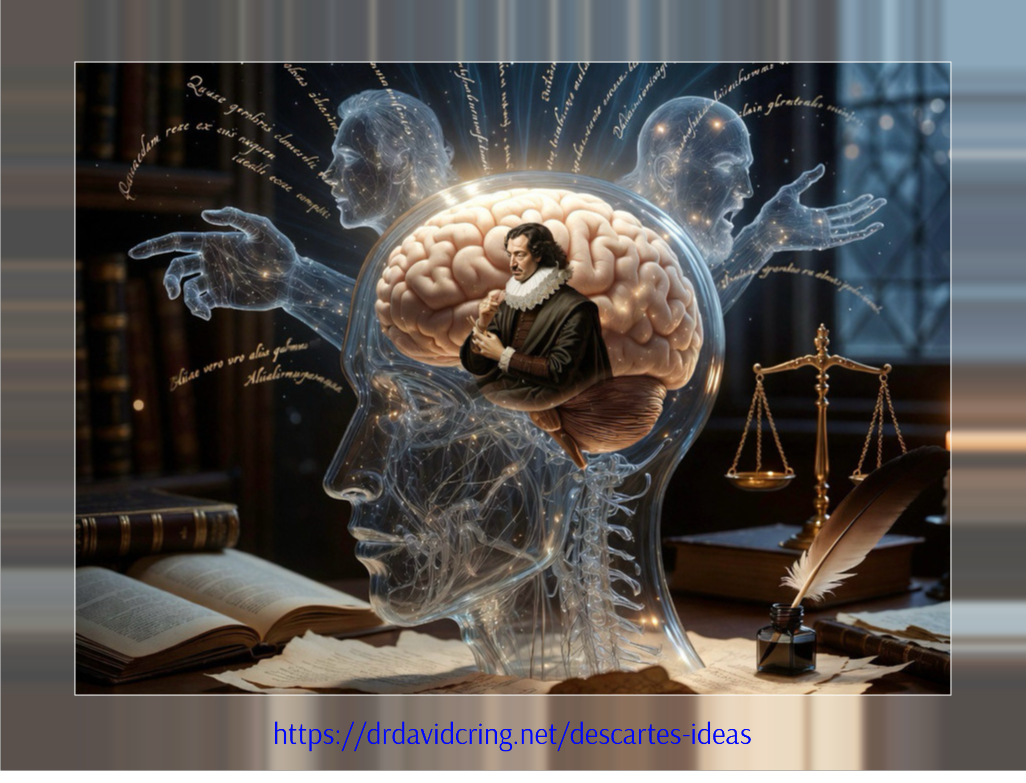
A. Strict-sense ideas: tanquam rerum imagines
The canonical strict-sense passage is Meditation III, where Descartes distinguishes those thoughts that are, as it were, images of things from volitions, emotions, and judgments.
“Some of my thoughts are, as it were, the images of things”
“it is only in these cases that the term ‘idea’ is strictly appropriate”
“when I think of a man, or a chimera, or the sky, or an angel, or God.”
Reference: Meditation III, AT VII 36–37; CSM II 25–26.
“Quaedam ex his tanquam rerum imagines sunt, quibus solis proprie convenit ideae nomen”
Reference: Meditation III, AT VII 37.
The immediately following contrast is crucial, because Descartes includes willing, fearing, affirming, and denying among thoughts, but not among ideas in this strict representational sense.
“Other thoughts have various additional forms”
“when I will, or am afraid, or affirm, or deny”
“my thought includes something more than the likeness of that thing.”
Reference: Meditation III, AT VII 36–37; CSM II 25–26.
“Aliae verò alias quasdam praeterea formas habent”
“ut, cùm volo, cùm timeo, cùm affirmo, cùm nego”
Reference: Meditation III, AT VII 37.
This is the strongest textual basis for saying that, strictly, ideas are those thoughts that function as likenesses or quasi-images of things: man, chimera, sky, angel, and God. The relevant strictness is representational or object-presenting, not imagistic in the corporeal-phantasm sense.
B. Objective-content sense: idea as the thing thought of objectively
A second passage does not use the word “strictly,” but it is central for the strict representational/objective-content sense of idea.
“an idea is the thing which is thought of in so far as it has objective being in the intellect”
“the idea of the sun is the sun itself existing in the intellect”
“not of course formally existing”
“but objectively existing.”
Reference: First Replies, AT VII 102–103; CSM II 74–75.
“objectivè in intellectu”
Reference: First Replies, AT VII 102–103; CSM II 74–75.
This is not the broad “any conscious mental act” sense. It is the objective-being sense: the idea is considered as the thing represented or intentionally present in the intellect.
Another place where Descartes appears to imply that all ideas are representational is in his Fifth Set of Replies, where he states:
“An idea represents the essence of a thing, and if anything is added to or taken away from the essence, then the idea automatically becomes the idea of something else. This Is how the ideas of Pandora and of all false Gods are formed by those who do not have a correct conception of the true God.” (AT VII 371; CSM II 256; bold italic not in original)
My interpretation is that in this context, Descartes was only talking about all strict ideas that are tanquam rerum imagines (as if an image) as representing essences, but not of all ideas generally speaking where we include his use of broad sense ideas as characterized below.
C. Broad-sense ideas: idea as form of any thought
The broadest formal definition occurs in the geometrical exposition appended to the Second Replies.
“Thought. I use this term to include everything that is within us in such a way that we are immediately aware of it.”
“all the operations of the will, the intellect, the imagination and the senses are thoughts.”
“Idea. By the term ‘idea’ I understand that form of any thought by the immediate perception of which I am conscious of that very thought.” [“Ideae nomine intelligo cujuslibet cogitationis formam illam, per cujus immediatam perceptionem ipsius ejusdem cogitationis conscius sum.”]
Reference: Second Replies, geometrical exposition, Definitions I–II, AT VII 160–161; CSM II 113–114.
“Thus it is not only the images depicted in the imagination which I call ‘ideas’.”
“I call them ‘ideas’ only in so far as they give form to the mind itself.”
Reference: Second Replies, geometrical exposition, Definition II, AT VII 160–161; CSM II 113–114.
“forma cujuslibet cogitationis”
Reference: Second Replies, geometrical exposition, Definition II, AT VII 160–161; CSM II 113–114.
This is the most important broad-sense definition: since thought includes will, intellect, imagination, and sense, and idea is the form of any given thought, “idea” is here extended beyond strict representational rerum imagines.
D. Broad-sense ideas: volition and fear counted among ideas
The most explicit broad-sense reply to Hobbes is in the Third Replies.
“I am taking the word ‘idea’ to refer to whatever is immediately perceived by the mind.”
“when I want something, or am afraid of something”
“I count volition and fear among my ideas.”
Reference: Third Replies, reply to Hobbes’s Fifth Objection, AT VII 181; CSM II 127–128.
This is the decisive passage for broad-sense ideas as objects or forms of consciousness. It confirms that willing and fearing can be counted as ideas without implying that they are ideas in the strict tanquam rerum imagines sense.
E. Broad-sense ideas: ideas in the will, not merely in the intellect
Descartes also makes clear in correspondence that “idea” extends to the will as well as to the intellect.
“we have ideas not only of all that is in our intellect, but also of all that is in the will.”
“we cannot will anything without knowing that we will it”
“I do not claim that the idea is different from the act itself.”
Reference: Letter to Mersenne, 28 January 1641, AT III 295; CSMK 172.
This is extremely important for the broad-sense doctrine. The “idea” of willing is not a second mental object hovering over the volition; Descartes explicitly allows the idea not to be different from the act itself.
F. Broad-sense ideas: anything established by reasoning or perceived in any manner
Descartes extends the term “idea” to what is perceived in any manner whatsoever, including what is established by reasoning.
“I use the term ‘idea’ to apply to what is established by reasoning”
“as well as anything else that is perceived in any manner whatsoever.”
Reference: Third Replies, reply to Hobbes’s Ninth Objection, AT VII 185; CSM II 130.
“by an ‘idea’ I mean whatever is the form of a given perception.”
Reference: Third Replies, AT VII 188; CSM II 132.
This is even broader than the will/fear passage, since it includes what is established by reasoning, not only what is imagined or sensed.
G. Broad-sense ideas: correspondence with Mersenne
Descartes’s correspondence with Mersenne also confirms that “idea” can be used in a broad sense for whatever can be in thought or in the mind when conceiving.
“I use the word ‘idea’ to mean everything which can be in our thought, and I distinguish three kinds. ‘Some are adventitious’, such as the idea we commonly have of the sun; ‘others are constructed or made up’, in which class we can put the idea which the astronomers construct of the sun by their reasoning; and ‘others are innate, such as the idea of God, mind, body, triangle, and in general all those which represent true, immutable and eternal essences.“ (bold not in original)
Reference: Letter to Mersenne, 16 June 1641, AT III 383; CSMK 183.
“by ‘idea’ I do not just mean the images depicted in the imagination”
“I mean in general everything which is in our mind when we conceive something”
“no matter how we conceive it.”
Reference: Letter to Mersenne, July 1641, AT III 393; CSMK 185.
The July 1641 letter is one of the clearest broad-sense texts because it explicitly contrasts ideas with images depicted in the imagination and extends “idea” to what is in the mind when conceiving, regardless of manner.
H. Broad-sense ideas: “any object of thought”
The Fifth Replies contains one of Descartes’s most compact broad-sense formulations.
“you restrict the term ‘idea’ to images depicted in the imagination”
“whereas I extend it to cover any object of thought.”
Reference: Fifth Replies, AT VII 366–67; CSM II 253.
This formulation sharply opposes the restriction of ideas to corporeal images in the imagination. It supports the broad reading: idea = object of thought, not merely image in phantasia.
I. Material/objective ambiguity in “idea”
The Preface to the Reader introduces a different but related distinction: idea taken materially as an operation of the intellect versus idea taken objectively as the thing represented by that operation.
“‘Idea’ can be taken materially, as an operation of the intellect”
“Alternatively, it can be taken objectively, as the thing represented by that operation.”
Reference: Preface to the Reader, AT VII 8; CSM II 7.
This passage should not be collapsed into the strict/broad distinction. It is a different distinction: idea taken materially as an operation of thought versus idea taken objectively as the thing represented by that operation. But it is relevant because it explains why Descartes can move between idea-as-act and idea-as-represented-content without simply equivocating.
J. Best classification
| Sense of “idea” | Core formula | Main references |
|---|---|---|
| Strict sense | Thought “as if the image of a thing” | Meditation III, AT VII 36–37; CSM II 25–26 |
| Objective-content sense | Thing thought of insofar as it has objective being in the intellect | First Replies, AT VII 102–103; CSM II 74–75 |
| Broad formal sense | Form of any given thought | Second Replies, AT VII 160–161; CSM II 113–14 |
| Broad consciousness sense | Whatever is immediately perceived by the mind | Third Replies, AT VII 181; CSM II 127–128 |
| Broad volitional sense | Ideas of what is in the will; idea not different from the act | Letter to Mersenne, 28 January 1641, AT III 295; CSMK 172 |
| Broad conception sense | Everything in the mind when conceiving, however conceived | Letter to Mersenne, July 1641, AT III 393; CSMK 185 |
| Broad object-of-thought sense | Any object of thought | Fifth Replies, AT VII 366–67; CSM II 253 |
K. Interpretive conclusion
The best interpretation is that Descartes has a privileged strict sense of idea in which “idea” applies to thought insofar as it internally represents something as its object, but also a broader technical use in which “idea” can apply to the complete conscious mental state, including volitions, fears, sensory perceptions, and items grasped by reasoning.
The strict sense is needed for objective reality and the causal argument. The broad sense is needed for Descartes’s ontology of thought and for his anti-Hobbesian insistence that ideas are not merely corporeal images. The distinction does not require two numerically distinct ideas within a single conscious state. A broad-sense idea can be one mental state with both an OR-bearing representational aspect and another formally real but non-OR-bearing aspect.
Descartes uses idea in a broad sense to cover conscious modes of thought. Within that broad use, three importantly different cases should be distinguished.
- Purely strict ideas contain objective reality.
These are broad-sense ideas, but they are also ideas in Descartes’s strict sense. The mental state internally represents a representatum—a substance, mode, or true and immutable nature of a possible substance or mode—and its relevant representational content is therefore constituted by objective reality.
Examples include:
- the idea of God,
- the idea of body,
- the idea of a triangle,
- the idea of extension,
- the idea of a determinate mode such as motion.
- Broad-sense thoughts with an OR-bearing representational aspect contain objective reality with respect to that aspect.
Many conscious acts are single mental states whose character is not exhausted by objective reality representational content. The same mental state can internally represent something as its object while also possessing an assertoric, volitional, affective, or other formally real character that does not itself bear objective reality. There is no need to posit a second, numerically distinct strict idea contained within the broader state.
For example:
- affirming that the triangle has three angles,
- willing to obtain food,
- fearing an approaching lion,
- judging that the body is extended.
Here the affirming, willing, fearing, or judging character of the mental state does not itself contribute objective reality. The objective reality belongs to the aspect of the same state in virtue of which something is internally represented as its object. A fear of a lion, for example, is one broad-sense idea with an OR-bearing lion-representing aspect and a non-OR-bearing affective aspect of fear.
Thus a broad-sense thought can contain objective reality without containing a second idea as one of its constituents. It contains objective reality insofar as that one mental state has an OR-bearing representational aspect.
- Broad-sense thoughts without an OR-bearing representational aspect contain no objective reality.
These are cases in which the mental state has no aspect in virtue of which a substance, mode, or true and immutable nature is internally represented as its representatum.
On the DTOI account these include:
- the mere sensation of cold, considered simply with respect to its phenomenal coldness,
- pain merely felt,
- generalized fear without an internally represented object,
- willing considered solely with respect to its volitional character,
- affirming or denying considered solely with respect to their assertoric character,
- comparative notions such as largest or smallest,
- second-order predicable roles such as genus and species,
- the notion of nothing.
These are genuine conscious modes or aspects of thought with formal reality, but they contain no objective reality insofar as no substance, mode, or true and immutable nature is internally represented through them as a representatum.
The crucial point is that “broad-sense idea” and “objective reality” do not coincide. The broad use of “idea” extends beyond purely strict ideas and beyond mental states whose entire character consists in OR-bearing representation.
A useful way to express the relationship is:
| Broad-sense thought | Contains objective reality? | Why? |
| Purely strict idea | Yes | The mental state internally represents a representatum, and its relevant representational content is constituted by objective reality. |
| Broad-sense thought with an OR-bearing representational aspect, such as fear of a lion | Yes, with respect to that aspect | The one mental state internally represents something as its object in one respect while also possessing a formally real non-OR-bearing affective, volitional, assertoric, or other character. |
| Broad-sense thought without an OR-bearing representational aspect | No | No substance, mode, or true and immutable nature is internally represented as a representatum. |
This distinction is one of the central advantages of the Restriction Thesis. It preserves Descartes’s broad use of idea for conscious thoughts while denying that every broad-sense idea contains objective reality. Objective reality is instead restricted to the aspect of thought in virtue of which the mind internally represents something as its representatum. Some broad-sense thoughts are purely strict ideas whose relevant content is OR-bearing representation. Others, such as a fear of a lion, are single mental states with both an OR-bearing representational aspect and a non-OR-bearing affective, volitional, assertoric, or other aspect. Still others have no OR-bearing representational aspect at all.
| Example / Item | Ontological Status (Descartes’s Framework) | Ens Rationis Alignment | Objective Reality Level | Key Citations (AT / CSM) | DTOI / Restriction Thesis Notes |
|---|---|---|---|---|---|
| Ideas of privations / negations (e.g., cold as privation of heat; darkness; idea of nothing/non-being) |
Privative or negative ideas; represent “what is nothing as if it were something”; arise from deficiency in the mind or lack of positive cause | Strongly aligned (classic limit case) | None; can be materially false if believed to exist | Third Meditation, AT VII 43–44 / CSM II 29–30 | Core counterexamples where OR apparatus reaches its limit. Ideas represent non-things as things. Aligns with Restriction Thesis: OR non-existent for privative/non-representational contents. |
| Universals and abstract concepts considered generally (e.g., “man” in general; number-in-general; duration as universal) |
Modi cogitandi (modes of thinking); intellectual abstractions or instruments of thought, not independent real things outside the mind | Yes (when considered abstractly/in general) | No independent ranked OR (OR apparatus falls silent per I.58) | Principles of Philosophy I.58–59, AT VIIIA 27–28 / CSM I 212–213 | Directly supports DTOI baseline: universals as modi cogitandi without independent OR rank. Principles I.58 explicitly treats alia omnia, quae universalia vocamus as modes of thinking when considered in general. |
| Common notions / axioms and many eternal truths as principles (e.g., ex nihilo, nihil fit / “from nothing, nothing comes”; “nothing has no attributes”) |
Positive principles of thought or intelligible truth-contents; innate or known by natural light; structure reasoning rather than represent ranked res | No (positive truths/principles, not entities or privations) | N/A or restricted; they are not ranked representata on the ontological hierarchy | Implicit/presupposed in causal reasoning (Third Meditation, AT VII 40–41 / CSM II 28); substance-attribute discussions (Principles); axioms in Second Replies, AT VII 145–146 / CSM II 104–105 | Decisive in Restriction Thesis: these function as modi cogitandi or structural eternal truths where strict OR ranking does not apply. Ex nihilo, nihil fit is a foundational common notion used in causal arguments, not a being of reason. |
| True-and-immutable natures / geometrical essences (e.g., triangle with its determinate properties such as angles summing to 180°) |
Determinate natures/essences with immutable properties; not invented by the finite mind; grounded in God’s creation of eternal truths | No (positive, non-invented content with genuine foundation) | Positive objective reality; represent ranked natures/essences | Fifth Meditation, AT VII 64–65 / CSM II 44–45 | Belong in the OR-bearing class of ranked representational content (alongside substances and modes). Distinct from Table 2 modi cogitandi items. Ideas of them are not materially false. |
| Positive ideas of ranked res (e.g., idea of God; idea of finite substance; idea of a particular mode such as shape) |
Represent real substances or modes that possess formal reality (or eminent containment) | No | Full ranked objective reality (infinite substance > finite substance > mode) | Third Meditation (causal adequacy principle), AT VII 40–42 / CSM II 28–29; Principles I.51–53, AT VIIIA 24–25 / CSM I 210–211 | Core domain where Descartes’s OR framework succeeds as a theory of ranked representational content. |
| Real modes inhering in substances (e.g., particular shape or motion of a body) vs. denied Scholastic “real qualities” |
Real modifications of substance (entia realia or modes); not mere conceptual items | No (real beings/modes, not ens rationis) | Inherit positive reality from the substance they modify | Principles I.53, I.61–62 (distinctions of reason vs. real), AT VIIIA 25, 29–30 / CSM I 210–211, 214 | Descartes reduces what Scholastics treated as real qualities (accidents in the category of quality) to modes of extension or ideas/sensations in the mind. Menn’s footnote highlights that mere ens rationis cannot belong to categories of being such as quality. |
Conclusions
The distinction between strict and broad ideas is not a peripheral terminological refinement but one of the organizing principles of Descartes’s theory of thought. Once this distinction is consistently maintained, numerous interpretive controversies assume a different shape. The central question is no longer whether every Cartesian idea is representational, but which conscious states actually contain an internal representatum and therefore possess objective reality.
According to my DTOI interpretation, only strict ideas satisfy that condition. They internally represent substances, attributes, true and immutable natures or essences, and modes, thereby supplying the objectively real representational content required for Descartes’s causal analysis of ideas. When that representing function occurs in an object-directed broad-sense thought, such as a fear of a lion, objective reality belongs to the representing aspect of the same thought, not to a second idea. The additional form of fearing, willing, or affirming does not itself bear objective reality. Other broad ideas, including many sensations and objectless affective states, contain no internally represented object at all. Their phenomenological content is formally real as a mode of thinking, but it is not objectively real representational content.
This distinction also explains why sensations can be vivid, conscious, practically indispensable, and even clear and distinct when considered merely as sensations without becoming internally representational ideas.9See my posts:
“The Core DTOI Argument: Sensations Without Cartesian Objective Reality,”
“Why There Are No Successful Candidates For SQ-Sensations Objective Reality Content,”
“Do Cartesian Sensations Have Objective Reality?: Strict Ideas, Broad Ideas, And Material Falsity In Descartes’s Theory Of Ideas,” and
“How My DTOI Baseline Accounts For The Material Falsity Of Secondary Quality Sensations” to name a few.
Their epistemic role is fundamentally different from that of strict ideas. Rather than presenting essences or natures through objective reality, they function primarily within the economy of the embodied mind, guiding action and preserving the human composite while remaining fully compatible with Descartes’s causal and metaphysical doctrines.
The wider consequence is methodological. Discussions of objective reality, material falsity, sensory representation, universals, impossible objects, and the causal adequacy principle all depend upon first identifying whether the mental state under consideration belongs to the strict or the broad sense of idea. Without that preliminary distinction, Descartes’s terminology appears inconsistent and his theory fragmented. With it, the various components of his theory of ideas become mutually reinforcing parts of a unified philosophical framework, one in which objective reality is properly restricted to internally representational ideas while the broader domain of conscious thought retains its own distinctive functions without being forced into an inappropriate representational model.
NOTES
- 1Descartes explicitly acknowledges the equivocal use of idea in the Preface to the Reader: “I answer that the term ‘idea’ here is ambiguous. It can be taken either in the material sense, as an operation of the understanding, in which case it cannot be said to be more perfect than myself, or objectively, for the thing represented by this operation; and this thing, even if it is not supposed to exist outside my understanding, can nonetheless be more perfect than me in virtue of its essence.” (AT VII 8; CSM II 7) ↩︎
- 2For a clear contemporary recognition of these different uses, see Kurt Smith, “Descartes’ Theory of Ideas,” in The Stanford Encyclopedia of Philosophy, Fall 2025 ed., ed. Edward N. Zalta and Uri Nodelman (Metaphysics Research Lab, Stanford University, 2025), especially §1, “Ideas Understood as Modes of Thinking”. Smith discusses both Descartes’s strict application of idea to thoughts that are tanquam rerum imagines and his broader formulations according to which an idea is whatever is immediately perceived by the mind. The interpretation defended here therefore does not claim that the strict and broad uses of idea have gone unnoticed. The point of departure comes instead with the status of objective reality. In §2, “Ideas and the Formal-Objective Reality Distinction”, Smith states that ideas possess objective reality “by their very nature.” The present interpretation rejects that unrestricted conclusion and argues that objective reality belongs only to the content whereby a cognition internally represents a representatum.
↩︎ - 3For a comparison of prominent interpretations of Cartesian ideas and objective reality, see my “Table of Cartesian Commentators on the Status of Ideas.”
↩︎ - 4
- 5
- 6
- 7
- 8
- 9See my posts:
“The Core DTOI Argument: Sensations Without Cartesian Objective Reality,”
“Why There Are No Successful Candidates For SQ-Sensations Objective Reality Content,”
“Do Cartesian Sensations Have Objective Reality?: Strict Ideas, Broad Ideas, And Material Falsity In Descartes’s Theory Of Ideas,” and
“How My DTOI Baseline Accounts For The Material Falsity Of Secondary Quality Sensations” to name a few.
↩︎