


Corrected transcript below:

Clarification: The transcript uses a simplified contrast between ideas that contain objective reality representational content (OR) and ideas that do not. The more precise position developed below operates at the level of content within thought. A complex Cartesian thought can contain an OR-bearing strict idea while also containing phenomenal, affective, volitional, judicative, imaginative, numerical, classificatory, relational, modal, or common-notion content that contributes no additional OR of its own. Thus the presence of non-OR-bearing content within a thought does not entail that the entire thought lacks OR.
[NOTE: Below, click on the image or on “Continue reading” to go to that post. Click on your browser’s back arrow to return here.]
The posts collectively advance a Restriction Thesis: Objective reality (OR) occurs only where a thought contains as its representatum (item represented) an actual or possible item in Cartesian ontology, or the true and immutable nature of a possible substance or mode. Within this domain, OR is ontologically rankable representational content, not merely a ranked ontological measure. It does not extend indiscriminately to every perfectly intelligible Cartesian content. The fact that a thought is formally a modus cogitandi (mode of thinking) does not by itself determine whether that thought contains OR-bearing content. A complex act of willing, judging, fearing, or imagining can contain a strict idea with a determinate representatum and therefore contain OR-bearing content, even though its additional volitional, judicative, affective, or imaginative form does not itself contribute further OR merely by being a real mental mode. Sensing considered merely as sensation likewise need not contain OR, although an accompanying strict idea, including one occurring as a constituent of a judgment concerning what is sensed, may contain OR independently of the sensation itself. Certain second-order universals and classificatory structures treated as modi cogitandi, non-representatum-bearing eternal-truth or common-notion content, privative content such as the idea of nothing, and purely second-order relational, classificatory, or logical-modal structures need not themselves possess OR. OR is therefore one determinate form of internal representational directedness rather than the universal source or necessary condition of directedness or aboutness, and it cannot serve as a universal theory of Cartesian thought or intentionality.
The posts therefore distinguish, especially in the second and third, between strict ideas of true and immutable natures or real essences, whose internal representations possess OR, and eternal truths or propositions involving such ideas, whose truth or necessity does not thereby contribute some additional OR. For example, the eternal truth “Every triangle has three sides” involves OR-bearing content because the cognition contains the strict idea of a triangle as a determinate true and immutable nature, and three-sidedness belongs to that represented nature. But the fact that the proposition is eternally and necessarily true does not, by itself, introduce some further OR-bearing representatum over and above the representation of the triangle and its essential features. Likewise, the eternal truth “The interior angles of a Euclidean triangle equal two right angles” may contain OR-bearing content insofar as the cognition includes the strict idea of a triangle and represents a necessary feature belonging to that determinate geometrical nature; the necessity of the proposition as such does not constitute an additional OR-bearing representatum. Many foundational common notions and eternal truths likewise need not possess OR in their own right. Weaker proposed counterexamples, such as false judgments like “a vacuum exists” or imaginative composites such as chimeras, are therefore retired in the third post because their represented constituents can already be OR-bearing and so do not establish the existence of intelligible content lacking OR. The more decisive cases are privative contents such as nothing, non-representatum-bearing eternal truths and common notions, second-order universals treated as modi cogitandi, second-order relational or classificatory structures, and modal propositions whose necessity does not itself introduce a distinct representatum.
Table 1: Types of Cartesian Thoughts Containing Objectively Real Representational Content (OR)
| Type / Category | Key Examples | Supporting Argument(s) Why It Contains OR | Key Descartes Citations (as referenced in the posts) |
Strict ideas of substances (ranked on ontological hierarchy) | Idea of God (infinite substance); idea of a finite mental substance, such as my mind or another finite mind; idea of a particular finite corporeal substance, such as this body or “this piece of gold” | These strict ideas contain as their representata substances belonging to determinate ranks in Cartesian ontology. Their OR is ranked according to the degree of being or perfection belonging to the kind of substance represented: infinite substance exceeds finite substance in objective reality. The represented finite substance need not actually exist formally in order for the idea to contain OR; what matters is that the representatum is an actual or possible substance of a determinate ontological rank. These are paradigmatic strict ideas because they contain substances as ontologically eligible representata, not merely because their content is conceptually determinate or consciously presented. | Third Meditation (AT VII 40, 161; CSM II 28, 113) “Some of my thoughts are as it were the images of things, and it is only in these cases that the term ‘idea’ is strictly appropriate—for example, when I think of a man, or a chimera, or the sky, or an angel, or God.” (Third Meditation, AT VII 37; CSM II 25; bold not in original) Principles I.51–53 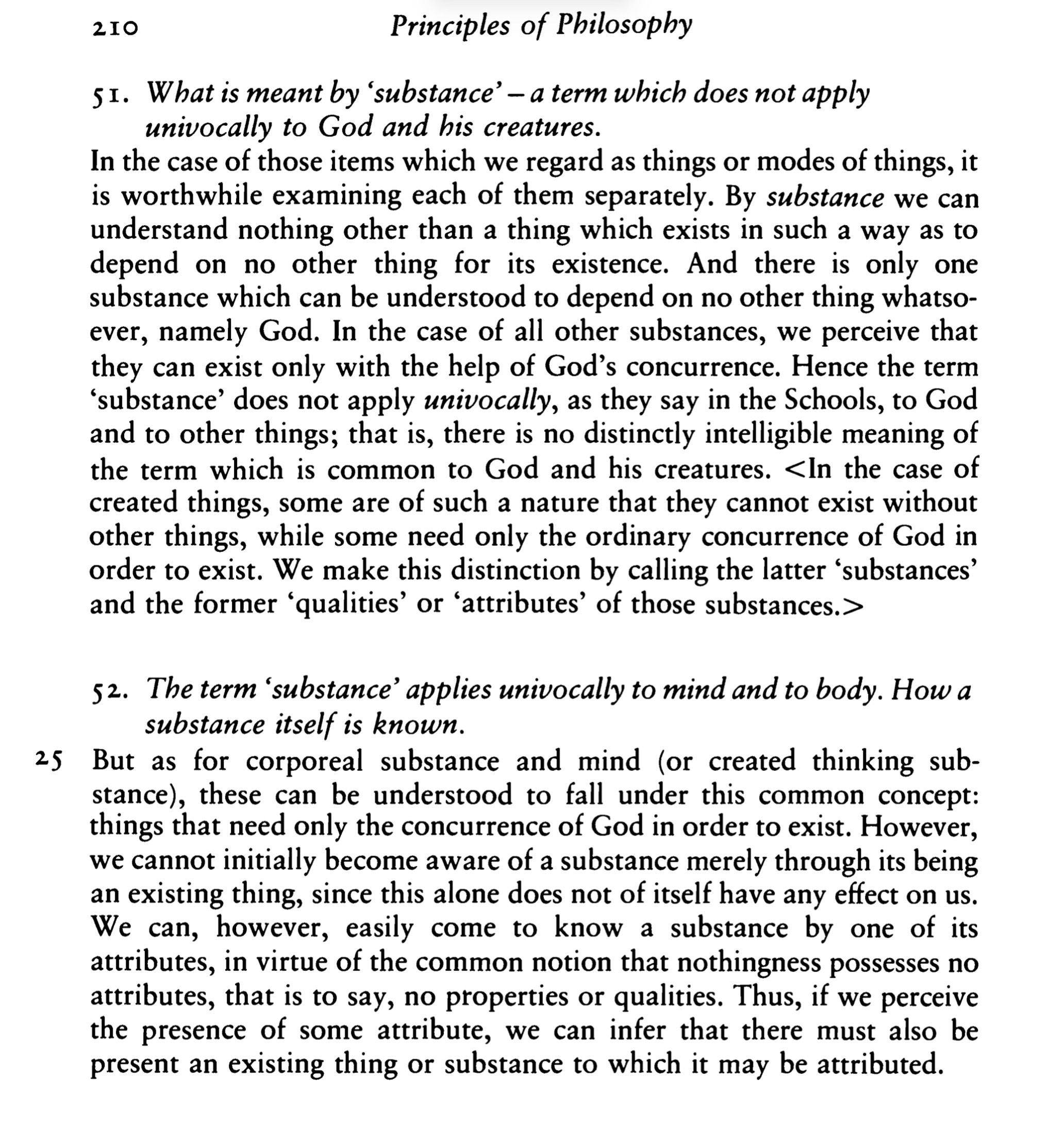 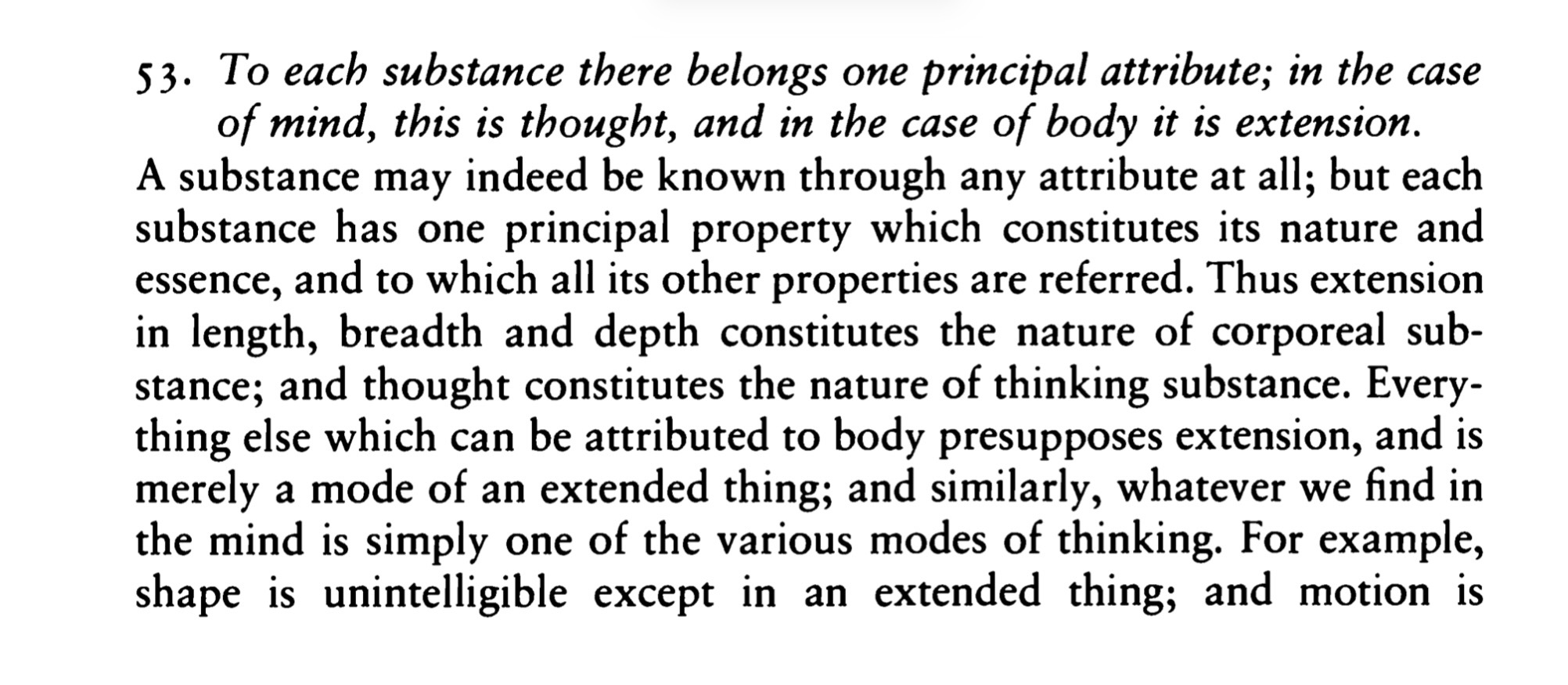 |
Strict ideas of modes and principal attributes | Modes such as shape, size, motion, and position; principal attributes such as extension and thought | Strict ideas whose representata are determinate modes or principal attributes contain OR because those modes and principal attributes are ontologically eligible representata within Cartesian ontology. Descartes explicitly distinguishes ideas that represent modes or accidents from ideas that represent substances and assigns the former a lower degree of objective reality. Accordingly, an idea of shape, size, motion, or position contains OR corresponding to the represented mode rather than inheriting the ontological rank of the substance in which that mode formally inheres. Extension and thought are principal attributes constituting the respective natures of corporeal and thinking substance. When extension or thought is itself the representatum of a strict idea, the idea contains OR corresponding to that determinate principal attribute. The relevant basis for OR is the ontological eligibility of the mode or principal attribute as the idea’s representatum, not merely conceptual determinacy, phenomenal presentation, ordinary-language aboutness, or the fact that the mental act containing the idea is itself a mode of thought. | Principles I.53 (see screenshot in row above) Third Meditation degree-of-reality comparisons (AT VII 40) “Namely, insofar as these ideas are merely certain modes of thinking, I do not recognize any inequality among them, and they all seem to proceed from me in the same way; but insofar as one represents one thing and another represents another, it is evident that they are very different from one another. For doubtless those which exhibit substances to me are something greater, and, so to speak, contain more objective reality in themselves than those which represent only modes or accidents. And again, that idea by which I understand some supreme God—eternal, infinite, omniscient, omnipotent, and the creator of all things that are besides Himself—has, to be sure, more objective reality in itself than those ideas through which finite substances are exhibited.” (Third Meditation, AT VII 40; cf. CSM II 27–28) |
Strict ideas of true-and-immutable natures / geometrical essences | Idea of a triangle, circle, or square considered as a determinate geometrical nature or essence; the essential features belonging to such a represented true and immutable nature insofar as they are included in what that nature is. | The strict idea possesses OR because its representatum is a determinate true and immutable nature of a possible mode of extension. A triangle, circle, or square can therefore be objectively present in thought even when no corresponding figure exists formally outside the mind. Essential properties belong to the OR-bearing content only insofar as they belong to what the represented nature itself is; their necessity or eternal truth does not independently confer additional OR. Thus the OR resides in the represented geometrical nature and the features constitutive of that nature, whereas the proposition that some property necessarily belongs to it does not thereby introduce a further OR-bearing representatum. This distinction prevents the category of OR-bearing true and immutable natures from expanding into the much broader category of all eternal truths, common notions, or necessarily true propositions. | Fifth Meditation, (AT VII 64–65; CSM II 44–45) 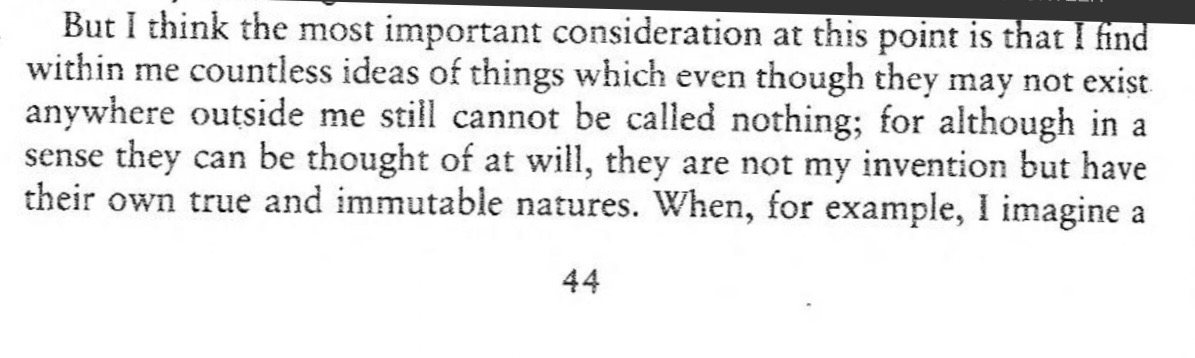 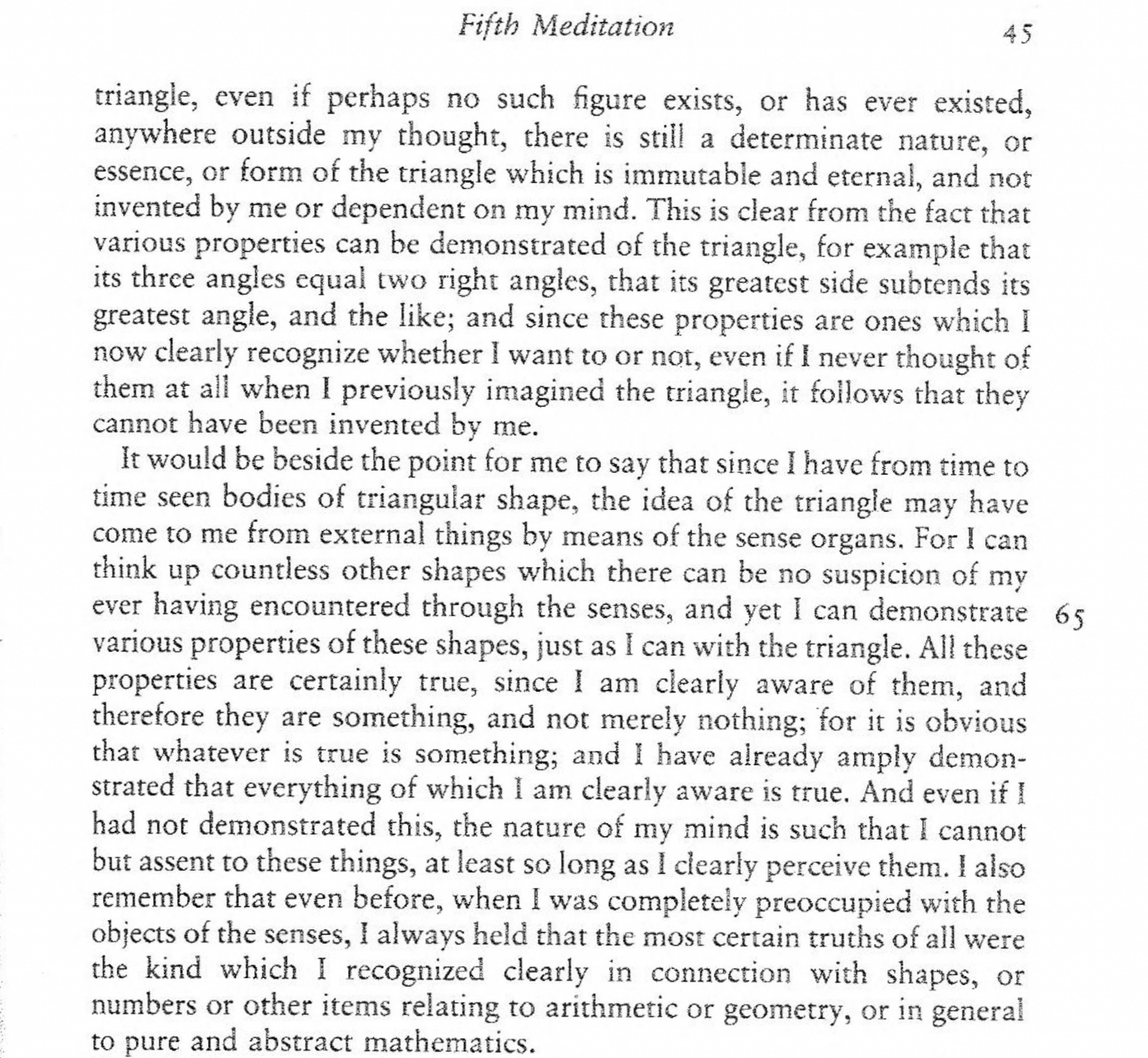 Third Meditation on objective reality, (AT VII 40–41; CSM II 28–29; see screenshot above) (Cross-reference: Second Meditation on the nature of the wax, (AT VII 30–32); CSM II 20–21; Principles I.53 on principal attributes) Fifth Meditation on true and immutable natures (see screenshot above) |
Duration (in re, as attribute of existing things) | Duration of a determinate existing thing, such as God’s eternal duration or the duration of a particular body | Duration can be represented as a real attribute of a determinate existing thing. It is motion-independent and belongs to the durating substance or mode. When duration itself is represented in this determinate in re way, it can function as an ontologically eligible representatum and the cognition can therefore contain OR corresponding to that represented duration. This does not mean that duration simply inherits the full ontological rank of the substance whose duration it is. Duration in re must also be distinguished from mind-dependent time considered merely as a measure of movement. | Principles I.57 (AT VIIIA 27; CSM I 212) 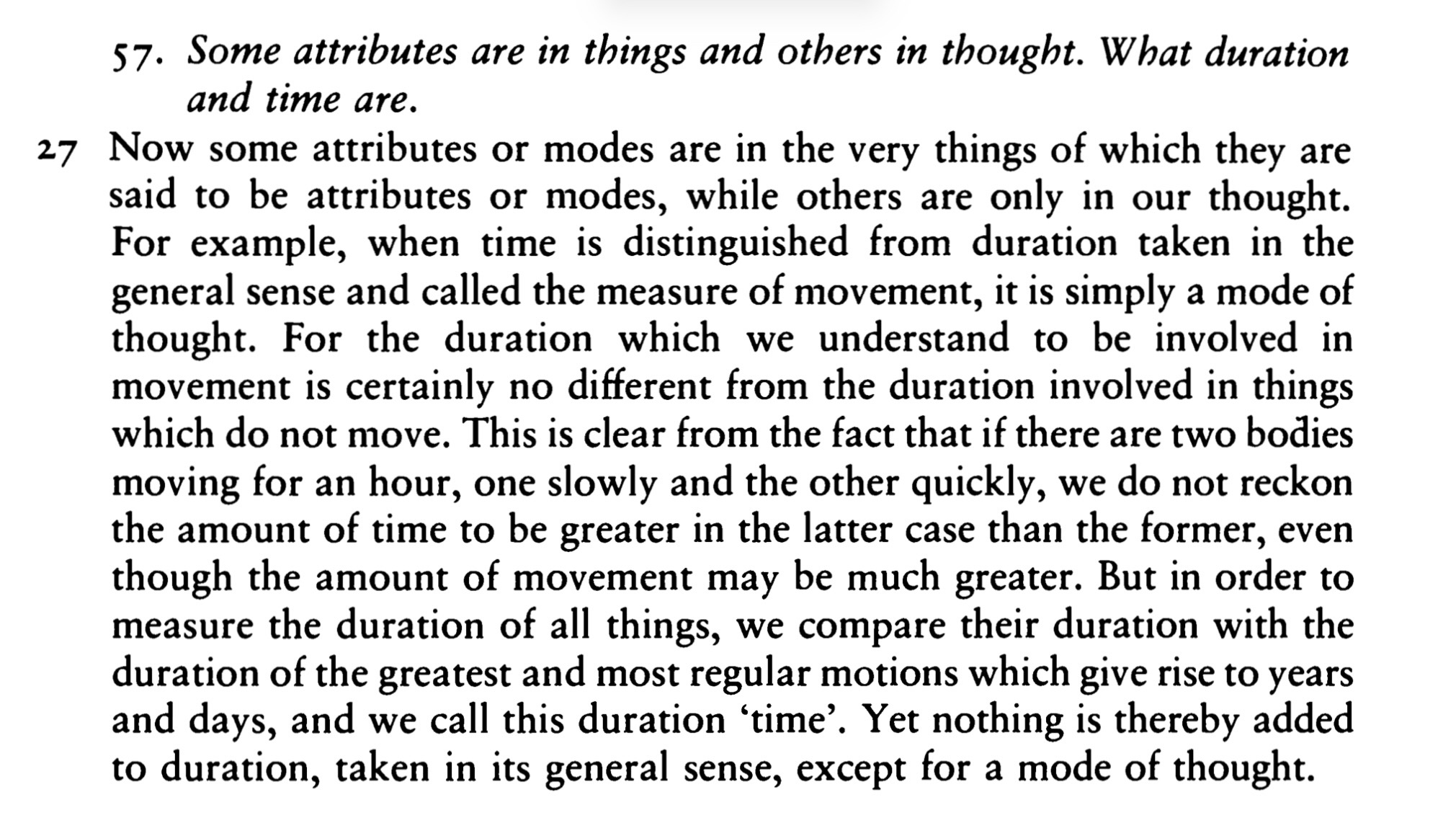 |
Thoughts involving number-in-things whose OR derives from represented particulars rather than from number itself. | Thinking of three stones, two bodies, or several determinate created things as numerically many; plurality or “many” insofar as it is predicated of OR-bearing particulars. | A thought of three stones or two bodies can contain OR because the stones or bodies are themselves ontologically eligible representata. But it does not follow that threeness, twoness, plurality, or number-in-things constitutes an additional independently OR-bearing representatum. The thought’s numerical organization may concern or classify already represented particulars without adding a further item possessing its own degree of objective reality. Accordingly, the OR in such a cognition derives from the represented things and any genuinely OR-bearing features they possess, not merely from the fact that they are counted as one, two, three, or many. Number-in-things must therefore be distinguished both from the OR-bearing particulars being numbered and from number considered abstractly or in general. | Principles I.55, I.58 distinction 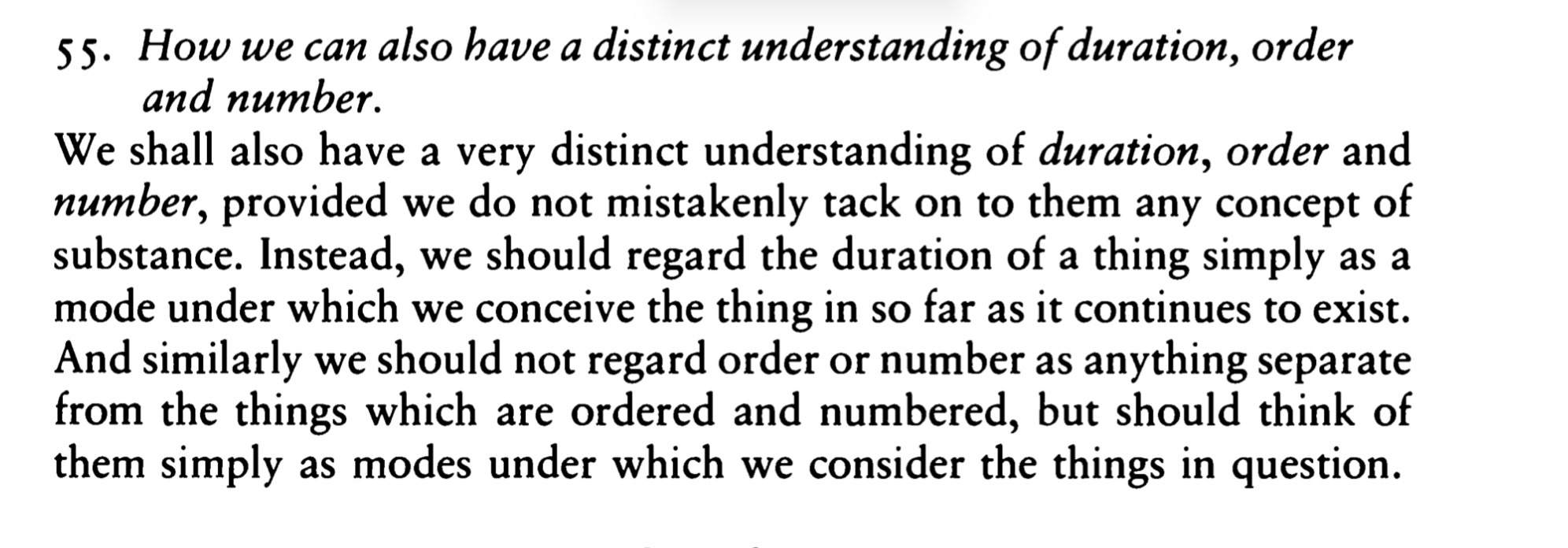  |
Table 2: Types of Cartesian Content That Do Not Themselves Contribute Objectively Real Representational Content (OR)
| Example / Type | Supporting Argument(s) Why This Content Does Not Itself Contribute OR | Key Descartes Citations (as referenced in the posts) |
Common-notion or certain eternal-truth content considered as such (foundational structural or causal axioms, e.g., ex nihilo, nihil fit / “Nothing comes from nothing”; “It is impossible for the same thing to be and not to be at the same time”; “What is done cannot be undone”; “He who thinks cannot but exist while he thinks”) | Common notions and eternal truths can function as intelligible truth-content, axioms, or structural principles indispensable to reasoning without thereby introducing an additional ontologically eligible representatum. Their being self-evident, eternally true, or necessarily true is therefore insufficient for OR. A cognition expressing such a truth may nevertheless contain OR through constituent strict ideas of substances, modes, principal attributes, or true and immutable natures; what does not itself contribute additional OR is the common-notion, axiomatic, or eternal-truth structure as such. The Conversation with Burman reports Descartes as holding that such common notions are “not strictly speaking ideas of real things” and belong only to an extended use of “idea.” | Principles I.48–49 (AT VIIIA 23–24; CSM I 208–09) 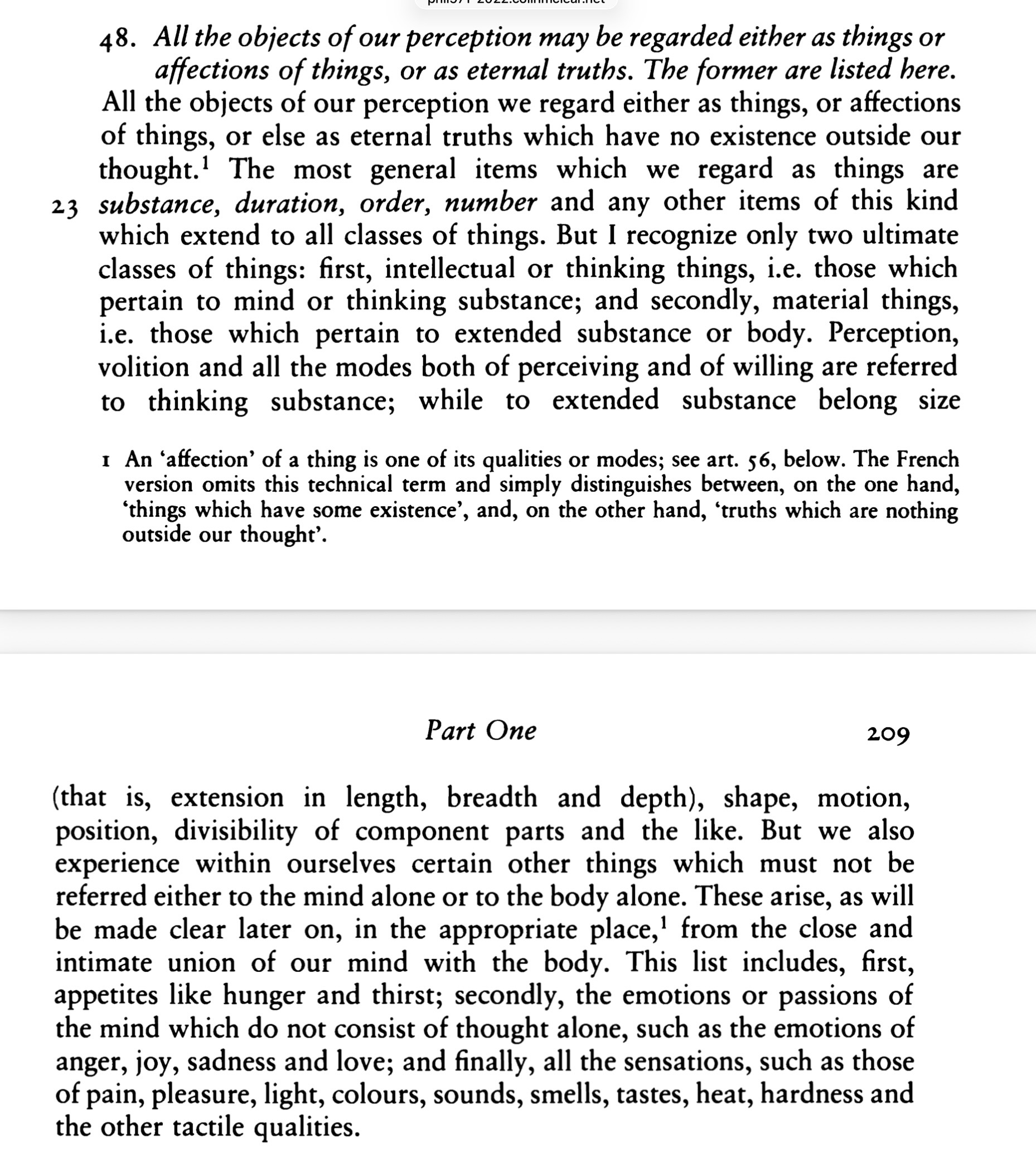 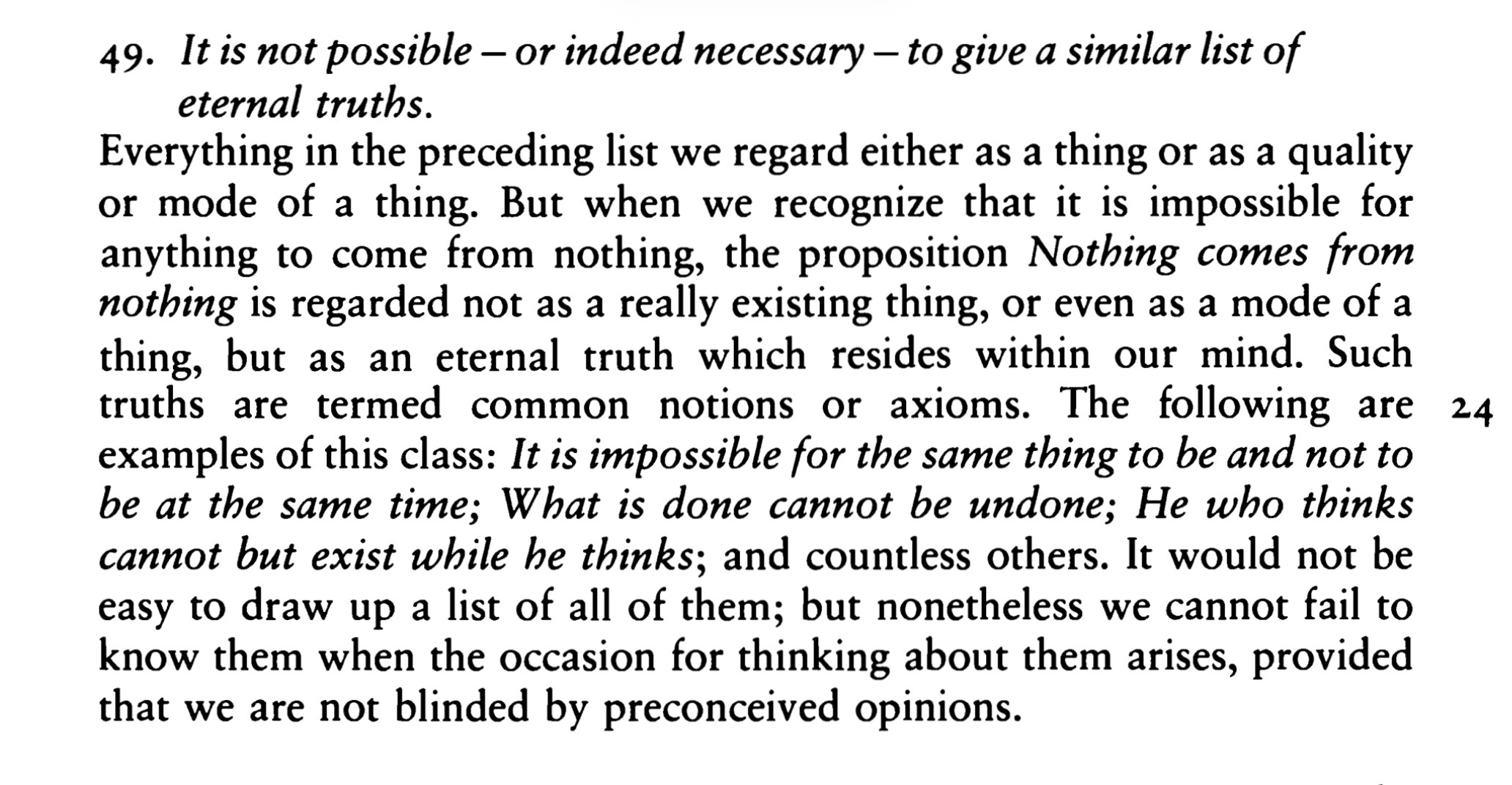 Conversation with Burman (AT V 148, 153; CSMK 334, 338) 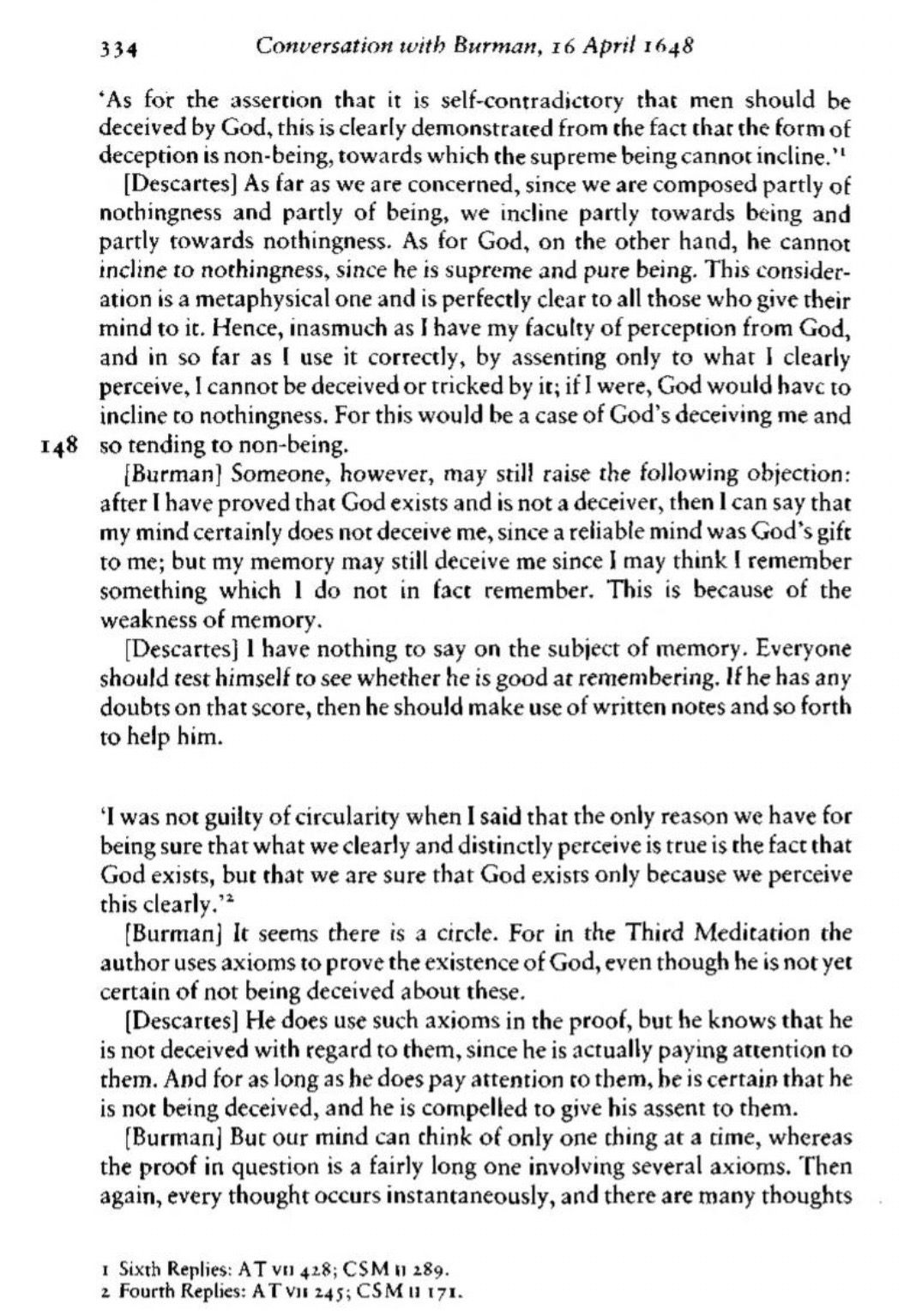 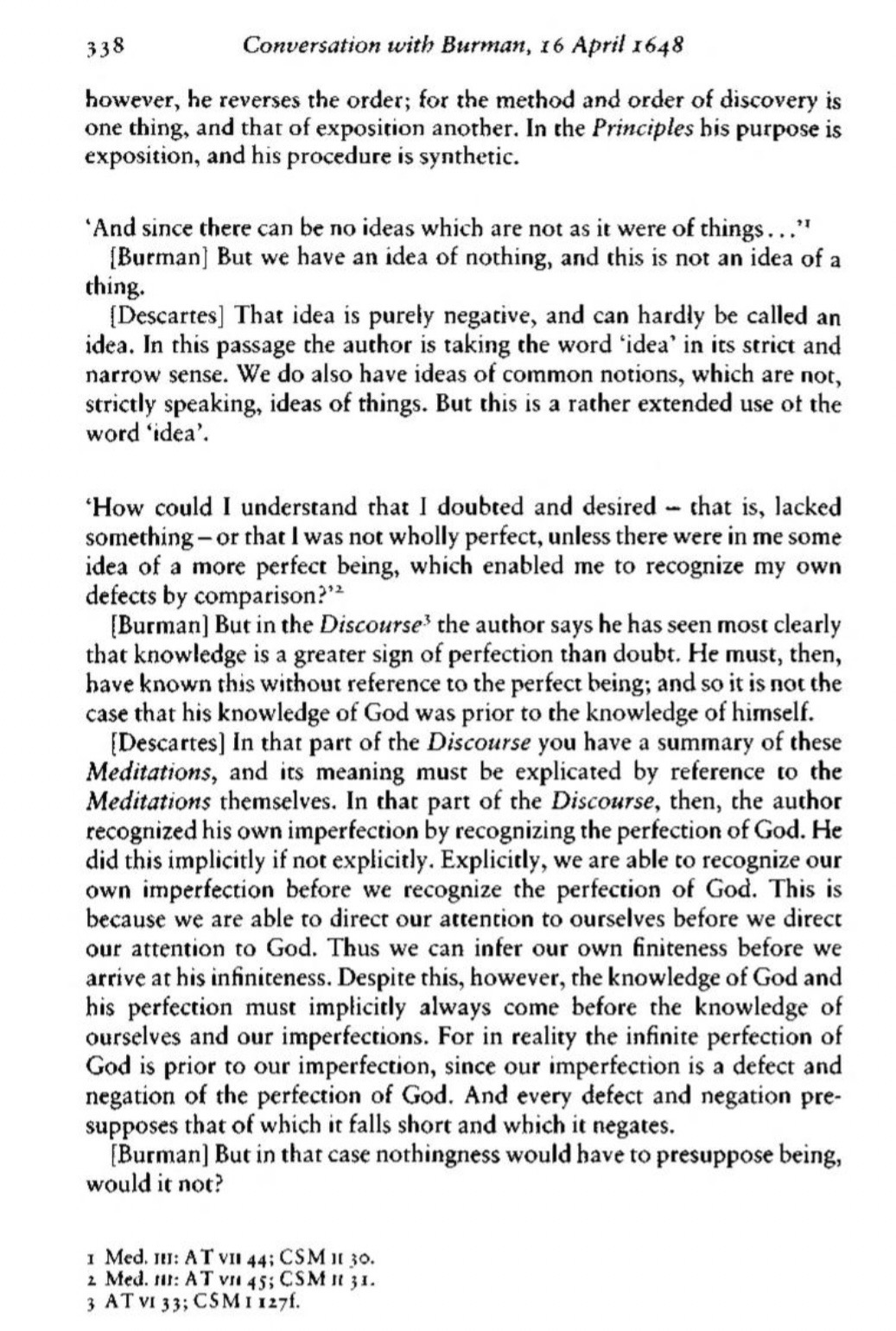 1630 Letters to Mersenne on eternal truths (AT I 145, 149–54) 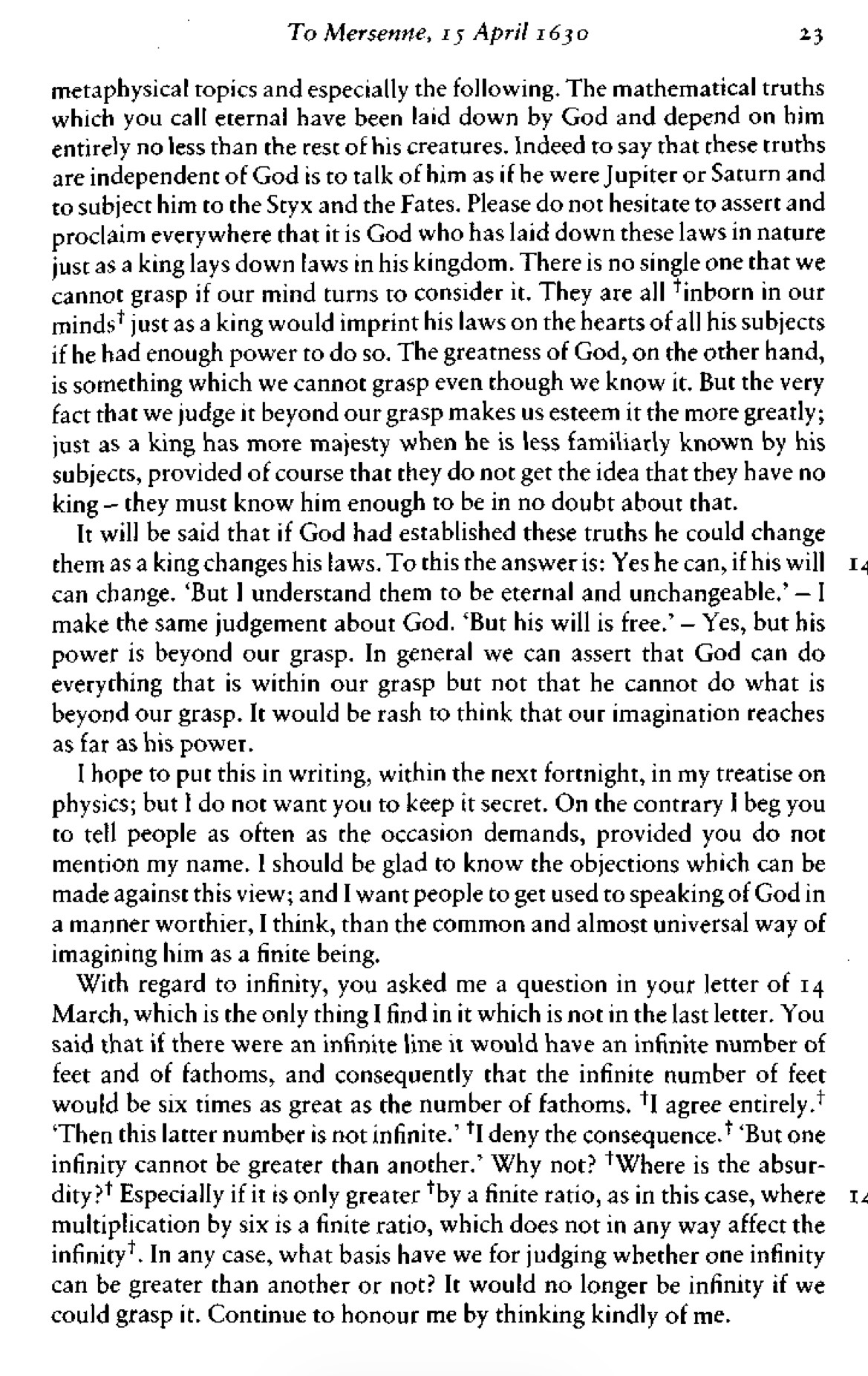 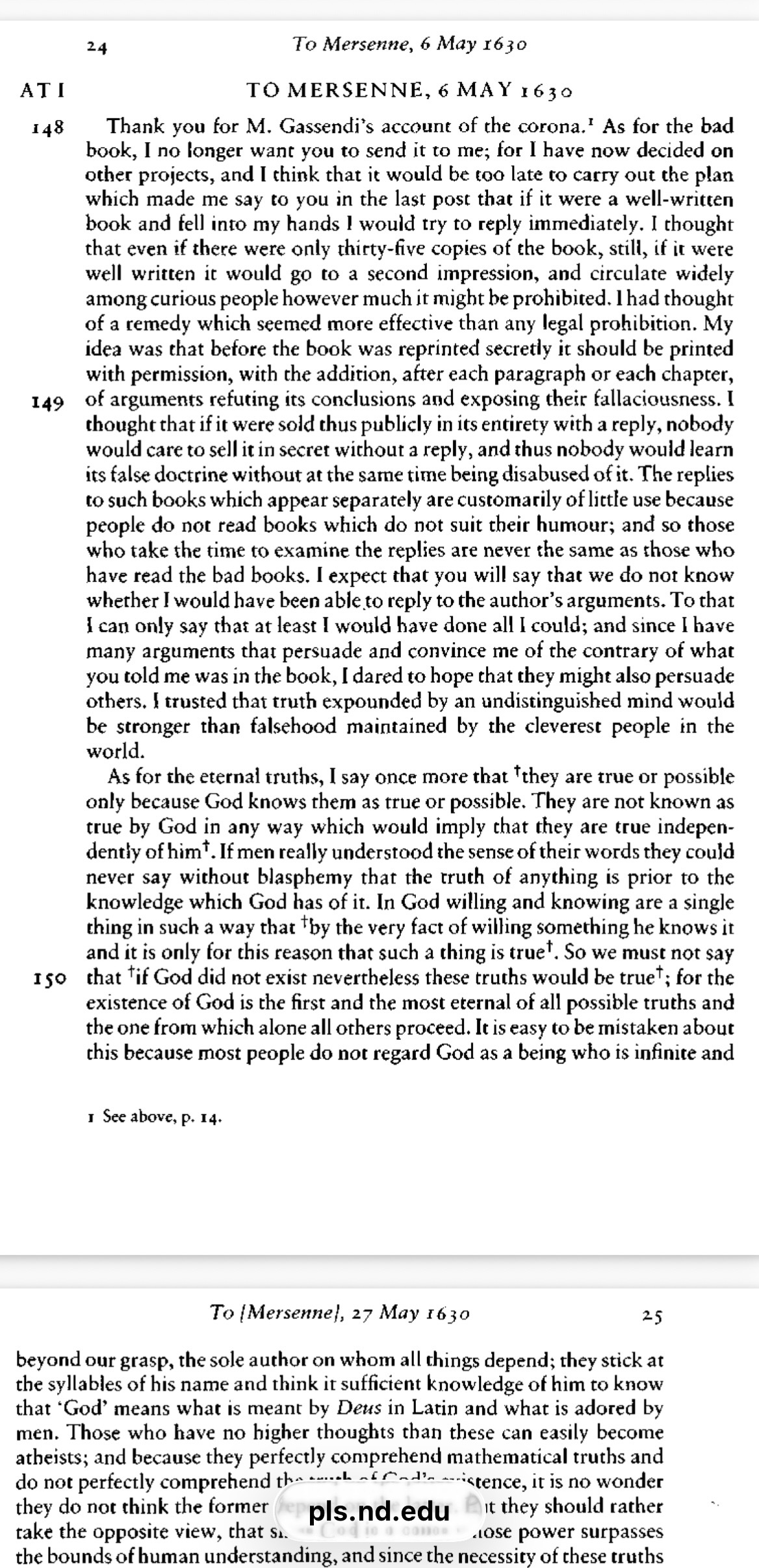 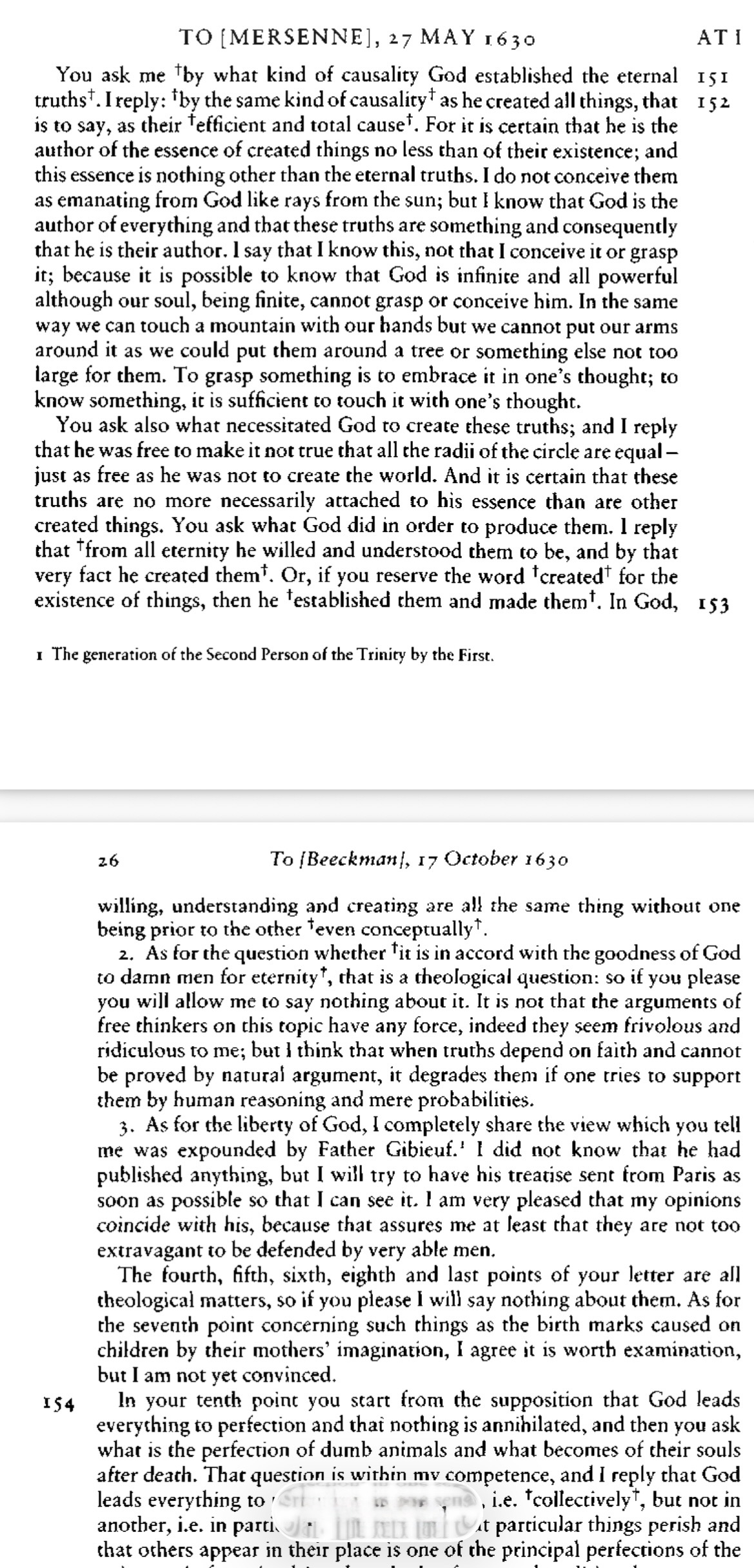 Reply to the Sixth Objections (AT VII 435–36; cf. CSM II 294) “Nevertheless they did give it a name; for it can be styled efficient causality in the same sense as the king is the efficient cause of the laws, although a law is not a thing which exists physically, but is merely as they say [in the Schools] a moral entity. Again it is useless to inquire how God could from all eternity bring it about that it should be untrue that twice four is eight, etc.; for I admit that that cannot be understood by us. Yet since on the other hand I correctly understand that nothing in any category of causation can exist which does not depend upon God, and that it would have been easy for Him so to appoint that we human beings should not understand how these very things could be otherwise than they are, it would be irrational to doubt concerning that which we correctly understand, because of that which we do not understand and perceive no need to understand. Hence neither should we think that eternal truths depend upon the human understanding or on other existing things they must depend on God alone, who, as the supreme legislator, ordained them from all eternity.” (René Descartes, Reply to the Sixth Objections, trans. Elizabeth S. Haldane and G. R. T. Ross, The Philosophical Works of Descartes, vol. II [Cambridge: Cambridge University Press, 1912], 251; AT VII 435–36; cf. CSM II 294) This passage supports the divine dependence of eternal truths and their distinction from created existing things. It is supplementary evidence for the present row: dependence upon God and necessary truth do not by themselves establish that the propositional or legislative structure constitutes an additional ranked representatum possessing OR. Principles I.48–49 (AT VIIIA 23–24; CSM I 208–09) is the primary textual anchor: Descartes distinguishes eternal truths from things and affections of things. Conversation with Burman (AT V 148, 153; CSMK 334, 338) is the primary idea-theoretic anchor: common notions are not strictly ideas of real things. Regulae Rule 12 (AT X 419; CSM I 45) is supporting evidence only: it classifies common notions as self-evident links among simple natures, thereby supporting their structural or inferential rather than independently object-representational role. |
The idea of nothing (nihil) / privative content more generally | Nothing is neither an actual nor a possible item possessing any degree of being or perfection and therefore cannot qualify as an ontologically eligible representatum. The thought of nothing is derivative from the prior understanding of being, and privation similarly presupposes that of which it is the privation. Nothing therefore contributes no positive objective reality and supplies no independently ranked representatum. The point is not merely that nothing lacks actual formal reality, since an idea can possess OR even when its possible representatum does not actually exist formally. Rather, nothing is precisely the absence of any ontologically eligible thing that could be contained objectively in the idea. Descartes accordingly says that it “hardly counts as an idea at all.” | Conversation with Burman (AT V 146–147; CSMK 334–35) 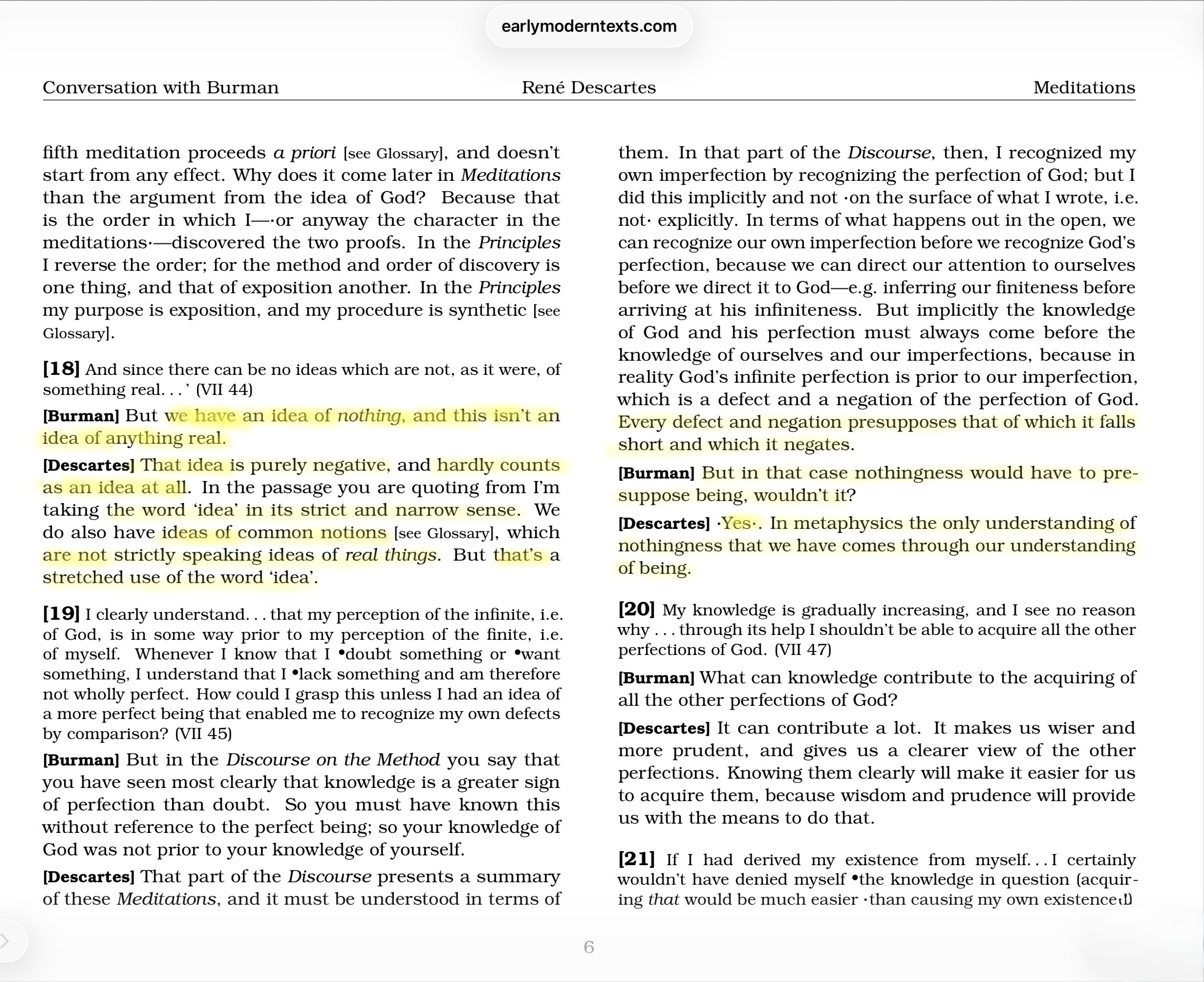 |
Secondary-quality sensations (cold, heat, color, pain, hunger, thirst, sounds, tastes, smells) and isolated affective states (e.g., fear considered merely as an affective mode, apart from any OR-bearing strict idea contained in the episode) Click to see the Table of Top Five Posts Proving SQ-sensations Lack Objective Reality at the bottom of this post. | Considered merely as sensations, phenomenal coolness, painfulness, redness-as-sensed, hunger, thirst, and similar phenomenal or affective characters do not function as ontologically eligible internal representata and therefore do not themselves contribute OR. Their being consciously presented, phenomenally determinate, or ordinarily describable as being “of” or “about” something is insufficient for objective reality. Under Descartes’s mature physics, no corresponding positive bodily res need formally instantiate the phenomenal quality as it is experienced, but that external noncorrespondence is supporting evidence rather than the fundamental reason the sensation lacks OR. Such sensations may be materially false because their phenomenal presentation supplies matter for error and can present a non-thing as if a thing (non rem tanquam rem repraesentant), while a subsequent judgment may falsely attribute to the body a positive quality corresponding to the sensation. Phenomenal character cannot simply be identified with OR-bearing content without losing the experience’s affective character: a representation of pain does not itself hurt. These sensations remain formally real mental modes, lawful signs, or broad-sense ideas, but their phenomenal or affective character considered merely as such contributes no OR. An accompanying strict idea, including one occurring as a constituent of a judgment concerning what is sensed, may nevertheless contain OR independently of the sensation itself. | Third Meditation (AT VII 43–44; CSM II 29–30) Principles I.68–70 Sixth Replies (Grade 2/3 distinctions) Passions of the Soul (Cottingham translation) I.22–29 (for affective surplus) Passions of the Soul (Bennett translation) I.22–29 |
Universalizing or abstract content considered merely as a modus cogitandi rather than as a determinate first-order representatum (e.g., certain second-order predicables and classificatory concepts; number-in-general, mode-in-general, substance-in-general, time as measure of movement, order, and duration-in-general insofar as these are considered merely through abstraction) | Descartes can treat universals considered simply in the abstract or in general as “merely a mode of thinking” (modus cogitandi). The important restriction is not that every universal lacks OR: first-order strict ideas of determinate natures, principal attributes, substances, or modes such as triangle, extension, body, or motion can contain OR. Rather, when universalizing or abstract content functions only as a mind-side abstraction and introduces no additional ontologically eligible representatum, that abstract structure itself contributes no additional OR. A cognition containing the abstraction may nevertheless contain OR through the determinate strict ideas from which or upon which the abstraction is formed. Conceptual generality, determinacy, or classificatory usefulness is therefore insufficient by itself for objective reality. | Principles I.55–58 (AT VIIIA 26–27; CSM I 211–12), especially I.58’s explicit discussion of alia omnia, quae universalia vocamus “When number is considered simply in the abstract or in general, and not in any created things, it is merely a mode of thinking; and the same applies to all the other universals, as we call them.” (Principles of Philosophy I.58, AT VIIIA 27; CSM I 212) |
Second-order relational, comparative, or classificatory structures introduced by the comparing or classifying intellect (e.g., “genus is distinguishable from species”; classifying A and B under the same genus; resemblance considered merely as a mind-side comparison). | Insofar as such structures arise from comparison, classification, or other mind-side operations, they function as modi cogitandi rather than as additional ranked representata. A complex cognition containing such a structure may nevertheless contain OR-bearing strict ideas of the items being compared or classified. Thus a thought that A and B fall under the same genus may contain OR insofar as A and B are themselves represented through ontologically eligible representata, while the second-order classificatory relation of their falling under the same genus contributes no additional OR merely in virtue of organizing those contents. Likewise, the thought that genus as a classificatory category is distinguishable from species as a classificatory category can be conceptually determinate without either classificatory role thereby constituting an additional OR-bearing representatum. The claim is restricted to mind-side relational, comparative, or classificatory structure and does not entail the stronger thesis that every relation whatsoever is merely mental or lacks OR. | Principles I.55–58 (AT VIIIA 26–27; CSM I 211–12), especially I.58’s treatment of universals as modes of thinking when considered simply in the abstract or in general. |
Modal necessity considered as propositional or modal structure (e.g., the necessity expressed in “a mode cannot exist independently of a substance”) This row’s core claim: a modal proposition can contain OR-bearing strict ideas of determinate substances, modes, principal attributes, or natures without the necessity expressed by the proposition itself thereby constituting an additional OR-bearing representatum. Being necessarily true is not by itself a source of additional OR. | A modal proposition may contain constituent strict ideas whose internal representations possess OR. For example, the necessary dependence of a mode upon a substance presupposes strict ideas of mode and substance that can themselves be OR-bearing. But the necessity of that dependence, considered as the proposition’s modal structure, does not automatically introduce another ontologically ranked representatum. The same distinction applies to necessary or eternal truths concerning true and immutable natures: the relevant OR belongs to the strict ideas of the determinate natures, substances, principal attributes, modes, or essential features represented, while the proposition’s necessity as such contributes no additional OR merely by being necessary. A foundational modal doctrine can therefore be perfectly intelligible and necessarily true while its modal necessity contributes no OR beyond whatever OR-bearing strict ideas occur within the cognition. Principles of Philosophy I.51–53 and I.61 provide the relevant ontological background: substances and modes stand in determinate dependence relations, but those passages do not thereby establish that the necessity of the dependence is itself an additional OR-bearing representatum. The eternal-truth texts provide complementary evidence. They establish that necessary truths can depend upon God and possess necessity without implying that necessity itself constitutes another objectively real item within the thought. | Principles I.51–53 • Principles of Philosophy I.51: AT VIIIA 24; CSM I 210 (substance defined as that which needs nothing else to exist; God as the sole substance requiring nothing whatever, created substances depending only on God’s concurrence). • Principles of Philosophy I.52–53: AT VIIIA 24–25; CSM I 210–11 (created substances and their principal attributes; modes as ways in which substances or their attributes are modified). • Principles of Philosophy I.61: AT VIIIA 29–30; CSM I 214: “we can clearly perceive a substance apart from the mode which we say differs from it, whereas we cannot, conversely, understand the mode independently of the substance.” These passages establish the ontological dependence that the modal proposition concerns. They do not by themselves show that the necessity of that dependence constitutes an additional OR-bearing representatum over and above the OR-bearing strict ideas of the relevant substance and mode. Conversation with Burman (1648): AT V 146–179; CSMK 332–54, especially AT V 148, 153; CSMK 334, 338 on common notions and axioms, and AT V 166; CSMK 348 on God’s immutable decrees and the necessity of eternal truths. 1630 Mersenne letters on the creation of the eternal truths: – 15 April 1630: AT I 145–46; CSMK 23 – 27 May 1630: AT I 151–54; CSMK 25–26 Sixth Replies (AT VII 432, 435–36; CSM II 291, 294) emphasizes that eternal truths depend on God alone as supreme legislator rather than upon the human understanding or created things. These texts support the distinction between (a) necessary or modal propositions containing strict ideas whose representata are substances, modes, principal attributes, true and immutable natures, or other ontologically eligible items, where the relevant OR belongs to those strict ideas, and (b) the necessity or modal structure of the proposition, which does not thereby contribute an additional OR-bearing representatum merely because the proposition is necessary. |
Top 5 Posts Proving Cartesian Secondary Quality Sensations Lack Objectively Real Representational Content
| Post | Scholarly Strengths & Commentary | Core Contribution to Proving SQS Lack OR |
 1. A Hyperlinked Pictorial Table of Cartesian Commentators on the Objective Reality Contents of Secondary Quality Sensations (Feb 20, 2026) | Excellent literature survey with a detailed hyperlinked table of commentators (Alanen, Bolton, Brown, Carriero, Hoffman, Wilson, etc.). Includes Position/Objection columns, quotations, and references. Critiques specific missteps (e.g., Hoffman on material falsity; Brown on compounding). Especially useful for mapping the scholarly positions and distinguishing strict ideas from broad-sense ideas that need not themselves contain OR-bearing content. | Argues that SQS are paradigmatic materially false ideas (non rem tanquam rem). They function as natural signs but lack a determinate representatum and therefore lack positive OR-bearing content. Grounds the no-positive-OR view in primary texts while engaging secondary literature directly. |
 2. Critiquing Dan Kaufman on the Objective Reality of Materially False Sensations with Grok 4 (Expert) Defending and ChatGPT 5.2 Thinking Criticizing (Jan 7, 2026) | Sustained, textually dense engagement with Kaufman’s 2000 paper. Uses key DTOI distinctions between strict and broad-sense ideas, formal reality and objective reality, and internal representation and external signification. Includes a taxonomy of premises and primary-text rebuttals. Especially useful for scholars working on materially false ideas and Cartesian causal principles. | Argues that Kaufman illicitly moves from the formal reality of a sensation as a real mental mode to objective reality as OR-bearing internal representational content. SQS are broad-sense ideas whose phenomenal content does not itself possess OR. They are positively real as mental modes, but that positivity is formal rather than objective. Fourth Replies and the Third Meditation support the claim that they lack “coldness itself existing objectively in the intellect.” |
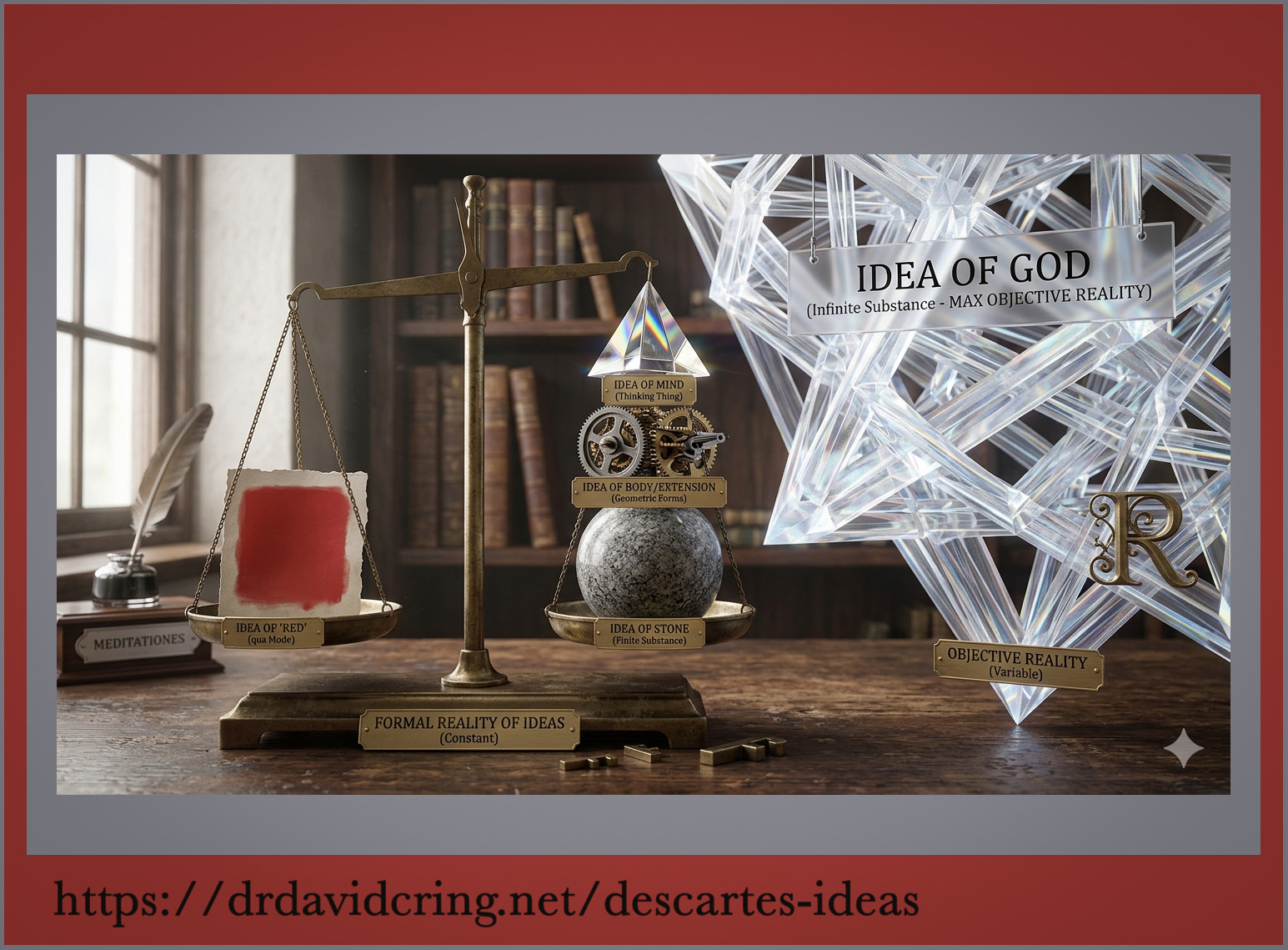 3. Current synthesis post on OR-bearing and non-OR-contributing Cartesian content (June 21, 2026) | Recent synthesis with two tables distinguishing OR-bearing content from content or structures that do not themselves contribute OR. Articulates the Restriction Thesis (Objective reality occurs only where a thought contains as its representatum an actual or possible item in Cartesian ontology, or the true and immutable nature of a possible substance or mode) with extensive citations. Systematic and integrative; draws together earlier arguments while distinguishing OR-bearing content from phenomenal, abstract, classificatory, and other content that does not itself contribute OR. | Places SQS, considered merely as sensations, among the kinds of content that do not themselves contribute OR. The same is true of privative content and certain common-notion, eternal-truth, classificatory, relational, and modal structures. Their phenomenal presentation can provide matter for error without containing positive OR-bearing internal representations of secondary qualities. A larger thought containing such content may nevertheless contain OR if it also contains a strict idea. |
 4. Cold Sensation as the Test Case: From “Purely Intellectual” to Sensory Confusion, and Descartes Against “Minimal” Objective Reality with ChatGPT 5.2 Thinking (March 2, 2026) | Highly focused dialectical argument using Descartes’s own paradigmatic example of cold from the Third Meditation. Distinguishes purely intellectual ideas from sensory ideas and argues against “minimal OR” by showing that the cold sensation does not determine what kind of thing, if anything, is being represented. Especially useful for a detailed analysis of the classic cold case and material falsity. | A cold sensation does not determine whether cold is a real bodily quality, a privation, or neither, and therefore does not supply a determinate OR-bearing representatum. The sensation is a formally real mental mode, and its phenomenal coolness can be consciously presented without itself possessing OR. This supports the account of material falsity as providing “matter for error” without compelling an erroneous judgment. |
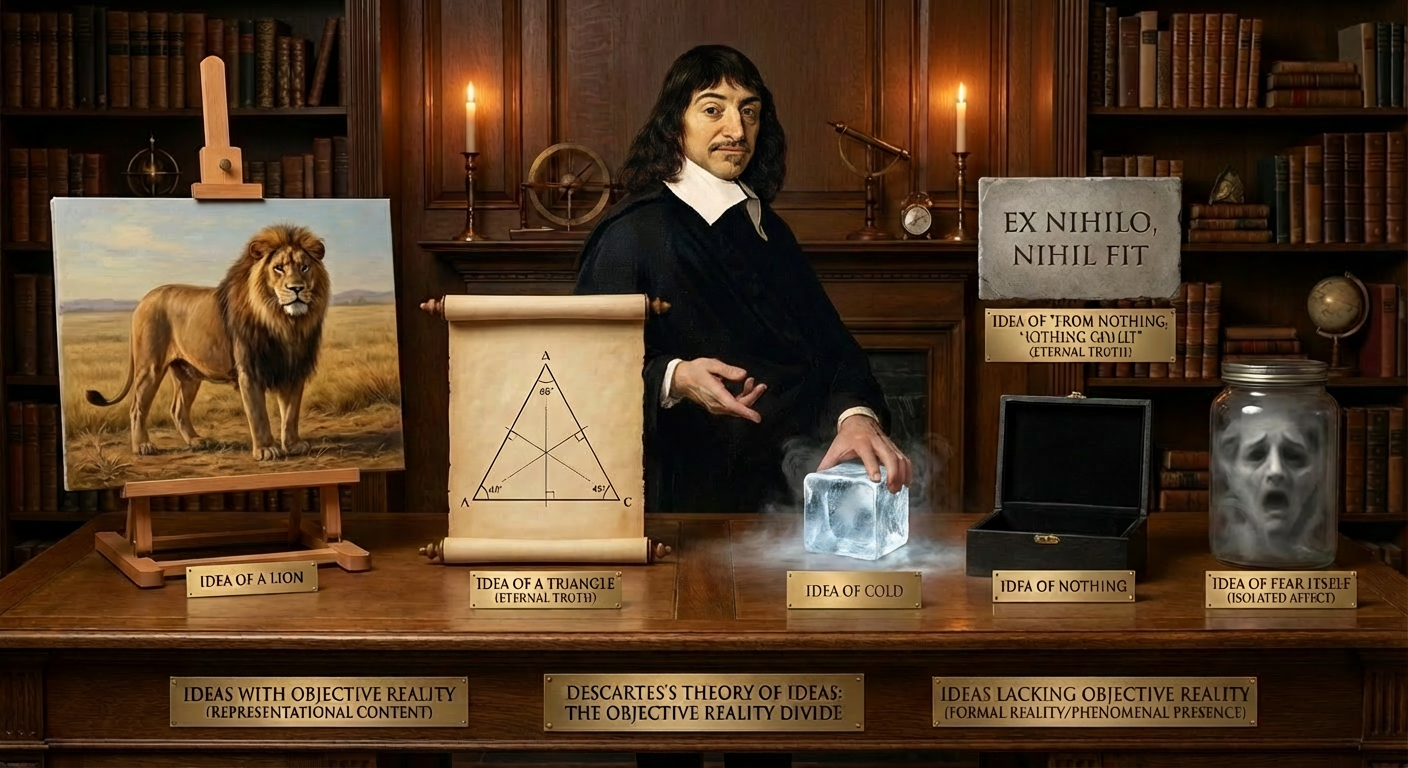 5. Why Objective Reality Cannot Be Universal in Descartes’s Theory of Ideas: Nothing, Eternal Truths, Sensations, and Fear with Claude Opus 4.6 (April 14, 2026) | Integrates SQS into the broader argument that OR is not universal to Cartesian thought, using a dialogue format that develops objections and replies. Defends the view that sensations considered merely as sensations lack OR (Principles I.68–70; Sixth Meditation). Valuable for assessing how far OR extends across Cartesian thought and which intelligible contents fall outside it. | SQS such as cold, heat, color, and pain lack OR when considered merely as sensations because their phenomenal contents do not themselves supply determinate OR-bearing representata. They remain formally real modes, phenomenal presentations, and natural signs. Their lack of OR supports the Restriction Thesis without implying that a complex thought containing a sensation cannot also contain an OR-bearing strict idea. |
Other relevant posts (hyperlinked in blue and underlined, with brief status notes; all under the Objective Reality or related categories on the site):
- From “Purely Intellectual” to Sensory Confusion, and Against “Minimal” Objective Reality (April 18, 2026) — Companion or refinement to the March 2026 cold sensation test case; further develops the argument against minimal OR using sensory confusion.
- More Reasons Why Objective Reality Cannot Be Descartes’s Universal Theory of Ideas with Claude Opus 4.7 (May 17, 2026) — Part of the series developing the Restriction Thesis and why OR cannot be universal; includes SQS among decisive counterexamples and refines earlier arguments.
- Why Objective Reality Cannot Be Descartes’s Universal Theory of Thought: Burman, Common Notions, and the Collapse of the Strict-Idea Model (June 21, 2026) — Companion to the June 21 synthesis post; focuses on Burman, common notions, and the failure of a universal strict-idea model as further support for limiting OR’s scope.
- Convincing ChatGPT 4.0 (April 2023 version) that Cartesian secondary quality sensations (SQS) have no objectively real mental content – (Maybe it will convince you, too!) (Nov 22, 2023) — Early foundational post with direct title match; uses conversational format with older AI model to argue the core claim. Strong historically on the site but predates the full DTOI baseline, tables, and mature content-level distinctions between strict and broad-sense ideas.
- Convincing Anthropic’s Claude.ai that Cartesian sensations lack objective reality (Dec 5, 2023) — Early companion to the above; persuasive dialogue format on sensations lacking objective reality. Useful precursor but less developed than the 2026 posts for scholarly use.
- Conversation on representation & the material falsity of ideas with ChatGPT 4.0 (April 2023 version) (March 6, 2024) — Relevant to material falsity and representation mechanisms (references Schmitter); broader than SQS-specific but engages related distinctions. Earlier conversational style.
- Object-Fixing Content and Objective Reality in Descartes: How Descartes Draws the Line Between Representation and Conscious Modes with ChatGPT 5.2 Thinking (Jan 31, 2026) — Explores the earlier “object-fixing content” formulation for distinguishing OR-relevant representation from broad-sense conscious modes. The present Restriction Thesis supplies a more precise criterion by asking whether the thought contains an ontologically eligible representatum, since consciousness, phenomenal presentation, ordinary-language aboutness, and conceptual determinacy are not by themselves sufficient for OR.
Additional posts in the category (e.g., on privations or other test cases) exist but are either less directly focused on SQS/OR or appear in date archives with mixed indexing. The 2026 posts generally represent the most mature phase of the DTOI project, with stronger integration of the baseline distinctions between strict and broad-sense ideas, the Restriction Thesis, and systematic aids such as tables and taxonomies. The earlier ones remain valuable for tracing the development of the argument.
All posts are accessible via the Objective Reality category: https://drdavidcring.net/descartes-ideas/category/objective-reality/
 These tables reflect the posts’ internal logic and textual anchoring, especially the sharpening in the third post around the Restriction Thesis and the explicit mapping of items to in re, modus cogitandi, and OR-bearing status. The overall picture that emerges is that OR remains indispensable within its proper domain as ontologically rankable internal representational content in strict ideas whose representata are substances, principal attributes, modes, or true and immutable natures or real essences, but cannot be treated as Descartes’s universal theory of thought or intentionality. The broader field of Cartesian thought includes broad-sense ideas and other formally real mental acts whose additional volitional, judicative, affective, imaginative, sensory, comparative, numerical, or classificatory determinations do not themselves acquire OR merely by being modes or determinations of thought, even though such complex thoughts can contain OR-bearing strict ideas as constituents. It also includes privative contents, common notions, and certain propositional, relational, classificatory, numerical, and modal structures that do not themselves introduce additional OR-bearing representata. The Restriction Thesis therefore limits where OR applies at the level of content within thought without denying that OR-bearing strict ideas can occur as constituents within broader and more complex Cartesian thoughts.

OLD BELOW
.
Corrected transcript below:
Clarification: The transcript uses a simplified contrast between ideas that contain objective reality and ideas that do not. The more precise position developed below operates at the level of content within thought. A complex Cartesian thought can contain an OR-bearing strict idea while also containing phenomenal, affective, volitional, judicative, imaginative, numerical, classificatory, relational, modal, or common-notion content that contributes no additional OR of its own. Thus the presence of non-OR-bearing content within a thought does not entail that the entire thought lacks OR.
[NOTE: Below, click on the image or on “Continue reading” to go to that post. Click on your browser’s back arrow to return here.]
The posts collectively advance a Restriction Thesis: Objective reality (OR) occurs only where a thought contains as its representatum an actual or possible item in Cartesian ontology, or the true and immutable nature of a possible substance or mode. Within this domain, OR is ontologically rankable representational content, not merely a ranked ontological measure. It does not extend indiscriminately to every perfectly intelligible Cartesian content. The fact that a thought is formally a modus cogitandi (mode of thinking) does not by itself determine whether that thought contains OR-bearing content. A complex act of willing, judging, fearing, or imagining can contain a strict idea with a determinate representatum and therefore contain OR-bearing content, even though its additional volitional, judicative, affective, or imaginative form does not itself contribute further OR merely by being a real mental mode. Sensing considered merely as sensation likewise need not contain OR, although an accompanying strict idea, including one occurring as a constituent of a judgment concerning what is sensed, may contain OR independently of the sensation itself. Certain second-order universals and classificatory structures treated as modi cogitandi, non-representatum-bearing eternal-truth or common-notion content, privative content such as the idea of nothing, and purely second-order relational, classificatory, or logical-modal structures need not themselves possess OR. OR is therefore one determinate form of internal representational directedness rather than the universal source or necessary condition of directedness or aboutness, and it cannot serve as a universal theory of Cartesian thought or intentionality.
The posts therefore distinguish, especially in the second and third, between strict ideas of true and immutable natures or real essences, whose internal representations possess OR, and eternal truths or propositions involving such ideas, whose truth or necessity does not thereby contribute some additional OR. For example, the eternal truth “Every triangle has three sides” involves OR-bearing content because the cognition contains the strict idea of a triangle as a determinate true and immutable nature, and three-sidedness belongs to that represented nature. But the fact that the proposition is eternally and necessarily true does not, by itself, introduce some further OR-bearing representatum over and above the representation of the triangle and its essential features. Likewise, the eternal truth “The interior angles of a Euclidean triangle equal two right angles” may contain OR-bearing content insofar as the cognition includes the strict idea of a triangle and represents a necessary feature belonging to that determinate geometrical nature; the necessity of the proposition as such does not constitute an additional OR-bearing representatum. Many foundational common notions and eternal truths likewise need not possess OR in their own right. Weaker proposed counterexamples, such as false judgments like “a vacuum exists” or imaginative composites such as chimeras, are therefore retired in the third post because their represented constituents can already be OR-bearing and so do not establish the existence of intelligible content lacking OR. The more decisive cases are privative contents such as nothing, non-representatum-bearing eternal truths and common notions, second-order universals treated as modi cogitandi, second-order relational or classificatory structures, and modal propositions whose necessity does not itself introduce a distinct representatum.
Table 1: Types of Cartesian Thoughts Containing Objectively Real Representational Content (OR)
| Type / Category | Key Examples | Supporting Argument(s) Why It Contains OR | Key Descartes Citations (as referenced in the posts) |
Strict ideas of substances (ranked on ontological hierarchy) | Idea of God (infinite substance); idea of a finite mental substance, such as my mind or another finite mind; idea of a particular finite corporeal substance, such as this body or “this piece of gold” | These strict ideas contain as their representata substances belonging to determinate ranks in Cartesian ontology. Their OR is ranked according to the degree of being or perfection belonging to the kind of substance represented: infinite substance exceeds finite substance in objective reality. The represented finite substance need not actually exist formally in order for the idea to contain OR; what matters is that the representatum is an actual or possible substance of a determinate ontological rank. These are paradigmatic strict ideas because they contain substances as ontologically eligible representata, not merely because their content is conceptually determinate or consciously presented. | Third Meditation (AT VII 40, 161; CSM II 28, 113) “Some of my thoughts are as it were the images of things, and it is only in these cases that the term ‘idea’ is strictly appropriate—for example, when I think of a man, or a chimera, or the sky, or an angel, or God.” (Third Meditation, AT VII 37; CSM II 25; bold not in original) Principles I.51–53 |
Strict ideas of modes and principal attributes | Modes such as shape, size, motion, and position; principal attributes such as extension and thought | Strict ideas whose representata are determinate modes or principal attributes contain OR because those modes and principal attributes are ontologically eligible representata within Cartesian ontology. Descartes explicitly distinguishes ideas that represent modes or accidents from ideas that represent substances and assigns the former a lower degree of objective reality. Accordingly, an idea of shape, size, motion, or position contains OR corresponding to the represented mode rather than inheriting the ontological rank of the substance in which that mode formally inheres. Extension and thought are principal attributes constituting the respective natures of corporeal and thinking substance. When extension or thought is itself the representatum of a strict idea, the idea contains OR corresponding to that determinate principal attribute. The relevant basis for OR is the ontological eligibility of the mode or principal attribute as the idea’s representatum, not merely conceptual determinacy, phenomenal presentation, ordinary-language aboutness, or the fact that the mental act containing the idea is itself a mode of thought. | Principles I.53 (see screenshot in row above) Third Meditation degree-of-reality comparisons (AT VII 40) “Namely, insofar as these ideas are merely certain modes of thinking, I do not recognize any inequality among them, and they all seem to proceed from me in the same way; but insofar as one represents one thing and another represents another, it is evident that they are very different from one another. For doubtless those which exhibit substances to me are something greater, and, so to speak, contain more objective reality in themselves than those which represent only modes or accidents. And again, that idea by which I understand some supreme God—eternal, infinite, omniscient, omnipotent, and the creator of all things that are besides Himself—has, to be sure, more objective reality in itself than those ideas through which finite substances are exhibited.” (Third Meditation, AT VII 40; cf. CSM II 27–28) |
Strict ideas of true-and-immutable natures / geometrical essences | Idea of a triangle, circle, or square considered as a determinate geometrical nature or essence; the essential features belonging to such a represented true and immutable nature insofar as they are included in what that nature is. | The strict idea possesses OR because its representatum is a determinate true and immutable nature of a possible mode of extension. A triangle, circle, or square can therefore be objectively present in thought even when no corresponding figure exists formally outside the mind. Essential properties belong to the OR-bearing content only insofar as they belong to what the represented nature itself is; their necessity or eternal truth does not independently confer additional OR. Thus the OR resides in the represented geometrical nature and the features constitutive of that nature, whereas the proposition that some property necessarily belongs to it does not thereby introduce a further OR-bearing representatum. This distinction prevents the category of OR-bearing true and immutable natures from expanding into the much broader category of all eternal truths, common notions, or necessarily true propositions. | Fifth Meditation, (AT VII 64–65; CSM II 44–45) Third Meditation on objective reality, (AT VII 40–41; CSM II 28–29; see screenshot above) (Cross-reference: Second Meditation on the nature of the wax, (AT VII 30–32); CSM II 20–21; Principles I.53 on principal attributes) Fifth Meditation on true and immutable natures (see screenshot above) |
Duration (in re, as attribute of existing things) | Duration of a determinate existing thing, such as God’s eternal duration or the duration of a particular body | Duration can be represented as a real attribute of a determinate existing thing. It is motion-independent and belongs to the durating substance or mode. When duration itself is represented in this determinate in re way, it can function as an ontologically eligible representatum and the cognition can therefore contain OR corresponding to that represented duration. This does not mean that duration simply inherits the full ontological rank of the substance whose duration it is. Duration in re must also be distinguished from mind-dependent time considered merely as a measure of movement. | Principles I.57 (AT VIIIA 27; CSM I 212) |
Thoughts involving number-in-things whose OR derives from represented particulars rather than from number itself. | Thinking of three stones, two bodies, or several determinate created things as numerically many; plurality or “many” insofar as it is predicated of OR-bearing particulars. | A thought of three stones or two bodies can contain OR because the stones or bodies are themselves ontologically eligible representata. But it does not follow that threeness, twoness, plurality, or number-in-things constitutes an additional independently OR-bearing representatum. The thought’s numerical organization may concern or classify already represented particulars without adding a further item possessing its own degree of objective reality. Accordingly, the OR in such a cognition derives from the represented things and any genuinely OR-bearing features they possess, not merely from the fact that they are counted as one, two, three, or many. Number-in-things must therefore be distinguished both from the OR-bearing particulars being numbered and from number considered abstractly or in general. | Principles I.55, I.58 distinction |
Table 2: Types of Cartesian Content That Do Not Themselves Contribute Objectively Real Representational Content (OR)
| Example / Type | Supporting Argument(s) Why This Content Does Not Itself Contribute OR | Key Descartes Citations (as referenced in the posts) |
Common-notion or certain eternal-truth content considered as such (foundational structural or causal axioms, e.g., ex nihilo, nihil fit / “Nothing comes from nothing”; “It is impossible for the same thing to be and not to be at the same time”; “What is done cannot be undone”; “He who thinks cannot but exist while he thinks”) | Common notions and eternal truths can function as intelligible truth-content, axioms, or structural principles indispensable to reasoning without thereby introducing an additional ontologically eligible representatum. Their being self-evident, eternally true, or necessarily true is therefore insufficient for OR. A cognition expressing such a truth may nevertheless contain OR through constituent strict ideas of substances, modes, principal attributes, or true and immutable natures; what does not itself contribute additional OR is the common-notion, axiomatic, or eternal-truth structure as such. The Conversation with Burman reports Descartes as holding that such common notions are “not strictly speaking ideas of real things” and belong only to an extended use of “idea.” | Principles I.48–49 (AT VIIIA 23–24; CSM I 208–09) Conversation with Burman (AT V 148, 153; CSMK 334, 338) 1630 Letters to Mersenne on eternal truths (AT I 145, 149–54) Reply to the Sixth Objections (AT VII 435–36; cf. CSM II 294) “Nevertheless they did give it a name; for it can be styled efficient causality in the same sense as the king is the efficient cause of the laws, although a law is not a thing which exists physically, but is merely as they say [in the Schools] a moral entity. Again it is useless to inquire how God could from all eternity bring it about that it should be untrue that twice four is eight, etc.; for I admit that that cannot be understood by us. Yet since on the other hand I correctly understand that nothing in any category of causation can exist which does not depend upon God, and that it would have been easy for Him so to appoint that we human beings should not understand how these very things could be otherwise than they are, it would be irrational to doubt concerning that which we correctly understand, because of that which we do not understand and perceive no need to understand. Hence neither should we think that eternal truths depend upon the human understanding or on other existing things they must depend on God alone, who, as the supreme legislator, ordained them from all eternity.” (René Descartes, Reply to the Sixth Objections, trans. Elizabeth S. Haldane and G. R. T. Ross, The Philosophical Works of Descartes, vol. II [Cambridge: Cambridge University Press, 1912], 251; AT VII 435–36; cf. CSM II 294) This passage supports the divine dependence of eternal truths and their distinction from created existing things. It is supplementary evidence for the present row: dependence upon God and necessary truth do not by themselves establish that the propositional or legislative structure constitutes an additional ranked representatum possessing OR. Principles I.48–49 (AT VIIIA 23–24; CSM I 208–09) is the primary textual anchor: Descartes distinguishes eternal truths from things and affections of things. Conversation with Burman (AT V 148, 153; CSMK 334, 338) is the primary idea-theoretic anchor: common notions are not strictly ideas of real things. Regulae Rule 12 (AT X 419; CSM I 45) is supporting evidence only: it classifies common notions as self-evident links among simple natures, thereby supporting their structural or inferential rather than independently object-representational role. |
The idea of nothing (nihil) / privative content more generally | Nothing is neither an actual nor a possible item possessing any degree of being or perfection and therefore cannot qualify as an ontologically eligible representatum. The thought of nothing is derivative from the prior understanding of being, and privation similarly presupposes that of which it is the privation. Nothing therefore contributes no positive objective reality and supplies no independently ranked representatum. The point is not merely that nothing lacks actual formal reality, since an idea can possess OR even when its possible representatum does not actually exist formally. Rather, nothing is precisely the absence of any ontologically eligible thing that could be contained objectively in the idea. Descartes accordingly says that it “hardly counts as an idea at all.” | Conversation with Burman (AT V 146–147; CSMK 334–35) |
Secondary-quality sensations (cold, heat, color, pain, hunger, thirst, sounds, tastes, smells) and isolated affective states (e.g., fear considered merely as an affective mode, apart from any OR-bearing strict idea contained in the episode) Click to see the Table of Top Five Posts Proving SQ-sensations Lack Objective Reality at the bottom of this post. | Considered merely as sensations, phenomenal coolness, painfulness, redness-as-sensed, hunger, thirst, and similar phenomenal or affective characters do not function as ontologically eligible internal representata and therefore do not themselves contribute OR. Their being consciously presented, phenomenally determinate, or ordinarily describable as being “of” or “about” something is insufficient for objective reality. Under Descartes’s mature physics, no corresponding positive bodily res need formally instantiate the phenomenal quality as it is experienced, but that external noncorrespondence is supporting evidence rather than the fundamental reason the sensation lacks OR. Such sensations may be materially false because their phenomenal presentation supplies matter for error and can present a non-thing as if a thing (non rem tanquam rem repraesentant), while a subsequent judgment may falsely attribute to the body a positive quality corresponding to the sensation. Phenomenal character cannot simply be identified with OR-bearing content without losing the experience’s affective character: a representation of pain does not itself hurt. These sensations remain formally real mental modes, lawful signs, or broad-sense ideas, but their phenomenal or affective character considered merely as such contributes no OR. An accompanying strict idea, including one occurring as a constituent of a judgment concerning what is sensed, may nevertheless contain OR independently of the sensation itself. | Third Meditation (AT VII 43–44; CSM II 29–30) Principles I.68–70 Sixth Replies (Grade 2/3 distinctions) Passions of the Soul (Cottingham translation) I.22–29 (for affective surplus) Passions of the Soul (Bennett translation) I.22–29 |
Universalizing or abstract content considered merely as a modus cogitandi rather than as a determinate first-order representatum (e.g., certain second-order predicables and classificatory concepts; number-in-general, mode-in-general, substance-in-general, time as measure of movement, order, and duration-in-general insofar as these are considered merely through abstraction) | Descartes can treat universals considered simply in the abstract or in general as “merely a mode of thinking” (modus cogitandi). The important restriction is not that every universal lacks OR: first-order strict ideas of determinate natures, principal attributes, substances, or modes such as triangle, extension, body, or motion can contain OR. Rather, when universalizing or abstract content functions only as a mind-side abstraction and introduces no additional ontologically eligible representatum, that abstract structure itself contributes no additional OR. A cognition containing the abstraction may nevertheless contain OR through the determinate strict ideas from which or upon which the abstraction is formed. Conceptual generality, determinacy, or classificatory usefulness is therefore insufficient by itself for objective reality. | Principles I.55–58 (AT VIIIA 26–27; CSM I 211–12), especially I.58’s explicit discussion of alia omnia, quae universalia vocamus “When number is considered simply in the abstract or in general, and not in any created things, it is merely a mode of thinking; and the same applies to all the other universals, as we call them.” (Principles of Philosophy I.58, AT VIIIA 27; CSM I 212) |
Second-order relational, comparative, or classificatory structures introduced by the comparing or classifying intellect (e.g., “genus is distinguishable from species”; classifying A and B under the same genus; resemblance considered merely as a mind-side comparison). | Insofar as such structures arise from comparison, classification, or other mind-side operations, they function as modi cogitandi rather than as additional ranked representata. A complex cognition containing such a structure may nevertheless contain OR-bearing strict ideas of the items being compared or classified. Thus a thought that A and B fall under the same genus may contain OR insofar as A and B are themselves represented through ontologically eligible representata, while the second-order classificatory relation of their falling under the same genus contributes no additional OR merely in virtue of organizing those contents. Likewise, the thought that genus as a classificatory category is distinguishable from species as a classificatory category can be conceptually determinate without either classificatory role thereby constituting an additional OR-bearing representatum. The claim is restricted to mind-side relational, comparative, or classificatory structure and does not entail the stronger thesis that every relation whatsoever is merely mental or lacks OR. | Principles I.55–58 (AT VIIIA 26–27; CSM I 211–12), especially I.58’s treatment of universals as modes of thinking when considered simply in the abstract or in general. |
Modal necessity considered as propositional or modal structure (e.g., the necessity expressed in “a mode cannot exist independently of a substance”) This row’s core claim: a modal proposition can contain OR-bearing strict ideas of determinate substances, modes, principal attributes, or natures without the necessity expressed by the proposition itself thereby constituting an additional OR-bearing representatum. Being necessarily true is not by itself a source of additional OR. | A modal proposition may contain constituent strict ideas whose internal representations possess OR. For example, the necessary dependence of a mode upon a substance presupposes strict ideas of mode and substance that can themselves be OR-bearing. But the necessity of that dependence, considered as the proposition’s modal structure, does not automatically introduce another ontologically ranked representatum. The same distinction applies to necessary or eternal truths concerning true and immutable natures: the relevant OR belongs to the strict ideas of the determinate natures, substances, principal attributes, modes, or essential features represented, while the proposition’s necessity as such contributes no additional OR merely by being necessary. A foundational modal doctrine can therefore be perfectly intelligible and necessarily true while its modal necessity contributes no OR beyond whatever OR-bearing strict ideas occur within the cognition. Principles of Philosophy I.51–53 and I.61 provide the relevant ontological background: substances and modes stand in determinate dependence relations, but those passages do not thereby establish that the necessity of the dependence is itself an additional OR-bearing representatum. The eternal-truth texts provide complementary evidence. They establish that necessary truths can depend upon God and possess necessity without implying that necessity itself constitutes another objectively real item within the thought. | Principles I.51–53 • Principles of Philosophy I.51: AT VIIIA 24; CSM I 210 (substance defined as that which needs nothing else to exist; God as the sole substance requiring nothing whatever, created substances depending only on God’s concurrence). • Principles of Philosophy I.52–53: AT VIIIA 24–25; CSM I 210–11 (created substances and their principal attributes; modes as ways in which substances or their attributes are modified). • Principles of Philosophy I.61: AT VIIIA 29–30; CSM I 214: “we can clearly perceive a substance apart from the mode which we say differs from it, whereas we cannot, conversely, understand the mode independently of the substance.” These passages establish the ontological dependence that the modal proposition concerns. They do not by themselves show that the necessity of that dependence constitutes an additional OR-bearing representatum over and above the OR-bearing strict ideas of the relevant substance and mode. Conversation with Burman (1648): AT V 146–179; CSMK 332–54, especially AT V 148, 153; CSMK 334, 338 on common notions and axioms, and AT V 166; CSMK 348 on God’s immutable decrees and the necessity of eternal truths. 1630 Mersenne letters on the creation of the eternal truths: – 15 April 1630: AT I 145–46; CSMK 23 – 27 May 1630: AT I 151–54; CSMK 25–26 Sixth Replies (AT VII 432, 435–36; CSM II 291, 294) emphasizes that eternal truths depend on God alone as supreme legislator rather than upon the human understanding or created things. These texts support the distinction between (a) necessary or modal propositions containing strict ideas whose representata are substances, modes, principal attributes, true and immutable natures, or other ontologically eligible items, where the relevant OR belongs to those strict ideas, and (b) the necessity or modal structure of the proposition, which does not thereby contribute an additional OR-bearing representatum merely because the proposition is necessary. |
Top 5 Posts Proving Cartesian Secondary Quality Sensations Lack Objectively Real Representational Content
| Post | Scholarly Strengths & Commentary | Core Contribution to Proving SQS Lack OR |
1. A Hyperlinked Pictorial Table of Cartesian Commentators on the Objective Reality Contents of Secondary Quality Sensations (Feb 20, 2026) | Excellent literature survey with a detailed hyperlinked table of commentators (Alanen, Bolton, Brown, Carriero, Hoffman, Wilson, etc.). Includes Position/Objection columns, quotations, and references. Critiques specific missteps (e.g., Hoffman on material falsity; Brown on compounding). High value for mapping the field and clarifying broad-sense ideas vs. strict ideas and OR-bearing content. | Positions SQS as materially false paradigms (non rem tanquam rem) that are indeterminate or opaque and function as natural signs without positive OR-bearing representational content or determinate representatum. Grounds the no-positive-OR view in primary texts while engaging secondary literature directly. |
2. Critiquing Dan Kaufman on the Objective Reality of Materially False Sensations with Grok 4 (Expert) Defending and ChatGPT 5.2 Thinking Criticizing (Jan 7, 2026) | Sustained, textually dense engagement with Kaufman’s 2000 paper. Uses DTOI distinctions (narrow vs. wide-sense ideas; formal positivity vs. objective being; internal representation vs. external signification). Includes taxonomy of premises and primary-text rebuttals. Ideal for scholars working on materially false ideas and causal principles. | Argues Kaufman illicitly slides from formal reality (sensation as real mental mode) to objective reality (internal representational content). SQS are broad-sense ideas whose phenomenal content does not itself constitute OR-bearing internal representational content; their positivity is formal rather than objective. Fourth Replies and Third Meditation show they lack “coldness itself existing objectively in the intellect.” |
3. Current synthesis post on OR-bearing and non-OR-contributing Cartesian content (June 21, 2026) | Recent synthesis with two tables distinguishing OR-bearing contents from contents or structures that do not themselves contribute OR. Articulates the Restriction Thesis (Objective reality occurs only where a thought contains as its representatum an actual or possible item in Cartesian ontology, or the true and immutable nature of a possible substance or mode) with extensive citations. Systematic and integrative; draws on prior work while sharpening distinctions between ontologically rankable representational content and phenomenal, abstract, classificatory, or other non-OR-bearing contents. | Places SQS considered merely as sensations among contents that do not themselves contribute OR, alongside privative content and certain common-notion, eternal-truth, classificatory, relational, and modal structures. Their phenomenal presentation can provide matter for error without containing positive OR-bearing internal representations of secondary qualities. A larger cognition containing such content may nevertheless contain OR through constituent strict ideas. |
4. Cold Sensation as the Test Case: From “Purely Intellectual” to Sensory Confusion, and Descartes Against “Minimal” Objective Reality with ChatGPT 5.2 Thinking (March 2, 2026) | Highly focused dialectical argument using Descartes’s own paradigmatic example (cold from Third Meditation). Distinguishes purely intellectual vs. sensory ideas and eliminates “minimal OR” alternatives through underdetermination. Strong for scholars wanting granular analysis of the classic case and material falsity. | Cold sensation exhibits in-the-moment underdetermination and does not thereby supply an ontologically eligible representatum possessing OR. It is a formally real mode (idea-m) whose phenomenal coolness can be consciously presented without being OR-bearing content (idea-r-int). Supports material falsity as providing “matter for error” without compelling erroneous judgment. |
5. Why Objective Reality Cannot Be Universal in Descartes’s Theory of Ideas: Nothing, Eternal Truths, Sensations, and Fear with Claude Opus 4.6 (April 14, 2026) | Integrates SQS into the broader anti-universal argument via dialogue format with objection-handling and taxonomy. Defends non-representational reading of sensations (Principles I.68–70; Sixth Meditation). Valuable for scholars exploring the scope of OR and thinkability beyond representational content. | SQS (cold, heat, color, pain, etc.) lack OR because their phenomenal contents considered merely as sensations do not constitute ontologically eligible internal representata. They remain formally real modes, phenomenal presentations, and natural signs. Their lack of OR supports the Restriction Thesis without implying that every complex thought containing a sensation lacks independently OR-bearing strict ideas. |
Other relevant posts (hyperlinked in blue and underlined, with brief status notes; all under the Objective Reality or related categories on the site):
- From “Purely Intellectual” to Sensory Confusion, and Against “Minimal” Objective Reality (April 18, 2026) — Companion or refinement to the March 2026 cold sensation test case; further develops the argument against minimal OR using sensory confusion.
- More Reasons Why Objective Reality Cannot Be Descartes’s Universal Theory of Ideas with Claude Opus 4.7 (May 17, 2026) — Part of the series developing the Restriction Thesis and why OR cannot be universal; includes SQS among decisive counterexamples and refines earlier arguments.
- Why Objective Reality Cannot Be Descartes’s Universal Theory of Thought: Burman, Common Notions, and the Collapse of the Strict-Idea Model (June 21, 2026) — Companion to the June 21 synthesis post; focuses on Burman, common notions, and the failure of a universal strict-idea model as further support for limiting OR’s scope.
- Convincing ChatGPT 4.0 (April 2023 version) that Cartesian secondary quality sensations (SQS) have no objectively real mental content – (Maybe it will convince you, too!) (Nov 22, 2023) — Early foundational post with direct title match; uses conversational format with older AI model to argue the core claim. Strong historically on the site but predates the full DTOI baseline, tables, and mature content-level distinctions.
- Convincing Anthropic’s Claude.ai that Cartesian sensations lack objective reality (Dec 5, 2023) — Early companion to the above; persuasive dialogue format on sensations lacking objective reality. Useful precursor but less developed than the 2026 posts for scholarly use.
- Conversation on representation & the material falsity of ideas with ChatGPT 4.0 (April 2023 version) (March 6, 2024) — Relevant to material falsity and representation mechanisms (references Schmitter); broader than SQS-specific but engages related distinctions. Earlier conversational style.
- Object-Fixing Content and Objective Reality in Descartes: How Descartes Draws the Line Between Representation and Conscious Modes with ChatGPT 5.2 Thinking (Jan 31, 2026) — Explores the earlier “object-fixing content” formulation for distinguishing OR-relevant representation from conscious modes. The present Restriction Thesis supplies a more precise criterion by asking whether the thought contains an ontologically eligible representatum, since consciousness, phenomenal presentation, ordinary-language aboutness, and conceptual determinacy are not by themselves sufficient for OR.
Additional posts in the category (e.g., on privations or other test cases) exist but are either less directly focused on SQS/OR or appear in date archives with mixed indexing. The 2026 posts generally represent the most mature phase of the DTOI project, with stronger integration of the baseline distinctions, Restriction Thesis, and systematic aids such as tables and taxonomies. The earlier ones remain valuable for tracing the development of the argument.
All posts are accessible via the Objective Reality category: https://drdavidcring.net/descartes-ideas/category/objective-reality/
These tables reflect the posts’ internal logic and textual anchoring, especially the sharpening in the third post around the Restriction Thesis and the explicit mapping of items to in re, modus cogitandi, and OR-bearing status. The overall picture that emerges is that OR remains indispensable within its proper domain as ontologically rankable internal representational content in strict ideas whose representata are substances, principal attributes, modes, or true and immutable natures or real essences, but cannot be treated as Descartes’s universal theory of thought or intentionality. The broader field of Cartesian thinkability includes formally real mental acts whose additional volitional, judicative, affective, imaginative, sensory, comparative, numerical, or classificatory determinations do not themselves acquire OR merely by being modes or determinations of thought, even though such complex thoughts can contain OR-bearing strict ideas as constituents. It also includes privative contents, common notions, and certain propositional, relational, classificatory, numerical, and modal structures that do not themselves introduce additional OR-bearing representata. The Restriction Thesis therefore limits where OR applies at the level of content within thought without denying that OR-bearing strict ideas can occur as constituents within more complex Cartesian thoughts.