Introduction by Grok 4.3 (edited & modified)
The sensation of cold raises a specific difficulty for Descartes’s account of objective reality representational content (OR). Although the sensation presents a positive phenomenal character—the felt coolness of which the perceiver is directly aware—it is not clear what, if anything, serves as its internal representatum. No quality or nature appears to be exhibited in a form that could constitute objectively real representational content.
The objections to each of the seven candidates is contained in the table below. They address the difficulty had by that candidate as the possible objectively real internal represenational content of a cold sensation. Each candidate is assessed according to whether it identifies a determinate content accessible through attention to the sensation itself. The examination shows that none of the candidates succeeds. The felt coolness therefore remains a formally real feature of the mental act whose connection to external conditions is effected through divinely enforced natural signification rather than through objective reality representations.
This outcome marks a limit in the reach of objective reality within Descartes’s theory of ideas. The evaluations below set out the grounds for rejecting each candidate and support the broader conclusion that secondary-quality sensations lack objective reality content. Their positive phenomenal character remains a formally real mental event whose connection to external states is effected through lawfully connected natural signification rather than through the internal presentation of any determinate representatum.
Candidates for the Objective Reality Content of a Cold Sensation and Reasons for Their Failure
|
Candidate OR content
|
Why it fails as the cold sensation’s internal objective reality content
|
|---|---|
|
Candidate 1 A real positive quality of cold in the external body
|
The sensation of cold has positive content: the phenomenal coolness, what Descartes calls the sensation itself, and this content is genuinely of something, namely of itself. The perceiver is directly aware of phenomenal coolness, and that direct awareness is itself an idea in Descartes’s broad use of the term. Candidate 1 fails because attending to the phenomenal coolness yields no determinate quality, structure, or nature that the mind can specify and analyze as the coolness’s represented content. Descartes holds that a perceiver cannot determine, from the sensation alone, whether a cold sensation relates to a real quality, a privation, or neither.
The phenomenology by itself therefore yields no candidate internal representation. That a perceiver cannot discern any determinate representational content is explained by such ideas lacking such content. They remain ideas in the broad sense, as acts of awareness, and their phenomenal coolness is formally, not objectively, real. A formally real pain idea is not an objectively real representation of pain; to make it such would convert it into a non-sensory, intellectual idea of pain. Sensory pains instead carry formally real mental hurting events. With the triangle, the perceiver can articulate the objective reality, drawing out properties that follow from it; with the chimera, the mind can specify the composed nature it represents. The coolness invites no comparable analysis. Its content can be described comparatively, as the feeling opposite to warmth, yet such description characterizes how the coolness feels rather than specifying a quality cold that the sensation exhibits as its objective reality. That bodies contain no real coldness does not, by itself, deprive the idea of objective reality: the idea of a chimera has no formally real counterpart in nature yet carries genuine objective reality, so absence of formal reality in the representatum does not strip an idea of objective reality. Nor does the sensation lack positive content or fail to be of anything; it has content, and it is of itself. The failure is precise: what the sensation is of is its own phenomenal coolness, not a quality cold that it exhibits as its objective reality. |
|
Candidate 2 A privation (the absence or diminution of heat)
|
A privation furnishes nothing positive for the mind to specify and analyze as represented content. The phenomenal coolness of a cold sensation is a positive feature of the sensory awareness, something felt; a privation is the absence of a quality, and an absence supplies no determinate nature the sensory cold idea could exhibit as its objective reality. Were the content genuinely a privation, attending to the coolness would present a lack, an emptiness where heat is diminished; instead the cold sensation presents a positive felt character, so the content the perceiver has and the content the candidate proposes diverge. The deeper difficulty is the one Descartes presses in the Third and Fourth Meditations: he grants that the sensation of cold may be of something real, or as a privation, and admits he cannot tell, from the sensation alone, which obtains. A content that can with equal warrant be read as a real quality, a privation, or neither is not a determinate objective reality; it is the absence of any settled representational content. The privation reading does not specify what the sensation represents; it records that one cannot specify it, which is the failure, not its repair. That heat may, in the physics, be particle motion and cold its diminution does not supply the sensation with this content: such a story concerns the external cause, recovered by intellect, not anything the phenomenal coolness exhibits internally and to consciousness. |
|
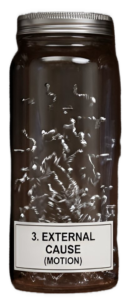
Candidate 3 The external cause of the sensation (the body or motion that produces it)
|
The phenomenal coolness exhibits nothing of that cause for the mind to specify as internal represented content. As Descartes points out (AT VII 43–44; CSM II 30), attending to the coolness the perceiver finds the felt character of the sensation, not the corpuscular motion or bodily state that occasions it. The cause is recovered, if at all, by intellectual inquiry into physics, not read off the sensation as its internal objectively real representation. Whatever genuine merit Candidate 3 has is fully captured by the present interpretation: the connection between sensation and external cause is real, but it is a matter of natural signs and external representation, not of internal objective reality. Descartes’s account of material falsity bears directly here: a sensation whose internal content were its cause would represent that cause truly or falsely, yet he treats sensations such as cold as materially false precisely because they do not exhibit their cause, presenting so little that one cannot specify what, if anything, they internally represent. An idea whose internal content genuinely tracked its external cause could not be materially false in this way. The materially false sensation carries no such internal object; it is the lawful effect of a cause without internally representing it. The external cause cannot itself be the objective reality of the idea, since objective reality belongs exclusively to the mental domain and a physical cause is non-mental; what is at issue is only whether the sensation internally exhibits a content answering to that cause, and it does not. This is not to deny the sensation all connection to its cause: the cold sensation can be a natural sign, lawfully governed by God, connecting to the physical causes both in the external object and in the perceiver’s body, so that a given motion reliably producing this feeling makes it a dependable guide to bodily benefit and harm (AT VII 83, 87–88; CSM II 57, 60–61). Such representativeness is external and divinely instituted, not an internal objective reality accessible to consciousness. To treat the cause as the sensation’s internal objective reality is to confuse what the sensation is caused by, and externally signifies, with what it internally represents. |
|
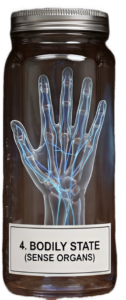
Candidate 4 The bodily state of the perceiver (sense organs, nerves, or brain)
|
The phenomenal coolness exhibits no more of the nerve or brain state than of the external motion; attending to the coolness the perceiver finds the felt character of the sensation, not a presentation of fibers, animal spirits, or cerebral movements. That the sensation arises from such states is established by anatomy and physics, recovered by intellectual inquiry, not read off the sensation as its internal content. The proposal is more clearly mistaken than Candidate 3: the ordinary perceiver who feels cold has no awareness whatever of the bodily mechanism and may be wholly ignorant that nerves and brain are involved. A content of which the perceiver can be entirely unaware, and which requires scientific instruction even to formulate, cannot be the internal objective reality the sensation exhibits to consciousness, since internal objective reality is accessible to the mind that has the idea. The bodily state is not so accessible in the sensation, but only through later inquiry. The connection is therefore of the same kind identified for the external cause: the sensation can serve as a natural sign of the body’s condition, ordained to alert the composite to what benefits or harms it (AT VII 83, 87–88; CSM II 57, 60–61), without internally representing that condition. The bodily state belongs to the causal and physiological account of how the sensation is produced, and to its external signification, not to any objective reality within the idea. |
|
Candidate 5 Its own phenomenal character (the felt coolness itself)
|
This proposal has more to recommend it than its predecessors, since it begins from what the perceiver genuinely has and is genuinely aware of, but it fails because it conflates the formal reality of the sensation with an objective reality it does not thereby possess. The phenomenal coolness is the sensation’s formal reality, and the idea is the awareness of that phenomenal coolness; the idea, the awareness, and the phenomenal coolness are numerically identical, one and the same mental state. That this state is present to consciousness, and that the awareness is of itself, does not convert the felt character into a represented object exhibited as objective reality. Objective reality is the internal exhibition of some quality, thing, or nature as that which the idea represents; the felt coolness is exhibited as nothing beyond itself. Nor can the felt character simply be its own represented content: felt pain hurts, whereas the objective reality of pain, pain as represented, does not itself hurt, so the two cannot be identical. The same holds for coolness, the feeling and any represented content it might carry are distinct, so identifying the sensation’s objective reality with its felt character cannot succeed. With the triangle the perceiver can draw out properties following from the represented nature, and with the chimera the mind can specify the composed nature it represents; the objective reality in each case sustains analysis into further content. The phenomenal coolness sustains no such analysis: it can be described comparatively, as the feeling opposite to warmth, yet this characterizes how the coolness feels rather than specifying a nature from which further properties follow. A content that collapses into the bare presence of the feeling is formal reality described, not objective reality specified. |
|
Candidate 6 A practical, action-guiding content (cold as to-be-avoided or as benefit/harm)
|
This proposal draws its strength from the Sixth Meditation, where Descartes assigns the senses the office of signaling what benefits and harms the mind-body composite (AT VII 83, 87–88; CSM II 57, 60–61), but it fails because it mistakes the function the sensation discharges for a content it internally exhibits. That the sensation guides action is not in dispute; how it does so is the question. On Descartes’s account the sensation guides by divine institution, as a natural sign lawfully tied to the states of the body and its environment, prompting pursuit and avoidance without exhibiting, to consciousness, any represented content of the form to-be-avoided. The perceiver feels the coolness and is moved accordingly; the perceiver does not find, presented within the coolness, a proposition or nature specifying avoidance or harm. Such practical significance is conferred from without, by the ordained connection between feeling and benefit, not displayed within as internal objective reality. The action-guiding reading therefore relocates, rather than supplies, the missing content: an import the sensation carries only by lawful institution, and that the perceiver can act upon while remaining unable to articulate it as a represented nature, is external signification once again. To-be-avoidedness is not drawn out of the coolness as the triangle’s properties are drawn from its objective reality; it is the role the feeling plays in the providential economy of the senses, not an internal content the idea exhibits. |
|
Candidate 7 A general, indeterminate awareness (cold as some quality or other, unspecified)
|
This is the last refuge of the representational reading, and it fails because an indeterminate objective reality is no objective reality at all. Objective reality, in Descartes’s use, is the exhibition of a determinate content, a quality, thing, or nature with features the mind can specify and analyze; it is what allows the proof from the idea to its cause to proceed, since the cause must be adequate to a determinate represented reality. A content that is merely some quality or other, with nothing in it to be drawn out or examined, supplies no such determinacy; it names the absence of specifiable content while preserving the vocabulary of representation. To call this an objectively real representation is to keep the word and discard the work it does. The proposal also misdescribes the phenomenology it claims to capture: the perceiver attending to the coolness is not aware of an unspecified something but of the determinate felt coolness, which is the sensation’s formal reality, one mental state of awareness and felt character together. The indeterminacy lies not in what is felt, which is perfectly definite as a feeling, but in what, if anything, the feeling represents beyond itself, and Descartes’s verdict is that the perceiver cannot tell whether it answers to a real quality, a privation, or neither (AT VII 43–44; CSM II 30). That admitted inability is not a faint or general objective reality; it is the absence of internal representational content, which is the conclusion the seven candidates together establish. |