


(Hyperlinks are in magenta or underlined)
Abstract
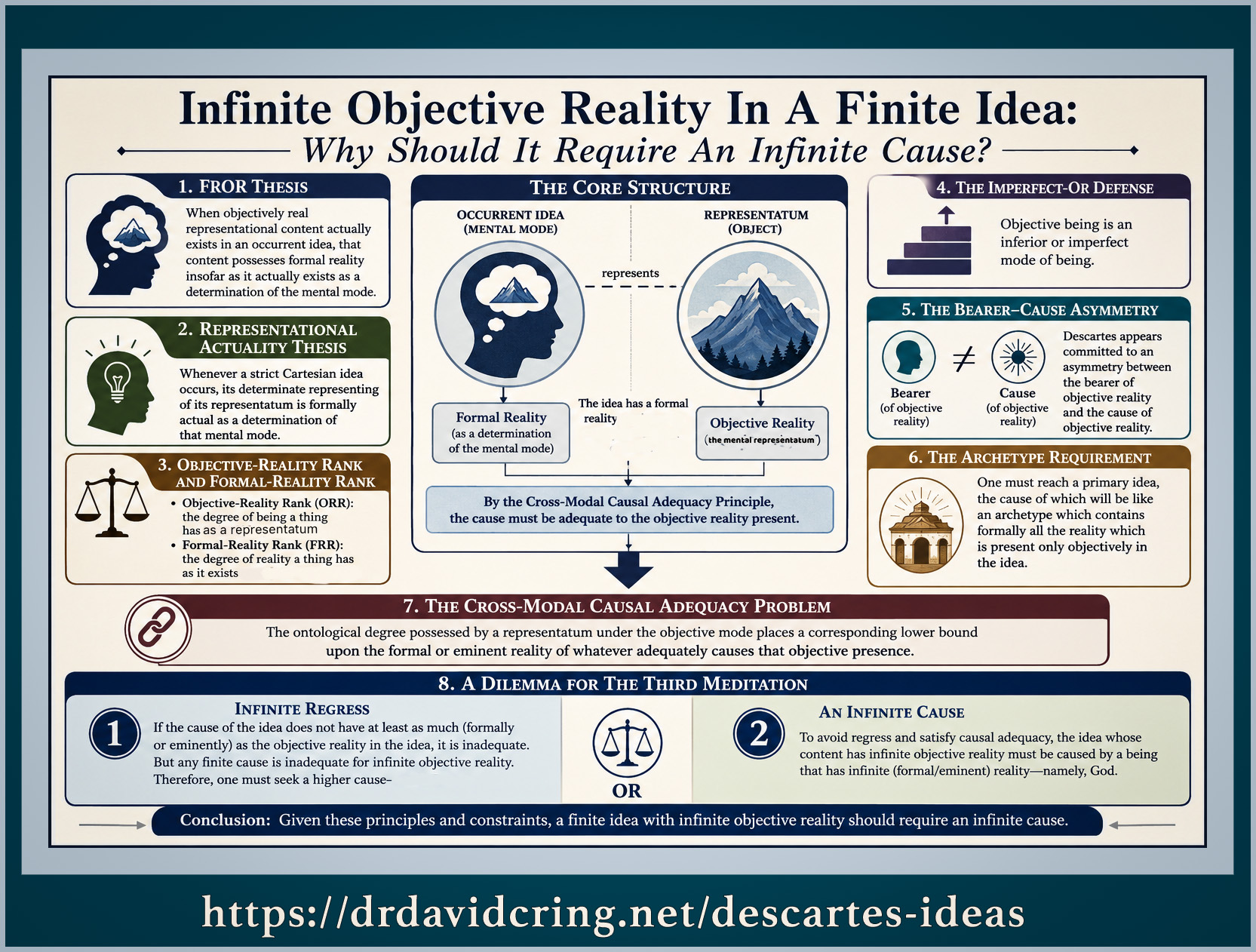
Descartes’s Third Meditation argument commits him to a striking asymmetry in the significance of objective reality rank: the objective-reality rank of an idea’s internal representation does not determine the formal rank of the mental mode that bears it, yet allegedly imposes a corresponding lower bound upon the formal or eminent reality of its adequate cause. Considered formally, a human idea remains a finite mode of thought even when its internal representation of a representatum (item represented) possesses the objective reality appropriate to a finite substance such as a rock or an infinite substance (for Descartes, only God). Consequently, the familiar objection that a finite idea cannot contain an internal representation possessing infinite objective reality rests upon an illegitimate inference from the objective-reality rank of the internal representation of the representatum to the formal-reality rank of the mental mode itself (i.e., the idea). The post therefore distinguishes the question whether an idea’s determinate representing is actually instantiated in the mind from the question what objective-reality rank belongs to its internal representation. When a strict idea occurs, its determinate representing is an actual determination of the finite mental mode. Actually representing an infinite God is one thing; possessing infinite formal reality is another. The mind can actually represent God while the internal representation of God possesses infinite-substance-level objective reality, without that objective-reality rank becoming a corresponding infinite formal-reality rank in the mental mode.
This concession does not rescue the Third Meditation causal inference. It instead reveals a deeper problem that arises before the idea of God is considered. An ordinary strict idea of a rock is formally a mental mode while its internal representation of the rock as a substance possesses finite-substance-level objective reality. According to the Objective-Reality Content Exhaustion Thesis (ORCET) developed below, the objective-reality-bearing internal representation of the rock exhausts the represented first-order content of the pure strict idea; no additional first-order represented content is required. ORCET is a thesis about the exhaustion of first-order represented content, not about the numerical identity of that content with the ideational occurrence in which it occurs. It therefore does not determine whether the objective-reality-bearing internal representation of the rock is numerically identical with or numerically distinct from the formally existing mental mode; the occurrence may possess further intrinsic or metaphysical features without containing any additional first-order represented content. The resulting Rock-OR Objection is therefore not an identity contradiction. It instead imposes a Causal Grounding Constraint: If the formal characterization of the occurrent idea and the objective-reality characterization of its internal representation generate importantly different causal-adequacy requirements, the difference between those requirements must be grounded in a genuine metaphysical difference and cannot be explained merely by redescribing or reconsidering the ideational occurrence.
Two important historical precursors expose different stages of this problem. In the First Objections, Johannes Caterus challenges the antecedent ontological commitment by treating objective being as an extrinsic denomination (attributing something to a thing not because it is a feature of that thing itself, but because of the thing’s connection with something else, for example, calling an object “thought about” because a mind thinks of it), thereby raising the question whether objective being possesses sufficient ontological significance to require causal explanation at all (AT VII 92–94; CSM II 66–68). Descartes’s First Replies distinguish the external thing merely denominated as thought from the represented thing insofar as it exists objectively in the intellect (AT VII 102–5; CSM II 74–76). Even granting this response, however, leaves a stronger question unanswered. In the Fifth Objections, Pierre Gassendi identifies as “a very big step” Descartes’s inference from the general causal principle to the proposition that “there must be at least as much formal reality in the cause of an idea as there is objective reality in the idea” (AT VII 288; CSM II 201). Caterus thus challenges whether objective being enters causal explanation in the first place; Gassendi challenges the stronger transition from objective-reality rank to corresponding formal-or-eminent causal rank.
Two important historical precursors expose different stages of this problem. In the First Objections, Johannes Caterus challenges the antecedent ontological commitment by treating objective being as an extrinsic denomination, thereby raising the question whether objective being possesses sufficient ontological significance to require causal explanation at all (AT VII 92–94; CSM II 66–68). Descartes’s First Replies distinguish the external thing merely denominated as thought from the represented thing insofar as it exists objectively in the intellect (AT VII 102–5; CSM II 74–76). Even granting this response, however, leaves a stronger question unanswered. In the Fifth Objections, Pierre Gassendi identifies as “a very big step” Descartes’s inference from the general causal principle to the proposition that “there must be at least as much formal reality in the cause of an idea as there is objective reality in the idea” (AT VII 288; CSM II 201). Caterus thus challenges whether objective being enters causal explanation in the first place; Gassendi challenges the stronger transition from objective-reality rank to corresponding formal-or-eminent causal rank
Descartes does possess an argument that objective reality requires causal explanation. Objective being, he insists, “is certainly not nothing, and so it cannot come from nothing.” (AT VII 41; CSM II 28) But establishing that objective reality requires a cause is weaker than establishing the principle needed by the proof of God: that objective-reality rank imposes a rank-preserving lower bound upon the formal or eminent reality of its adequate cause. Descartes’s Archetype Requirement (discussed below) explicitly commits him to this stronger correspondence, since the causal series must terminate in an archetype (original model from which something is derived) containing formally “all the reality {or perfection} which is present only objectively {or representatively} in the idea.” (AT VII 42; CSM II 29)
The resulting Cross-Modal Causal Adequacy Problem: why the objective-reality rank of an idea’s internal representation should impose a corresponding minimum formal or eminent rank upon its adequate cause is captured by the Bearer–Cause Asymmetry: objective-reality rank does not determine the formal rank of its immediate mental bearer, yet allegedly determines a corresponding lower bound upon the formal or eminent rank of its adequate cause. An internal representation possessing finite-substance-level objective reality may occur in a finite mental mode without that bearer possessing finite-substance-level formal reality, and an internal representation possessing infinite-substance-level objective reality may likewise occur in a finite mental mode without making that bearer formally infinite. Yet objective-reality rank allegedly imposes a corresponding lower bound upon the formal or eminent reality of its adequate cause. The imperfect-OR defense therefore successfully explains why infinite objective reality need not make a finite idea formally infinite, but it does not explain why that same infinite objective reality must depend upon an adequate cause possessing infinite formal or eminent reality.
The central unresolved question is consequently not whether a finite mind can represent an infinite God, nor whether objective reality is sufficiently real to require some causal explanation. It is why objective-reality rank possesses precisely the causal structure Descartes’s proof requires: it need not determine the formal rank of its immediate bearer, yet it allegedly does determine a corresponding, rank-preserving lower bound upon the formal or eminent reality of its adequate cause. An idea of an ordinary rock reveals this problem at the transition from mode to finite substance; the idea of God magnifies the same structural difficulty into the indispensable causal step of the Third Meditation.
Introduction
Descartes’s distinction between formal and objective reality is indispensable to the causal argument of the Third Meditation. Considered formally, an idea is an actually existing mode of thought. Considered with respect to its internal representation of a representatum, however, a strict idea contains objective reality, and strict ideas differ according to the degree of objective reality they contain. Descartes makes the contrast explicit: “In so far as the ideas are considered simply as modes of thought, there is no recognizable inequality among them: they all appear to come from within me in the same fashion.” (AT VII 40; CSM II 27–28)
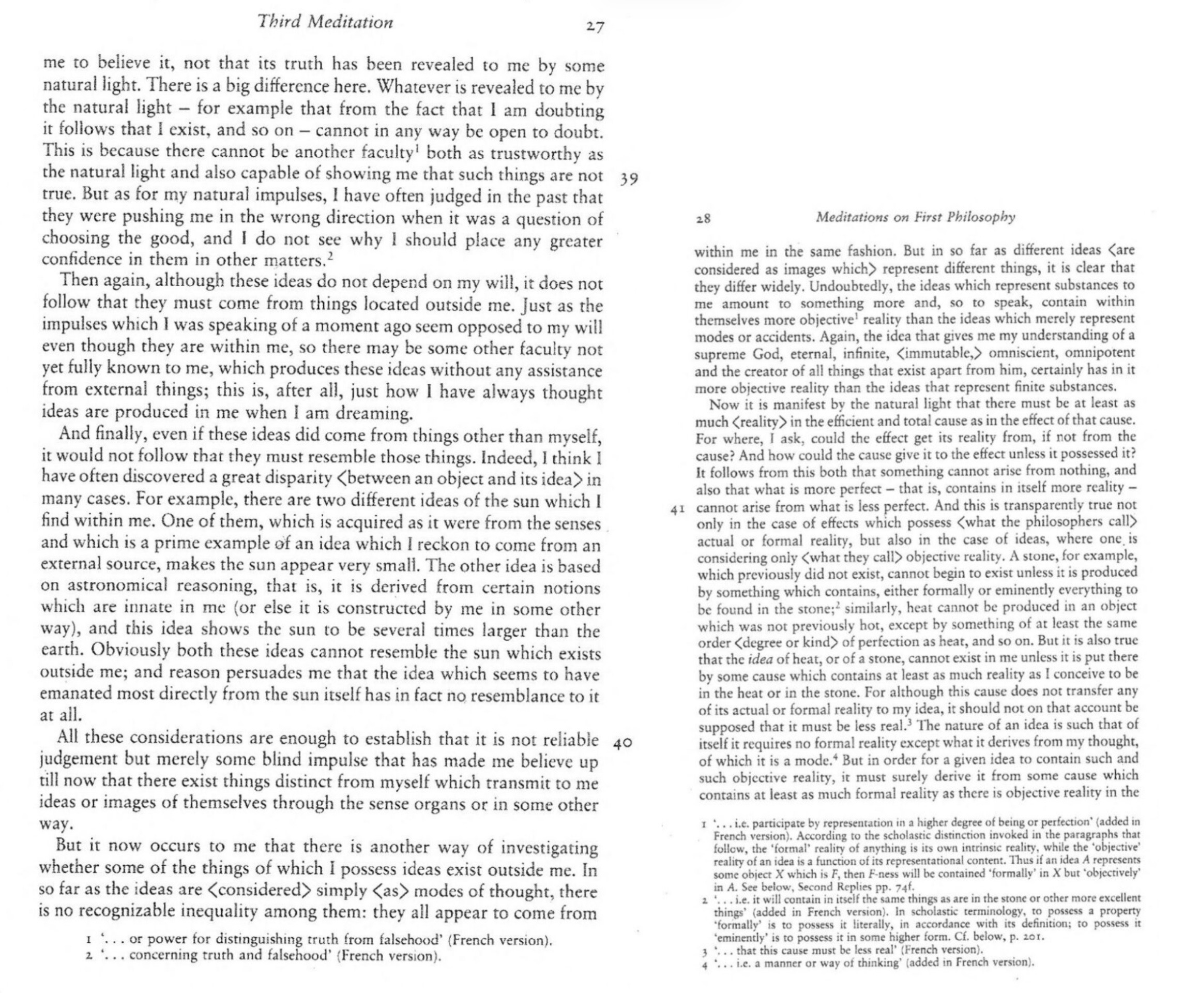
Yet when ideas are considered representationally, their equality disappears: “But in so far as different ideas are considered as images which represent different things, it is clear that they differ widely.” (AT VII 40; CSM II 28)
On the interpretation developed here, the difference is ontological rather than merely semantic. Descartes assigns ideas different degrees of objective reality according to the ontological status of what they represent. “Undoubtedly, the ideas which represent substances to me amount to something more and, so to speak, contain within themselves more objective reality than the ideas which merely represent modes or accidents.” (AT VII 40; CSM II 28) He then places the idea of God above ideas representing finite substances: “Again, the idea that gives me my understanding of a supreme God, eternal, infinite, {immutable,} omniscient, omnipotent and the creator of all things that exist apart from him, certainly has in it more objective reality than the ideas that represent finite substances.” (AT VII 40; CSM II 28)
These passages establish two importantly different rankings. Considered formally as modes of thought, human ideas do not differ in ontological rank merely because they represent different things. Considered objectively, however, they do differ. More precisely, on the account developed here, an idea’s internal representation of a mode possesses mode-level objective reality; its internal representation of a finite substance possesses finite-substance-level objective reality; and its internal representation of God possesses infinite-substance-level objective reality.1“Finite-substance-level” designates the substance-level threshold relevant to the present argument and does not require the stronger claim that every finite substance possesses exactly the same degree of reality or perfection. What matters here is that an internal representation of a finite substance ranks above one representing merely a mode and below the internal representation of Descartes’s infinite substance, God.
The representatum is the item represented; the relevant objective ranking belongs to the internal representation of that representatum insofar as the item is represented in the intellect.
Descartes’s Third Meditation argument depends not merely upon this hierarchy but upon a further causal claim. The degree of objective reality contained in an idea allegedly determines the minimum degree of formal or eminent reality required of its adequate cause. Descartes therefore needs more than a generic comparison between objective and formal reality. He needs a rank-preserving cross-modal correspondence: higher objective-reality rank must require a correspondingly higher minimum degree of formal or eminent reality in the adequate cause.2By “rank-preserving” I mean preservation of the relevant minimum causal threshold, not equality between the objective-reality rank of the idea’s internal representation and the actual formal or eminent rank of its cause. Descartes’s requirement is that the cause possess at least as much reality; a cause may exceed the minimum.
Unless infinite-substance-level objective reality requires an adequate cause possessing infinite formal or eminent reality, the Third Meditation argument cannot reach God.
The familiar difficulty is to ask how a finite mind can possess an idea with infinite objective reality. That formulation, however, locates the deepest problem in the wrong place. Once objective and formal modes of being are distinguished, there need be no contradiction in a finite mental mode representing infinite substance. The fact that the internal mental representation of God has infinite-substance-level objective reality need not entail that the idea itself has infinite formal reality. Actually representing something does not give the idea the formal-reality rank of what it represents. When the mind actually represents a rock, the idea remains formally a finite mode even though its internal representation of the rock possesses finite-substance-level objective reality. Likewise, when the mind actually represents God, the idea remains formally a finite mode even though its internal representation of God possesses infinite-substance-level objective reality. Thus, the actuality of the mind’s representing does not convert the objective-reality rank of its internal representation into a corresponding formal-reality rank in the mental mode.
This divergence of ranks has an important ontological consequence. Every occurrent human idea remains formally a finite mode of thought, regardless of what it represents, while the objective-reality rank of its internal representation varies according to the ontological rank of its representatum. An idea representing a mode possesses mode-level objective reality; an idea representing a finite substance possesses finite-substance-level objective reality; and the idea of God possesses infinite-substance-level objective reality. The formal-reality rank of the bearer (i.e., the finite mode of mind that is the idea) can therefore remain fixed while the objective-reality rank of its representational content varies. This does not prove that the formally existing mental mode and its objective-reality-bearing internal representation are numerically distinct entities, but it does show that their respective ranks cannot simply be identified. At minimum, the formal and objective characterizations correspond to ontologically distinguishable features of the ideational occurrence.3“Ontologically distinguishable” should not here be understood as “existentially separable” or as establishing that the formally existing mental mode and its objective-reality-bearing internal representation are two independently existing entities. The rank argument establishes the weaker conclusion that the two cannot be identified simply as one and the same ontological determination: the formal-reality rank of every human ideational occurrence remains that of a finite mode, whereas the objective-reality rank of its internal representation varies with the rank of the representatum. A further argument would be required to infer numerical distinctness or independent existence from this difference. Indeed, Cartesian objective being is objective being in the intellect, which gives reason to resist treating it as a separately subsisting entity. The alternatives therefore remain open: the formal and objective determinations may be genuinely different metaphysical features of one numerically identical ideational occurrence, or the formally existing mental mode and its objective-reality-bearing content may be ontologically distinguishable constituents whose unity within one idea requires explanation.
What remains open is whether those features are different metaphysical aspects of one numerically identical occurrence or belong to ontologically distinguishable constituents within the idea. This rank-divergence result is independent of ORCET (in an occurrent pure strict Cartesian idea, the objective-reality-bearing internal representation exhausts the represented first-order content of the idea) developed below: it follows from the divergence between the formal rank of the mental bearer and the objective-reality rank of its internal representation, whereas ORCET enters later to constrain what additional first-order represented content may be posited within a pure strict idea.
The more difficult question concerns causation. If infinite objective reality need not determine a corresponding infinite formal-reality rank in the finite mental mode that immediately bears it, why must that same objective reality impose an infinite lower bound upon the formal or eminent reality of its adequate cause? The ordinary idea of a rock shows that this question arises before infinity enters the argument. A rock idea is formally a mode, while its internal representation of the rock as a substance possesses finite-substance-level objective reality. The same disparity therefore already appears at the transition from mode to finite substance.
The post develops this disparity through the Rock-OR Objection. Its first component, the Objective-Reality Content Exhaustion Thesis (ORCET), holds that in an occurrent pure strict Cartesian idea, the objective-reality-bearing internal representation exhausts the represented first-order content of the idea; no additional first-order internal representation is required. Because this is a content-exhaustion thesis rather than an identity thesis, it leaves open the metaphysical relation between that content and the mental occurrence that bears it. The resulting explanatory burden is captured by a Causal Grounding Constraint: if the formal characterization of the occurrent idea and the objective-reality characterization of its internal representation generate importantly different causal-adequacy requirements, the difference between those requirements must be grounded in a genuine metaphysical difference and cannot be explained merely by redescribing or reconsidering the ideational occurrence.
The seventeenth-century objections sharpen the issue in two stages. Johannes Caterus first challenges whether objective being possesses sufficient ontological significance to require efficient-causal explanation at all (AT VII 92–94; CSM II 66–68). Descartes’s First Replies answer by distinguishing an external thing merely denominated as thought from the represented thing insofar as it exists objectively in the intellect (AT VII 102–5; CSM II 74–76). Even if that response succeeds, Pierre Gassendi raises the stronger question in the Fifth Objections: what justifies the transition from general causal adequacy to the proposition that “there must be at least as much formal reality in the cause of an idea as there is objective reality in the idea,” a transition Gassendi calls “a very big step”? (AT VII 288; CSM II 201)
Descartes himself insists that the objective mode of being “is certainly not nothing, and so it cannot come from nothing” (AT VII 41; CSM II 28). This supplies an argument for requiring some causal explanation of objective reality. It does not by itself establish the stronger, rank-sensitive principle required by the proof. Descartes’s Archetype Requirement makes his commitment to that stronger principle explicit: “Eventually one must reach a primary idea, the cause of which will be like an archetype which contains formally {and in fact} all the reality {or perfection} which is present only objectively {or representatively} in the idea.” (AT VII 42; CSM II 29) The central question is therefore not whether Descartes asserts a rank-preserving correspondence, but what metaphysically licenses it.
The argument systematically traces this question. It proceeds from the earlier FROR thesis (the claim that the objective reality present in an occurrent strict idea is itself formally real as a determination of the mental mode) and its refinement into the Representational Actuality Thesis (RAT) (the claim that when a strict idea occurs, its determinate representing is formally actual as a determination of the mental mode, without requiring the objective-reality rank of its internal representation to become the corresponding formal-reality rank of that mode). It then advances a unified Rock-OR Objection (the idea of an ordinary rock showing that the causal problem arises already when a finite mental mode bears an internal representation possessing finite-substance-level objective reality), incorporating ORCET (the claim that the objective-reality-bearing internal representation exhausts the represented first-order content of a pure strict idea) and the Causal Grounding Constraint (the requirement that importantly different causal-adequacy demands be grounded in a genuine metaphysical difference rather than mere redescription), to expose the underlying metaphysical problem. After examining the historical challenges from Caterus and Gassendi, the progression isolates the Bearer–Cause Asymmetry and then uses Descartes’s Archetype Requirement to make explicit the stronger causal commitment upon which the final Cross-Modal Dilemma for the Third Meditation turns: objective-reality rank does not determine the formal rank of its bearer, yet allegedly imposes a rank-preserving lower bound upon the formal or eminent reality of its adequate cause.
Argumentative Outline
- Formal and objective reality must be distinguished. An idea can remain formally a finite mode while its internal representation possesses objective reality appropriate to a representatum of a higher ontological rank, such as finite substance or infinite substance.
- Representational actuality does not require objective-reality rank to be instantiated as the corresponding formal-reality rank of the mental mode. The determinate representing of a representatum is formally actual as a determination of the mental mode without requiring the objective-reality rank of its internal representation to become the formal-reality rank of that mode.
- The imperfect-OR defense defeats the crude finite-containment objection, but leaves a causal gap. Explaining why a finite idea can remain formally finite while its internal representation possesses infinite-substance-level objective reality does not explain why that objective reality imposes an infinite causal requirement.
- The Rock-OR Objection exposes the underlying metaphysical problem. A formally mode-level idea of a rock contains an internal representation possessing finite-substance-level objective reality. ORCET
(the claim that the objective-reality-bearing internal representation exhausts the represented first-order content of a pure strict idea) blocks an attempted explanation that introduces some additional first-order represented content alongside the objective-reality-bearing representation of the rock, while the Causal Grounding Constraint requires any difference between the causal significance of the idea’s formal characterization and that of its ranked objective reality to rest upon a genuine metaphysical ground rather than mere redescription. - Caterus raises the antecedent ontological challenge. The First Objections ask whether objective being is anything more than an extrinsic denomination (attributing something to a thing not because it is a feature of that thing itself, but because of the thing’s connection with something else, for example, calling an object “thought about” because a mind thinks of it) and therefore whether it possesses sufficient ontological significance to require efficient-causal explanation at all.
- Gassendi raises the stronger rank-sensitive challenge. The Fifth Objections challenge the transition from general causal adequacy to rank-preserving cross-modal causal adequacy, while the later Disquisitio presses more directly upon the inseparability of the formal and objective reality of the same idea and their dependence upon the same efficient cause.
- The Bearer–Cause Asymmetry isolates the central causal problem. Objective-reality rank does not determine the formal rank of its bearer but allegedly does determine a corresponding lower bound upon the formal or eminent rank of its adequate cause.
- The Archetype Requirement confirms the stronger causal commitment upon which the final Cross-Modal Dilemma turns. Because Descartes requires the reality present objectively in an idea ultimately to be matched by corresponding formal or eminent reality in an adequate cause, the proof of God must explain why infinite objective reality fixes an infinite causal minimum while leaving the formal rank of its immediate bearer (the idea itself) finite.
From FROR to the Representational Actuality Thesis
An initially attractive but insufficiently discriminating thesis may be called FROR: when objectively real representational content actually exists in an occurrent idea, that content possesses formal reality insofar as it actually exists as a determination of the mental mode. There is an important insight behind this thesis, but its formulation conflates two distinguishable candidates for “representational content.” An occurrent representation is not nothing, and the representational character through which one idea represents the sun while another represents God must in some respect be actually instantiated in the thought. FROR nevertheless requires refinement because the expression “objectively real representational content” can refer to two importantly different things. First, there is the idea’s representational determination: its actually representing this rather than that. Second, there is the objective reality of the internal representation of the representatum: the degree of objective reality possessed by the internal representation of the item represented. The first may be formally actual as a determination of the mental mode without the second thereby becoming formally instantiated at the corresponding ontological rank.
Representational Actuality Thesis (RAT): Whenever a strict Cartesian idea occurs, its determinate representing of its representatum is formally actual as a determination of that mental mode. This formal actuality does not entail that the objective-reality rank of the internal representation of the representatum is thereby instantiated as a corresponding formal-reality rank in either the idea or its representational determination.
The thesis does not claim that the represented item itself thereby exists formally in the intellect. If the idea is an idea of the sun, the formally existing physical sun does not become a constituent of the mind. Descartes explicitly rules out that interpretation in the First Replies: “The idea of the sun is the sun itself existing in the intellect—not of course formally existing, as it does in the heavens, but objectively existing, i.e. in the way in which objects normally are in the intellect.” (AT VII 102–3; CSM II 75)
The sun is therefore the representatum, the item represented. When the idea of the sun is thought, the mind is actually representing the sun, but the idea itself remains formally a finite mode of thought. Its internal representation of the sun possesses finite-substance-level objective reality because the sun is represented as a substance. That objective-reality rank does not make the idea itself formally a substance. Nor must there be some additional, formally existing sun-like constituent inside the idea. Given ORCET (the objective-reality-bearing internal representation exhausts the represented first-order content of a pure strict idea), the internal representation of the sun already supplies all of the first-order represented content required for having the
pure strict idea of the sun. What remains to be determined is the metaphysical relation between the formal actuality of the occurrent representing and the objective-reality rank of its internal representation, especially if these are subsequently invoked to impose importantly different causal-adequacy requirements.
This interpretation receives support from Descartes’s treatment of ideas as modes of thought. “The nature of an idea is such that of itself it requires no formal reality except what it derives from my thought, of which it is a mode.” (AT VII 41; CSM II 28) The idea therefore has formal reality as a mode of a thinking substance. Its determinate representational character is an actual determination of that mode. Yet nothing in this claim entails that the substance-level objective reality of its internal representational content becomes substance-level formal reality within the mental modification.
Objective-Reality Rank and Formal-Reality Rank
The distinction between representational actuality and objective-reality rank becomes clearer once two different dimensions are separated: the mode of being and the degree or ontological rank of reality. Formal and objective being concern the mode of being; mode, finite substance, and infinite substance concern ontological rank. An idea representing a finite substance is formally a mode of thought while its internal representation of the finite-substance representatum has finite-substance-level objective reality. The idea does not thereby acquire the formal reality of a substance. Likewise, the idea of God may formally remain a finite mental mode while its internal representation of the God representatum has the objective reality appropriate to infinite substance. The formal rank of the idea as a mental mode and the objective-reality rank of its internal representation need not coincide.
If the internal representation of the sun has the objective reality appropriate to a finite substance, it does not follow that finite-substance-level formal reality exists inside the idea. The idea remains formally a mode. Consequently, any principle according to which the objective-reality rank of an internal representation of a finite-substance representatum must become formally instantiated at the same rank in the idea is already false in finite cases. The idea of God does not first create that problem.
Descartes’s causal argument introduces a different relation between objective and formal ranking. He writes: “But in order for a given idea to contain such and such objective reality, it must surely derive it from some cause which contains at least as much formal reality as there is objective reality in the idea.” (AT VII 41; CSM II 28)
This principle does not say that the objective-reality rank of the internal representation of the representatum becomes the formal rank of the idea that bears it. Instead, it requires a rank-preserving correspondence between the objective-reality rank of that internal representational content and the minimum formal or eminent reality of the idea’s adequate cause. That distinction becomes decisive in the idea of God.
Why Mere Representation of Infinity Is Still Insufficient
Rejecting the claim that infinite objective reality must become infinite formal reality within the idea does not eliminate the central difficulty in Descartes’s proof. A finite representation can plainly represent something infinite without itself possessing infinitely many parts, infinitely many explicitly represented predicates, or infinite formal reality. A finite mathematical expression can specify an infinite sequence, and a finite mental state can be directed toward something conceived as unlimited.
As a general account of representation, this is unproblematic. As a defense of Descartes’s Third Meditation argument, however, it is insufficient. Descartes does not merely say that the idea of God has an infinite referent; he explicitly states that it “certainly has in it more objective reality than the ideas that represent finite substances.” (AT VII 40; CSM II 28)
The subsequent causal inference operates upon precisely this objective reality. If the entire significance of infinity were exhausted by a finite representational state merely semantically denoting something infinite, nothing about that fact alone would exclude a finite cause as sufficient for producing the state. Descartes’s argument consequently requires objective reality to have a robust causal significance exceeding the mere fact that a finite representation is directed toward an infinite object.
The Imperfect-OR Defense
A sophisticated response to the apparent finite-containment problem may be called the imperfect-OR defense. It begins from Descartes’s explicit acknowledgment that objective being is an inferior or imperfect mode of being. What exists objectively in an idea does not possess the same mode of existence as something existing formally. The sun objectively present in the intellect is not a formally existing extended substance, and God objectively present in an idea is not the formally existing infinite substance.
Descartes provides an obvious textual basis for this response: “The mode of being by which a thing exists objectively {or representatively} in the intellect by way of an idea, imperfect though it may be, is certainly not nothing, and so it cannot come from nothing.” (AT VII 41; CSM II 28)
The defender can therefore emphasize that objective existence is inferior to formal existence without supposing that the degree of objective reality is thereby diminished. An objectively existing sun does not heat the intellect. An objectively existing body occupies no physical region in the mind. God as objectively present in a finite idea does not thereby exercise omnipotence or create the universe. Objective existence permits a representatum to be present in the intellect without the intellect formally instantiating the properties, powers, or ontological rank belonging to the represented thing under formal existence.
Applied to the idea of God, this defense can coherently maintain that the idea remains formally a finite mental modification while its internal representation of God possesses infinite-substance-level objective reality. The imperfection concerns the mode in which God exists in the intellect, not a reduction of the objective-reality rank from infinite substance to finite substance.
Understood in this way, the imperfect-OR defense successfully answers the crude finite-containment objection. There is no need to suppose that infinite formal reality is lodged inside a finite mental mode. Nor is there any need to suppose that the objectively existing representatum is a second formally real constituent of the idea. The finite idea therefore remains formally finite while its internal representation of God possesses infinite-substance-level objective reality.
What the Imperfect-OR Defense Does Not Explain
Although the imperfect-OR defense can explain why the idea of God need not be formally infinite, it does not by itself vindicate Descartes’s causal proof. Its success in distinguishing objective mode from formal mode creates a further question: if the internal representation of God can possess infinite-substance-level objective reality within a finite mental mode without making that mode infinitely real, why must that objective reality depend upon an adequate cause possessing infinite formal or eminent reality?
The phrase “imperfect though it may be” confirms that objective and formal existence are different modes of being. It does not establish that infinite objective reality becomes finite objective reality. Descartes cannot permit such a reduction because the causal argument depends upon the objective-reality rank of the idea of God exceeding that of every idea representing a finite substance.
The important distinction is therefore between showing that objective being requires a cause and showing that a particular degree of objective reality requires a cause possessing a corresponding degree of formal or eminent reality. Descartes’s assertion that objective being “is certainly not nothing” supports the first claim. The Third Meditation requires the much stronger second claim.
The Rock-OR Objection
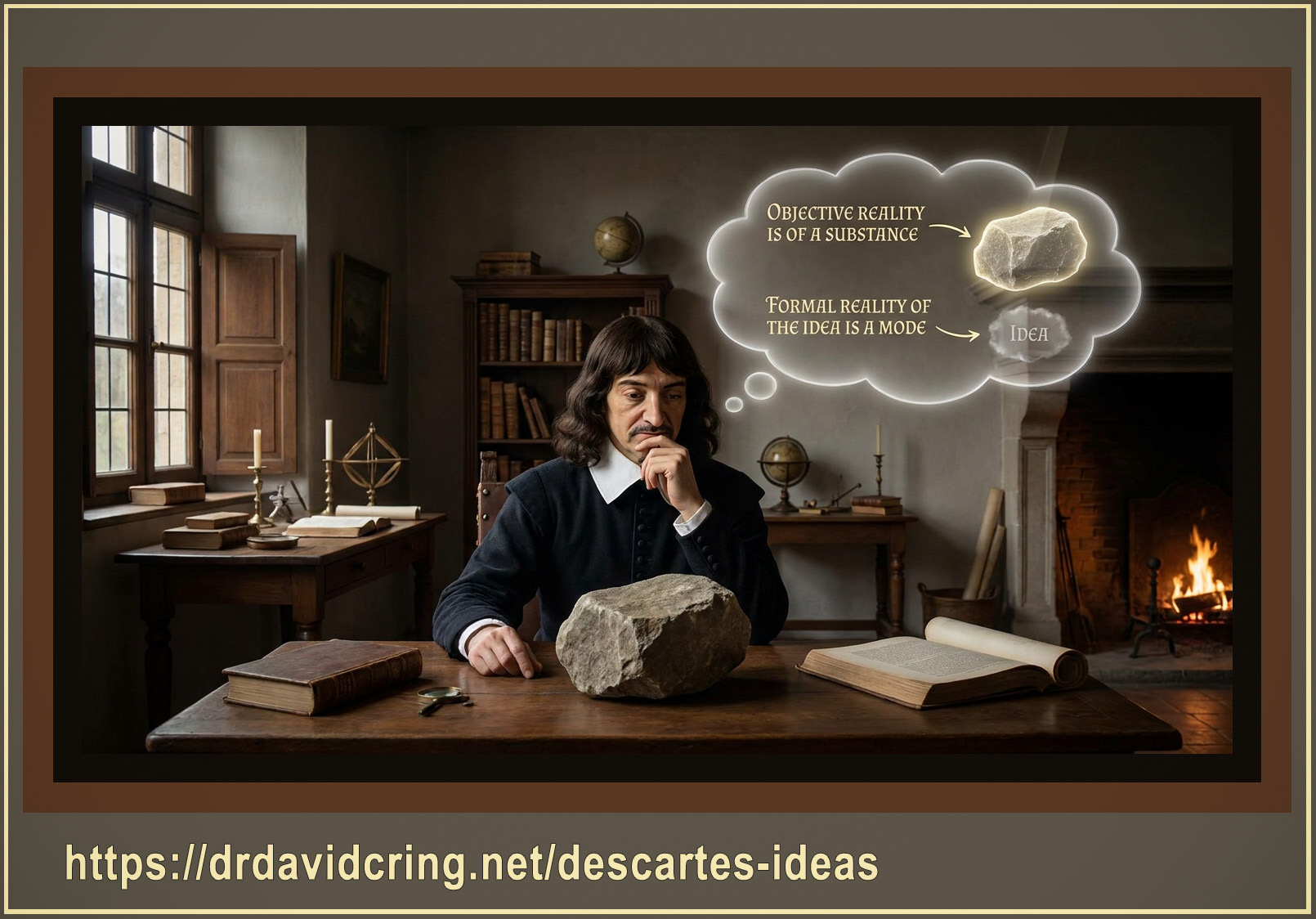
The difficulty can be exposed without beginning with Descartes’s idea of an infinite God. Consider instead the philosophically unremarkable case of an idea of a rock. Suppose that Descartes is occurrently thinking of a rock and that the idea is a strict Cartesian idea possessing objectively real representational content. Nothing about infinity is involved. The representatum is simply a finite physical substance.
Descartes himself uses the closely related example of a stone in the Third Meditation. In explaining the causal principle governing objective reality, he writes: “But it is also true that the idea of heat, or of a stone, cannot exist in me unless it is put there by some cause which contains at least as much reality as I conceive to be in the heat or in the stone.” (AT VII 40–41; CSM II 28)
The internal representation of the rock in a strict Cartesian idea represents the rock as a substance and therefore possesses finite-substance-level objective reality. Descartes explicitly distinguishes the objective reality of substance ideas from that of ideas representing modes: “Undoubtedly, the ideas which represent substances to me amount to something more and, so to speak, contain within themselves more objective reality than the ideas which merely represent modes or accidents.” (AT VII 40; CSM II 28)
Thus far there should be nothing controversial. The internal representation of the rock is not reduced to mode-level objective reality merely because it occurs in an idea that is formally a mode.4The present post treats the idea of a rock, and the idea of God, as clear cases of ranked objective reality. This is deliberate and limited. Earlier posts in the series develop the Restriction Thesis: objective reality is not Descartes’s universal theory of ideas and falls silent for secondary quality sensations, certain modi cogitandi, including common notions, privative ideas, and various relational or modal contents. ORCET (in an occurrent pure strict Cartesian idea, the objective-reality-bearing internal representation exhausts the represented first-order content of the idea) applies only within the class of pure strict ideas that do carry ranked objective reality of a representatum. It does not extend to non OR intelligible contents, nor does it threaten the boundary that the Restriction Thesis (the claim that objective reality is restricted to strict ideas with objective-reality-bearing internal representations of a representatum, and is not a universal feature of all Cartesian thoughts, sensations, common notions, or privative thoughts, such as the idea of nothing) protects. The two claims are consistent: the rock and God belong on the ranked side of the distinction; the modi cogitandi for which objective reality falls silent remain outside the scope of both ORCET and the Rock-OR Objection developed in this post.
For my posts developing and defending the Restriction Thesis, see
”Why Objective Reality Cannot Be Descartes’s Universal Theory of Thought: Burman, Common Notions, and the Collapse of the Strict-Idea Model”
“Do Cartesian Universals Have Objective Reality? Genus, Species, and Modes of Thinking without Representata”
“Do Cartesian Sensations Have Objective Reality?: Strict Ideas, Broad Ideas, and Material Falsity in Descartes’s Theory of Ideas”
Its objective-reality rank corresponds to what the idea represents: a finite substance. Because of this objective-reality rank, Descartes states the relevant causal principle without qualification: “But in order for a given idea to contain such and such objective reality, it must surely derive it from some cause which contains at least as much formal reality as there is objective reality in the idea.” (AT VII 41; CSM II 28) Because the internal representation of the rock possesses finite-substance-level objective reality, Descartes consequently requires an adequate cause possessing at least the corresponding degree of reality formally or eminently.
This claim must be distinguished from Descartes’s argument that objective being requires some cause. His statement that the objective mode of being “is certainly not nothing, and so it cannot come from nothing” (AT VII 41; CSM II 28) supplies a reason for placing objective reality within the scope of causal explanation. It does not by itself establish that the degree of objective reality fixes the minimum degree of
formal or eminent reality required of its adequate cause. That rank-sensitive correspondence is the additional cross-modal causal principle whose justification is at issue.5Geoff Pynn, “Handout 5: The Third Meditation,” Philosophy 322: Modern Philosophy, Northern Illinois University, Spring 2016, esp. pp. 4–5. I encountered Pynn’s handout only after the present post and its principal arguments had already been completed. His discussion is nevertheless important because he independently identifies a central inferential pressure developed here in substantially greater detail. Pynn distinguishes Descartes’s general Causal Principle from the stronger Causal Principle for Ideas and explicitly observes that “the Causal Principle can’t motivate premise (2) of Descartes’s argument by itself” (p. 4). Because ideas considered formally are modes of thought, the ordinary causal principle does not by itself establish that the objective reality of an idea requires a cause possessing at least a corresponding degree of formal reality. Pynn thus independently recognizes the need for a stronger principle connecting the objective reality of an idea with the formal reality of its cause.
Pynn presses the problem further through Descartes’s discussion of the sun. Descartes holds both that the sun exists objectively in the intellect and that this objective mode of being is less perfect than the sun’s formal existence outside the intellect. Pynn accordingly asks why the objectively existing sun could not have a cause possessing less formal reality than the formally existing sun and concludes that “It is not clear how Descartes would answer this question” (p. 5). This comes especially close to the problem developed here concerning the imperfect-OR defense and the Cross-Modal Causal Adequacy Problem. Pynn sees that acknowledging objective reality and the general principle that reality cannot arise from nothing does not by itself make transparent why the degree of objective reality should determine a corresponding minimum degree of formal reality in the cause. His discussion therefore provides an independent precursor to the present post’s distinction between general causal adequacy and rank-sensitive cross-modal causal adequacy.
Pynn does not, however, develop the further structure of the objection defended here. In particular, he does not formulate the Representational Actuality Thesis, the Rank-Divergence Argument, ORCET, the distinction between ontological distinguishability, numerical distinctness, and existential separability, the Bearer–Cause Asymmetry, or the Causal Grounding Constraint. Nor does he distinguish Caterus’s challenge to the causal eligibility of objective being from Gassendi’s stronger challenge to the transition from general causal adequacy to correspondingly ranked causal reality, or use Descartes’s Archetype Requirement to isolate the rank-preserving causal commitment required by the Third Meditation. Most importantly, the present argument sharpens Pynn’s difficulty by distinguishing the inferiority of objective being as a mode of being from any diminution in the objective-reality rank of the internal representation. The problem is therefore not simply that objective existence is less perfect than formal existence. Even granting that difference, the question remains why an internal representation whose objective-reality rank does not determine a corresponding formal rank in its finite mental bearer nevertheless allegedly fixes a corresponding minimum formal or eminent rank in its adequate cause. The present post develops that question into the Bearer–Cause Asymmetry and asks whether the required rank-preserving cross-modal principle has a further metaphysical ground or must instead be accepted as primitive.
To see why this cross-modal requirement is structurally problematic, we must ask what exactly is present to Descartes when he is actually having this strict idea of the rock. The natural answer is strikingly economical. Descartes must be aware of the rock as objectively present in the intellect. Nothing further needs to be added to the first-order represented content in order for this thought to be an idea of the rock. If another first-order representation were required, one would have to explain what it contributes that is not already supplied by the objective-reality-bearing representation of the rock.
Descartes’s explanation of the idea of the sun in the First Replies strongly supports this direct characterization of an idea taken objectively: “By this I mean that the idea of the sun is the sun itself existing in the intellect—not of course formally existing, as it does in the heavens, but objectively existing, i.e., in the way in which objects normally are in the intellect.” (AT VII 102–3; CSM II 75)
Applied to the rock, the rock itself is the representatum, while the idea’s internal representation of the rock is the objective-reality-bearing first-order represented content by which the rock is present to the intellect as represented. For the purposes of the objection, the crucial claim is therefore:
Objective-Reality Content Exhaustion Thesis (ORCET): In an occurrent pure strict Cartesian idea, its objective-reality-bearing internal representation of the representatum exhausts the represented first-order content of that idea; no additional first-order internal representation is required. This does not apply to composite thoughts in which the OR content of a strict idea is combined with additional non-OR content, such as the fear component in the fear of a lion.
ORCET is therefore deliberately restricted to first-order represented content. It does not claim that the objective-reality-bearing internal representation of the representatum exhausts the metaphysical constitution of the ideational occurrence, nor does it determine what grounds that occurrence’s capacity to represent. It likewise does not determine whether the internal representation of the representatum is numerically identical with or numerically distinct from the mental occurrence in which it occurs. The thesis says only that no additional first-order internal representation is required alongside the rock OR in order for the thought to represent that rock.6ORCET (in an occurrent pure strict Cartesian idea, the objective-reality-bearing internal representation exhausts the represented first-order content of the idea) is a developed interpretive thesis rather than a proposition Descartes states verbatim. Descartes explicitly ranks ideas of substances above ideas of modes in objective reality (AT VII 40; CSM II 28), and he separately maintains both that an idea considered formally is a mode of thought and that “such and such objective reality” requires a cause possessing at least as much formal reality (AT VII 41; CSM II 28). ORCET adds the more specific claim that, within a pure strict idea, no additional distinct first-order represented content is required alongside the objective-reality-bearing internal representation of the representatum. Its role is therefore not to generate the difference between the causal significance of the idea’s formal characterization and that of its ranked objective reality. That difference arises from Descartes’s own causal commitments. ORCET instead blocks an attempted explanation that introduces some further first-order represented constituent to account for the idea’s representational content. A critic who rejects ORCET should therefore identify a pure strict idea in which additional distinct first-order represented content is required and explain what representational work that additional content performs. Composite thoughts and contents that fall outside the class of OR-bearing strict ideas, such as common notions and non-OR sensations, do not constitute counterexamples. Material falsity by itself, however, is not an exclusion condition; only materially false thoughts that fail to qualify as pure strict OR-bearing ideas fall outside ORCET.
Consequently, when Descartes simply thinks of the rock, he need not simultaneously represent his thought as a finite mental mode. His first-order awareness is directed toward the rock objectively present in the intellect. Reflectively considering the occurrence as my present finite mental mode of thinking about a rock would introduce a further, second-order consideration of the thought itself. It does not follow from the fact that Descartes is not first-order aware of the idea as a finite mental mode that the occurrence cannot ontologically be a finite mental mode. The distinction between what an awareness is of and what that awareness is must be preserved. Descartes is therefore entitled to maintain that the occurrence is ontologically a mode even though that mode is not another object contained within the first-order represented content.
We can confidently grant Descartes this much: let the awareness of the rock OR occur in, or constitute, a finite mental mode. ORCET alone does not decide the metaphysical relation between the objective-reality-bearing content and the occurrence in which it occurs. Granting this point makes the coming difficulty more precise rather than weaker. Descartes explicitly characterizes the idea formally as a mode of thought. Immediately before stating the causal requirement governing objective reality, he writes: “The nature of an idea is such that of itself it requires no formal reality except what it derives from my thought, of which it is a mode.” (AT VII 41; CSM II 28)
So far, this too can be granted. The occurrence in which Descartes is aware of the objectively represented rock may be classified, considered formally, as a finite mode of a finite thinking substance.
We now have four commitments jointly operative in the present argument:
- The idea represents the rock as a substance, so its internal representation of the rock possesses finite-substance-level objective reality.
- Descartes requires that substance-level objective reality to have an adequate cause possessing at least the corresponding degree of formal or eminent reality.
- The objective-reality-bearing internal representation of the rock exhausts the first-order represented content required for having the pure strict idea of the rock.
- Descartes nevertheless classifies the ideational occurrence, considered formally, as a finite mental mode.
These commitments do not constitute a formal contradiction. They generate an explanatory problem. Descartes must explain the metaphysical relation between the formal characterization of the ideational occurrence and its objective-reality-bearing internal representation and, in particular, why the latter generates a causal requirement whose rank is not generated by the occurrence considered merely as a finite mode.
The Metaphysical Dilemma
The difficulty is now fully visible. The internal representation of the rock possesses the objective-reality rank of a substance. Descartes therefore requires its adequate cause to possess at least substance-level formal or eminent reality. Yet the ideational occurrence, considered merely according to its formal reality as a mode, possesses only mode-level formal reality. Nothing about its being a mode as such explains the additional substance-level causal requirement.
This difference is not by itself contradictory. The formal characterization of an ideational occurrence may assign it mode-level reality while the objective-reality characterization of its internal representation assigns that representation substance-level objective reality. The difficulty concerns the different causal significance Descartes attaches to these characterizations. If they generate importantly different causal-adequacy requirements, their difference must correspond to some genuine metaphysical feature capable of grounding that difference in causal requirements.
Causal Grounding Constraint: If the formal characterization of the occurrent idea and the objective-reality characterization of its internal representation generate importantly different causal-adequacy requirements, the difference between those requirements must be grounded in a genuine metaphysical difference and cannot be explained merely by redescribing or reconsidering the ideational occurrence.7A defender of Descartes may grant the Causal Grounding Constraint in form while denying that it generates any further difficulty. The defender may distinguish the mode in which reality is possessed from its degree or ontological rank: formal and objective being are different modes of being, while mode, finite substance, and infinite substance specify degrees of reality. Once objective being is acknowledged to be “certainly not nothing” (AT VII 41; CSM II 28), the defender may contend that the stronger principle according to which objective-reality rank places a corresponding lower bound upon formal or eminent causal rank is itself a further deliverance of the natural light. On this view, the demand for a deeper grounding is misplaced. The distinction between modes of being permits objective-reality rank not to determine the formal rank of its immediate bearer, while the degree of reality remains causally significant across the difference between objective and formal being. Descartes may therefore regard the rank-preserving cross-modal causal principle as metaphysically primitive.
My reply is that this is a coherent Cartesian stopping point, but it does not derive the required causal correspondence from the distinction between formal and objective being or from the weaker premise that objective being is not nothing. The distinction of modes is already presupposed by the argument, and the “not nothing” premise establishes at most that objective reality requires causal explanation. What the Causal Grounding Constraint additionally asks is why, given the distinction between modes of being, objective-reality rank has asymmetric implications for bearer and cause: why it does not determine a corresponding formal rank in the immediate mental bearer while allegedly fixing a strict lower bound upon the formal or eminent reality of the adequate cause. An appeal to the natural light may provide epistemic warrant for accepting that principle, but it does not by itself identify the metaphysical feature that grounds this selective rank correspondence. The Rock-OR Objection makes the question concrete even in the ordinary case of a pure strict idea of a rock. Treating the rank-preserving cross-modal principle as primitive therefore remains available to Descartes, but it confirms that the principle constitutes an additional metaphysical commitment rather than something established merely by the formal–objective distinction or by the claim that objective being cannot come from nothing.
This leaves two broad possibilities open for Descartes, generating a metaphysical dilemma.
- If the formal and objective characterizations belong to one numerically identical ideational occurrence, Descartes must identify the metaphysical feature that grounds their different causal-adequacy requirements. A natural reply is that there is one occurrence considered under two respects: considered formally, the occurrence is a finite mode; considered objectively, its internal representation possesses substance-level objective reality. While coherent, this does not explain why those aspects generate different causal requirements, and objective reality cannot simply be reduced to a conceptual perspective without violating Descartes’s claim that objective being “is certainly not nothing.” The Causal Grounding Constraint still applies.
- If the formally existing mental mode and its objective-reality-bearing internal representation are ontologically distinguishable, Descartes must explain their relation and unity within one strict idea. ORCET (In an occurrent pure strict Cartesian idea, its objective-reality-bearing internal representation of the representatum exhausts the represented first-order content of that idea ) prevents introducing the finite mode as an additional first-order represented content alongside the rock OR. Therefore, while the finite mode may function as the ontological bearer, Descartes must explain how substance-level objective reality can be unified with this bearer in the intellect without becoming substance-level formal reality itself.
Neither alternative is fatal by itself. What neither alternative supplies merely by being stated is the explanation Descartes needs: why the objective-reality-bearing content of the rock idea carries a substance-level causal requirement while the mental occurrence that immediately bears it remains formally a mode. The familiar formal–objective distinction therefore identifies the alternatives within which the problem must be solved, but does not by itself solve it.
The Problem Precedes the Idea of God
The importance of the rock example is that the problem arises before infinity enters the discussion. The structural difficulty already appears whenever a finite mental mode bears an internal representation whose objective-reality rank exceeds the formal rank of the bearer while Descartes treats that higher objective-reality rank as imposing a correspondingly higher minimum formal or eminent rank upon its adequate cause.
The idea of God intensifies rather than creates this problem. In the rock case, finite-substance-level objective reality allegedly requires at least finite-substance-level formal or eminent reality in its adequate cause. In the God case, infinite-substance-level objective reality allegedly requires infinite formal or eminent reality. The rock is philosophically revealing because it shows that the underlying difficulty is already built into Descartes’s general causal use of objective reality; the idea of God makes that difficulty indispensable to the proof of an infinite cause.
From the Rock-OR Problem to the Bearer–Cause Asymmetry
The Rock-OR Objection isolates the structural disparity. Descartes permits a finite mode to contain an internal representation possessing the objective reality appropriate to a substance while nevertheless requiring at least finite-substance-level formal or eminent reality in the adequate cause of that objective reality.
The resulting Bearer–Cause Asymmetry can now be stated directly. Objective-reality rank does not determine the formal rank of its bearer but allegedly does determine a corresponding lower bound upon the formal or eminent rank of its adequate cause. The identity question remains relevant only to the metaphysical structure underlying this asymmetry: if the formal and objective characterizations concern aspects of one occurrence, their different causal profiles require a ground; if the bearer and objective-reality-bearing content are ontologically distinguishable, their relation requires explanation.
Caterus and the Antecedent Ontological Challenge
Before the Cross-Modal Causal Adequacy Problem arises, Descartes faces a more fundamental challenge. The Third Meditation argues that objective being is “certainly not nothing” and therefore cannot come from nothing (AT VII 41; CSM II 28). But this leaves open the antecedent question whether objective being possesses sufficient ontological significance to fall under an efficient-causal requirement at all.
Johannes Caterus presses precisely this objection in the First Objections. Drawing upon the Scholastic conception of objective being as an extrinsic denomination, Caterus characterizes it as an “extrinsic denomination that adds nothing to the thing itself” (AT VII 92; CSM II 66–67). He then asks why one should “look for a cause of something which is not actual, which is simply an empty label, a non-entity” (AT VII 92–93; CSM II 67). Caterus thus asks whether objective being requires this kind of causal explanation before the question arises how much reality its cause must possess.
Descartes’s First Replies resist that deflationary conclusion. He grants that if the question concerns what happens to the formally existing sun merely through its being thought, “nothing happens to it beyond the application of an extraneous label” (AT VII 102; CSM II 74). But he immediately distinguishes that question from the idea itself: “I was speaking of the idea, which is never outside the intellect” (AT VII 102; CSM II 74).
Descartes then characterizes the idea of the sun, taken objectively, as “the sun itself existing in the intellect—not of course formally existing, as it does in the heavens, but objectively existing, i.e. in the way in which objects normally are in the intellect” (AT VII 102–3; CSM II 75). He states the causal consequence explicitly: “An idea does not require a cause enabling it to exist outside the intellect. This I accept, but it surely needs a cause enabling it to be conceived, which is the sole point at issue.” (AT VII 103; CSM II 75) Descartes thus distinguishes the merely extrinsic denomination (attributing something to a thing not because it is a feature of that thing itself, but because of the thing’s connection with something else, for example, calling an object “thought about” because a mind thinks of it) attaching to the external thing through its being thought from the representatum insofar as it exists objectively in the intellect and places the latter within causal explanation.
For purposes of the present argument, Descartes may be granted this response. Suppose, against Caterus, that objective being is not exhausted by an extrinsic denomination (attributing something to a thing not because it is a feature of that thing itself, but because of the thing’s connection with something else, for example, calling an object “thought about” because a mind thinks of it) and that the objective-reality-bearing internal representation of a representatum genuinely requires causal explanation. This establishes that some causal explanation is required, but not the stronger proposition needed by the Third Meditation: that objective-reality rank imposes a corresponding, rank-preserving lower bound upon the formal or eminent reality of its adequate cause.
This locates the transition to Gassendi precisely. Caterus challenges the causal eligibility of objective being; Gassendi challenges the stronger inference from objective-reality rank to correspondingly ranked causal reality.8Predrag Milidrag develops a particularly strong interpretation of Descartes’s response to Caterus, according to which Descartes assigns essences a genuine intramental mode of objective being rather than treating objective being merely as an extrinsic denomination (attributing something to a thing not because it is a feature of that thing itself, but because of the thing’s connection with something else, for example, calling an object “thought about” because a mind thinks of it). See Predrag Milidrag, “Katerus i Dekart o idejama, uzrokovanju i večnim istinama” [“Caterus and Descartes on Ideas, Causality and Eternal Truths”], Theoria 55, no. 1 (2012): 45–69. Milidrag’s interpretation and its implications for innate ideas, conscious mental representation, ORCET, intramental essences, and the causal role of objective reality are examined separately in “Can Objective Reality Exist Unthought? Milidrag, Intramental Essences, and Cartesian Mental Representation.”
Gassendi Anticipates the Problem
The Rock-OR Objection has an important seventeenth-century precursor. In the Fifth Objections, Pierre Gassendi (1592–1655) presses Descartes at the transition from the general causal principle to the stronger claim that the objective-reality rank of an idea determines the minimum formal or eminent reality required of its adequate cause.
Gassendi first recognizes Descartes’s distinction between the idea considered as an entity and the idea considered representationally:
“You do in fact immediately afterwards distinguish between objective and formal reality, where ‘formal reality’, as I understand it, applies to the idea itself not as it represents something but as an entity in its own right.” (AT VII 285; CSM II 199)
Considered formally, the idea is an actually existing mental mode. Considered representationally, its internal representation possesses objective reality according to the ontological rank of the representatum. Descartes then assigns that objective-reality rank a causal requirement not fixed merely by the mode-level formal reality of the mental bearer.
Gassendi immediately challenges this transition:
“You next assume that it is ‘manifest by the natural light that there must be at least as much in the efficient and total cause as there is in the effect’. This enables you to infer that there must be at least as much formal reality in the cause of an idea as there is objective reality in the idea. But this is a very big step to take, and we must stop you here for a while.” (AT VII 288; CSM II 201; bold italic not in original)
The objection targets precisely the cross-modal and rank-sensitive character of Descartes’s inference. The general causal principle concerns reality in an effect and the reality required of its cause. Descartes applies it across different modes of being and requires the ordering to be preserved: mode-level, finite-substance-level, and infinite-substance-level objective reality allegedly impose correspondingly ordered lower bounds upon the formal or eminent reality of their adequate causes.
Gassendi also questions Descartes’s account of formal or eminent containment:
“Your objection that the effect must be contained in the cause ‘either formally or eminently’ proves nothing more than that an effect sometimes has a form which resembles the form of its cause, while sometimes it has a dissimilar and imperfect form, so that the form of its cause is eminently superior. But it does not follow that even an eminent cause bestows on the effect some of its essence.” (AT VII 289; CSM II 201; bold not in original)
Gassendi’s objection is not identical to the Rock-OR Objection. He challenges the inference from general causal adequacy to a correspondence between objective-reality rank and formal or eminent causal rank. The Rock-OR Objection adds the grounding question. ORCET does not generate the causal asymmetry; rather, it blocks an attempted explanation that introduces additional first-order represented content alongside the objective-reality-bearing internal representation. The remaining question is what metaphysical feature associated with the objective-reality characterization of the rock’s internal representation grounds a finite-substance-level causal requirement when the ideational occurrence that bears it remains formally a mode.
Gassendi comes closer to that question in his 1644 Disquisitio metaphysica:
“Third, the ‘objective’ reality of an idea, as you understand it, is inseparable from the formal reality of the same idea; for there will be no ‘objective’ reality unless there is formal reality, nor formal reality without ‘objective’. Therefore, the ‘objective’ reality will depend upon the same efficient cause the formal reality will depend upon.” (Pierre Gassendi, Disquisitio metaphysica, “Doubt Seven,” Rebuttal, Article Two, in Craig B. Brush, ed. and trans., The Selected Works of Pierre Gassendi (New York: Johnson Reprint Corporation, 1972), 210)
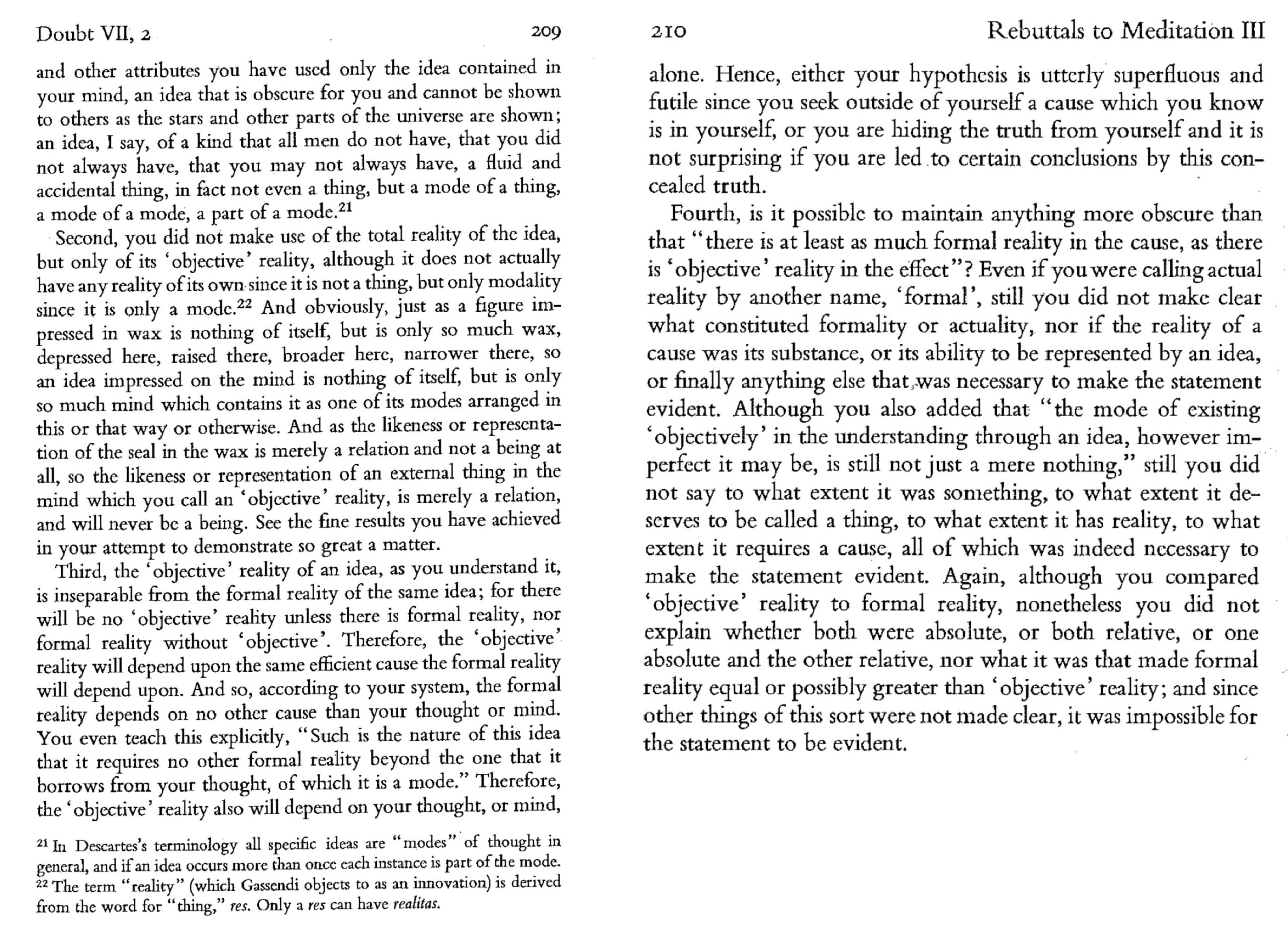
The later formulation makes the grounding problem more explicit. Gassendi argues that formal and objective reality are inseparable in the same idea and therefore depend upon the same efficient cause. This does not show that they cannot impose different requirements upon that cause; different features of one effect may have different explanatory roles. But it makes the relevant question unavoidable: what grounds the different causal profiles? Gassendi does not formulate ORCET or the Causal Grounding Constraint, but the Fifth Objections and the Disquisitio anticipate the two central pressures of the present objection: the need to justify rank-preserving cross-modal causal adequacy and the need to explain the metaphysical basis for the different causal roles associated with the formal characterization of the idea and the objective-reality characterization of its representational content.
Descartes’s Reply to Gassendi
Descartes’s reply is strikingly brief given the importance of the objection. He begins:
“You say a great deal here to give the appearance of contradicting me, but in fact you do not contradict me at all, since you reach exactly the same conclusion as I do. Nevertheless you include in your discussion many assertions with which I strongly disagree.” (AT VII 366; CSM II 252)
He then rejects Gassendi’s attempt to relocate the relevant causal containment in the material rather than the efficient cause:
“You say that the axiom ‘There is nothing in the effect which did not previously exist in the cause’ should be taken to refer to material rather than efficient causes; but it is unintelligible that perfection of form should ever pre-exist in a material cause; it can do so only in an efficient cause.” (AT VII 366; CSM II 252; bold not in original)
This reply gives Descartes a plausible answer to one question: where must the relevant perfection pre-exist? A material cause supplies that out of which something is constituted or that which receives a determination; an efficient cause accounts for the production or actualization of the effect. Mere receptivity therefore cannot explain why one particular perfection rather than another becomes actual.
Descartes appeals to the same causal intuition in the Third Meditation: “Similarly, heat cannot be produced in an object which was not previously hot, except by something of at least the same order {degree or kind} of perfection as heat.” (AT VII 41; CSM II 28) His response therefore supplies a principled reason for preferring efficient to merely material causation. What it does not yet determine is how much formal or eminent perfection the efficient cause must possess.
The Deeper Principle: Reality Cannot Come From Nothing
Behind Descartes’s appeal to efficient causation lies a more fundamental principle: whatever reality or perfection occurs in an effect must have an adequate causal source. Descartes asks: “For where, I ask, could the effect get its reality from, if not from the cause? And how could the cause give it to the effect unless it possessed it?” (AT VII 40; CSM II 28) The relevant reality need not exist in the cause under exactly the same form, since Descartes allows formal or eminent containment.
He explicitly extends this reasoning to objective being:
“For if we suppose that an idea contains something which was not in its cause, it must have got this from nothing; yet the mode of being by which a thing exists objectively {or representatively} in the intellect by way of an idea, imperfect though it may be, is certainly not nothing, and so it cannot come from nothing.” (AT VII 41; CSM II 28)
This establishes that objectively real representational content cannot simply be causally ungrounded. But the conclusion remains weaker than the proposition required by the proof. From the fact that objective reality requires an adequate causal source it does not yet follow that its rank fixes the minimum rank of the
formal or eminent reality possessed by that source. The argument from nothing therefore establishes causal dependence without yet establishing rank-preserving cross-modal causal adequacy.
The Bearer–Cause Asymmetry
The central difficulty can now be formulated without treating the idea of God as an exception to representational actuality and without relying upon a controversial inference from numerical identity. Descartes appears committed to an asymmetry in what objective-reality rank determines with respect to its immediate mental bearer (I.e., the idea) and what it allegedly determines with respect to its adequate cause.
On the bearer side, objective-reality rank does not determine the formal-reality rank of the mental mode. An idea of a finite substance remains formally a mode, and an idea of infinite substance likewise remains formally a finite mode. On the causal side, however, Descartes maintains that finite-substance-level objective reality requires at least finite-substance-level formal or eminent reality in an adequate cause, while infinite-substance-level objective reality requires infinite formal or eminent reality.
The asymmetry is therefore not that the same rank must appear formally in both bearer and cause. Rather, objective-reality rank leaves the bearer’s formal rank underdetermined while allegedly fixing a minimum rank for the adequate cause. The unresolved question is what metaphysical feature of objective reality explains this difference between the bearer relation and the causal relation.
The Structure of the Bearer–Cause Asymmetry
| Case | Formal Rank of the Bearer (the idea itself as a mode of mind) | Objective-Reality Rank of the internal representation | Minimum Causal Rank Descartes Requires | The Asymmetry |
|---|---|---|---|---|
| Idea representing a mode | Finite mode | Finite mode-level objective reality | Formal or eminent reality sufficient for mode-level objective reality | No rank disparity: the bearer has mode-level formal reality, its internal representation has mode-level objective reality, and the corresponding causal requirement does not rise to substance-level reality. |
| Idea of a rock | Finite mode | Finite-substance-level objective reality | Finite-substance-level formal or eminent reality | Objective-reality rank does not determine a corresponding substance-level formal rank in the bearer, yet allegedly does determine a substance-level minimum causal rank. |
| Idea of God | Finite mode | Infinite-substance-level objective reality | Infinite formal or eminent reality | Objective-reality rank does not make the bearer formally infinite, yet allegedly requires an adequate cause possessing infinite formal or eminent reality. |
The table makes the disputed structure explicit. The objective-reality ranking and the bearer’s formal ranking can diverge, whereas Descartes allegedly requires the objective-reality ranking and the minimum causal ranking to correspond. It is this selective rank correspondence that requires metaphysical justification.
The Archetype Requirement
Descartes’s appeal to an archetype (original model from which something is derived) confirms the strength of his causal commitment. He does not merely require some cause of an idea. The causal series must ultimately terminate in something containing formally the reality present objectively in the idea: “Eventually one must reach a primary idea, the cause of which will be like an archetype which contains formally {and in fact} all the reality {or perfection} which is present only objectively {or representatively} in the idea.” (AT VII 42; CSM II 29) 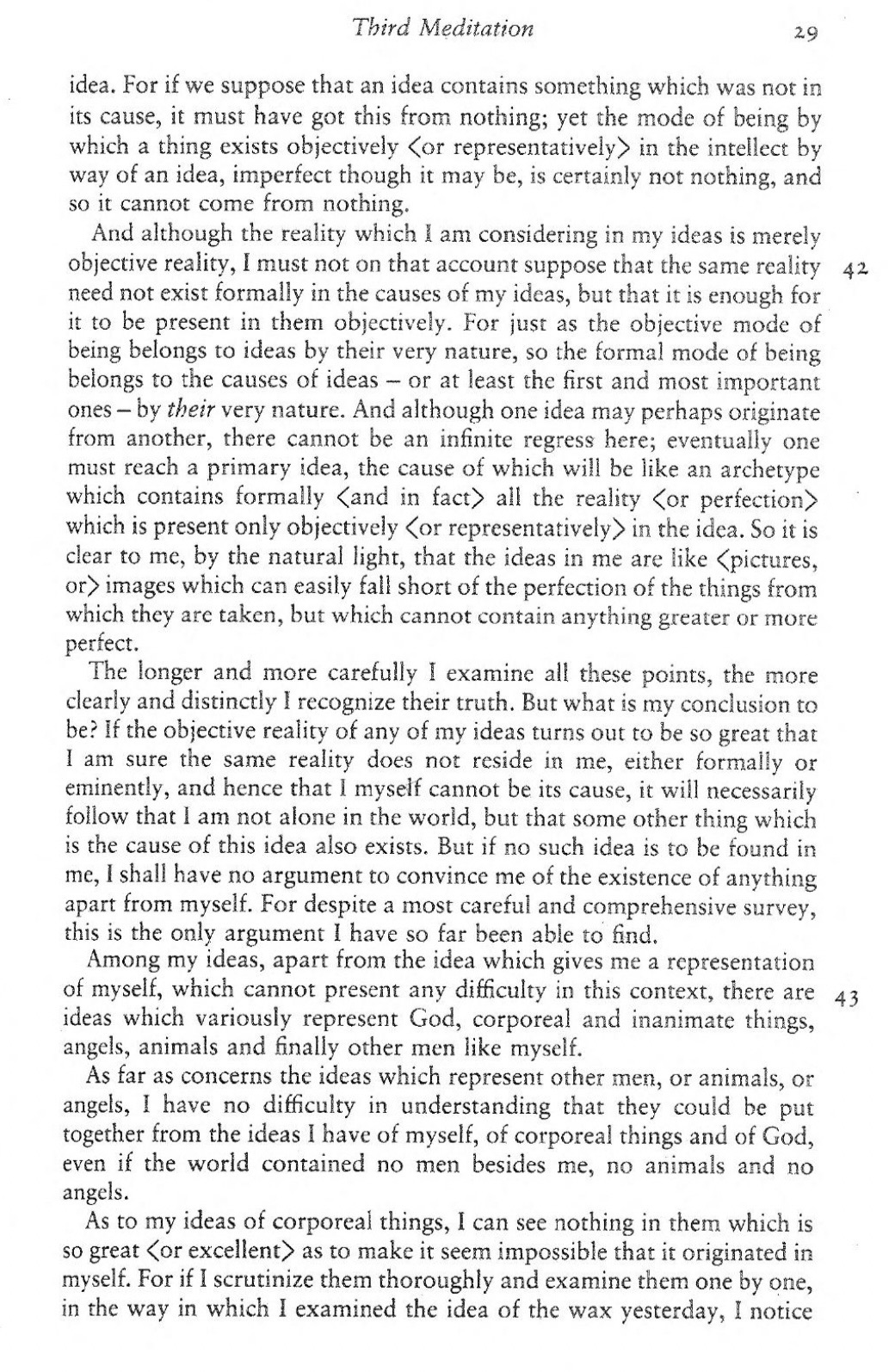
This is powerful textual evidence that Descartes intends objective and formal degrees of reality to stand in a rank-preserving causal correspondence. But the Archetype Requirement states rather than independently establishes that correspondence. Nor can the imperfection of objective being reduce the idea of God to finite-substance-level objective reality, since that would remove the basis for requiring an infinite cause.
The Archetype Requirement therefore sharpens rather than resolves the problem. Descartes unmistakably requires the reality present objectively in an idea ultimately to be matched by corresponding formal or eminent reality in an adequate cause. What remains at issue is the metaphysical principle authorizing that rank-preserving bridge.
The Cross-Modal Dilemma for the Third Meditation
The Cross-Modal Causal Adequacy Problem becomes decisive in the idea of God. The proof depends upon the stronger principle already isolated: the objective-reality rank possessed by the internal representation of the representatum places a rank-preserving lower bound upon the formal or eminent reality of its adequate cause. Without that principle, the route from a finite idea representing an infinite substance to an infinite cause simply does not follow.
This leaves Descartes with a dilemma concerning causal significance. If objective reality is not metaphysically robust enough for its rank to impose a corresponding minimum causal rank, the inference to an infinite cause is unsupported. If it is robust enough for infinite objective reality to require an infinite cause, Descartes must identify what grounds that rank-sensitive causal significance or else treat the rank-preserving cross-modal principle as metaphysically primitive, while still allowing the immediate bearer to remain formally finite.
The Third Meditation therefore requires more than the base proposition that reality cannot arise from nothing. It requires a rank-preserving cross-modal causal adequacy principle sufficient to license the inference from objective-reality rank to a corresponding minimum formal or eminent causal rank. The Bearer–Cause Asymmetry raises the further metaphysical question whether that principle can be grounded or must instead be treated as primitive. The ordinary rock exposes the structure of this explanatory gap; the idea of God makes its justification indispensable for the entire Cartesian project.
Conclusions
The argument began with what initially appears to be a special problem concerning Descartes’s idea of an infinite God. That formulation proves misleading. Once objective being and formal being are properly distinguished, there is no immediate contradiction in a finite mental occurrence whose internal representation of God possesses infinite-substance-level objective reality without the occurrence itself becoming formally infinite. The imperfect-OR defense is therefore substantially correct against the crude finite-containment objection.
This result requires refining the earlier FROR thesis into the Representational Actuality Thesis. What must be formally actual when a strict Cartesian idea occurs is its determinate representing of its representatum, not the objective-reality rank possessed by the internal representation of that representatum. Representational actuality therefore does not require the objective-reality rank of the internal representation to become a corresponding formal-reality rank in the mental mode.
The deeper difficulty appears already in the ordinary rock. According to the Objective-Reality Content Exhaustion Thesis (ORCET), the objective-reality-bearing internal representation of the representatum exhausts the represented first-order content required for having the pure strict idea. ORCET neither determines the complete metaphysical constitution of the ideational occurrence nor entails numerical identity between that content and its bearer. The resulting Rock-OR Objection is therefore not an identity contradiction, but rather a demand for metaphysical justification. It imposes the Causal Grounding Constraint: if the formal characterization of the occurrent idea and the objective-reality characterization of its internal representation generate importantly different causal-adequacy requirements, the difference between those requirements must be grounded in a genuine metaphysical difference and cannot be explained merely by redescribing or reconsidering the ideational occurrence.
Caterus9Johannes Caterus (1590–1655), First Objections (AT VII 92–93; CSM II 66–67):
“My question is this: what sort of cause does an idea need? Indeed, what is an idea? It is the thing that is thought of, in so far as it has objective being in the intellect. But what is ‘objective being in the intellect’? This is simply the determination of an act of the intellect by means of an object. And this is merely an extraneous label which adds nothing to the thing itself. Just as ‘being seen’ is nothing other than an act of vision attributable to myself, so ‘being thought of’, or having objective being in the intellect, is simply a thought of the mind which stops and terminates in the mind. And this can occur without any movement or change in the thing itself, and indeed without the thing in question existing at all. So why should I look for a cause of something which is not actual, which is simply an empty label, a non-entity?”
Descartes’s Response (AT VII 102–3; CSM II 74–75):
“My opponent says, ‘Objective being in the intellect is simply the determination of an act of the intellect by means of an object. And this is merely an extraneous label which adds nothing to the thing itself.’ Notice here that he is referring to the thing itself as if it were located outside the intellect, and in this sense ‘objective being in the intellect’ is certainly an extraneous label. But I was speaking of the idea, which is never outside the intellect, and in this sense ‘objective being’ simply means being in the intellect in the way in which objects are normally there. For example, if anyone asks what happens to the sun through its being objectively in my intellect, the best answer is that nothing happens to it beyond the application of an extraneous label which does indeed, ‘determine an act of the intellect by means of an object.’ But if the question is about what the idea of the sun is, and we answer that it is the thing which is thought of, in so far as it has objective being in the intellect, no one will take this to be the sun itself with this extraneous label applied to it. ‘Objective being in the intellect’ will not here mean ‘the determination of an act of the intellect by means of an object’, but will signify the object’s being in the intellect in the way in which its objects are normally there. By this I mean that the idea of the sun is the sun itself existing in the intellect, not of course formally existing, as it does in the heavens, but objectively existing, i.e. in the way in which objects normally are in the intellect. Now this mode of being is of course much less perfect than that possessed by things which exist outside the intellect. But, as I did explain, it is not therefore simply nothing. An idea does not require a cause enabling it to exist outside the intellect. This I accept, but it surely needs a cause enabling it to be conceived, which is the sole point at issue.”
exposes the antecedent issue by challenging whether objective being possesses sufficient ontological significance to require causal explanation at all, whereas Gassendi presses the stronger transition from general causal adequacy to correspondingly ranked formal or eminent causal reality. Descartes’s own Archetype Requirement nevertheless makes his commitment to that stronger correspondence unmistakable: the causal series must terminate in an archetype containing formally the reality present objectively in the idea. This brings the Bearer–Cause Asymmetry into the open: objective-reality rank need not determine the formal rank of its immediate bearer, yet it allegedly determines a corresponding lower bound upon the formal or eminent reality of its adequate cause.
The strongest conclusion of this analysis is therefore not that Descartes’s theory is formally inconsistent. The revised objection is more exacting. Descartes can coherently distinguish an idea considered formally from its objective-reality-bearing representational content. However, the causal proof requires an additional metaphysical principle according to which the objective-reality rank of that content, although it can exceed the formal rank of the mental mode in which it occurs, nevertheless places a correspondingly ranked lower bound upon the formal or eminent reality of its adequate cause. Descartes may regard that rank-preserving cross-modal principle as metaphysically primitive, but if so, the Third Meditation depends upon an additional primitive causal commitment rather than upon something established merely by the formal–objective distinction or by the premise that objective being cannot come from nothing. Whether that bridge is further grounded or instead defended as primitive, the formal–objective distinction by itself identifies the structure within which the Third Meditation’s causal problem arises; it does not resolve it.

NOTES
(If it’s underlined in the NOTES below, it is a clickable hyperlink. Click on the small bent arrow at the end of any note to jump back to the body of the text at that note’s location)
- 1“Finite-substance-level” designates the substance-level threshold relevant to the present argument and does not require the stronger claim that every finite substance possesses exactly the same degree of reality or perfection. What matters here is that an internal representation of a finite substance ranks above one representing merely a mode and below the internal representation of Descartes’s infinite substance, God.
↩︎ - 2By “rank-preserving” I mean preservation of the relevant minimum causal threshold, not equality between the objective-reality rank of the idea’s internal representation and the actual formal or eminent rank of its cause. Descartes’s requirement is that the cause possess at least as much reality; a cause may exceed the minimum.
↩︎ - 3“Ontologically distinguishable” should not here be understood as “existentially separable” or as establishing that the formally existing mental mode and its objective-reality-bearing internal representation are two independently existing entities. The rank argument establishes the weaker conclusion that the two cannot be identified simply as one and the same ontological determination: the formal-reality rank of every human ideational occurrence remains that of a finite mode, whereas the objective-reality rank of its internal representation varies with the rank of the representatum. A further argument would be required to infer numerical distinctness or independent existence from this difference. Indeed, Cartesian objective being is objective being in the intellect, which gives reason to resist treating it as a separately subsisting entity. The alternatives therefore remain open: the formal and objective determinations may be genuinely different metaphysical features of one numerically identical ideational occurrence, or the formally existing mental mode and its objective-reality-bearing content may be ontologically distinguishable constituents whose unity within one idea requires explanation.
↩︎ - 4The present post treats the idea of a rock, and the idea of God, as clear cases of ranked objective reality. This is deliberate and limited. Earlier posts in the series develop the Restriction Thesis: objective reality is not Descartes’s universal theory of ideas and falls silent for secondary quality sensations, certain modi cogitandi, including common notions, privative ideas, and various relational or modal contents. ORCET (in an occurrent pure strict Cartesian idea, the objective-reality-bearing internal representation exhausts the represented first-order content of the idea) applies only within the class of pure strict ideas that do carry ranked objective reality of a representatum. It does not extend to non OR intelligible contents, nor does it threaten the boundary that the Restriction Thesis (the claim that objective reality is restricted to strict ideas with objective-reality-bearing internal representations of a representatum, and is not a universal feature of all Cartesian thoughts, sensations, common notions, or privative thoughts, such as the idea of nothing) protects. The two claims are consistent: the rock and God belong on the ranked side of the distinction; the modi cogitandi for which objective reality falls silent remain outside the scope of both ORCET and the Rock-OR Objection developed in this post.
For my posts developing and defending the Restriction Thesis, see
”Why Objective Reality Cannot Be Descartes’s Universal Theory of Thought: Burman, Common Notions, and the Collapse of the Strict-Idea Model”
“Do Cartesian Universals Have Objective Reality? Genus, Species, and Modes of Thinking without Representata”
“Do Cartesian Sensations Have Objective Reality?: Strict Ideas, Broad Ideas, and Material Falsity in Descartes’s Theory of Ideas”
↩︎ - 5Geoff Pynn, “Handout 5: The Third Meditation,” Philosophy 322: Modern Philosophy, Northern Illinois University, Spring 2016, esp. pp. 4–5. I encountered Pynn’s handout only after the present post and its principal arguments had already been completed. His discussion is nevertheless important because he independently identifies a central inferential pressure developed here in substantially greater detail. Pynn distinguishes Descartes’s general Causal Principle from the stronger Causal Principle for Ideas and explicitly observes that “the Causal Principle can’t motivate premise (2) of Descartes’s argument by itself” (p. 4). Because ideas considered formally are modes of thought, the ordinary causal principle does not by itself establish that the objective reality of an idea requires a cause possessing at least a corresponding degree of formal reality. Pynn thus independently recognizes the need for a stronger principle connecting the objective reality of an idea with the formal reality of its cause.
Pynn presses the problem further through Descartes’s discussion of the sun. Descartes holds both that the sun exists objectively in the intellect and that this objective mode of being is less perfect than the sun’s formal existence outside the intellect. Pynn accordingly asks why the objectively existing sun could not have a cause possessing less formal reality than the formally existing sun and concludes that “It is not clear how Descartes would answer this question” (p. 5). This comes especially close to the problem developed here concerning the imperfect-OR defense and the Cross-Modal Causal Adequacy Problem. Pynn sees that acknowledging objective reality and the general principle that reality cannot arise from nothing does not by itself make transparent why the degree of objective reality should determine a corresponding minimum degree of formal reality in the cause. His discussion therefore provides an independent precursor to the present post’s distinction between general causal adequacy and rank-sensitive cross-modal causal adequacy.
Pynn does not, however, develop the further structure of the objection defended here. In particular, he does not formulate the Representational Actuality Thesis, the Rank-Divergence Argument, ORCET, the distinction between ontological distinguishability, numerical distinctness, and existential separability, the Bearer–Cause Asymmetry, or the Causal Grounding Constraint. Nor does he distinguish Caterus’s challenge to the causal eligibility of objective being from Gassendi’s stronger challenge to the transition from general causal adequacy to correspondingly ranked causal reality, or use Descartes’s Archetype Requirement to isolate the rank-preserving causal commitment required by the Third Meditation. Most importantly, the present argument sharpens Pynn’s difficulty by distinguishing the inferiority of objective being as a mode of being from any diminution in the objective-reality rank of the internal representation. The problem is therefore not simply that objective existence is less perfect than formal existence. Even granting that difference, the question remains why an internal representation whose objective-reality rank does not determine a corresponding formal rank in its finite mental bearer nevertheless allegedly fixes a corresponding minimum formal or eminent rank in its adequate cause. The present post develops that question into the Bearer–Cause Asymmetry and asks whether the required rank-preserving cross-modal principle has a further metaphysical ground or must instead be accepted as primitive.
↩︎ - 6ORCET (in an occurrent pure strict Cartesian idea, the objective-reality-bearing internal representation exhausts the represented first-order content of the idea) is a developed interpretive thesis rather than a proposition Descartes states verbatim. Descartes explicitly ranks ideas of substances above ideas of modes in objective reality (AT VII 40; CSM II 28), and he separately maintains both that an idea considered formally is a mode of thought and that “such and such objective reality” requires a cause possessing at least as much formal reality (AT VII 41; CSM II 28). ORCET adds the more specific claim that, within a pure strict idea, no additional distinct first-order represented content is required alongside the objective-reality-bearing internal representation of the representatum. Its role is therefore not to generate the difference between the causal significance of the idea’s formal characterization and that of its ranked objective reality. That difference arises from Descartes’s own causal commitments. ORCET instead blocks an attempted explanation that introduces some further first-order represented constituent to account for the idea’s representational content. A critic who rejects ORCET should therefore identify a pure strict idea in which additional distinct first-order represented content is required and explain what representational work that additional content performs. Composite thoughts and contents that fall outside the class of OR-bearing strict ideas, such as common notions and non-OR sensations, do not constitute counterexamples. Material falsity by itself, however, is not an exclusion condition; only materially false thoughts that fail to qualify as pure strict OR-bearing ideas fall outside ORCET.
↩︎ - 7A defender of Descartes may grant the Causal Grounding Constraint in form while denying that it generates any further difficulty. The defender may distinguish the mode in which reality is possessed from its degree or ontological rank: formal and objective being are different modes of being, while mode, finite substance, and infinite substance specify degrees of reality. Once objective being is acknowledged to be “certainly not nothing” (AT VII 41; CSM II 28), the defender may contend that the stronger principle according to which objective-reality rank places a corresponding lower bound upon formal or eminent causal rank is itself a further deliverance of the natural light. On this view, the demand for a deeper grounding is misplaced. The distinction between modes of being permits objective-reality rank not to determine the formal rank of its immediate bearer, while the degree of reality remains causally significant across the difference between objective and formal being. Descartes may therefore regard the rank-preserving cross-modal causal principle as metaphysically primitive.
My reply is that this is a coherent Cartesian stopping point, but it does not derive the required causal correspondence from the distinction between formal and objective being or from the weaker premise that objective being is not nothing. The distinction of modes is already presupposed by the argument, and the “not nothing” premise establishes at most that objective reality requires causal explanation. What the Causal Grounding Constraint additionally asks is why, given the distinction between modes of being, objective-reality rank has asymmetric implications for bearer and cause: why it does not determine a corresponding formal rank in the immediate mental bearer while allegedly fixing a strict lower bound upon the formal or eminent reality of the adequate cause. An appeal to the natural light may provide epistemic warrant for accepting that principle, but it does not by itself identify the metaphysical feature that grounds this selective rank correspondence. The Rock-OR Objection makes the question concrete even in the ordinary case of a pure strict idea of a rock. Treating the rank-preserving cross-modal principle as primitive therefore remains available to Descartes, but it confirms that the principle constitutes an additional metaphysical commitment rather than something established merely by the formal–objective distinction or by the claim that objective being cannot come from nothing.
↩︎ - 8Predrag Milidrag develops a particularly strong interpretation of Descartes’s response to Caterus, according to which Descartes assigns essences a genuine intramental mode of objective being rather than treating objective being merely as an extrinsic denomination (attributing something to a thing not because it is a feature of that thing itself, but because of the thing’s connection with something else, for example, calling an object “thought about” because a mind thinks of it). See Predrag Milidrag, “Katerus i Dekart o idejama, uzrokovanju i večnim istinama” [“Caterus and Descartes on Ideas, Causality and Eternal Truths”], Theoria 55, no. 1 (2012): 45–69. Milidrag’s interpretation and its implications for innate ideas, conscious mental representation, ORCET, intramental essences, and the causal role of objective reality are examined separately in “Can Objective Reality Exist Unthought? Milidrag, Intramental Essences, and Cartesian Mental Representation.”
↩︎ - 9Johannes Caterus (1590–1655), First Objections (AT VII 92–93; CSM II 66–67):
“My question is this: what sort of cause does an idea need? Indeed, what is an idea? It is the thing that is thought of, in so far as it has objective being in the intellect. But what is ‘objective being in the intellect’? This is simply the determination of an act of the intellect by means of an object. And this is merely an extraneous label which adds nothing to the thing itself. Just as ‘being seen’ is nothing other than an act of vision attributable to myself, so ‘being thought of’, or having objective being in the intellect, is simply a thought of the mind which stops and terminates in the mind. And this can occur without any movement or change in the thing itself, and indeed without the thing in question existing at all. So why should I look for a cause of something which is not actual, which is simply an empty label, a non-entity?”
Descartes’s Response (AT VII 102–3; CSM II 74–75):
“My opponent says, ‘Objective being in the intellect is simply the determination of an act of the intellect by means of an object. And this is merely an extraneous label which adds nothing to the thing itself.’ Notice here that he is referring to the thing itself as if it were located outside the intellect, and in this sense ‘objective being in the intellect’ is certainly an extraneous label. But I was speaking of the idea, which is never outside the intellect, and in this sense ‘objective being’ simply means being in the intellect in the way in which objects are normally there. For example, if anyone asks what happens to the sun through its being objectively in my intellect, the best answer is that nothing happens to it beyond the application of an extraneous label which does indeed, ‘determine an act of the intellect by means of an object.’ But if the question is about what the idea of the sun is, and we answer that it is the thing which is thought of, in so far as it has objective being in the intellect, no one will take this to be the sun itself with this extraneous label applied to it. ‘Objective being in the intellect’ will not here mean ‘the determination of an act of the intellect by means of an object’, but will signify the object’s being in the intellect in the way in which its objects are normally there. By this I mean that the idea of the sun is the sun itself existing in the intellect, not of course formally existing, as it does in the heavens, but objectively existing, i.e. in the way in which objects normally are in the intellect. Now this mode of being is of course much less perfect than that possessed by things which exist outside the intellect. But, as I did explain, it is not therefore simply nothing. An idea does not require a cause enabling it to exist outside the intellect. This I accept, but it surely needs a cause enabling it to be conceived, which is the sole point at issue.”
↩︎