


[NOTE: Words below in magenta or blue underlined are clickable hyperlinks. For many of the hyperlinked glossary items you may need to scroll down to see that entry after clicking on it. Hit the back button in your browser afterwards to return to this post.]
Medium Abstract
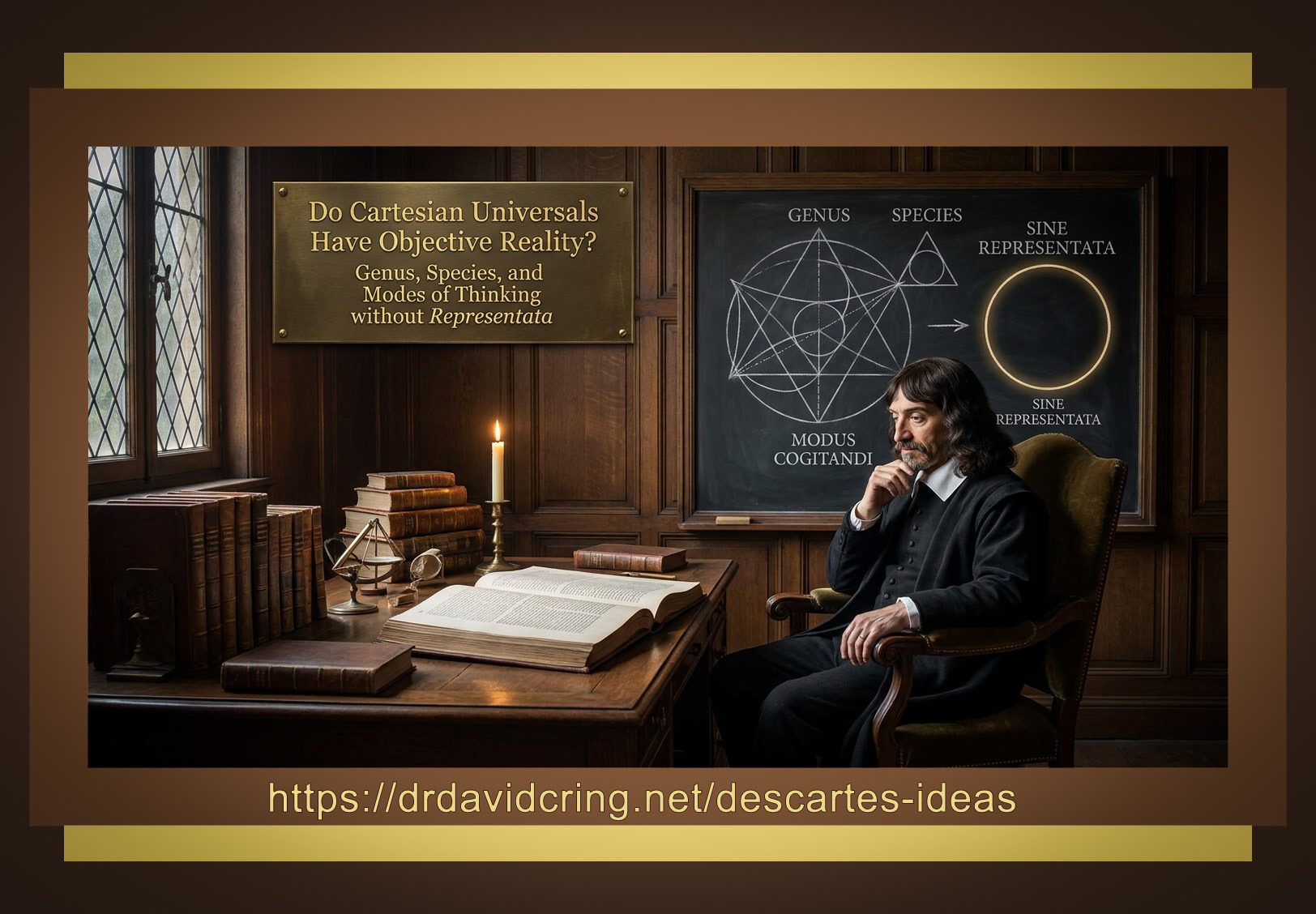
This post examines whether the five Porphyrian predicables—genus, species, differentia, proprium (typically translated as “property”), and accident—possess objective reality representational content (OR) in Descartes’s theory of ideas when they are considered as second-order classificatory roles (concepts applied to other concepts to indicate their place within a logical classification—for example, whether a concept functions as a genus, species, differentia, proprium, or accident).1The expressions first-order and second-order distinguish two different levels at which the intellect can think. First-order ideas are ideas of things or of their principal attributes, true and immutable natures, and modes. Thus the ideas of animal, human, triangle, extension, and motion are first-order ideas because they represent what things are or the natures, principal attributes, or modes they possess.
Second-order ideas, by contrast, are ideas about first-order ideas. They do not introduce additional represented natures alongside animal or triangle; instead, they classify the logical role that first-order ideas play within a taxonomic scheme. Thus, when the intellect judges that animal is a genus relative to human, or that human is a species relative to animal, the represented nature animal remains exactly the same. What changes is not the represented nature but the way the intellect classifies that first-order idea. Likewise, rational functions as a differentia, risible as a proprium, and white as an accident relative to the species human.
The distinction is therefore one of level, not of represented object. First-order ideas represent substances, principal attributes, true and immutable natures, or modes. Second-order ideas represent ways of classifying those first-order ideas. The latter do not thereby introduce additional first-order natures or modes alongside the ideas they classify.
This distinction is fundamental to the argument of this post. My Restriction Thesis does not deny that first-order universal ideas, such as the idea of animal, may contain objective reality. The question is whether the second-order classificatory ideas of genus, species, differentia, proprium, and accident contribute any additional OR-bearing representatum beyond the first-order ideas to which they are applied. The argument defended here is that they do not. They classify first-order ideas without thereby introducing a new substance, principal attribute, true and immutable nature, or mode as an additional representatum.
Objective reality is the ontologically rankable internal representational content contained in a Cartesian strict idea: the representational presence within the idea of a representatum considered as a substance, principal attribute, true and immutable nature, or mode. Its degree corresponds to the ontological standing of the representatum (item represented). Ideas of finite substances and their principal attributes possess finite substantial objective reality, whereas ideas of possible modes and the true and immutable natures of possible modes possess modal objective reality. Conceptual determinacy, however, does not by itself establish the presence of any such representatum.
See my posts in support:
 “The Core DTOI Argument: Sensations Without Cartesian Objective Reality
 “
“ See the complete uncondensed version “Why Objective Reality Cannot Be Descartes’s Universal Theory Of Thought: Burman, Common Notions, And The Failure Of The Strict-Idea Model”
and its companion piece “Why Objective Reality Cannot Be Universal In Descartes’s Theory Of Ideas: Nothing, Eternal Truths, Sensations, And Fear With Claude Opus 4.6.”
The argument therefore distinguishes first-order universal ideas from second-order predicables. A first-order universal idea, such as the idea of triangularity, extension, or animal, may possess OR through the nature, principal attribute, or mode it represents. By contrast, when the intellect classifies animal as a genus relative to human or horse, that second-order classificatory status does not obviously introduce a further represented nature or mode beyond the first-order nature animal. In Principles I.58–59, Descartes explains number and universals as modes of thinking arising through intellectual comparison, abstraction, and general naming. Yet identifying those formally real intellectual operations as the origin or ground of classification is not equivalent to showing that the classificatory role itself is internally represented as an OR-bearing modification of thinking substance.
Preliminary test cases establish the governing distinction between conceptual determinacy and objective reality. The round square shows that a formally real and intelligible act of thought may employ independently OR-bearing component ideas without containing a coherent unified representatum.
Unlike ‘round square, the impossibility of a largest natural number does not arise from an internally contradictory combination of its constituent concepts, but from the mathematical structure of the natural numbers: for every natural number, there is a greater one. Comparative notions such as largest and smallest may possess determinate application conditions and track objectively grounded relations without representing additional intrinsic modes of the objects compared. Cartesian common notions may be necessary, self-evident, and inferentially indispensable without every constituent notion contributing objective reality, while distinctions of reason may differentiate inseparable aspects of an OR-bearing nature without adding a further modal representatum. These cases jointly establish that intelligibility, necessity, inferential structure, and conceptual determinacy do not entail objective reality.
Three positions are then evaluated through the test case GSD: “the predicable role of genus is distinct from the predicable role of species.” Position 1 denies that GSD contains any additional OR-bearing representatum corresponding to those predicable roles. Position 2 assigns them modal objective reality because universals are modifications of thinking substance. Position 3 assigns them weakened or derivative objective reality as idealized classificatory forms abstracted from actual intellectual operations. The second and third positions should not be understood as attributions to Descartes or as reconstructions of any single commentator. They are philosophical reconstructions introduced to test whether second-order predicables can be brought within the objective-reality framework by the strongest available lines of argument.
The objections to Positions 2 and 3 are structurally parallel. Position 2 confuses the formal reality of the intellectual operations grounding classification with the represented content of the classificatory thought. Position 3 confuses determinate conceptual structure with objective reality. Neither formally real intellectual grounding nor conceptual determinacy establishes that the predicable roles are internally represented as substances, principal attributes, true and immutable natures, or modes.
The post concludes that Position 1 provides the best Cartesian account. Second-order predicable roles are conceptually determinate and indispensable to logical and taxonomic cognition, but they do not themselves contribute distinct OR-bearing representata. Thoughts employing them may contain objective reality through the first-order ideas being classified, and a further strict idea representing a particular classificatory act may possess modal objective reality because that act is an actual mode of thinking substance. Neither exercising nor thematizing the predicable role, however, converts the role itself into a represented substance, principal attribute, true and immutable nature, or mode.2By exercising a predicable role (using a first-order concept in its classificatory role as genus, species, differentia, proprium, or accident) I mean employing it in an act of classification without making the role itself the object of reflection. Thus, when one judges that animal is a genus relative to human and horse, the intellect uses the predicable role of genus as a classificatory instrument for organizing first-order concepts. The thought is principally about the nature animal and its taxonomic relation to human and horse, not about genus itself. By thematizing a predicable role I mean making that role itself the explicit topic of intellectual inquiry—for example, by asking, “What is a genus?” or “How does genus differ from species?” In this second case, the intellect’s attention shifts from using the classificatory role to examining it.
What changes, however, is only the direction and purpose of intellectual attention. What does not change is the predicable role itself: its logical function, its ontological status, and, on the interpretation defended here, its status as lacking any distinct OR-bearing representatum all remain exactly the same. Reflection therefore changes the mind’s cognitive relation to genus without changing the ontological status of genus. The philosophical significance of this distinction is that reflection is epistemically reflexive but not ontologically creative. Merely making a predicable role the subject of investigation cannot transform it into a substance, principal attribute, true and immutable nature, or mode, nor thereby endow it with objective reality. Otherwise, every logical connective, comparative notion, rule of inference, or classificatory device would acquire objective reality simply because philosophers chose to reflect upon it.
My Restriction Thesis developed at Descartes’s Theory of Ideas (DTOI) rejects that consequence because objective reality is not generated merely by directing intellectual attention toward something. A thought acquires objective reality only if it contains an ontologically rankable representatum objectively present within a strict Cartesian idea. Reflection may alter the focus of attention, but it cannot by itself supply a new substance, principal attribute, true and immutable nature, or mode for the idea to represent. Redirecting attention toward a logical or classificatory role cannot by itself create the ontologically rankable representatum required for objective reality. Reflection changes the intellect’s mode of attention without changing the ontological kind of the object under consideration. Accordingly, neither exercising nor thematizing a predicable role converts it into an OR-bearing representatum; whatever objective reality is present belongs instead to any first-order ideas employed or to a distinct strict idea whose representatum is the particular act of reflection itself.
The result supports my Restriction Thesis developed at Descartes’s Theory of Ideas (DTOI): objective reality is not a universal feature of every Cartesian thought or every intellectually determinate content, but begins only where a strict Cartesian idea contains the representational presence of an ontologically rankable representatum. The post concludes with a comprehensive table summarizing the ontological standing, Cartesian and DTOI treatment, and objective-reality status of the principal representational items examined. The table contrasts first-order universal ideas with the five Porphyrian predicables, GSD, exercised and thematized classificatory roles, particular reflective acts, comparative notions, a conditional ordering principle analogous to a common notion, impossible unified objects, their independently intelligible component ideas, and necessarily inseparable geometrical determinations distinguished by reason. It thereby provides a systematic synopsis of which contents possess objective reality, which possess it only through constituent strict ideas, and which contribute no additional OR-bearing representatum.
Introduction
Descartes introduces objective reality in the Third Meditation to distinguish ideas according to what they internally represent. Considered merely as formally real modes of thought, ideas possess the same ontological standing: each is a modification of a finite thinking substance. Considered according to their representational content, however, they differ because they present items of different ontological ranks. Descartes writes:
“In so far as the ideas are considered simply as modes of thought, there is no recognizable inequality among them: they all appear to come from within me in the same fashion. But in so far as different ideas are considered as images which represent different things, it is clear that they differ widely.” (AT VII 40; CSM II 27–28; italics not in original)
He immediately adds:
“Undoubtedly, the ideas which represent substances to me amount to something more and, so to speak, contain within themselves more objective reality than the ideas which merely represent modes or accidents.” (AT VII 40; CSM II 27–28)
Two features of this doctrine govern the argument developed below.
First, objective reality (OR) is the ontologically rankable internal representational content contained in a strict Cartesian idea: the representational presence within the idea of a representatum considered as a substance, principal attribute, true and immutable nature, or mode. Its degree corresponds to the ontological standing of the representatum. Thus ideas representing God possess infinite objective reality; ideas representing finite substances possess finite substantial objective reality; ideas representing the principal attributes of finite substances likewise possess finite substantial objective reality, since they represent the essential natures of those substances; and ideas representing possible modes or the true and immutable natures of possible modes possess modal objective reality. It is this ontological standing of the representatum, rather than the mere determinacy of conceptual content, that determines the amount of formal or eminent reality required of the idea’s adequate cause.3Descartes nowhere explicitly introduces a fourth ontological rank corresponding simply to true and immutable natures. Rather, the degree of objective reality is best understood as determined by the ontological status of the representatum. Consequently, true and immutable natures need not all possess the same degree of objective reality. The idea of extension represents the principal attribute and therefore the essence of corporeal substance, while the idea of thought represents the principal attribute of thinking substance. The interpretation defended here, considers ideas of these principal attributes to possess finite substantial objective reality, since they represent the essential natures of finite substances rather than possible modes. By contrast, the idea of triangularity represents the true and immutable nature of a possible mode of extension and therefore possesses modal objective reality. Thus the degree of objective reality depends not upon an item’s being a true and immutable nature as such, but upon the ontological category of the representatum whose nature the idea represents.
Second, objective reality is not identical with conceptual content generally. A conscious thought may be determinate, intelligible, inferentially articulated, and even necessarily true without containing an internal representatum of the kind required for objective reality. Objective reality belongs to strict Cartesian ideas and to broader thoughts only insofar as those thoughts contain strict ideas as constituents.4See my posts “Strict And Broad Ideas In DTOI” and “Condensation: Why Objective Reality Cannot Be Descartes’s Theory Of Thought: Burman, Common Notions, And The Failure Of The Strict Idea Model,” among many others.
The word “accidents” in the second Third Meditation passage must be distinguished from the Porphyrian predicable accident discussed later. Descartes there uses “accidents” as an ontological designation for dependent items ranked below substances. A Porphyrian accident, by contrast, is one of five logical predicables and classifies the way a feature may belong to a kind without belonging necessarily or exclusively to it. The first is an ontological category; the second is a classificatory role. Conflating them would import Descartes’s hierarchy of substances and modes into a logical taxonomy to which it does not directly apply.
Before asking whether universals possess objective reality, it is equally necessary to distinguish two very different kinds of universality. In one sense, a universal idea is a first-order general idea of a substance, principal attribute, true and immutable nature, or mode. The idea of triangle in general represents triangularity as a true and immutable geometrical nature capable of instantiation in possible triangular modes of extended substance. The idea of extension represents the principal attribute of corporeal substance. The idea of animal may represent a general nature applicable to individual living things. Such ideas do not represent particular triangles, particular bodies, or particular animals, but they may nevertheless contain determinate objective reality because their representata are genuine substances, principal attributes, true and immutable natures, or possible modes within Cartesian ontology.
Generality of application is therefore not sufficient to place an idea outside the objective-reality framework. An idea may apply to indefinitely many individuals while still internally representing a true and immutable nature or an ontologically rankable general nature. Descartes’s Fifth Meditation reasoning depends upon precisely this possibility: the idea of triangle in general represents triangularity as a determinate nature whose properties are discovered rather than invented. The representational content is general, but it is not merely classificatory. First-order universals in this sense correspond to what the Routledge Encyclopedia of Philosophy entry on universals treats as properties, relations, and features that particular individuals may instantiate.
The target of the present argument is different. It concerns the five Porphyrian predicables—genus, species, differentia, proprium, and accident—considered as second-order classificatory roles. These predicables do not name additional first-order natures alongside animal, human, rational, risible, or pale. They classify the logical relations in which first-order concepts and natures stand within a scheme of division. Animal, for example, may be considered as a genus relative to human and horse and as a species relative to living thing. The represented nature animal does not change when its classificatory position changes. What changes is the way the intellect situates that first-order concept within a taxonomic structure.
The traditional distinction between first and second intentions captures the contrast. First intentions concern things and their real features: animal, human being, extension, triangularity, motion, and other substances, principal attributes, true and immutable natures, or modes. Second intentions concern the intellect’s treatment of first-order concepts: their status as genus, species, differentia, proprium, or accident. A second intention is therefore a concept of a concept or, more exactly, a concept of the logical role played by a first-order concept. Calling these predicables “second-order universals” does not commit the argument to treating them as additional higher-order entities instantiated by first-order universals. The designation marks their classificatory order, not their ontological independence.
The terminology of proprium and accident requires special care. “Property” in contemporary metaphysics is a broad term for an attribute, feature, or relation that may be instantiated by individuals. A proprium is much narrower: it is a feature belonging necessarily and exclusively to a species without stating its essence or entering its definition. Risibility is traditionally treated as a proprium of human beings. The Porphyrian accident, by contrast, is a feature that may belong to members of a kind without belonging necessarily or exclusively to them. Both are predicable roles describing how features relate to kinds; neither should be confused with Descartes’s ontological use of “accident” for a dependent modification of a substance.
The principal question can now be stated precisely. When the intellect thinks that animal is a genus, the idea of animal may contain objective reality through the general nature represented. But does the classificatory notion genus contribute an additional OR-bearing representatum? When the intellect reflects upon genus as such, does thematization transform that classificatory role into an internally represented mode of thinking substance? More generally, does the conceptual determinacy of a second-order predicable suffice to establish objective reality?
The post defends a negative answer. Its governing Restriction Thesis holds that objective reality is the ontologically rankable representational content contained in a strict Cartesian idea. It therefore belongs only where a thought is itself a strict Cartesian idea containing the representational presence of an actual or possible substance, principal attribute, true and immutable nature, or mode, or where a broader thought contains such a strict idea as a constituent. This restriction does not imply that every conscious state lacking objective reality is contentless. Sensations may possess phenomenal content; common notions may possess inferential and axiomatic structure; comparative notions may have determinate application conditions; and second-order predicables may perform indispensable classificatory functions. The claim is only that these forms of content do not automatically constitute objective reality.
A contemporary comparison helps isolate the point. The logical connective and has a determinate inferential role: from P and Q, one may infer P ∧ Q; from P ∧ Q, one may infer either conjunct. Mastery of those rules can constitute possession of the concept without requiring and to represent an object, substance, property, or mode. Whatever one ultimately thinks about inferentialism as a general theory of concepts, the example demonstrates the intelligibility of conceptually determinate content that is not item-representational. The Cartesian question is correspondingly not whether genus and species are meaningful, usable, or conceptually distinct, but whether they internally represent ontologically rankable representata.5Whether concepts are always representations is disputed in contemporary philosophy of mind. Representationalist theories treat concepts as mental representations, while dispositionalist, inferentialist, enactivist, Fregean, and Wittgensteinian approaches deny that representation is fundamental to every kind of conceptual content. The relevance here is limited: conceptual determinacy alone does not establish that a concept has an OR-eligible representatum in Descartes’s technical sense.
For representationalism, see Jerry A. Fodor, The Language of Thought (Cambridge, MA: Harvard University Press, 1975) and Concepts: Where Cognitive Science Went Wrong (Oxford: Clarendon Press, 1998).
For dispositionalism, see Gilbert Ryle, The Concept of Mind (London: Hutchinson, 1949).
For conceptual-role and inferentialist accounts, see Robert B. Brandom, Making It Explicit: Reasoning, Representing, and Discursive Commitment (Cambridge, MA: Harvard University Press, 1994); Brandom, Articulating Reasons: An Introduction to Inferentialism (Cambridge, MA: Harvard University Press, 2000); and Wilfrid Sellars, “Empiricism and the Philosophy of Mind,” in Minnesota Studies in the Philosophy of Science, vol. 1, ed. Herbert Feigl and Michael Scriven (Minneapolis: University of Minnesota Press, 1956), 253–329.
For enactivist accounts, see Daniel D. Hutto and Erik Myin, Radicalizing Enactivism: Basic Minds without Content (Cambridge, MA: MIT Press, 2013) and Evolving Enactivism: Basic Minds Meet Content (Cambridge, MA: MIT Press, 2017).
For proof-theoretic inferentialism concerning logical connectives, see Gerhard Gentzen, “Untersuchungen über das logische Schließen,” Mathematische Zeitschrift 39 (1935): 176–210, 405–31, translated as “Investigations into Logical Deduction,” in The Collected Papers of Gerhard Gentzen, ed. M. E. Szabo (Amsterdam: North-Holland, 1969), 68–131; and Dag Prawitz, Natural Deduction: A Proof-Theoretical Study (Stockholm: Almqvist and Wiksell, 1965).
The argument proceeds through a series of increasingly difficult cases. Impossible combinations such as a round square establish that the formal reality and intelligibility of a mental act do not guarantee a coherent unified representatum. The largest natural number shows that an intelligible description may be necessarily unsatisfied without being internally contradictory in the same way. Comparative notions such as largest and smallest then demonstrate that determinate application conditions and objectively grounded relational statuses need not introduce additional intrinsic modes or OR-bearing representata. Cartesian common notions show that necessity and self-evidence do not confer objective reality upon every constituent notion. Distinctions of reason further reveal that intellectual differentiation can operate upon OR-bearing ideas without adding further represented entities or modes.
These cases prepare the central analysis of second-order universals. Descartes’s characterization of universals as modes of thinking may be interpreted in at least three ways. According to Position 1, thoughts employing genus and species contain no additional OR-bearing representatum corresponding to those predicable roles. According to Position 2, reflective thought represents them as genuine modifications of thinking substance and therefore gives them modal objective reality. According to Position 3, they possess a weakened or derivative objective reality as idealized classificatory forms abstracted from actual intellectual operations.
The objections to Positions 2 and 3 are structurally parallel. Position 2 confuses the formal reality of the intellectual operations grounding classification with the represented content of the thought employing the classification. Position 3 confuses conceptual determinacy with objective reality. Neither the fact that classification is performed through formally real mental acts nor the fact that classificatory roles possess determinate logical structure establishes that those roles are internally represented as substances, principal attributes, true and immutable natures, or modes.
The thesis defended is not that second-order predicables are unreal, meaningless, arbitrary, or cognitively dispensable. It is that their function is classificatory rather than item-representational. Thoughts employing them may contain objective reality through the first-order ideas classified, and a further idea representing a particular act of classification may possess modal objective reality because that act is a genuine mode of mind. But the predicable roles themselves contribute no additional OR-bearing representata, whether they are exercised in classification or thematized in reflective thought. Conceptual determinacy and objective reality remain distinct.
One qualification is therefore needed at the outset. The claim that second-order universals such as genus and species contribute no additional objective reality applies both when they are exercised within classificatory acts and when they are thematized as objects of reflective thought. When exercised, whatever objective reality is present belongs to the first-order ideas being classified. A thought that classifies animal as a genus may contain objective reality through the idea of animal, while the predicable role genus contributes none of its own. When thematized, the classificatory role becomes an object of intellectual scrutiny, but reflection alone does not transform it into a represented substance, mode, principal attribute, or true and immutable nature. Thematization changes the mode of consideration without supplying a new OR-bearing representatum.
In this respect, second-order predicables resemble common notions in falling partly or wholly outside the objective-reality framework, although the reasons differ. Common notions are principles of intelligible order; second-order predicables concern the intellect’s classificatory ordering of first-order ideas. A common notion may be clearly and distinctly entertained without every constituent notion contributing objective reality, just as a second-order classificatory status may be fully determinate without internally representing an ontologically rankable item.
The question I address is whether second-order universals such as genus, species, and their kindred predicables fall within the objective-reality economy so defined. Throughout, “universals” in the target sense must be sharply distinguished from first-order universals representing genuine substances, principal attributes, true and immutable natures, or possible modes. The argument concludes that second-order predicable roles do not contribute distinct OR-bearing representata, whether exercised or thematized. Their conceptual determinacy, classificatory indispensability, and grounding in formally real intellectual acts do not establish objective reality.
Impossible Objects and the Absence of a Unified OR-Bearing Representatum
Consider first the idea of a round square. Applying Descartes’s account of objective reality, this idea does not contain an objectively real round square.
Objective reality is the ontologically rankable internal representational content contained in a strict Cartesian idea: the representational presence within the idea of a representatum considered as a possible substance, principal attribute, true and immutable nature, or mode. A round square cannot supply such objectively real representational content because roundness and squareness are internally incompatible geometrical determinations: they cannot be combined into one coherent unified nature or representatum.6Staffan Angere finds round squares to be perfectly acceptable in some contexts, as argued in his “The Square Circle.”
What one has is a genuine act of thinking involving the verbal formula “round square” and the component ideas of roundness and squareness, but not an idea whose representatum is a coherent round square. The impossibility therefore lies in the internally contradictory combination of the represented geometrical determinations, not in the actual mental act. Roundness and squareness may each be genuinely represented, but their conjunction does not constitute a possible object or a true and immutable nature.
A somewhat different analysis applies to “the largest natural number.” Unlike “round square,” this description is not internally contradictory merely in virtue of combining the meanings of its component terms. It is intelligible what it would be for a natural number to be larger than every other natural number. Nevertheless, the description is necessarily unsatisfied: for every natural number n, n + 1 is also a natural number and is greater than n. There can therefore be no natural number satisfying the description. The phrase “the largest natural number” is an intelligible verbal formula employing numerical and comparative notions, but it does not yield an idea whose unified representatum is a possible largest natural number. The round square and the largest natural number thus fail in different ways. The former combines internally incompatible determinations; the latter imposes intelligible conditions that no possible natural number can satisfy. In neither case is there a possible unified representatum corresponding to the complete expression.
These cases do not, however, empty the underlying ideas of OR entirely. The idea of roundness and the idea of squareness, taken separately, each have a genuine geometrical representatum and carry OR at the modal level. Similarly, the thought of a largest natural number employs intelligible numerical and relational notions, but the OR-status of those component notions must be assessed independently. The present argument establishes only that no OR corresponds to a unified largest-natural-number representatum; it neither establishes nor requires that every conceptual component of the description possesses OR. Impossible thoughts or descriptions may therefore be intelligible at the level of their component notions and may employ component ideas that independently possess OR while nevertheless lacking any OR corresponding to the alleged unified object.
The examples accordingly illustrate two distinguishable ways in which a determinate thought may fail to contain an OR-bearing unified representatum: internal contradiction among its component determinations and necessary non-satisfaction of an otherwise intelligible description. They establish only a negative principle, but it is crucial for what follows: a thought’s intelligibility, compositional structure, or conceptual determinacy does not by itself show that it contains an OR-bearing representatum.
Comparative Notions: Largest, Smallest, and Comparative Structure Without Additional OR
Consider the ideas of largest and smallest. These comparative ideas possess conceptually determinate application conditions. The idea of largest applies to a member of an ordered domain when every member of that domain is less than or equal to it under the relevant ordering, while the idea of smallest applies to a member when it is less than or equal to every member of that domain. Their conceptual determinacy, however, does not by itself establish that the comparative statuses of being largest and being smallest constitute distinct OR-bearing representata within those ideas, over and above any objects, quantities, or determinate magnitudes being compared.
- The idea of largest conceptually identifies any member of a specified ordered domain that is at least as great as every member of that domain under the relevant ordering.
- The idea of smallest conceptually identifies any member of a specified ordered domain that is no greater than every member of that domain under the relevant ordering.
The descriptions “occupying the upper extremity” and “occupying the lower extremity” therefore characterize the application conditions and inferential roles of these comparative ideas. They do not thereby identify additional things, natures, or modes internally represented beyond the members and magnitudes compared. To speak of alleged OR contents called “LGT” for largest and “SMT” for smallest would merely assign names to these determinate conceptual roles. Naming a conceptual role does not establish that an idea internally represents that role as an OR-bearing representatum.
Nor does the idea of something as largest or smallest internally represent an additional intrinsic mode of the object so classified. An object can become the largest member of a domain when a larger object is removed, and it can cease to be the largest when a still larger object is introduced, without any intrinsic change in the object itself. Its comparative status depends upon its magnitude together with the magnitudes of the other members, the ordering relation employed, and the domain under consideration. Being largest or smallest is therefore better understood as a domain-relative relational status apprehended through intellectual comparison than as an additional intrinsic mode represented in the object. This does not make the comparative truth merely subjective or created by the intellect: the status may be objectively grounded in the magnitudes of the members and their ordering even though the relevant domain is selected and the relation is apprehended through thought.
The ideas employed in thinking the common notion “the largest is bigger than the smallest” should therefore be analyzed differently. The resulting thought is conceptually and inferentially determinate, but this does not require a complex OR-bearing representational content composed of distinct representata corresponding to being largest, being smallest, and being greater than. Rather, the ideas of largest and smallest function within an act of intellectual comparison governed by the rule that, when an ordered domain contains distinct greatest and least members, the member occupying the upper extremity exceeds the member occupying the lower extremity. Any OR present belongs to ideas internally representing the objects, quantities, or determinate magnitudes compared, not to the comparative statuses or ordering structure as such.
The comparative structure of this thought should not be confused with the OR contained in its constituent ideas. The fact that the intellect can distinguish larger than from smaller than, equality, and their converses establishes that the thought possesses a definite conceptual structure.
It does not establish that the ideas of these comparative relations internally represent actual or possible substances, principal attributes, true and immutable natures, or modes. Conceptual determinacy alone is insufficient for OR-bearing representational content. OR belongs only to strict ideas whose representata are actual or possible substances, principal attributes, true and immutable natures, or modes within Cartesian ontology. Comparative notions employed in acts of intellectual comparison do not themselves present such representata; rather, they structure acts operating upon ideas that may independently contain OR.
This conclusion does not imply that no OR is involved whenever the common notion is entertained. A particular thought or judgment affirming that the largest is bigger than the smallest may employ ideas internally representing extended things, quantities, or determinate magnitudes, and whatever objective reality is present belongs to those constituent ideas and their represented objects or modes. What need not be posited are additional OR-bearing representata within the ideas of largest, smallest, upper extremity, lower extremity, or the comparative ordering itself.
The proper analysis is therefore not that the thought contains a complex OR-bearing representational content constructed from LGT, SMT, and bigger than. Rather, it involves an act of intellectual comparison operating upon concepts that may themselves employ OR-bearing ideas of determinate magnitude or quantity. The truth and intelligibility of the resulting judgment derive from the determinate conceptual and inferential structure of the thought, not from each constituent comparative idea possessing a distinct objectively real representatum. This illustrates the broader principle defended throughout this study: the conceptual determinacy of a thought should not be conflated with the objective reality contained only in its strict ideas.
One qualification is in order. The restriction defended above applies to the comparative ideas of largest and smallest, whether they are employed in comparative judgments or thematized as objects of reflective awareness. Thematization changes the reflective act, but it does not by itself change the categorical status of the comparative content. The reflective act is a mode of thinking substance and, when internally represented as the representatum of a further strict idea, can carry OR at the modal level, since it is an actual mode of a finite substance. What thematization does not do is convert the comparative notion, considered as content, into an actual or possible substance, principal attribute, true and immutable nature, or mode. A further strict idea representing the particular reflective act can therefore carry modal OR, since its representatum is an actual mode of mind. By contrast, a reflective thought that thematizes the comparative notion as such need not contain OR, since it does not thereby internally represent the comparative status as an actual or possible substance, principal attribute, true and immutable nature, or mode. The claim defended here concerns the OR-status of the ideas or notions employed as comparative contents, whether exercised or thematized, and does not extend to strict ideas whose representata are the reflective acts themselves considered as modes of thinking substance.
Common Notions and the Restriction Thesis
The preceding analysis concerned the OR-status of the comparative ideas themselves; the present question is whether their occurrence within a possible Cartesian common notion changes that result.
The thought expressed by “the largest is bigger than the smallest” has many of the marks of a common notion in Descartes’s sense. It is knowable by the natural light,7See James Filler’s “Descartes’ “Lumen Naturale”: Reflecting on the Mind’s Light.”
self-evident once its constituent ideas and the relevant ordering conditions are grasped, and capable of functioning as a principle governing judgments about ordered domains. In Principles I.49, Descartes describes eternal truths as follows:
“But when we recognize that it is impossible for anything to come from nothing, the proposition Ex nihilo nihil fit is not considered as an existing thing, or even as a mode of a thing, but as an eternal truth which resides within our mind. Such truths are termed common notions or axioms.” (AT VIIIA 23; CSM I 208–09; Latin not in original English translation)
The Restriction Thesis of DTOI holds that objective reality is the ontologically rankable representational content contained in a strict Cartesian idea. It therefore belongs only to ideas whose representata are actual or possible substances, principal attributes, true and immutable natures, or modes within Cartesian ontology. Thoughts involving nothing, secondary-quality sensations such as cold, second-order predicable roles such as genus and species, domain-relative comparative notions, and certain common notions may therefore be fully determinate without every notion employed in them contributing an OR-bearing representatum.
The ideas employed in thinking “the largest is bigger than the smallest” illustrate this restriction rather than constituting an exception to it. The comparative ideas LGT (the largest) and SMT (the smallest) are not, merely as comparative ideas, ideas of substances or modes, nor do they internally represent true and immutable natures of possible substances or modes. They express domain-relative relational statuses: occupying the greatest or least position within a specified ordering. Whatever occupies the role of largest in a particular domain may be an individual substance or mode and may be represented through an independently OR-bearing idea. Being-largest as such, however, is not an additional intrinsic nature or mode represented over and above that individual and its magnitude. The same applies to being-smallest and to the comparative relation bigger than. They articulate the ordering of represented items rather than introducing further OR-bearing representata.
Consequently, entertaining this possible common notion does not require a complex OR-bearing content composed of distinct representata corresponding to LGT, SMT, and the relation bigger than. None of those comparative ideas, merely as comparative, supplies a representatum of the kind required for OR. Whatever objective reality is present belongs instead to any constituent strict ideas internally representing the objects, quantities, or determinate magnitudes being compared. The truth, necessity, or intelligibility of the resulting judgment does not itself confer objective reality upon the judgment or upon every comparative notion employed within it.
What the Restriction Thesis excludes from OR is therefore a principled and content-sensitive range of notions and conscious contents: nothing, which contributes no internal representatum; sensations such as cold, whose phenomenal content need not constitute objectively real representational content; second-order predicable roles, which classify first-order ideas rather than adding represented substances, modes, or natures; domain-relative comparative notions, which articulate relational positions rather than intrinsic modes; and thoughts whose constituent notions are non-OR-bearing in these ways. Thus, in ex nihilo nihil fit, the notion nothing contributes no OR-bearing representatum; in “the largest is bigger than the smallest,” the comparative ideas contribute none merely through their classificatory and relational functions.
The restriction is not a blanket exclusion of common notions as a class. A thought entertaining a common notion may employ strict ideas of substances, principal attributes, true and immutable natures, or modes, and whatever OR is present belongs to those constituent ideas. What is excluded is the assumption that every notion employed within a self-evident or necessary thought contributes an additional OR-bearing representatum. The example therefore illustrates the general principle defended throughout this study: the conceptual necessity, inferential role, or self-evidence of a thought does not by itself establish that every constituent idea or notion contributes distinct objectively real representational content.
Relations and Distinctions of Reason
Descartes’s technical distinction of reason (distinctio rationis) concerns cases in which the intellect distinguishes items that cannot be separated in reality—for example, a substance from an inseparable attribute or two inseparable attributes of the same substance. This account can illuminate some comparative and classificatory thoughts, but it should not be treated as a general category encompassing every relation that fails to constitute an additional intrinsic mode. The question relevant here is narrower: whether distinguishing or comparing items introduces an additional OR-bearing representatum beyond the substances, principal attributes, true and immutable natures, or modes already represented.
The triangle case is instructive because the idea of triangle in general carries OR through its internal representation of triangularity as a true and immutable geometrical nature. Triangularity is not itself a particular possible triangle, although it is capable of being instantiated in possible triangular modes of extended substance. Three-sidedness is not a feature superadded to triangularity but a constitutive determination of that nature. Three-angledness is likewise necessarily connected with the same triangular nature. The two are conceptually distinguishable but necessarily inseparable determinations of triangularity. Thinking their necessary connection therefore introduces no additional geometrical representatum beyond the true and immutable nature of triangularity and its necessarily connected determinations.
The point can be sharpened by considering a reflective thought concerning the coextension of three-sidedness and three-angledness. Such a thought may employ OR-bearing geometrical ideas, including the idea of triangle in general and the determinations of three-sidedness and three-angledness. What it does not thereby introduce is an additional OR-bearing relational representatum over and above triangularity and its necessarily connected determinations. The distinction is effected by an intellectual act, but it should not be identified with that token act. Rather, it records a conceptual differentiation that does not correspond to separable entities or additional modes in any particular triangle or in triangularity itself.
The claim should therefore be read with precision: a distinction of reason introduces no additional modal representatum of its own and contributes no further OR beyond what the related ideas independently contain. It does not strip OR from ideas that already possess OR-eligible representata. In the triangle case, the OR belongs to the idea’s internal representation of triangularity as a true and immutable geometrical nature and to whatever determinations are contained in or necessarily connected with that nature. The intellectual act of distinguishing three-sidedness from three-angledness adds no further represented substance, mode, attribute, nature, or essence. When the items related contain no OR-bearing representata, the distinction supplies none either.
In Principles I.62, Descartes writes:
“A conceptual distinction is a distinction between a substance and some attribute of that substance without which the substance is unintelligible; alternatively, it is a distinction between two such attributes of a single substance. Such a distinction is recognized by our inability to form a clear and distinct idea of the substance if we exclude from it the attribute in question.” (AT VIIIA 30; CSM I 214)
Cases explicitly or directly covered by Descartes’s account in Principles I.62 include:
- A substance and its duration.
- A substance and its existence.
- A substance and an inseparable principal attribute, such as corporeal substance and extension.
- Two inseparable attributes of a single substance considered distinctly by the intellect.
Other cases discussed in this post are best regarded as analogical extensions of Descartes’s account rather than as cases that Descartes himself explicitly classifies as technical distinctions of reason. These include number considered in relation to numbered things, second-order predicable roles such as genus and species considered in relation to the first-order ideas they classify, and domain-relative comparative relations considered in relation to the intrinsic modes that ground them. Principles I.58–59 characterizes number and universals as modes of thought and explains their origin through comparison, abstraction, and general naming, but it does not expressly classify all such cases as distinctions of reason in the technical sense of I.62.
Relations grounded in genuine modifications of substances must therefore be distinguished from the comparative notions through which the intellect considers those modifications together. A body’s determinate size, shape, position, and motion are modes of extended substance. Ideas of such modes can contain OR because their representata are actual or possible modifications of extended substance. But a comparative thought that one body is greater than another does not thereby introduce an additional intrinsic mode in either body. It presupposes the determinate sizes of the two bodies and apprehends their ordering relation.
Consider two bodies, A and B. A may have one determinate size and B another. Those sizes are genuine modes, and ideas of them may have modal OR. If A is greater than B, that relation is objectively grounded in the intrinsic magnitudes of A and B and is not merely created by an act of thought. Nevertheless, the greater-than relation need not constitute an additional intrinsic mode in A, in B, or in the pair considered as a further entity. Nor must the comparative idea contribute a distinct OR-bearing representatum beyond the ideas of the magnitudes compared. The relation is domain-relative and apprehended through intellectual comparison, but it is not thereby reduced to a token mental act.
The same point applies to LGT and SMT. “The largest” and “the smallest” do not pick out modes or substances merely by virtue of their comparative roles. They are domain-relative comparative notions that classify whichever members occupy the extreme positions within a selected ordered domain. Nor does the relation greater than automatically supply an independent modal representatum. The ideas employed in thinking that the largest is greater than the smallest may be conceptually determinate and may enter a possible common notion, while the comparative statuses themselves contribute no additional OR-bearing representational content. Any OR present belongs to constituent strict ideas representing the relevant objects, quantities, or determinate magnitudes.
This result does not deprive the relevant ideas or thoughts of all content. The intellect genuinely thinks the sizes of A and B, and strict ideas of those sizes may possess modal OR. The intellect also genuinely performs an act of comparison, and a further strict idea whose representatum is that actual act can possess modal OR because the act is an actual mode of thinking substance. But the formal reality of the comparative act does not make that act the represented content of the original comparison, nor does it introduce an additional mode in the bodies compared. Likewise, a reflective thought concerning the necessary coextension of three-sidedness and three-angledness may employ the OR-bearing idea of triangularity and its necessarily connected determinations while contributing no additional relational representatum beyond that true and immutable geometrical nature.
The proper conclusion is therefore not that every comparative or ordering relation is a technical distinction of reason. Intrinsic determinations such as size, shape, position, and motion are modes of extended substance and may be represented with modal OR. Comparative and ordering notions such as greater than, lesser than, largest, and smallest articulate domain-relative relations among such determinations. They need not be treated as additional intrinsic modes or as distinct OR-bearing representata. Some may be illuminated by analogy with Descartes’s distinctions of reason, but they should not all be identified without qualification as technical distinctions of reason.
Universals as Modes of Thinking
Before pressing the argument further, the distinction sketched in the Introduction between two very different things Descartes and his commentators call “universal” must be developed more fully, because the ensuing argument turns on it. In one sense, a universal idea is a first-order universal: a general idea of a thing or of a mode, such as the idea of a triangle, the idea of extension, the idea of motion, or the idea of body. These ideas are “universal” in that they apply to many particulars and do not represent any particular triangle, any particular extended body, and so on; but their representata are genuine possible items in Cartesian ontology or the true and immutable natures of possible substances or modes. Thus triangularity is a true and immutable geometrical nature capable of instantiation in possible triangular modes of extended substance; extension is the principal attribute of corporeal substance; and the idea of body represents corporeal nature, which is instantiated in finite corporeal substances. Ideas of this kind possess determinate OR: in representing their objects, they present them as substances, principal attributes, true and immutable natures, or modes, and their representational content is thus ontologically determinate. Descartes builds central arguments upon that fact: the Fifth Meditation’s derivation of geometrical properties depends upon the idea of triangle in general representing triangularity as a true and immutable nature with determinate, objectively real content. First-order universals in this sense correspond to what the Routledge Encyclopedia of Philosophy entry on universals treats as universals in the standard metaphysical sense, that is, properties and relations that particulars may share or fail to share, such as redness, roundness, sisterhood, or causation. These universals are not at issue in what follows.
In a second, narrower sense, the relevant universals are the second-order universals, paradigmatically genus and species, together with the kindred notions of differentia, proprium (typically translated as “property”), and accident, the five Porphyrian predicables. The argument concerns these notions as second-order classificatory statuses, not the first-order general natures that may occupy those statuses. The idea of animal, for example, may represent a genuine general nature and thereby carry OR. When animal is considered as a genus relative to human, or as a species relative to living thing, the second-order classificatory status does not constitute a further nature represented in addition to animal. Genus and species, considered as such, concern the logical or classificatory status of first-order concepts. The interpretation defended below maintains that genus and species, considered as such, are not themselves concepts whose representata are possible substances, principal attributes, true and immutable natures, or modes. Rather, they are not further features of individuals or further natures alongside animal, human, or living thing, but classificatory positions occupied by first-order ideas within a scheme of division. The distinction being drawn is the traditional one between first intentions and second intentions. First intentions are concepts of things and their real features; second intentions are concepts of concepts, or concepts of the logical roles first-order concepts play. First-order universals are first-intention universals; second-order universals are second-intention universals. Such classificatory status depends upon the intellect’s acts of comparison, abstraction, and general naming, though it should not simply be identified with any particular intellectual operation. It is exclusively these second-order universals that are the target of the argument developed below. The question is not whether first-order universal ideas possess OR, but whether the second-order classificatory statuses themselves contribute an additional OR-bearing representatum.8Paul Hoffman (1952–2010)  offers a reductionist account on which universals considered abstractly are modes of thought, while their extra-mental correlates in particular objects are not additional universal entities. His analysis is compatible with the anti-reification aspect of the present interpretation, but it concerns primarily first-order universals and Descartes’s theory of distinction. It does not determine whether second-order predicable roles such as genus and species contribute objective reality to the thoughts in which they are employed. See Paul Hoffman, “Descartes’s Theory of Distinction,” Philosophy and Phenomenological Research 64, no. 1 (2002): 57–78.
In Principles I.58 and I.59, Descartes characterizes universals as modes of thought and then explains how they arise through intellectual comparison, abstraction, and general naming. He first states in Principles I.58: “Number and all universals are simply modes of thinking.” (AT VIIIA 27; CSM I 212) and then explains their origin in Principles I.59:
“Universals arise solely from the fact that we make use of one and the same idea for thinking of all individual items which resemble each other: we apply one and the same term to all the things which are represented by the idea in question, and this is the universal term.” (AT VIIIA 27; CSM I 212)
The question is whether ideas whose central constituents are second-order universals, paradigmatically the idea “the predicable role of genus is distinct from the predicable role of species” (hereafter GSD), carry OR.
For dialectical purposes, three positions may be distinguished. Position 1 reflects my interpretation defended in this post, whereas Positions 2 and 3 reconstruct the two strongest ways one might attempt to extend objective reality to second-order predicables.
Position 1: GSD contains no OR-bearing representatum. Its determinate content consists in a classificatory or logical distinction without internally representing a substance, principal attribute, true and immutable nature, or mode. Second-order classificatory statuses arise through the intellect’s comparative and abstractive operations without supplying a distinct OR-eligible representatum. A further clarification is essential: Position 1 does not deny OR to every first-order general idea that can be classified as a genus or species. The idea of animal may have OR through the general nature it represents. The intellect’s classification of that nature as a genus introduces no further OR-eligible representatum. Nor does Position 1 deny that a thought applying the notion genus to animal can contain OR through the idea of animal. The claim is only that the second-order notions genus and species, considered precisely as predicable roles, supply no distinct OR-eligible representatum of their own.
Position 2: GSD contains OR because genus and species are genuine second-order universals whose ontological status is that of modifications of thinking substance. When these second-order universals become the objects of reflective thought, the idea internally represents those second-order universals as modifications of thinking substance. Accordingly, GSD possesses modal OR because its representata are genuine modifications of thinking substance.
Position 3 reconstructs a possible intermediate view according to which GSD (“the predicable role of genus is distinct from the predicable role of species”) contains a weakened or derivative OR. Rather than representing full-fledged modal representata, the idea represents only an idealized classificatory form abstracted from actual intellectual operations. Its objective content is therefore less robust than the OR possessed by ideas of substances or determinate modes, yet greater than the complete absence of OR maintained by Position 1.
Objection to Position 2: Formal-Reality Grounding Is Not Objective-Reality Content
Position 2 holds that GSD (“the predicable role of genus is distinct from the predicable role of species”) possesses modal OR because it internally represents the second-order universals genus and species precisely as modifications of thinking substance. Even if the formal ontological ground of second-order classification consists in modifications of thinking substance, however, it does not follow that those modifications are the objects represented by GSD. The appeal to Descartes’s characterization of universals as modes of thinking therefore requires a further premise. From the fact that the intellect’s classificatory activity is a mode of thought, it does not follow that an idea employing genus or species represents that activity as its representatum. The former identifies the ontological ground of the classification; the latter identifies the represented content required for modal OR.
The decisive objection is that Position 2 misidentifies what GSD represents. If the idea really represented genus and species as modifications of thinking substance, someone entertaining GSD would be thinking about modes of mind rather than about the predicable roles of genus and species. But that is not what someone entertaining GSD is thinking about. GSD is a logical or taxonomic truth concerning the distinction between two second-order predicable roles, a truth one can understand without entertaining any thought whatsoever about minds, modifications of thinking substance, or acts of abstraction. Were GSD about modifications of thinking substance, it would be a thesis in the philosophy of mind rather than a logical or taxonomic truth concerning predicable roles. It is not.
Of course, a thought that applies genus to an OR-bearing first-order idea, such as animal, can contain OR through that first-order idea. The point is that the predicable role of genus is not thereby internally represented as a modification of thinking substance merely because the classificatory activity giving rise to that role is itself grounded in mental operations. Nor does the predicable role thereby acquire an additional OR-bearing representatum of its own.
Position 2 therefore misidentifies the OR content. It confuses the formal reality of the intellect’s operations of comparison, abstraction, and general naming, which ground the application of second-order classifications, with the represented content of ideas that employ those classifications. The application of second-order universals is grounded in mental operations, but ideas involving them do not thereby represent those operations. The formal ontological ground is not OR content, and once the distinction is drawn, Position 2 collapses as a route to OR for second-order universals.
The point may be put more generally. If the occurrence of a thought were sufficient to make the mental act producing or sustaining that thought part of its represented content, then every thought would represent the mental act whose occurrence it presupposes. But this is plainly false. Ordinary thoughts about triangles, horses, numbers, or God do not thereby become thoughts about acts of thinking simply because those thoughts necessarily occur through acts of thinking. The ontological ground of a thought’s occurrence must therefore be distinguished from the representatum contained in that thought. Otherwise, the formal reality of every mental act would automatically become objective reality, collapsing Descartes’s distinction between formally real acts of thought and the objectively real representational content contained in strict ideas.
An idea whose representatum is itself a mode of thinking can carry objective reality at the modal level, for a mode of thinking substance is a genuine item within Cartesian ontology. The claim advanced here is narrower. The second-order predicable roles of genus and species do not thereby become internally represented as modifications of thinking substance and therefore do not acquire modal objective reality on that basis. The formal reality of the reflective act is one thing; whether the classificatory content includes an OR-bearing representatum is another.
Objection to Position 3: Conceptual Determinacy Is Not Objective Reality Content
Position 3 holds that GSD (“the predicable role of genus is distinct from the predicable role of species”) represents an idealized classificatory form abstracted from actual intellectual operations and that this form supplies the thought with weakened or derivative OR. That analysis may successfully characterize the conceptual or logical structure of second-order universals. It does not thereby establish that the thought contains objective reality in Descartes’s technical sense. It describes the conceptual or logical organization of the predicable roles and then simply identifies that organization with “OR content” without showing that it satisfies Descartes’s account of objective reality.
On Descartes’s theory, objective reality is not merely whatever conceptual or semantic content a thought possesses. Rather, objective reality is the ontologically rankable representational content contained in a strict Cartesian idea: the idea’s internal representation of a representatum whether a substance, principal attribute, true and immutable nature, or mode considered according to the degree of being or perfection that the represented item possesses and the corresponding formal or eminent reality required of its adequate cause. This is precisely why Meditation III immediately connects objective reality to the causal adequacy principle9For the entire entry on causation and the book itself, click on The Cambridge Descartes Lexicon.: “there must be at least as much reality in the efficient and total cause as in the effect of that cause” (AT VII 40; CSM II 28), and consequently, “in order for a given idea to contain such and such objective reality, it must surely derive it from some cause which contains at least as much formal reality as there is objective reality in the idea” (AT VII 41; CSM II 28–29). Objective reality therefore presupposes an internally represented representatum whose ontological rank determines the explanatory burden imposed upon its adequate cause.
The present objection is not that every thought employing second-order notions therefore lacks objective reality altogether. A thinker may judge that animal is a genus or that human is a species while simultaneously entertaining strict ideas of animal or human nature. Those first-order ideas may indeed contain objective reality. The claim instead is that the second-order classificatory notions genus, species, and their relation of non-identity contribute no additional internal representatum beyond the first-order natures already represented. They function as conceptual or logical classifications imposed upon represented natures rather than as independently represented objects of strict Cartesian ideas.
Position 3 therefore conflates two fundamentally different notions of content. One is conceptual determinacy: the intellect’s ability to distinguish, classify, compare, and infer. The other is objective reality: the internal representational presence of a representatum within a strict Cartesian idea. These are not equivalent. A thought may be perfectly determinate without containing any new objective reality. GSD may express a genuine logical or taxonomic truth and possess complete conceptual intelligibility, yet its determinacy alone does not establish the presence of a distinct internally represented nature corresponding to genus, species, or the distinction between their predicable roles. The thought articulates a logical distinction between concepts rather than thereby introducing a new object of representation.
Accordingly, Position 3 succeeds only in demonstrating that second-order universals possess determinate conceptual significance. It does not demonstrate that they possess objective reality in Descartes’s technical sense. Unless it can identify a distinct internal representatum corresponding to the second-order universal itself—one capable of possessing an ontological rank and therefore entering the causal framework of Meditation III—it has not shown that second-order universals contribute objective reality at all. At most, it redescribes conceptual determinacy as though it were objective reality, thereby replacing Descartes’s technical notion with a broader semantic conception that his theory does not recognize. It therefore either collapses into Position 1 or concedes that “OR” is being used in a non-Cartesian sense.
The Structural Symmetry of the Two Objections
The two objections have the same structural form, though they expose different kinds of category mistakes:
- Against Position 2: formal ontological ground is confused with OR content.
- Against Position 3: conceptual determinacy is confused with OR content.
Both confusions arise from failing to preserve Descartes’s technical conception of objective reality. Objective reality is the ontologically rankable internal representational content contained in a strict Cartesian idea: the representational presence within the idea of a representatum considered as a substance, principal attribute, true and immutable nature, or mode. Its degree corresponds to the ontological standing of the representatum and determines the amount of formal or eminent reality required of the idea’s adequate cause. Once objective reality is held to that standard, neither the fact that second-order classification is grounded in formally real mental operations (Position 2) nor the possession of determinate conceptual structure (Position 3) is sufficient to establish objective reality for second-order universals.
A further qualification strengthens Position 1. Thoughts employing second-order classificatory statuses or domain-relative comparative notions do not thereby contain OR-bearing representata corresponding to those statuses or notions, whether they function within classificatory or comparative acts or become objects of reflective thought. In the former case, whatever objective reality is present belongs to the first-order ideas being classified or compared. In the latter case, reflection changes the mode of consideration but does not by itself introduce a distinct internal representatum corresponding to the second-order universal or comparative status. In this respect, such thoughts resemble thoughts involving common notions in falling partly or wholly outside the objective-reality framework, although the reasons differ. Even when the intellect reflects upon the classificatory role of genus as such, the resulting thought thematizes a way of classifying first-order ideas rather than thereby becoming a strict Cartesian idea with its own ontologically rankable representatum. The reflective act possesses formal reality as a mode of thinking substance, and a further strict idea representing that act could possess modal OR. But the act’s formal reality does not generate OR-bearing content corresponding to genus itself. Thematization therefore alters the mode of consideration; it does not by itself supply the distinct internally represented content required for objective reality.
Table of the Ontological Standing, Cartesian Treatment, and Objective Reality of Selected Representational Items
| Item | Represented Content and Ontological Standing | Cartesian and DTOI Treatment | OR-bearing? |
|---|---|---|---|
| Idea of animal as a first-order general nature | A possible general nature represented as applicable to individual living things |
First-order universal idea that may represent an ontologically rankable general nature |
Yes, through the general nature represented |
| The five Porphyrian predicables: genus, species, differentia, proprium (typically translated as “property”), and accident | Second-order classificatory statuses attributed to first-order general natures or ideas | Explained through modes of thinking arising from intellectual comparison, abstraction, and general naming; on the interpretation defended here, they articulate classificatory positions without supplying distinct OR-eligible representata | No additional OR; any OR belongs to the first-order ideas or natures classified |
| GSD: “The predicable role of genus is distinct from the predicable role of species” | A determinate logical or taxonomic distinction between two second-order predicable roles | The truth concerns the distinction between the predicable roles themselves. It does not thereby represent those roles as modifications of thinking substance merely because their application is grounded in intellectual operations. | No; its classificatory content supplies no distinct OR-bearing representatum |
| Classification of animal as a genus | A second-order classificatory status attributed to a first-order general nature |
Its application is grounded in comparative and abstractive intellectual activity (Principles I.58–59), but the classificatory status is not thereby represented as a modification of thinking substance. 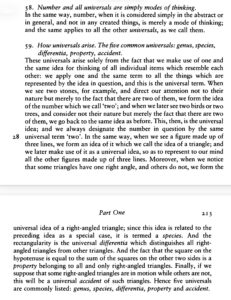 |
No additional OR; any OR belongs to the first-order idea of animal |
| Reflective idea of genus considered precisely as a predicable role | A second-order classificatory role considered as such, rather than an idea whose representatum is a particular act of classification | Reflective consideration changes what the intellect attends to, but on the interpretation defended here it does not transform the classificatory role into a represented modification of thinking substance or supply a new modal representatum | No |
| Reflective idea of a particular act of classifying | An actual determinate modification of thinking substance represented as such | Unlike the abstract predicable role, the particular intellectual act is a genuine mode of mind and can itself serve as an internal representatum | Yes, at the modal level |
| Comparative notions such as largest and smallest | Relational statuses arising from intellectual comparison within a selected ordered domain | Mind-dependent comparative notions rather than intrinsic modes of the objects compared; they may be treated as relations of reason or as an extension of Descartes’s account of modes of thought applied to objects | No additional OR beyond any OR contained in the ideas of the objects compared |
| Conditional principle: “In any ordered domain containing distinct greatest and least members, the greatest member is greater than the least member” | A determinate logical principle concerning the ordering conditions imposed upon a domain |
A constructed principle analogous to a common notion, rather than a Cartesian common notion explicitly stated in Principles I.49; it expresses an intelligible ordering relation rather than representing a substance, principal attribute, true and immutable nature, or mode. 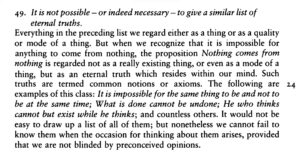 |
No distinct OR-bearing representatum |
| Unified idea of a round square | An incoherent combination lacking a possible unified representatum | A meaningful verbal formula composed from individually intelligible component ideas; the impossibility concerns the alleged unified object, not the formally real mental act | No, with respect to the alleged unified object |
| Component ideas of roundness and squareness | Possible modal determinations of extension | Genuine geometrical representata when considered separately | Yes, at the modal level when taken separately |
| Three-sidedness and three-angledness of a triangle | Conceptually distinguishable but necessarily inseparable determinations of the same true and immutable triangular nature |
They may be distinguished by reason without introducing an additional geometrical mode beyond the represented triangular nature (Principles I.62). 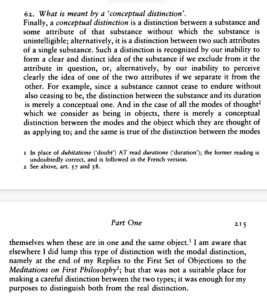 |
No additional OR beyond the objectively real triangular nature and its necessarily connected determinations |
Conclusions
The argument has defended my Restriction Thesis concerning Cartesian objective reality. Objective reality is not coextensive with consciousness, intelligibility, conceptual content, inferential structure, or generality. It is the ontologically rankable representational content contained in a strict Cartesian idea: the representational presence within the idea of a representatum considered as a substance, principal attribute, true and immutable nature, or mode. A broader conscious thought contains objective reality only insofar as it is itself a strict idea or contains one or more strict ideas as constituents.
This restriction explains why first-order universal ideas may possess objective reality. The idea of triangle in general does not represent a particular possible triangle; it represents triangularity as a true and immutable geometrical nature capable of instantiation in possible triangular modes of extension. Likewise, the idea of animal may represent a general nature applicable to many individual living things. Universality of application does not remove these ideas from the OR economy, because what they internally represent remains ontologically determinate. Ideas representing finite substances or their principal attributes possess finite substantial objective reality, whereas ideas representing possible modes or the true and immutable natures of possible modes possess modal objective reality.
Second-order predicables differ categorically from such first-order universal natures. Genus, species, differentia, proprium, and accident, considered precisely as predicable roles, classify first-order concepts within a scheme of intellectual division. The idea of animal may carry objective reality; animal’s status as a genus relative to human contributes no further nature, principal attribute, substance, or mode over and above the represented nature animal. The predicable role changes with the classificatory context while the first-order nature remains the same. Its variability is evidence that it marks an intellectual relation within a taxonomy rather than an additional intrinsic constituent of the represented thing.
The preliminary cases establish the general principle upon which this conclusion depends. The thought of a round square is formally real and possesses intelligible component ideas, yet no coherent unified round-square representatum exists. The description “the largest natural number” is intelligible but necessarily unsatisfied. Comparative notions such as largest and smallest have determinate application conditions and may track objectively grounded relations, yet being-largest and being-smallest need not be represented as additional intrinsic modes of the objects compared. Common notions may be self-evident, necessary, and inferentially indispensable without every constituent notion contributing objective reality. Distinctions of reason may differentiate inseparable aspects of an OR-bearing nature without adding a further modal representatum. These cases jointly show that conceptual determinacy does not entail objective reality.
The same principle defeats the intermediate Position 3. Describing genus and species as idealized classificatory forms may explain their logical structure, inferential role, and conceptual intelligibility. It does not establish that either form is internally represented as an ontologically rankable item. Unless the defender can identify a substance, principal attribute, true and immutable nature, or mode corresponding to the predicable role itself, weakened or derivative “OR” amounts to a broader semantic notion rather than Descartes’s technical objective reality. Position 3 therefore either collapses into Position 1 or abandons the Cartesian restriction governing OR.
Position 2 fails for a different but structurally parallel reason. Intellectual comparison, abstraction, and general naming are formally real modes of thinking substance. But the fact that these operations ground the use of second-order classifications does not establish that a thought employing genus or species represents those operations. Someone who understands that the predicable role of genus differs from the predicable role of species need not be thinking about minds, mental acts, or modifications of thinking substance. The formal ontological ground of classification must therefore be distinguished from the represented content of the classificatory thought. Formal-reality grounding is not objective-reality content.
The possibility of reflective thought does not alter this conclusion. When the intellect asks what it is to be a genus or species, the classificatory notion becomes the object of attention, but thematization alone does not supply a new OR-bearing representatum. The reflective thought concerns a way of classifying first-order concepts. A further strict idea representing the particular reflective act could possess modal objective reality because that act is an actual modification of thinking substance. But the formal reality of the act does not generate objective reality corresponding to genus or species themselves. Reflection changes the mode of consideration, not the categorical status of the classificatory content.
The resulting account also clarifies the relation between strict and broad Cartesian ideas. Strict ideas contain objective reality because they internally represent representata. Composite broad-sense thoughts may contain objective reality through the strict ideas they include. A judgment that animal is a genus may therefore contain objective reality through the idea of animal even though the notion genus contributes none. By contrast, broad-sense conscious acts or contents lacking an internal representatum may remain phenomenally, affectively, conceptually, or inferentially determinate without possessing objective reality. The Restriction Thesis does not impoverish Cartesian thought; it differentiates kinds of content that a universal OR thesis wrongly assimilates.
The principal conclusion is consequently precise rather than global. It is not that universals lack objective reality. First-order universal ideas representing genuine substances, principal attributes, true and immutable natures, or possible modes may possess it. Nor is the conclusion that second-order predicables lack all content. They possess determinate classificatory roles and are indispensable to logical and taxonomic cognition. The conclusion is that second-order predicable roles, considered as such, do not contribute distinct OR-bearing representata. Whatever objective reality occurs in thoughts employing them belongs to independently represented first-order substances, principal attributes, true and immutable natures, or possible modes.
The result is internal to Descartes’s ontology and theory of ideas. It does not purport to settle the metaphysics of universals for every rival view. A Platonist who admits Forms or abstract universals as further beings will reject a central premise of the argument: that second-order classificatory statuses supply no OR-eligible representata within Descartes’s ontology. Such a theory may provide candidates for representata that Cartesian ontology does not recognize, but it would still need to explain how those candidates enter an account of objective reality governed by Descartes’s causal principles. My argument establishes only that, given Descartes’s ontology of substances, principal attributes, and modes, together with his treatment of number and universals as modes of thinking in Principles I.58–59, and his account of objective reality in the Third Meditation, second-order predicable roles contribute no distinct objective reality. The distinction between conceptual determinacy and objective reality should therefore be maintained throughout Descartes’s theory of ideas. A thought may be intelligible without representing an item; necessary without containing a true and immutable nature as its own representatum; classificatorily indispensable without introducing a new mode; or grounded in a formally real intellectual operation without representing that operation. Objective reality belongs only where a strict Cartesian idea contains the representational presence of an ontologically rankable representatum.
Accordingly, GSD—“the predicable role of genus is distinct from the predicable role of species”—possesses determinate logical and taxonomic content but contains no distinct objectively real representatum corresponding to genus, species, or the distinction between their predicable roles. Position 1 gives the best Cartesian account: the thought is conceptually determinate, its constituent first-order ideas may independently possess objective reality, and its classificatory content contributes no additional OR of its own.
My Restriction Thesis is thus further confirmed. Objective reality is not carried by every Cartesian thought or every intellectually determinate content. This conclusion further supports the arguments developed in “Condensation: Why Objective Reality Cannot Be Descartes’s Theory of Thought: Burman, Common Notions, and the Failure of the Strict Idea Model” and its companion piece, “Why Objective Reality Cannot Be Universal in Descartes’s Theory of Ideas: Nothing, Eternal Truths, Sensations, and Fear with Claude Opus 4.6.” The proper verdict is not that second-order predicable roles possess weakened, derivative, or merely formal objective reality. It is that objective reality is not the appropriate category for their classificatory content.
Author’s Note on AI-Assisted Preparation
This post presents my own interpretation of Descartes’s theory of ideas, objective reality, universals, and related topics. The central theses, philosophical positions, arguments, terminology choices, classifications, criticisms of alternative interpretations, and final editorial decisions are entirely my own and should not be attributed to any AI models.
Artificial intelligence was employed as a research and editorial assistant throughout the preparation of this post. Its assistance included identifying potentially relevant primary and secondary literature, suggesting alternative formulations, testing arguments through critical dialogue, proposing structural revisions, improving clarity and organization, checking for consistency across sections, and helping identify possible objections, ambiguities, and unintended implications.
All substantive philosophical claims, historical interpretations, quotations, translations, reference citations, and conclusions have been independently reviewed, revised where necessary, and accepted or rejected by me. AI-generated suggestions were treated as provisional hypotheses requiring critical evaluation rather than as authoritative scholarly judgments. Numerous proposed revisions were modified substantially or rejected altogether where they failed to satisfy the interpretive or philosophical standards adopted in this study.
Accordingly, responsibility for every remaining claim, interpretation, argument, quotation, citation, and conclusion rests solely with the author.10I greatly appreciate the support and assistance in the development of this post provided by Professor George H. Rudebusch of the Northern Arizona University Philosophy Department.

NOTES
[NOTE: If it is underlined below, it is a clickable hyperlink. The symbol at the end of each endnote is the Unicode symbol LEFTWARDS ARROW WITH HOOK: U+21A9. Click on it to return from that endnote to the referring text.
- 1The expressions first-order and second-order distinguish two different levels at which the intellect can think. First-order ideas are ideas of things or of their principal attributes, true and immutable natures, and modes. Thus the ideas of animal, human, triangle, extension, and motion are first-order ideas because they represent what things are or the natures, principal attributes, or modes they possess.
Second-order ideas, by contrast, are ideas about first-order ideas. They do not introduce additional represented natures alongside animal or triangle; instead, they classify the logical role that first-order ideas play within a taxonomic scheme. Thus, when the intellect judges that animal is a genus relative to human, or that human is a species relative to animal, the represented nature animal remains exactly the same. What changes is not the represented nature but the way the intellect classifies that first-order idea. Likewise, rational functions as a differentia, risible as a proprium, and white as an accident relative to the species human.
The distinction is therefore one of level, not of represented object. First-order ideas represent substances, principal attributes, true and immutable natures, or modes. Second-order ideas represent ways of classifying those first-order ideas. The latter do not thereby introduce additional first-order natures or modes alongside the ideas they classify.
This distinction is fundamental to the argument of this post. My Restriction Thesis does not deny that first-order universal ideas, such as the idea of animal, may contain objective reality. The question is whether the second-order classificatory ideas of genus, species, differentia, proprium, and accident contribute any additional OR-bearing representatum beyond the first-order ideas to which they are applied. The argument defended here is that they do not. They classify first-order ideas without thereby introducing a new substance, principal attribute, true and immutable nature, or mode as an additional representatum.
↩︎ - 2By exercising a predicable role (using a first-order concept in its classificatory role as genus, species, differentia, proprium, or accident) I mean employing it in an act of classification without making the role itself the object of reflection. Thus, when one judges that animal is a genus relative to human and horse, the intellect uses the predicable role of genus as a classificatory instrument for organizing first-order concepts. The thought is principally about the nature animal and its taxonomic relation to human and horse, not about genus itself. By thematizing a predicable role I mean making that role itself the explicit topic of intellectual inquiry—for example, by asking, “What is a genus?” or “How does genus differ from species?” In this second case, the intellect’s attention shifts from using the classificatory role to examining it.
What changes, however, is only the direction and purpose of intellectual attention. What does not change is the predicable role itself: its logical function, its ontological status, and, on the interpretation defended here, its status as lacking any distinct OR-bearing representatum all remain exactly the same. Reflection therefore changes the mind’s cognitive relation to genus without changing the ontological status of genus. The philosophical significance of this distinction is that reflection is epistemically reflexive but not ontologically creative. Merely making a predicable role the subject of investigation cannot transform it into a substance, principal attribute, true and immutable nature, or mode, nor thereby endow it with objective reality. Otherwise, every logical connective, comparative notion, rule of inference, or classificatory device would acquire objective reality simply because philosophers chose to reflect upon it.
My Restriction Thesis developed at Descartes’s Theory of Ideas (DTOI) rejects that consequence because objective reality is not generated merely by directing intellectual attention toward something. A thought acquires objective reality only if it contains an ontologically rankable representatum objectively present within a strict Cartesian idea. Reflection may alter the focus of attention, but it cannot by itself supply a new substance, principal attribute, true and immutable nature, or mode for the idea to represent. Redirecting attention toward a logical or classificatory role cannot by itself create the ontologically rankable representatum required for objective reality. Reflection changes the intellect’s mode of attention without changing the ontological kind of the object under consideration. Accordingly, neither exercising nor thematizing a predicable role converts it into an OR-bearing representatum; whatever objective reality is present belongs instead to any first-order ideas employed or to a distinct strict idea whose representatum is the particular act of reflection itself.
↩︎ - 3Descartes nowhere explicitly introduces a fourth ontological rank corresponding simply to true and immutable natures. Rather, the degree of objective reality is best understood as determined by the ontological status of the representatum. Consequently, true and immutable natures need not all possess the same degree of objective reality. The idea of extension represents the principal attribute and therefore the essence of corporeal substance, while the idea of thought represents the principal attribute of thinking substance. The interpretation defended here, considers ideas of these principal attributes to possess finite substantial objective reality, since they represent the essential natures of finite substances rather than possible modes. By contrast, the idea of triangularity represents the true and immutable nature of a possible mode of extension and therefore possesses modal objective reality. Thus the degree of objective reality depends not upon an item’s being a true and immutable nature as such, but upon the ontological category of the representatum whose nature the idea represents.
↩︎ - 4
- 5Whether concepts are always representations is disputed in contemporary philosophy of mind. Representationalist theories treat concepts as mental representations, while dispositionalist, inferentialist, enactivist, Fregean, and Wittgensteinian approaches deny that representation is fundamental to every kind of conceptual content. The relevance here is limited: conceptual determinacy alone does not establish that a concept has an OR-eligible representatum in Descartes’s technical sense.
For representationalism, see Jerry A. Fodor, The Language of Thought (Cambridge, MA: Harvard University Press, 1975) and Concepts: Where Cognitive Science Went Wrong (Oxford: Clarendon Press, 1998).
For dispositionalism, see Gilbert Ryle, The Concept of Mind (London: Hutchinson, 1949).
For conceptual-role and inferentialist accounts, see Robert B. Brandom, Making It Explicit: Reasoning, Representing, and Discursive Commitment (Cambridge, MA: Harvard University Press, 1994); Brandom, Articulating Reasons: An Introduction to Inferentialism (Cambridge, MA: Harvard University Press, 2000); and Wilfrid Sellars, “Empiricism and the Philosophy of Mind,” in Minnesota Studies in the Philosophy of Science, vol. 1, ed. Herbert Feigl and Michael Scriven (Minneapolis: University of Minnesota Press, 1956), 253–329.
For enactivist accounts, see Daniel D. Hutto and Erik Myin, Radicalizing Enactivism: Basic Minds without Content (Cambridge, MA: MIT Press, 2013) and Evolving Enactivism: Basic Minds Meet Content (Cambridge, MA: MIT Press, 2017).
For proof-theoretic inferentialism concerning logical connectives, see Gerhard Gentzen, “Untersuchungen über das logische Schließen,” Mathematische Zeitschrift 39 (1935): 176–210, 405–31, translated as “Investigations into Logical Deduction,” in The Collected Papers of Gerhard Gentzen, ed. M. E. Szabo (Amsterdam: North-Holland, 1969), 68–131; and Dag Prawitz, Natural Deduction: A Proof-Theoretical Study (Stockholm: Almqvist and Wiksell, 1965).
↩︎ - 6Staffan Angere finds round squares to be perfectly acceptable in some contexts, as argued in his “The Square Circle.”
↩︎ - 7
- 8Paul Hoffman (1952–2010) offers a reductionist account on which universals considered abstractly are modes of thought, while their extra-mental correlates in particular objects are not additional universal entities. His analysis is compatible with the anti-reification aspect of the present interpretation, but it concerns primarily first-order universals and Descartes’s theory of distinction. It does not determine whether second-order predicable roles such as genus and species contribute objective reality to the thoughts in which they are employed. See Paul Hoffman, “Descartes’s Theory of Distinction,” Philosophy and Phenomenological Research 64, no. 1 (2002): 57–78.
↩︎ - 9For the entire entry on causation and the book itself, click on The Cambridge Descartes Lexicon. ↩︎
- 10I greatly appreciate the support and assistance in the development of this post provided by Professor George H. Rudebusch of the Northern Arizona University Philosophy Department.
↩︎