


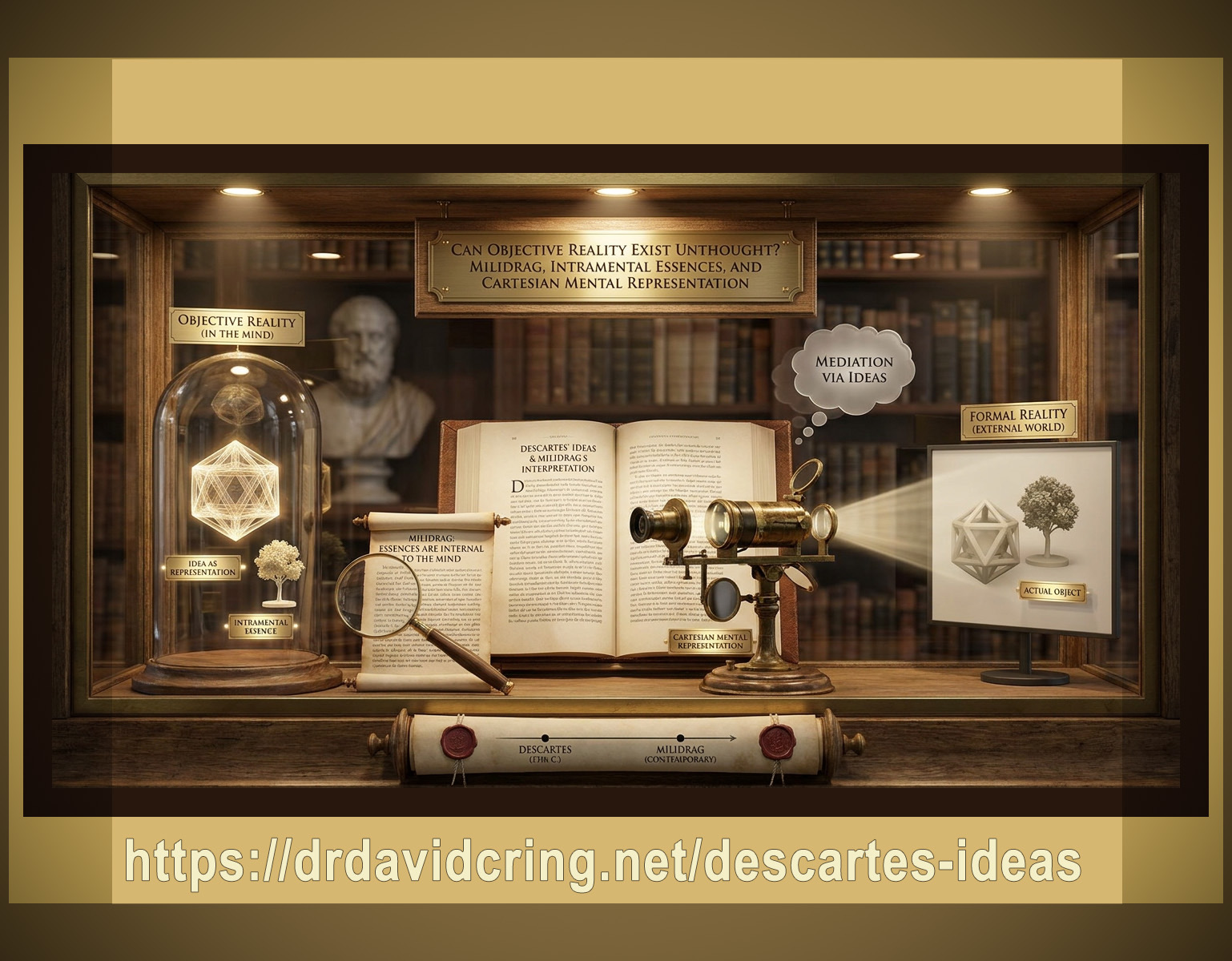
Can Objective Reality Exist Unthought? Milidrag, Intramental Essences, and Cartesian Mental Representation
(Hyperlinks are in magenta or underlined)
Milidrag’s stronger claim must be stated carefully. He does not merely say that an essence exists in the intellect waiting someday to become represented. On the interpretation examined here, the objectively existing essence is already present in the intellect as representational content even when it is not being actively thought or consciously apprehended. Its becoming a res cogitata [a thing occurrently thought] therefore does not first make it representational. Rather, a standing objectively existing representation becomes the object of an occurrent act of conscious thinking. This distinction is central to Milidrag’s account of innate ideas, the intelligibility of essences, and Descartes’s extension of efficient causation to objective being.1Milidrag’s Serbian text supports each of these claims:
On the ontological basis of innate ideas he writes: “If it is intramental, the essence of a thing must be in the genuine objective mode of being, but it need not also be represented by an idea, that is, the human mind need not know at all that it is in its intellect; these are the innate ideas” (55), and in the accompanying note: “This genuine mode of being of essences in the intellect is the ontological basis of innate ideas in Descartes” (55 n. 39). Milidrag’s expression “need not also be represented by an idea” should not be read here as denying that the standing essence is representational in the broader sense at issue in his ontology. His contrast is between the essence’s standing objective presence in the intellect and its becoming an actively thought res cogitata [a thing as actively thought].
On conceivability and intelligibility he writes: “Because it is intelligible, the essence of a thing can also be in the human intellect, and because it is in it, it can be an object of consciousness and so receive the extrinsic denomination ‘objective being’” (55).
On the extension of efficient causation to objective being he writes in the article’s abstract: “To the late-Scholastic understanding Descartes opposes his new ‘ontology of the possible,’ according to which the intramental essences of things are in the human intellect, whose objective being cannot be reduced to an extrinsic denomination [a denomination, or description, applied to an object because of something extrinsic to it, without anything about the object itself having to change; not author’s], and which therefore requires actual efficient causation. Hence he claims that the very conceivability and intelligibility of essences must have an actual efficient cause, which is equivalent to the creation of the eternal truths” (45). Milidrag further notes that Descartes names this genuine mode of being of an essence esse objectivum and also relates it to esse potentiale, in contrast with esse formale sive actuale (55).
Translations from the Serbian are by Claude Opus 5; the Latin is reproduced as it stands in the original.
See Predrag Milidrag, “Katerus i Dekart o idejama, uzrokovanju i večnim istinama,” Theoria 55, no. 1 (2012): 45–69.
 This post argues that Milidrag has identified a genuine and philosophically important strand in Descartes’s response to Caterus, but that Milidrag’s standing-representation interpretation creates a further ontological problem. I call the constraining principle the Objective-Reality Content Exhaustion Thesis (ORCET).2For further development and explanation of ORCET, see “When Does Content in an Idea Have Objective Reality?,” “Strict and Broad Ideas in Descartes,” and “Infinite Objective Reality in a Finite Idea: Why Should It Require an Infinite Cause?.”
Properly stated, ORCET says that, in an occurrent pure strict Cartesian idea, its OR-bearing representation exhausts its first-order internal representational content. ORCET does not contradict Milidrag’s thesis, since it constrains only what an occurrent idea contains, not where objective being can obtain. It does, however, remove one easy way of accommodating that thesis: if the OR-bearing representation exhausts an occurrent idea’s internal first-order content, there is no residual content in which a standing unthought essence could be lodged. It therefore does not yet say that objective reality can exist only in occurrent cognition. That stronger conclusion requires argument against Milidrag’s proposal that the same objectively real representation can also subsist as an independently standing unthought res in intellectu [in the intellect whether thought about or not].
 The central question is therefore not whether objectively real content can somehow exist “without being represented.” Milidrag’s stronger interpretation already treats the standing OR as representational. The question is: Can an OR-bearing intramental representation of X remain genuinely instantiated in a finite Cartesian intellect when X is not being actively thought? This formulation also avoids an important confusion about “actuality.” To say that objective content is presently instantiated in the intellect does not require denying formal or actual reality to the mental determination in which that content exists objectively. An OR-bearing mental determination may itself actually and formally exist as a finite determination of a finite intellect. What does not follow is that X itself, merely in virtue of being represented, thereby formally exists in the intellect. An actually existing finite representation of God may possess finite formal reality as a determination of the intellect while possessing infinite objective reality insofar as it represents God; God himself does not therefore possess formal existence in the finite mind.
The decisive difficulty for Milidrag’s standing-representation interpretation is consequently ontological. Milidrag himself locates the dispute with Caterus at exactly this level:
„Sada je očita priroda razlike između Dekartovog i Katerusovog razumevanja: to je razlika u ontologijama, jer za Dekarta postoji modus bivstvovanja suština kojeg za Katerusa nema, naime bivstvovanje u razumu.”
[“The nature of the difference between Descartes’s and Caterus’s understanding is now evident: it is a difference in ontologies, because for Descartes there is a mode of being of essences that Caterus does not have, namely being in the intellect.”] (Milidrag 2012, 55)
If the difference is indeed a difference in ontologies, then the question of what kind of existent the standing essence is cannot be deferred.
What sort of Cartesian existent is the unthought res in intellectu (in the intellect whether thought about or not)? If it is a formally real mode of the finite mind, Descartes’s consciousness doctrine creates a problem concerning how a representational mental mode can exist without being actively thought. If it is formally real in the intellect but not a mode of the thinking substance, an additional Cartesian ontological category is required. If it possesses no formal reality as an intramental existent, Milidrag must explain what makes it a genuinely existing standing representation rather than a faculty, disposition, potentiality, or other determinate structure from which an OR-bearing cognition can later be elicited.3Milidrag’s characterization of this genuine intramental mode as both esse objectivum (objective being) and esse potentiale (potential being), in contrast with esse formale sive actuale (formal or actual being), makes the distinction between presently instantiated objective representation and merely dispositional availability especially pressing. The terminology does not decide that question: Milidrag plainly intends a genuine mode of being, but an additional argument is still required to show that this being constitutes an already instantiated standing representation rather than the antecedent ground from which an OR-bearing cognition can subsequently be elicited. See Milidrag 2012, 55.
This ontological fork provides the principal pressure on Milidrag’s standing-essence interpretation developed in this post. A companion post [“Can Objective Reality Exist Unthought? Milidrag, Intramental Essences, and Cartesian Mental Representation”] examines objections and possible replies in greater detail.
The faculty alternative therefore must not be caricatured as the absence of representational determination. A faculty capable of eliciting an idea of a triangle rather than an idea of God, the sun, or a rock must itself be determinately constituted. The relevant contrast is instead between a standing actually existing representation and a determinate representational power. Encoding X-directed determination in a faculty does not by itself make X objectively present. Conversely, merely calling antecedent determinacy an “implicit representation” cannot by itself transform dispositional availability into presently instantiated objective being.4Milidrag’s own explanatory order runs from intelligibility to intramental being to objecthood for consciousness: „Zato što je inteligibilna, suština stvari može bivstvovati i u ljudskom razumu, a zato što bivstvuje u njemu može biti objekt svesti te dobiti spoljnu oznaku „objektivno bivstvovanje“.” [“Because it is intelligible, the essence of a thing can also have being in the human intellect, and because it has being in it, it can be an object of consciousness and so receive the extrinsic denomination ‘objective being.’”] (Milidrag 2012, 55) The faculty model can accept every step of that order while declining the further claim that what grounds intelligibility must itself be an already instantiated objective representation; intelligibility grounds a determinate representational power, and the power is exercised in the occurrent idea.
The triangle case developed below remains important, but primarily as a test of the distinction between what a cognition represents and what the thinker explicitly attends to.5The passage referred to here as the triangle case is the discussion of the true and immutable nature of the triangle in the Fifth Meditation, where the triangle is said to have a determinate nature even if no such figure exists anywhere outside thought, and where its properties are said to be demonstrable and to be recognized whether the meditator wills it or not: AT VII 64; CSM II 44–45, continuing at AT VII 64–65; CSM II 45. It is this second stretch of text that carries the point that a finite occurrent act need not explicitly represent every necessary property of what it represents. For the exchange with Caterus over the same nature, where Caterus quotes the passage back and calls the nature of the triangle an eternal truth requiring no cause, see AT VII 93; CSM II 67, together with Descartes’s reply at AT VII 101–105; CSM II 73–76.
The Fifth Meditation establishes that an occurrent representation of a triangle need not explicitly represent every necessary property of triangular nature. It establishes property-opacity, not the stronger claim that the triangle can possess objective being in the intellect when no representation of triangular nature is actively occurring.6Milidrag reads the corresponding question in the First Replies as concerning the presence of the nature in the intellect rather than its occurrent representation. Descartes’s question is „zašto postoji njegova ideja [uzeta objektivno] u nama” [“why its idea (taken objectively) is in us”] (Milidrag 2012, 61, quoting First Replies: VII 104), and Milidrag glosses it as asking „zašto je ona u nama, zašto je u razumu (ne u ideji), što ne implicira da je nužnim načinom i reprezentovana.” [“why it is in us, why it is in the intellect (not in an idea), which does not imply that it is necessarily also represented.”] (61) That gloss secures a cause for the nature’s presence to the intellect; the further step to a presently instantiated standing representation is what this post contests.
The actually infinite range of necessary consequences grounded by triangular nature intensifies this issue but does not decide it. A finite generative intellectual structure can ground indefinitely many consequences, so infinity alone does not substantially favor either Milidrag’s standing-representation ontology or the faculty model.
The idea of God supplies a separate clarification that should not be conflated with the standing-essence dispute. The same cognition may possess finite formal reality as a mental determination while possessing infinite objective reality insofar as it represents infinite substance. Milidrag also offers substantial resources for explaining why objective being and its determinate character require causal grounding rather than being metaphysically negligible.7This is Milidrag’s central causal conclusion: the degree of objective reality is „unutrašnja oznaka suštine stvari koja zahteva delotvorno uzrokovanje” [“an intrinsic denomination of the essence of a thing that requires efficient causation”], and this requirement „je ekvivalentno sa stvaranjem večnih istina” [“is equivalent to the creation of the eternal truths”] (Milidrag 2012, 45, 63).
But causal grounding and standing instantiation are distinct questions. Even if objective being and its determinate structure require efficient causal explanation, it does not follow that objectively real representational content remains presently instantiated in a finite intellect between acts of cognition. A causally grounded determinate intellectual structure could instead ground the capacity to instantiate the relevant objective content when cognition occurs.
Click here to skip the very detailed outline below and jump to “The Argumentative Spine.”
Graphic for the Detailed Outline below
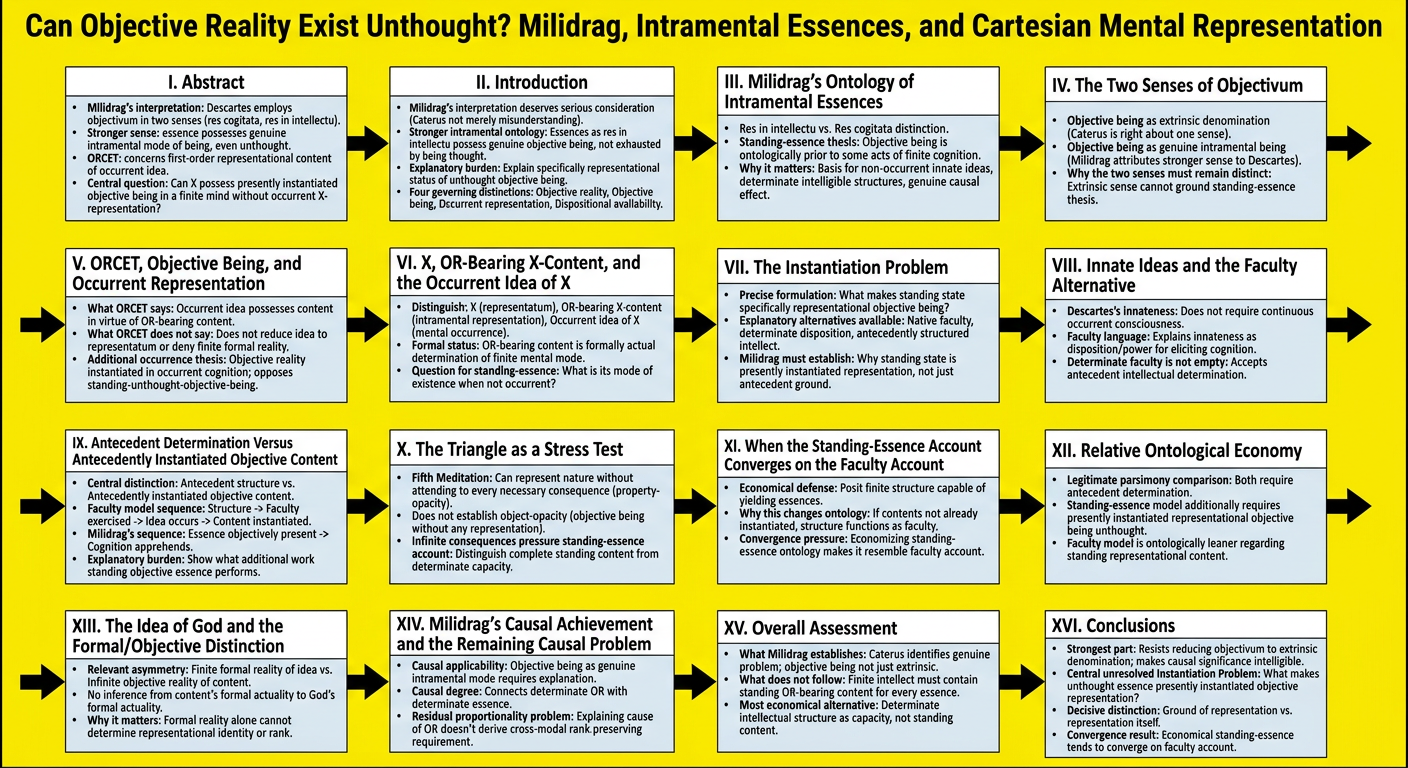
Detailed Outline
Can Objective Reality Exist Unthought? Milidrag, Intramental Essences, and Cartesian Mental Representation
I. Abstract
A. Milidrag’s interpretation of Descartes and Caterus
- Milidrag argues that Descartes does not simply reject the late-Scholastic conception of objective being as an extrinsic denomination (a denomination, or description, applied to an object because of something extrinsic to it, without anything about the object itself having to change).
- Descartes instead employs objectivum in two distinguishable senses:
- the res cogitata sense, in which something is denominated as thought because an act of thinking terminates upon it;
- the stronger res in intellectu sense [in the intellect whether thought about or not], in which an essence possesses a genuine intramental mode of being.
- Milidrag maintains that an essence can possess the second kind of objective being even when no occurrent idea of that essence is presently occurring.
- The resulting ontology is designed to explain how essences can be innate, intelligible, causally grounded, and available for cognition without continuously appearing before consciousness.
B. The restricted role of ORCET
- The Objective-Reality Content Exhaustion Thesis (ORCET) concerns the first-order representational content of an occurrent pure strict Cartesian idea.
- Its claim is that the OR-bearing internal representation supplies the content in virtue of which the occurrent idea represents its representatum.
- ORCET does not mean that the thinker explicitly attends to every property or consequence belonging to the represented nature.
- Nor does it deny the finite formal reality of the occurring mental mode.
- The stronger claim relevant to Milidrag is that, in a finite mind, presently instantiated objective reality occurs as representational content of an actually occurring cognition rather than persisting independently between cognitive acts.
C. The three items that must not be conflated
- X: the representatum (item represented), such as God, a triangle, or a body.
- The OR-bearing X-content: the content whereby an occurrent cognition internally represents X and whose objective reality is ranked according to X.
- The occurrent idea of X: the finite mental occurrence in which that X-content is instantiated.
- The OR-bearing X-content must not be identified with X itself.
- Consequently, saying that the OR-bearing X-content is instantiated as a formally actual determination of a finite mental mode does not imply that X itself acquires formal reality in the mind.
D. The central question
- Can X possess presently instantiated Cartesian objective being in a finite mind when there is no occurrent X-representation in that mind?
- The question does not ask whether X itself possesses formal reality in the mind.
- Nor does it ask whether the mind retains a determinate power, disposition, faculty, or intellectual structure from which an X-idea can subsequently be elicited.
- The question is specifically whether actual OR-bearing X-content exists prior to and independently of an occurrent act of representing X.
E. The faculty alternative
- The competing faculty account does not posit a blank, indeterminate, or contentless power.
- It concedes antecedent determinate intellectual structure capable of producing appropriately determinate ideas.
- What it denies is the further inference from:
- antecedent intellectual determination
- to antecedently instantiated objective representational content.
- The burden therefore falls upon the standing-essence interpretation to explain what is gained by calling the prior determination an objectively existing essence rather than a determinate faculty for eliciting the relevant cognition.
F. The convergence problem
- A defender of standing essences might avoid positing an actually infinite stock of separately resident mathematical contents by appealing instead to one finite determinate intellectual structure from which indefinitely many mathematical essences, truths, or representations can be elicited.
- But that proposal is no longer a genuine alternative to the faculty model.
- Its structure is precisely:
- finite determinate intellectual structure;
- capacity to elicit E1, E2, E3, … as cognition occurs;
- rather than E1, E2, E3, … already objectively instantiated in the intellect.
- This establishes an important pressure point: attempts to make the standing-essence ontology more economical can cause it to converge upon the non-Milidragian faculty account.
G. Milidrag’s causal motivation for objective being
- Milidrag gives a powerful explanation of why genuine objective being would require causal grounding rather than being causally negligible.
- His interpretation therefore improves substantially upon an account that treats objective being merely as an extrinsic denomination.
- His created-eternal-truths framework also helps explain why the determinate character of an essence and its objective reality are causally grounded.
- But causal grounding does not establish standing instantiation: even if objective being requires a cause, further argument is needed to show that OR-bearing representational content remains presently instantiated in a finite intellect when no corresponding cognition occurs.
II. Introduction
A. Why Milidrag’s interpretation deserves serious consideration
- Caterus should not be treated as merely misunderstanding Descartes’s terminology.
- Milidrag argues that Caterus identifies a genuine late-Scholastic sense of objectivum that remains relevant to Descartes.
- The important interpretive question is therefore not simply whether Descartes rejects Caterus, but what new ontological work Descartes assigns to objective being.
- Milidrag’s reconstruction is strongest when it shows why Descartes needs objective being to be metaphysically substantial enough to enter causal explanation.
B. Milidrag’s stronger intramental ontology
- Essences as res in intellectu [in the intellect whether thought about or not] possess genuine objective being.
- Their status is not exhausted by being presently thought about.
- An essence may therefore supposedly remain objectively present when it is not a res cogitata in an occurrent act.
- Subsequent cognition apprehends or activates something already objectively in the intellect rather than first instantiating its objective being.
C. The resulting explanatory burden
- Once an essence’s objective being is detached from occurrent representation, its specifically representational status requires explanation.
- A finite mind may undoubtedly possess determinate powers and structures when it is not thinking of X.
- What requires argument is why such antecedent determination should count as X already possessing objective being rather than as the mind’s capacity to instantiate X-content when an X-idea occurs.
D. Four governing distinctions
- Objective reality: the ontologically rankable feature of representational content according to what is represented.
- Objective being: the mode of being possessed by represented content insofar as it is objectively present in the intellect.
- Occurrent representation: an actually occurring cognitive act in which X is internally represented.
- Dispositional availability: determinate capacity for an X-representation to occur without an X-representation presently being instantiated.
E. The scope of the present argument
- The post does not attempt to deny that Cartesian essences possess determinate necessary structures.
- It does not deny that those structures constrain finite cognition independently of what a thinker happens presently to notice.
- It does not deny that innate cognition presupposes antecedent determination of the intellect.
- It challenges the additional claim that these truths require standing presently instantiated OR-bearing content inside the finite intellect between occurrent acts.
- The fuller ontological trilemma concerning all possible forms such a standing essence might take is reserved for a separate companion post [“Can Objective Reality Exist Unthought? Milidrag, Intramental Essences, and Cartesian Mental Representation”] devoted specifically to objections to Milidrag’s interpretation.
III. Milidrag’s Ontology of Intramental Essences
A. Res in intellectu and res cogitata
- A res cogitata is something presently functioning as the terminus or object of an act of thought.
- A res in intellectu, on Milidrag’s interpretation, can possess intramental being even when it is not presently being cognized.
- The distinction therefore allows the objective essence to persist through intervals in which no corresponding conscious cognitive act occurs.
B. The standing-essence thesis
- At t1, X possesses objective being in the intellect.
- At t1, no occurrent idea representing X need be present.
- At t2, an act of cognition apprehends or renders explicit what already possessed objective being at t1.
- Objective being is therefore ontologically prior to at least some particular acts of finite cognition.
C. Why the standing ontology matters to Milidrag
- It provides a metaphysical basis for non-occurrent innate ideas.
- It permits essences to possess determinate intelligible structures prior to finite apprehension.
- It makes objective being a genuine effect to which efficient causation can apply.
- It thereby gives Descartes a substantially stronger response to Caterus than would a purely denominational account.
IV. The Two Senses of Objectivum
A. Objective being as extrinsic denomination
- Something can be denominated “thought” because an act of thought is directed toward it.
- The denomination depends upon what occurs in the thinker rather than upon an intrinsic alteration in the object.
- Caterus is therefore right that one legitimate sense of objective being can be explained extrinsically.
B. Objective being as genuine intramental being
- Milidrag attributes to Descartes a stronger sense in which the essence exists objectively within the intellect.
- This status is not exhausted by its being presently thought about.
- The essence can therefore supposedly retain objective being independently of any current res cogitata relation.
- Only this stronger sense generates the principal dispute of the post.
C. Why the two senses must remain distinct
- The extrinsic-denomination sense cannot by itself ground Milidrag’s standing-essence thesis.
- The stronger intramental sense cannot simply be inferred from the fact that Descartes sometimes calls represented things objectively present in the intellect.
- The question is whether that stronger status persists when the representational act itself is absent.
V. ORCET, Objective Being, and Occurrent Representation
A. What ORCET says
- An occurrent pure strict idea of X possesses first-order representational content in virtue of its OR-bearing X-content.
- No second first-order representational content is required to make the occurrence an idea of X.
- The thesis concerns the representational determination of the occurring idea, not every formally real feature of the cognitive event.
B. What ORCET does not say
- It does not reduce the idea to its representatum.
- It does not deny that the idea itself is a finite mental mode.
- It does not make every necessary property of X explicitly represented.
- It does not by itself establish the stronger historical thesis that Descartes explicitly denies every possible kind of unthought intramental essence.
C. The additional occurrence thesis
- In a finite mind, objective reality is instantiated as the representational content of an actually occurring cognition.
- When the cognition ceases, the mind may retain the determinate capacity to instantiate that content again.
- What does not thereby follow is that the same OR-bearing content continues to exist objectively between acts.
- This occurrence thesis, rather than ORCET (in an occurrent pure strict Cartesian idea, its OR-bearing representation exhausts its first-order representational content) considered in isolation, directly opposes Milidrag’s standing-unthought-objective-being interpretation.
VI. X, OR-Bearing X-Content, and the Occurrent Idea of X
A. X is not the intramental representational content
- X is what the cognition represents.
- The OR-bearing X-content is the intramental representational determination whereby X is represented.
- Conflating these two generates mistaken questions about whether the represented object itself must acquire formal reality in the mind.
B. The occurrent idea is the mental occurrence
- The idea of X considered materially is a finite mode of thinking.
- Its occurrence has the finite formal reality appropriate to a modification of a finite thinking substance.
- The same occurrence is an idea of X because it contains the relevant OR-bearing X-content.
C. The formal status of the OR-bearing content
- When OR-bearing X-content is instantiated in an occurrent idea, it is not an abstract item floating free of the finite mental mode.
- It is a formally actual determination or content of that finite occurrence while also possessing objective reality according to X.
- Its finite formal actuality does not determine its objective-reality rank.
- An idea of God can therefore be formally finite as a mental occurrence while its God-representing content has infinite-substance-level objective reality.
- None of this entails that God possesses formal reality in the finite mind.
D. A question for the standing-essence account
- If the standing intramental essence is the very same OR-bearing content later instantiated in an occurrent idea, Milidrag must explain what its mode of intramental existence is while no cognitive act instantiates it.
- If it is instead an antecedent ground, structure, or source from which the later OR-bearing content arises, then the standing item is no longer obviously itself the later representational content.
- The distinction between prior ground and presently instantiated representational content therefore becomes unavoidable.
VII. The Instantiation Problem
A. Precise formulation
- Milidrag requires X to possess objective being in the finite intellect even when no occurrent representation of X exists.
- The objection does not simply assume that objective being is definitionally impossible without occurrent representation.
- It instead asks what presently exists in the intellect during such an interval that constitutes X’s objective being, rather than merely a disposition or intellectual structure capable of producing a later representation of X.
B. The explanatory alternatives already available
- A native faculty.
- A determinate disposition.
- An antecedently structured intellect.
- A power capable of eliciting determinate ideas.
- Divinely instituted cognitive structure.
C. What Milidrag must additionally establish
- The standing state must not merely explain why an X-idea can later occur.
- It must explain why X-content is already objectively instantiated before that occurrence.
- Otherwise the purported standing essence functions as the antecedent ground of representation rather than as presently instantiated representation itself.
VIII. Innate Ideas and the Faculty Alternative
A. What Descartes’s innateness doctrine establishes
- An innate idea need not continuously occur before consciousness.
- Consequently, “innate” cannot simply mean “presently occurrent.”
- This blocks any argument that infers directly from non-occurrence to non-innateness.
B. Descartes’s faculty language
- Descartes can explain innateness in terms of a faculty or disposition for eliciting the relevant cognition.
- The mind can therefore possess the power for an X-idea when no X-idea is presently occurring.
- This provides a Cartesian model of non-occurrent innateness that does not require an unconscious occurrent idea.
- More importantly, it does not by itself require continuously instantiated OR-bearing X-content.
C. A determinate faculty is not an empty faculty
- An X-producing faculty must be appropriately structured to yield X rather than Y.
- The faculty interpretation therefore accepts antecedent intellectual determination.
- The dispute cannot be settled by arguing that determinate cognition requires something determinate in the intellect beforehand.
- Both accounts accept that premise.
- The disagreement concerns whether the antecedent determination is already instantiated objective representational content.
IX. Antecedent Determination Versus Antecedently Instantiated Objective Content
A. The central distinction
- Antecedent determination means that the intellect already possesses whatever structure is required for determinate future cognition.
- Antecedently instantiated objective content means that the future cognition’s representational content is already objectively present before that cognition occurs.
- The first thesis does not entail the second.
B. The faculty model’s sequence
- At t1, determinate intellectual structure exists.
- No occurrent X-representation exists.
- At t2, the relevant faculty is exercised.
- An X-idea occurs.
- OR-bearing X-content is thereby instantiated.
C. Milidrag’s standing representation sequence
- At t1, the essence already possesses objective being in the intellect.
- No occurrent thought with an X-representation need occur.
- At t2, cognition apprehends or activates the already objectively present essence.
- The decisive difference therefore lies at t1, not t2.
D. The explanatory burden
- Because both views can explain later determinate cognition, Milidrag must show what additional explanatory work is performed by the standing objective essence.
- Simply redescribing the determinate faculty as an objectively existing essence cannot decide the dispute.
- What is required is a criterion distinguishing standing objective content from determinate representational capacity.
X. The Triangle as a Stress Test
A. The Fifth Meditation phenomenon
- A thinker can represent triangular nature without explicitly attending to every necessary truth following from it.
- Necessary consequences can subsequently be discovered as belonging to the same nature.
- The case therefore shows that occurrent representation is not exhausted by explicit attention to all of the represented nature’s necessary consequences.
B. Property-opacity and object-opacity must remain distinct
- Property-opacity: triangle is represented although some necessary property P is not explicitly attended to.
- Object-opacity: an objectively real representation of triangle supposedly remains instantiated while triangle itself is not actively represented at all.
- The Fifth Meditation clearly supports the first.
- It does not by itself establish the second.
C. The indefinitely extensible range of mathematical consequences
- Triangular nature grounds indefinitely many necessary consequences.
- Finite human cognition apprehends only finitely many of them at any particular time and can proceed through further consequences successively.
- This does not give the triangle infinite-substance-level objective reality.
- Objective-reality rank tracks the ontological rank of what is represented, not the number of truths necessarily connected with it.
D. Why the triangle case pressures the standing-essence account
- Milidrag need not posit one separately resident entity for every mathematical truth.
- He can maintain that one triangular nature grounds indefinitely many necessary consequences.
- But numerical unity does not answer the relevant question: what determinate representational content is already objectively instantiated in the finite intellect before the triangle is thought?
- The triangle therefore serves as a stress test for the distinction between a complete standing essence and a determinate capacity to elicit progressively richer cognition of that essence.
XI. When the Standing-Essence Account Converges on the Faculty Account
A. The economical defense of Milidrag
- A defender may resist loading the finite intellect with an indefinitely large inventory of separately instantiated mathematical contents.
- The defender may instead posit one finite determinate intellectual structure capable of yielding the relevant essences and truths as cognition proceeds.
- That response initially appears to preserve Milidrag’s antecedent ontology while avoiding excessive ontological proliferation.
B. Why this defense changes the ontology
- Suppose a finite determinate structure S grounds the mind’s ability to elicit E1, E2, E3, … .
- If E1, E2, E3, … are not already objectively instantiated in S, then S functions as a capacity or faculty for producing their later cognitive instantiation.
- That is precisely the faculty model under a more structurally explicit description.
- Calling S a standing essence does not convert dispositional determinacy into already instantiated OR-bearing content.
C. The convergence pressure
- The more the standing-essence account avoids claiming that indefinitely many determinate contents are already objectively instantiated, the more it resembles a determinate faculty account.
- The more strongly it insists that complete representational determinations are already objectively instantiated, the more substantive its standing ontology becomes.
- The present post need not develop every horn generated by this pressure.
- Its narrower conclusion is sufficient: a finite generative intellectual structure is not a third alternative between Milidrag’s standing contents and the faculty model; unless the relevant contents are already instantiated, it is the faculty model.
XII. Relative Ontological Economy
A. The wrong parsimony argument
- The faculty account is not automatically simpler merely because it uses the term “faculty.”
- A determinate faculty may embody substantial intellectual structure.
- Both interpretations therefore carry antecedent metaphysical commitments.
B. The legitimate parsimony comparison
- Both models require antecedent determination.
- Only the standing-essence model additionally requires presently instantiated representational objective being during periods of non-occurrence.
- The faculty model is therefore ontologically leaner specifically with respect to standing representational content, not necessarily with respect to intellectual structure as such.
C. What could defeat the parsimony advantage
- Milidrag could justify the additional ontology if the standing objective essence explains something that no determinate faculty can explain.
- Possible candidates include identity through repeated cognition, essential necessity, or the ontological grounding of intelligibility.
- But each requires an argument showing why a determinate antecedent structure plus occurrent representation is insufficient.
- Without such an argument, the additional standing representational ontology remains under-motivated.
XIII. The Idea of God and the Formal/Objective Distinction
A. The relevant asymmetry
- An occurrent idea of God is a finite mental modification.
- Its occurrence therefore possesses finite formal reality.
- Its God-representing content possesses infinite-substance-level objective reality because God is represented as infinite substance.
- Formal and objective rank therefore answer different questions.
B. No inference from the representation’s formal actuality to God’s formal actuality
- The God-representing cognition can itself be a formally actual finite determination of the intellect.
- Its finite formal actuality does not determine its objective-reality rank.
- Its objective-reality rank is infinite because the represented object is infinite substance.
- None of this entails that God himself possesses formal reality in the finite intellect merely in virtue of being represented.
C. Why the case matters to the present dispute
- The God case prevents formal reality and objective reality from being treated as mutually exclusive predicates of everything intramental.
- An OR-bearing cognition can possess finite formal reality while bearing objective reality of a different rank.
- The standing-essence question is therefore not whether X itself must possess formal reality in the intellect.
- The relevant question is what, if anything, formally realizes or bears the supposedly standing objective representation when no occurrent cognition of X exists.
XIV. Milidrag’s Causal Achievement and Its Proper Role in the Argument
A. Causal applicability
- If objective being is a genuine intramental mode of being rather than merely an extrinsic denomination, there is something metaphysically substantive to explain.
- Milidrag therefore gives Descartes a strong answer to Caterus’s suspicion that objective being is too insubstantial to require efficient causation.
- This is one of the principal strengths of Milidrag’s interpretation and should be preserved rather than turned into an objection to his standing-essence thesis.
B. Causal determination
- Milidrag connects the determinate degree of objective reality with the determinate essence whose predicates and relations are divinely instituted.
- His appeal to Descartes’s doctrine of the created eternal truths therefore gives a substantive account of why objective being is not causally arbitrary.
- This causal achievement concerns the grounding and determination of objective being, not whether such objective being must remain continuously instantiated in a finite intellect between cognitive acts.
C. Why causation does not settle standing instantiation
- A determinate intellectual faculty may itself be divinely caused and metaphysically grounded.
- Consequently, the fact that intelligibility or objective reality ultimately requires efficient causal grounding does not choose between a standing-representation model and a faculty model.
- The standing-essence interpretation still requires the additional claim that the causally grounded item is already instantiated objective representational content rather than a causally grounded power capable of producing such content.
- The causal discussion therefore supports Milidrag’s general metaphysics while leaving the present post’s Instantiation Problem intact.
XV. Overall Assessment
A. What Milidrag successfully establishes
- Caterus identifies a genuine philosophical problem rather than merely making a terminological mistake.
- Descartes’s treatment of objective being cannot be understood adequately if it is reduced without remainder to extrinsic denomination.
- Essences have determinate structures not reducible to whatever a finite thinker happens currently to attend to.
- Innateness does not require continuous occurrent consciousness.
- If objective being is metaphysically genuine, its existence and determinations invite causal explanation.
B. What does not yet follow
- It does not follow that a finite intellect continuously contains presently instantiated OR-bearing content for every essence it is capable of representing.
- It does not follow that antecedent intellectual determination must itself be objective representation.
- It does not follow that mathematical truths exceeding present attention already exist as separately instantiated objective contents in the finite mind.
- It does not follow that an antecedent structure capable of producing an X-idea is numerically or ontologically identical with the OR-bearing X-content instantiated when the X-idea occurs.
- Nor does the causal grounding of essences establish that their objective representational content must remain instantiated between acts of cognition.
C. The most economical alternative
- A determinate intellectual structure persists between cognitive acts.
- The structure constitutes a genuine capacity for determinate cognition rather than an indeterminate power.
- When exercised, it produces an occurrent idea containing the appropriate OR-bearing content.
- Objective being is thereby instantiated without requiring a continuously standing stock of unthought representational contents.
XVI. Conclusions
A. The strongest part of Milidrag’s interpretation
- Milidrag correctly resists reducing every Cartesian use of objectivum to the extrinsic denomination involved in being thought about.
- His distinction between res cogitata [a thing as actively thought] and res in intellectu [a thing in the intellect] provides a sophisticated reconstruction of the metaphysical issue raised by Caterus.
- His account makes intelligible why objective being can be treated as causally significant.
B. The central unresolved Instantiation Problem
- Milidrag has not yet shown what makes an entirely unthought intramental essence presently instantiated objective representational content.
- A finite mind can possess antecedent determinate intellectual structure without presently representing everything that structure enables it to represent.
- The faculty account therefore accepts the needed prior determinacy while denying the further ontology of standing unthought OR-bearing content.
C. The decisive distinction
- A ground of future representation is not automatically the representation it grounds.
- A capacity to instantiate X-content is not automatically already instantiated X-content.
- Antecedent intellectual determination therefore does not yet entail antecedently instantiated objective reality.
D. The result of the triangle case
- A represented nature can have necessary consequences that are not explicitly attended to.
- This establishes property-opacity within occurrent cognition.
- It does not establish that an objectively real representation of the represented nature remains instantiated when that nature is not being represented at all.
- The indefinitely extensible range of mathematical consequences increases the pressure to distinguish complete standing objective content from a finite determinate capacity for progressively extensible cognition.
E. The convergence result
- A defender of Milidrag may attempt to avoid a large stock of standing mathematical contents by positing a finite determinate structure from which indefinitely many contents can be elicited.
- But if those contents are not already objectively instantiated, the resulting model has the form:
- finite determinate intellectual structure → capacity to generate E1, E2, E3, …
- rather than E1, E2, E3, … already objectively existing in the intellect.
- That is precisely the faculty account.
- The attempt to make the standing-essence ontology more economical can therefore eliminate the very feature that distinguishes it from the competing interpretation.
F. The result concerning the OR-bearing content’s formal reality
- The representatum X, the OR-bearing X-content, and the occurrent idea of X must remain distinct.
- When instantiated in an occurrent idea, the OR-bearing representation can itself be formally actual as a determination of a finite mental occurrence.
- Its objective-reality rank nevertheless depends upon X.
- Consequently, finite formal actuality of the representation neither reduces its objective-reality rank nor attributes formal reality to X itself merely because X is represented.
G. The causal result
- Milidrag substantially improves the explanation of why objective being enters causal explanation at all.
- His created-eternal-truths framework also helps explain why the determinate character of essences and objective reality requires causal grounding.
- These are strengths of his interpretation, not independent objections to the standing-essence thesis.
- The relevant limitation is narrower: causal grounding does not by itself show that the thing causally grounded is a continuously instantiated standing representation rather than a determinate power or structure capable of yielding objective representation when cognition occurs.
H. The post’s central unanswered question
- What makes an unthought intramental essence presently instantiated objective representational content, rather than the determinate intellectual ground, faculty, disposition, capacity, or potentiality from which such content can arise when cognition occurs?
- Until that question is answered, Cartesian innateness establishes the persistence of determinate representational power more securely than the persistence of already instantiated objective content.
I. Division of labor with the companion objections post
- The present post establishes the central Instantiation Problem, develops the faculty alternative, uses the triangle as a stress test, and identifies the convergence pressure on attempts to economize Milidrag’s standing ontology.
- It does not need to develop every possible ontology of standing essences or every objection generated by them.
- The expanded ontological trilemma, the individual objections generated by its horns, and further objections to Milidrag’s standing-essence interpretation belong in the separate companion post devoted specifically to those objections.
XVII. NOTES
A. Milidrag textual documentation
- Documentation for the distinction between res in intellectu and res cogitata.
- Documentation for Milidrag’s claim that objective being cannot be reduced to an extrinsic denomination.
- Documentation connecting intramental essences with innateness.
- Documentation connecting objective being, intelligibility, efficient causation, and created eternal truths.
B. Descartes’s faculty language
- Third Replies evidence for a facultas eliciendi.
- Other Cartesian material concerning innate ideas as dispositions, faculties, or native powers.
- The textual point required by the argument is modest: Descartes has available a determinate dispositional conception of non-occurrent innateness.
- Nothing in that faculty language by itself establishes standing unthought objective content.
C. The triangle textual basis
- Fifth Meditation discussion of true and immutable natures.
- Necessary properties not all explicitly attended to in a single occurrent cognition.
- Caterus’s appeal to mathematical essences.
- The distinction between indefinitely extensible mathematical consequence and infinite objective-reality rank.
D. Terminological safeguards
- Do not identify objective reality with objective being.
- Do not identify X with the OR-bearing X-content.
- Do not identify the OR-bearing X-content with a second idea inside the occurrent idea.
- Do not infer X’s formal reality from the formal actuality of the mental representation whereby X is represented.
- Do not infer standing objective content merely from antecedent intellectual determination.
- Do not infer standing objective instantiation merely from the fact that objective being or intelligibility requires causal grounding.
The Argumentative Spine
Reduced to its deepest structure, the post advances one principal criticism of Milidrag’s standing-essence interpretation.
The Instantiation Problem: Milidrag gives strong reasons for holding that Cartesian essences are determinate, that innate cognition need not continuously occur, and that objective being cannot simply be dismissed as an extrinsic denomination (a denomination, or description, applied to an object because of something extrinsic to it, without anything about the object itself having to change). None of these points yet establishes that a finite intellect contains presently instantiated OR-bearing representational content when no corresponding cognition is occurring. The crucial alternative is not an unstructured faculty. It is a determinate intellectual structure capable of instantiating the relevant OR-bearing content when exercised. Antecedent determination therefore does not entail antecedently instantiated representation.
The triangle case makes the difference especially clear. An occurrent idea of triangle can represent a determinate nature without explicitly presenting all of the indefinitely extensible range of necessary consequences belonging to it. That establishes property-opacity, not the stronger thesis that an objectively real representation of triangular nature remains instantiated in the finite intellect when triangle itself is entirely unrepresented. Moreover, if a defender avoids positing indefinitely many already resident mathematical contents by appealing to a finite determinate intellectual structure from which E1, E2, E3, … can be elicited, the proposed alternative has converged upon the faculty account: finite determinate structure → capacity to generate the relevant objective contents as cognition occurs, rather than all those contents already objectively instantiated beforehand.
The argument also depends upon keeping three items sharply distinct: X, the OR-bearing X-content, and the occurrent idea of X. The OR-bearing X-content is the intramental representational determination whereby X is represented; it is not X itself. When instantiated in an occurrent idea, the representation can be formally actual as a determination of a finite mental mode while possessing objective reality according to X. Thus the finite formal actuality of God-representing content does not make God formally present in the finite intellect, and it does not reduce the content’s infinite-substance-level objective reality to the finite formal rank of the mental occurrence.
Milidrag’s causal analysis should be treated as a strength of his interpretation rather than as a second independent criticism. By treating objective being as a genuine intramental ontological status rather than merely an extrinsic denomination, he gives Descartes a substantive answer to the question why objective being should require efficient causal explanation at all. His appeal to the created eternal truths further helps explain why the determinate character of essences is causally grounded. But this success does not decide the Instantiation Problem. A determinate intellectual faculty can also be causally grounded. The further question remains whether what is thereby grounded must already exist as standing objective representational content or can instead be a determinate power whose exercise produces such content in occurrent cognition.
The deepest issue can therefore be expressed in a single contrast:
standing objectively instantiated representation
versus:
determinate representational power capable of instantiating objective content when exercised.
The post argues that Milidrag has not yet supplied the additional Cartesian ontological explanation required to move from the second to the first.
Introduction
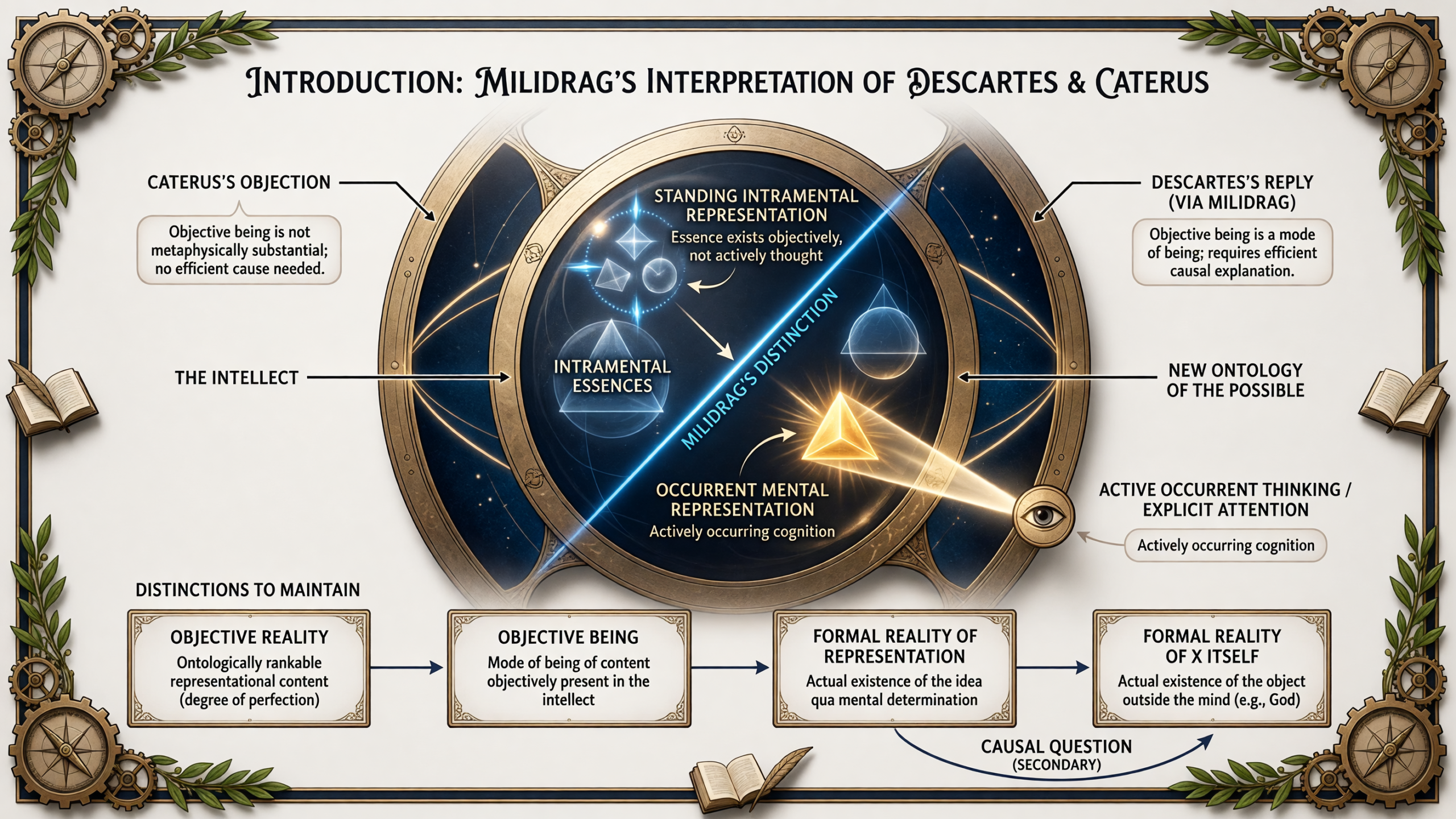
Milidrag’s interpretation of the exchange between Caterus and Descartes has an important virtue. It refuses to trivialize Caterus’s objection. Caterus does not merely misunderstand Descartes’s terminology. Milidrag’s position is stronger: Caterus is right about one of the two senses Descartes gives to objectivum, and the equivocation between those senses is Descartes’s own responsibility rather than Caterus’s.8Milidrag says this in so many words: „Iako je dvostrukost smisla esse objectivum nasledio od kasne sholastike, sam Dekart je doprineo nerazlikovanju spoljne oznake bivstvovanje-kao-objekt-svesti od intramentalnog modusa bivstvovanja suštine, time što je i ovaj drugi nazvao objektivnim.” [“Although he inherited the twofold sense of esse objectivum from late Scholasticism, Descartes himself contributed to the failure to distinguish the extrinsic denomination being-as-object-of-consciousness from the intramental mode of being of an essence, by calling this second one objective as well.”] He immediately adds that Descartes nonetheless does draw the distinction: „On ipak pravi razliku između njih, te kada govori o genuinom modusu bivstvovanja govori o bivstvovanju suštine u razumu.” [“He does nevertheless make a distinction between them, and when he speaks of the genuine mode of being he speaks of the being of an essence in the intellect.”] (Milidrag 2012, 55)
Milidrag also holds that Caterus locates the decisive issue more accurately than Arnauld and many modern commentators because he recognizes that the causal question ultimately concerns the ontological status of essences and necessary truths. The dispute is whether objective being is metaphysically substantial enough to require efficient causal explanation.9Milidrag writes: “If it is intramental, the essence of a thing must be in the genuine objective mode of being, but it need not also be represented by an idea, that is, the human mind need not know at all that it is in its intellect; these are the innate ideas” (p. 56 in the PDF pagination of the article; the discussion begins on p. 55). He also says that objective reality is a determination possessed by the essence “whether perceived or not” (pp. 56–57) and describes the sun’s essence as a res in intellectu that exists intramentally independently of whether it is simultaneously a res cogitata [a thing as actively thought] (p. 58). See Predrag Milidrag, “Katerus i Dekart o idejama, uzrokovanju i večnim istinama,” Theoria 55, no. 1 (2012): 45–69. Translations from the Serbian are by Claude Opus 5 unless otherwise indicated.
Milidrag argues that Descartes’s answer depends upon a new “ontology of the possible” in which intramental essences possess objective being that cannot be reduced to an extrinsic denomination and consequently requires efficient causation.10The phrase is Milidrag’s own, from the abstract: „Kasnosholastičkom razumevanju Dekart suprotstavlja svoju novu „ontologiju mogućeg“ prema kojoj u ljudskom razumu bivstvuju intramentalne suštine stvari, čije objektivno se bivstvovanje ne može svesti na spoljašnju oznaku, te da zahteva aktualno delotvorno uzrokovanje. Otud, on tvrdi da i sama pojmljivost i inteligibilnost suština mora imati aktualni delotvorni uzrok, što je ekvivalentno sa stvaranjem večnih istina.” [“To the late-Scholastic understanding Descartes opposes his new ‘ontology of the possible,’ according to which the intramental essences of things have being in the human intellect, whose objective being cannot be reduced to an extrinsic denomination and which therefore requires actual efficient causation. Hence he claims that the very conceivability and intelligibility of essences must have an actual efficient cause, which is equivalent to the creation of the eternal truths.”] (Milidrag 2012, 45) What this establishes directly is the causal grounding of conceivability, intelligibility, and intramental objective being. It does not by itself establish that such objective being must remain instantiated as standing representational content in a finite intellect between acts of cognition.
See Milidrag 2012, pp. 55–60, 69.
That interpretation substantially strengthens Descartes against Caterus. But it also creates a new explanatory burden. Milidrag’s standing essence should not be described as something that exists “without being represented,” because on the interpretation being examined its objective being already constitutes a form of representational presence in the intellect. What is absent is not representation simpliciter but active occurrent thinking or conscious apprehension. Milidrag himself frames the disagreement at precisely this level:
„Sada je očita priroda razlike između Dekartovog i Katerusovog razumevanja: to je razlika u ontologijama, jer za Dekarta postoji modus bivstvovanja suština kojeg za Katerusa nema, naime bivstvovanje u razumu.”
[“The nature of the difference between Descartes’s and Caterus’s understanding is now evident: it is a difference in ontologies, because for Descartes there is a mode of being of essences that Caterus does not have, namely being in the intellect.”] (Milidrag 2012, 55)
The sharper question is therefore: what makes an intramental essence an already existing objectively real representation when no active thought of that essence is occurring?
Several distinctions must be maintained throughout:
- Objective reality is ontologically rankable representational content: the representation of something according to the degree of being or perfection of what is represented.
- Objective being is the mode of being of represented content insofar as it is objectively present in the intellect. Objective being and objective reality should not therefore be treated as simple synonyms.11Milidrag’s own explanatory order keeps these apart, and runs from intelligibility through intramental being to objecthood for consciousness: „Zato što je inteligibilna, suština stvari može bivstvovati i u ljudskom razumu, a zato što bivstvuje u njemu može biti objekt svesti te dobiti spoljnu oznaku „objektivno bivstvovanje“.” [“Because it is intelligible, the essence of a thing can also have being in the human intellect, and because it has being in it, it can be an object of consciousness and so receive the extrinsic denomination ‘objective being.’”] He also records that Descartes labels this same mode esse potentiali as against esse formali sive actuali: „Ovaj genuini modus bivstvovanja suštine Dekart takođe imenuje kao esse objectivum (M III 14: VII 42; I Odg: VII 102), ali ga imenuje i kao esse potentiali stavljajući ga nasuprot esse formali sive actuali, odnosno nasuprot njenom formalnom bivstvovanju kao suštine jedne realno egzistirajuće stvari (M III 27: VII 47).” [“Descartes also names this genuine mode of being of an essence esse objectivum (M III 14: VII 42; First Replies: VII 102), but he also names it esse potentiali, setting it against esse formali sive actuali, that is, against its formal being as the essence of a really existing thing (M III 27: VII 47).”] (Milidrag 2012, 55) Milidrag’s terminology therefore does not by itself settle whether this genuine objective being constitutes an already instantiated standing representation or instead the antecedent ontological ground from which such a representation can be elicited.
- Standing intramental representation refers to the stronger Milidragian state at issue: an essence already exists objectively and representationally in the intellect even when it is not being actively thought.
- Occurrent mental representation is an actively occurring cognition in which a representatum is mentally represented.
- Explicit attention is narrower than occurrent representation. A thinker can represent a triangle without explicitly attending to every property necessarily belonging to triangular nature.
- Potential or dispositional availability is the possession of a determinate power, faculty, or structure enabling the mind to elicit an X-representation without that representation already being instantiated as standing objective content.
The faculty interpretation must not be presented as though nothing determinate exists before an occurrent idea is elicited. A faculty capable of eliciting an idea of X rather than Y must possess or depend upon antecedent structure sufficient to account for that difference. Both the faculty model and the standing-representation model therefore require determinate antecedent conditions. The disagreement concerns whether those conditions must already instantiate a representation of X possessing objective being. Antecedent representational determination does not by itself entail antecedently instantiated objective content.12Descartes has at least four candidates for antecedent determinate structure, none of which by itself requires already instantiated objective being. First, a determinate modification-disposition of the thinking substance. The mind is a substance whose principal attribute is thought, and a faculty may be understood as a way that substance is disposed to be modified, so that determinacy belongs to the power rather than to a resident representational object. Second, divine institution of the mind’s nature. The determinacy may be fixed by God’s creative constitution of the mind rather than by an inventory of already instantiated representational objects. Third, the intellect’s own determinate cognitive nature may ground indefinitely extensible clear and distinct cognition without requiring every resulting objective content to be pre-instantiated. Fourth, corporeal traces together with intellectual attention may explain some mixed cases of latent cognition and memory, although this option does not suffice for purely intellectual natures. The dialectical point is that these alternatives satisfy the requirement of antecedent determination without yet yielding presently instantiated objective content. The inference from antecedent determinate structure to standing objective representation therefore requires an additional premise.
This distinction also blocks an easy verbal solution. Calling the faculty’s antecedent determination an “implicit representation” does not settle the issue. If “implicit representation” means only that the mind is determinately capable of producing an X-representation, the description remains dispositional. If it means that X is already objectively present as representational content, the standing-representation thesis has merely been restated. What requires justification is the transition between those two claims.13Milidrag’s handling of the First Replies shows how easily the two run together. Descartes’s question is „zašto postoji njegova ideja [uzeta objektivno] u nama” [“why its idea (taken objectively) is in us”], and Milidrag interprets this as asking „zašto je ona u nama, zašto je u razumu (ne u ideji), što ne implicira da je nužnim načinom i reprezentovana.” [“why it is in us, why it is in the intellect (not in an idea), which does not imply that it is necessarily also represented.”] (Milidrag 2012, 61, quoting First Replies: AT VII 104). Milidrag’s interpretation treats Descartes as asking for the cause of X’s presence in the intellect while expressly denying that X is thereby represented by an occurrent idea. The remaining question is whether, when X is not being actively thought, there is nevertheless already an OR-bearing representation of X instantiated in the intellect, or only a nonrepresentational disposition or intellectual structure capable of producing such a representation when X is later thought.
A second issue concerns formal reality. An OR-bearing representation that actually occurs in an idea can itself possess formal or actual existence qua mental determination. That is fully compatible with its bearing objective reality according to the ontological rank of what it represents. The relevant distinction is therefore not:
objective reality versus any formal reality whatsoever.
It is instead necessary to distinguish:
- the formal reality of the intramental representation itself, from
- the formal reality of X itself.
An idea of God can therefore be a formally real finite determination of a finite mind while possessing infinite objective reality insofar as it represents God. Nothing in this entails that God himself is formally present in the intellect. Descartes’s distinction between formal and objective being remains intact.
This correction also clarifies the causal discussion. The formally real ideational state need not be regarded as something that merely supplies occurrence while an independent objective constituent does all the representing. The same formally real state can be the state that represents God. The causal question concerning the relation between formal and objective rank is important within Descartes’s Third Meditation argument, but it is not distinctive of Milidrag’s standing-essence interpretation and therefore should not function as a second principal objection in the present post. The issue specific to Milidrag remains whether objective representational content can be instantiated in the finite intellect when no corresponding occurrent cognition exists.
Milidrag’s Ontology of Intramental Essences
Milidrag’s interpretation is stronger than the claim that an essence merely becomes an object of thought when an intellectual act happens to terminate upon it. He argues that, for Descartes, an essence possesses a genuine intramental mode of being in addition to the extrinsic denomination that Descartes shares with Caterus. Milidrag expressly distinguishes the essence as a res in intellectu, a thing in the intellect, from its becoming a res cogitata, a thing actively thought.
The distinction should not be represented as:
unrepresented essence → later representation.
That formulation weakens Milidrag’s position and prejudges the question in favor of ORCET (in an occurrent pure strict Cartesian idea, its OR-bearing representation exhausts its first-order representational content). The stronger Milidragian sequence is:
standing objectively existing intramental representation → later active conscious apprehension.
The essence is therefore not merely something that can later become represented. Its objective mode already makes it representationally present in the intellect. What changes when an occurrent idea arises is that this standing representational content becomes actively thought or consciously apprehended.
Milidrag’s ontology can consequently be represented more accurately as follows:
t1: EX exists objectively in the intellect as a standing representation ∧ ¬ Tocc(X). [At the earlier time an objectively existing representation of X is already in the intellect, although X is not being actively thought.]
t2: EX remains objectively present ∧ Tocc(X). [At the later time the standing objectively existing representation remains, and X is now actively thought.]
On this model, the later intellectual act does not first give EX its representational status or its objective being. It actively apprehends what was already objectively and representationally present.
This is why Milidrag’s interpretation is powerful against Caterus. Caterus treats objective being as exhaustively an extrinsic denomination (a denomination, or description, applied to an object because of something extrinsic to it, without anything about the object itself having to change) imposed upon an object because an intellectual operation happens to terminate upon it. On that construal his question is pressing: why seek an efficient cause of what adds no intrinsic reality? Milidrag’s reply is not that Caterus misunderstands that denomination. Descartes grants it for one sense of objectivum [objective]. His reply is that Caterus mistakes one sense for the only sense. Alongside it Descartes recognizes a second sense in which the objective essence itself possesses a genuine intramental ontological status and therefore falls within the causal order. See Milidrag 2012, pp. 55, 58, 60, 69.
This successfully advances the debate from:
 Why should objective being require a cause at all?
to:
 What sort of Cartesian existent possesses this standing objective and representational status?
The second question is the one on which the standing-representation interpretation becomes vulnerable.
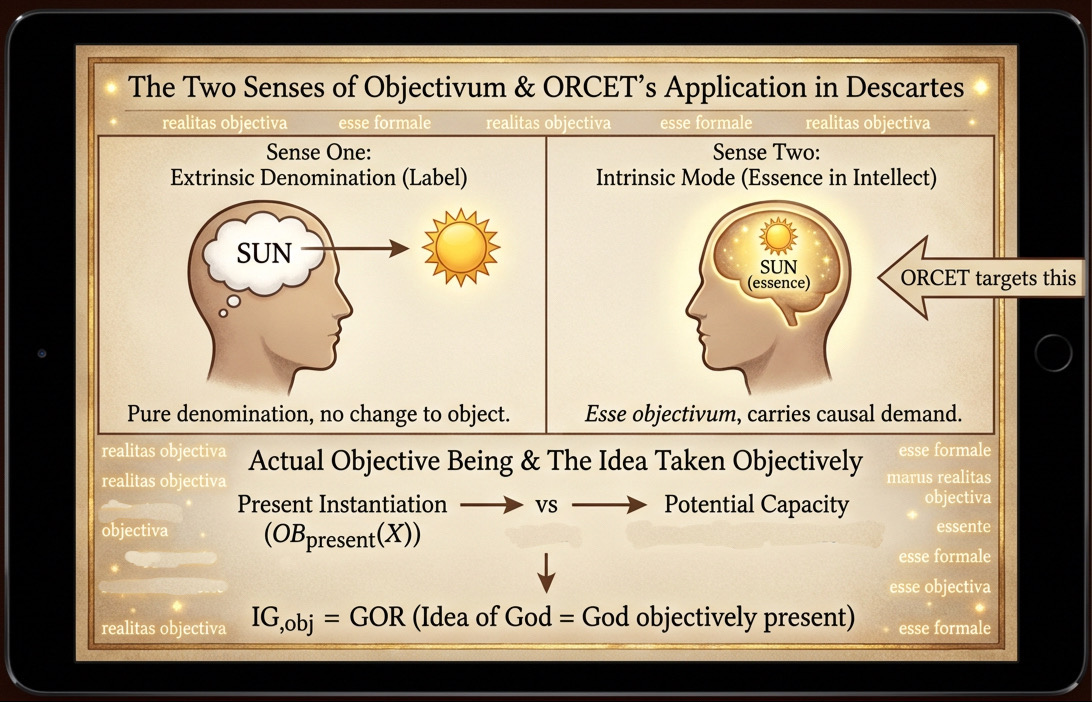
The Two Senses of Objectivum and Where ORCET Applies
Milidrag’s distinction between two senses of objectivum must be preserved if ORCET (in an occurrent pure strict Cartesian idea, its OR-bearing representation exhausts its first-order representational content) is to address his interpretation rather than define it away.
- Sense One: objective being of the res cogitata [a thing as actively thought]. An object receives an extrinsic denomination from an intellectual act directed toward it. Nothing intrinsic need happen to the object. This is the extrinsic denomination Caterus emphasizes: realitas enim objectiva pura denominatio est, actu non est [for objective reality is a pure denomination; it is not in act].
- Sense Two: objective being of the essence as res in intellectu. Here the essence possesses a genuine mode of being within the intellect that is not reducible to the extrinsic denomination “being thought about.” Milidrag associates this objective mode with esse objectivum and with the vocabulary of esse potentiale. It is this stronger intramental status that is supposed to make the essence metaphysically nontrivial and therefore subject to efficient causal explanation.
The crucial point is that Sense Two should not itself be characterized as nonrepresentational. Milidrag’s ontology is strongest when the res in intellectu is treated as already possessing representational status even when it is not yet an actively thought res cogitata. Otherwise the dispute with ORCET would partly disappear by verbal stipulation.
ORCET (in an occurrent pure strict Cartesian idea, its OR-bearing representation exhausts its first-order representational content) must therefore be restricted accordingly. It does not begin with the assertion that all objective reality is by definition occurrent representation. Its initial claim is only:
In an occurrent pure strict idea, its OR-bearing representation exhausts its first-order representational content.
From that starting point, a further argument is needed against extending the OR-bearing representation beyond the occurrent cognition into a numerically or ontologically standing unthought state. This is where the disagreement with Milidrag actually lies.
The dispute can therefore be stated without collapsing the two senses:
Milidrag: an OR-bearing representation may remain objectively instantiated in the intellect when it is not being actively thought.
ORCET plus the argument developed below: the first-order OR-bearing representation of an occurrent strict idea does not, without further Cartesian ontological justification, survive as an independently standing representation once the occurrent cognition ceases.
What “Presently Instantiated Objective Being” Means in This Argument
An important ambiguity in the earlier formulation must be removed. To ask whether an essence possesses “presently instantiated objective being” should not suggest that objective being must stand in simple opposition to every form of esse formale sive actuale. That is too strong.
An OR-bearing representational state may itself actually and formally exist in the intellect. Suppose a finite mind is actively thinking of God. The occurrent ideational state is a real finite modification of that mind. It therefore possesses finite formal reality. At the same time, insofar as that state represents God, it possesses infinite-substance-level objective reality. There is no contradiction:
FR(CG) = finite mode-level. [The God-representing cognitive determination actually exists as a finite determination of a finite mind.]
OR(CG) = infinite-substance-level. [The same determination represents God and therefore possesses objective reality appropriate to infinite substance.]
What does not follow is that God himself thereby possesses formal existence in the finite intellect. The fact that God is objectively represented does not make God formally present there. The relevant distinction is between the formal reality of whatever intramental entity bears or constitutes the representation and the objective reality it possesses insofar as it represents X.
That formulation is especially useful against Milidrag because it prevents the reply that “X does not exist formally in the intellect” from answering the real question. The issue is not whether X itself exists formally in the intellect. It is what formally real intramental entity, if any, bears or realizes X’s objective representation when X is not being actively thought. Accordingly, “presently instantiated objective being” in this post means simply that an objectively real representation is genuinely instantiated in the intellect now, rather than merely available as a future possibility.
We may distinguish:
Present objective instantiation: an objectively real representation of X exists in the intellect now.
from:
Dispositional availability: the intellect is determinately capable of producing an objectively real representation of X when the relevant faculty is exercised.
The standing-representation interpretation affirms the first condition even during periods in which X is not being actively thought. The faculty interpretation affirms only the second during those periods.
This corrected formulation removes a misleading inference from the earlier version of the post. The question is not whether presently instantiated objective being requires X itself to exist formally in the intellect. The question is what presently exists in the intellect during the interval between active cognitions, and under what Cartesian ontological category it exists.
ORCET and the Idea Taken Objectively
ORCET (in an occurrent pure strict Cartesian idea, its OR-bearing representation exhausts its first-order representational content) should therefore not be defined as the thesis that objective reality simply is occurrent conscious representation. Such a definition would assume precisely what Milidrag contests. Its more limited and defensible claim concerns the internal structure of an occurrent strict idea:
In an occurrent pure strict Cartesian idea, the OR-bearing representation exhausts its first-order representational content.
This does not abolish the formal reality of the mental state. The ideational cognition itself may be a formally real finite mode of the thinking substance. Nor does ORCET require the thinker explicitly to attend to every property necessarily belonging to the representatum. Its claim is that no second first-order representational constituent must be added to the OR-bearing representation in order to make the cognition a representation of X.
Descartes’s First Replies are especially important. In explaining the idea taken objectively, he writes:
adeo ut idea solis sit sol ipse in intellectu existens, non quidem formaliter, ut in coelo, sed objective, hoc est eo modo quo objecta in intellectu esse solent. [So that the idea of the sun is the sun itself existing in the intellect, not indeed formally, as in the heavens, but objectively, that is, in the way in which objects are accustomed to exist in the intellect.] (AT VII 102–103; CSM II 75)
The clause non quidem formaliter, ut in coelo must be interpreted with care. Descartes denies that the sun exists formally in the intellect as the celestial sun exists formally in the heavens. He need not thereby deny that the sun-representing cognitive determination possesses formal reality as a mental existent. The passage therefore supports a distinction between:
- the sun’s formal existence as sun, and
- the formal existence of the mental representation through which the sun is objectively present.
The Second Replies definition of objective reality reinforces the representational connection:
Per realitatem objectivam ideae intelligo entitatem rei repraesentatae per ideam, quatenus est in idea. [By the objective reality of an idea I understand the being of the thing represented by the idea insofar as it is in the idea.] (AT VII 161; CSM II 113)
The definition ties objective reality to a rei repraesentatae per ideam, a thing represented by an idea. It does not, by itself, settle whether that representation may persist in a standing unthought condition. Milidrag’s interpretation supplies precisely that possibility. The text therefore motivates ORCET without completing the argument against the standing-representation thesis.
The resulting position is deliberately asymmetric. ORCET begins with what can be said about an occurrent strict idea: its OR-bearing representation exhausts its first-order representational content. Milidrag then proposes that this objectively real representation can also exist as a standing res in intellectu when no active cognition of X is occurring. The remaining question is whether Cartesian ontology supplies a coherent category for that additional state.
Mental Instantiation, Thought, and Consciousness
The consciousness issue becomes important once Milidrag’s standing essence is treated as genuinely intramental and representational. Descartes’s definition of idea in the Second Replies explicitly connects an idea with the immediate perception of a thought:
Ideae nomine intelligo cujuslibet cogitationis formam illam, per cujus immediatam perceptionem ipsius ejusdem cogitationis conscius sum. [By the name “idea” I understand that form of any thought through whose immediate perception I am conscious of that same thought.] (AT VII 160; CSM II 113)
The Fourth Replies make the consciousness requirement still stronger:
nec ulla potest in nobis esse cogitatio, cujus eodem illo momento, quo in nobis est, conscii non simus. [And there can be no thought in us of which we are not conscious at the very same moment at which it is in us.] (AT VII 246; CSM II 171)
A simple consciousness argument might therefore proceed:
mental representation → thought → consciousness.
But this does not straightforwardly refute Milidrag. He can deny that the standing res in intellectu [in the intellect whether thought about or not] is itself a cogitatio [occurrent thought]. The occurring mental operation is the idea materialiter sumpta, the idea taken materially as a mode of thinking; the objectively existing essence is what is objectively present in relation to such acts. If the standing essence is not itself a thought, the transparency principle does not directly apply to it.
This limitation should be granted. The argument cannot simply be:
the standing representation is in the intellect → it must be an unconscious thought → Descartes forbids unconscious thought.
Milidrag’s interpretation is specifically designed to block that inference by distinguishing the intramental essence from the occurrent cogitatio.
But the concession does not end the issue. It changes the question. Milidrag cannot indefinitely answer that the standing representation is “not a cogitatio” without giving a positive account of what it is. Once the essence is said genuinely to exist in a finite Cartesian intellect as representational content while no active thought of it occurs, the problem becomes one of ontological classification.
This is where the consciousness argument acquires its proper force. Transparency does not directly reach every possible standing intramental item. But if the standing representation is classified as a formally real representational mode of the thinking substance, then Descartes’s consciousness doctrine becomes immediately relevant. If it is not such a mode, its alternative ontological status must be supplied.
The Ontological Status of the Standing Representation
The strongest objection to the standing-representation interpretation is therefore not simply that “representation must be occurrent.” That formulation is too close to assuming ORCET in the very sense Milidrag denies. The sharper question is:
What sort of Cartesian existent is an objectively real representation that genuinely remains in a finite intellect while it is not being actively thought?
The standing res in intellectu [in the intellect whether thought about or not] appears to face three possibilities.
- It is a formally real mode of the finite mind. In that case it is an actually existing representational determination of the thinking substance. Descartes’s consciousness doctrine then creates an immediate difficulty: how can such a representational mode exist in the mind without being actively thought or consciously apprehended?
- It possesses formal reality in the intellect but is not a mode of the finite mind. In that case Milidrag owes an account of the Cartesian ontological category to which such an intramental existent belongs. It cannot simply be the thinking substance itself, and it has been excluded from the category of its modes. The interpretation therefore appears to require a distinct kind of finite intramental representational existent.
- It possesses no formal reality as an intramental existent. In that case the difficulty shifts. What makes it a genuinely existing representation already instantiated in the intellect rather than a faculty, disposition, potentiality, or determinate representational structure capable of producing such a representation when cognition occurs?
The third possibility is particularly important because it prevents the issue from being resolved simply by repeating the vocabulary of esse objectivum [objective being, which on Caterus’s side names only an extrinsic denomination and on Milidrag’s adds a mode of being in the intellect] or esse potentiale [potential being, as opposed to esse formale sive actuale, formal or actual being]. If the standing essence genuinely exists as a representation but lacks formal reality as an intramental existent, the interpretation must still distinguish objectively real from merely objectively realizable, that is, content the intellect is determinately able to bring to objective being but has not.
This also clarifies what happens when an active cognition ceases. During an occurrent idea of a triangle, the triangle-representing cognitive determination can possess finite formal reality as a mental determination and objective reality appropriate to what it represents. When the active cognition disappears, Milidrag says that a standing objectively real representation remains. If this remainder is the same representational item, its changed ontological status requires explanation. If it is a different item, the relation between the standing representation and the OR-bearing content of the later occurrent idea must be explained. If the remainder amounts only to a determinate power for reproducing that content, the account moves toward the faculty interpretation: a determinate intellectual capacity that yields OR-bearing representations when exercised.
The ontological fork can therefore be stated compactly:
formally real mode → consciousness problem;
formally real non-mode → Cartesian category problem;
no formal reality → distinction from faculty, disposition, or potentiality problem.
This does not by itself refute Milidrag. It establishes the principal ontological burden his interpretation must discharge. The companion objections post can develop the three horns and the available responses more fully. For present purposes, the fork supplies the correct framework for comparing the standing-representation account with Descartes’s own faculty language concerning innate ideas.
Milidrag’s Strongest Reply: Innate Ideas Need Not Be Occurrent
Milidrag has an important response. Descartes unquestionably denies that innate ideas must always be occurrently before consciousness. It is therefore illegitimate to infer without argument:
in the intellect → actively thought now.
If innate ideas can belong to the mind during periods in which they are not actively contemplated, Milidrag can ask why their objective contents could not likewise persist in the intellect during those intervals.
Descartes’s reply to Thomas Hobbes (1588–1679) is crucial:
Denique, cùm dicimus ideam aliquam nobis esse innatam, non intelligimus illam nobis semper obversari: sic enim nulla prorsus esset innata; sed tantùm nos habere in nobis ipsis facultatem illam eliciendi. [Finally, when we say that an idea is innate in us, we do not understand it to be always before us: for in that way no idea at all would be innate; but only that we have in ourselves the faculty of eliciting that idea.] (AT VII 189; CSM II 132)
The philosophically important expression is facultatem illam eliciendi, the faculty of eliciting that idea. Nothing in this formulation requires an unconscious occurrent token idea waiting to be retrieved. More importantly for the present dispute, it does not by itself require an already instantiated standing representation possessing objective being. Descartes can instead be read dispositionally: prior to occurrent ideation, the mind possesses a faculty capable of eliciting the idea.
This does not show that the faculty is blank or indeterminate. An X-directed faculty must differ in some relevant respect from a Y-directed faculty, or the mind must possess a more general but sufficiently determinate structure whose exercise under appropriate conditions yields X rather than Y. The question is therefore not:
standing essence or no antecedent determination?
It is:
standing objectively real representation or determinate representational power?
The latter distinction is harder for Milidrag because Descartes explicitly has room for faculties and powers that are not currently being exercised.14For support, see (1) Third Replies, Reply to Objection X, AT VII 189; CSM II 132, (2) Comments on a Certain Broadsheet, AT VIII B 357–59; CSM I 303–04, and (3) Descartes’s letter to Voetius, May 1643, AT VIII B 166–67; CSMK 222–23.
A defender of the standing-representation account must therefore explain why the facultas eliciendi is insufficient and why the ontology must be augmented by an already existing OR-bearing representation.
The point should not be overstated. The faculty passage does not prove that every innate idea is merely a disposition, nor does it settle the ontology of true and immutable natures. It does, however, establish a distinctively Cartesian model for non-occurrent innateness. That makes it insufficient simply to infer from the fact that an idea is innate and not always consciously contemplated to the conclusion that its objectively real content must be continuously instantiated as a standing representation.
The Faculty Model Versus the Standing-Representation Model
The disagreement can now be represented more accurately as a competition between two accounts of representational latency.
The faculty model:
t1: FX ∧ ¬ IX,occ. [At the earlier time the mind possesses a determinate power capable of eliciting an idea of X, but no occurrent idea of X exists.]
t2: exercise(FX) → IX,occ ∧ ORX. [At the later time the faculty is exercised, an idea of X occurs, and objective reality appropriate to X is instantiated in that cognition.]
The faculty’s antecedent state may be highly determinate. It must be sufficiently structured to account for the kind of representation elicited when exercised. What it does not yet contain, according to this model, is an already instantiated standing representation of X possessing objective being.
The standing-representation model:
t1: EX possesses objective being as a standing representation ∧ ¬ Tocc(X). [At the earlier time an objectively real representation of X already exists in the intellect although X is not being actively thought.]
t2: EX remains objectively present ∧ Tocc(X). [At the later time the standing objectively real representation remains and is now actively apprehended.]
On this second model, active ideation does not first confer representational status upon X. The representational content is already present. What active thought adds is occurrent apprehension of that standing content.
This correction matters because the two models should not be contrasted as representation versus no representation. The faculty model contains determinate representational power. The standing-representation model adds the further thesis that an objectively real representation itself already exists. The dispute is therefore between:
a standing genuinely existing representation
and
a determinate power whose exercise yields an objectively real representation.
The faculty model already explains why an innate idea need not be continuously before consciousness. It also allows the antecedent intellectual structure to encode all the determination required for X-directed cognition. But encoding X-directed information in a power does not by itself make X objectively present. Conversely, describing such encoded determination as an “implicit representation” does not establish that it possesses instantiated objective being. The critical question remains what ontological addition converts determinate representational power into a standing objectively real representation.
A natural objection presses precisely here. Suppose that, long before anyone has formulated the name or mathematics of a tesseract (aka a hypercube), the human intellect is nevertheless capable of eventually forming an idea of one. If the faculty account says merely that the intellect possesses a determinate capacity which, under appropriate circumstances, produces that representation, one may ask what makes the intellect capable, under those circumstances, of producing the idea of a tesseract in particular. Perhaps the relevant innate idea must already be present in the intellect, and perhaps its being already present requires an OR-bearing representation of the tesseract to exist there before anyone actively thinks of it.
This objection identifies a genuine burden for the faculty account, but it does not yet establish Milidrag’s standing-representation conclusion. It requires distinguishing a determinate power to generate a representation from the prior instantiation of the representation generated by that power. The intellect might possess antecedent capacities concerning extension, dimension, number, geometrical construction, and necessary inference whose coordinated exercise eventually yields an idea of a four-dimensional hypercube  . The resulting representation can be completely determinate even if that representation was never previously instantiated. A determinate generative structure need not contain each of its possible outputs as already existing representational contents.
The decisive inference would therefore require an additional premise: a faculty can produce a determinate representation of X only if X is already represented within that faculty. But that premise is precisely what Milidrag’s standing-representation interpretation must establish. It cannot be inferred merely from the fact that the later cognition represents X determinately. Determination of the source does not by itself entail prior instantiation of the determinate representational output.
The tesseract example accordingly sharpens what is meant by an innate idea. If saying that an idea of X is innate means that an OR-bearing representation of X already exists in the intellect before X is actively thought, then the standing-representation interpretation follows, but only because that strong conception of innateness has already been assumed. The faculty interpretation instead locates innateness in the native intellectual source of the cognition: the mind possesses antecedent intellectual powers and structures sufficient to elicit the X-representation without deriving its representational content from sensory experience. On this account, what is already in the mind is the determinate intellectual ground for producing the idea, not necessarily the OR-bearing representation produced when that power is exercised.
This distinction becomes especially important for representations that have never previously occurred in any finite human intellect. The question is not whether something determinate must antecedently explain why the intellect can form an idea of a tesseract rather than some different idea. The faculty model can grant that requirement. The disputed step is from such antecedent determination to the conclusion that an OR-bearing representation of the tesseract must already be instantiated in the intellect. Unless that further implication is independently established, the appropriate conditions for eliciting the idea may consist in the exercise of more general innate intellectual structures rather than in the prior presence of the very representation subsequently elicited.
Milidrag therefore needs to identify explanatory work performed by the standing representation that cannot be performed by a determinately constituted faculty. If the standing representation is genuinely ontologically additional, its Cartesian status and explanatory contribution must be specified. If it is ultimately identified with the mind’s determinate capacity to elicit the relevant cognition, the account moves toward the faculty model and the claim of independently standing objective content becomes correspondingly weaker.
The next question is consequently not whether one interpretation has antecedent structure while the other does not. Both do. It is whether antecedent determination requires antecedently instantiated objective representational content as Milidrag holds.
Antecedent Structure and Relative Ontological Economy
The faculty model should not be defended by claiming that it requires less antecedent structure merely because it replaces a standing essence with a faculty. A faculty capable of eliciting an idea of a triangle rather than an idea of God, the sun, or a rock cannot be wholly indeterminate. Something about the constitution of the intellect must account for the specificity of the representation produced when the faculty is exercised.
The important distinction is therefore between antecedent determination and antecedently instantiated objective representational content. A power can be determinately structured so that its exercise yields X rather than Y without an objectively real representation of X already existing as a standing intramental item. Thus:
FX does not by itself entail standing OB(X). [The mind’s being determinately capable of producing an idea of X does not by itself show that an objectively real representation of X already exists in the intellect.]
This is a limited claim about ontological economy, not a claim that the faculty model is metaphysically simple in every respect. A content-sensitive intellectual power may itself possess considerable structure. Its economy lies specifically in not adding, beyond that determinate power, a standing objectively real representation whose existence continues during periods in which X is not actively thought.
The contrast can therefore be sharpened:
Faculty model: determinate representational power → exercise → occurrent OR-bearing cognition.
Standing-representation model: standing OR-bearing representation → later active apprehension of that representation.
The first account does not deny that the mind is already X-directed in a dispositional or structural sense. The second makes the stronger claim that X is already objectively present as representational content. The inference from the former to the latter requires justification.
This also prevents the dispute from being settled by the word “implicit.” If X is “implicitly represented” only in the sense that the mind possesses a determinate capacity to elicit an X-representation, the account remains dispositional. If “implicitly represented” means that an objectively real representation of X already exists, the standing-representation thesis has merely been restated. The substantive question is what makes the second condition obtain.
The resulting challenge to Milidrag is therefore comparatively modest. If the standing representation EX is ontologically additional to the determinate faculty or structure FX, its additional explanatory work must be identified. If EX ultimately amounts to the determinate representational capacity embodied in FX, the interpretation approaches the faculty model and no longer clearly establishes a separately instantiated objective representation during the period of non-occurrence.
The Triangle Complication
The Fifth Meditation provides Milidrag with an important qualification to any account that ties objective representation too closely to what a thinker explicitly apprehends. Descartes maintains that mathematical truths may in an important sense already be “in” him before he directs his attention toward them:
quae dudum quidem in me erant, licet non prius in illa obtutum mentis converterem. [Which indeed had long been in me, although I had not previously turned the gaze of my mind toward them.] (AT VII 64; CSM II 44)
He then observes that necessary properties of the triangle can be recognized even though he had not previously thought explicitly of those properties when imagining the figure. (AT VII 64–65; CSM II 44–45)
This evidence prevents ORCET from being interpreted as an attention-exhaustion thesis. A thinker can represent triangular nature without explicitly representing every theorem or necessary property belonging to it. What a cognition represents is therefore not reducible to an inventory of everything explicitly before consciousness at that instant.
The triangle case nevertheless does not establish the stronger standing-representation thesis. There is a fundamental difference between:
actively representing T while failing explicitly to represent some necessary property P of T,
and:
an objectively real representation of T remaining instantiated when T itself is not being actively thought.
The Fifth Meditation directly supports the first condition. Milidrag requires the second. The inference from the first to the second does not follow merely from the fact that the representational content of an occurrent idea outruns explicit attention.
The triangle evidence should therefore be regarded as a genuine constraint upon ORCET, but not as a refutation of it. ORCET must allow a finite cognition to represent a determinate nature more richly than the thinker explicitly analyzes at any moment. What it denies without further argument is the additional ontological move from that representational richness to an independently standing OR-bearing representation during the absence of active thought.
Property-Opacity Does Not Establish Object-Opacity
The distinction can be stated more precisely by separating property-opacity from object-opacity.
Property-opacity occurs when a thinker actively represents X while failing explicitly to represent every property necessarily belonging to X:
Tocc(X) ∧ ∃P [P belongs necessarily to X ∧ ¬ A(P)]. [X is actively thought, but at least one property necessarily belonging to X is not explicitly attended to.]
Object-opacity, in the sense relevant to Milidrag, would be stronger. An objectively real representation of X would remain genuinely present in the intellect even though X itself was not being actively thought:
OBstanding(X) ∧ ¬ Tocc(X). [An objectively real standing representation of X remains in the intellect even though no active thought of X is occurring.]
The triangle passage establishes property-opacity. It does not directly establish object-opacity.
This distinction preserves the intellectual richness of Cartesian ideas without making objective representation depend upon exhaustive explicit consciousness. An idea of a triangle can represent triangular nature while leaving indefinitely many truths unconsidered. The relevant distinction is between what the idea represents and everything necessarily true of what the idea represents.
Accordingly, ORCET can maintain both:
triangular nature is represented in the occurrent idea,
and:
not every necessary truth about triangular nature is occurrently represented or explicitly attended to.
Milidrag therefore needs an additional argument for extending the objective representation of triangular nature beyond the occurrent cognition into a standing unthought state. The Fifth Meditation by itself does not supply that extension.
The Infinite-Determinacy Pressure Test
Triangular nature also supplies a useful pressure test because its necessary consequences are not exhausted by any finite sequence of acts of attention. A finite thinker apprehends only finitely many of them at any particular time and can continue to derive further consequences successively.
This claim must not be confused with the claim that the idea of a triangle possesses infinite objective reality in Descartes’s technical hierarchy. Objective-reality rank tracks the ontological rank of the representatum, not the number of truths that follow from its nature. A finite mathematical nature may therefore ground indefinitely many necessary truths without acquiring the objective-reality rank appropriate to infinite substance.
The infinity point also should not bear more argumentative weight than it can support. A finite generative structure can ground indefinitely many consequences without separately storing every consequence as a numerically distinct item. Milidrag can therefore maintain that one intramental triangular essence grounds indefinitely many truths, and the faculty interpretation can likewise maintain that a finite determinate intellectual structure makes indefinitely many demonstrations possible.
The useful question is narrower. If the complete essence of triangle is already objectively instantiated as a standing representation in a finite intellect, what degree of its determinate structure is thereby already present? Three broad possibilities arise:
- The complete determinacy is already grounded in the standing representation. Milidrag then attributes to the finite intellect an objectively existing representation whose nature suffices for an indefinitely extensible range of necessary consequences, even though those consequences are only successively apprehended.
- Only some finite determination is presently instantiated. It then becomes less obvious why the standing item should be identified with the complete true and immutable nature rather than with a partial cognitive basis.
- The remaining determination is present only dispositionally. The account then approaches the faculty model insofar as the intellect is structured so that additional consequences can be elicited without those consequences themselves already being objectively instantiated.
No immediate refutation follows from this trilemma. The infinity of triangular determination is therefore best treated as a pressure test rather than a principal argument. Its importance lies in making vivid the distinction between an already instantiated representational object and a finite but generatively determinate intellectual capacity.
The more extensive questions concerning how many distinct essences a finite intellect would contain, and whether a standing-essence ontology generates a broader infinite-multitude problem, are better reserved for the companion objections post.
The Quasi-Platonic Worry: An Internalized Object-Before-Act Ontology
A standing ontology of intramental essences should not simply be identified with Platonic realism. Platonic Forms are not ordinarily understood as finite-mind-dependent entities located within individual human intellects. Milidrag’s essences are intramental, and his broader interpretation connects their intelligibility and objective being with divine efficient causation. The ontologies are therefore importantly different.
Nevertheless, a structural analogy remains. The relevant feature of the Platonic explanatory pattern is not merely the transcendence of the Forms. It is an object-before-act structure: the intelligible object is already determinate independently of the particular cognitive act by which a thinker apprehends it.
Milidrag’s standing-representation model has a structurally similar sequence:
standing determinate representation → subsequent active apprehension.
The relevant object has been relocated within the finite intellect, but the explanatory direction remains object first and active cognition second. The objectively real essence already possesses its representational standing, and the later act makes it an actively thought res cogitata.
The faculty model offers a different sequence:
determinate representational capacity → exercise → occurrent OR-bearing cognition.
Here what precedes the act is not a standing object already possessing objective representational being but a structured power whose exercise yields the relevant cognition.
The objection to Milidrag should therefore not be stated as “Milidrag makes Descartes a Platonist.” The more defensible claim is that his interpretation internalizes an object-before-act explanatory architecture structurally reminiscent of Platonism. Whether that architecture is genuinely Cartesian remains an independent question.
Why the Issue Is Not Simply Platonism Versus Conceptualism
The alternative to Milidrag should not be characterized as straightforward finite-mind conceptualism. Descartes’s true and immutable natures are not arbitrary constructions whose determinate properties depend upon what a finite thinker happens to invent, believe, or explicitly attend to. A triangle possesses necessary properties that constrain thought and can be discovered rather than freely stipulated. (AT VII 64–65; CSM II 44–45)
At least three positions should therefore be distinguished:
- Autonomous Platonic realism: intelligible natures possess an ontology independent of finite cognition and not grounded in finite acts of conception.
- Simple finite-mind conceptualism: essences are products of finite conceptual construction or abstraction.
- Cartesian divine-dependent essentialism: true and immutable natures possess determinate necessary structures not arbitrarily constituted by finite thinkers, while their ultimate status remains dependent upon the Cartesian divine order rather than upon autonomous Platonic Forms.
Milidrag is therefore right to emphasize that the determinate structure of an essence can exceed what any finite thinker is presently contemplating. The truths concerning triangular nature do not become true only when a thinker attends to them.
But two claims must still be distinguished:
essential truth is independent of present finite attention;
and:
the complete essence is presently instantiated in a particular finite intellect as a standing objectively real representation during the absence of active thought.
The former does not entail the latter. Divine-dependent determinacy of essences can therefore be granted without yet granting Milidrag’s stronger claim about their continuous intramental representational instantiation.
The Idea of God and ORCET
The idea of God is useful here primarily because it clarifies the relation between formal and objective reality within one occurrent cognition. The same cognition can possess finite formal reality and infinite objective reality. These should not be divided into two independently existing mental representers.
Consider the occurrent idea of God IG. As an actually existing determination of a finite thinking substance:
FR(IG) = finite mode-level. [The cognition itself actually exists as a finite determination of a finite mind.]
Insofar as that same cognition represents God:
OR(IG) = infinite-substance-level. [The cognition contains objective reality appropriate to what it represents, namely infinite substance.]
There is no inconsistency. Formal reality concerns how the cognitive state actually exists in the finite mind. Objective reality concerns the ontological rank of what that state represents. The fact that the state contains infinite objective reality does not make the state formally infinite, and it does not make God formally present in the finite intellect.
ORCET adds only that, within this occurrent pure strict idea, the OR-bearing representation exhausts its first-order representational content. It does not require a second numerically distinct God-representing item alongside the formally real ideational state. The formally real state itself is the cognition that represents God, and insofar as it does so it contains the relevant objective reality.
The God case therefore guards against one possible confusion in the standing-essence dispute. The question is not whether an objectively real representation must lack formal reality merely because it bears objective reality. In an occurrent idea, the representation can be a formally real finite cognitive determination. The question specific to Milidrag is what, if anything, plays the corresponding ontological role when the objective representation is supposed to remain in the intellect while no such cognition occurs.
Formal Reality, Representation, and the Bearer Question
An earlier version of this argument placed too much weight on asking whether the formally real mode “adds” a second representational contribution. That formulation encourages an unnecessary picture in which formal reality and objective reality belong to two different entities.
A better formulation begins with one occurrent ideational state. That state is formally real as a finite modification of the finite mind. The same state, insofar as it represents X, possesses objective reality appropriate to X. Formal and objective descriptions therefore need not pick out two numerically distinct representers:
one cognition, two ontological dimensions.
The formal dimension concerns the state’s existence as a finite mental determination. The objective dimension concerns the state’s representation of an object and the ontological rank of that represented object.
This can be seen by comparing an idea of God with an idea of a rock. Both cognitive episodes are finite modes:
FR(IG) = finite mode-level.
FR(IR) = finite mode-level.
Yet they differ representationally:
OR(IG) = infinite-substance-level.
OR(IR) = finite-substance-level.
Their common finite formal rank therefore does not determine their representational object or objective-reality rank. But this does not make formal reality explanatorily inert. It identifies the actual ontological status of each cognition as a mode of a finite thinking substance.
For the present post, the important consequence is not a new causal objection. It is a clarification of the bearer question. During an occurrent idea, there is no mystery about what formally exists: a finite cognitive determination of the mind. If Milidrag claims that the same objectively real content remains instantiated when the cognition ceases, the interpretation must explain what then bears or realizes that standing representation.
The issue can therefore be stated without the potentially misleading phrase “X qua represented.” The relevant contrast is:
- the formal reality of the intramental representation of X, and
- the formal reality of X itself.
The first can obtain when an idea of X actually occurs. The second does not follow merely because X is represented. The standing-essence problem asks what becomes of the first during intervals in which there is no occurrent idea of X.
Milidrag’s Causal Achievement and Why It Does Not Settle the Instantiation Question
Milidrag’s interpretation should be granted a substantial success. If objective being in his stronger sense is genuinely metaphysical rather than merely an extrinsic denomination (a denomination, or description, applied to an object because of something extrinsic to it, without anything about the object itself having to change), Caterus can no longer dismiss the demand for a cause merely by observing that being thought about adds nothing intrinsic to the external object. Milidrag thereby explains why objective being enters the causal order at all.
Schematically:
genuine objective being → causal grounding required.
Milidrag also deepens this explanation by appealing to Descartes’s doctrine of the created eternal truths. On his reconstruction, the determinate predicates and relations constituting an essence are themselves divinely instituted. This gives him a substantive account of why the determinate character of an essence and its objective reality are not causally unexplained.
That causal achievement should not be converted into a separate objection to Milidrag’s standing-essence interpretation. The general Cartesian question whether objective-reality ranks require causes of proportionate formal or eminent rank is important, especially in the Third Meditation, but it is not peculiar to Milidrag’s thesis that essences remain objectively present when unthought.
The causal material matters here for a narrower reason. Even if Milidrag is entirely correct that objective being and its determinate character require efficient causation, this does not tell us what kind of intramental effect God causes in the finite mind between occurrent acts. The causal ground could be:
- a standing objectively real representation, as Milidrag proposes, or
- a determinate intellectual power or structure capable of producing the relevant OR-bearing cognition when exercised.
Both can be divinely caused. Causal grounding therefore does not itself choose between them. The Instantiation Problem survives intact:
Why should the causally grounded antecedent condition count as already instantiated objective representational content rather than as the determinate ground from which such content is elicited?
For a separate examination of the general Cartesian causal-proportionality problem, see my post “Infinite Objective Reality in a Finite Idea: Why Should It Require an Infinite Cause?” The present post does not need that problem as an objection to Milidrag.
Milidrag’s Best Responses and Remaining Questions
Milidrag has serious responses available to each stage of the argument. The following compressed summary keeps the present post from duplicating the fuller companion discussion.
- Response 1: Objective being is genuine being, not merely an extrinsic denomination. This is Milidrag’s central achievement against Caterus. Remaining question: why must the causally grounded intramental condition be an already instantiated standing representation rather than a determinate ground for later objective representation?
- Response 2: The standing essence is not an unconscious cogitatio. It is a res in intellectu [in the intellect whether thought about or not] whose objective status can precede active apprehension. Remaining question: if it is genuinely present as an intramental representation, what Cartesian ontological category does it occupy—formally real mode, formally real non-mode, or something possessing no formal reality as an intramental existent?
- Response 3: Innate ideas need not always be consciously before the mind. This is unquestionably Cartesian. Remaining question: Descartes’s facultas eliciendi provides a dispositional model of non-occurrence, so non-occurrent innateness does not by itself establish a standing objectively real representation.
- Response 4: The triangle represents more than the thinker explicitly attends to. This correctly rejects attention-exhaustion. Remaining question: property-opacity does not establish that the objectively real representation of the triangle remains instantiated when triangular nature itself is not actively thought.
- Response 5: True and immutable natures cannot be reduced to arbitrary finite conceptual construction. This also should be granted. Remaining question: attention-independent necessary truth and continuous standing intramental objective instantiation remain different theses.
- Response 6: A standing essence explains repeatability and determinate content. Repeated cognition can be understood as renewed apprehension of one enduring objective essence. Remaining question: a determinately constituted faculty may explain repeatability and representational specificity without positing an already instantiated standing representation.
- Response 7: One essence may implicitly ground indefinitely many necessary truths. This prevents the infinity argument from becoming a crude numerical objection. Remaining question: if “implicit” means only dispositionally derivable, the explanation approaches the faculty model; if it means already objectively instantiated, the standing-representation ontology remains to be explained.
- Response 8: Created eternal truths explain the causal grounding and determinate character of objective being. This is a major strength of Milidrag’s account. Remaining question: divine causal grounding still does not show whether what persists in a finite intellect between acts is standing objective content or a determinate intellectual power.
The cumulative result is not that Milidrag’s interpretation is impossible. It is that his strongest thesis carries a larger ontological burden than the claim that Descartes recognizes innate intellectual capacities and true and immutable natures. The companion objections post can examine whether that burden can be discharged.
The Deeper Ontological Choice
The dispute ultimately concerns two different accounts of what persists in a finite intellect between occurrent acts of thinking.
Milidrag’s Standing-representation ontology:
standing objectively real representation → possible later active apprehension. [An objectively real representation of X already exists in the intellect, and an occurrent cognition later makes X actively thought.]
On this interpretation, objective representational content is ontologically prior to the particular cognitive episodes in which it becomes a res cogitata [a thing as actively thought].
Faculty/ORCET ontology:
determinate representational power → exercise → occurrent OR-bearing cognition. [What persists is a structured intellectual capacity, and objective representational content is instantiated in the corresponding cognition when that capacity is exercised.]
The contrast is not between a structured theory and an unstructured one. Both require antecedent determination. Nor is it between representation and complete representational indeterminacy. The faculty is specifically a representational power. The disagreement concerns whether the representational determination of that power already constitutes an objectively present representation.
The two accounts also reverse the direction of explanation:
standing representation first → active cognitive apprehension second;
versus:
determinate representational capacity first → OR-bearing cognitive occurrence second.
The relative parsimony of the faculty model is correspondingly limited but real. It need not posit less intellectual structure. It posits fewer standing representational existents. Milidrag can overcome that advantage if the standing res in intellectu [in the intellect whether thought about or not] performs indispensable explanatory work that cannot be supplied by a determinately constituted faculty together with Descartes’s theory of true and immutable natures and divine institution.
This is also why the central dispute should no longer be expressed as whether objective reality can exist “without being represented.” Milidrag’s strongest account already says that the essence remains representationally present. The correct question is whether objective representational content can remain instantiated independently of the active cognition in which that content becomes consciously thought.
The answer depends upon the ontological status of the standing representation. That issue is more fundamental than the subsidiary questions concerning explicit attention, mathematical infinity, comparative parsimony, or the general causal proportionality required by Descartes’s Third Meditation, because it asks what exactly exists in the finite Cartesian intellect during the interval between acts.
Conclusions
Milidrag’s interpretation should be credited with identifying a genuine metaphysical dimension in Descartes’s response to Caterus. Descartes does not simply discard the extrinsic-denomination sense of objectivum. On Milidrag’s reconstruction he supplements it with a stronger sense under which an essence possesses genuine intramental objective being as a res in intellectu [in the intellect whether thought about or not]. This makes intelligibility and objective being substantial enough to enter the causal order and gives Descartes a far stronger response to Caterus than the bare claim that objective being is “not nothing.”
Milidrag’s position should also be stated in its strongest form. The standing essence is not merely an entity that exists in the mind “without being represented.” It already exists there as representational content. What is absent is active occurrent thought. The relevant sequence is therefore a standing objectively real representation followed by its active apprehension as a res cogitata [a thing as actively thought].
This correction prevents ORCET (in an occurrent pure strict Cartesian idea, its OR-bearing representation exhausts its first-order representational content) from winning by definition. ORCET should initially claim only that, in an occurrent pure strict idea, the OR-bearing representation exhausts its first-order representational content. A separate argument is required against extending that representation into an independently standing unthought state.
The principal difficulty confronting that extension is ontological. Once a standing objectively real representation is said genuinely to remain within a finite Cartesian intellect during the absence of active thought, its positive status must be specified. Three possibilities present themselves:
- If it is a formally real mode of the finite thinking substance, Descartes’s consciousness doctrine creates the problem of explaining how such a representational mode can exist without being actively thought.
- If it is formally real but not a mode, Milidrag must identify the Cartesian ontological category occupied by a genuinely existing finite intramental representational entity distinct from both the thinking substance and its modes.
- If it possesses no formal reality as an intramental existent, an account is needed of what makes it a genuinely instantiated objectively real representation rather than a faculty, disposition, potentiality, or determinate intellectual structure capable of yielding such representation.
The issue is especially sharp because denying that X itself exists formally in the intellect does not answer the bearer question. Descartes can deny that the sun exists formally in the intellect as a celestial body while the sun-representing cognition nevertheless possesses formal reality as a mental existent. The relevant distinction is:
formal reality of the intramental representation of X
versus:
formal reality of X itself.
The fact that God is objectively present in an idea does not make God formally present in the finite mind. But the cognitive state through which God is represented can itself possess finite formal reality as an actual determination of thought.
The consciousness argument must accordingly be pressed conditionally rather than dogmatically. Descartes’s transparency principle directly governs cogitationes. Milidrag can therefore block a simple refutation by denying that the standing essence is itself an occurrent thought. But this response transfers rather than eliminates the burden: if the standing representation is not a cogitatio, what positive Cartesian ontological kind is it?
Descartes’s account of innate ideas also supplies a genuine alternative. His facultas eliciendi allows the mind to possess a determinate power for producing an idea without that idea continuously occurring. This faculty should not be conceived as a blank capacity. It may possess or depend upon substantial antecedent structure sufficient to explain why its exercise yields a representation of X rather than Y. But antecedent representational determination does not yet entail an antecedently instantiated objectively real representation.
The Fifth Meditation does not close that gap. It establishes that an occurrent representation of a triangle need not include explicit attention to every necessary property of triangular nature. This is property-opacity. It does not establish object-opacity in the stronger sense required by Milidrag: continued objective instantiation of the triangle representation when triangular nature itself is not being actively thought.
The indefinitely extensible range of necessary consequences grounded by triangular nature intensifies the issue but should not be made a principal argument. A finite generative structure can ground indefinitely many consequences, so infinity alone does not decide between the two ontologies. Its value is as a pressure test: it forces clarification of what determinate content is already instantiated in a standing essence and what remains merely derivable through the exercise of intellectual powers.
The quasi-Platonic comparison should likewise remain structural rather than classificatory. Milidrag does not make Descartes a literal Platonist. Nevertheless, the standing-representation interpretation internalizes an object-before-act architecture: a determinate intelligible representation exists first, and active cognition subsequently apprehends it. The faculty interpretation reverses that explanatory direction by placing a determinate representational capacity first and an occurrent objectively real cognition second.
The idea of God clarifies, rather than independently challenges, this argument. The same occurrent cognitive state may possess finite formal reality as a mode of a finite mind and infinite objective reality insofar as it represents infinite substance. The formally real cognitive state can itself be the state that represents God. Consequently, there is no need to posit a second representational entity merely to distinguish formal from objective reality.
Milidrag also significantly advances the discussion by connecting the determinate character of objective being with Descartes’s doctrine of the created eternal truths. If God efficiently creates essences and the predicates constituting them, Milidrag can explain why objective being and its determinate character belong within the causal order. This is a strength of his interpretation.
But causal grounding does not decide what persists in the finite intellect between acts of cognition. A divinely instituted, determinate intellectual faculty can also be causally grounded. The decisive further question therefore remains:
What exists in a finite Cartesian intellect when an innate essence is not being actively thought that makes it already an objectively real representation rather than merely objectively realizable through a determinate intellectual power?
Until that question is answered, the faculty model has a significant explanatory advantage. It preserves antecedent determination, innateness, necessary structure, and divine causal grounding while declining the additional ontology of standing unthought representational content. Milidrag can defeat that advantage only by showing that the standing res in intellectu performs explanatory work that no determinate faculty can perform.
The central conclusion of the post is therefore narrower and stronger than the earlier two-problem formulation. The issue peculiar to Milidrag is not the general Cartesian problem of causal proportionality. It is the Instantiation Problem: whether a genuinely objective representation can remain presently instantiated in a finite Cartesian intellect during an interval in which no corresponding occurrent cognition exists. The ontological status of that alleged standing representation is the point on which Milidrag’s interpretation must ultimately stand or fall.

NOTES
(If it is in black or underlined font, it is a clickable hyperlink)
- 1Milidrag’s Serbian text supports each of these claims:
On the ontological basis of innate ideas he writes: “If it is intramental, the essence of a thing must be in the genuine objective mode of being, but it need not also be represented by an idea, that is, the human mind need not know at all that it is in its intellect; these are the innate ideas” (55), and in the accompanying note: “This genuine mode of being of essences in the intellect is the ontological basis of innate ideas in Descartes” (55 n. 39). Milidrag’s expression “need not also be represented by an idea” should not be read here as denying that the standing essence is representational in the broader sense at issue in his ontology. His contrast is between the essence’s standing objective presence in the intellect and its becoming an actively thought res cogitata [a thing as actively thought].
On conceivability and intelligibility he writes: “Because it is intelligible, the essence of a thing can also be in the human intellect, and because it is in it, it can be an object of consciousness and so receive the extrinsic denomination ‘objective being’” (55).
On the extension of efficient causation to objective being he writes in the article’s abstract: “To the late-Scholastic understanding Descartes opposes his new ‘ontology of the possible,’ according to which the intramental essences of things are in the human intellect, whose objective being cannot be reduced to an extrinsic denomination [a denomination, or description, applied to an object because of something extrinsic to it, without anything about the object itself having to change; not author’s], and which therefore requires actual efficient causation. Hence he claims that the very conceivability and intelligibility of essences must have an actual efficient cause, which is equivalent to the creation of the eternal truths” (45). Milidrag further notes that Descartes names this genuine mode of being of an essence esse objectivum and also relates it to esse potentiale, in contrast with esse formale sive actuale (55).
Translations from the Serbian are by Claude Opus 5; the Latin is reproduced as it stands in the original.
See Predrag Milidrag, “Katerus i Dekart o idejama, uzrokovanju i večnim istinama,” Theoria 55, no. 1 (2012): 45–69.
↩︎ - 2For further development and explanation of ORCET, see “When Does Content in an Idea Have Objective Reality?,” “Strict and Broad Ideas in Descartes,” and “Infinite Objective Reality in a Finite Idea: Why Should It Require an Infinite Cause?.”
↩︎ - 3Milidrag’s characterization of this genuine intramental mode as both esse objectivum (objective being) and esse potentiale (potential being), in contrast with esse formale sive actuale (formal or actual being), makes the distinction between presently instantiated objective representation and merely dispositional availability especially pressing. The terminology does not decide that question: Milidrag plainly intends a genuine mode of being, but an additional argument is still required to show that this being constitutes an already instantiated standing representation rather than the antecedent ground from which an OR-bearing cognition can subsequently be elicited. See Milidrag 2012, 55.
↩︎ - 4Milidrag’s own explanatory order runs from intelligibility to intramental being to objecthood for consciousness: „Zato što je inteligibilna, suština stvari može bivstvovati i u ljudskom razumu, a zato što bivstvuje u njemu može biti objekt svesti te dobiti spoljnu oznaku „objektivno bivstvovanje“.” [“Because it is intelligible, the essence of a thing can also have being in the human intellect, and because it has being in it, it can be an object of consciousness and so receive the extrinsic denomination ‘objective being.’”] (Milidrag 2012, 55) The faculty model can accept every step of that order while declining the further claim that what grounds intelligibility must itself be an already instantiated objective representation; intelligibility grounds a determinate representational power, and the power is exercised in the occurrent idea.
↩︎ - 5The passage referred to here as the triangle case is the discussion of the true and immutable nature of the triangle in the Fifth Meditation, where the triangle is said to have a determinate nature even if no such figure exists anywhere outside thought, and where its properties are said to be demonstrable and to be recognized whether the meditator wills it or not: AT VII 64; CSM II 44–45, continuing at AT VII 64–65; CSM II 45. It is this second stretch of text that carries the point that a finite occurrent act need not explicitly represent every necessary property of what it represents. For the exchange with Caterus over the same nature, where Caterus quotes the passage back and calls the nature of the triangle an eternal truth requiring no cause, see AT VII 93; CSM II 67, together with Descartes’s reply at AT VII 101–105; CSM II 73–76.
↩︎ - 6Milidrag reads the corresponding question in the First Replies as concerning the presence of the nature in the intellect rather than its occurrent representation. Descartes’s question is „zašto postoji njegova ideja [uzeta objektivno] u nama” [“why its idea (taken objectively) is in us”] (Milidrag 2012, 61, quoting First Replies: VII 104), and Milidrag glosses it as asking „zašto je ona u nama, zašto je u razumu (ne u ideji), što ne implicira da je nužnim načinom i reprezentovana.” [“why it is in us, why it is in the intellect (not in an idea), which does not imply that it is necessarily also represented.”] (61) That gloss secures a cause for the nature’s presence to the intellect; the further step to a presently instantiated standing representation is what this post contests.
↩︎ - 7This is Milidrag’s central causal conclusion: the degree of objective reality is „unutrašnja oznaka suštine stvari koja zahteva delotvorno uzrokovanje” [“an intrinsic denomination of the essence of a thing that requires efficient causation”], and this requirement „je ekvivalentno sa stvaranjem večnih istina” [“is equivalent to the creation of the eternal truths”] (Milidrag 2012, 45, 63).
↩︎ - 8Milidrag says this in so many words: „Iako je dvostrukost smisla esse objectivum nasledio od kasne sholastike, sam Dekart je doprineo nerazlikovanju spoljne oznake bivstvovanje-kao-objekt-svesti od intramentalnog modusa bivstvovanja suštine, time što je i ovaj drugi nazvao objektivnim.” [“Although he inherited the twofold sense of esse objectivum from late Scholasticism, Descartes himself contributed to the failure to distinguish the extrinsic denomination being-as-object-of-consciousness from the intramental mode of being of an essence, by calling this second one objective as well.”] He immediately adds that Descartes nonetheless does draw the distinction: „On ipak pravi razliku između njih, te kada govori o genuinom modusu bivstvovanja govori o bivstvovanju suštine u razumu.” [“He does nevertheless make a distinction between them, and when he speaks of the genuine mode of being he speaks of the being of an essence in the intellect.”] (Milidrag 2012, 55)
↩︎ - 9Milidrag writes: “If it is intramental, the essence of a thing must be in the genuine objective mode of being, but it need not also be represented by an idea, that is, the human mind need not know at all that it is in its intellect; these are the innate ideas” (p. 56 in the PDF pagination of the article; the discussion begins on p. 55). He also says that objective reality is a determination possessed by the essence “whether perceived or not” (pp. 56–57) and describes the sun’s essence as a res in intellectu that exists intramentally independently of whether it is simultaneously a res cogitata [a thing as actively thought] (p. 58). See Predrag Milidrag, “Katerus i Dekart o idejama, uzrokovanju i večnim istinama,” Theoria 55, no. 1 (2012): 45–69. Translations from the Serbian are by Claude Opus 5 unless otherwise indicated.
↩︎ - 10The phrase is Milidrag’s own, from the abstract: „Kasnosholastičkom razumevanju Dekart suprotstavlja svoju novu „ontologiju mogućeg“ prema kojoj u ljudskom razumu bivstvuju intramentalne suštine stvari, čije objektivno se bivstvovanje ne može svesti na spoljašnju oznaku, te da zahteva aktualno delotvorno uzrokovanje. Otud, on tvrdi da i sama pojmljivost i inteligibilnost suština mora imati aktualni delotvorni uzrok, što je ekvivalentno sa stvaranjem večnih istina.” [“To the late-Scholastic understanding Descartes opposes his new ‘ontology of the possible,’ according to which the intramental essences of things have being in the human intellect, whose objective being cannot be reduced to an extrinsic denomination and which therefore requires actual efficient causation. Hence he claims that the very conceivability and intelligibility of essences must have an actual efficient cause, which is equivalent to the creation of the eternal truths.”] (Milidrag 2012, 45) What this establishes directly is the causal grounding of conceivability, intelligibility, and intramental objective being. It does not by itself establish that such objective being must remain instantiated as standing representational content in a finite intellect between acts of cognition.
↩︎ - 11Milidrag’s own explanatory order keeps these apart, and runs from intelligibility through intramental being to objecthood for consciousness: „Zato što je inteligibilna, suština stvari može bivstvovati i u ljudskom razumu, a zato što bivstvuje u njemu može biti objekt svesti te dobiti spoljnu oznaku „objektivno bivstvovanje“.” [“Because it is intelligible, the essence of a thing can also have being in the human intellect, and because it has being in it, it can be an object of consciousness and so receive the extrinsic denomination ‘objective being.’”] He also records that Descartes labels this same mode esse potentiali as against esse formali sive actuali: „Ovaj genuini modus bivstvovanja suštine Dekart takođe imenuje kao esse objectivum (M III 14: VII 42; I Odg: VII 102), ali ga imenuje i kao esse potentiali stavljajući ga nasuprot esse formali sive actuali, odnosno nasuprot njenom formalnom bivstvovanju kao suštine jedne realno egzistirajuće stvari (M III 27: VII 47).” [“Descartes also names this genuine mode of being of an essence esse objectivum (M III 14: VII 42; First Replies: VII 102), but he also names it esse potentiali, setting it against esse formali sive actuali, that is, against its formal being as the essence of a really existing thing (M III 27: VII 47).”] (Milidrag 2012, 55) Milidrag’s terminology therefore does not by itself settle whether this genuine objective being constitutes an already instantiated standing representation or instead the antecedent ontological ground from which such a representation can be elicited.
↩︎ - 12Descartes has at least four candidates for antecedent determinate structure, none of which by itself requires already instantiated objective being. First, a determinate modification-disposition of the thinking substance. The mind is a substance whose principal attribute is thought, and a faculty may be understood as a way that substance is disposed to be modified, so that determinacy belongs to the power rather than to a resident representational object. Second, divine institution of the mind’s nature. The determinacy may be fixed by God’s creative constitution of the mind rather than by an inventory of already instantiated representational objects. Third, the intellect’s own determinate cognitive nature may ground indefinitely extensible clear and distinct cognition without requiring every resulting objective content to be pre-instantiated. Fourth, corporeal traces together with intellectual attention may explain some mixed cases of latent cognition and memory, although this option does not suffice for purely intellectual natures. The dialectical point is that these alternatives satisfy the requirement of antecedent determination without yet yielding presently instantiated objective content. The inference from antecedent determinate structure to standing objective representation therefore requires an additional premise.
↩︎ - 13Milidrag’s handling of the First Replies shows how easily the two run together. Descartes’s question is „zašto postoji njegova ideja [uzeta objektivno] u nama” [“why its idea (taken objectively) is in us”], and Milidrag interprets this as asking „zašto je ona u nama, zašto je u razumu (ne u ideji), što ne implicira da je nužnim načinom i reprezentovana.” [“why it is in us, why it is in the intellect (not in an idea), which does not imply that it is necessarily also represented.”] (Milidrag 2012, 61, quoting First Replies: AT VII 104). Milidrag’s interpretation treats Descartes as asking for the cause of X’s presence in the intellect while expressly denying that X is thereby represented by an occurrent idea. The remaining question is whether, when X is not being actively thought, there is nevertheless already an OR-bearing representation of X instantiated in the intellect, or only a nonrepresentational disposition or intellectual structure capable of producing such a representation when X is later thought.
↩︎ - 14For support, see (1) Third Replies, Reply to Objection X, AT VII 189; CSM II 132, (2) Comments on a Certain Broadsheet, AT VIII B 357–59; CSM I 303–04, and (3) Descartes’s letter to Voetius, May 1643, AT VIII B 166–67; CSMK 222–23.
↩︎