


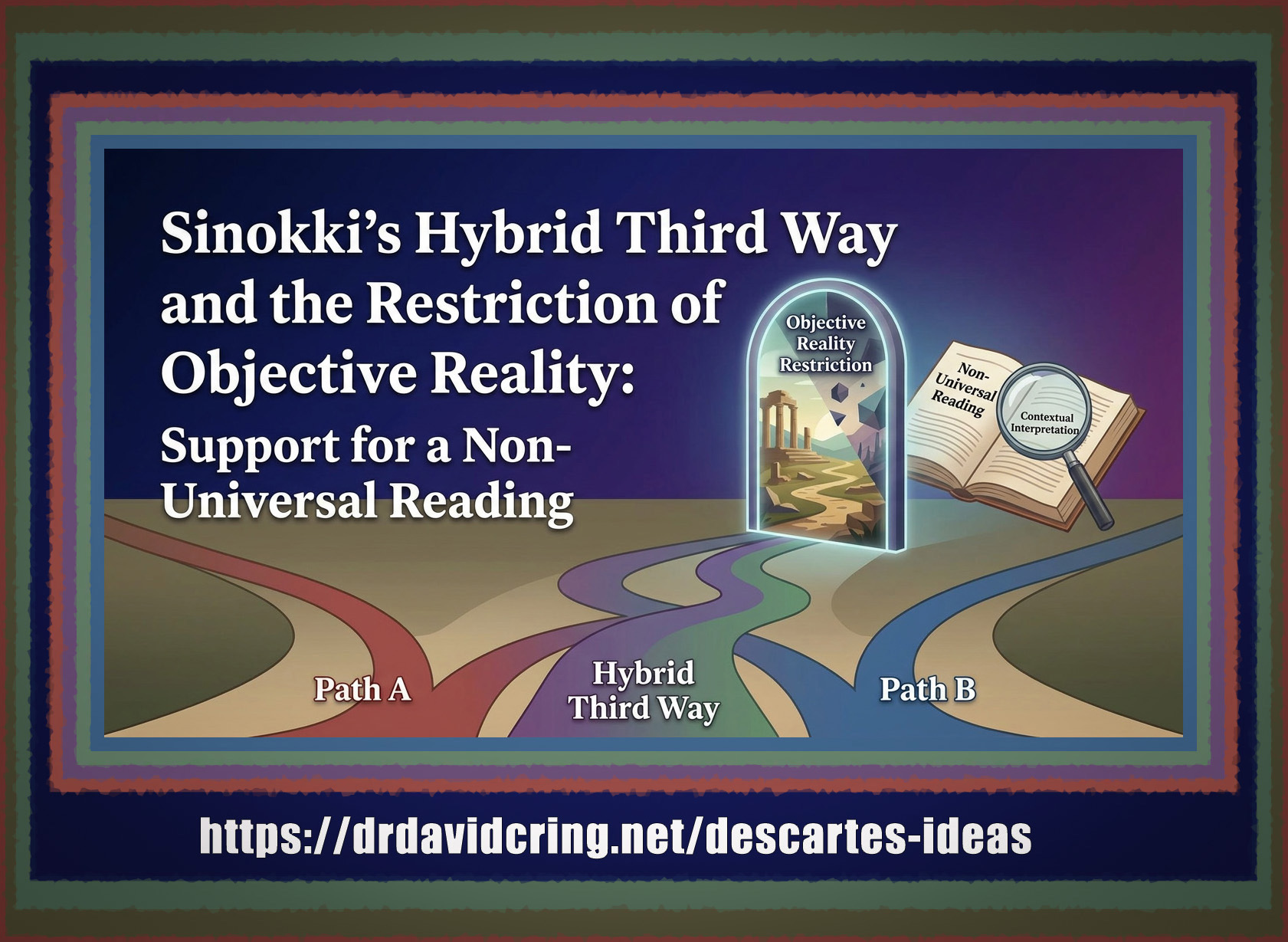
Jani Sinokki  develops a hybrid “third alternative” account of Descartes’s ideas and objective reality [in Ch. 3: Descartes’ Metaphysics of Thinking. PhD diss., University of Turku, 2016, Chapter 3 and in his Topoi article: “Having a Cake and Eating It Too? Direct Realism and Objective Identity in Descartes.” Topoi 43 (2024): 87–99. https://doi.org/10.1007/s11245-023-09981-8 that rejects both strong veil-of-ideas indirect realism and overextended direct realist readings. He argues that robust objective reality and objective identity—secured by causal transference of reality and a sortalist understanding of identity criteria—apply paradigmatically to ideas of actual objects whose formal reality can enter the mind, while representational and presentational features serve only as auxiliary devices for explaining seemings, illusions, and differences in cognitive adequacy. This scoped treatment directly supports the Restriction Thesis: objective reality succeeds as a framework for ranked representational content (God, finite substances, modes, and true-and-immutable natures or geometrical essences, Fifth Meditation, AT VII 64–65; CSM II 44–45) but necessarily falls silent for large classes of intelligible contents that function as modi cogitandi rather than ranked representations, including common notions and universals considered abstractly (Principles I.58), privative ideas such as the idea of nothing, and certain relational or modal necessities. Sinokki’s distinction between the material sense of “idea” (as operation of the intellect) and its objective sense, together with his critique of interpretations that equate objective reality with universal representational content or structure, supplies independent scholarly grounding for treating objective reality as powerful yet non-universal—precisely the position developed across the DTOI project and its extended material falsity taxonomy.
Jani Sinokki offers valuable independent support for the claim that objective reality (realitas objectiva) is not Descartes’s universal theory of ideas. In both Chapter 3 of his 2016 dissertation Descartes’ Metaphysics of Thinking and his 2023/2024 article “Having a Cake and Eating It Too? Direct Realism and Objective Identity in Descartes” (Topoi 43: 87–99), Sinokki develops a nuanced position that rejects the reduction of objective reality to strong representational content or structure while limiting robust OR to specific cases. His account aligns closely with—and helps substantiate—the Restriction Thesis that has guided the DTOI project.
Sinokki argues that Descartes’s view of ideas and objective reality bears earmarks of both direct and indirect realism but is best understood as a coherent third alternative. He writes that Descartes’s position “bears the earmarks of both direct and indirect realist views but must be classified as a third alternative combining some central features of both.” This hybrid reading is grounded in what Sinokki calls objective identity, developed through a form of sortalism (identity criteria depend on the kind or sort of object) together with the causal transference of reality. Robust objective reality and objective identity apply paradigmatically to ideas that contain or are the reality of actual objects whose formal reality can be transferred into the mind (the sun, intricate machines, and other cases of “actual things”).
Crucially, Sinokki does not extend this robust sense of OR universally. He uses concessive language that keeps the scope limited: “Even if all ideas of actual things similarly do contain the reality of their objects, they are nevertheless different from God’s idea…” He further distinguishes the material sense of “idea” (as an operation of the intellect) from the objective sense (as the thing represented), noting that these can involve distinct criteria of identity. Representational and presentational features of ideas—while real—function as auxiliary devices. They help explain why things seem as they do, including illusions and differences in cognitive adequacy, but they do not bear the primary explanatory burden for the metaphysical connection that secures that thinking is of something. That work is done by the being or reality of the thing itself when objective identity obtains.
This framework directly supports the Restriction Thesis. Objective reality succeeds as a framework for ranked representational content—God, finite substances, modes, and true-and-immutable natures or geometrical essences (Fifth Meditation, AT VII 64–65; CSM II 44–45). These are cases in which ideas exhibit determinate natures with measurable formal reality that can be inherited in objective being. By contrast, OR necessarily falls silent or operates differently for large classes of intelligible contents that function as modi cogitandi rather than as representations of ranked objects on the ontological hierarchy. This includes common notions, universals considered abstractly (Principles of Philosophy I.58: alia omnia, quae universalia vocamus), privative ideas such as the idea of nothing or non-being, certain relational and modal necessities, and other eternal truths understood structurally rather than as ranked res.
The same limitation appears in the extended taxonomy of material falsity and in the treatment of sensations: representational features and obscurity can be present without robust, ranked objective reality doing the primary ontological work. Sinokki’s distinction between objective reality (the thing’s being) and objective intricacy or artifice (variable richness of conception for the same object) further reinforces that OR is not coextensive with every instance of mental representation or every intelligible content.
The comparison table below summarises Sinokki’s critiques of universalising or reductive readings, his positive hybrid alternative, and explicit points of alignment with the Restriction Thesis categories developed in the DTOI project (including cross-references to the Fifth Meditation, Principles I.58, the material falsity taxonomy, and related primary texts).
Comparison Table: Sinokki’s Critiques, Positive Alternative, and Explicit Comparisons with Yolton, Wilson, and DTOI Restriction Thesis Categories
Aspect |
Problematic Interpretations Critiqued by Sinokki |
Sinokki’s Rejection / Diagnostic View (primarily Ch. 3) |
Sinokki’s Positive Alternative (Topoi article + building on Ch. 3) |
Alignment with / Extension via DTOI Restriction Thesis (Ring) |
|---|---|---|---|---|
| (S1) OR containment | OR treated as automatic or unproblematic presence in any mental content or act | Rejects automatic containment; insists on causal transference of the thing’s reality | Objective reality in an idea has its origin in the formal reality of the object existing outside the mind (via causal transference). The same reality exists in two modes: formally outside the mind and objectively in the intellect. | Supports limiting robust OR to cases with actual transferable ranked reality (not automatic for all contents) |
| (S2) Universality of OR across all ideas | OR (or representationality via OR) presented as general/universal feature of all ideas | Critiques Alanen’s claim that representation is “a general feature of all ideas” and sensory ideas “do not lack objective reality” (Alanen 2003, p. 148, quoted in Ch. 3) | Scoped and concessive: “Even if all ideas of actual things similarly do contain the reality of their objects…” (p. 95); contrasts with God’s idea | Strongly supports non-universality: OR succeeds for ranked representational content but falls silent for modi cogitandi, common notions (Principles I.58), idea of nothing, etc. |
| (S3) Equating OR with strong representational content/structure | OR reduced to mental representational content, structure, or intentional feature of which the subject is aware | “If the objective being is analyzed as something mental … it will unavoidably render the reading quite similar to indirect realism” (Ch. 3); accepts Hoffman’s mediation critique | OR = the object’s own reality/being present (not a representing mental structure); representational features are secondary | Rejects reduction of OR to representational content; OR as ontological presence for ranked res / true-and-immutable natures only |
| (S4) Scope of robust OR / objective identity | Broad or universal application without clear limits | Critiques failure to separate OR from objective intricacy and from representational structure (e.g., Carriero, Nadler) | Limited to cases involving the objective presence of an object’s reality via causal transference and sortal identity (e.g., the sun, machines); developed via sortalism | Directly supports Restriction: robust OR/objective identity applies to ranked substances, modes, and true-and-immutable natures (Fifth Meditation AT VII 64–65; CSM II 44–45); not to universals abstractly considered or privative ideas |
| (S5) Material / operational aspect of ideas | Often downplayed or collapsed into representational content | Notes the ambiguity but focuses on problems when OR is treated only as content | “‘Idea’ can be taken materially, as an operation of the intellect…” (quoting Descartes, CSM II 7; AT VII 9). Two senses can involve distinct identity criteria/kinds (p. 95) | Allows non-representational operational aspect; compatible with ideas functioning as modi cogitandi without full ranked OR |
| (S6) Role of representational features | Often made primary or exhaustive (connection explained via awareness of content/structure) | “The representationalist explains the connection … by the representational features of thought. Descartes explains the connection by the being of the thing itself, the representational features being only auxiliary devices…” (Ch. 3 conclusion) | Explain seemings, illusions, hallucinations, and cognitive differences (e.g., objective intricacy). Do not bear primary burden for the metaphysical “of-ness” connection | Representational features are real but secondary/auxiliary; primary burden for ranked connection borne by OR only where it applies |
| (S7) Overall position on realism / hybrid character | Forced into binary: direct (no mediation) or indirect (veil/mediation via content) | Diagnoses that even many “direct” readings collapse into indirect | Third alternative / hybrid: “bears the earmarks of both direct and indirect realist views but must be classified as a third alternative combining some central features of both” (abstract, p. 87). Uses sortalism + causal realism | Provides metaphysical resources for a non-binary framework that distinguishes ranked representational content (robust OR) from modi cogitandi contents (where OR is silent or different) |
| Yolton | Objective being as semantic/figurative (“to be in the understanding is simply to be understood”); ideas = perceptions (act view); seemings via sensations as signs | Too weak ontologically (“no metaphysical punch whatsoever”); underdeveloped signs doctrine; does not adequately explain difference between how things are and how they seem | N/A (critiqued as insufficiently robust) | Aligns with DTOI in rejecting overly strong ontological claims for OR but is critiqued by Sinokki for being too semantic/weak; DTOI strengthens this with explicit ranked vs. modi cogitandi distinctions |
| Wilson | Ideas have “representational character” (more than mere objects); divides into referential vs. presentational representation; thinking proceeds via cognitive presentation | Requires awareness of the presentation to reach the object — mediation; functionally like other content-based views | N/A (grouped with views that make representational features primary) | DTOI agrees with Sinokki’s critique: presentational/referential distinctions still subordinate to ranked OR vs. non-representational contents; Wilson-style division does not capture the Restriction Thesis scope limits |
| DTOI Restriction Thesis (Ring) | N/A (positive framework) | N/A | Compatible with and extended by Sinokki’s limitation of robust OR to cases involving the objective presence of an object’s reality via causal transference and sortal identity | Core claim: OR succeeds as framework for ranked representational content (God, finite substances, modes, true-and-immutable natures/geometrical essences — Fifth Meditation AT VII 64–65; CSM II 44–45) but necessarily falls silent for modi cogitandi, common notions, universals considered abstractly (Principles I.58), privative ideas (idea of nothing), relational/modal necessities. Cross-referenced with Conversation with Burman, Comments on a Certain Broadsheet, René Descartes to Denis Mesland, 2 May 1644 (AT IV 113–16; CSMK III 231–3, Rule 14, 1630 letters to Mersenne, and Sixth Replies. |
Sources
Ch. 3: Sinokki, Jani. Descartes’ Metaphysics of Thinking. PhD diss., University of Turku, 2016, Chapter 3.
Topoi article: Sinokki, Jani. “Having a Cake and Eating It Too? Direct Realism and Objective Identity in Descartes.” Topoi 43 (2024): 87–99. https://doi.org/10.1007/s11245-023-09981-8
Sinokki’s work thus provides a philosophically attractive middle path that avoids both the veil-of-ideas problems associated with strong representationalist readings and the over-extension of objective reality to every idea or thought-content. It supplies independent scholarly grounding for treating objective reality as a powerful but non-universal framework—one that succeeds for ranked representational content while remaining silent where Descartes’s texts indicate modi cogitandi or structural eternal truths are at issue as supported in my DTOI interpretation at “The Core DTOI Argument: Sensations Without Cartesian Objective Reality.”