


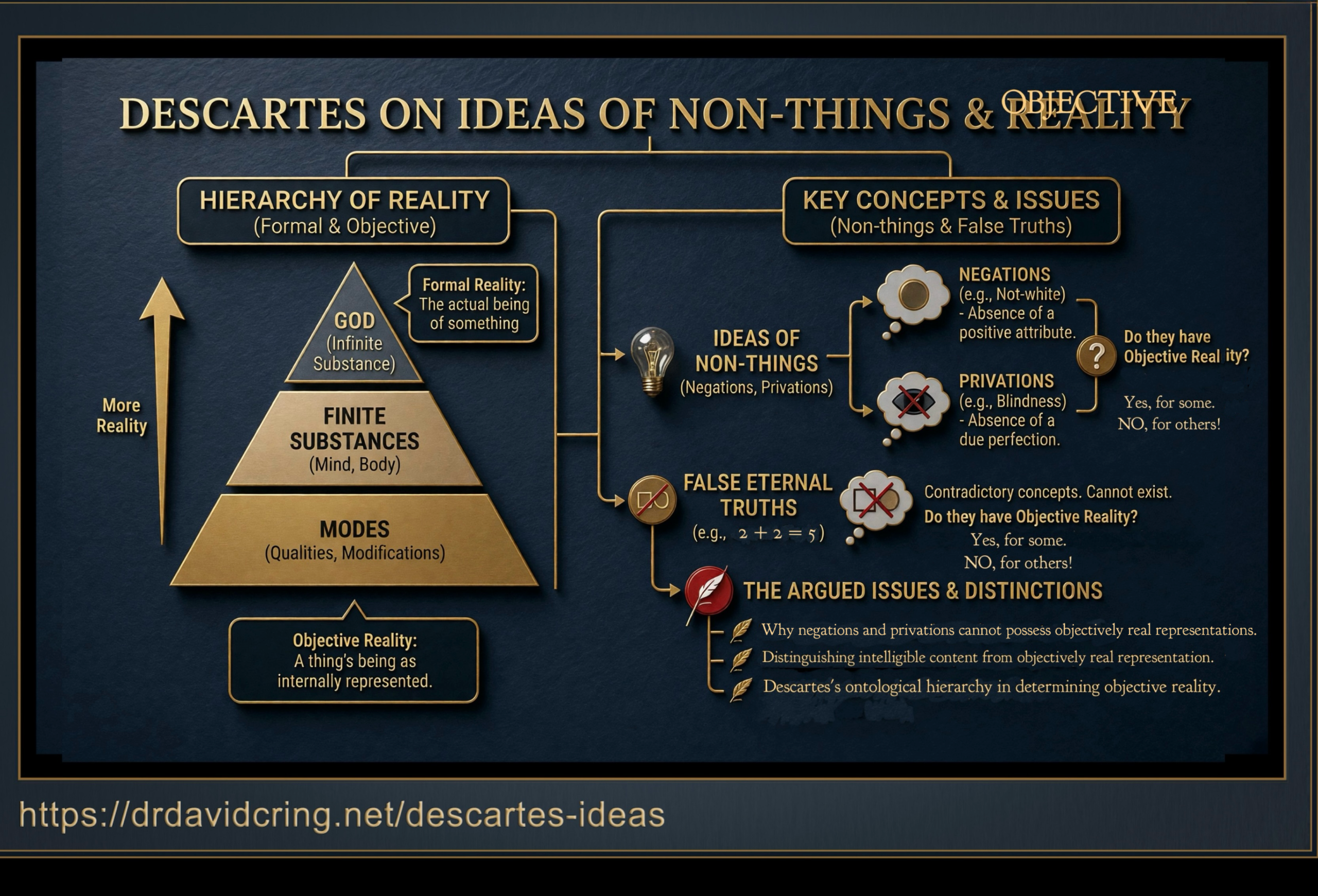
Abstract
Not every Cartesian idea contains an objective reality representation merely because it is a conscious mental mode or has determinate content. Whether an idea contains objective reality depends on whether it internally represents a representatum possessing objective being. In Sections 1–7, I defend this claim by applying Descartes’s definition to each alleged representatum and examining its ontological rank under the causal adequacy principle, which requires the cause of an idea to possess at least as much reality formally or eminently as the idea contains objectively (AT VII 40–42; CSM II 28–29). The intelligibility of a Cartesian idea does not establish that it contains an objectively real internal representation or, if it does, what degree of objective reality that representation possesses.
The bare idea of sight presents a challenge precisely because sight is a genuine positive capacity. Sections 9–12 distinguish an unexercised capacity from an occurrent conscious mental mode and argue that neither sight’s existence nor its intelligibility establishes an internal representation of a Cartesian mode, attribute, or true and immutable nature. Sections 13–17 develop a stronger conclusion concerning blindness. Four reductios exclude identifying this privation with a positive thing, mode, substance, or true and immutable nature; the ontological hierarchy and causal adequacy principle create further difficulties. Blindness and deafness remain distinguishable through the different capacities denied, while true judgments about their absence require no additional objectively real representations of the privations.
Ideas of absent cats and dogs can represent possible animals without separately representing their absences (Section 8). Sections 18–20 extend the distinction to common notions, impossible combinations, false necessary connections, and the proposed pure idea of necessity, whose possibility remains disputed. By contrast, Section 21 defends the stronger conclusion that the pure idea of non-existence contains no objective reality, since non-existence itself is neither an actual nor a possible thing. An opponent who posits an objectively real constituent idea of existence must establish both that the constituent is necessary and that existence in general possesses objective reality independently of any particular being.
Materially false sensations furnish another test in Section 22. A cold sensation presents phenomenal coolness, whereas smelling a rose presents an olfactory quality. These formally real sensory modes may have bodily causes and function as natural, lawfully governed external signs without internally representing their phenomenal qualities or bodily causes with objective reality. As Section 23 concludes, distinguishing phenomenal presentation and external signification from internal representation supports the Restriction Thesis, according to which a Cartesian idea possesses objective reality only insofar as it internally represents a representatum with objective being. This thesis neither restricts objective reality to clear and distinct ideas nor denies the intelligibility of ideas concerning non-things.
OLD BELOW of Earlier
Abstract
A Cartesian idea can be intelligible without internally representing everything it concerns with objective reality. In Sections 1–7, I defend the claim that not every Cartesian idea contains objective reality by applying Descartes’s definition to the alleged representatum and examining whether the attribution satisfies his hierarchy of represented being and causal adequacy principle. The cause of an idea must possess, formally or eminently, at least as much reality as the idea contains objectively (AT VII 40–42; CSM II 28–29). The mere occurrence or intelligibility of an idea does not establish that it contains an objectively real internal representation, much less identify the represented item’s ontological rank or the reality required of its adequate cause.
Sight and blindness test this claim in different ways. Sections 9–12 examine the bare idea of sight, a genuine positive capacity distinct from its exercise. Since an unexercised capacity is not an occurrent conscious mental mode, and sight is neither thought as the principal attribute of mind nor any particular bodily mechanism, calling sight a positive power does not establish that its bare idea internally represents a Cartesian mode, attribute, or true and immutable nature with objective reality. Sections 13–17 develop the stronger case against an objectively real representation of blindness within the idea of blindness. Four reductios in Section 15 exclude identifying blindness, a privation, with a positive thing, mode, substance, or true and immutable nature. Section 16 shows that assigning the alleged representation a degree of objective reality cannot be justified through Descartes’s ontological hierarchy and causal adequacy principle. Section 17 rejects the further inference from distinguishability. Ideas of blindness and deafness differ through the distinct capacities of sight and hearing and the intellectual acts recognizing their absence; true judgments about those privations likewise do not require that either idea internally represent its respective privation with objective reality.
The distinction between an absent positive thing and its absence is developed in Section 8. Ideas of an absent cat and an absent dog may contain objective reality belonging to possible animals without additional objectively real representations of their non-existence. Sections 18 and 19 extend the analysis to common notions, eternal truths, impossible objects, and false necessary connections, distinguishing positive constituent ideas from the alleged objective reality of a proposition or impossible relation itself. Section 20 argues that understanding a necessary connection does not establish an additional objectively real representation of necessity, while leaving the possibility of a pure idea of necessity disputed. By contrast, Section 21 defends the stronger conclusion that the pure idea of non-existence contains no objectively real representational content at all, since non-existence itself is neither an actual nor a possible thing. An opponent who claims that an objectively real idea of existence necessarily occurs as a constituent must establish both that the constituent is required and that existence in general, independently of any particular being, possesses objective reality. Neither claim follows from the intelligibility of non-existence.
A different challenge arises from materially false secondary-quality sensations in Section 22. A cold sensation presents phenomenal coolness, while smelling a rose presents a distinctive olfactory quality, without the phenomenal differences requiring internal representations with objective reality. These formally real sensory modes can have bodily causes and function as natural, lawfully governed external signs of those causes without internally representing them. Distinguishing phenomenal presentation and external signification from internal representation supports the Restriction Thesis, according to which a Cartesian idea possesses objective reality only insofar as it internally represents a representatum with objective being. As explained in Sections 1–7 and concluded in Section 23, this thesis does not confine objective reality to clear and distinct ideas or deny the intelligibility of ideas concerning non-things. Rather, it requires identification of the alleged internal representation, its ontological rank, and its adequate cause. The article challenges objective reality in the bare idea of sight, argues that the idea of blindness does not internally represent blindness with objective reality, and defends the complete absence of objective reality from the pure idea of non-existence.
OLD BELOW
The existence of a Cartesian idea does not establish that everything the idea concerns is internally represented with objective reality. An idea may have determinate intelligible content without containing an objectively real representation of everything that can be understood through it. I defend this distinction by examining Descartes’s definition of objective reality, which requires the being of a representatum internally represented in an idea, rather than merely something that can be understood or discussed. His causal adequacy principle and hierarchy of represented being impose further requirements. If an idea contains objective reality, the alleged representatum must possess a determinate degree of reality, and its adequate cause must contain at least as much reality formally or eminently. These requirements provide grounds for challenging attributions of objective reality that rest solely on the intelligibility of an idea. Blindness is a particularly important example because it is the absence of sight in a subject naturally capable of possessing that capacity. Understanding blindness requires distinguishing a sight-capable subject, the capacity for sight, and the denial that the subject possesses it. But none of these establishes an objectively real representation of blindness itself, since the subject and the missing capacity are not identical with the privation. The bare idea of sight presents a different difficulty because sight is a genuine positive capacity rather than an absence. Nevertheless, the existence of sight as a capacity does not establish that the bare idea of sight internally represents that capacity with objective reality. The proposed representation must be distinguished from ideas of particular visual experiences, bodily organs, and other positive features involved in seeing. Together, these examples challenge the inference from the intelligibility of an idea to its possession of objectively real representational content, whether the idea concerns a privation or a genuine positive capacity.
The argument against attributing objective reality to blindness proceeds by examining the strongest reasons for treating the privation itself as something internally represented. Four reductios establish that blindness cannot be classified as a positive thing, mode, substance, or true and immutable nature without ceasing to be the absence of sight. The further requirement of causal adequacy raises a difficulty that the distinction between formal and objective being does not resolve. Blindness has no positive being to which a degree of objective reality can be assigned. Assigning blindness no degree concedes that the privation contributes none, while assigning it a positive degree requires identifying a kind of represented being that the proposed Cartesian categories cannot accommodate. The ability to distinguish blindness from deafness supplies no missing justification. These ideas differ because sight and hearing are different capacities whose absence can be recognized in subjects naturally capable of possessing them. Similarly, a judgment that a person is blind or deaf can be true because the person lacks the relevant capacity. The differences between these ideas and the truth of the corresponding judgments can therefore be explained through the positive subjects and capacities involved, together with the intellectual acts of denial. Neither distinguishability nor truth requires blindness or deafness itself to contribute an additional objectively real representation. The defender must establish that such a representation is necessary and identify the being, degree of objective reality, and adequate cause belonging to the alleged representatum. The arguments developed here show why the defender’s proposed attribution fails to satisfy those requirements.
An absent cat and an absent dog illustrate a distinction that extends beyond blindness. Ideas of these animals can contain objective reality belonging to different possible finite substances even when neither animal exists, but that objective reality does not establish additional internal representations of the animals’ absences. The same problem arises with pure negations, impossible objects, and false eternal truths. Understanding a contradiction or a false necessary connection does not make the contradiction or false connection into a possible representatum possessing objective reality. A more demanding question concerns purely intellectual ideas of necessity and non-existence itself. The proposed pure idea of necessity presents a conditional challenge, since it remains necessary to establish whether necessity can be understood independently of the positive natures connected and whether necessity itself is an internally represented nature. Non-existence presents a stronger case. Unlike an absent cat, which is the kind of positive thing that could exist, non-existence itself is not any kind of thing, actual or possible, whose being could be internally represented. I defend the conclusion that the pure idea of non-existence is intelligible without containing any objectively real representational content.
Against that conclusion, the defender may maintain that an idea of non-existence necessarily includes an idea of existence or being that supplies objective reality to the complete idea. The objection must establish two independent claims. First, an idea of existence or being must be shown to be a necessary constituent of the idea of non-existence, rather than something understood in making the distinction between existence and non-existence. Second, existence or being considered in itself, independently of any particular actual or possible thing, must be shown to be internally represented with objective reality. Even if an objectively real constituent were established, its presence would not confer objective reality upon non-existence itself. Nor can the defender infer that such a constituent is necessary, or that existence as such possesses objective reality, merely from the intelligibility of non-existence. I argue that neither alleged requirement has been established and defend the stronger conclusion that the pure idea of non-existence contains no objectively real representation whatsoever.
A further difficulty arises when sight itself, rather than blindness, is considered as the subject of a bare idea. Sight is a genuine positive capacity, but possessing that capacity is different from exercising it in an actual episode of seeing. An unexercised capacity cannot be identified with an actual conscious modification of thought without confusing the capacity with its exercise. A person can possess sight while neither seeing nor being aware of the capacity. Descartes nevertheless insists in the Fourth Replies that actual thinking cannot occur without consciousness (CSM II 171; AT VII 246) and acknowledges that faculties may be possessed without being consciously apprehended (CSM II 172; AT VII 247). His description of the faculties of imagining and sensing as distinguished from thinking substance in the manner of modes in the Sixth Meditation consequently requires reconciliation with the difference between a standing power and its conscious exercise (CSM II 54; AT VII 78). Sight cannot simply be identified with thought as the principal attribute of mind, since a person born without eyes may retain intellectual capacities while lacking ordinary human sight. Nor is the general capacity identical with any particular eye, visual pathway, or bodily operation through which vision occurs, since different kinds of perceivers may exercise sight through different physiological structures. Calling sight a positive power therefore does not establish that the capacity itself, rather than its exercise, bodily realization, or possessor, is a determinate Cartesian mode, attribute, or true and immutable nature internally represented in the bare idea of sight. The positive status of the capacity cannot itself establish that its bare idea contains objective reality. This argument leaves open the possibility of a defensible account of such a representatum, but denies that its existence or internal representation has been established merely by identifying sight as a genuine capacity.
Materially false secondary-quality sensations provide an independent test of the same unrestricted attribution of objective reality, this time involving positive qualities actually presented in consciousness rather than missing capacities or disputed natures. A cold sensation is a formally real sensory mental mode whose phenomenal coolness is presented as its qualitative determination, not thereby internally represented as a corresponding bodily quality. Similarly, the experienced scent of a rose is a phenomenal determination of an olfactory sensation rather than an additional objectively real representation of a fragrance. These sensations are distinguishable by what they phenomenally present. The bodily conditions that cause a sensation explain why the formally real sensory mode occurs without establishing that its bodily cause is internally represented with objective reality. Through their natural, lawfully governed causal relations to bodily conditions, the sensations can also function as external representational signs of their causes without making those causes internally represented representata possessing objective reality. Phenomenal presentation, natural external signification, and internal representation through objective reality must therefore be distinguished rather than treated as a single relation. These cases support the Restriction Thesis, according to which a Cartesian idea contains objective reality only insofar as it internally represents a representatum possessing objective being in the idea. The thesis does not restrict objective reality to clear and distinct ideas, since an obscure strict idea may still represent a positive substance or mode, and it does not deny the intelligibility of ideas concerning negations, privations, impossible objects, or non-existence. Instead, an attribution of objective reality must identify the internally represented item, establish its ontological status and degree, and explain the corresponding requirement of causal adequacy. The arguments developed here reject objective reality belonging to blindness and non-existence themselves, challenge its unproved attribution to the bare idea of sight, and defend the stronger conclusion that the pure idea of non-existence has no objectively real representational content. Objective reality remains indispensable to Cartesian strict ideas, but neither the occurrence of a conscious mode nor the intelligibility or determinacy of its content establishes that objective reality is present.
Introduction: Objective Reality, Its Definition, and Its Limits
Descartes distinguishes an idea’s existence as a mental mode from the objective reality it contains insofar as it internally represents a thing. Yet the distinction does not establish that every Cartesian idea possesses both kinds of reality. We can understand blindness, think about a cat that has never existed, deny that anything exists, entertain a contradiction, or recognize a false claim about a necessary connection. In each case a thought occurs, but its occurrence does not identify what, if anything, possesses objective being within it. Nor does the thought’s determinate intelligibility tell us what degree of represented being is present or what could adequately cause it. The central error examined in this article is the inference from being able to think about something to its possessing objectively real representational content.
On my interpretation, ideas in the strict sense internally represent a representatum, the item represented, whose being is present objectively in the idea. Ideas in the broad sense include sensations and other conscious mental modes whose formal reality and intelligibility do not by themselves require such internal representation. Objective reality is the internally contained representational presence of the representatum, not the mere existence of the mental mode or a property automatically conferred on everything the mind can consider. Nor does clarity and distinctness alone determine whether objective reality is present. The relevant question is which content within a cognition, if any, is internally represented with objective being. Descartes’s definition in the Second Replies, together with his hierarchy of represented being and causal adequacy principle, supplies the standards for answering it.
Blindness makes the difficulty unusually clear. A sight-capable person can lack sight, and we can understand that lack and distinguish blindness from deafness or ignorance. A defender of unrestricted objective reality may concede that blindness is not a positive feature formally existing in the person while insisting that it nevertheless possesses objective being as something conceived. The distinction between formal and objective being makes this a serious objection. Its answer cannot consist merely in repeating that blindness is an absence. Sections 8–17 distinguish positive constituent ideas from the privations understood through them, reconstruct the defender’s inference and reductio from distinguishability, and examine whether blindness could qualify under any appropriate ontological category or possess a degree of objective reality satisfying Descartes’s causal requirements.
The example also exposes an easily overlooked difference between an absent positive thing and the absence itself. An idea of an absent cat may internally represent a cat, just as an idea of an absent dog may represent a dog. The animals could be represented even in a possible world in which neither had ever existed. Their different objectively real contents explain why the ideas differ; no additional objective being need be attributed to the animals’ absences. A true judgment that no cats exist likewise does not make non-existence into another represented being. This distinction prevents the restriction thesis from mistakenly denying objective reality to every complex idea that concerns an absence. It also prepares the more demanding argument of Section 21, where the proposed subject matter is non-existence itself, not a particular positive thing that happens not to exist.
Non-existence itself, I argue, is not merely an actual thing that happens to be missing. It is not any sort of thing, whether actual or possible. Consequently, distinguishing objective existence from formal existence does not establish that non-existence can possess the being Descartes requires of an objectively real representatum. A defender may reply that thinking of non-existence necessarily involves an idea of existence or being with objectively real content. That reply, even if successful, would establish at most the objective reality of a constituent idea, not of non-existence itself. I defend the stronger reading that the pure idea of non-existence contains no objectively real representation at all. A proposed constituent idea of existence would require independent proof both that it necessarily belongs to the thought and that existence considered as such possesses objective reality. Neither follows simply from understanding the contrast between existence and non-existence. The proposed pure idea of necessity in Section 20 differs because its possibility and the ontological status of necessity itself remain disputed.
Other cases test the proposed restriction from different directions. The positive ideas through which we understand a false common notion or false eternal truth do not thereby bestow objective being upon the false necessary connection. Even genuine necessary connections require us to distinguish the positive natures connected from any alleged further objectively real representation of necessity itself. Materially false secondary-quality sensations raise a complementary problem. A cold sensation is a positive, causally produced mental mode that presents phenomenal coolness without thereby internally representing a corresponding bodily coolness. Its lawful external signification of bodily conditions also differs from internal representation. These cases cannot all be resolved by the same argument, since a privation, an impossible combination, a necessary relation, and a positive sensation have different statuses. Together they show why objective reality must be attributed according to the being of an internally represented item, not simply according to the determinacy, truth, phenomenal character, or causal origin of a thought.
The paired examination of sight and blindness introduces another challenge. A person can possess sight while not seeing or even attending to the capacity. Ordinary human sight also depends on bodily conditions that a human being born without eyes lacks. Yet a positive capacity is not thereby an occurrent conscious mental mode, a principal attribute of mind, or any one bodily mechanism. Sections 9–12 test the strongest proposal that the bare idea of sight represents a positive functional power and ask what Cartesian being, if any, could belong to that alleged representatum. This argument is not identical to the argument against the objective being of blindness itself. It presses the restriction thesis against a genuine capacity rather than merely against a privation.
1. The Definition of Objective Reality in the Second Replies
The Introduction distinguished the occurrence of an idea from the presence of objective reality within it. Descartes’s definition supplies the starting point for defending that distinction against a defender who concedes that blindness lacks positive formal existence but maintains that it exists objectively in the intellect. The issue is not whether formal and objective being differ. Descartes expressly distinguishes them. The issue is whether this distinction permits us to attribute objective being to anything we can think about, including privations and contradictions whose alleged being has not been identified.
Descartes offers the decisive definition in the geometrical exposition appended to the Second Replies: “Objective reality of an idea. By this I mean the being of the thing which is represented by an idea, in so far as this exists in the idea.” (AT VII 161; CSM II 113) The Latin specifies the same governing relation: Per realitatem objectivam ideae intelligo entitatem rei repraesentatae per ideam, quatenus est in idea. The explanatory burden falls on entitatem rei repraesentatae, not merely on the fact that a subject can entertain a thought.
In the same definition Descartes writes, “For whatever we perceive as being in the objects of our ideas exists objectively in the ideas themselves.” (AT VII 161; CSM II 113) This offers a useful positive rule, but not an unrestricted converse. To discover that something is entertained as a subject of discussion is not to discover that it is a thing represented with being. Nor does the word object by itself settle whether an absence, contradiction, or negated proposition has the ontological status demanded by the definition.
On the present interpretation, objective reality is the internally contained representational content of a Cartesian strict idea: the representational presence in the intellect of its representatum, considered as a substance, principal attribute, true and immutable nature, or mode. The representatum, insofar as it possesses objective being in the idea, has a determinate ontological rank. That rank determines the degree of objective reality and the adequacy requirement on the cause. Objective reality depends on the idea’s formal reality but is not reducible to the idea merely considered as a mental modification.
The explanatory clause must not be converted into an unrestricted converse. An idea of blindness can involve an idea of a sight-apt subject, an understanding of sight, and a denial of that capacity without blindness thereby becoming another being represented alongside the subject. Likewise, understanding the words square circle or the false assertion that two and two make five does not establish a possible figure or a true mathematical connection. The occurrence of the thought is formally real, and its positive constituents may possess objective reality, but neither fact establishes that the privation, contradiction, or falsehood itself contributes objective reality.
The explicit hierarchy of substances and modes should not be treated as an exhaustive classification of all intelligible contents. True and immutable natures, eternal truths, and common notions raise separate questions about represented being. A truth can be grasped without its having been established that the proposition, rather than the positive ideas involved in understanding it, is an additional objectively real representatum. This qualification strengthens the test: a defender must establish the ontological status of the particular item alleged to be objectively represented.
2. The Third Meditation: Causation and Degrees of Objective Reality
An idea’s occurrence as a mental mode does not by itself establish that everything the idea concerns possesses objective reality. The definition in the Second Replies therefore raises a further problem: what prevents us from assigning objective reality to any intelligible subject matter merely because we can think about it? Descartes’s causal account supplies a constraint. Where an idea contains objective reality, its degree depends on the ontological rank of the internally represented representatum, and that degree requires a cause possessing at least as much reality formally or eminently. The formal reality of the idea establishes that a mental mode exists; it does not establish that every item the idea concerns is internally represented, or determine the rank of any alleged representatum.
Different kinds of represented things, rather than differences in the intensity of consciousness, explain why Cartesian ideas possess different degrees of objective reality. In the Third Meditation, Descartes writes that “the ideas which represent substances to me amount to something more and, so to speak, contain within themselves more objective reality than the ideas which merely represent modes or accidents” (AT VII 40; CSM II 28). A substance ranks above a mode in the order of represented being. Nothing in this comparison establishes that an idea possesses objective reality merely because it is conscious, intelligible, or capable of being distinguished from another idea.
That ontological difference becomes crucial in Descartes’s causal argument. The objective reality contained in an idea requires an adequate cause possessing the corresponding degree of reality formally or eminently (AT VII 41; CSM II 28). The idea of God consequently differs from an idea representing a finite substance. On Descartes’s argument, a formally finite thinker cannot provide the adequate cause of the infinite objective perfection contained in the idea of God. The inference depends on the positive ontological rank of the infinite substance internally represented, not on the mere ability to understand or pronounce the word infinite. Without an identified representatum and its degree of objective reality, the causal principle has no corresponding representational perfection to explain.
Particular care is required with Descartes’s claim that the objective mode of being belongs to ideas by their own nature (AT VII 42; CSM II 29). The claim occurs in the explanation of objective reality and its causal requirements for ideas considered as internal representations. It cannot establish, without an additional argument about the scope of idea, that every conscious mental mode called an idea in Descartes’s broader usage possesses objective reality. The question is whether the assertion concerns ideas insofar as they internally represent things or extends to sensations and other conscious modes even when no objectively real representatum has been identified.
Blindness exposes the consequences of extending the causal account beyond what has been established. A person who lacks sight is a positive finite substance, and an idea of that person may contain objective reality. Blindness itself, however, is the missing capacity, not another substance or a low-ranking positive mode. Assigning objective reality to blindness therefore requires identifying what being the privation allegedly possesses, what degree of reality belongs to it, and what could adequately cause that degree formally or eminently. Neither the objective reality of an idea of the sight-capable person nor any as-yet-unproved objective reality of the bare idea of sight supplies objective reality to blindness itself. The rank of a positive subject or capacity cannot simply be transferred to its absence.
Read in its argumentative setting, the assertion that objective being belongs to ideas by their own nature establishes the causal importance of objective reality where ideas internally represent things; it does not settle the separate question of whether every broad-sense Cartesian idea does so. Extending the assertion to all conscious mental modes would require proving that each mode internally represents a representatum possessing objective reality. That universal premise is disputed throughout this article. Descartes’s hierarchy and causal adequacy principle provide reasons to demand an account of what is represented, rather than permission to infer objective reality from the occurrence or intelligibility of an idea alone.
3. Caterus, Objective Being, and the Scholastic Alternative
Scholastic discussions introduce a serious alternative to the Cartesian causal account. The intellect can conceive blindness or another being of reason without thereby discovering an additional positive thing outside thought. Caterus’s objection presses whether objective being contributes anything beyond the intellectual act’s determination by its object. Descartes’s reply, using the sun as objectively present in an idea but not formally present there as a physical sun, insists that the objective being relevant to his argument cannot simply be dismissed as nothing. The causal requirements of the idea must still be explained.
In the First Objections, Caterus questions whether objective being amounts to anything beyond the determination of an act of intellect by its object (AT VII 92; CSM II 66) Descartes insists that the sun in the intellect does not formally exist there as the sun exists in the heavens, yet its objective existence is not simply nothing (AT VII 102; CSM II 74) His answer rejects the suggestion that objective being is merely an extrinsic label without causal consequences.
The contrast with Suárez needs careful handling. Suárez’s distinction between conceptus formalis and conceptus objectivus distinguishes the actual intellectual act from what it conceives; his treatment of beings of reason permits an objective concept of a privation without treating that privation as a real positive entity. Descartes’s stronger demand that objectively real perfection have a formally or eminently adequate cause must not be silently identified with this scholastic permission to think absences. 1On Suárez, compare Disputationes metaphysicae, II (formal and objective concepts) and LIV (entia rationis). The claim that Suárez’s objective concept of a privation by itself warrants Cartesian objective reality is precisely what requires an argument. Caterus’s objection and Descartes’s reply are at (AT VII 92; CSM II 66) and (AT VII 102; CSM II 74)
The distinction between a conceptus formalis, the intellectual act, and a conceptus objectivus, what is conceived, offers a defender a way to describe the thought of blindness. It does not settle whether a privation possesses objective reality in Descartes’s causal sense. Calling blindness a being of reason may describe its intelligibility without identifying a represented perfection to which an ontological rank and causal adequacy requirement belong. What the scholastic account permits us to conceive must not simply be identified with what Descartes requires an objectively real strict idea to represent.
The positive mental act by which blindness is considered certainly has formal reality. The act may employ ideas of a person, bodily organs, or other positive items that contain objective reality. But the reality of the thinker, the content of those ideas, and the absence of sight in the subject are three different matters. The exchange with Caterus therefore sharpens, rather than removes, the burden of proving objective being belonging to blindness itself.
4. The Ontological Scale and Its Limits
The rank-ordering becomes a substantive difficulty when a defender claims that blindness itself has objective being. Blindness is not simply a mode at the lowest level of the hierarchy: it is a privation, rather than a positive determination of the substance. To assign a positive degree of objective reality to it requires identifying what being that degree measures. To assign no degree concedes that blindness itself contributes no objective reality. Naming the privation as an object of thought does not resolve the dilemma.
The rank-ordering is explicit: infinite substance has more reality than finite substance, which in turn has more than a mode. In Axiom VI Descartes applies these differences to the objective reality of corresponding ideas (AT VII 166; CSM II 117) It would be a mistake to infer that anything thinkable automatically receives a place in this hierarchy. One must first identify the represented item, then determine its grade; the mere occurrence of a thought does not fix either.
A complication arises with mathematical truths and common notions. They may be grasped intellectually although they are not conveniently classified as substances or bodily modes. A defender of broad objective reality can appeal to this fact to argue that the hierarchy is not an exhaustive inventory of its possible subjects. But it is equally unwarranted to infer that every proposition, including a false common notion, possesses objective being as a proposition. The mere existence of the concepts used in a proposition does not make the proposition itself a positive item with its own objective-reality rank.
There is a significant objection to treating the hierarchy as an exhaustive list. Mathematics, eternal truths, common notions, and true and immutable natures are intelligible even though a proposition is not straightforwardly a finite substance or bodily mode. But the existence of these cognitions does not by itself prove that every truth is objectively represented as a truth, still less that every false proposition or privation is objectively represented as an additional being. The defender must distinguish the objective reality of positive constituent ideas from any alleged objective reality of their connection, denial, or absence.
Accordingly, the hierarchy is neither a catalogue of every possible thought nor a license to invent an unranked kind of objective reality whenever a thought is intelligible. In cases beyond the explicit comparisons of substance and mode, the defender owes an account of the supposed represented item, its degree of being, and its adequate cause. An appeal to the possibility of intellectual understanding does not discharge those obligations.
5. Is Objective Reality Restricted to Clear and Distinct Ideas?
No. Clarity and distinctness should not be mistaken for a constitutive condition of objective reality. An idea can represent a finite substance imperfectly while nevertheless having determinately representational content. Obscurity of apprehension does not logically entail absence of a representatum. Equally, consciousness of a mode’s felt quality does not entail that the mode internally represents a property over and above that felt quality.
The right diagnostic question is: which content within this cognition, if any, is internally represented and bears objective reality? A subject can have an obscure idea with genuine objective reality, or a clear apprehension of a sensation as a sensation without objective reality of a bodily secondary quality. To suppose that clarity is the only measure leaves these two alternatives invisible. The contrast is developed in Descartes’s treatment of secondary-quality sensations in Principles I.68 (AT VIIIA 33; CSM I 217).
6. What Does It Mean That We Cannot Conceive Anything Except as Existing?
Axiom X presents an apparent obstacle to ideas of non-things lacking objective reality. If existence is contained in the concept of every thing, one might argue that whatever the intellect can conceive must possess at least objective being. But the axiom distinguishes what belongs to the concept of a thing from every proposition a thinker can formulate about something allegedly impossible. It also distinguishes possible or contingent existence from the necessary existence attributed to God. Conceiving a finite thing does not affirm that it actually exists.
Axiom X of the Second Replies declares, “Existence is contained in the idea or concept of every single thing, since we cannot conceive of anything except as existing.” (AT VII 166; CSM II 117) The qualification matters. Descartes distinguishes possible or contingent existence in the concept of a limited thing from necessary and perfect existence in the concept of a supremely perfect being (AT VII 166; CSM II 117) Therefore the axiom does not imply that every conceived triangle or horse actually exists.
The harder case is the thought that God cannot exist. A defender can say that the mind joins or denies ideas without successfully conceiving the purported impossible object. Descartes explains contradiction in terms of mistakenly conjoining inconsistent ideas (AT VII 152; CSM II 108) Yet the ability to entertain or deny a sentence does not automatically supply an objectively existing representatum for the whole sentence. This distinction anticipates the argument concerning false eternal truths. 2The Euclidean angle-sum theorem in the Fifth Meditation ((AT VII 64; CSM II 44)) is not a geometry-independent property of every mathematical system called a geometry. Hyperbolic triangles have angle sum below 180 degrees; spherical triangles have angle sum above 180 degrees. The contrast concerns different geometrical structures and does not by itself show that Euclidean geometry is inconsistent. It does show why an alleged necessary property must be identified relative to its axioms rather than treated as inherent in any use of the term triangle.
Consider the statement that God cannot exist. On Descartes’s account this statement cannot describe a genuine possible divine nature, since necessary existence belongs to the supremely perfect being. Yet one can entertain the statement and understand its denial. Likewise, someone can assert that two and two make five, or describe a square circle, while employing intelligible ideas of positive numerical or geometrical contents. Entertaining an assertion is not the same as successfully conceiving its alleged impossible representatum. The positively understood constituents do not make their contradictory combination an additional objectively real nature.
The same distinction applies to blindness. The person, sight, and the mental act of denial may each be understood, but their conjunction in a thought of blindness does not establish that the privation itself possesses objective being. Axiom X does not eliminate the distinction between a possible thing represented within an idea and a denial or privation about which the thinker can make a judgment.
7. Provisional Test for an Idea’s Objective Reality
The following tests are consequences of the preceding interpretation, not a three-part decision procedure stated verbatim by Descartes. They concern what an attribution of objective reality must explain, rather than whether the thought is true, vivid, or clearly and distinctly perceived. A formally real mental mode may be intelligible without every item it concerns possessing objective reality.
An attribution of objective reality should satisfy three demands. It must identify an internal representatum, rather than merely a word, act, sensation, or extrinsic sign; give an account of the being attributed to the item represented; and explain how any proposed degree of objective reality fits Descartes’s causal and ontological apparatus. These demands are not a decision procedure supplied verbatim by Descartes. They are consequences proposed on the basis of his definition, hierarchy, and causal principle.
The strongest challenge comes from privations. We can think about blindness, distinguish it from sight, and infer that someone is blind. Does the determinacy of this thought make blindness itself an objectively existing item in the idea? The second part examines the most compelling affirmative answer before arguing that the inference mistakes the positive materials of a cognition for the objective being of its privative subject matter.
8. Negations, Privations, and the Being of What Is Absent
The preceding sections have distinguished having an idea of something from containing an objectively real representation of that very item. Absences make this distinction especially important because an idea can concern something missing without the absence itself being a thing. We can think about an absent cat, distinguish that idea from an idea of an absent dog, and make a true judgment that neither animal is in the room. But which contents, if any, possess objective reality? The distinction between what is absent and the absence itself must be established before turning to negations and privations. Otherwise, the fact that some ideas concerning absences have objective reality could be mistakenly taken to establish that their absences are themselves objectively represented.
Consider first the idea of an absent cat. The cat need not be present, and no actual cat need correspond to the idea, for the idea to internally represent a cat with objective reality. Its represented content concerns a possible finite substance. Likewise, the idea of an absent dog can contain an objectively real representation of a dog. The two ideas differ because cats and dogs are different positive things with different representable characteristics. Neither distinction requires a further objectively real representation of the cat’s absence or the dog’s absence. The presence of objective reality belonging to what is absent must not be confused with objective reality allegedly belonging to the absence itself.
Now suppose that in an entire possible world no cats exist and none ever have existed. We can truly say that there are no cats in that world. But this is not the absence of some particular cat that has departed or ought to be present. It is the nonexistence of cats throughout that world. Even here, an intellect capable of forming an idea of a cat could possess an objectively real representation of the kind of finite substance a cat would be, despite there being no actual cats anywhere in that world. What does not follow is that the nonexistence of cats supplies a second objectively real item in the idea. The truth of the denial is not evidence that nonexistence is itself another thing with being to be represented.
A pure negation is a mere absence of something that the subject is not naturally supposed to possess. A stone’s lack of sight is a useful example, since vision is not a capacity belonging to the nature of a stone. A privation, by contrast, is an absence of a perfection that ought, in the relevant respect, to be present. Blindness in a person or animal naturally capable of sight is a privation. Descartes employs this distinction in the Fourth Meditation when he treats error as a privation of knowledge rather than a pure negation (AT VII 55; CSM II 38) Later, he explains that the privation constituting fault requires no divine concurrence because it is not a thing (AT VII 61; CSM II 42) The positive being of the subject and of the mental act recognizing an absence must therefore be distinguished from the privation itself.
Descartes’s discussion in the Fourth Meditation concerns error rather than blindness, but the proposed extension rests on more than a resemblance between two cases of something missing. Both are privations because each consists in the absence of a perfection that ought to be present in the relevant subject. If the absence constituting error is not a thing, the same ontological reasoning applies to the absence constituting blindness. The reductios in Section 15 defend this generalization rather than simply assuming it. A further argument is nevertheless required. Since Descartes distinguishes objective from formal being, establishing that blindness is not a positive thing does not, by itself, establish that an idea cannot contain an objectively real representation of blindness itself. Section 16 examines that further claim in light of the hierarchy of reality and the causal adequacy principle.
The example of blindness clarifies what is at issue. A sight-capable person is a positive finite substance, and sight is a positive capacity. The idea of the person can contain objective reality; whether the bare idea of sight does so is separately tested in Sections 9–12. But blindness as a privation is not the person, the capacity, or an additional positive feature alongside them. It is the lack of sight where sight ought to be present. Just as an idea of an absent cat can represent a cat without representing its absence as another thing, an idea through which blindness is understood can involve positive representations without adding an objectively real representation of blindness. This comparison does not independently prove that an absence cannot have objective reality attributed to it. It shows why objective reality belonging to the positive contents is not evidence for objective reality belonging to their absence.
A defender may reply that the determinate intelligibility of blindness itself requires an objectively real representation of the privation. The idea of blindness differs from the idea of deafness, and we can truly judge that one person lacks sight while another lacks hearing. Yet these differences can be explained through our intelligible grasp of sight, hearing, and their respective subjects, together with the denials by which their absence is understood. Determinate intelligibility does not, by itself, establish that each absence contributes additional objectively real representational content. Sections 13, 14, and 17 develop the defender’s strongest version of this objection and the response to it.
Nor does the truth of a judgment about an absence establish that the absence possesses objective reality. We can correctly judge that a person is blind because that person lacks sight. We can also correctly judge that no cats exist in a possible world. Neither judgment requires blindness or the nonexistence of cats to be an additional thing with being of its own. The ideas through which these judgments are formed may contain objectively real representations of positive things, including persons and cats. Whether the bare idea of sight also possesses objective reality remains a separate issue. But the truth of the judgments does not transfer objective reality from those represented things to what is denied or lacking. To infer otherwise would confuse what makes a judgment true with what, if anything, possesses objective being within an idea.
The distinction established here has consequences beyond blindness. An idea of a nonexistent thing can possess objective reality because it internally represents a positive thing that could exist. An idea concerning an absence may also contain objectively real representations of positive constituents without the absence contributing objective reality of its own. The defender who attributes objective reality to blindness itself must therefore identify what kind of being belongs to the privation, what degree of objective reality that being possesses, and how the alleged degree satisfies Descartes’s causal adequacy principle. Appealing to the positive subject, the missing capacity, or the truth of a judgment about their relation does not answer these questions. Section 21 raises the more radical case of the pure idea of non-existence itself, considered apart from any cat, dog, person, missing capacity, or other positive item. Non-existence is not an actual thing or a possible thing, and its being intelligible does not establish that it can possess objective being in an idea. Whether the pure idea also lacks all objectively real constituent content requires separate consideration. The claim established here is more limited but indispensable: objective reality belonging to what is absent does not establish objective reality belonging to the absence itself.
9. The Bare Idea of Sight: A Positive Capacity and Its Possible Representatum
The preceding discussion of blindness relied on a contrast between a positive capacity and its privation. Blindness is the absence of sight in a subject naturally suited to possess it. The capacity for sight, by contrast, can genuinely belong to a person even when that person is not seeing anything. But this difference raises a question that cannot be settled by calling one positive and the other privative. Does the bare idea of sight contain an objectively real representation of sight itself? Or can we understand the capacity to see without thereby internally representing a further item that possesses objective being?
The proposed representatum must be specified carefully. I am not asking whether an idea of an eye, a human body, a visual scene, or a particular act of seeing can contain objective reality. Such ideas have their own subjects. The question concerns the bare idea of sight, understood as the capacity to see. If a defender attributes objective reality to that idea, the relevant objective being must belong to the capacity itself, not merely to an eye, a visible object, or a conscious visual experience that may accompany its exercise.
A working characterization is that sight is the capacity for direct perceptual apprehension and discrimination of visually accessible features of objects and events. This characterization does not assume that seeing always involves identifying the object seen, forming a judgment about it, or being conscious of seeing. Nor does it build a human eye or any particular visual apparatus into the meaning of sight. It identifies a capacity through what that capacity enables a perceiver to do. Whether this functional characterization identifies an independently representable Cartesian being is a different matter.
Ordinary human sight certainly depends on the body’s organization. Consider a human being born without eyes. The person can still be a thinking substance, capable of understanding and willing, without possessing the ordinary human capacity for vision. Even among sighted persons, possessing sight does not mean that visual perception is continuously occurring. The person retains the capacity with closed eyes, in darkness, or while attending to something other than a visual scene. The capacity and its exercise are not identical.
Descartes himself distinguishes faculties from their exercise. In the Sixth Meditation he writes, “Besides this, I find in myself faculties for certain special modes of thinking, namely imagination and sensory perception” [“Praeterea invenio in me facultates specialibus quibusdam modis cogitandi, puta facultates imaginandi, et sentiendi”] (CSM II 54; AT VII 78). A faculty for a mode of thinking must be distinguished, at least conceptually, from a particular occurrence of that mode. Possessing the faculty of sensing is not the same as now having a sensation.
Yet Descartes immediately introduces a complication. He says of the faculties of imagining and sensing that he perceives them to be distinguished from himself “as modes from a thing” [“ut modos a re”] (CSM II 54; AT VII 78). This is genuine textual evidence for their modal dependence on a thinking substance. It does not, without further interpretation, establish that a faculty which is not being exercised is an occurrent modification of thought. The modal language requires examination, especially in light of Descartes’s refusal to admit unconscious thoughts. Section 10 will take up that difficulty directly.
The same Sixth Meditation distinguishes faculties involving the intellect from faculties involving extension. Descartes includes changing place and taking on different shapes among faculties that must belong to corporeal rather than thinking substance, because extension rather than intellection enters their clear and distinct conception (CSM II 54–55; AT VII 78–79). A further distinction separates the mind’s passive faculty of sensory perception from an active faculty responsible for producing the corresponding sensory ideas. The latter cannot simply be assigned to the mind considered alone. Thus, even Descartes’s own discussion does not license treating every faculty implicated in perception as a power of thinking substance.
Nor should we identify sight with a particular conscious visual experience. A case of blindsight makes the difficulty plain. A subject may discriminate or locate features of a visual stimulus through functioning visual pathways without the ordinary conscious visual experience of those features. Whether every experimental case deserves the name seeing is debated, but the philosophical possibility matters here. If such visually guided discrimination counts as seeing, a definition requiring a conscious visual sensation will be too narrow. Insects and other animals also exhibit visual discrimination without requiring the sophisticated perceptual judgments characteristic of human vision.3For a major informational account of seeing, see Fred Dretske, Seeing and Knowing (Chicago: University of Chicago Press, 1969), and his discussion of perceptual information, receptor systems, and the availability of information for action in “Perception Without Awareness”, in Perceptual Experience, ed. Tamar Szabó Gendler and John Hawthorne (Oxford: Oxford University Press, 2006), 147–80. These accounts offer resources for characterizing perceptual capacities, not evidence that Descartes assigns objective reality to the bare idea of sight. The philosophical use of blindsight here does not depend upon the stronger empirical claim that every kind of blindsight constitutes unconscious seeing.
The distinction between sight and its bodily realization also runs in the other direction. Suppose that an incorporeal perceiver could directly apprehend visually accessible features of an object. Whether angels, ghosts, or God actually see is not settled by this supposition. Its point is conceptual: the capacity for sight as presently understood does not specify a retina, optic nerve, or brain as a necessary constituent. One may dispute whether the stipulated perception should count as sight; one cannot resolve that dispute by silently importing the anatomical conditions of human vision into the general concept.
Neither does sight reduce to the mere receipt of information about visible objects. A person might learn the position of a chair from a spoken description without seeing it. Information that guides an action may arrive through hearing or touch as well as through sight. A characterization of sight therefore needs a distinction between visual perceptual access and other means of acquiring information. But even an improved account of that distinction would tell us how to identify sight, not yet what Cartesian ontological category the capacity itself occupies.4Compare Dretske’s “Perception Without Awareness”, especially his discussion of information carried by appropriate sensory receptors and available for the guidance of action. Requirements proposed for identifying an occurrence as visual perception must not be mistaken for an account of the objective reality of an idea of the capacity for visual perception.
One might now propose the following answer. Sight is a positive functional power belonging to a perceiver, and the bare idea of sight internally represents that power. Unlike blindness, sight is something a perceiver can actually possess. The proposed representatum is therefore not the privation but the capacity itself. This is the strongest initial defense of objective reality in the bare idea of sight, precisely because it does not confuse the capacity with any one episode or mechanism through which the capacity is exercised.
Nevertheless, describing sight as a power does not establish the being that would be present objectively in its idea. Descartes defines objective reality in terms of “the being of the thing which is represented by an idea, in so far as this exists in the idea” [“entitatem rei repraesentatae per ideam, quatenus est in idea”] (CSM II 113; AT VII 161). Here the explanatory burden falls upon what is represented with being, not upon the mere possibility of applying a concept correctly.
The capacity for sight is genuine when it belongs to an appropriately constituted perceiver. I do not deny the existence of such capacities, nor do I assume that conceptual ideas are incapable of containing objective reality. A purely intellectual idea may internally represent a determinate nature. The issue is whether the bare concept capacity to see contains an objectively real representation of a determinate Cartesian substance, attribute, mode, or true and immutable nature. The description of a function is not, without argument, an identification of such a representatum.
This gives us a more demanding problem than the one initially raised by blindness. Sight is not a negation or privation, and actual perceivers may possess it. If the bare idea of sight nevertheless lacks objectively real representational content, that conclusion cannot rest on sight’s non-existence or lack of intelligibility. It must be established by examining the alleged being of the capacity itself and whether that being is internally represented. The next section considers the proposed classifications of sight as a mode or attribute of mind or body; Section 11 then examines whether calling it a positive power or a true and immutable nature supplies what those classifications may fail to provide.
10. Why Sight Cannot Simply Be Classified as a Cartesian Mode or Attribute
If the bare idea of sight internally represents the capacity to see, what kind of Cartesian being would that capacity possess? Calling it a positive power does not answer the question. The defender must determine whether sight is a mode of thinking, a mode of extension, an attribute, or some other positive determination that could be the idea’s representatum. The alternatives face difficulties that become apparent once the standing capacity is distinguished from its exercise.
Begin with the proposal that sight is a mode of mind. Descartes identifies thinking as the principal attribute of mental substance in Principles I.53 (CSM I 210; AT VIIIA 25). Particular acts of understanding, doubting, willing, imagining, and sensing are determinate ways of thinking. In Descartes’s account, an actual thought cannot be an occurrence of which its thinker is wholly unaware. He states in the Fourth Replies, “we cannot have any thought of which we are not aware at the very moment when it is in us” [“nec ulla potest in nobis esse cogitatio, cujus eodem illo momento, quo in nobis est, conscii non simus”] (CSM II 171; AT VII 246).
An unexercised capacity for sight fails this test. A person can possess sight without currently seeing and without consciously attending to the fact that the capacity is possessed. The potential to have a visual experience is not the visual experience. Nor does the capacity become an actual act of understanding simply because someone else describes it as a faculty of mind. If a mode of mind is an actual conscious determination of thought, the standing capacity is not such a mode.
Descartes himself supplies an important qualification to his consciousness principle. In the Fourth Replies he acknowledges that “we are not always aware of the mind’s faculties or powers, except potentially” [“facultatum, sive potentiarum, non semper, nisi potentia”] (CSM II 172; AT VII 247). This admission does not disclose a hidden visual perception or unconscious thought. It distinguishes the possession of a power from the conscious operations in which it is used. We can become aware of our faculties when we attend to their exercise without having been continuously aware of the faculties beforehand.
The defender may appeal again to the Sixth Meditation, where Descartes says the faculties of imagining and sensing are distinguished from the thinking substance “as modes from a thing” [“ut modos a re”] (CSM II 54; AT VII 78). The grammatical reference is to the faculties themselves. We should not conceal that difficulty by claiming that Descartes is talking only about their actual exercises. But the passage also calls them faculties for particular modes of thinking and requires an intellectual act in their formal conception. It does not explicitly say that an unused faculty is a continuously existing unconscious thought. The defender must reconcile the modal language with the equally explicit admission that faculties may be possessed without awareness.
One reconciliation treats the faculty as a dependent power grounded in the nature of the mind, while reserving actual mental mode for an occurrent conscious exercise of that power. This preserves the difference between capacity and actuality. It also raises a further question: does the modal distinction in the Sixth Meditation classify the standing potentiality as an additional mode, or does it mark the faculty’s dependence on a substance whose actual operations are modes? The text does not settle that question simply by using the word mode. Dependence upon a substance is not sufficient, by itself, to establish an additional occurrent modification of consciousness.5For discussion of Descartes’s division between substance, principal attribute, and mode, see Kurt Smith, “Descartes’ Theory of Ideas,” Stanford Encyclopedia of Philosophy, section 1. The ontological classification of mental modes does not independently establish that an unexercised capacity is a presently occurring thought or that its bare idea contains objective reality.
Could sight instead be the mind’s principal attribute? No. That attribute is thought, not sight. A person born without eyes is not therefore deprived of thinking substance or of its capacity for intellectual thought. The mind is intelligible without the ordinary human faculty of vision. Conversely, the ability to see, considered as a distinct specific capacity, is not coextensive with the essential nature of every thinking substance. Identifying it with the principal attribute would erase distinctions that Descartes’s account requires.
The proposal that sight is some other attribute of mind is less easily dismissed. In Principles I.56, Descartes uses the terminology of modes, qualities, and attributes according to different ways of considering what belongs to a substance; the fact that something is called an attribute does not guarantee that it occupies the same position as the principal attribute (CSM I 211; AT VIIIA 26). A defender must therefore specify what the proposed attribute consists in. If it is a particular conscious act, the capacity has been exchanged for its exercise. If it is a potentiality grounded in the mind’s nature, its status as an additional objectively representable determination remains to be established. The label nonprincipal attribute cannot perform that argument by itself.
Relocating sight to extended substance creates a different difficulty. Human visual capacity depends upon bodily organization. Eyes, visual pathways, and brain processes explain how visual information reaches and affects the human being. A person lacking the structures needed for ordinary visual function will lack the corresponding embodied capacity. But an eye is not sight, a physiological motion is not the standing capacity, and the spatial organization of one kind of visual apparatus is not identical with sight considered generally. What realizes a capacity in a particular body is not automatically the capacity itself.
Different animals possess substantially different visual mechanisms. Moreover, if the concept of sight permits the hypothetical possibility of incorporeal seeing, no bodily shape or motion can be a necessary constituent of sight as such. Descartes’s physiology of ordinary human vision may explain its bodily conditions without supplying a single bodily mode that is the representatum of the bare idea of sight. The defender would have to show that a more general positive determination belongs to the relevant substance or substances, rather than assuming that the functional description itself establishes such a mode.
The strongest objection to these exclusions is that real powers need not be identical with their exercises. An unexercised disposition can genuinely belong to a substance. I grant this point. The argument is not that capacities are unreal, nor that every nonconscious condition is therefore impossible in a created substance. It is that the defender has not identified the positive Cartesian being of sight as a capacity by identifying any particular conscious thought, bodily motion, principal attribute, or physiological structure. A standing power may be grounded in the nature or arrangement of a substance without thereby being shown to be an additional actual mode of thought.
The result is therefore stronger than a bare request for evidence, but more discriminating than a proof that no category could possibly accommodate sight. Our analysis rules out identifying the bare capacity with an occurrent act of seeing, with thought as the principal attribute of mind, or with any one bodily implementation of vision. It also makes a specific demand upon the proposed classifications of sight as a nonprincipal attribute or standing dependent power. The defender must explain the positive being of that alleged item without confusing the capacity with its exercise, its bodily conditions, or its possessor. Section 11 examines whether a general power or true and immutable nature can meet that demand and, separately, whether the bare idea internally represents it with objective reality.
11. Does the Bare Concept of Sight Contain an Objectively Real Representation?
Having rejected several straightforward identifications of sight with a Cartesian mode or attribute in Section 10, we still face a serious alternative. Sighted perceivers genuinely possess the capacity to see, and the defender may maintain that the bare idea of sight internally represents this positive power. The failure of the earlier classifications does not, by itself, establish that the capacity cannot possess objective reality when conceived. We must examine what, precisely, would be internally represented in the idea of sight.
From the fact that we understand sight and know that some beings possess it, the defender infers that the bare idea of sight contains an objectively real representation of the capacity itself. That inference is invalid. Understanding what a concept means, identifying actual instances to which it applies, and internally representing a determinate representatum with objective reality are different accomplishments. The first two do not independently establish the third. The existence of sighted perceivers establishes that sight is a genuine capacity, not that the bare idea of that capacity internally represents an additional item possessing objective reality.
Nothing in this objection implies that a conceptual idea must lack objective reality simply because its subject matter is a capacity. Concepts frequently figure in strict ideas with objectively real content. An idea can internally represent a substance, mode, or determinate nature without that thing being present outside the mind. The relevant distinction is not between concepts and realities, or between abstract and concrete terms. It is between the intelligible consideration of sight and the further claim that sight itself is internally represented with objective reality in the idea.
Descartes supplies the governing definition in the Second Replies: “By this I mean the being of the thing which is represented by an idea, in so far as this exists in the idea” [“Per realitatem objectivam ideae intelligo entitatem rei repraesentatae per ideam, quatenus est in idea”] (CSM II 113; AT VII 161). His expression entitatem rei repraesentatae requires an account of the being of what is internally represented. A functional description of the activity a capacity enables does not, by itself, identify the representatum whose being allegedly exists objectively in the idea.
To define sight as the capacity to see is to specify what a perceiver must be able to do. Such a definition distinguishes sight from hearing, touch, or acquiring information about something visible through another person’s report. But it does not establish whether the capacity itself is an actual mode of thinking, a bodily mode, a further attribute, or a true and immutable nature. The functional description can apply to differently organized perceivers. The fact that all qualify as sighted does not yet identify a further positive item shared by them as the objectively represented content of the bare idea of sight.
Variation among the mechanisms of vision may suggest a stronger defense: one and the same positive power could be realized through different structures. I grant that possibility. Different realizations do not prove that there is no common capacity. Nevertheless, the Cartesian question remains unanswered. If sight is a positive power belonging to a substance, the defender must identify which positive determination is internally represented. Identifying it with the body’s arrangement or operation returns us to a particular realization of sight. Identifying it with a mental perception substitutes an exercise of the faculty for the standing capacity. If the proposed power is neither, its place in Descartes’s account of substance, attribute, and mode requires independent justification.
An alternative with greater philosophical promise treats sight as a true and immutable nature rather than an occurring mental or bodily mode. The Fifth Meditation allows us to understand determinate natures whose properties do not depend on the thinker’s arbitrary invention (CSM II 44–45; AT VII 64–65). This proposal cannot be dismissed merely because sight is conceived rather than perceived. A nature can possess an intellectually determinate structure even if nothing instantiates it outside the intellect.
Whether sight itself qualifies as such a nature, however, is exactly what needs to be established. A fixed definition does not prove that what it defines possesses the intrinsic necessary properties of a Cartesian true and immutable nature. We can stipulate conditions for using the expression capacity to see without discovering a further positive nature whose being is contained objectively in the idea. Nor does the nonarbitrary difference between sight and hearing establish that each capacity constitutes a separately representable nature. Distinct meanings are not sufficient evidence of two positive representata possessing objective reality.
Invoking divine creation does not eliminate the difficulty. A Cartesian may maintain that God creates minds and bodies with powers characteristic of their natures. But each description of what those powers enable does not thereby identify another positive representatum. A mind can possess a faculty for producing an idea without continually entertaining that idea, and the causal contribution of a power to an act is not itself the act’s represented object. An explanation of how the idea of sight arises must therefore be distinguished from an account of what, if anything, that idea internally represents with objective reality.
Neither can the causal adequacy principle establish in advance that the bare idea of sight represents a positive power. Descartes requires an adequate cause for whatever degree of objective reality an idea contains; the principle does not assign such a degree merely because some genuine power helps cause the idea. The cause of an idea and its representatum are not interchangeable. Otherwise, every causal condition involved in producing an intelligible idea could be counted as its objectively real representational content without any demonstration that the condition is internally represented.
These objections establish more than a demand for better terminology. The standing capacity for sight is not identical with an occurrent conscious visual perception, sight is not the principal attribute of mind, and no particular physiological mechanism constitutes sight as such. Calling the remaining candidate a positive power specifies what it enables a perceiver to do but leaves its Cartesian ontological classification unestablished. Describing it as a true and immutable nature advances a more substantial proposal, yet its status must still be defended through Descartes’s texts and the intrinsic structure of the alleged nature.
None of the preceding arguments proves that an idea could never internally represent a power, or that no capacity could qualify as a true and immutable nature. Those stronger exclusions would require further premises. What the arguments do establish is that the positive status of sight, the existence of sighted perceivers, and the intelligibility of the bare concept do not entitle the defender to attribute objective reality to the bare idea of sight. An alleged internal representation must be identified, its representatum given an appropriate ontological classification, and its degree of objective reality justified. Without those arguments, the name of a capacity has been supplied, but no objectively represented Cartesian representatum has been established.
Bringing sight and blindness together in Section 12 will reveal why the challenge concerning a positive capacity differs from the argument against the objective reality of a privation. Understanding blindness does not require taking for granted that the bare idea of sight contains objective reality, and even a successful attribution of objective reality to sight would not establish objective reality belonging to its absence.
12. Sight and Blindness: Two Challenges to Universal Objective Reality
We can now place the bare idea of sight alongside the idea of blindness. The pairing matters because these are not two examples of the same kind of absence. Sight is a positive capacity actually possessed by some perceivers, even when they are not exercising it. Blindness is the privation of that capacity in a subject for whom sight is appropriate. If every intelligible idea must possess objectively real representational content, both ideas should admit an account of the being that is internally represented. Yet the difficulty presented by each is different.
Begin with blindness. It is not another faculty alongside sight, nor a positive activity that replaces seeing. The failure to see on some particular occasion need not amount to blindness; a sighted person may close their eyes or enter a dark room. Blindness concerns the absence or loss of the relevant capacity itself. To understand that privation, we must distinguish the sort of subject capable of sight from a subject that lacks sight. But it does not follow that blindness, considered as the missing capacity, has positive being of its own.
The original discussion made use of positive constituents. An idea of a person may internally represent a finite substance, and an idea of an eye or a particular bodily organization may internally represent bodily modes. We can then understand the failure or absence of visual capacity in that subject. Objective reality belonging to the person or to a positively represented bodily feature cannot simply be transferred to the missing capacity. An idea can be determinately concerned with a privation without the privation itself becoming an additional positive representatum.
But our investigation has made this conclusion more exacting. We cannot simply assume that the bare idea of sight also possesses objective reality and then use it as an unquestioned constituent of the idea of blindness. The capacity to see is real in appropriately constituted perceivers. Nevertheless, Sections 9–11 showed that treating the capacity itself as a distinct objectively represented item requires further arguments. Even if an idea of sight proves to have objective reality, it does not follow that blindness inherits that reality. Conversely, if the bare idea of sight lacks objective reality, that does not prevent us from grasping the functional difference between sight and its privation.
A defender may object that this renders blindness and deafness indistinguishable. If neither privation possesses objective being, what accounts for the difference between the corresponding ideas? The objection assumes what needs proof: that every intelligible distinction must consist in different objectively represented items. Blindness concerns the absence of a capacity for visual discrimination; deafness concerns the absence of a capacity for hearing. Different positive bodily and mental activities, different causal conditions, and different intelligible descriptions can explain the distinction. None of these facts establishes that the absences themselves have an additional degree of objective reality.
The case of sight introduces a parallel but more difficult problem. If the bare idea internally represents a genuine capacity, what sort of being is present in the idea? An actual visual sensation is a conscious mental occurrence on Descartes’s account, but it is not the standing faculty. An eye or visual pathway may be required for ordinary human sight, but it is not sight considered generally. Thought is the principal attribute of mind, yet the capacity for sight is not essential to every thinking substance. A general functional description identifies what seeing enables without by itself establishing a distinct positive mode, attribute, or true and immutable nature. The defender has work to do that is not required merely to explain why sighted beings exist.
Notice an important asymmetry. The objection against objective being belonging to blindness itself proceeds from its privative character. What blindness names is a perfection missing from a sight-apt subject. The objection against objective reality in the bare idea of sight cannot proceed in that way, because sight is a genuine positive capacity. Instead it concerns the proposed capacity’s ontological classification and whether that capacity, rather than its manifestations or realizations, is internally represented. One argument challenges the positive being of a privation; the other challenges the inference from a positive capacity to an objectively real representation of that capacity.
These challenges should also not be mistaken for a denial that conceptual ideas can have objectively real content. An idea of a particular positive thing may possess objective reality even when that thing does not exist formally outside the intellect. Equally, the thinker may recognize a relation or absence without that relation or absence contributing additional objective being. The presence or absence of objective reality depends on what is internally represented as a representatum, not on whether an idea is abstract, verbally expressible, true, or readily understood.
Descartes’s own definition remains the controlling constraint. Objective reality is the being of the thing represented in an idea, not the idea’s mere intelligibility (CSM II 113; AT VII 161). The Third Meditation also orders objective reality according to the kinds of being represented, distinguishing ideas of substances from ideas of modes or accidents (CSM II 28; AT VII 40). Consequently, the defender must say what being sight or blindness allegedly contributes, what degree of objective reality it has, and what can adequately cause that degree. Neither a distinction between functions nor the denial of a function supplies those answers automatically.
Consider a final possible defense. Perhaps the idea of blindness contains the idea of sight, and perhaps the latter contains objective reality even if blindness itself does not. I do not rule out that possibility merely by introducing the paired comparison. Rather, the preceding sections show that the objective reality of the bare idea of sight is itself disputed. The defender cannot use that unsettled attribution as an unquestioned premise. Even a successful proof that sight possesses objective being would establish the being of the capacity, not the being of its absence. A failed proof would leave the thought of blindness intelligible through distinctions whose objectively real status must be assessed individually.
The conclusion is twofold. Blindness, considered as a privation, contributes no additional positive being merely because the absence can be understood and distinguished from other absences. Sight, considered as a capacity, is not thereby an actual mental mode, the principal attribute of mind, or any particular bodily mode; nor has its bare idea been shown to internally represent a determinate positive nature. The argument against objective reality belonging to blindness itself is more conclusive than the present argument against objective reality in the bare idea of sight. Nevertheless, the latter provides independent and substantial objections to the strongest proposed accounts of its representatum.
The pairing thus extends the restriction thesis beyond the original investigation of non-things. Intelligibility by itself establishes neither an objectively real representation of a genuine positive capacity nor objective being belonging to its privation. To defend universal objective reality, it is not enough to say that both sight and blindness are conceivable, or that sighted creatures really exist. What must be established is which item, if any, is internally represented in each thought and why its being satisfies the Cartesian requirements for objective reality.
13. The Defender’s Strongest Argument for Objective Reality in the Idea of Blindness
The preceding section distinguished a privation from the positive subject and capacity whose absence constitutes it. That distinction does not yet settle whether a privation can possess objective being in an idea. Descartes distinguishes the being of a represented thing in the intellect from its formal existence outside the intellect. A defender may therefore concede that blindness is not a positive attribute of a person while insisting that blindness nevertheless exists objectively when it is conceived. This is the strongest objection to the proposed restriction on objective reality. If it succeeds, the absence of positive formal being will not prevent blindness from having objectively real representational content. The objection must be considered before the claim that blindness lacks such content can be defended.
The defender begins with Definition III of the Second Replies, where Descartes identifies objective reality with the being of the thing represented insofar as it exists in the idea (AT VII 161; CSM II 113) We possess a determinate idea of blindness. It differs from the ideas of deafness, darkness, and ignorance, because it concerns the absence of sight in a subject naturally apt for sight. The defender argues that blindness, as conceived, is the object whose being exists objectively in this idea. On this account, blindness need not exist formally as a positive quality superadded to the person. It need only possess objective being as the specifically understood privation of sight. The defender thus denies that attributing objective reality to blindness turns it into an actual feature alongside the features the person possesses.
The defender can also explain how the idea is formed. The intellect understands a subject capable of sight, understands sight as a capacity, and understands that the subject lacks it. These positive constituent ideas, together with the mind’s act of denial, account for the thought’s determinacy. The defender then makes a further claim: because the resulting thought is determinately of blindness, blindness itself must be objectively present in it. The cause of the thought need not contain blindness as a positive feature. The formal reality of the thinking mind and its positive cognitive resources, the defender argues, are sufficient to explain why the privation is conceived. This proposal is more serious than a simple reification of absence because it distinguishes the positive reality of the cognition from the alleged objective being of what is conceived.
A further defense appeals to eternal truths, common notions, and relations. Descartes permits us to understand such contents even though they are not straightforwardly classified as finite substances or modes. A defender might therefore argue that the objective contents of ideas cannot be limited to independently existing positive things. If a truth or relation can possess objective being without being a substance or mode, why should blindness be excluded merely because it is a privation? The challenge cannot be dismissed by repeating the hierarchy of substances and modes as though Descartes had expressly declared it exhaustive. Yet the defender must still establish that the ideas of these other contents possess objective reality and explain why their case supports the corresponding attribution to an absence.
The dispute now has a precise form. Both sides can agree that blindness is intelligible and that the mental act by which it is understood possesses formal reality. An idea of its subject may contain objective reality, but whether the bare idea of sight does so is independently disputed in Sections 9–12. What remains disputed is whether the privation itself contributes any objectively real representational content beyond those positive constituents. The defender’s strongest argument moves from the determinacy of the complete thought to the objective being of blindness as its supposed object. If that inference is legitimate, the restriction thesis fails in this case. If it is not, the ability to think determinately about blindness establishes no objective reality belonging to blindness itself. The next section examines that inference before the subsequent reductios and hierarchy argument test the alleged being of the privation more directly.
14. Why the Defender’s Inference Fails
The defender’s argument deserves a careful answer because it does not make the obvious mistake of treating blindness as a positive property of a person. The claim is instead that blindness may possess objective being within an idea even though the privation possesses no positive formal being in the person. Such a distinction is legitimate in Descartes’s theory. A represented thing need not exist formally outside the intellect in order to possess objective reality in a strict idea. But the defender must still establish that blindness itself is something capable of possessing the being attributed to it. An explanation of how we understand an absence is not yet an explanation of how the absence comes to possess objective being. If determinate intelligibility were sufficient to establish objective reality, the defender would have no independent criterion for distinguishing thoughts that contain objectively real representations from thoughts that merely concern something intelligible. Descartes’s definition, ontological hierarchy, and causal adequacy principle would no longer constrain the attribution of objective reality. Objective reality would simply follow from the fact that something can be thought about.
The first difficulty concerns two different senses of content. The thought that a person is blind has determinate intelligible content because the thinker understands a sight-apt subject, understands sight, and denies that the subject possesses sight. This explains why the thought concerns blindness rather than deafness or ignorance. The idea of the subject can contain an objectively real representation of a positive thing. We also understand sight as a positive capacity, but Sections 9–12 challenge the assumption that its bare idea contains an objectively real representation of that capacity. Yet the determinacy of the entire thought does not establish that blindness itself is an additional representatum possessing objective being. The defender moves from a difference in what we understand to a difference in what exists objectively within the idea. That inference requires an argument, not merely an appeal to the fact that we can distinguish the thoughts.
The absent-cat example introduced in Section 8 makes the difficulty clearer. We can distinguish an idea of an absent cat from an idea of an absent dog because the first may internally represent a cat and the second a dog. The animals need not exist in the situation considered, or even exist anywhere, for ideas of these possible finite substances to possess objective reality. What distinguishes the ideas is the positive represented subject matter, not an additional objectively real representation belonging to either absence. Likewise, the difference between blindness and deafness can be understood through the positive ideas of sight and hearing and the denial of those capacities in subjects naturally apt to possess them. The defender cannot infer from these differences that absence, blindness, or deafness contributes a further objectively real item.
Nor does the explanatory clause of Descartes’s Definition III justify that inference. He says that what we perceive as being in the objects of our ideas exists objectively in the ideas themselves (AT VII 161; CSM II 113). When we judge that a sight-apt person is blind, we deny that the person possesses sight. Nothing in that judgment establishes that blindness is another feature whose being we perceive in the person or that the privation possesses objective being in the idea. The defender may point out, correctly, that objective being is not the same as positive formal being. But this distinction does not make everything we can think about into something that possesses objective being. The question remains whether the privation itself qualifies as a represented item capable of possessing being. Identifying the absence of sight as what the thinker understands does not establish that the absence has objective being in the idea. Otherwise the disputed universal claim would be built into the meaning of “understands.”
A true judgment about an absence supplies no missing premise. The judgment that a particular person is blind may be true because the person lacks sight. Similarly, the judgment that no cats exist in a possible world may be true because that world contains no cats. Neither truth requires blindness or non-existence to be an additional item possessing being. A judgment can correctly identify what is missing without internally representing the absence as an objectively real thing. The defender therefore cannot move from the truth of a judgment to the objective reality of everything the judgment concerns. Truth, determinate intelligibility, and objectively real internal representation must be distinguished.
The proposed causal explanation faces a related difficulty. The positive reality of the subject, the objectively real content of an idea of sight, and the formal reality of the thinker’s act may account for the occurrence and specificity of the thought. But explaining why we think of blindness rather than deafness does not establish a further degree of objective reality belonging to blindness. If the defender attributes an additional degree of objective reality to blindness, the defender must identify the being represented, determine its ontological rank, and explain how its adequate cause contains at least as much reality formally or eminently. If blindness contributes no degree of objective reality of its own, the proposed explanation accounts for our understanding of the privation without establishing that blindness itself possesses objective being.
This objection does not imply that every thought involving an absence is wholly devoid of objective reality. A complex thought of blindness can include strict ideas of a person and of sight, and those ideas may contain objectively real representations. The point concerns blindness qua privation. Nor does the argument restrict objective reality to clear and distinct ideas. The issue is whether the alleged internal representation has a representatum capable of possessing objective being, not whether the thought is sufficiently vivid, distinct, or intelligible. The positive constituents of the thought cannot confer their objective reality upon the absence merely because the thinker denies one of them of the other.
The defender’s inference therefore fails. The ability to think determinately about an absence, distinguish it from other absences, and make true judgments involving it does not establish that the absence itself possesses objective reality. This result does not yet prove that a privation is incapable of objective being. Section 15 examines whether blindness could belong to any relevant Cartesian ontological category without ceasing to be a privation, and Section 16 tests the alleged objective being against ontological rank and causal adequacy. Section 17 will return to the defender’s claim that blindness and deafness must be objectively represented if their ideas are to remain distinguishable. The same distinction ultimately bears on the pure idea of non-existence in Section 21. If representing a positive thing that does not exist is not the same as representing non-existence itself, the defender must explain what kind of being non-existence could possess before attributing objective reality to it.
15. Four Reductios: Is Blindness a Thing, Mode, Substance, or True and Immutable Nature?
The following reductio ad absurdum arguments test whether the idea of blindness can contain an objectively real representation of blindness itself. Descartes’s account of objective reality requires that what is internally represented possess being capable of existing objectively in an idea. The proposed categories are positive things, modes, substances, and true and immutable natures. Blindness, however, is a privation, the absence of sight in a subject that ought to possess it. Each reductio supposes that blindness belongs to one of these categories and examines whether that supposition is compatible with its privative character. The categories cannot simply be assumed exhaustive. If they are excluded, a defender must identify and defend some further kind of objective being rather than treating the exclusions alone as a proof that none is possible.
First, suppose blindness were a positive thing (res). It would possess being of its own rather than consisting simply in the absence of sight. But the feature picked out by blindness is exactly the missing perfection. If a distinct positive being were discovered, that being would not be identical with the absence. The proposed identification therefore defeats itself.
Second, suppose blindness were a mode. A Cartesian mode is a dependent positive determination of a substance, such as a particular shape or an act of thought. A physiological condition accompanying blindness may well be a positive mode, but a mode that causes or realizes loss of sight is not numerically the privation itself. The attempt to turn the privation into the mode exchanges the absent sight for the positive basis of that absence.
Third, suppose blindness were either an infinite or a finite substance. The only infinite substance is God, whose infinite perfection excludes every privation. Blindness, being the absence of sight in a subject that ought to possess it, cannot be identical with an infinitely perfect being. Nor can blindness be a finite substance. A person or a rock is a finite substance, capable of possessing attributes and dependent on God for continued existence. Blindness could not be one more such substance existing alongside the person who lacks sight. It cannot exist in its own right as a subject bearing attributes, since its identification depends entirely on a sight-apt subject and the missing capacity. Whether considered infinite or finite, a substance possesses positive being, whereas blindness is the privation of a perfection. Treating blindness as either kind of substance therefore destroys the privative character it was meant to explain.
Fourth, suppose blindness were a true and immutable nature. The definition of blindness may be stable and necessary conditional claims may follow from it. But the existence of necessary propositions about a privation does not make that privation itself a positive nature with intrinsic perfections. One can have a fixed definition of an absence without thereby producing a represented positive entity. This reductio is strongest against the proposal that the privation itself, rather than the relational or conceptual structure through which it is understood, is a true and immutable nature.
The four reductios exclude the proposed positive categories under which blindness might be said to possess objectively real representational content. If blindness were a positive thing, mode, substance, or true and immutable nature, it would possess a kind of being incompatible with its status as a privation. These arguments do not deny the existence of a positive mind, a cognitive act, or positive constituent ideas through which blindness is understood. Such ideas may themselves contain objective reality, but none establishes objective being belonging to blindness itself. A defender may rightly object that Descartes never expressly declares these four categories exhaustive. The objection therefore prevents an automatic inference from the four exclusions to the impossibility of any further kind of objective being, but it provides no suitable alternative. The defender must identify another ontological category whose members possess objective being without turning privations into positive entities, then explain what degree of objective reality those members possess and how its adequate cause contains the corresponding reality formally or eminently. Without that account, the proposed alternative merely renames the difficulty. The reductios and the further hierarchy argument in Section 16 together support the conclusion that blindness itself contributes no objectively real representation.
16. The Hierarchy Problem for the Objective Being of Absences
The preceding reductios establish that blindness cannot be a positive thing, mode, substance, or true and immutable nature without ceasing to be a privation. But an objection remains. Objective being is not identical to formal being. Descartes allows something to exist objectively in an idea without existing formally as the thing represented. A defender might therefore concede every reductio while maintaining that blindness has objective being precisely as an absence, not as a positive entity. The denial of positive formal being cannot, by itself, rule out that possibility. To complete the argument, we must ask whether the supposed objective being of blindness can satisfy Descartes’s further requirements concerning degrees of reality and adequate causation. This section examines the strongest way to defend that attribution and explains why it remains objectionable.
Descartes relates degrees of objective reality to the being of what is represented. In the Third Meditation and Axiom VI of the Second Replies, the explicit ordering is infinite substance, finite substance, and modes or accidents (AT VII 40; CSM II 28; AT VII 166; CSM II 117). Where would the objective being of blindness itself belong? Blindness is not an especially low-ranking mode: it is the absence of sight, not a further positive modification of the subject. To assign blindness zero objective reality is to concede that the privation contributes none. Assigning it a positive degree instead requires an explanation of what being is being ranked. Simply giving the absence a special name does not answer that question.
The defender can make a stronger reply than merely renaming the absence. Descartes’s explicit substance–mode ordering may not exhaust everything that can be understood. We apprehend true and immutable natures, eternal truths, and common notions without treating each truth as a finite substance or bodily mode. Even if some of these ideas contain objective reality, however, that concession does not establish the objective being of a privation. A true eternal proposition is not the absence of a perfection. Moreover, whether the proposition itself possesses objective being, rather than its positive constituent ideas, is a separate question requiring argument. The defender cannot use a disputed attribution of objective reality to truths as an unrestricted license to attribute objective reality to absences.
A more promising defense would make the objective being of blindness derivative from the positive ideas needed to understand it. An idea of a sight-capable subject may possess objective reality, and the mind can intelligibly consider the capacity for sight and understand that the subject lacks it. Whether the bare idea of sight itself possesses objective reality is a further question, not a premise of this explanation. This explains why the thought of blindness is determinate and why we can distinguish blindness from other privations. But it leaves the decisive question unanswered. What additional objectively real content belongs to the absence itself? The reality of the subject, the capacity, and the mental act explains the positive components of the cognition; it does not show that the missing capacity becomes another item with objective being. Nor does a cause adequate to produce those positive ideas, merely for that reason, cause an additional degree of objective reality belonging to their absence.
The defender now faces three alternatives. If blindness receives a positive degree of objective reality of its own, the defender must say what kind of being the degree measures without converting the privation into a positive feature. If blindness contributes no degree of objective reality, the claim that blindness itself possesses objectively real content has been surrendered, even if the cognition includes positive ideas that do. The remaining alternative is a non-ranked intentional or logical content that can be thought without possessing a positive degree of being. Such content may explain what a cognition is about, but calling it Cartesian objective reality requires an independent argument that Descartes permits this weaker sense within the causal account at issue. His distinction between objective and formal being does not itself establish that every absence acquires objective being when thought about.
The result matters beyond blindness. The preceding reductios exclude the familiar positive ontological candidates; the present argument challenges the proposed escape into purely objective being. It does not assume that the explicit substance–mode hierarchy is an exhaustive inventory of everything intelligible. Instead, it requires a defender who proposes another category to identify what being its members possess, whether that being contributes a determinate degree of objective reality, and how the corresponding causal adequacy requirement is satisfied. Merely identifying a thought of an absence, or borrowing the objective reality of its positive constituents, does not meet those demands. Thus an idea can make a negation or privation intelligible without that negation or privation itself possessing objective being. The argument does not deny that positive constituent ideas may have objective reality. It denies that their objective reality can simply be transferred to what they enable us to recognize as absent.
17. The Defender’s Reductio and Its Failure
Sections 15 and 16 established the ontological and causal grounds for denying objective reality to blindness itself. Section 15 excluded blindness from the proposed Cartesian categories of positive being. Blindness is not a positive thing, mode, substance, or true and immutable nature. To place it in any of these categories would convert the absence of sight into something possessing positive being and thereby destroy its character as a privation. Section 16 demonstrated that the distinction between formal and objective being does not solve the additional problem of determining the degree of objective reality allegedly belonging to blindness. Descartes assigns degrees of objective reality according to the being of what is represented and requires an adequate cause possessing the corresponding reality formally or eminently. Blindness has no positive being to rank. Assigning it no degree of objective reality concedes that the privation contributes none, while assigning it a positive degree requires identifying a kind of being that the proposed Cartesian categories cannot accommodate without turning the privation into something positive. The defender has supplied no alternative within Descartes’s ontology that resolves this difficulty. The remaining objection attempts to overturn these conclusions by arguing that the distinguishability of blindness and deafness requires objective reality belonging to each privation. Its decisive assumption is that every intelligible difference between ideas requires a corresponding difference in what those ideas internally represent with objective reality. The arguments of Sections 15 and 16 establish why blindness cannot simply be assigned objective reality; the present section examines why the distinguishability objection cannot establish what those arguments deny.
The defender’s reductio begins from a genuine feature of our ideas: we can understand blindness and deafness as different privations. Suppose that neither idea contains an objectively real representation of the particular privation it concerns. According to the defender, every difference in the determinate intelligible contents of two ideas must be explained by a corresponding difference in what those ideas internally represent with objective reality. On that assumption, denying objective reality to blindness and deafness would leave no representational resources for distinguishing them. Yet blindness concerns the absence of sight in a subject naturally capable of seeing, while deafness concerns the absence of hearing in a subject naturally capable of hearing. The defender concludes that each privation must possess objective reality in its respective idea. This argument does not mistakenly classify either absence as a positive property of its subject. It attempts instead to establish objective reality from the difference between the ideas themselves. If the defender’s principle were correct, an interpretation denying objective reality to both privations could not account for their different intelligible contents. The response must therefore explain those differences without converting either privation into an additional representatum.
The defender’s argument depends on the assumption that every difference between the intelligible contents of two ideas requires a corresponding difference in what those ideas internally represent with objective reality. But our ability to understand and distinguish ideas is not the same as their possessing objectively real representational content. Under Descartes’s definition, objective reality concerns the being of a representatum internally represented in a strict idea. We can distinguish blindness from deafness because we understand the difference between sight and hearing and can recognize the absence of either capacity in a subject naturally capable of possessing it. Neither distinction requires blindness or deafness itself to be an additional representatum possessing objective reality. Nor does denying objective reality to these privations deprive their respective ideas of intelligible content. The ideas remain distinguishable because they concern the absence of different capacities, even though the absences themselves contribute no objective reality. The defender therefore cannot infer from the determinate intelligibility of the ideas of blindness and deafness that either privation must possess objective reality.
The ideas of an absent cat and an absent dog, discussed in Section 8, provide a useful comparison. Both ideas can contain objective reality because a cat and a dog are different positive beings capable of being internally represented, even when neither animal exists. The ideas differ because one internally represents a cat and the other a dog, not because the cat’s absence and the dog’s absence contribute additional objectively real representations. Suppose, moreover, that no cats have ever existed in a particular possible world. An intellect could still possess an idea representing a cat, although no corresponding animal exists anywhere in that world. The non-existence of cats does not eliminate the objective reality of an idea representing a possible cat, but neither does that objective reality establish a further representation of the cat’s non-existence itself. The distinction is decisive for the defender’s argument. We can distinguish ideas concerning different absences through their positive representational contents without assigning objective reality to the absences themselves. Although this example does not independently prove that an absence cannot possess objective reality, it defeats the defender’s claim that distinguishing ideas of different absences requires the absences themselves to be objectively represented.
Blindness and deafness can be distinguished in a similar way, although the explanation must not assume that the bare ideas of sight and hearing already possess objective reality. An idea of blindness concerns a subject naturally capable of sight who lacks that capacity. An idea of deafness concerns a subject naturally capable of hearing who lacks hearing. We understand these differences because sight and hearing are distinct positive capacities, and we can recognize the absence of either capacity without first establishing that its bare idea contains an objectively real representation. Strict ideas of particular persons, bodily organs, or visual and auditory activities may contain objective reality belonging to those positive representata. A person who has lost sight but retains hearing provides a further example. We can understand the person’s condition by distinguishing the capacity that is missing from the capacity that remains. The absence of sight makes the person blind, while the continued possession of hearing means that the person is not deaf. Nothing in this explanation requires blindness or deafness to be additional items internally represented with objective reality. The different capacities, the subjects capable of possessing them, and the denials of their possession account for the differences between the ideas. The defender therefore cannot establish objective reality belonging to either privation merely by demonstrating that the ideas of blindness and deafness have different intelligible contents.
The difference between a cold sensation and the sensation of smelling a rose provides a further objection to the defender’s premise. Both are conscious sensory mental modes with distinguishable phenomenal qualities. A cold sensation presents phenomenal coolness, whereas smelling a rose presents a distinctive olfactory quality. Neither phenomenal quality must be internally represented with objective reality for us to distinguish the sensations. On my interpretation, phenomenal coolness is a formally real qualitative determination of the cold sensation, just as the experienced fragrance is a formally real qualitative determination of the olfactory sensation. The qualities are phenomenally presented in consciousness rather than internally represented as additional representata. Internal representation, in the strict Cartesian sense, requires objectively real representational content, but the sensation’s phenomenal character does not itself establish such content. Nor does the fact that an internal representation of coldness need not itself be cold, or that an internal representation of a rose’s fragrance need not smell like a rose, establish that either sensation contains such a representation. A different representational relation is involved when sensations function as natural, lawfully governed signs of their bodily causes. A cold sensation can externally signify bodily conditions associated with cold, while the sensation of smelling a rose can externally signify the presence of odor-producing substances and the bodily processes through which they affect the perceiver. These external representational relations depend on the natural causal connections between bodily conditions and sensations, not on the presence of objectively real internal representations of those conditions. We can therefore distinguish the sensations by their phenomenal qualities, and the sensations can externally signify different causes, without either fact establishing that the sensory modes internally represent their phenomenal contents or bodily causes with objective reality. The distinction between phenomenal presentation, internal representation through objective reality, and natural external signification directly challenges the defender’s assumption that every intelligible difference between ideas requires a corresponding difference in objectively real internal representation. Consequently, the distinguishability of blindness and deafness cannot, by itself, establish objective reality belonging to either privation.
The defender might now argue that an act of denial cannot contribute determinate content to an idea unless the absence denied is itself objectively represented. But this argument confuses the intellectual act of denying a capacity with an objectively real representation of the capacity’s absence. When we deny that a person possesses sight, the denial is an actual conscious determination of the mind and therefore possesses formal reality as a mental mode. The mind can understand the person, understand what possessing sight would involve, and deny that the person has that capacity. These intellectual resources explain both the occurrence and the determinate character of the denial. They do not establish an additional objectively real representatum corresponding to blindness. The formal reality of the denying act belongs to the act itself, not to the absence that the act concerns. If every intelligible denial automatically conferred objective reality upon what was denied, the mere act of denying a capacity would be sufficient to establish objective reality belonging to its absence. Such an inference would eliminate the distinction between a formally real intellectual act and the objectively real content of an idea. It would also make the defender’s universal attribution of objective reality follow from the occurrence of denial alone, without establishing the represented being required by Descartes’s definition.
The truth of judgments concerning privations does not strengthen the defender’s case. A judgment that a particular person is blind is true when the person lacks sight under the relevant conditions. Similarly, a judgment that no cats exist in a stipulated possible world is true when that world contains no cats. These judgments concern different subjects and conditions, but their truth does not establish objective reality belonging to blindness or to the non-existence of cats. An idea of the person may internally represent a finite substance, and an idea of a cat may contain objective reality belonging to a possible animal. Whether the bare idea of sight itself possesses objective reality remains disputed, as argued in Sections 9–12. In none of these cases does the objective reality of a positive constituent idea transfer to what is denied or absent. A judgment may correctly state that a capacity or thing is missing without internally representing the absence as an additional item possessing objective reality. The defender must therefore distinguish the conditions that make a judgment true from the representata, if any, that possess objective reality within the ideas involved in making that judgment.
Even after the differences between blindness and deafness have been explained through the relevant capacities, subjects, and acts of denial, the defender may continue to insist that the privations must possess objective reality of their own. That insistence requires more than repeating that the ideas are distinguishable. The stronger reply is that distinguishability alone does not establish objective reality belonging to either privation, especially when the differences can be explained without attributing objective reality to the absences themselves. The defender can challenge whether the proposed explanation is sufficient, but must then identify what the explanation fails to account for and why only an objectively real representation of blindness or deafness could supply what is missing. Nor would defeating the alternative explanation, by itself, identify the represented being of either privation. The proposed attribution must still satisfy the ontological and causal requirements examined in Sections 15 and 16. The defender must identify what kind of represented being belongs to blindness itself, establish its degree of objective reality, and explain how an adequate cause possesses the corresponding reality formally or eminently. Section 15 excluded blindness from the proposed categories of positive thing, mode, substance, and true and immutable nature without destroying its character as a privation. Section 16 demonstrated why distinguishing objective from formal being or borrowing the objective reality of positive constituent ideas does not establish objective reality belonging to blindness. Assigning the privation no degree of objective reality concedes the conclusion in dispute. Assigning it a positive degree requires identifying what positive being that degree measures. Proposing another ontological category demands independent justification within Descartes’s account. The distinguishability of blindness and deafness supplies none of those arguments, so their different intelligible contents cannot establish the objective reality that the defender seeks to attribute to the privations themselves.
The defender’s reductio therefore fails because its central premise is false. Our ability to distinguish ideas of blindness and deafness does not require objectively real representations of the respective privations. We understand blindness and deafness through differences between sight and hearing, the subjects naturally capable of possessing those capacities, and the acts of denial by which their absence is recognized. The objective reality of particular positive constituent ideas must be assessed independently, and no such attribution can simply be extended to the missing capacities. The arguments of Sections 15 and 16 establish further reasons for denying objective reality to blindness itself, while the present argument defeats the defender’s attempt to derive that reality from the distinguishability of ideas. This conclusion also prepares the more fundamental examination of the pure idea of non-existence in Section 21. An idea of an absent cat or dog can contain objective reality belonging to a possible animal, even though no corresponding animal exists. Likewise, our ideas of sight and hearing can remain intelligible without the objective reality of the bare ideas of those capacities having been established. The pure idea of non-existence presents a more demanding case because its subject matter is not a particular positive thing that happens not to exist. Non-existence itself is neither an actual nor a possible thing whose being could be internally represented. The defender must therefore establish not merely that the idea of non-existence is intelligible, but that it contains a representatum capable of possessing objective reality. The failed inference from the distinguishability of blindness and deafness provides no grounds for attributing objective reality to non-existence itself.
18. Common Notions and Eternal Truths: What of Their Objective Reality?
The argument against objective reality belonging to blindness raises a further issue concerning common notions and eternal truths. Descartes recognizes that the intellect can grasp necessary truths, but the truth of a proposition does not, by itself, establish that the proposition is internally represented as an additional representatum possessing objective reality. The distinction matters because a defender might reason that, if an eternal truth can possess objective reality without being an ordinary substance or mode, the privation of sight can do so as well. That inference requires two arguments which cannot simply be assumed. The defender must first establish that the common notion or eternal truth itself possesses objective reality, rather than merely being understood through constituent ideas that possess it. The defender must then explain why whatever warrants objective reality in the case of a necessary truth also warrants its attribution to a privation. The intelligibility or truth of a proposition does not establish either conclusion. Descartes’s definition in the Second Replies identifies objective reality with the being of what an idea internally represents, not with the truth of every judgment the intellect can make.
Consider the common notion that nothing comes from nothing. Understanding the principle involves understanding what it denies about the production of beings and the requirement of an adequate cause. An idea of a positive being or of a determinate cause may contain objective reality, but this does not establish that the common notion, considered as a necessary proposition, contributes another objectively real representatum beyond the contents of the ideas through which it is understood. Even the suggestion that an idea of being as such possesses objective reality requires independent defense, rather than being assumed from the intelligibility of the word being. Nor should we infer that a common notion has no objective reality merely because it is a proposition rather than a substance or bodily mode. Descartes’s treatment of intellectual natures and eternal truths requires that possibility to be examined. The argument is instead that a truth’s necessity, the intellect’s recognition of that necessity, and the objective reality of the positive ideas involved are distinct matters. A defender who attributes objective reality to the necessary connection itself must identify its representatum, explain its ontological status, and justify the corresponding degree of reality under Descartes’s causal principle.
The distinction prevents a defender from using eternal truths to evade the conclusions concerning blindness. Suppose a necessary relation is internally represented with objective reality. That result would concern the particular relation whose being has been established, not every intelligible relation, denial, or absence. Blindness is the privation of sight in a subject naturally capable of seeing; understanding that privation is not the same as apprehending a positive necessary relation. The defender must demonstrate why the absence of a capacity qualifies as an objectively represented item instead of borrowing the alleged objective reality of truths or of the positive ideas through which a privation is understood. Sections 15–17 have already supplied reasons for rejecting that attribution to blindness itself. The next section tests the distinction more sharply by examining false common notions and false claims of necessary connection. If even an intelligible assertion of necessity can be false, intelligibility cannot establish that the asserted connection possesses objective reality.
19. False Eternal Truths and False Common Notions
Section 18 distinguished the objective reality that may belong to positive constituent ideas from the objective reality allegedly belonging to a common notion or necessary connection considered in its own right. False claims of necessity expose the danger of treating these as equivalent. If merely understanding an alleged necessary connection establishes objective reality belonging to that connection, the same reasoning assigns objective reality to intelligible false necessities. If understanding the claim is insufficient, the defender must identify what further condition distinguishes an objectively represented connection from a merely intelligible assertion. An intellect can understand the assertion that two and two make five and recognize that the asserted equality is false. The intelligibility of the assertion does not make the false equality a true mathematical nature. Yet a defender of universal objective reality might maintain that the idea of the false connection must contain an objectively real representation of that connection, simply because the connection is intelligibly specified. That argument converts our ability to understand and reject a false proposition into evidence that its purported necessary relation possesses objective reality. The issue is not whether the assertion is an actual intellectual occurrence. It is whether the false relation itself, rather than the positive ideas used to formulate the assertion, qualifies as a representatum possessing objective reality.
The false common notion that something can arise from absolutely nothing provides a particularly sharp example. An intellect can understand what the assertion purports to say through ideas of being and causation, an intelligible idea of nothing, and the denial that any cause is present. Invoking the idea of nothing does not assume that nothing itself possesses objective reality. Similarly, the assertion that two and two make five can be understood through ideas of numbers, numerical addition, and equality. These constituent ideas explain why the assertions have determinate meanings and why their falsity can be recognized. They do not establish objectively real representations of a causal production from absolutely nothing or of the false equality of two and two with five. The defender may reply that a false connection can be an intelligible subject of an idea despite never obtaining. But the possibility of entertaining an alleged connection is not evidence that the connection is a positive item possessing being in the idea. A false purported necessity must not be treated as a true and immutable nature merely because we can understand the proposition asserting it.
The defender’s strongest objection is that an idea can contain objective reality even when the judgment made about its representatum is false. I accept that distinction. An idea internally representing a cat does not lose its objective reality when the thinker falsely judges that the cat exists, and an obscure idea need not be false or lack objective reality merely because it is obscure. But neither example establishes objective reality belonging to a false necessary connection. In the arithmetic case, ideas of two, five, and addition may contain positive representational content. The further assertion that two plus two equals five does not identify another mathematical nature or a connection with its own degree of objective reality. In the causal case, the intelligibility of effects and causes does not create an objectively real relation in which an effect arises from absolutely nothing. What requires defense is precisely the alleged objective reality of the false relation, not the reality of the constituent ideas or the possibility of making an erroneous judgment about them.
The attribution of objective reality to a false necessary connection therefore cannot be justified by the fact that the assertion is intelligible, that its constituents are internally represented, or that ideas can be used in false judgments. Descartes’s definition requires the defender to identify the item allegedly represented with being. His causal adequacy principle then requires an account of the degree of objective reality belonging to that item and of a cause containing at least the corresponding reality formally or eminently. An asserted equality that does not hold is not thereby established as a mathematical nature whose being can be ranked merely by combining the numbers appearing in the assertion. Similarly, the denial of any cause does not establish a positive causal relation between an effect and absolutely nothing. Assigning objective reality to either false connection by borrowing it from the positive constituents repeats the mistake exposed by the blindness argument. Understanding sight and a sight-capable subject does not establish objective reality belonging to blindness, just as understanding numbers and addition does not establish objective reality belonging to their falsely asserted equality.
The conclusion must be stated precisely. I do not deny objective reality to every idea involved in understanding a false common notion, nor do I infer that every proposition is incapable of possessing objective reality. A complex idea expressing an alleged necessity may include strict ideas whose positive representata possess objective reality. What the defender has failed to establish is an additional objectively real representation belonging to the false necessary connection itself. The analysis in Section 18 showed why the truth of a common notion does not automatically establish objective reality belonging to the common notion considered as a whole. The examination of false connections adds that an intelligible assertion of necessity cannot establish objective reality belonging to a relation that does not obtain. The argument thus reinforces the conclusion of Sections 15–17: our ability to form and distinguish ideas, recognize absences, and make true or false judgments does not entitle us to attribute objective reality to every item those ideas concern. Section 20 pursues the remaining difficulty concerning genuine necessity. Even where a connection is necessary, its necessity must not automatically be treated as an additional representatum beyond the positive natures connected.
20. Necessary Connections, Internal Representation, and the Pure Idea of Necessity
The arguments concerning true and false eternal truths in Sections 18 and 19 challenged the inference from understanding a proposition to attributing objective reality to the connection asserted in it. Necessary connections present a particularly demanding case. An intellect can understand that shape cannot exist without extension, but the positive natures of shape and extension are not identical with the necessity of their connection. Even if strict ideas of both natures contain objective reality, it does not follow that their necessary connection is a third representatum possessing objective reality of its own. This distinction matters because the intelligibility of a necessary truth might otherwise be mistaken for evidence that every aspect of its content is internally represented with objective reality. The inquiry must therefore separate the internal representation of the connected natures from the intellect’s apprehension of their necessary dependence. A still more difficult question concerns the pure idea of necessity itself, considered independently of any particular substances, attributes, modes, or natures between which a necessary connection holds.
Rule Twelve of Descartes’s Rules for the Direction of the Mind provides a textual basis for separating simple natures from the connections recognized between them. Descartes discusses simple natures, common notions used in reasoning, and conjunctions that hold necessarily rather than contingently (AT X 419–25; CSM I 45–48). Shape and extension illustrate the distinction. Because shape is a determination of extension, the intellect understands that shape cannot exist without something extended. An idea of shape and an idea of extension can internally represent positive determinations of body, with objective reality belonging to their respective representata. But recognizing that shape necessarily depends on extension does not establish an additional objectively real representation of necessity alongside those determinations. The necessary dependence can be intelligible without its intelligibility proving that necessity itself has a separate ontological rank or a corresponding causal adequacy requirement.
Three cases must be distinguished to avoid attributing objective reality to necessity simply because the intellect understands a necessary proposition. In the first, an idea concerning the necessary connection between shape and extension involves strict ideas of two positive natures, and those constituent ideas may contain objective reality. In the second, the intellect attends specifically to the necessity of their connection. The positive natures remain intelligible, but attending to their necessary dependence does not establish that necessity is itself another internally represented representatum. The third case removes even the specified natures from consideration. An intellect might attempt to apprehend necessity itself in general, without representing any particular things that stand in a necessary relation. This proposed pure idea would be a stronger test of the restriction thesis: if it is a possible Cartesian idea and contains no internally represented substance, attribute, mode, or true and immutable nature, then the proposed idea would lack objectively real content, provided necessity itself is not an independently represented positive nature. Neither the possibility of such a pure idea nor the absence of an independently representable nature of necessity can simply be assumed.
A comparison between equal lengths exposes the mistake involved in treating every intelligible relation as an additional positive determination. Two bodies can have determinate lengths, each grounded in extension, and those lengths may be equal. The lengths are positive determinations of extended things. Their equality, however, is not shown to be a further positive mode inhering in either body merely because the intellect can compare their lengths. In Principles of Philosophy I.55–58, Descartes distinguishes ways of considering substances, their attributes, and such notions as order and number (AT VIIIA 26–27; CSM I 211–12). The distinction cautions against converting every comparison made by the intellect into another real feature of the things compared. Necessary connections require similar care. Objective reality belonging to the connected natures does not establish objective reality belonging to necessity as an additional represented relation.
The strongest objection identifies necessity itself as a positive intelligible nature capable of internal representation. On this proposal, an intellect that apprehends necessity independently of particular connections represents a determinate nature rather than merely recognizing a relation between other natures. Descartes’s recognition of true and immutable natures makes this a serious possibility. Excluding necessity merely because it is neither a finite substance nor a bodily mode would illegitimately treat the substance–mode hierarchy as an exhaustive classification of all possible representata. Nevertheless, the proposed nature must be established rather than inferred from our ability to use or understand the concept of necessity. The defender must explain what positive nature necessity possesses, why the pure idea internally represents that nature rather than expressing the intellect’s recognition of dependence, and what degree of objective reality and adequate cause belong to the alleged representatum. The intelligibility of necessity supplies none of these conclusions by itself.
A second objection challenges the very possibility of a pure idea of necessity. Necessary connections may be unintelligible without at least implicitly apprehending something connected. If an idea of necessity necessarily includes ideas of its terms, the proposed abstraction might leave out constituents without which no Cartesian idea of necessity is possible. This objection differs fundamentally from the claim that necessity is a positive true and immutable nature. The first objection attributes objective reality to necessity itself; the second argues that the alleged pure idea cannot be separated from constituent ideas that may possess objective reality. Neither conclusion follows from the fact that we can say necessity or necessary connection without naming the connected things. To establish the pure idea as a counterexample to universal objective reality, one must show that an intellect can apprehend necessity without internally representing any positive constituents and that necessity itself is not an independently represented positive nature. The expression pure idea of necessity identifies the proposed case; it does not demonstrate that Descartes’s theory permits it.
The distinction between understood necessity and objectively real internal representation supports the restriction thesis in two different ways, although the conclusions have different degrees of support. The first conclusion does not depend on the possibility of an entirely pure idea of necessity. Although strict ideas of shape and extension may contain objective reality, the intellect’s recognition that shape necessarily depends on extension does not establish a further objectively real representation of that necessity. The defender cannot transfer objective reality from the connected natures to the connection merely because the relation is necessary and intelligible. The second, stronger conclusion depends on additional premises. If the pure idea of necessity is possible without any internally represented positive constituents, and if necessity itself is not a positive nature internally represented in that idea, then the pure idea would be intelligible while containing no objective reality. The arguments developed here expose the two premises that still require defense; they do not establish either merely by stipulating a pure idea. Even without that stronger example, the result challenges the universal inference from understanding a necessary connection to internally representing necessity as an additional representatum. Descartes’s definition requires an account of what possesses objective reality within the idea, not merely proof that the necessary connection can be understood.
21. The Pure Idea of Non-Existence: Why Non-Existence Cannot Possess Objective Reality
The preceding section considered whether the intellect can apprehend necessity without internally representing necessity as a further thing. An even more demanding case is the pure idea of non-existence, considered without reference to a cat, a person, or any other particular thing that does not exist. This case matters because the defense of universal objective reality seems to have no appropriate item to identify as the idea’s objectively real representational content. An absent cat remains a possible positive thing that can be internally represented. Non-existence itself is not a cat, a missing property, a possible substance, or any other positive being. The question is whether it can nevertheless qualify as something possessing objective reality merely because the intellect can understand non-existence.
The distinction between the non-existence of a thing and non-existence itself is essential. Suppose that no cats have ever existed in a possible world. An intellect could nevertheless have an idea representing a cat, understood as a possible finite substance. The cat need not exist formally for its idea to contain objective reality. Similarly, ideas of an absent cat and an absent dog can differ because they internally represent different positive animals. But neither example establishes a separate objectively real representation of the cat’s absence or the dog’s absence. The pure idea of non-existence is different again. By hypothesis, it does not single out any animal, individual, substance, or possible thing whose being might supply objective reality. Its entire subject matter is the absence of existence as such.
Descartes defines objective reality in the Second Replies as follows: “Objective reality of an idea. By this I mean the being of the thing which is represented by an idea, in so far as this exists in the idea.” (AT VII 161; CSM II 113) The relevant Latin is entitatem rei repraesentatae, the being of the thing represented. Applying this definition to non-existence demands more than identifying a mental act with an intelligible subject. The defender must identify what being belongs to non-existence itself, rather than to the intellect that considers it.
The argument against such an attribution is not merely that non-existence does not actually exist. A triangle that has never been drawn can still be a possible thing internally represented with objective reality. Nor is the claim simply that non-existence fails to exist outside the intellect. Descartes’s distinction between formal and objective being already allows represented things to have objective being without corresponding formal existence outside the mind. The stronger claim is that non-existence is not any sort of thing at all. It is neither an actual being nor a possible being, neither an infinite nor a finite substance, neither an attribute nor a mode, and not an independently existing nature. To make non-existence itself into a being would negate the very distinction the idea expresses.
An argument follows. Objective reality requires the representational presence of a thing possessing being in an idea. Non-existence itself supplies no thing whose being could be present, whether that alleged thing is described as actual, possible, formal, or objective. Since the supposed representatum is not a being of any kind, the idea’s intelligibility does not supply objectively real representational content of non-existence. This argument does not deny that the idea occurs. The mental mode has formal reality. What it denies is that the subject matter of that mode thereby becomes a further represented being with a degree of objective reality.
A defender can object that non-existence is represented as non-existence and therefore need not be represented as an actually existing thing. This reply fails to reach the argument. If representing non-existence means only that an idea concerns non-existence, the point is conceded: we can think about what is not a thing. But the definition of objective reality does not make everything an idea concerns into a thing possessing represented being. If representing non-existence means that non-existence itself possesses objective reality in the idea, the reply simply restates the disputed conclusion. It still leaves unexplained what kind of being is represented and what objective-reality rank could belong to the alleged item. Calling it a negative object or a being of reason does not discharge that burden.
The distinction between formal and objective being offers no escape. The idea of a nonexistent cat can contain objective reality because a cat is the kind of thing that could possess formal reality, even though no corresponding cat actually exists. But non-existence itself is not the kind of thing that could possess formal reality. The defender cannot infer that non-existence possesses objective reality merely because objective being is different from formal being. Descartes’s causal account reinforces this point: objectively real content must possess a determinate degree of reality whose adequate cause contains corresponding reality formally or eminently (AT VII 41; CSM II 28). What positive degree could belong to non-existence itself? Assigning it zero concedes that non-existence contributes no objective reality. Assigning a positive degree turns it into an alleged being. Introducing a special, unranked objective reality requires an independent argument that Descartes recognizes such content in the sense relevant to his causal principle.
The defender’s strongest remaining objection does not attribute a positive nature to non-existence. Instead, it challenges the possibility of an entirely objective-reality-free idea. Perhaps non-existence can be understood only through the idea of existence or being together with an act of negation. If the constituent idea of being contains objective reality, then a complex idea through which non-existence is understood may also contain objective reality, even though none belongs to non-existence itself. This objection is important because it distinguishes two claims that must not be confused. One claim is that non-existence itself has no objectively real representation. The stronger claim is that the pure idea of non-existence contains no objectively real constituent content whatsoever. The first does not logically entail the second.
There are two replies. First, the defender must establish that a general intellectual apprehension of existence necessarily contains an objectively real representation of a thing, rather than simply assuming that everything intelligible has objective reality. An idea of existence in general need not already be an idea representing a particular existing or possible substance. The defender may argue that existence itself is a positive nature with objective reality, but that is a separate thesis requiring its own defense under the definition in the Second Replies. Second, even if the defender succeeded in showing that a complex idea of non-existence necessarily employs some objectively real positive constituent idea, the success would not assign objective reality to non-existence itself. It would explain the intellectual resources through which the negative idea is understood. That is exactly the distinction established by the arguments concerning blindness and absent animals.
The most promising understanding of the pure idea of non-existence is therefore an intellectual act whose determinate character consists in negating existence as such, without internally representing a separate item corresponding to non-existence. On this account its content is intelligible, but there is no positive thing represented under the description non-existence itself. The defender may question whether such an intellectual act can be entirely pure. But a proposed necessary constituent idea of existence is not established by observing that non-existence is understood through contrast. Nor has the defender shown that existence as such possesses objective reality. Without both arguments, the objection supplies no reason to assign objectively real content to the pure idea. The fact that the idea is intelligible does not convert non-existence into a represented being.
The resulting conclusion is stronger than the observation that absent things may still be represented. Non-existence itself cannot acquire objective reality simply by becoming the subject matter of an idea. It is not an unactualized cat or some other possible entity awaiting formal existence. It is not a deficient mode occupying the lowest position in the hierarchy. And it cannot be made into an objectively real thing merely by distinguishing its alleged objective existence from formal existence. The defender’s attribution of objective reality to non-existence itself therefore fails: it either mistakes the reality of the mental act for the being of what is thought about, borrows objective reality from positive constituent ideas, or introduces an unexplained kind of represented being. I therefore defend the stronger conclusion that the pure idea of non-existence is entirely without objective reality. The defender may contest the purity of the proposed idea, but must establish that an objectively real idea of existence necessarily enters into the thought and independently show that existence itself has objective reality. Merely asserting either point does not defeat the proposed counterexample to universal objective reality.
22. Material Falsity: Phenomenal Presentation Without Internal Representation
The preceding sections have challenged the inference from the intelligibility of an absence, privation, false necessary connection, or non-existence itself to the possession of objective reality by what is thought about. The present section examines a different case. A cold sensation is not an absence or a denial. It is a positive, formally real mental mode with a determinate phenomenal character. Yet neither that positivity nor the fact that the sensation has a cause establishes that it contains an objectively real representation of a corresponding quality in a body. Material falsity therefore tests the universal attribution of objective reality where the content presented in consciousness is positive rather than negative. It also requires us to distinguish three relations that the earlier arguments must not conflate: phenomenal presentation, internal representation, and external signification.
Descartes describes materially false sensory ideas with the phrase non rem tanquam rem repraesentant, presenting what is not a thing as if it were a thing (AT VII 43; CSM II 30). On the interpretation defended here, the sensation presents phenomenal coolness. This presentation is not a second, internal representation of coolness. The felt coolness is itself an actual qualitative determination of the conscious sensory mode. The supposed item that is not present in the ice cube is a matching phenomenal coolness existing as a positive bodily quality.
The non-thing in this case is not a ghostly representatum lodged inside the sensation. It is the supposed body-inherent phenomenal coldness for which there is no corresponding positive quality in the external cause. The sensation can incline the mind to regard its own qualitative character as if that character belonged to the body. Thus the sensory presentation supplies a basis for material falsity without requiring the sensation to internally represent a determinate external quality with objective reality. Descartes’s use of repraesentant in describing material falsity does not, by itself, settle whether the sensation contains an internally represented representatum in the strict sense at issue here.
Nor does this interpretation imply that a cold sensation arises without a cause. The mental mode has formal reality and requires a cause. Descartes proceeds to consider its bodily and sensory sources (AT VII 44; CSM II 30). What is rejected is the inference from a caused, phenomenally determinate sensation to either a matching positive quality in the body or an objectively real internal representation of such a quality. The sensation may also externally signify bodily conditions through the lawful relations connecting sensation and body. That extrinsic signification is not the internal representation to which Descartes assigns objective reality in strict ideas.
The sensory mode need not be obscure in every respect. Descartes allows that sensations can be clearly and distinctly perceived when considered simply as sensations or thoughts (AT VIIIA 33; CSM I 217). Such clarity about what is felt does not establish that phenomenal coolness exists as a resembling property of ice. Equally, material falsity does not establish that every complex thought concerning an absence lacks objectively real constituent ideas. The claim here is narrower and more consequential for sensations: positive phenomenal presentation, causal production, and external signification do not, singly or together, establish objectively real internal representation.
This result complements the arguments about negations, privations, and pure non-existence without depending upon them. Those arguments ask whether what is absent or is no thing at all can possess the represented being required by Descartes’s definition of objective reality. The case of cold reverses the pressure. Here something positive is indisputably present in consciousness, yet the presence belongs to the sensation as a formally real mode rather than to an internally represented bodily quality. The defender cannot infer objective reality simply from an idea’s determinacy, from the reality of the mental act, from the existence of its physical cause, or from its capacity to signify that cause. To establish objective reality, the defender must identify an internally represented representatum rather than redescribe the sensation’s phenomenal character or causal role. This is why material falsity supplies an independent limit on the claim that all Cartesian ideas internally represent. It leaves objective reality indispensable to strict ideas while denying that every conscious mode must contain it.
For the fuller interpretive case, see Presentation Without Representation, How My DTOI Baseline Accounts for Material Falsity, and What Makes an Idea Materially False?.
23. Conclusions
The preceding arguments challenge a general assumption about Cartesian ideas. From the fact that we can think about something, it does not follow that what we think about possesses objective reality within the idea. Descartes defines objective reality in the Second Replies as the being of the thing represented insofar as that being exists in the idea (AT VII 161; CSM II 113). This definition must be read together with his causal adequacy principle and hierarchy of represented being. They require us to identify an internally represented representatum, establish what being belongs to it, and determine its ontological rank and the reality required of its adequate cause. Neither the occurrence of a mental mode nor the intelligibility of its subject matter satisfies these requirements by itself.
The distinction between an absent thing and its absence is indispensable here. An idea of an absent cat can contain an objectively real representation of a cat even if that cat does not exist at the time or place in question. The same holds for the idea of an absent dog, and the different positive representata explain why the ideas differ. We can even conceive a possible world in which no cats have ever existed without making the nonexistence of cats into an additional objectively real item. What is objectively represented in the idea of a possible cat must not be confused with the absence or nonexistence that we recognize or assert concerning cats. The objective reality of a positive constituent idea does not automatically belong to what is denied of it.
The arguments concerning blindness apply this distinction to privation. Descartes treats the privation involved in error as something other than a positive thing, and blindness likewise consists in the absence of a capacity that ought to be present in the relevant subject. An idea of a person, our intelligible grasp of the capacity for sight, and an act of denial explain how we understand blindness and distinguish it from deafness. The defender can correctly insist that the privation is determinate and that judgments about it can be true. Neither point establishes objective being belonging to blindness itself. The four reductios in Section 15 challenge its eligibility as a positive thing, mode, substance, or true and immutable nature; Section 16 presses the separate problem of assigning its alleged objective reality an ontological rank and an adequate cause. The distinguishability reductio in Section 17 fails because differences among positive constituent ideas and denials suffice to distinguish thoughts of different privations.
This conclusion does not rest on treating objective being as identical with positive formal being. Descartes allows a thing to possess objective being in an idea without existing formally outside the intellect. The defender’s difficulty is more basic: the distinction between these modes of being does not establish that a privation qualifies as something capable of possessing objective being. Nor can its alleged reality be borrowed from the subject or capacity whose absence is understood. The positive reality of an intellectual act explains that the thought occurs, while the objective reality of its positive constituent ideas explains part of what it contains. Neither explanation supplies an additional objectively real representatum corresponding to the privation.
The discussions of contradictions, false eternal truths, and false common notions support a related but distinct result. The ideas by which we understand a square and a circle can contain objectively real representations without their impossible combination possessing the being of a possible figure. Likewise, we can understand what is being asserted by a false mathematical or purportedly necessary claim without granting objective being to its falsity or to a false necessary connection. The true and immutable natures and common notions considered elsewhere in the article raise questions of their own. Descartes’s explicit hierarchy of substances and modes does not, without further argument, provide an exhaustive classification of every intellectual content that might possess objective reality. But even if some truths or natures possess objective being, their status cannot establish objective reality for impossible objects or false necessities.
The case of necessity itself requires the same care. A necessary connection understood through positive ideas does not thereby become a further objectively real item distinct from those ideas. A pure idea of necessity, considered apart from anything connected, might be a stronger candidate for intellectual content without objective reality. Yet this possibility remains conditional. One must establish both that the intellect can entertain such an idea independently of its terms and that necessity is not itself an internally represented positive nature. The article does not need to settle those questions to reject the inference from understanding a necessary connection to possessing an additional objectively real representation of necessity.
The pure idea of non-existence presents the most fundamental challenge to universal objective reality. Non-existence is not merely something that happens not to exist formally. It is not an actual thing, a possible thing, or any other kind of being whatsoever. A possible cat can possess objective being within a strict idea although no corresponding cat exists outside the intellect. Non-existence itself is different. Since it cannot be any sort of thing, it cannot qualify as the being of a thing represented under Descartes’s definition in the Second Replies. The defender cannot meet this objection by saying that non-existence is represented as non-existence. Unless representation here means no more than thinking about a subject, the claim presupposes precisely the objectively real representatum whose possibility is at issue. And if it means no more than thinking about a subject, it supplies no argument for objective reality at all.
The appeal to objective rather than formal being does not rescue the defender. Descartes’s distinction explains how a represented thing may possess objective being without existing formally outside the intellect; it does not turn what is not any kind of thing into a being of a different sort. Nor does the positive formal reality of the act of thinking confer objective reality on non-existence. If an idea can concern non-existence without internally representing a thing, then its occurrence and intelligibility provide no reason to attribute objective reality to it. On this interpretation, the pure idea of non-existence is a Cartesian idea without objective reality. Its determinacy belongs to the intellect’s ability to think non-existence, not to an objectively existing non-thing within the idea.
A defender may instead argue that thinking non-existence requires a positive constituent idea of existence or being, and that the constituent supplies objective reality to the whole thought. This is an objection to the purity of the example, not a defense of objective being belonging to non-existence. It incurs two distinct obligations. The defender must show, first, that the thought necessarily contains such a constituent idea rather than merely requiring the thinker to understand the contrast between existence and non-existence. The defender must then show, independently, that the idea of existence as such possesses objectively real representational content. Existence considered without any particular actual or possible being is not thereby established as a substance, attribute, mode, or other positive representatum. Nor does familiarity with the concept of being prove that being itself is internally represented as an additional thing. The objective reality of an idea of a particular existing or possible cat cannot simply be transferred to the pure idea of existence and then to non-existence. Until those two obligations are met, the constituent-content proposal does not undermine the conclusion that the pure idea of non-existence lacks objective reality. It merely identifies what the defender would have to establish to overturn it.
The examination of sight as a positive capacity complicates the earlier appeal to an idea of sight as a positive constituent of the thought of blindness. Sight is genuinely possessed by some perceivers, but its possession must not be confused with a currently conscious visual perception. Descartes’s account of faculties also prevents any simple identification of the standing capacity with an occurrent mode of thought. Sight is not the principal attribute of mind, and the structures that realize ordinary human vision do not constitute the general capacity itself. It remains open whether the capacity is a nonprincipal attribute or a true and immutable nature. Those proposals require independent justification, as does the distinct claim that the bare idea of sight internally represents the alleged capacity with objective reality. Thus the argument from sight is not as conclusive as the case against objective being belonging to blindness itself, but it supplies independent objections to treating intelligibility or genuine positive powers as sufficient for objective reality.
Material falsity supplies an independent challenge to unrestricted internal representation. In a cold sensation, phenomenal coolness is positively present as a formally real determination of a conscious sensory mode. It need not be internally represented as an additional quality of that mode or as a corresponding quality inhering in ice. The sensation can be caused by bodily conditions and can externally signify those conditions without containing an objectively real internal representation of a matching phenomenal bodily property. Nor does the interpretation require the sensation to be obscure in every respect: the felt quality may be clearly and distinctly apprehended precisely as a sensation. The relevant distinctions are between presentation, internal representation, and external signification, and between the sensation’s formal reality and any objectively real content it may or may not contain. Material falsity must not be explained by denying the sensation an adequate cause.
The resulting restriction thesis is neither that only clear and distinct ideas possess objective reality nor that every thought involving an absence is devoid of it. Strict ideas internally representing substances, attributes, true and immutable natures, or modes may possess objective reality, including when their representata do not exist formally outside the intellect. The pure idea of non-existence provides a direct counterexample to the universal claim on the interpretation defended here. More generally, it does not follow that every Cartesian idea in the broad sense possesses objective reality, or that every item we can intelligibly discuss, deny, or falsely affirm contributes an objectively real representation of its own. In each disputed case the defender must identify the alleged representatum and justify the being, rank, and causal adequacy of its objectively real content rather than equating meaningful thought with representation.
These results preserve an indispensable role for objective reality in Descartes’s theory while refusing to make it a universal feature of consciousness. They also preserve genuine differences among kinds of cognition. A strict idea can internally represent a possible cat; a judgment can deny that any cats exist; an intellectual act can consider non-existence itself; and a sensation can present phenomenal coolness while externally signifying a bodily cause. These are not merely different examples of a single representational relation. Treating them as such conceals the very distinctions required to explain how Cartesian thought can be determinate, intelligible, and sometimes true or materially false without everything it concerns possessing objective being. The question that must govern an interpretation is therefore not simply what is the idea about? but what, if anything, is internally represented with objective reality in the idea?
NOTES
OLD BELOW
Abstract
The existence of a Cartesian idea does not establish that everything it concerns possesses objective being within it. I defend this restriction by examining Descartes’s definition of objective reality, his causal adequacy principle, and the hierarchy of represented being. Blindness provides the principal test. Although we can understand this privation through positive ideas of a sight-capable subject and of sight, the objective reality of those constituent ideas does not establish objective being belonging to blindness itself. I reconstruct the defender’s argument, examine four reductios concerning the alleged being of blindness, and challenge the attempt to assign it a degree of objective reality consistent with Descartes’s causal requirements. The ability to distinguish blindness from deafness, or to make true judgments about either, does not rescue that attribution.
The distinction extends beyond privations. Ideas of an absent cat and an absent dog may contain objectively real representations of different positive beings without containing further objectively real representations of their absences. Nor does the intelligibility of a pure negation, an impossible object, or a false eternal truth establish objective reality belonging to the absence, contradiction, or false necessary connection itself. I also examine the possibility of purely intellectual ideas of necessity and non-existence itself. Non-existence is not merely something that fails to exist actually; it is not any sort of thing, actual or possible, whose being could be represented. The attribution of objective reality to non-existence itself therefore fails, although the stronger claim that its pure idea contains no objectively real constituent content requires a separate argument.
Finally, materially false secondary-quality sensations show how a formally real sensory mode can present positive phenomenal coolness without internally representing a matching bodily quality. Phenomenal presentation, physical causation, and external signification must be distinguished from internal representation. The resulting restriction thesis neither confines objective reality to clear and distinct ideas nor denies the intelligibility of thoughts concerning non-things. It requires an account of what, if anything, is internally represented with objective being, what ontological status and degree belong to the alleged representatum, and how its objective reality satisfies Descartes’s causal adequacy principle.
Introduction: Objective Reality, Its Definition, and Its Limits
Descartes distinguishes an idea’s existence as a mental mode from the objective reality it contains insofar as it internally represents a thing. Yet the distinction does not establish that every Cartesian idea possesses both kinds of reality. We can understand blindness, think about a cat that has never existed, deny that anything exists, entertain a contradiction, or recognize a false claim about a necessary connection. In each case a thought occurs, but its occurrence does not identify what, if anything, possesses objective being within it. Nor does the thought’s determinate intelligibility tell us what degree of represented being is present or what could adequately cause it. The central error examined in this article is the inference from being able to think about something to its possessing objectively real representational content.
On my interpretation, ideas in the strict sense internally represent a representatum, the item represented, whose being is present objectively in the idea. Ideas in the broad sense include sensations and other conscious mental modes whose formal reality and intelligibility do not by themselves require such internal representation. Objective reality is the internally contained representational presence of the representatum, not the mere existence of the mental mode or a property automatically conferred on everything the mind can consider. Nor does clarity and distinctness alone determine whether objective reality is present. The relevant question is which content within a cognition, if any, is internally represented with objective being. Descartes’s definition in the Second Replies, together with his hierarchy of represented being and causal adequacy principle, supplies the standards for answering it.
Blindness makes the difficulty unusually clear. A sight-capable person can lack sight, and we can understand that lack and distinguish blindness from deafness or ignorance. A defender of unrestricted objective reality may concede that blindness is not a positive feature formally existing in the person while insisting that it nevertheless possesses objective being as something conceived. The distinction between formal and objective being makes this a serious objection. Its answer cannot consist merely in repeating that blindness is an absence. Sections 8–13 distinguish positive constituent ideas from the privations understood through them, reconstruct the defender’s inference and reductio from distinguishability, and examine whether blindness could qualify under any appropriate ontological category or possess a degree of objective reality satisfying Descartes’s causal requirements.
The example also exposes an easily overlooked difference between an absent positive thing and the absence itself. An idea of an absent cat may internally represent a cat, just as an idea of an absent dog may represent a dog. The animals could be represented even in a possible world in which neither had ever existed. Their different objectively real contents explain why the ideas differ; no additional objective being need be attributed to the animals’ absences. A true judgment that no cats exist likewise does not make non-existence into another represented being. This distinction prevents the restriction thesis from mistakenly denying objective reality to every complex idea that concerns an absence. It also prepares the more demanding argument of Section 17, where the proposed subject matter is non-existence itself, not a particular positive thing that happens not to exist.
Non-existence itself, I argue, is not merely an actual thing that happens to be missing. It is not any sort of thing, whether actual or possible. Consequently, distinguishing objective existence from formal existence does not establish that non-existence can possess the being Descartes requires of an objectively real representatum. A defender may reply that thinking of non-existence necessarily involves an idea of existence or being with objectively real content. That reply, even if successful, would establish at most the objective reality of a constituent idea, not of non-existence itself. Whether a pure intellectual idea of non-existence can be entirely free of objectively real constituents is a further question, which the argument must not assume to be settled. A parallel qualification arises for the proposed pure idea of necessity in Section 16.
Other cases test the proposed restriction from different directions. The positive ideas through which we understand a false common notion or false eternal truth do not thereby bestow objective being upon the false necessary connection. Even genuine necessary connections require us to distinguish the positive natures connected from any alleged further objectively real representation of necessity itself. Materially false secondary-quality sensations raise a complementary problem. A cold sensation is a positive, causally produced mental mode that presents phenomenal coolness without thereby internally representing a corresponding bodily coolness. Its lawful external signification of bodily conditions also differs from internal representation. These cases cannot all be resolved by the same argument, since a privation, an impossible combination, a necessary relation, and a positive sensation have different statuses. Together they show why objective reality must be attributed according to the being of an internally represented item, not simply according to the determinacy, truth, phenomenal character, or causal origin of a thought.
1. The Definition of Objective Reality in the Second Replies
The Introduction distinguished having an idea from establishing that the idea contains objective reality. The definition in the Second Replies supplies the starting point for defending that distinction. Its wording matters because a defender of objective being for negations and privations can concede that blindness has no positive existence outside the intellect while arguing that it nevertheless exists objectively within an idea. The issue is therefore not whether objective being differs from formal being. Descartes explicitly distinguishes them. It is whether that difference permits us to attribute objective being to anything we can think about, including what has no positive being of its own.
In the geometrical exposition appended to the Second Replies, Descartes defines the term: “Objective reality of an idea. By this I mean the being of the thing which is represented by an idea, in so far as this exists in the idea.” (AT VII 161; CSM II 113) His Latin is Per realitatem objectivam ideae intelligo entitatem rei repraesentatae per ideam, quatenus est in idea. The words entitatem rei repraesentatae direct our attention to the being of the thing represented, not merely to the existence of the mental mode in which something is conceived. Descartes does not say that the occurrence of any thought, by itself, establishes the objective being of whatever that thought concerns.
He immediately adds: “For whatever we perceive as being in the objects of our ideas exists objectively in the ideas themselves.” (AT VII 161; CSM II 113) This explains what is objectively in an idea when an idea represents a thing possessing being. It does not license the different inference that everything about which we can think must possess objective being. The difference is illustrated by blindness. We can identify the absence of sight in a subject naturally capable of seeing without thereby establishing that this absence possesses being within our idea. Similarly, understanding a proposed square circle or the false assertion that two and two make five does not establish objective being for an impossible figure or a false mathematical truth. In each case, the mental act is real, and its positive constituent ideas may themselves contain objective reality. What remains unproved is that the privation, contradiction, or falsehood itself contributes objectively real content. Calling something an object of thought specifies what the cognition concerns; it does not settle what being, if any, belongs to that item as represented.
On my interpretation, objective reality is the internally contained representational content of a Cartesian strict idea. It consists in the representational presence in the intellect of the idea’s representatum (the item represented), considered as a substance, principal attribute, true and immutable nature, or mode. The representatum, insofar as it possesses objective being in the idea, has a determinate ontological status. Where Descartes explicitly ranks the represented items, that rank determines the degree of objective reality contained in the idea and the formal or eminent reality required of its adequate cause. An idea must exist formally as a mental mode in order to contain objective reality, but its objective reality is not reducible to the existence of that mode. Nor does the formally real occurrence of a broad-sense idea suffice to show that it has any objectively real content.
One qualification prevents this account from assuming more than Descartes has established. His explicit hierarchy ranks represented substances and modes, but true and immutable natures, eternal truths, and common notions require further examination. Being intellectually understood, even clearly and distinctly, does not by itself prove that a truth or common notion possesses objective reality as a proposition, rather than that objective reality belongs to positive ideas involved in understanding it. Conversely, the possibility that some such contents possess objective reality does not establish objective being for privations or false propositions. The definition in the Second Replies thus identifies the question the ensuing arguments must answer: which content, if any, is internally represented as possessing being in the idea? The causal principle and the hierarchy examined next supply further constraints on the answer.
2. The Third Meditation: Causation and Degrees of Objective Reality
The definition of objective reality in the Second Replies raises a question that Descartes’s account in the Third Meditation helps us answer. What qualifies something to possess objective being in an idea, and what prevents us from attributing such being to everything we can think about? Descartes maintains that objectively real content possesses a degree of reality determined by what is represented and that this reality requires an adequate cause. These requirements matter because they place constraints on what can count as objective reality. If blindness, a negation, or a false proposition possesses objective being, its defender must explain what kind of being it possesses, what degree of objective reality belongs to it, and how that reality satisfies Descartes’s causal principle. The ability to think about something does not establish that these requirements have been met.
Descartes distinguishes the objective contents of different ideas by what they represent: “the ideas which represent substances to me amount to something more and, so to speak, contain within themselves more objective reality than the ideas which merely represent modes or accidents” (AT VII 40; CSM II 28) The comparison concerns the degree of being possessed by what is represented, not the comparative intensity of the corresponding episodes of consciousness. An idea representing a finite substance contains more objective reality than an idea representing a mode because a substance has a higher ontological rank than a mode. The degree of objective reality therefore depends on what is internally represented, not merely on the fact that an idea exists as a mental modification.
The causal principle gives this hierarchy its argumentative importance. Descartes maintains that a given idea’s objective reality requires an adequate cause possessing the corresponding reality formally or eminently (AT VII 41; CSM II 28) The idea of God is therefore unlike the idea of a finite substance. The formally finite thinker cannot, according to Descartes, supply the infinite objective perfection present in that idea. The conclusion depends on the positive ontological rank of the represented infinite substance, not simply on the thinker’s ability to pronounce the word infinite. An attribution of objective reality carries a corresponding causal commitment. The defender must identify what objectively real content the idea contains before determining what could adequately cause that content.
The celebrated assertion that the objective mode of being belongs to ideas by their very nature occurs within this causal account (AT VII 42; CSM II 29) It does not independently establish that every item called an idea in the wider Cartesian vocabulary bears objective reality. The crucial issue is the domain of the claim. Is Descartes referring to ideas considered precisely as internal representations of things possessing being, or to every conscious modification whatsoever? On my interpretation, the passage concerns strict ideas whose internal representational content possesses objective being. It cannot establish that every broad-sense idea contains such content without first showing that every broad-sense idea internally represents something possessing objective being.
These distinctions matter for the arguments concerning negations, privations, and false propositions. Descartes does not treat objective reality as an undifferentiated property possessed equally by everything we can think about. Where he explicitly compares degrees of objective reality, he relates them to the ontological rank of what is represented and makes them subject to the causal adequacy principle. Blindness, however, is the absence of sight, not a substance or mode possessing some lesser degree of positive reality. A defender who claims that blindness itself possesses objective being must explain what ontological rank belongs to that absence and what degree of objective reality its idea contains. The question cannot be answered merely by pointing to the positive ideas of sight or of a subject capable of sight, since their objective reality does not establish the objective being of blindness itself. Eternal truths, common notions, and true and immutable natures require further consideration because their status cannot simply be read off the explicit substance–mode hierarchy. But even if some of their ideas contain objective reality, it does not follow that privations or false propositions do. What must be established in each case is whether there is an internally represented item possessing the kind of being required for objective reality. The Third Meditation thus supplies an additional constraint on the unrestricted attribution of objective reality to Cartesian ideas. The existence of an idea is one question. Whether it contains objectively real representational content, and what degree of reality that content possesses, is another.
3. Caterus, Objective Being, and the Scholastic Alternative
The preceding sections have established two requirements for attributing objective reality to an idea. There must be something internally represented whose being constitutes that objective reality, and the objectively real content must satisfy Descartes’s causal adequacy principle. But a defender of the objective being of privations might question whether these requirements apply to everything that can exist objectively in the intellect. Scholastic philosophers had recognized that we can conceive negations, privations, and other beings of reason without treating them as positive realities existing outside thought. Could blindness possess objective being in this weaker sense? The exchange between Caterus and Descartes is important because it reveals why the ability to conceive something under a description does not, by itself, establish that it possesses objective reality in Descartes’s sense.
In the First Objections, Caterus questions whether objective being amounts to anything beyond the determination of an act of intellect by its object (AT VII 92; CSM II 66) On this interpretation, objective being does not introduce a positive entity possessing its own degree of reality. It identifies what the intellect is directed toward when it thinks. Descartes rejects the adequacy of this account for the objective being involved in his causal argument. He explains that the sun in the intellect does not formally exist there as the sun exists in the heavens, yet its objective existence is not simply nothing (AT VII 102; CSM II 74) The sun possesses objective being in the idea without formally existing there as the physical sun. Its represented being is nevertheless sufficient to raise the question of an adequate cause. The distinction between merely thinking about something and possessing objectively real representational content therefore has consequences that a purely extrinsic account of objective being cannot explain.
The contrast with Suárez requires careful handling. His distinction between conceptus formalis and conceptus objectivus distinguishes the actual intellectual act from what it conceives. His treatment of beings of reason also permits the intellect to conceive privations without converting those privations into positive realities. A defender might appeal to this distinction and argue that blindness can possess objective being merely because it is the determinate object of an intellectual act. But that appeal assumes what needs to be established. Descartes requires that the objective reality involved in his causal argument possess a degree of reality for which an adequate cause must be supplied. It does not follow from the possibility of conceiving blindness that blindness possesses such being. The defender must show why a scholastic objective concept of a privation should count as an objectively real representation in Descartes’s stronger sense.6For the scholastic background, compare Francisco Suárez, Disputationes metaphysicae, II, on the distinction between conceptus formalis and conceptus objectivus, and LIV, on entia rationis (beings of reason). The distinction between an intellectual act and what is conceived through that act does not by itself establish that the conceived item possesses positive being. Nor does the scholastic treatment of privations settle whether their objective concepts possess Cartesian objective reality. For Caterus’s objection and Descartes’s reply, see (AT VII 92; CSM II 66) and (AT VII 102; CSM II 74)
The significance of this disagreement extends directly to the idea of blindness. A scholastic account may explain how blindness can be conceived without being a positive thing, but it does not establish that blindness possesses objective being of the kind Descartes invokes when explaining the causal requirements of ideas. The defender cannot establish the objective reality of blindness simply by giving the absence of sight the name objective concept or being of reason. What remains to be explained is what being belongs to blindness itself, how that being could possess a degree of objective reality, and why Descartes’s causal principle would apply to it. The positive intellectual act through which blindness is understood certainly possesses formal reality. Positive constituent ideas, such as the idea of sight, may also contain objective reality. Neither fact establishes that the privation possesses objective being. The exchange with Caterus therefore reinforces the central restriction defended in this article. Being something we can think about is not sufficient for possessing objectively real representational content. A defender who maintains otherwise must establish that Descartes recognizes a weaker kind of objective reality applicable to privations, rather than assuming that the scholastic permission to conceive non-things already supplies it.
4. The Ontological Scale and Its Limits
The preceding sections established that Descartes distinguishes the objective reality of an idea from its existence as a mental mode and requires objectively real content to have an adequate cause. A further question concerns the different degrees of reality that such content can possess. If an idea internally represents something with objective being, how do we determine the degree of reality belonging to what is represented? This question matters because a defender who attributes objective reality to blindness, a negation, or a false proposition must explain where such content belongs within Descartes’s ontological hierarchy. It is not enough to establish that these items can be thought about. The defender must explain what being they possess and how that being compares with the kinds of reality Descartes explicitly recognizes.
The rank-ordering is explicit: infinite substance has more reality than finite substance, which in turn has more than a mode. In Axiom VI Descartes applies these differences to the objective reality of corresponding ideas (AT VII 166; CSM II 117) The hierarchy is significant because an idea’s degree of objective reality depends on the ontological rank of what it represents. An idea of a finite substance contains more objective reality than an idea of a mode because the represented substance possesses a higher degree of being. It would nevertheless be a mistake to infer that anything thinkable automatically receives a place in this hierarchy. One must first establish that the idea contains objectively real representational content and then determine its degree. The mere occurrence of a thought establishes neither.
This distinction becomes important when considering the idea of blindness. Blindness is the absence of sight in a subject that ought to possess it. It is not itself a substance or mode with some lesser degree of positive reality. A defender might maintain that blindness nevertheless possesses objective being because it can be understood as the determinate absence of a particular capacity. But identifying what is absent does not establish that the absence itself possesses being. Nor does the objective reality of the idea of sight establish that blindness possesses objective reality. The defender must explain whether blindness has a degree of being of its own or whether its alleged objective reality is entirely derivative of the positive ideas through which it is understood. If it is entirely derivative, what objectively real content belongs to blindness itself rather than to those positive ideas?
A complication arises with mathematical truths, true and immutable natures, and common notions. These can be grasped intellectually without being classified simply as substances or modes. A defender of a broader account of objective reality may therefore argue that Descartes’s hierarchy is not an exhaustive inventory of everything capable of possessing objective being. This objection deserves consideration. The fact that the hierarchy explicitly ranks substances and modes does not by itself prove that no other kind of content can possess objective reality. Yet the defender must establish more than the possibility of knowing something that is not itself a substance or mode. The further claim that the truth itself possesses objective being, rather than that the positive ideas involved in understanding it possess such being, requires independent argument. Even if certain eternal truths or common notions possess objective reality, this would not establish that negations, privations, and false propositions do. A true proposition is not the absence of a perfection, and the intelligibility of a false proposition does not confer upon it the being of a true and immutable nature.
The significance of the hierarchy is therefore not that Descartes has supplied an exhaustive list of everything we can think about. Rather, he has established that objective reality, where it is present, concerns represented being and possesses degrees that matter to his causal argument. A defender who wishes to extend objective reality beyond the explicitly ranked categories must explain what additional kind of being is represented, why it qualifies as objectively real content, and how its degree of reality satisfies the causal adequacy principle. Merely pointing to eternal truths or common notions does not answer these questions for blindness or other privations. Nor can the defender assume that a false common notion possesses objective being simply because its constituent concepts are intelligible. These distinctions support the restriction thesis by showing why the possibility of thinking about something does not establish that it possesses objectively real representational content. They also identify the burden facing anyone who claims that Descartes’s hierarchy accommodates the objective being of non-things.
5. Is Objective Reality Restricted to Clear and Distinct Ideas?
No. Clarity and distinctness should not be mistaken for a constitutive condition of objective reality. An idea can represent a finite substance imperfectly while nevertheless having determinately representational content. Obscurity of apprehension does not logically entail absence of a representatum. Equally, consciousness of a mode’s felt quality does not entail that the mode internally represents a property over and above that felt quality.
The right diagnostic question is: which content within this cognition, if any, is internally represented and bears objective reality? A subject can have an obscure idea with genuine objective reality, or a clear apprehension of a sensation as a sensation without objective reality of a bodily secondary quality. To suppose that clarity is the only measure leaves these two alternatives invisible. The contrast is developed in Descartes’s treatment of secondary-quality sensations in Principles I.68 (AT VIIIA 33; CSM I 217).
6. What Does It Mean That We Cannot Conceive Anything Except as Existing?
One apparent obstacle to denying objective reality to ideas of non-things comes from Descartes’s claim that we cannot conceive anything except as existing as quoted in the next oaragraph. If everything genuinely conceived must be conceived as possessing existence, does it follow that everything we can have an idea of possesses objective being? A defender of unrestricted objective reality might appeal to this principle to argue that even ideas of negations, privations, and impossible objects must possess some objectively real content. But the argument depends on what Descartes means by conceiving something and by the existence included in its concept. It also requires distinguishing the conception of a thing from our ability to entertain a proposition about something that cannot exist. These distinctions matter because the capacity to think about blindness or formulate a false proposition does not necessarily establish the objective being of the privation or falsehood itself.
Axiom X of the Second Replies declares, “Existence is contained in the idea or concept of every single thing, since we cannot conceive of anything except as existing.” (AT VII 166; CSM II 117) Descartes immediately distinguishes possible or contingent existence in the concept of a limited thing from necessary and perfect existence in the concept of a supremely perfect being (AT VII 166; CSM II 117) The distinction prevents us from interpreting the axiom as asserting that everything conceived actually exists. A triangle or horse can be conceived without existing outside the intellect. For finite things, the existence included in their concepts is possible or contingent existence, not the assertion of their actual existence.
The more difficult question concerns what happens when we think about something whose existence is impossible. Consider the proposition that God cannot exist. Descartes maintains that necessary existence belongs to the essence of a supremely perfect being. A defender can therefore argue that the proposition does not constitute a genuine conception of a necessarily nonexistent God. Rather, it involves denying something that cannot be separated from the idea of God without contradiction. Descartes explains self-contradictoriness in terms of mistakenly joining mutually inconsistent ideas (AT VII 152; CSM II 108) On this account, we can entertain the proposition that God cannot exist without possessing an internally represented impossible being corresponding to that proposition. The thought occurs, but the impossible combination does not thereby acquire objective being.
This response, however, must not be confused with the stronger claim that we cannot think about contradictions or false propositions at all. We can understand what someone is asserting when they claim that two and two make five, just as we can recognize the incompatible requirements involved in describing a square circle. These thoughts have positive formal reality as mental acts. They can also involve positive constituent ideas, such as the ideas of numbers, addition, squares, and circles. But the existence of those ideas does not establish that the false proposition or contradictory object possesses objective being of its own. The defender must distinguish the objectively real contents of the constituent ideas from the alleged objective reality of their impossible combination. Without that distinction, every intelligible falsehood would acquire objective being merely because its constituent ideas can be understood.
The same problem arises with the idea of blindness. We understand blindness through the ideas of sight, a subject capable of sight, and the absence of that capacity. The positive constituents may possess objective reality without blindness itself possessing objective being. Axiom X does not establish otherwise. It concerns the existence included in the concept of a thing, whereas blindness is a privation rather than an additional positive thing whose possible existence must be included in its concept. To infer objective being for blindness from the possibility of thinking about it would require the very assumption under dispute: that everything intelligible must possess objectively real representational content.
The significance of Axiom X for the present argument is therefore more limited than a defender of unrestricted objective reality might suppose. Descartes distinguishes possible existence from necessary existence, and neither distinction establishes that every thought concerns something with objective being. We can entertain denials, contradictions, and false propositions without thereby producing objectively real representations of impossible objects or false truths. The positive ideas through which these thoughts are formed must not be confused with the alleged being of what is denied, contradicted, or falsely asserted. This distinction will be especially important when we consider false eternal truths and false common notions. Axiom X does not establish that everything we can think about possesses objective reality. The defender must still identify what being belongs to the alleged represented item and explain why that being satisfies Descartes’s definition and causal principles.7The Euclidean angle-sum theorem discussed in the Fifth Meditation (AT VII 64; CSM II 44) is not a geometry-independent property of every mathematical system called a geometry. Hyperbolic triangles have interior angle sums below 180 degrees, whereas spherical triangles have angle sums above 180 degrees. These differences do not make Euclidean geometry inconsistent. They show that the angle-sum theorem depends on the geometrical structure within which a triangle is defined. Consequently, the claim that a proposition expresses a necessary truth requires identifying the assumptions and mathematical structures under which it holds. This does not by itself disprove Descartes’s account of true and immutable natures, but it cautions against assuming that a proposition possesses an immutable mathematical content merely because it appears self-evident within one familiar geometrical framework.
7. Provisional Test for an Idea’s Objective Reality
An attribution of objective reality should satisfy three demands:
- It must identify an internal representatum, rather than merely a word, mental act, sensation, or extrinsic sign.
- It must explain the being of the item internally represented, rather than assuming that everything we can think about possesses being in an idea.
- It must explain how the proposed degree of objective reality fits Descartes’s causal adequacy principle and ontological hierarchy.
Although Descartes does not explicitly formulate these three demands as a test for objective reality, they follow from his definition of objective reality, his hierarchy of being, and his causal adequacy principle.
The strongest challenge to this test arises from ideas of privations, because we can think about a determinate absence without that absence being a positive thing. We can think about blindness, distinguish it from sight or deafness, and correctly judge that someone is blind. None of these facts establishes that blindness itself possesses an objectively real representation within the idea. The defender’s strongest response is that blindness, although lacking positive formal being, can nevertheless exist objectively in the intellect as the specifically conceived absence of sight in a subject naturally capable of vision. The following sections examine that proposal and argue that the positive ideas of a subject and of sight explain how blindness can be understood without establishing that the privation itself contributes any objectively real representational content. This distinction matters because, if the determinacy of a thought were sufficient to establish objective reality, the same reasoning could attribute objectively real representations to negations, contradictions, and false propositions merely because we can understand them. The restriction thesis instead requires an independent argument showing that what is internally represented possesses the kind of being Descartes’s account of objective reality demands.
9. The Defender’s Strongest Argument for Objective Reality in the Idea of Blindness
The preceding section distinguished a privation from the positive subject and capacity whose absence constitutes it. That distinction does not yet settle whether a privation can possess objective being in an idea. Descartes distinguishes the being of a represented thing in the intellect from its formal existence outside the intellect. A defender may therefore concede that blindness is not a positive attribute of a person while insisting that blindness nevertheless exists objectively when it is conceived. This is the strongest objection to the proposed restriction on objective reality. If it succeeds, the absence of positive formal being will not prevent blindness from having objectively real representational content. The objection must be considered before the claim that blindness lacks such content can be defended.
The defender begins with Definition III of the Second Replies, where Descartes identifies objective reality with the being of the thing represented insofar as it exists in the idea (AT VII 161; CSM II 113) We possess a determinate idea of blindness. It differs from the ideas of deafness, darkness, and ignorance, because it concerns the absence of sight in a subject naturally apt for sight. The defender argues that blindness, as conceived, is the object whose being exists objectively in this idea. On this account, blindness need not exist formally as a positive quality superadded to the person. It need only possess objective being as the specifically understood privation of sight. The defender thus denies that attributing objective reality to blindness turns it into an actual feature alongside the features the person possesses.
The defender can also explain how the idea is formed. The intellect understands a subject capable of sight, understands sight as a capacity, and understands that the subject lacks it. These positive constituent ideas, together with the mind’s act of denial, account for the thought’s determinacy. The defender then makes a further claim: because the resulting thought is determinately of blindness, blindness itself must be objectively present in it. The cause of the thought need not contain blindness as a positive feature. The formal reality of the thinking mind and its positive cognitive resources, the defender argues, are sufficient to explain why the privation is conceived. This proposal is more serious than a simple reification of absence because it distinguishes the positive reality of the cognition from the alleged objective being of what is conceived.
A further defense appeals to eternal truths, common notions, and relations. Descartes permits us to understand such contents even though they are not straightforwardly classified as finite substances or modes. A defender might therefore argue that the objective contents of ideas cannot be limited to independently existing positive things. If a truth or relation can possess objective being without being a substance or mode, why should blindness be excluded merely because it is a privation? The challenge cannot be dismissed by repeating the hierarchy of substances and modes as though Descartes had expressly declared it exhaustive. Yet the defender must still establish that the ideas of these other contents possess objective reality and explain why their case supports the corresponding attribution to an absence.
The dispute now has a precise form. Both sides can agree that blindness is intelligible, that the mental act by which it is understood possesses formal reality, and that ideas of the subject and sight may contain objective reality. What remains disputed is whether the privation itself contributes any objectively real representational content beyond those positive constituents. The defender’s strongest argument moves from the determinacy of the complete thought to the objective being of blindness as its supposed object. If that inference is legitimate, the restriction thesis fails in this case. If it is not, the ability to think determinately about blindness establishes no objective reality belonging to blindness itself. The next section examines that inference before the subsequent reductios and hierarchy argument test the alleged being of the privation more directly.
10. Why the Defender’s Inference Fails
The defender’s argument deserves a careful answer because it does not make the obvious mistake of treating blindness as a positive property of a person. The claim is instead that blindness may possess objective being within an idea even though the privation possesses no positive formal being in the person. Such a distinction is legitimate in Descartes’s theory. A represented thing need not exist formally outside the intellect in order to possess objective reality in a strict idea. But the defender must still establish that blindness itself is something capable of possessing the being attributed to it. An explanation of how we understand an absence is not yet an explanation of how the absence comes to possess objective being. If determinate intelligibility were sufficient to establish objective reality, the defender would have no independent criterion for distinguishing thoughts that contain objectively real representations from thoughts that merely concern something intelligible. Descartes’s definition, ontological hierarchy, and causal adequacy principle would no longer constrain the attribution of objective reality. Objective reality would simply follow from the fact that something can be thought about.
The first difficulty concerns two different senses of content. The thought that a person is blind has determinate intelligible content because the thinker understands a sight-apt subject, understands sight, and denies that the subject possesses sight. This explains why the thought concerns blindness rather than deafness or ignorance. The ideas of the subject and of sight can contain objectively real representations of positive things. Yet the determinacy of the entire thought does not establish that blindness itself is an additional representatum possessing objective being. The defender moves from a difference in what we understand to a difference in what exists objectively within the idea. That inference requires an argument, not merely an appeal to the fact that we can distinguish the thoughts.
The absent-cat example introduced in Section 8 makes the difficulty clearer. We can distinguish an idea of an absent cat from an idea of an absent dog because the first may internally represent a cat and the second a dog. The animals need not exist in the situation considered, or even exist anywhere, for ideas of these possible finite substances to possess objective reality. What distinguishes the ideas is the positive represented subject matter, not an additional objectively real representation belonging to either absence. Likewise, the difference between blindness and deafness can be understood through the positive ideas of sight and hearing and the denial of those capacities in subjects naturally apt to possess them. The defender cannot infer from these differences that absence, blindness, or deafness contributes a further objectively real item.
Nor does the explanatory clause of Descartes’s Definition III justify that inference. He says that what we perceive as being in the objects of our ideas exists objectively in the ideas themselves (AT VII 161; CSM II 113). When we judge that a sight-apt person is blind, we deny that the person possesses sight. Nothing in that judgment establishes that blindness is another feature whose being we perceive in the person or that the privation possesses objective being in the idea. The defender may point out, correctly, that objective being is not the same as positive formal being. But this distinction does not make everything we can think about into something that possesses objective being. The question remains whether the privation itself qualifies as a represented item capable of possessing being. Identifying the absence of sight as what the thinker understands does not establish that the absence has objective being in the idea. Otherwise the disputed universal claim would be built into the meaning of “understands.”
A true judgment about an absence supplies no missing premise. The judgment that a particular person is blind may be true because the person lacks sight. Similarly, the judgment that no cats exist in a possible world may be true because that world contains no cats. Neither truth requires blindness or non-existence to be an additional item possessing being. A judgment can correctly identify what is missing without internally representing the absence as an objectively real thing. The defender therefore cannot move from the truth of a judgment to the objective reality of everything the judgment concerns. Truth, determinate intelligibility, and objectively real internal representation must be distinguished.
The proposed causal explanation faces a related difficulty. The positive reality of the subject, the objectively real content of an idea of sight, and the formal reality of the thinker’s act may account for the occurrence and specificity of the thought. But explaining why we think of blindness rather than deafness does not establish a further degree of objective reality belonging to blindness. If the defender attributes an additional degree of objective reality to blindness, the defender must identify the being represented, determine its ontological rank, and explain how its adequate cause contains at least as much reality formally or eminently. If blindness contributes no degree of objective reality of its own, the proposed explanation accounts for our understanding of the privation without establishing that blindness itself possesses objective being.
This objection does not imply that every thought involving an absence is wholly devoid of objective reality. A complex thought of blindness can include strict ideas of a person and of sight, and those ideas may contain objectively real representations. The point concerns blindness qua privation. Nor does the argument restrict objective reality to clear and distinct ideas. The issue is whether the alleged internal representation has a representatum capable of possessing objective being, not whether the thought is sufficiently vivid, distinct, or intelligible. The positive constituents of the thought cannot confer their objective reality upon the absence merely because the thinker denies one of them of the other.
The defender’s inference therefore fails. The ability to think determinately about an absence, distinguish it from other absences, and make true judgments involving it does not establish that the absence itself possesses objective reality. This result does not yet prove that a privation is incapable of objective being. Section 11 examines whether blindness could belong to any relevant Cartesian ontological category without ceasing to be a privation, and Section 12 tests the alleged objective being against ontological rank and causal adequacy. Section 13 will return to the defender’s claim that blindness and deafness must be objectively represented if their ideas are to remain distinguishable. The same distinction ultimately bears on the pure idea of non-existence in Section 17. If representing a positive thing that does not exist is not the same as representing non-existence itself, the defender must explain what kind of being non-existence could possess before attributing objective reality to it.
11. Four Reductios: Is Blindness a Thing, Mode, Substance, or True and Immutable Nature?
The following reductio ad absurdum arguments establish that the idea of blindness cannot contain an objectively real representation of blindness itself. Descartes’s account of objective reality requires that what is internally represented possess being of a kind capable of existing objectively in an idea. The relevant candidates are positive things, modes, substances, and true and immutable natures. If blindness possessed objective being, it would have to qualify under at least one of these categories. But blindness is a privation, the absence of sight in a subject that ought to possess it. Each reductio begins by assuming that blindness belongs to one of the four categories and then shows that the assumption is incompatible with its being a privation. If all four possibilities can be excluded, there is no remaining candidate for the supposed objective being of blindness.
First, suppose blindness were a positive thing (res). It would possess being of its own rather than consisting simply in the absence of sight. But the feature picked out by blindness is exactly the missing perfection. If a distinct positive being were discovered, that being would not be identical with the absence. The proposed identification therefore defeats itself.
Second, suppose blindness were a mode. A Cartesian mode is a dependent positive determination of a substance, such as a particular shape or an act of thought. A physiological condition accompanying blindness may well be a positive mode, but a mode that causes or realizes loss of sight is not numerically the privation itself. The attempt to turn the privation into the mode exchanges the absent sight for the positive basis of that absence.
Third, suppose blindness were either an infinite or a finite substance. The only infinite substance is God, whose infinite perfection excludes every privation. Blindness, being the absence of sight in a subject that ought to possess it, cannot be identical with an infinitely perfect being. Nor can blindness be a finite substance. A person or a rock is a finite substance, capable of possessing attributes and dependent on God for continued existence. Blindness could not be one more such substance existing alongside the person who lacks sight. It cannot exist in its own right as a subject bearing attributes, since its identification depends entirely on a sight-apt subject and the missing capacity. Whether considered infinite or finite, a substance possesses positive being, whereas blindness is the privation of a perfection. Treating blindness as either kind of substance therefore destroys the privative character it was meant to explain.
Fourth, suppose blindness were a true and immutable nature. The definition of blindness may be stable and necessary conditional claims may follow from it. But the existence of necessary propositions about a privation does not make that privation itself a positive nature with intrinsic perfections. One can have a fixed definition of an absence without thereby producing a represented positive entity. This reductio is strongest against the proposal that the privation itself, rather than the relational or conceptual structure through which it is understood, is a true and immutable nature.
The four reductio arguments establish that blindness cannot belong to any of the categories under which Descartes recognizes objectively real representational content. If blindness were a positive thing, mode, substance, or true and immutable nature, it would possess a kind of being incompatible with its status as a privation. Blindness cannot acquire objective being merely by becoming something we think about. These arguments do not deny the existence of a positive mind, a positive cognitive act, or positive constituent ideas through which blindness is understood. Such ideas may themselves contain objective reality, but none establishes that blindness itself possesses objective being in the idea of blindness. A defender might object that Descartes never explicitly states that the four categories exhaust everything capable of objective being. Yet this objection provides no alternative. To sustain the attribution of objective reality to blindness, the defender must identify some further ontological category whose members possess objective being without being positive things, modes, substances, or true and immutable natures. What could such a category contain, and what degree of objective reality would its members possess? Merely proposing an additional category does not establish that anything belongs to it. Unless the defender can identify such a category and explain how a privation qualifies for membership without ceasing to be a privation, there is no remaining candidate for the alleged objective being of blindness. The reductios therefore establish that the idea of blindness contains no objectively real representation of blindness itself.
12. The Hierarchy Problem for the Objective Being of Absences
The preceding reductios establish that blindness cannot be a positive thing, mode, substance, or true and immutable nature without ceasing to be a privation. But an objection remains. Objective being is not identical to formal being. Descartes allows something to exist objectively in an idea without existing formally as the thing represented. A defender might therefore concede every reductio while maintaining that blindness has objective being precisely as an absence, not as a positive entity. The denial of positive formal being cannot, by itself, rule out that possibility. To complete the argument, we must ask whether the supposed objective being of blindness can satisfy Descartes’s further requirements concerning degrees of reality and adequate causation. This section examines the strongest way to defend that attribution and explains why it remains objectionable.
Descartes relates degrees of objective reality to the being of what is represented. In the Third Meditation and Axiom VI of the Second Replies, the explicit ordering is infinite substance, finite substance, and modes or accidents (AT VII 40; CSM II 28; AT VII 166; CSM II 117). Where would the objective being of blindness itself belong? Blindness is not an especially low-ranking mode: it is the absence of sight, not a further positive modification of the subject. To assign blindness zero objective reality is to concede that the privation contributes none. Assigning it a positive degree instead requires an explanation of what being is being ranked. Simply giving the absence a special name does not answer that question.
The defender can make a stronger reply than merely renaming the absence. Descartes’s explicit substance–mode ordering may not exhaust everything that can be understood. We apprehend true and immutable natures, eternal truths, and common notions without treating each truth as a finite substance or bodily mode. Even if some of these ideas contain objective reality, however, that concession does not establish the objective being of a privation. A true eternal proposition is not the absence of a perfection. Moreover, whether the proposition itself possesses objective being, rather than its positive constituent ideas, is a separate question requiring argument. The defender cannot use a disputed attribution of objective reality to truths as an unrestricted license to attribute objective reality to absences.
A more promising defense would make the objective being of blindness derivative from the positive ideas needed to understand it. The ideas of a sight-capable subject and of sight may possess objective reality, and the mind can understand that the subject lacks the relevant capacity. This explains why the thought of blindness is determinate and why we can distinguish blindness from other privations. But it leaves the decisive question unanswered. What additional objectively real content belongs to the absence itself? The reality of the subject, the capacity, and the mental act explains the positive components of the cognition; it does not show that the missing capacity becomes another item with objective being. Nor does a cause adequate to produce those positive ideas, merely for that reason, cause an additional degree of objective reality belonging to their absence.
The defender now faces three alternatives. If blindness receives a positive degree of objective reality of its own, the defender must say what kind of being the degree measures without converting the privation into a positive feature. If blindness contributes no degree of objective reality, the claim that blindness itself possesses objectively real content has been surrendered, even if the cognition includes positive ideas that do. The remaining alternative is a non-ranked intentional or logical content that can be thought without possessing a positive degree of being. Such content may explain what a cognition is about, but calling it Cartesian objective reality requires an independent argument that Descartes permits this weaker sense within the causal account at issue. His distinction between objective and formal being does not itself establish that every absence acquires objective being when thought about.
The result matters beyond blindness. The preceding reductios exclude the familiar positive ontological candidates; the present argument challenges the proposed escape into purely objective being. It does not assume that the explicit substance–mode hierarchy is an exhaustive inventory of everything intelligible. Instead, it requires a defender who proposes another category to identify what being its members possess, whether that being contributes a determinate degree of objective reality, and how the corresponding causal adequacy requirement is satisfied. Merely identifying a thought of an absence, or borrowing the objective reality of its positive constituents, does not meet those demands. Thus an idea can make a negation or privation intelligible without that negation or privation itself possessing objective being. The argument does not deny that positive constituent ideas may have objective reality. It denies that their objective reality can simply be transferred to what they enable us to recognize as absent.
13. The Defender’s Reductio and Its Failure
Sections 11 and 12 developed two arguments against attributing objective reality to blindness itself. Section 11 examined whether blindness could belong to any proposed category of positive being without ceasing to be a privation. Section 12 asked what degree of objective reality could belong to blindness and how that degree could satisfy Descartes’s causal adequacy requirement. The defender may accept that blindness is not a positive feature of a person and still object that these arguments have an unacceptable consequence. Unless blindness itself is objectively represented, what distinguishes the idea of blindness from the idea of deafness? An account that denies objective reality to privations must explain their differences, not merely insist that privations are not things.
The defender’s reductio begins with the supposition that neither blindness nor deafness contributes an objectively real representation of the privation itself. If everything that differentiates one idea from another must be objectively represented, the two ideas will apparently lack the content needed to distinguish them. Yet they are plainly different. Blindness concerns the absence of sight in a subject naturally capable of sight, whereas deafness concerns the absence of hearing in a subject naturally capable of hearing. The defender concludes that the respective absences must themselves possess objective being in these ideas. This is a stronger objection than the assertion that an absence is a positive property. It appeals instead to a genuine requirement of any satisfactory interpretation: our thoughts of different privations must remain intelligible and distinguishable.
The difficulty lies in the defender’s assumption that every difference in determinate intelligible content must be a difference in objectively real representational content. The former concerns what we can understand and distinguish in thinking. The latter, under Descartes’s definition, concerns the being of the item internally represented in a strict idea. An idea involving blindness can be determinate without blindness itself being an additional objectively real representatum. Denying the privation its own objective being does not render the entire thought contentless. It denies only the inference from the thought’s intelligibility to the objective being of the absence about which we think.
Consider first the ideas of an absent cat and an absent dog discussed in Section 8. Both may contain objective reality because a cat and a dog are different positive beings capable of being internally represented, even if neither animal is present and even if no animal of either kind actually exists. Their ideas are distinguishable by what is positively represented. We need not suppose that the cat’s absence and the dog’s absence possess two additional objectively real representations. Nor would a possible world in which cats never existed eliminate the possibility of an idea representing a cat. The cat’s nonexistence in that world and the objective reality of an idea of a cat are different questions. This example does not prove that absences cannot possess objective being. It does defeat the claim that our ability to distinguish ideas involving different absences requires the absences themselves to possess it.
The same explanation applies to blindness and deafness. A thought of blindness can involve a strict idea of sight, an idea of a subject naturally capable of sight, and a denial that the subject possesses that capacity. A thought of deafness can involve an idea of hearing, an idea of a subject naturally capable of hearing, and a corresponding denial. Sight and hearing are different positive capacities, and strict ideas internally representing them can possess different objectively real contents. Suppose that a person has lost sight but retains hearing. We understand what the person lacks and what the person retains because we distinguish sight from hearing and can deny the presence of one without denying the other. These differences require no further objectively real items corresponding to blindness and deafness. The positive constituents explain the thoughts’ specificity, while the denials explain why those thoughts concern privations rather than the possession of the relevant capacities.
The defender may press the objection by asking whether a denial can contribute anything to a thought if the absence denied is not objectively represented. But this confuses an intellectual act of denial with the alleged being of what is denied. Denying that a person possesses sight is an actual determination of thought. The act therefore has formal reality as a mental mode. Its occurrence, together with the positive ideas of the person and of sight, makes the judgment intelligible. The existence of the act does not confer objective reality on blindness itself. Otherwise the formal reality of denying something would automatically generate objective being for whatever absence the denial concerns, which is the very inference the restriction thesis disputes.
True judgments about privations give the defender no better result. The judgment that a particular person is blind may be true because that person actually lacks sight. Similarly, the judgment that no cats exist in a stipulated possible world may be true of that world. In neither case does the truth of the judgment establish an additional objectively real representation of the absence or nonexistence itself. The person, sight, and cat may figure in positive constituent ideas that contain objective reality. The condition affirmed or denied by a judgment is another matter. The truth of a judgment about an absence is not evidence that the absence possesses objective being in the intellect.
A defender could concede all these explanations and still insist that, alongside the positive constituents and the denial, blindness possesses an objective being of its own. But distinguishability no longer supplies a reason for adding it. The defender must now identify what kind of represented being belongs to blindness, how its objective reality is ranked, and how its adequate cause contains the requisite reality formally or eminently. Sections 11 and 12 address those questions. The appeal to the thought’s determinate content cannot bypass their conclusions by silently promoting the privation into another represented item.
The reductio therefore fails at its crucial step. From the fact that we distinguish blindness from deafness, it does not follow that either privation possesses objective reality of its own. Positive ideas and the different denials account for the distinction without erasing anything we can understand or truly judge about the subjects involved. This result also prepares the later argument concerning the pure idea of non-existence in Section 17. Ideas of absent cats, dogs, sight, or hearing may retain objectively real positive constituents. The question becomes more demanding when we consider non-existence itself, independently of any positive thing said not to exist. There the defender must explain not merely why a negative thought is intelligible but how what is not any kind of thing could qualify as an objectively real representatum. The arguments of Sections 11 and 12 cannot be overturned by the failed claim that distinguishable thoughts always require objectively real representations of their absences.
14. Common Notions and Eternal Truths: What of Their Objective Reality?
Common notions and eternal truths raise a more fundamental qualification. The previous argument must not assume that every true proposition possesses objective reality simply in virtue of its truth. That assumption was made in the earlier exchange, but it is not established by Definition III. A proposition can be clearly understood as a proposition without establishing that the truth, considered as a truth, is a represented substance, mode, or nature with independently assignable objective being.
Some propositions concern objects whose constituent strict ideas possess objective reality. The principle that nothing comes from nothing may employ the positive ideas of being and causation. Nevertheless, the objective reality of those constituent ideas is not automatically the objective reality of the common notion as a whole. The distinction between intellectually grasping a truth and internally representing an ontologically ranked representatum is indispensable here.
This also blocks the inference from true relations to privative objects. Even granting that an idea of a necessary connection has some objectively real content, the defender must explain why the same holds for the absence specified by a privation. The two cases cannot be assimilated merely because both can be thought and expressed.
15. False Eternal Truths and False Common Notions
Section 14 questioned whether the truth of a common notion is sufficient to establish that the common notion itself contains objective reality, rather than merely being understood through ideas that contain such reality. The difficulty becomes sharper when the supposed eternal truth or common notion is false. We can understand an idea expressing an alleged necessary connection and recognize that the connection cannot obtain. Does the idea nevertheless contain an objectively real representation of that false connection? If the answer is yes simply because the connection can be thought about, the defender risks extending objective reality to every intelligible falsehood. If the answer is no, we need to explain how an idea can be intelligible without containing an objectively real representation of the false relation itself. This issue tests whether objective reality is determined by what has being in an idea or merely by what the intellect can entertain.
Consider an idea expressing the false common notion that something can arise from absolutely nothing. We can have ideas of being, causation, and nothing, combine them in this way, and understand what would be asserted. Similarly, we can entertain the false mathematical claim that two and two make five while understanding the numbers and the operation of addition. These are genuine episodes of thinking, and their intelligibility is not in dispute. The dispute concerns the alleged objective reality of the false necessity itself. A defender may argue that the false connection has determinate intelligible content and that its failure to hold does not prevent its being internally represented. On this account, objective reality belongs to what an idea represents, whether or not the thinker judges correctly that the represented connection holds. The opposing account distinguishes the positive items understood through strict ideas from an allegedly necessary connection that is not a true and immutable nature or relation.
The defender’s argument has force because understanding a false common notion often depends upon ideas that themselves contain objective reality. To understand the claim that two and two make five, a thinker must understand the numbers and addition. Their positive content does not disappear merely because the judgment is false. But the defender has not thereby identified any further objectively real representation corresponding to the asserted equality of two plus two with five. The positive numerical ideas explain how the false mathematical claim can be formulated and rejected. They do not make the false equality a mathematical nature possessing objective reality in its own right. Likewise, ideas of being and causation can make the claim that something arises from absolutely nothing intelligible without there being an objectively real necessary connection according to which an effect can originate from no cause whatsoever. The alleged connection is what is disputed, not the reality of the constituent ideas.
A defender might reply that objective representation need not guarantee truth. This is correct, but it does not answer the objection. The question is not whether every idea containing objective reality is clearly and distinctly perceived, or whether every judgment made using such an idea is true. Neither restriction follows from Descartes’s account. The question is whether the false necessary connection itself, over and above the positive contents of its constituent ideas, possesses the kind of being required for an objectively real representation. To establish that it does, the defender must identify that represented item and explain what degree of objective reality belongs to it under Descartes’s causal principle. Merely pointing out that the false claim can be understood, or that its constituent ideas possess objective reality, leaves that burden unmet. Assigning reality to the false equality of two plus two with five because the numbers themselves are intelligible repeats the error of assigning objective reality to blindness because sight is intelligible.
The result is not that every idea involved in a false common notion must lack objective reality. A complex idea expressing a false necessity can include strict ideas with objectively real representational content. What lacks justification is the further attribution of objective reality to the false necessity considered as a represented item in its own right. The truth of a common notion does not automatically establish its objective reality, as Section 14 argued, and the intelligibility of a false common notion provides still less reason to assign objective reality to a necessary connection that does not hold. This strengthens the argument concerning blindness. In both cases we can explain how the relevant idea is understood through positive constituent ideas without making the absent perfection or false relation into an additional objectively real representation. The burden remains on the defender to show what being that alleged representation contains, rather than merely showing that the idea can be formed, understood, or judged false.
16. Necessary Connections, Internal Representation, and the Pure Idea of Necessity
The preceding discussion of eternal truths and common notions raises a further question about objective reality. Can the intellect understand a necessary connection without internally representing that connection as something possessing objective reality? This matters because the intelligibility of a necessary truth is sometimes treated as evidence that its entire content exists objectively in an idea. Yet a necessary connection between two things is not obviously a third thing added to them. To determine whether necessity itself contributes objectively real representational content, we must distinguish an idea of the things connected from our intellectual apprehension that their connection is necessary. The distinction also permits us to consider a more demanding case: the pure idea of necessity itself, apart from any particular substances, attributes, modes, or natures connected by it.
Descartes provides a useful basis for this distinction in Rule Twelve of the Rules for the Direction of the Mind. He identifies simple natures, distinguishes common notions that connect them in reasoning, and discusses conjunctions that are necessary rather than contingent (AT X 419–25; CSM I 45–48). Shape and extension provide an example. The intellect understands that shape cannot exist without extension. An idea of shape and an idea of extension can contain internal representations of positive determinations of body. But the necessity of their connection is not thereby established as a further represented item with its own objective reality. The intellect can recognize the dependence of shape upon extension without adding a third objectively real representation called necessity to the ideas of the connected natures.
Consider, then, three distinct cases. First, an idea of a necessary connection between shape and extension can involve strict ideas of both positive natures. Their internal representations may possess objective reality. Second, we can attend specifically to the necessity of the connection, rather than to the natures connected. The fact that this necessity is understood does not show that it constitutes another objectively real representation alongside shape and extension. Third, we can attempt to consider necessity itself in general, without specifying any things or natures between which a connection holds. This final case is the proposed example of a purely intellectual idea whose content is confined to necessity. If its apprehension introduces no internally represented thing, attribute, mode, or true and immutable nature, it contains no independently identifiable content to which Descartes’s definition of objective reality applies.
The distinction between a real foundation and an additional represented relation also matters here. Two bodies may possess determinate lengths and be equal in length. Their lengths are positive determinations grounded in extension. But it does not follow that their equality is a further positive mode existing in either body. Descartes’s discussion of order, number, attributes, and modes of thinking in the Principles of Philosophy I.55–58 warns against treating every way the intellect compares or considers things as an additional positive item in the things themselves (AT VIIIA 26–27; CSM I 211–12). The same caution applies to necessary connections. Even when the connected natures possess objectively real representations, it remains a separate question whether necessity contributes another such representation.
A defender can object that necessity itself is a positive intelligible nature. If the intellect can understand it in abstraction from particular connections, why should the pure idea of necessity not represent that nature and contain its objective reality? This objection cannot be dismissed by saying that necessity is not a finite substance or bodily mode. Descartes recognizes true and immutable natures, and his explicit hierarchy of substances and modes does not by itself prove that no additional kind of item can be objectively represented. The defender must nevertheless establish what the alleged nature of necessity is, why it exists objectively in the idea rather than being an intellectual way of understanding connections, and how its purported objective reality satisfies the causal adequacy requirement. Being intelligible as necessary does not establish that necessity itself is an additional internally represented item.
There is a further objection to the example of pure necessity. Perhaps a connection cannot be conceived without at least implicitly conceiving something connected. If this is correct, the proposed idea of necessity completely abstracted from its terms may not be an independently possible Cartesian idea. This objection must be distinguished from the previous one. The first claims that necessity itself is a positively represented nature. The second denies that there is a pure idea of necessity with no objectively real constituent ideas. Neither objection is resolved merely by observing that we can use the expression necessary connection without naming what is connected. What must be shown is that the intellect can apprehend necessity alone and that this apprehension does not contain an internal representation of a positive nature. The abstract expression supplies a candidate for examination, not an automatic proof of its Cartesian possibility.
The significance for the restriction thesis is twofold. First, the ideas through which we understand a necessary connection may contain objective reality belonging to the positive natures connected, without the necessity of their connection thereby possessing an additional objectively real representation. This conclusion follows without assuming that the pure idea of necessity is possible. Second, if necessity itself can be intellectually apprehended without any internally represented positive constituents, that idea provides a stronger example: a purely intellectual Cartesian idea with determinate intelligibility but no objective reality. The second conclusion remains conditional on establishing both the possibility of the pure idea and the absence of a represented nature of necessity. In either case, the distinction blocks the unrestricted inference from understanding a necessary connection to internally representing necessity with objective reality. Descartes’s account requires an identification of the objectively real content, not merely proof that the intellect understands something necessarily.
17. The Pure Idea of Non-Existence: Why Non-Existence Cannot Possess Objective Reality
The preceding section considered whether the intellect can apprehend necessity without internally representing necessity as a further thing. An even more demanding case is the pure idea of non-existence, considered without reference to a cat, a person, or any other particular thing that does not exist. This case matters because the defense of universal objective reality seems to have no appropriate item to identify as the idea’s objectively real representational content. An absent cat remains a possible positive thing that can be internally represented. Non-existence itself is not a cat, a missing property, a possible substance, or any other positive being. The question is whether it can nevertheless qualify as something possessing objective reality merely because the intellect can understand non-existence.
The distinction between the non-existence of a thing and non-existence itself is essential. Suppose that no cats have ever existed in a possible world. An intellect could nevertheless have an idea representing a cat, understood as a possible finite substance. The cat need not exist formally for its idea to contain objective reality. Similarly, ideas of an absent cat and an absent dog can differ because they internally represent different positive animals. But neither example establishes a separate objectively real representation of the cat’s absence or the dog’s absence. The pure idea of non-existence is different again. By hypothesis, it does not single out any animal, individual, substance, or possible thing whose being might supply objective reality. Its entire subject matter is the absence of existence as such.
Descartes defines objective reality in the Second Replies as follows: “Objective reality of an idea. By this I mean the being of the thing which is represented by an idea, in so far as this exists in the idea.” (AT VII 161; CSM II 113) The relevant Latin is entitatem rei repraesentatae, the being of the thing represented. Applying this definition to non-existence demands more than identifying a mental act with an intelligible subject. The defender must identify what being belongs to non-existence itself, rather than to the intellect that considers it.
The argument against such an attribution is not merely that non-existence does not actually exist. A triangle that has never been drawn can still be a possible thing internally represented with objective reality. Nor is the claim simply that non-existence fails to exist outside the intellect. Descartes’s distinction between formal and objective being already allows represented things to have objective being without corresponding formal existence outside the mind. The stronger claim is that non-existence is not any sort of thing at all. It is neither an actual being nor a possible being, neither an infinite nor a finite substance, neither an attribute nor a mode, and not an independently existing nature. To make non-existence itself into a being would negate the very distinction the idea expresses.
An argument follows. Objective reality requires the representational presence of a thing possessing being in an idea. Non-existence itself supplies no thing whose being could be present, whether that alleged thing is described as actual, possible, formal, or objective. Since the supposed representatum is not a being of any kind, the idea’s intelligibility does not supply objectively real representational content of non-existence. This argument does not deny that the idea occurs. The mental mode has formal reality. What it denies is that the subject matter of that mode thereby becomes a further represented being with a degree of objective reality.
A defender can object that non-existence is represented as non-existence and therefore need not be represented as an actually existing thing. This reply fails to reach the argument. If representing non-existence means only that an idea concerns non-existence, the point is conceded: we can think about what is not a thing. But the definition of objective reality does not make everything an idea concerns into a thing possessing represented being. If representing non-existence means that non-existence itself possesses objective reality in the idea, the reply simply restates the disputed conclusion. It still leaves unexplained what kind of being is represented and what objective-reality rank could belong to the alleged item. Calling it a negative object or a being of reason does not discharge that burden.
The distinction between formal and objective being offers no escape. The idea of a nonexistent cat can contain objective reality because a cat is the kind of thing that could possess formal reality, even though no corresponding cat actually exists. But non-existence itself is not the kind of thing that could possess formal reality. The defender cannot infer that non-existence possesses objective reality merely because objective being is different from formal being. Descartes’s causal account reinforces this point: objectively real content must possess a determinate degree of reality whose adequate cause contains corresponding reality formally or eminently (AT VII 41; CSM II 28). What positive degree could belong to non-existence itself? Assigning it zero concedes that non-existence contributes no objective reality. Assigning a positive degree turns it into an alleged being. Introducing a special, unranked objective reality requires an independent argument that Descartes recognizes such content in the sense relevant to his causal principle.
The defender’s strongest remaining objection does not attribute a positive nature to non-existence. Instead, it challenges the possibility of an entirely objective-reality-free idea. Perhaps non-existence can be understood only through the idea of existence or being together with an act of negation. If the constituent idea of being contains objective reality, then a complex idea through which non-existence is understood may also contain objective reality, even though none belongs to non-existence itself. This objection is important because it distinguishes two claims that must not be confused. One claim is that non-existence itself has no objectively real representation. The stronger claim is that the pure idea of non-existence contains no objectively real constituent content whatsoever. The first does not logically entail the second.
There are two replies. First, the defender must establish that a general intellectual apprehension of existence necessarily contains an objectively real representation of a thing, rather than simply assuming that everything intelligible has objective reality. An idea of existence in general need not already be an idea representing a particular existing or possible substance. The defender may argue that existence itself is a positive nature with objective reality, but that is a separate thesis requiring its own defense under the definition in the Second Replies. Second, even if the defender succeeded in showing that a complex idea of non-existence necessarily employs some objectively real positive constituent idea, the success would not assign objective reality to non-existence itself. It would explain the intellectual resources through which the negative idea is understood. That is exactly the distinction established by the arguments concerning blindness and absent animals.
The most promising understanding of the pure idea of non-existence is therefore an intellectual act whose determinate character consists in negating existence as such, without internally representing a separate item corresponding to non-existence. On this account its content is intelligible, but there is no positive thing represented under the description non-existence itself. To establish that this pure act is possible within Descartes’s theory of ideas, rather than merely that the phrase non-existence itself is meaningful, further argument may be required. That limitation should not be confused with a successful defense of objective reality for non-existence. The defender has supplied no candidate being that could be the objectively real content of the pure idea.
The resulting conclusion is stronger than the observation that absent things may still be represented. Non-existence itself cannot acquire objective reality simply by becoming the subject matter of an idea. It is not an unactualized cat or some other possible entity awaiting formal existence. It is not a deficient mode occupying the lowest position in the hierarchy. And it cannot be made into an objectively real thing merely by distinguishing its alleged objective existence from formal existence. The defender’s attribution of objective reality to non-existence itself therefore fails: it either mistakes the reality of the mental act for the being of what is thought about, borrows objective reality from positive constituent ideas, or introduces an unexplained kind of represented being. The narrower conclusion is established by these objections. The stronger claim that a pure idea of non-existence is entirely without objective reality remains dependent on showing that the intellect can apprehend non-existence without any objectively real constituent idea of existence. This distinction locates both the force and the precise remaining burden of the proposed counterexample to universal objective reality.
18. Material Falsity: Phenomenal Presentation Without Internal Representation
The preceding sections have challenged the inference from the intelligibility of an absence, privation, false necessary connection, or non-existence itself to the possession of objective reality by what is thought about. The present section examines a different case. A cold sensation is not an absence or a denial. It is a positive, formally real mental mode with a determinate phenomenal character. Yet neither that positivity nor the fact that the sensation has a cause establishes that it contains an objectively real representation of a corresponding quality in a body. Material falsity therefore tests the universal attribution of objective reality where the content presented in consciousness is positive rather than negative. It also requires us to distinguish three relations that the earlier arguments must not conflate: phenomenal presentation, internal representation, and external signification.
Descartes describes materially false sensory ideas with the phrase non rem tanquam rem repraesentant, presenting what is not a thing as if it were a thing (AT VII 43; CSM II 30). On the interpretation defended here, the sensation presents phenomenal coolness. This presentation is not a second, internal representation of coolness. The felt coolness is itself an actual qualitative determination of the conscious sensory mode. The supposed item that is not present in the ice cube is a matching phenomenal coolness existing as a positive bodily quality.
The non-thing in this case is not a ghostly representatum lodged inside the sensation. It is the supposed body-inherent phenomenal coldness for which there is no corresponding positive quality in the external cause. The sensation can incline the mind to regard its own qualitative character as if that character belonged to the body. Thus the sensory presentation supplies a basis for material falsity without requiring the sensation to internally represent a determinate external quality with objective reality. Descartes’s use of repraesentant in describing material falsity does not, by itself, settle whether the sensation contains an internally represented representatum in the strict sense at issue here.
Nor does this interpretation imply that a cold sensation arises without a cause. The mental mode has formal reality and requires a cause. Descartes proceeds to consider its bodily and sensory sources (AT VII 44; CSM II 30). What is rejected is the inference from a caused, phenomenally determinate sensation to either a matching positive quality in the body or an objectively real internal representation of such a quality. The sensation may also externally signify bodily conditions through the lawful relations connecting sensation and body. That extrinsic signification is not the internal representation to which Descartes assigns objective reality in strict ideas.
The sensory mode need not be obscure in every respect. Descartes allows that sensations can be clearly and distinctly perceived when considered simply as sensations or thoughts (AT VIIIA 33; CSM I 217). Such clarity about what is felt does not establish that phenomenal coolness exists as a resembling property of ice. Equally, material falsity does not establish that every complex thought concerning an absence lacks objectively real constituent ideas. The claim here is narrower and more consequential for sensations: positive phenomenal presentation, causal production, and external signification do not, singly or together, establish objectively real internal representation.
This result complements the arguments about negations, privations, and pure non-existence without depending upon them. Those arguments ask whether what is absent or is no thing at all can possess the represented being required by Descartes’s definition of objective reality. The case of cold reverses the pressure. Here something positive is indisputably present in consciousness, yet the presence belongs to the sensation as a formally real mode rather than to an internally represented bodily quality. The defender cannot infer objective reality simply from an idea’s determinacy, from the reality of the mental act, from the existence of its physical cause, or from its capacity to signify that cause. To establish objective reality, the defender must identify an internally represented representatum rather than redescribe the sensation’s phenomenal character or causal role. This is why material falsity supplies an independent limit on the claim that all Cartesian ideas internally represent. It leaves objective reality indispensable to strict ideas while denying that every conscious mode must contain it.
For the fuller interpretive case, see Presentation Without Representation, How My DTOI Baseline Accounts for Material Falsity, and What Makes an Idea Materially False?.
19. Conclusions
The preceding arguments challenge a general assumption about Cartesian ideas. From the fact that we can think about something, it does not follow that what we think about possesses objective reality within the idea. Descartes defines objective reality in the Second Replies as the being of the thing represented insofar as that being exists in the idea (AT VII 161; CSM II 113). This definition must be read together with his causal adequacy principle and hierarchy of represented being. They require us to identify an internally represented representatum, establish what being belongs to it, and determine its ontological rank and the reality required of its adequate cause. Neither the occurrence of a mental mode nor the intelligibility of its subject matter satisfies these requirements by itself.
The distinction between an absent thing and its absence is indispensable here. An idea of an absent cat can contain an objectively real representation of a cat even if that cat does not exist at the time or place in question. The same holds for the idea of an absent dog, and the different positive representata explain why the ideas differ. We can even conceive a possible world in which no cats have ever existed without making the nonexistence of cats into an additional objectively real item. What is objectively represented in the idea of a possible cat must not be confused with the absence or nonexistence that we recognize or assert concerning cats. The objective reality of a positive constituent idea does not automatically belong to what is denied of it.
The arguments concerning blindness apply this distinction to privation. Descartes treats the privation involved in error as something other than a positive thing, and blindness likewise consists in the absence of a capacity that ought to be present in the relevant subject. Ideas of a person and of sight, together with an act of denial, explain how we understand blindness and distinguish it from deafness. The defender can correctly insist that the privation is determinate and that judgments about it can be true. Neither point establishes objective being belonging to blindness itself. The four reductios in Section 11 challenge its eligibility as a positive thing, mode, substance, or true and immutable nature; Section 12 presses the separate problem of assigning its alleged objective reality an ontological rank and an adequate cause. The distinguishability reductio in Section 13 fails because differences among positive constituent ideas and denials suffice to distinguish thoughts of different privations.
This conclusion does not rest on treating objective being as identical with positive formal being. Descartes allows a thing to possess objective being in an idea without existing formally outside the intellect. The defender’s difficulty is more basic: the distinction between these modes of being does not establish that a privation qualifies as something capable of possessing objective being. Nor can its alleged reality be borrowed from the subject or capacity whose absence is understood. The positive reality of an intellectual act explains that the thought occurs, while the objective reality of its positive constituent ideas explains part of what it contains. Neither explanation supplies an additional objectively real representatum corresponding to the privation.
The discussions of contradictions, false eternal truths, and false common notions support a related but distinct result. The ideas by which we understand a square and a circle can contain objectively real representations without their impossible combination possessing the being of a possible figure. Likewise, we can understand what is being asserted by a false mathematical or purportedly necessary claim without granting objective being to its falsity or to a false necessary connection. The true and immutable natures and common notions considered elsewhere in the article raise questions of their own. Descartes’s explicit hierarchy of substances and modes does not, without further argument, provide an exhaustive classification of every intellectual content that might possess objective reality. But even if some truths or natures possess objective being, their status cannot establish objective reality for impossible objects or false necessities.
The case of necessity itself requires the same care. A necessary connection understood through positive ideas does not thereby become a further objectively real item distinct from those ideas. A pure idea of necessity, considered apart from anything connected, might be a stronger candidate for intellectual content without objective reality. Yet this possibility remains conditional. One must establish both that the intellect can entertain such an idea independently of its terms and that necessity is not itself an internally represented positive nature. The article does not need to settle those questions to reject the inference from understanding a necessary connection to possessing an additional objectively real representation of necessity.
The pure idea of non-existence presents the most fundamental challenge to universal objective reality. Non-existence is not merely something that happens not to exist formally. It is not an actual thing, a possible thing, or any other kind of being whatsoever. A possible cat can possess objective being within a strict idea although no corresponding cat exists outside the intellect. Non-existence itself is different. Since it cannot be any sort of thing, it cannot qualify as the being of a thing represented under Descartes’s definition in the Second Replies. The defender cannot meet this objection by saying that non-existence is represented as non-existence. Unless representation here means no more than thinking about a subject, the claim presupposes precisely the objectively real representatum whose possibility is at issue. And if it means no more than thinking about a subject, it supplies no argument for objective reality at all.
The appeal to objective rather than formal being does not rescue the defender. Descartes’s distinction explains how a represented thing may possess objective being without existing formally outside the intellect; it does not turn what is not any kind of thing into a being of a different sort. Nor does the positive formal reality of the act of thinking confer objective reality on non-existence. If an idea can concern non-existence without internally representing a thing, then its occurrence and intelligibility provide no reason to attribute objective reality to it. On this interpretation, the pure idea of non-existence is a Cartesian idea without objective reality. Its determinacy belongs to the intellect’s ability to think non-existence, not to an objectively existing non-thing within the idea.
A defender may instead argue that thinking non-existence requires a positive constituent idea of existence or being, and that the constituent supplies objective reality to the whole thought. This is an objection to the purity of the example, not a defense of objective being belonging to non-existence. It incurs two distinct obligations. The defender must show, first, that the thought necessarily contains such a constituent idea rather than merely requiring the thinker to understand the contrast between existence and non-existence. The defender must then show, independently, that the idea of existence as such possesses objectively real representational content. Existence considered without any particular actual or possible being is not thereby established as a substance, attribute, mode, or other positive representatum. Nor does familiarity with the concept of being prove that being itself is internally represented as an additional thing. The objective reality of an idea of a particular existing or possible cat cannot simply be transferred to the pure idea of existence and then to non-existence. Until those two obligations are met, the constituent-content proposal does not undermine the conclusion that the pure idea of non-existence lacks objective reality. It merely identifies what the defender would have to establish to overturn it.
Material falsity supplies an independent challenge to unrestricted internal representation. In a cold sensation, phenomenal coolness is positively present as a formally real determination of a conscious sensory mode. It need not be internally represented as an additional quality of that mode or as a corresponding quality inhering in ice. The sensation can be caused by bodily conditions and can externally signify those conditions without containing an objectively real internal representation of a matching phenomenal bodily property. Nor does the interpretation require the sensation to be obscure in every respect: the felt quality may be clearly and distinctly apprehended precisely as a sensation. The relevant distinctions are between presentation, internal representation, and external signification, and between the sensation’s formal reality and any objectively real content it may or may not contain. Material falsity must not be explained by denying the sensation an adequate cause.
The resulting restriction thesis is neither that only clear and distinct ideas possess objective reality nor that every thought involving an absence is devoid of it. Strict ideas internally representing substances, attributes, true and immutable natures, or modes may possess objective reality, including when their representata do not exist formally outside the intellect. The pure idea of non-existence provides a direct counterexample to the universal claim on the interpretation defended here. More generally, it does not follow that every Cartesian idea in the broad sense possesses objective reality, or that every item we can intelligibly discuss, deny, or falsely affirm contributes an objectively real representation of its own. In each disputed case the defender must identify the alleged representatum and justify the being, rank, and causal adequacy of its objectively real content rather than equating meaningful thought with representation.
These results preserve an indispensable role for objective reality in Descartes’s theory while refusing to make it a universal feature of consciousness. They also preserve genuine differences among kinds of cognition. A strict idea can internally represent a possible cat; a judgment can deny that any cats exist; an intellectual act can consider non-existence itself; and a sensation can present phenomenal coolness while externally signifying a bodily cause. These are not merely different examples of a single representational relation. Treating them as such conceals the very distinctions required to explain how Cartesian thought can be determinate, intelligible, and sometimes true or materially false without everything it concerns possessing objective being. The question that must govern an interpretation is therefore not simply what is the idea about? but what, if anything, is internally represented with objective reality in the idea?
NOTES
- 1On Suárez, compare Disputationes metaphysicae, II (formal and objective concepts) and LIV (entia rationis). The claim that Suárez’s objective concept of a privation by itself warrants Cartesian objective reality is precisely what requires an argument. Caterus’s objection and Descartes’s reply are at (AT VII 92; CSM II 66) and (AT VII 102; CSM II 74) ↩︎
- 2The Euclidean angle-sum theorem in the Fifth Meditation ((AT VII 64; CSM II 44)) is not a geometry-independent property of every mathematical system called a geometry. Hyperbolic triangles have angle sum below 180 degrees; spherical triangles have angle sum above 180 degrees. The contrast concerns different geometrical structures and does not by itself show that Euclidean geometry is inconsistent. It does show why an alleged necessary property must be identified relative to its axioms rather than treated as inherent in any use of the term triangle. ↩︎
- 3For a major informational account of seeing, see Fred Dretske, Seeing and Knowing (Chicago: University of Chicago Press, 1969), and his discussion of perceptual information, receptor systems, and the availability of information for action in “Perception Without Awareness”, in Perceptual Experience, ed. Tamar Szabó Gendler and John Hawthorne (Oxford: Oxford University Press, 2006), 147–80. These accounts offer resources for characterizing perceptual capacities, not evidence that Descartes assigns objective reality to the bare idea of sight. The philosophical use of blindsight here does not depend upon the stronger empirical claim that every kind of blindsight constitutes unconscious seeing. ↩︎
- 4Compare Dretske’s “Perception Without Awareness”, especially his discussion of information carried by appropriate sensory receptors and available for the guidance of action. Requirements proposed for identifying an occurrence as visual perception must not be mistaken for an account of the objective reality of an idea of the capacity for visual perception. ↩︎
- 5For discussion of Descartes’s division between substance, principal attribute, and mode, see Kurt Smith, “Descartes’ Theory of Ideas,” Stanford Encyclopedia of Philosophy, section 1. The ontological classification of mental modes does not independently establish that an unexercised capacity is a presently occurring thought or that its bare idea contains objective reality. ↩︎
- 6For the scholastic background, compare Francisco Suárez, Disputationes metaphysicae, II, on the distinction between conceptus formalis and conceptus objectivus, and LIV, on entia rationis (beings of reason). The distinction between an intellectual act and what is conceived through that act does not by itself establish that the conceived item possesses positive being. Nor does the scholastic treatment of privations settle whether their objective concepts possess Cartesian objective reality. For Caterus’s objection and Descartes’s reply, see (AT VII 92; CSM II 66) and (AT VII 102; CSM II 74) ↩︎
- 7The Euclidean angle-sum theorem discussed in the Fifth Meditation (AT VII 64; CSM II 44) is not a geometry-independent property of every mathematical system called a geometry. Hyperbolic triangles have interior angle sums below 180 degrees, whereas spherical triangles have angle sums above 180 degrees. These differences do not make Euclidean geometry inconsistent. They show that the angle-sum theorem depends on the geometrical structure within which a triangle is defined. Consequently, the claim that a proposition expresses a necessary truth requires identifying the assumptions and mathematical structures under which it holds. This does not by itself disprove Descartes’s account of true and immutable natures, but it cautions against assuming that a proposition possesses an immutable mathematical content merely because it appears self-evident within one familiar geometrical framework. ↩︎