


(Hyperlinks are in magenta or underlined)
A companion to “Can Objective Reality Exist Unthought? Milidrag, Intramental Essences, and Cartesian Mental Representation”
Abstract
Predrag Milidrag  offers a powerful interpretation of Descartes’s exchange in the First Replies with Caterus . (See Predrag Milidrag, “Katerus i Dekart o idejama, uzrokovanju i večnim istinama,” Theoria 55, no. 1 (2012): 45–69.) On Milidrag’s reconstruction, Descartes does not merely treat esse objectivum (objective being) as an extrinsic denomination: a designation something has because of its relation to something else—for example, an object’s being “thought about” because a mind thinks of it. He also recognizes a stronger intramental mode of being belonging to essences as res in intellectu (a thing present in the intellect). Such an essence can exist in the intellect without simultaneously being a res cogitata (a thing actually thought of) and its genuine though diminished mode of being makes intelligibility itself something requiring efficient causal explanation. This interpretation gives considerable metaphysical depth to Descartes’s reply to Caterus.
This companion post “Can Objective Reality Exist Unthought?” argues that Milidrag’s interpretation nevertheless leaves an Instantiation Problem: antecedent intellectual determination does not by itself establish antecedently instantiated objective representational content. The present post develops the objections deliberately left compressed there. The central difficulty is that Milidrag’s standing essence must occupy a stable ontological position between an occurrent conscious thought and a merely dispositional intellectual power. Yet Descartes’s own act/faculty distinction places considerable pressure on precisely this intermediate category.
The objections form a cumulative case. If the standing essence is itself an act or operation of thought, Cartesian awareness threatens its supposedly unthought status. If it is a faculty, disposition, or power, Descartes’s own language characterizes it as potential rather than as an actually instantiated idea. If it is a third kind of standing representational entity, Milidrag owes an account of its bearer, individuation, representationality, causal contribution, and relation to the subsequent occurrent idea. The problem becomes especially acute for mathematical essences. A complete triangular nature supports infinitely many necessary truths. If all that determinacy is already objectively instantiated in a finite intellect, the standing ontology becomes extraordinarily rich; if only a finite generative basis is present, the account converges upon the faculty model.
The final sections extend the criticism to the idea of God and to Milidrag’s causal reconstruction. Milidrag explains why genuine objective being is causally significant and why its determinate degree calls for explanation. But causal applicability is not yet causal proportionality. The Third Meditation requires a rank-preserving relation from objective reality to formal or eminent causal reality, and neither the standing-essence ontology nor the doctrine of created eternal truths by itself derives that cross-modal relation. The conclusion is not that Milidrag’s interpretation lacks explanatory power. It is that its most distinctive ontological commitment—presently instantiated objective being without occurrent representation—does more metaphysical work than the Cartesian texts require and less explanatory work than a determinate faculty account can already perform.
Introduction: From Reconstruction to Objection
The previous post (“Can Objective Reality Exist Unthought? Milidrag, Intramental Essences, and Cartesian Mental Representation”) granted as much as possible to Milidrag’s interpretation before asking whether its most controversial ontological commitment is necessary. That methodological order should be preserved. Caterus’s objection is philosophically serious. Descartes plainly does not want objective being to collapse into a causally negligible label attached to an extramental thing merely because an act of thought happens to terminate upon it. His First Replies distinguish what happens to the external Sun through being thought from the objective being involved when one asks what the idea of the Sun itself is. Milidrag is therefore right to insist that the disagreement concerns more than vocabulary.1René Descartes, First Replies, AT VII 102–04; CSM II 74–75. Predrag Milidrag, “ Katerus i Dekart o idejama, uzrokovanju i večnim istinama” [“Caterus and Descartes on Ideas, Causality and Eternal Truths”], Theoria 55, no. 1 (2012): 45–69, especially 55–64.
The crucial issue is what follows once this legitimate point is granted. Milidrag reads Descartes as distinguishing the essence as res in intellectu (a thing in the intellect) from the same essence insofar as it becomes a res cogitata (a thing actually thought of). The former can supposedly possess intramental being whether or not it is simultaneously perceived. The cognitive act therefore does not bring the essence’s objective being into existence; it makes consciously apprehended what was already intramentally available.
That is a much stronger claim than the thesis that a finite mind possesses a determinate capacity to think an essence when it is not presently thinking it. The latter is straightforwardly compatible with Descartes’s faculty language. The former adds a standing item already possessing the specifically objective or intelligible mode of being associated with representation.
The present post therefore accepts, for purposes of argument, Milidrag’s reconstruction of the two senses of objectivum and concentrates on the ontology required by the stronger sense. The question is not whether essences are determinate, whether mathematical truths are independent of arbitrary finite invention, whether innate ideas need always be occurrent, or whether God ultimately grounds intelligibility. All four propositions can be accepted without yet accepting Milidrag’s standing-content ontology.
The central issue is narrower:
What makes an unthought intramental essence presently instantiated objective representational content rather than the determinate intellectual ground, faculty, disposition, power, or potentiality from which such content becomes instantiated when cognition occurs?
“Presently instantiated” must not be confused with Cartesian esse actuale sive formale. The issue is not whether objective being becomes formal being. It is whether the objective mode itself is presently instantiated rather than merely possible or dispositional.
Three Items That Must Remain Distinct
The objections require a distinction that can easily disappear once one begins speaking loosely of “the idea” existing in the intellect.
- X is the representatum: God, a triangle, the Sun, a rock, or some other represented item.
- RX is the OR-bearing X-content: the intramental representational determination whereby an occurrent cognition represents X.
- IX is the occurrent idea of X: the finite mental event or mode in which RX is instantiated.
X is not RX. God is not the God-representing content of a finite idea. A triangle is not the representational determination by which the triangle is thought. Similarly, RX is not a numerically distinct second idea hidden inside IX. The one occurrent idea has finite formal reality as a mental mode and, insofar as it internally represents X, possesses OR-bearing representational content.
This is the role of the Objective-Reality Content Exhaustion Thesis (ORCET) in the present argument. For an occurrent pure strict idea, its OR-bearing internal representation exhausts its first-order representational content. ORCET does not deny the formally real mental occurrence. Nor does it imply exhaustive awareness of every property necessarily belonging to X. It says only that no additional first-order representer is needed beyond the OR-bearing content by which the idea is an idea of X.
This distinction also prevents a recurrent confusion concerning formal reality. When RX is instantiated in IX, it is a formally actual determination of a finite mental occurrence. That does not give X formal reality in the mind. Nor does the finite formal actuality of RX determine its objective-reality rank. The God-representing content of a finite thought can therefore possess infinite-substance-level objective reality without either the thought or its intramental determination becoming formally infinite.
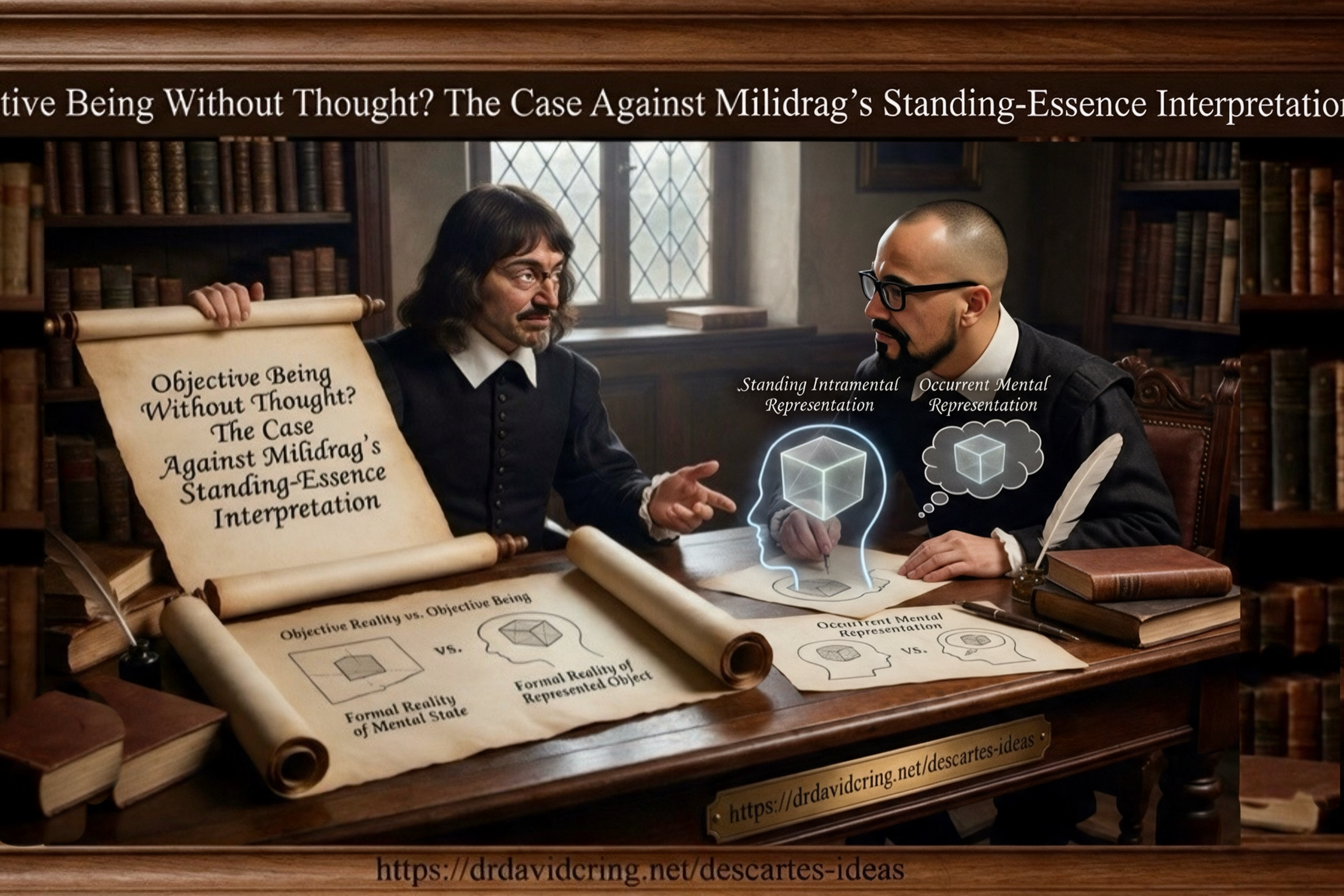
The standing-essence interpretation must now explain where its additional item fits. Let EX denote Milidrag’s supposedly standing intramental essence of X. EX is said to exist in the intellect when no IX occurs. Is EX identical with RX? Is it the ground from which RX subsequently arises? Is it a faculty? Or is it some further entity distinct from both the faculty and the occurrent representational content? The objections below arise from attempting to answer these questions.
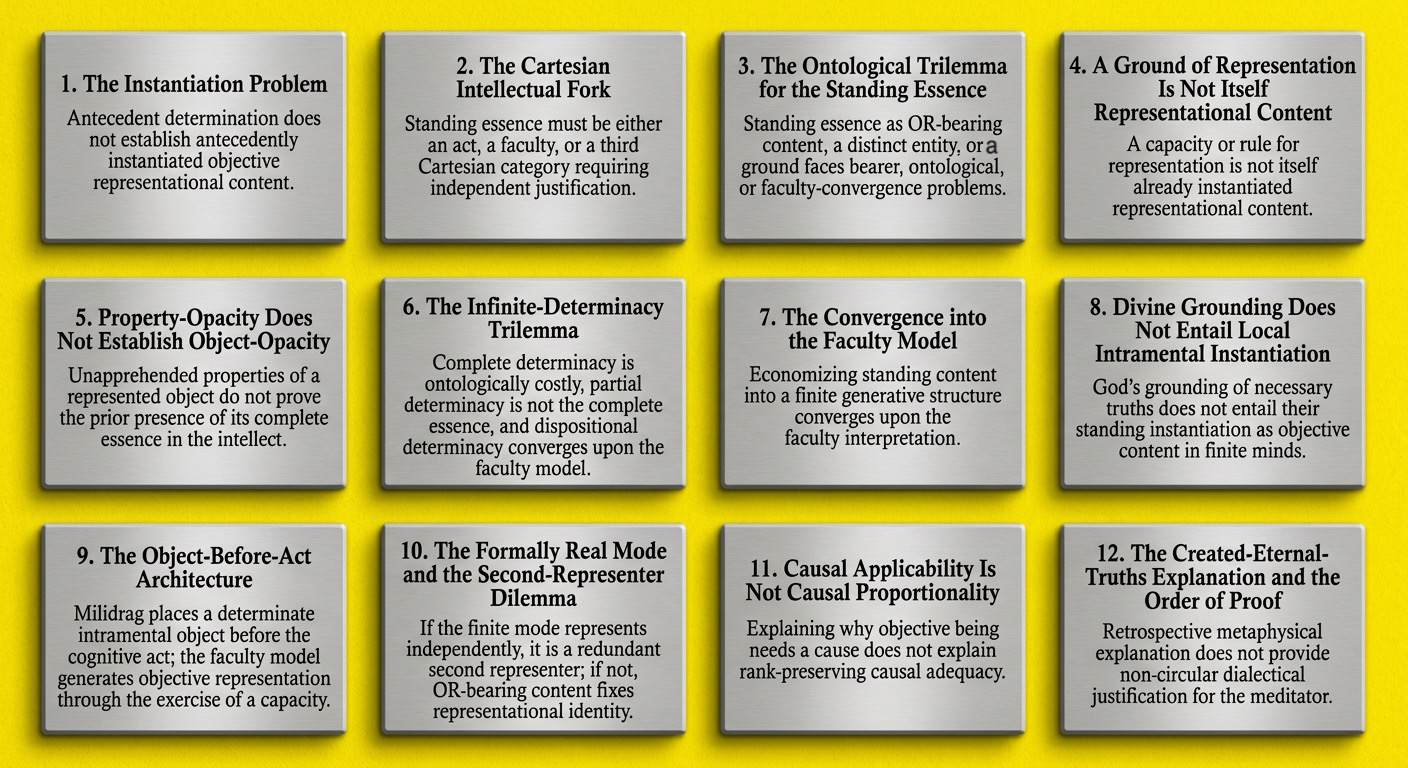
Twelve Objections: Why Standing Essence Does Not Yield Unthought Objective Reality
Objection 1: The Instantiation Problem
The first objection is the most fundamental because every later objection elaborates it.
Suppose at t1 a finite mind is not thinking of X. At t2 it thinks of X. Both interpretations can agree that something about the mind at t1 explains why the determinate X-thought rather than an arbitrary Y-thought can occur at t2. The faculty interpretation calls this antecedent condition FX: an appropriately determinate intellectual power, disposition, or structure. At t2 FX is exercised and RX becomes instantiated in IX.
Milidrag’s account adds EX at t1. X already possesses objective being in the intellect before IX occurs. The later thought does not first instantiate objective content; it apprehends an objective essence already there.
But the shared explanandum is already covered by FX: why can this intellect generate or apprehend an X-thought? The additional thesis that EX is already objectively instantiated requires a further reason. It is not enough to answer that cognition must be determinate, since FX is already determinate. It is not enough to answer that X has necessary properties independent of present attention, since the faculty account does not make mathematical or metaphysical truth dependent upon current attention. And it is not enough to answer that X is innate, because Cartesian innateness can itself be analyzed dispositionally.
The burden is therefore not on the faculty account to explain how an entirely indeterminate intellect mysteriously produces determinate ideas. No such intellect is being proposed. The burden is on the standing-content account to justify the inference:
antecedent intellectual determination → antecedently instantiated objective representational content.
That inference is precisely what remains unestablished.
Objection 2: The Cartesian Intellectual Fork
Descartes’s distinction between acts and faculties creates a textual fork for the standing essence. In the Fourth Replies he distinguishes the acts or operations of the mind, of which the mind is actually aware, from its faculties or powers, of which it need be aware only potentially. The same distinction fits his explanation of innate ideas in the Third Replies and the Comments on a Certain Broadsheet.2Descartes, Third Replies, AT VII 189; CSM II 132; Fourth Replies, AT VII 246–47; CSM II 171–72; Comments on a Certain Broadsheet, AT VIIIB 357–61; CSM I 303–5.
A. First horn: EX is an act or operation of intellect
If EX is itself a cognition, perception, representation, or other occurrent operation of thought, then Descartes’s awareness principle applies. The alleged standing essence is no longer genuinely unthought. A thinker need not attend reflectively to every feature of the cognition, but an actually occurring thought cannot simply be wholly absent from awareness while remaining an actual operation of the Cartesian mind.
This does not prove that every item in the mind must itself be an occurrent thought. Descartes explicitly recognizes faculties. But that qualification produces the second horn.
B. Second horn: EX is a faculty or power
If EX is instead the mind’s power to elicit or instantiate an X-idea, then unawareness is unproblematic. But Descartes characterizes precisely this kind of presence as potential rather than actual. The mind possesses the power before exercising it; the corresponding cognitive operation becomes actual when the faculty is exercised.
This is not a minor terminological point. It marks the exact distinction needed by the faculty interpretation:
- FX exists at t1;
- IX does not;
- RX becomes instantiated when FX is exercised at t2.
The texts therefore provide a ready-made Cartesian category for precisely the persistence Milidrag needs to explain: potentiality in a faculty. What they do not straightforwardly supply is a category of non-occurrent but already instantiated representational content standing between power and act.
C. The attempted middle position
Milidrag can reply that EX is neither an act nor merely a faculty. It is an intramental essence possessing its own diminished or potential mode of being. But this answer does not dissolve the fork; it introduces a third ontological category whose relation to the categories Descartes explicitly contrasts must now be explained. That problem becomes the next objection.
Objection 3: The Ontological Trilemma for the Standing Essence
The standing essence EX appears to have only three plausible ontological roles.
A. EX is the very OR-bearing content later instantiated in IX
This option preserves continuity most directly. The content that later becomes occurrent was already there. But it immediately raises a bearer problem. At t2 RX is a determination of an occurring mental mode. What is its bearer at t1, when the mode does not exist? If the answer is the thinking substance itself, the account must explain how a substance bears determinately representational X-content without thereby undergoing an X-thought. If the answer is another standing mental mode, the view has reintroduced a non-occurrent mental entity distinct from the later idea.
The identity claim therefore does not eliminate the ontological problem. It relocates it: what exactly is it for representational content to be instantiated when no representing act or mode instantiates it?
B. EX is a distinct standing representational entity
This gives the content a bearer, but at substantial metaphysical cost. There is now a standing entity in the finite intellect that is not the occurrent idea, not the faculty, and not merely the representatum. It has sufficient determination to be specifically of X, persists independently of the corresponding cognitive act, and somehow enters into that act when X becomes consciously represented.
Several new questions follow. Is the entity a mode of mind? If so, why is it exempt from the awareness conditions applying to mental operations? If it is not a mode, what Cartesian category does it occupy? What individuates one standing essence from another? What makes it represent X prior to any representing act? And what causal role remains for the subsequent occurrent representation if the relevant representational determination is already fully instantiated?
C. EX is a determinate disposition, ground, or intellectual structure
This is ontologically the least problematic option. It also approaches the faculty model. The standing item explains why X-content can be elicited without itself already being an occurrent X-representation. But once the actual representational content is reserved for the exercise of the structure, the specifically Milidragian thesis has been surrendered. The mind possesses the ground of future objective representation, not already instantiated objective representation itself.
The trilemma therefore has a systematic shape:
- identify EX with RX, and explain how representational content is instantiated without a representing act;
- make EX a distinct standing representational entity, and incur a substantial new ontology;
- make EX the determinate ground or power for RX, and converge upon the faculty model.
No horn is formally contradictory. The force of the trilemma is comparative and explanatory: the faculty interpretation occupies an independently attested Cartesian category, whereas the second horn requires considerably more metaphysics and the first leaves the instantiation relation obscure.
Objection 4: A Ground of Representation Is Not Yet Representational Content
The preceding trilemma reveals a distinction that should be made explicit. A metaphysical or cognitive ground of representation need not itself be the representation it grounds.
A disposition to think of a triangle is not itself a thought of a triangle. A rule-governed intellectual structure that guarantees that, when a triangle is conceived, its angles will be understood as constrained in determinate ways is not thereby an already occurrent representation of those constraints. A capacity to produce RX is not identical with RX.
This point matters because Milidrag’s strongest explanatory considerations naturally establish grounds. The finite intellect must have a nature such that some ideas can arise from it rather than others. God must be the ultimate source of the intellect’s nature. Necessary truths must not depend upon arbitrary finite invention. None of these claims entails that the representational effect is already instantiated before the relevant faculty is exercised.
The distinction can be stated as a non-identity principle:
GROUND(RX) ≠ RX, unless an independent argument establishes their identity.
The standing-essence interpretation needs precisely that independent argument. Otherwise its strongest evidence establishes the antecedent conditions for representation rather than antecedent representation.
Objection 5: Property-Opacity Does Not Establish Object-Opacity
The Fifth Meditation initially appears favorable to a standing-content interpretation. Descartes can think of a triangle and subsequently recognize necessary properties that he had not explicitly considered when he first represented it. The triangular nature constrains cognition beyond whatever predicates happen to be occurrently attended to.3Descartes, Fifth Meditation, AT VII 63–65; CSM II 44–45.
But two kinds of cognitive opacity must be separated.
A. Property-opacity
X is presently represented, but the thinker does not explicitly represent or attend to every property P necessarily belonging to X.
B. Object-opacity
X itself is not presently represented at all, although X supposedly continues to possess objective being in the intellect.
The Fifth Meditation establishes property-opacity. It does not establish object-opacity. When Descartes discovers a previously unattended theorem concerning triangle, he is already thinking of triangular nature. The fact that the content of an occurrent idea is not propositionally exhaustive does not imply that the represented nature remains objectively instantiated through intervals in which no triangle-representation occurs.
This distinction is especially important for ORCET. The thesis does not require that an idea explicitly enumerate everything necessarily true of its representatum. The OR-bearing content can determine the represented nature without containing an occurrently articulated proposition corresponding to every consequence of that nature.
Milidrag therefore cannot move directly from:
some truths about X transcend present explicit attention
to:
X possesses standing objective being when X itself is entirely unrepresented.
An additional ontological premise is required.
Objection 6: The Infinite-Determinacy Trilemma
The triangle case generates a deeper difficulty once the extent of mathematical determination is considered. A triangular nature does not ground merely the two properties Descartes happens to mention. Infinitely many necessary mathematical truths concern triangles. This claim should be distinguished from the historically separate question whether Descartes would describe any created entity as actually infinite. The present point is mathematical: the necessary consequences associated with triangular nature are not exhausted by any finite list a human thinker can successively entertain.
If ET is the complete triangular essence objectively instantiated in a finite intellect even when triangle is unthought, what exactly is already instantiated? Three possibilities arise.
A. The complete determinacy is already objectively instantiated
On the strongest reading, ET already possesses whatever determinate structure grounds the entire infinite range of necessary truths. This is coherent as an abstract metaphysical proposal, but it makes the standing ontology extraordinarily rich. A finite intellect contains a complete, unthought, objectively instantiated mathematical nature whose determinate consequences vastly exceed everything that intellect has ever apprehended or could apprehend in a single finite cognition.
The objection is not that one entity cannot ground infinitely many truths. Numerical unity does not imply poverty of structure. The objection is that calling the item “one essence” does not answer the question of what determinate content is already instantiated. One essence capable of grounding infinitely many truths may be ontologically more demanding than many simple entities.
B. Only a finite portion of the determinacy is objectively instantiated
This avoids the first problem but destabilizes the identification of ET with the complete triangular essence. What is present now looks like a partial representation, finite basis, schema, rule, or structured intellectual resource from which further consequences can be developed.
But then the question returns: why call this finite basis the complete true and immutable nature rather than the mind’s determinate basis for successively cognizing that nature?
C. The remaining determination is “implicit”
This is the most natural response, but “implicit” is ambiguous.
- Strong implicitness: all the determinations are already objectively grounded in ET, although not explicitly unfolded. This returns to the first horn.
- Dispositional implicitness: the finite intellect is structured so that indefinitely many further truths can be elicited, derived, or apprehended. This approaches the faculty model.
The important discovery is therefore not that Milidrag must posit infinitely many separately resident essences or truth-tokens. He need not. The stronger objection concerns the status of the determinacy itself. Either the complete structure is already objectively instantiated, or what exists prior to cognition begins to look like the determinate generative structure posited by the faculty account.
Objection 7: The Convergence or Collapse into the Faculty Model
This is the most important new consequence of the preceding discussion.
A defender of Milidrag may understandably resist an interpretation on which a finite mind contains an enormous array of already instantiated objective contents. The defender can instead posit a finite, highly determinate intellectual structure S from which the mind can elicit E1, E2, E3, … as occasions for cognition arise.
But this proposal is not a third position between standing essences and the faculty model. It is the faculty model once the ontology is stated clearly.
The structure is:
finite determinate intellectual structure S → capacity to elicit E1, E2, E3, …
rather than:
E1, E2, E3, … already objectively instantiated in the intellect.
The difference cannot be preserved merely by calling S an “essence.” If S contains the relevant items only as powers for their subsequent cognitive actualization, its role is dispositional. If the relevant contents themselves are already objectively instantiated in S, the full standing-content problem returns.
This yields a convergence principle:
The more the standing-essence account economizes its ontology by replacing already instantiated contents with a finite determinate generative structure, the more completely it converges upon the faculty interpretation.
This is stronger than a generic appeal to Ockham’s razor. The faculty account need not contain less determinate structure. It is ontologically leaner in one precise respect: it does not add standing representational content over and above the structure required to explain the capacity for determinate cognition.
Objection 8: Divine Grounding Does Not Entail Local Intramental Instantiation
Milidrag’s appeal to Descartes’s created-eternal-truths doctrine gives the standing-essence interpretation an impressive metaphysical background. If God establishes the necessary structures and intelligibility of essences, then their determinacy is not a product of arbitrary finite invention. Mathematical and metaphysical necessity can be independent of what any finite thinker happens to think at a particular time.4See Descartes to Mersenne, 27 May 1630, AT I 151–53; CSMK 25–26; Sixth Replies, AT VII 435–36; CSM II 293–94. See also Milidrag, “Caterus and Descartes on Ideas, Causality and Eternal Truths,” 60–64.
But a gap remains between two claims:
- God grounds the intelligibility and necessary determination of X.
- X therefore exists as standing objective content inside each finite intellect capable of thinking X.
The first does not entail the second. God could ground X’s necessary structure while also creating finite minds with determinate faculties capable of representing X when exercised. Indeed, divine institution provides a particularly natural explanation of how a faculty can be highly determinate without containing independently instantiated representational objects.
The distinction is between global metaphysical grounding and local finite-mind instantiation. Milidrag’s account of the former does not settle the ontology of the latter.
This point is especially damaging to an inference from the eternal truths to standing intramental essences. The eternal truth concerning triangle may be eternally dependent upon God and independent of finite thought. But from that it does not follow that triangular nature must continuously possess objective being in every human intellect capable of eliciting an idea of triangle. Divine dependence and finite intramental residence are different relations.
Objection 9: The Object-Before-Act Architecture
The previous post described a quasi-Platonic structural worry. This objection requires careful formulation because calling Milidrag’s interpretation “Platonist” without qualification would be inaccurate.
Milidrag’s essences are not autonomous transcendent Forms. They are intramental, and their intelligibility is ultimately dependent upon divine causation. The criticism is therefore not that Milidrag turns Descartes into Plato.
The relevant similarity lies in explanatory architecture. On the standing-essence model:
determinate intelligible object → subsequent cognitive apprehension.
The object possesses its determinate intramental status before the occurrent cognitive act. Cognition is fundamentally receptive or revelatory with respect to that already present intelligible item.
On the faculty model:
determinate intellectual capacity → exercise of capacity → occurrent objectively real representation.
The antecedent condition is still highly determinate, so the model is not constructivist in the sense of allowing the thinker arbitrarily to make triangle whatever the thinker wishes. But representational objective being is instantiated in the cognitive act rather than standing before it as a pre-existing intramental object.
The objection is comparative. Milidrag’s interpretation internalizes an object-before-act architecture that requires additional ontology. The faculty account preserves the mind-independent or finite-thought-independent necessity of the essence while avoiding the further claim that a finite intellect contains that essence as already instantiated objective content between acts of cognition.
Objection 10: The Formally Real Mode and the Second-Representer Dilemma
The idea of God exposes another problem that is independent of whether objective content can stand unthought.
Consider an occurrent idea of God. The entire ideational episode is a finite modification of a finite mind. Its formal reality is therefore finite. Yet the idea possesses infinite-substance-level objective reality because it represents God.
What representational work is performed by the formally real mental mode over and above the OR-bearing God-content?
A. The finite mode is a second representer
If the formally real mental mode possesses a representational determination independently of the OR-bearing God-content, there are effectively two representational contributors. But RGod already explains why the idea represents God rather than a rock, triangle, angel, or finite mind. The additional formally real representational constituent appears redundant unless some further representational function is identified.
Worse, if the finite mode’s God-directedness is explained by its relation to RGod, then the objective content remains explanatorily prior with respect to representational identity.
B. The finite mode is the same occurrence considered formally
This is the preferable interpretation. Formal reality answers how the occurrence exists—as a finite modification of mind. Objective reality answers what its representational content represents and with what ontological rank.
But then the formal and objective descriptions do not identify two independently generated representational entities. They are distinguishable aspects or dimensions of one occurrent idea. This is exactly what ORCET predicts: the OR-bearing content supplies the first-order representational identity while formal reality supplies the occurrence’s mode of existence.
The result matters for Milidrag’s causal reconstruction. If formal and objective being are not two separate effects, merely distinguishing them does not explain why a finite cause apparently sufficient for the finite occurrence is radically insufficient for its objectively real content. The Third Meditation asserts that the objective content requires a proportionate cause. The interpretive challenge is to explain the metaphysical bridge that makes this differential causal requirement intelligible.
Objection 11: Causal Applicability Is Not Causal Proportionality
Milidrag’s strongest contribution should be preserved before the objection is stated. Caterus’s denominational analysis threatens to make objective being causally inert. If being objectively in the intellect adds nothing intrinsic and is merely an extrinsic denomination, asking for its efficient cause looks misguided. Milidrag’s stronger ontology makes objective being metaphysically nontrivial. It is now something whose existence and determination can require explanation.
This successfully addresses what may be called Causal Applicability:
Why should objective being enter efficient causal explanation at all?
Milidrag also goes further. If an essence’s degree of objective reality is intrinsic to its determinate structure, and if the truths constituting that structure depend upon divine creation, then the degree itself is causally grounded. This is an important improvement over an account that explains only bare objective existence.
But Descartes requires something stronger:
If an idea possesses objective reality of rank n, its cause must possess at least n formal or eminent reality.
This is a proportionality relation across two different ontological dimensions. The fact that objective reality requires some cause does not yet show why the cause must preserve or exceed its rank.
The difficulty can be called the Cross-Modal Causal Adequacy Problem. Objective reality and formal reality are not simply two quantities measured along an independently established common scale. The Third Meditation treats them as sufficiently commensurable for formal or eminent reality in the cause to answer to objective reality in the idea. Milidrag explains why the left-hand side is metaphysically substantive. He does not yet derive the mapping rule connecting it to the right-hand side.
The idea of God makes the gap dramatic:
- a finite mental occurrence;
- God-representing content with infinite-substance-level objective reality;
- a requirement for an infinitely formally or eminently real cause.
What licenses the third step is not supplied merely by establishing that the God-content is genuine objective being or that its degree has a cause. A rank-preserving causal adequacy principle is still required.
This is the Bearer–Cause Asymmetry in its sharpest form. A finite mental mode can bear content of infinite objective rank, but the finite mind cannot be the adequate cause of that content. That may indeed be Descartes’s view. The philosophical question is what explains the asymmetry. Milidrag’s ontologization of objective being makes the causal question legitimate; it does not by itself answer it.
Objection 12: The Created-Eternal-Truths Explanation and the Order of Proof
Milidrag’s appeal to created eternal truths also creates a dialectical problem within the Third Meditation.
Metaphysically, the proposed explanation is intelligible:
- an essence has determinate predicates and necessary relations;
- its objective-reality degree is determined by what sort of essence it is;
- God freely establishes the eternal truths and hence the determinate structure of created essences;
- God therefore ultimately causes the essence and its degree of objective reality.
But the Third Meditation is itself attempting to establish God’s existence. If divine creation of the eternal truths is invoked as the justification for a premise required by that proof, the order of justification threatens to become circular.
This objection must be stated precisely. It does not show that Descartes cannot consistently hold both doctrines. A metaphysical explanation can be true even if the meditator has not yet established it epistemically. God might in fact be the cause of the eternal truths before the meditator proves that God exists.
The narrower conclusion is that the created-eternal-truths doctrine cannot straightforwardly function as the non-circular dialectical justification of the causal proportionality premise within the Third Meditation. It can explain the principle retrospectively from within Descartes’s completed metaphysics. It cannot without further argument supply the epistemic bridge by which the meditator is entitled to use that principle to prove God in the first place.
This leaves two distinct explanatory projects:
- metaphysical explanation: why objective realities and eternal truths ultimately depend upon God;
- dialectical justification: why the pre-theistic meditator is entitled to infer from a given degree of objective reality to a formally or eminently adequate cause.
Milidrag substantially advances the first. The second remains more difficult.
Milidrag’s Strongest Replies
A. Reply: Objective being is genuine being, not a mere denomination
This reply succeeds against Caterus more readily than against the present objections. If objective being is genuine intramental being, there is something to explain causally. But the Instantiation Problem asks what makes a non-occurrent state specifically representational objective being rather than a dispositional ground of future representation. Metaphysical non-nullity does not settle representational status.
B. Reply: The standing essence is not an unconscious thought
This blocks an overly simple transparency argument. Milidrag need not call EX a cogitatio. But the success comes at a price. Once EX is distinguished from an operation of thought, its relation to Descartes’s other category—the faculty or power—becomes decisive. If it is not a faculty either, its status as a third kind of intramental representational entity must be independently established.
C. Reply: Innate ideas plainly need not be continuously conscious
Correct, but insufficient. The faculty account was designed precisely to accommodate this Cartesian datum. Descartes’s Third Replies and later Comments support a distinction between possessing a power to elicit an idea and actually entertaining the idea. Innateness therefore establishes non-occurrent availability; it does not decide whether that availability consists in standing objective content or a determinate faculty.
D. Reply: The triangle has a determinate nature exceeding explicit cognition
Correct again. But this establishes property-opacity rather than object-opacity. An occurrent idea can represent a nature whose necessary implications exceed explicit attention. Nothing in that fact yet requires the nature itself to remain objectively instantiated when no idea of it occurs.
E. Reply: One essence can ground infinitely many truths
This defeats a crude numerical-proliferation objection. The present objection is different. What matters is not the number of resident entities but the amount and kind of determinacy already objectively instantiated in the allegedly single essence. Numerical unity leaves the infinite-determinacy trilemma untouched.
F. Reply: The complete determination is implicit
This is probably the strongest response to the mathematical pressure. But its force depends entirely upon “implicit.” If all determinations are already objectively grounded, the rich standing ontology remains. If “implicit” means that a finite determinate structure enables the intellect successively to derive or elicit them, the view has moved toward the faculty account.
G. Reply: The faculty itself requires determinate structure
Granted. This concession strengthens rather than weakens the objection. The faculty model has never depended upon an empty power. Once both interpretations accept antecedent determination, the debate concerns whether that determination must additionally consist in already instantiated representational objective being. The faculty account can therefore absorb the determinacy objection without absorbing the standing-content ontology.
H. Reply: God’s creation of eternal truths explains the essences
It explains their ultimate metaphysical dependence more successfully than their local mode of presence in finite minds. God can create both necessary truths and finite intellects structured to apprehend them. The additional claim that the truth must therefore reside continuously as objective content in each finite intellect remains a further step.
I. Reply: The degree of objective reality is intrinsic to the essence
This is Milidrag’s strongest response concerning causal degree. It explains why objective reality is not merely homogeneous being with an unexplained numerical ranking imposed from outside. But it still does not derive the general principle that a cause adequate to OR rank n must possess formal or eminent reality of at least n. Intrinsic degree and rank-preserving cross-modal causation are distinct claims.
The Cumulative Argument
No single objection above requires the conclusion that Milidrag’s interpretation is logically impossible. The stronger case is abductive and cumulative.
- Descartes needs a way to explain non-occurrent innateness and determinate future cognition.
- He explicitly possesses the categories of faculty, power, disposition, and potentiality for doing so.
- He distinguishes such faculties from actual operations of thought.
- Actual operations are subject to awareness conditions that make wholly unthought occurrent representations problematic.
- A standing essence that is neither an operation nor a faculty therefore requires an additional Cartesian ontological category.
- If that category is identified with already instantiated OR-bearing content, its bearer and mode of instantiation in the absence of an act remain unclear.
- If it is treated as a distinct standing representational entity, the ontology becomes substantially richer and its additional explanatory work must be demonstrated.
- If it is treated as a finite determinate structure capable of eliciting the relevant contents, the position converges upon the faculty interpretation.
- The Fifth Meditation’s triangle case establishes that essential truth exceeds explicit attention, but not that objective being survives complete non-representation.
- The indefinitely extensible or infinite structure of mathematical truth intensifies the choice between a richly instantiated standing essence and a determinate generative faculty.
- Divine grounding of necessary truth does not entail standing local instantiation of those truths as objective content in each finite intellect.
- Milidrag’s causal reconstruction explains why genuine objective being calls for causal explanation, but it does not independently derive the Third Meditation’s rank-preserving cross-modal adequacy principle.
The combined evidential balance therefore favors the faculty interpretation. It accepts everything that genuinely requires explanation—innateness, antecedent determinacy, necessary structure, finite cognitive limitations, divine grounding, and the eventual instantiation of objectively real representation—without adding continuously standing representational contents whose ontological status remains contested.
Conclusions
Milidrag’s interpretation should not be rejected at its strongest points. Caterus does identify a genuine metaphysical difficulty. Descartes’s objective being cannot plausibly be understood in every context as merely an extrinsic denomination of an extramental object. Milidrag also provides a particularly valuable reconstruction of the connection among objective being, intelligibility, efficient causation, and the created eternal truths.
The difficulty lies in the further move from intramental intelligibility to standing, presently instantiated objective representational content in the absence of an occurrent representation.
The Cartesian act/faculty distinction is especially damaging here. If the standing essence is an actual operation of thought, awareness becomes difficult to avoid. If it is a faculty, Descartes provides precisely the dispositional interpretation required by the rival account. If it is neither, a third intramental category must be introduced and defended.
The ontological trilemma reinforces that result. EX can be identified with RX, distinguished as another standing representational entity, or reduced to the ground or capacity for RX. The first leaves unexplained how representational content is instantiated without a representing act. The second multiplies the ontology and creates new explanatory burdens. The third approaches the faculty account.
The triangle case makes the convergence particularly visible. Mathematical nature contains far more necessary structure than a finite thinker explicitly apprehends. But property-opacity is not object-opacity. The fact that infinitely many truths belong to triangular nature does not show that all their representational determination stands objectively instantiated inside a finite mind when triangle is entirely unthought. If the defender instead posits a finite determinate basis capable of eliciting indefinitely many such truths, the proposed structure is exactly what the faculty interpretation has been claiming all along.
The deepest contrast is therefore not between a rich intellect and an empty one. Both interpretations can posit a rich and determinate intellect. The contrast is between two orders of explanation:
standing-object model: determinate intramental object → cognitive apprehension;
faculty model: determinate intellectual structure → exercise → occurrent objective representation.
The second order is preferable because the determinate structure already performs the work needed to explain why the later cognition has the content it does. Adding EX as presently instantiated objective content before cognition occurs is warranted only if it performs indispensable explanatory work unavailable to FX. None of the strongest candidate explanations considered here—innateness, necessary truth, repeatability, mathematical determinacy, or divine grounding—establishes that indispensability.
The causal issue produces a parallel result. Milidrag makes objective being sufficiently metaphysically substantial for causal explanation to apply to it. His created-eternal-truths interpretation also offers an illuminating explanation of why an essence has the determinations and degree it does. But this still leaves the Cross-Modal Causal Adequacy Problem: why must objective reality of rank n have a cause possessing at least n formal or eminent reality? The metaphysical genuineness of objective being explains why there must be causal grounding; it does not by itself explain the required proportionality.
The idea of God reveals the remaining difficulty with maximum clarity. A finite occurrent mental mode can instantiate God-representing content with infinite-substance-level objective reality. The formal actuality of that content as a finite mental determination neither makes God formally present in the mind nor lowers its objective rank. Yet this same asymmetry requires an explanation of why the finite mind can bear the content while being causally inadequate to it. Milidrag’s interpretation illuminates the metaphysics of the bearer side more successfully than it derives the causal bridge.
The strongest conclusion is consequently comparative rather than merely negative. The standing-essence interpretation introduces a genuine object-before-act ontology within the finite intellect. The faculty interpretation preserves the antecedent intellectual determination that Milidrag rightly insists upon, but it locates actual objective representation where Descartes’s theory of thought most naturally places it: in an occurrent cognition. Between acts, what persists is the determinate power for representation. When the power is exercised, OR-bearing content is instantiated.
That distinction captures the principal result of both posts:
Cartesian innateness establishes the latency of determinate representational power more securely than it establishes the persistence of already instantiated objective representational content.
Until the standing-essence interpretation supplies a principled criterion distinguishing unthought objective content from the determinate faculty capable of producing that content, the faculty account has the better combination of textual support, ontological economy, and explanatory sufficiency.
NOTES
- 1René Descartes, First Replies, AT VII 102–04; CSM II 74–75. Predrag Milidrag, “ Katerus i Dekart o idejama, uzrokovanju i večnim istinama” [“Caterus and Descartes on Ideas, Causality and Eternal Truths”], Theoria 55, no. 1 (2012): 45–69, especially 55–64. ↩︎
- 2Descartes, Third Replies, AT VII 189; CSM II 132; Fourth Replies, AT VII 246–47; CSM II 171–72; Comments on a Certain Broadsheet, AT VIIIB 357–61; CSM I 303–5. ↩︎
- 3Descartes, Fifth Meditation, AT VII 63–65; CSM II 44–45. ↩︎
- 4See Descartes to Mersenne, 27 May 1630, AT I 151–53; CSMK 25–26; Sixth Replies, AT VII 435–36; CSM II 293–94. See also Milidrag, “Caterus and Descartes on Ideas, Causality and Eternal Truths,” 60–64. ↩︎