


(Hyperlinks are in magenta or underlined)
Abstract
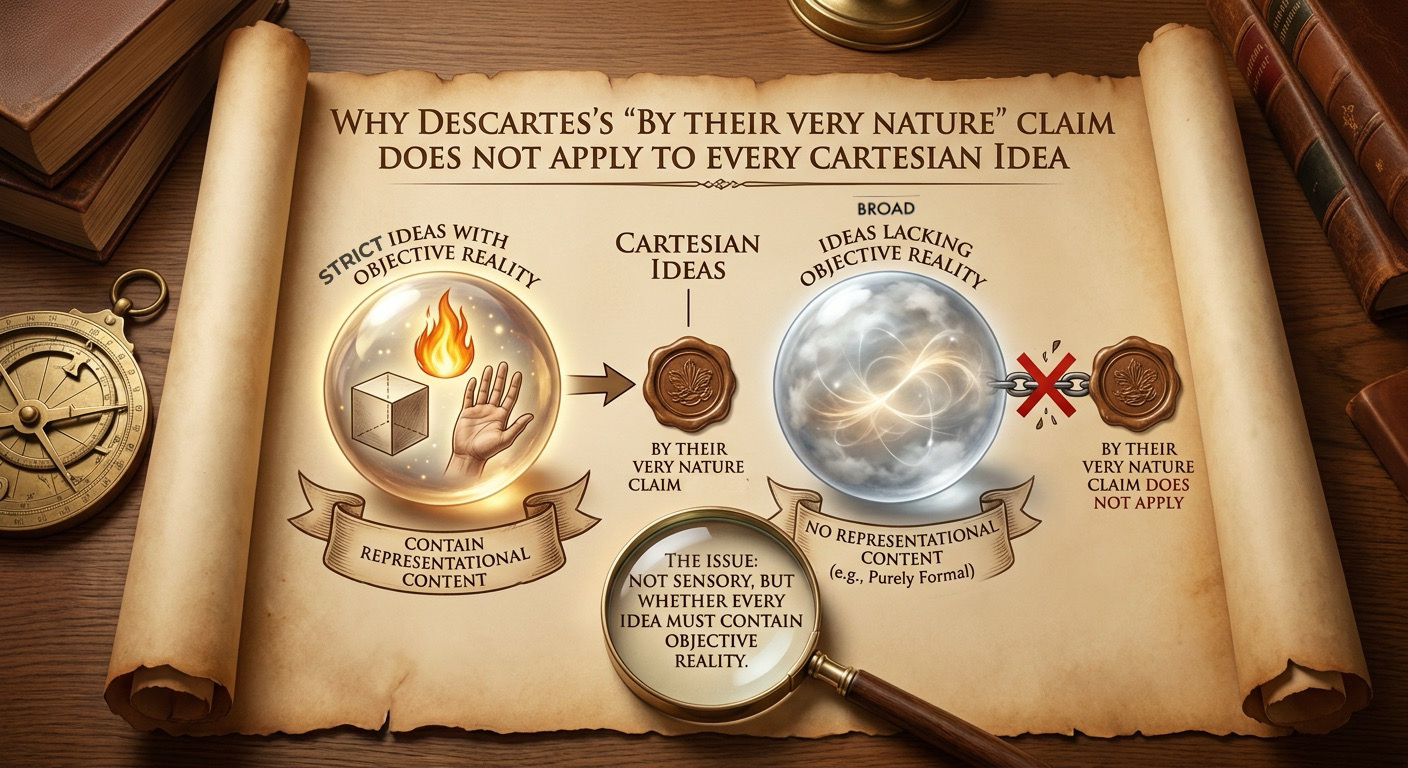
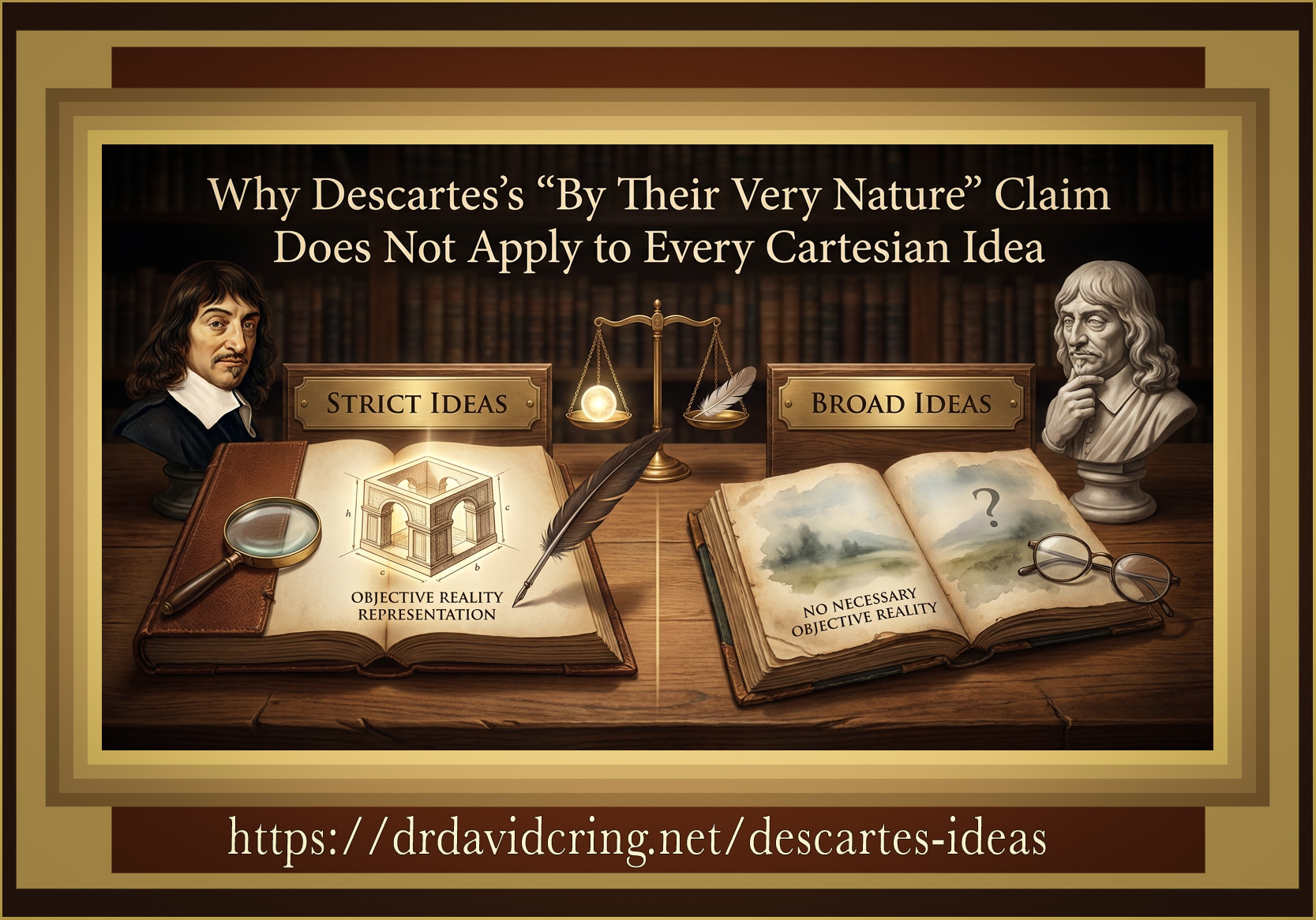
Descartes’s claim that the objective mode of being belongs to ideas “by their very nature” appears to support a universal-objective-reality thesis: every Cartesian idea, simply because it is an idea, contains objectively real representational content (OR). That reading is too broad. The passage occurs inside the Third Meditation causal proof, where Descartes is considering ideas under their objective aspect, that is, insofar as they represent or exhibit things with differing degrees of objective reality. It should therefore be read as a thesis about strict ideas, not about every item Descartes elsewhere calls an idea in the broad sense. Strict ideas possess objective reality by their nature because to be a strict idea is to be one of the tanquam rerum imagines [as if images of things], and for Descartes the being that such represented content has in the mind just is objective being.
Broad ideas, by contrast, include immediately perceived occurrent thoughts such as willing, fearing, affirming, denying, and sensing. A single such thought may be considered with respect to its representational character and also with respect to its volitional, affective, judicative, or sensory character, without implying that these are separate components of the thought. Considering a thought with respect to its representational character is an inquiry, not a guarantee of a result: a thought may be of something in the broad sense of presenting something to consciousness while containing no objectively real representatum [item represented] at all. The correct conclusion is not that Descartes’s “by their very nature” claim is false, but that its scope is restricted: objective reality belongs by nature to ideas insofar as they are strict representational ideas, not to every conscious mode that can be called an idea in the broader Cartesian usage. Three worked cases below show further that the universal thesis is not merely unlicensed by the text but false: some common notions, the idea of nothing, and secondary-quality sensations, such as a cold sensation, all lack any objectively real representational content.
Introduction
The interpretive difficulty is real. In the Third Meditation, Descartes writes: “iste modus essendi objectivus competit ideis ex ipsarum naturâ.” [this objective mode of being belongs to ideas from their own nature] (AT VII 42; CSM II 29)
Taken in isolation, this sentence seems to say that every idea, simply as an idea, contains objective reality. That is the universal-objective-reality reading.1See my posts arguing the falsity of the universal readings: “Do Cartesian Sensations Have Objective Reality?: Strict Ideas, Broad Ideas, And Material Falsity In Descartes’s Theory Of Ideas,” “Condensation: Why Objective Reality Cannot Be Descartes’s Theory Of Thought: Burman, Common Notions, And The Failure Of The Strict Idea Model,” its companion piece “Why Objective Reality Cannot Be Universal In Descartes’s Theory Of Ideas: Nothing, Eternal Truths, Sensations, And Fear With Claude Opus 4.6,” and “The Core DTOI Argument: Sensations Without Cartesian Objective Reality.”
It treats Descartes’s claim as if it had the following form: for any Cartesian idea whatsoever, objectively real representational content belongs to it by its nature. On that reading, every sensation, volition, passion, judgment, fear, desire, affirmation, and every immediately perceived mental mode must contain objectively real representational content. Three published formulations make the temptation vivid, and they show why the isolated sentence is not a straw opponent.
Kurt Smith  writes that ideas possess objective reality by their very nature, and that only ideas possess both formal and objective reality:
“Descartes says that ideas possess objective reality by their very nature. Equally importantly, ideas are the only items in his ontology that possess both formal and objective reality.” (AT VII 42; CSM II 29)
”Descartes very clearly says that ideas are the items in his ontology that possess objective reality, and they possess it by their very nature.” (AT VII 42; CSM II 29)2Smith in his “Descartes’ Theory of Ideas,” Stanford Encyclopedia of Philosophy, “2. Ideas and The Formal-Objective Reality Distinction,” 3rd paragraph and final paragraph in “5. The Rules: Simple Natures and the Concepts of Clarity and Distinctness.”
On that statement, AT VII 42 is treated as a doctrine about the essence of ideas as such: wherever there is an idea, there is objective being, because that mode of being is what an idea is.
Steven Nadler  treats objective reality as “a defining feature of the mind’s ideas,” and he reaches that result by placing the strict-name restriction of AT VII 37; CSM II 25 immediately beside the “by their very nature” sentence of AT VII 42; CSM II 29.
”We can say, in fact, that for Descartes objective reality is a defining feature of the mind’s ideas: “Some of my thoughts are as it were images of things, and it is only in these cases that the term ‘idea’ is strictly appropriate.” It is essential to an idea that it has a representational content that it displays to the mind. “The objective mode of being belongs to ideas by their very nature.” (Meditation III, AT vi, 42)3Steven Nadler, “The Doctrine of Ideas,” in The Blackwell Guide to Descartes’ Meditations, Stephen Gaukroger, ed., (Malden, MA: Blackwell, 2006), 93.
For a comparative placement of this reading among other commentators, see my “A Hyperlinked Pictorial Table of Cartesian Commentators on the Objective Reality Contents of Secondary Quality Sensations.”
The concatenation is textually tempting. Descartes first says that the name “idea” is strictly appropriate only for thoughts that are as if images of things, and five pages later he says that the objective mode of being belongs to ideas by their nature. If those two sentences are read as a single essential definition, then representational content and objective reality become what an idea is, and every later broad use of “idea” must be pulled back under that definition.
Last, but not least, Gary Hatfield himself makes the relevant universalizing move explicit:
“I not only take Descartes at his word when he says that ‘the objective mode of being belongs to ideas by their very nature’ (7: 42), but I also take him to be saying with this phrase that all ideas represent.” (Gary Hatfield
, “Descartes on Sensory Representation, Objective Reality, and Material Falsity,” in Descartes’ Meditations: A Critical Guide, Karen Detlefsen
ed.), Cambridge: Cambridge University Press 2012, 144)
Hatfield’s sentence therefore supports two claims that should be distinguished: the stronger thesis that objective being belongs to all ideas by their nature and the weaker thesis that all ideas (internally) represent.
That is the reading this post rejects. AT VII 37 does restrict the proper name. AT VII 42 does say that objective being belongs to ideas by their nature. What does not follow is that the later sentence is defining every item Descartes is anywhere willing to call an idea, including the immediately perceived forms of willing, fearing, sensing, and the common notions. Smith, Nadler, and Hatfield take AT VII 42 to settle the essence of Cartesian ideahood. The sentence does not bear that weight. It is a claim inside the causal argument about ideas already under objective consideration. The work of the post is to show first that the passage does not license the unrestricted quantifier, and then that Descartes’s own examples make the unrestricted thesis false.
Descartes’s sentence must be read in its argumentative context. He is not there giving a maximally broad definition of idea. He is developing the causal argument for God’s existence, and that argument turns on the objective reality contained in ideas insofar as they represent different things. The relevant domain is therefore not every conscious mental mode, but ideas under objective consideration: strict ideas whose contents exhibit or represent a res, a mode, a finite substance, an infinite substance, or a true and immutable nature.
Two distinct claims are in play, and they should be kept apart. The first is a claim about what the text licenses. When Descartes writes that this objective mode of being belongs to ideas by their very nature, the word “ideas” stands without any qualifier, and the universalist takes it to range over every item Descartes anywhere calls an idea. The first claim denies that the passage supplies that range. Read in its place in the causal argument, “ideas” picks out the ideas already under discussion, namely those considered insofar as one represents one thing and another another. On this claim the universalist has not been refuted; he has been shown to be reading into the sentence a scope the sentence does not give him, and the burden returns to him to supply it.
The second claim is stronger and independent. It holds that the unrestricted thesis is not merely unsupported but false, because Descartes himself identifies thoughts that he calls ideas and that carry no objectively real content by their nature. A single such case is enough, since a universal claim is refuted by one counterexample, and no amount of interpretive charity about AT VII 42; CSM II 29 can restore a thesis that Descartes’s own examples contradict.
This post argues both claims, and by different means. The Third Meditation establishes the first, but only in the limited sense that matters. The restriction of the proper name “idea” at AT VII 37; CSM II 25, the quatenus contrast at AT VII 40; CSM II 28, and the demonstrative iste at AT VII 42; CSM II 29 do not, taken together, prove that some ideas lack objective reality. What they show is that the “by their very nature” sentence cannot be lifted out of that sequence and used as an unrestricted definition of every item Descartes anywhere calls an idea. The Conversation with Burman, together with the treatment of cold sensations, establishes the second. The lead exhibit is some of the the common notions. The idea of nothing corroborates the same conclusion, though Descartes’s hedge that it can scarcely be called an idea must be kept in view. Cold sensations are a further and independent case.
The better interpretation preserves the full force of Descartes’s language while restricting its scope. Objective reality does belong to ideas by their very nature when “idea” is taken strictly. It does not follow that every broad idea contains objective reality. The difference is not a merely verbal distinction imposed on Descartes. It is grounded in Descartes’s own taxonomy of thoughts in the Third Meditation, in his later broad definitions of “idea,” in the Conversation with Burman, and in the treatment of sensations and material falsity.
The Third Meditation First Restricts the Proper Name “Idea”
The decisive textual point occurs before the “by their very nature” sentence. Descartes begins the relevant stretch of the Third Meditation by dividing thoughts into kinds. Some thoughts are image-like or representation-like. Others include additional forms. His initial description of the first class is: “Quædam ex his tanquam rerum imagines sunt.” [some of these are as if images of things] (AT VII 37; CSM II 25)
He then adds the crucial restriction: “quibus solis proprie convenit ideae nomen.” [to which alone the name idea properly belongs]. (AT VII 37; CSM II 25)
That phrase should control the later passage. Descartes has not yet licensed a universal thesis about every conscious mode. On the contrary, he has just said that the name “idea” properly belongs only to those thoughts that are, as it were, images of things. These are strict ideas. They are the thoughts that can function in the causal proof because they can be considered according to what they exhibit objectively.
Descartes immediately distinguishes this class from thoughts that have something more than the likeness of a thing: “Aliae verò alias quasdam praeterea formas habent.” [But others have certain other additional forms] (AT VII 37; CSM II 25; bold not in original)
Those additional forms are willing, fearing, affirming, and denying. Descartes says of such cases: “aliquid etiam amplius quàm istius rei similitudinem cogitatione complector.” [I also include in thought something more than the likeness of that thing] (AT VII 37; CSM II 25)
He also says of this second class: “semper quidem aliquam rem ut objectum meae cogitationis apprehendo.” [I always apprehend some thing as the object of my thought] (AT VII 37; CSM II 26)
That semper—“always,” in the sense of “in every such case”—is the most dangerous clause in the taxonomy for the restriction this post defends, because it appears to universalize the presence of a res as object throughout this second class. But its force must be determined together with its actual grammatical companions. Descartes is not saying that every conscious mode always has a res as object. He is speaking of the thoughts that have additional forms: when I will, when I fear, when I affirm, when I deny. In those cases I always apprehend some thing as the object of my thought, but I also include in thought something more than the likeness of that thing. The thought that is fear of a lion already has a representational aspect of a lion, while its character as fear is nonrepresentational because it presents or exhibits an actual fear state; it is not representing a fear state. The inquiry into whether such a thought exhibits a representatum has already been answered, and answered in the affirmative, by Descartes himself.
A fear of a lion can therefore be one unified occurrent thought considered with respect to its representational character, in which it represents the lion, and with respect to its affective character, in which it is fear. The thought is OR-bearing as of the lion; its being fear does not introduce a second representational item or a further objective reality. Likewise, an affirmation that God exists can be one unified thought considered with respect to its representational character, in which it represents God, and with respect to its judicative character, in which it is an affirmation. The idea of God contains infinite objective reality, but the affirmation does not thereby constitute an additional objective-reality content. The aspectual model is built for this class. It explains how one thought can be called an idea in the broad sense because it is immediately perceived, while the objective reality in it belongs only to the represented res.
What the clause does not do is decide the later case of secondary-quality sensation. Descartes does not list sensing beside willing, fearing, affirming, and denying in this sentence. The additional-form thoughts are operations that take an already apprehended thing as object and add a further form to that apprehension. A cold sensation is not introduced here as an additional form of a likeness. It arrives later in the Third Meditation, and again in the Fourth Replies, as a confused idea of sense whose defect is that one cannot determine whether it exhibits anything positive outside the sensation. Those later texts would be unintelligible if AT VII 37 had already settled that every sensory mode, like every volition and fear, always apprehends some res as its object.
A careful universalist will try to use the semper against the sensation case all the same. The move is to treat “when I will or fear I always apprehend some thing” as a general law of Cartesian consciousness, and then to infer that a cold sensation must also apprehend some thing, even if the thing is obscure, confused, or a non-thing taken as a thing. That inference widens the clause beyond the class Descartes is describing. The semper governs the additional-form thoughts. It does not automatically govern every item later called an idea on the broad criterion of immediate perception. The later inquiry into whether a cold sensation exhibits a representatum is therefore not already answered by AT VII 37. The clause does not reach it.
A clarification is required here, since the phrase “considered with respect to its representational character” is easily misread. To consider a thought under its representational aspect is to ask whether it exhibits a representatum (item represented); it is not to assume that it exhibits one. The inquiry admits three outcomes. First, the thought exhibits a representatum that is either an actual or possible individual item in Cartesian ontology, that is, God, a finite substance, or a mode, or else the true and immutable nature of a possible mode or substance; such a thought has objective reality, ranked according to the ontological standing of what it exhibits. Second, the thought is not of any thing, and so is not an idea in the strict sense at all, yet it carries positive phenomenal content whose obscurity occasions an intellectual uptake that construes it as of an external quality; such a thought has no objectively real representational content, since phenomenal content is not a representatum, though it supplies the positive subject and the matter for error. Third, the thought is likewise not of any thing and occasions no such construal; such a thought has no objective reality and supplies no matter for error. What every occurrent thought shares is availability for the inquiry, not possession of an objectively real content. The requirement that there are no ideas except as if of things governs ideas properly and strictly so called, and the second and third outcomes are not counterexamples to it but thoughts that fall outside its range, which is exactly the distinction Descartes himself draws in the Conversation with Burman. The universalist therefore gains nothing from the aspectual model, since the aspect under which a thought is interrogated does not settle in advance that the interrogation succeeds. Without this qualification the aspectual reading would hand the universalist his conclusion by another route, since every occurrent thought could then be said to be OR-bearing with respect to some representational aspect. The cases examined below show that the answer is sometimes negative.
The initial taxonomy therefore blocks the unrestricted reading. Descartes’s later claim that objective being belongs to ideas by their nature should inherit the restricted operative sense he has just marked: ideas properly so called, the tanquam rerum imagines (as if an image of a thing). The burden falls on the universal-objective-reality reading to explain why Descartes would first restrict the proper name “idea” to representational thoughts and then, without warning, use “idea” two pages later to include every conscious mode.
The Objective-Reality Argument Depends on an “Insofar As” Restriction
The next major consideration is Descartes’s quatenus distinction.4In both clauses, quatenus means “insofar as,” “to the extent that,” or “considered under the aspect that.” It marks two respects of the same ideas, not two classes of ideas. The construction functions much like a distinction secundum rationem: a distinction according to the aspect under which something is conceived, without by itself requiring a real distinction between two things. It is stronger than a casual “because,” and it does not guarantee that the second respect will find a representatum.
He first considers ideas “quatenus ideae istae cogitandi quidam modi tantùm sunt.” [insofar as those ideas are merely certain modes of thinking] (AT VII 40; CSM II 27) He then introduces the contrasting representational description: “quatenus una unam rem, alia aliam repraesentat.” [insofar as one represents one thing, another another] (AT VII 40; CSM II 28)
This distinction is decisive. Ideas considered merely as formal mental modes have no objective-reality hierarchy. They are all finite modes of thought. Objective reality enters only when ideas are considered insofar as they represent different things. The causal proof needs exactly that second description. It needs the idea of a mode, the idea of a finite substance, and the idea of God to differ according to the objective reality of what they represent. It does not need every conscious mental modification to contain an OR-bearing representatum.
The same restriction governs the “by their very nature” sentence. The argument can be stated in five steps. The steps are not five independent proofs. They are one continuous sequence, and the sentence at AT VII 42 is intelligible only as a sentence inside that sequence:
 1. At AT VII 40, Descartes distinguishes ideas qua modes of thought from ideas qua representing one thing rather than another. The first quatenus is not a denial that ideas represent. It is a restriction of the comparison. Considered merely as modes inhering in the mind, the ideas do not differ in a way the causal argument can use. Each is a finite mode of thought. If the argument stopped there, there would be no hierarchy to explain and no need for a cause proportioned to different degrees of objective reality.
 2. Objective reality enters only under the second aspect. The inequality required by the causal argument is determined by what the ideas represent: modes, finite substances, and infinite substance. Ideas that represent substances contain more objective reality than those that represent merely modes or accidents (AT VII 40; CSM II 28). The difference is not a difference in consciousness, vividness, or formal reality. It is a difference in the ontological rank of what is exhibited. That is already a restriction of subject matter. The ideas in play are ideas of which it can be asked what they represent and how much reality that represented item has.
 3. The discussion then continues specifically with an idea’s containing this rather than that objective reality, and with the demand for a cause containing at least as much formal or eminent reality as the idea contains objectively. The argumentative context is already representationally restricted. Descartes is not asking how a thought can be conscious, or how a volition can be immediately perceived. He is asking how an idea can contain a given degree of objective reality, and why that degree cannot come from nothing. A sentence that then attributes an objective mode of being to “ideas by their nature” is answering that question, not changing the subject to every conscious mode.
 4. At AT VII 42 Descartes says not merely modus essendi objectivus, but iste modus essendi objectivus, “this objective mode of being.” In this sequence the demonstrative points back to the objective mode already under discussion: the mode by which what is represented is objectively in the intellect through an idea. Two further features of the sentence confirm that backward reference. First, the sentence is a comparison, not a definition of a class: “Nam quemadmodum iste modus essendi objectivus competit ideis ex ipsarum naturâ, ita modus essendi formalis competit idearum causis . . .” [For just as this objective mode of being belongs to ideas from their own nature, so the formal mode of being belongs to the causes of ideas] (AT VII 42; CSM II 29). The quemadmodum / ita structure pairs two modes of being in order to block a mistake about causes: one must not suppose that because the reality in the idea is only objective, the cause need contain that reality only objectively. The sentence is doing causal work. It is not cataloguing every item Descartes is willing to call an idea. Second, if iste were not anaphoric, the sentence would have to introduce a new, unrestricted subject. Nothing in the surrounding lines introduces that new subject. The ideas already on the table are the ideas whose objective reality has just been ranked and is now being referred to a cause.5Read in isolation, “iste modus essendi objectivus competit ideis ex ipsarum naturâ” naturally sounds universal. AT VII 42 does not by itself prove that ideis ranges only over ideas considered under their representational aspect, and it does not by itself establish that some Cartesian ideas lack objective reality. The surrounding argument shows that the sentence cannot legitimately be removed from its context and used as proof of the unrestricted claim. The inference from “this objective mode of being belongs to ideas by their very nature” to “every Cartesian idea whatsoever has objective reality by its very nature” requires an additional premise: that ideis at AT VII 42 ranges over every item Descartes calls an idea in any sense, rather than over the ideas already being considered quatenus … repraesentat. The passage itself does not supply that unrestricted quantifier. The independent refutation of the universal thesis comes later, from Burman and from cold sensation. The burden of proof falls upon the universalist to show the unrestricted range.
 5. Descartes then describes the relevant ideas as veluti quasdam imagines, “like certain images” (AT VII 42; CSM II 29). That is not a new metaphor introduced for decoration. It returns the discussion to the class marked at AT VII 37: the tanquam rerum imagines to which the name “idea” properly belongs. An image-like idea can fall short of the perfection of the thing from which it is taken, but it cannot contain more reality than that thing. The comparison makes sense only for ideas that exhibit a res with a rank of being. It does not make sense as a claim about every immediately perceived form of thought.
The conclusion of this sequence should be limited in just the way the five steps warrant. AT VII 42 does not prove that some ideas lack objective reality. Claim 1 is not that proof. What the sequence shows is that Descartes is not saying: every item he calls an idea has objective reality merely by being an idea. He is saying: when an idea is taken objectively, as representing this rather than that, objective being is its proper mode of being. The unrestricted reading has to break the sequence. It has to treat iste as if it introduced a new subject, treat the quemadmodum / ita comparison as if it were a definition of ideahood, and treat veluti quasdam imagines as if it were a remark about consciousness in general. None of those breaks is supplied by the text.
The structure of the causal proof confirms the restriction. Descartes writes: “in quo omnis realitas formaliter contineatur, quae est in ideâ tantùm objective.” [in which all the reality is contained formally which is in the idea only objectively] (AT VII 42; CSM II 29)
This is not a theory of consciousness in general. It is a rank-preserving causal principle applied to objective reality in ideas. The idea contains the relevant reality objectively; the first and principal cause must contain that same reality formally or eminently. The proof works only because some ideas contain contents with different objective-reality ranks. The proof does not require, and provides no support for, the flattening thesis that every conscious mode has OR merely because it is conscious.
The universal-objective-reality reading therefore mistakes a restricted causal-metaphysical claim for an unrestricted theory of all occurrent thought. Descartes’s point is not that consciousness entails objective reality. His point is that strict representational content, when objectively considered, has a mode of being that requires an adequate cause.
“By Their Very Nature” Should Not Be Weakened, but Its Scope Must Be Restricted
The best interpretation should not try to weaken Descartes’s language. He does not say that objective being merely happens to accompany some ideas. He says it belongs to ideas by their nature. That is a strong claim, and it should be retained. A strict idea does not first exist as a purely formal mental event and then contingently acquire objective being from an additional act. To be a strict idea is to be a mental mode whose content exists objectively in the intellect.
But a strong claim within a restricted domain is not a universal claim over every broader use of a term. The issue is scope. Descartes’s sentence is true of ideas insofar as they are strict representational ideas. It does not follow that it is true of everything called an idea when “idea” is taken broadly for the immediately perceived form of any thought.
This is the central logical point. From the claim that objective reality belongs by nature to ideas in the relevant strict sense, it does not follow that objectively real representational content belongs to every Cartesian idea in every sense of “idea.” Nor does it follow that every conscious mode contains an OR-bearing internal representation. The universal reading equivocates between two extensions of the term. In the causal proof, “idea” is governed by the strict tanquam rerum imagines context. In broader Cartesian usage, “idea” can name the immediately perceived form of an occurrent thought. The same word does not guarantee the same quantifier domain.
The strongest compact reply available to the universalist should be faced here. If objective being belongs to ideas ex ipsarum naturâ, why not infer that anything lacking objective being is, by that fact, not an idea in the sense of the sentence? The reply is compact because it does not require ignoring AT VII 37, and it does not require treating “by their very nature” as loose or honorary. It simply converts the essentialist wording. From “ideas have objective being by their nature” it infers “whatever lacks objective being is not an idea.” On that conversion, the common notions, the idea of nothing, and the cold sensation drop out of the class before they can serve as counterexamples. They were never ideas in the relevant sense, the universalist will say, which is why they lack objective reality.
The conversion is illicit once “idea” has two extensions. Within the strict class the biconditional is exactly what Descartes is asserting. To be a tanquam rerum imago is to be a mental mode whose content exists objectively in the intellect; so a strict idea has objective being by its nature, and a thought that exhibits no representatum is not a strict idea. That is not in dispute. What does not follow is that a thought which fails the strict test is not an idea in any sense Descartes recognizes. The Second Replies, the Third Replies, and the Conversation with Burman supply the second extension: an idea may also be the immediately perceived form of a thought. The natura named at AT VII 42 is the nature that makes a thought a tanquam rerum imago, which is why the next sentence can call the relevant ideas veluti quasdam imagines (AT VII 42; CSM II 29). “By their very nature” remains an essentialist claim about ideas taken objectively. It is not a test that converts every immediately perceived form of thought into a strict idea, and it is not a license to exclude from the broad use of “idea” whatever fails that test. If the universalist is allowed that exclusion, Claim 2 is made unarguable by definition. The later texts show that Descartes does not grant the exclusion.
The question is therefore not whether a whole cognition is called an idea. The question is which content within the cognition, if any, is OR-bearing. A broad cognition may be considered with respect to its representational character and also with respect to its volitional, affective, judicative, or sensory character, without treating these as separate components. Objective reality then attaches to content, not to whole episodes. That is a deliberate consequence of the aspectual model, not an equivocation. Fear of a lion is OR-bearing as of the lion and not OR-bearing as fear. Where the representational inquiry yields no representatum, as in the second and third outcomes distinguished above, there is nothing for the causal principle to rank.
Thus the most precise thesis is not simply “only strict ideas have OR,” if that is heard as a crude classification of whole mental episodes. The better thesis is content-sensitive: objective reality belongs by nature to strict representational content within cognition. Broad thoughts may be OR-bearing with respect to their representational character without their volitional, affective, judicative, or sensory character thereby being OR-bearing, and some broad thoughts are not OR-bearing at all.
The Second Replies Give a Broad Definition of Idea Based on Immediate Awareness
The strict use in the Third Meditation is not Descartes’s only use. In the Second Replies, Descartes gives a broad definition of idea: “Ideae nomine intelligo cujuslibet cogitationis formam.” [By the name idea I understand the form of any thought] (AT VII 160; CSM II 113)
He immediately explains the consciousness condition: “per cujus immediatam perceptionem ipsius ejusdem cogitationis conscius sum.” [by whose immediate perception I am conscious of that very thought] (AT VII 160; CSM II 113)
This is not the definition of idea operative in the objective-reality hierarchy. It is broader. It identifies an idea with the form of any thought by whose immediate perception one is conscious of that thought. The point is not that every such form represents a thing with objective reality. The point is that every occurrent thought is immediately present to the mind. The definition belongs to the doctrine of consciousness, not to the causal proof’s ranking of representational contents.
This broad definition is one of the strongest reasons to reject the universal-objective-reality reading. If every immediately perceived form of thought counted as an idea, and if every idea as such contained objective reality, then every act of willing, fearing, affirming, denying, sensing, and doubting would contain an OR-bearing content simply as that act. But Descartes’s Third Meditation taxonomy has already distinguished the represented likeness from the additional forms. The broad definition must therefore be read as broadening the term “idea” beyond strict representational ideas, not as converting every conscious form into a strict idea.
This also avoids a regress. If the occurrence of a fear required a further strict idea representing the fear in order for the fear to be conscious, then the awareness of that further idea would require yet another strict idea, and so on. Descartes does not need that regress. An occurrent thought is immediately perceived. Immediate perception is not the same as objective reality. The fear can be conscious as fear without containing, in itself, the objective reality of fear-as-object. A later reflective idea of fear may represent fear as a mental mode, and that second-order strict idea may have mode-level objective reality. But that does not show that the original fear was already an internal representation of itself.
A further question remains. Granting that the fear does not represent itself, what represents the lion? Two answers are available. On the aspectual answer defended here, one occurrent thought is fear and represents the lion, and these are two respects under which the single thought is considered. On a compositional answer, there are two items: an idea of the lion, which bears objective reality, and a fear founded upon that idea, which bears none. The two answers agree about every verdict concerning objective reality in this case. They differ about the unity of the episode.
The aspectual answer is preferable for a textual reason. Descartes’s own division at AT VII 37 is not a division of thoughts into representations and accompaniments of representations. It is a division between thoughts that are as if images of things and thoughts that have certain other forms in addition, where the additional form is predicated of the same thought that includes the likeness: when I will or fear, he says, I include in thought something more than the likeness of the thing. The likeness is in the thought, and the willing or fearing is something further in that same thought. That is the grammar of one thought under two respects, not of two thoughts standing in a founding relation. The Third Replies confirms the reading, since Descartes there counts willing and fearing as ideas themselves, on the ground that they are immediately perceived, rather than counting them as non-ideas founded upon ideas.
The Third Replies Confirm That Volition and Fear Count as Ideas Only in the Broad Sense
The same broad usage appears in the Third Replies. Descartes writes: “ideam enim voco omne id quod est immediate a mente perceptum.” [for I call an idea everything that is immediately perceived by the mind] (AT VII 181; CSM II 127–28)
Descartes then gives the relevant examples: “cum volo, vel timeo, quia simul percipio me velle & timere.” [when I will, or fear, because I simultaneously perceive that I will and fear] (AT VII 181; CSM II 127–28)
This passage is incompatible with an unqualified universal-objective-reality reading unless one erases Descartes’s own reason for counting volition and fear among ideas. He does not say that volition and fear count as ideas because their volitional and affective characters contain objective reality. He says they count as ideas because they are immediately perceived. Their inclusion among ideas rests on consciousness, not on objective-reality rank. The aspectual model already explains how such a thought can still be OR-bearing with respect to its object. What the Third Replies adds is the ground of the broad use itself. That ground is not the ground on which the idea of God has infinite objective reality in the Third Meditation causal proof.
Three Cases, and What Each Can Show
Claim 2 is a family of counterexamples, not one example restated three times. Each case answers a different universalist reply, and the reply available in one case does not transfer to the others. The common notions show that Descartes will call something an idea while denying that it is, strictly, an idea of a thing. The idea of nothing shows that he will still speak of “that idea” even when he says it can scarcely be called one. The cold sensation shows a broadly so-called idea that does exhibit something positive, namely phenomenal coolness, but whose obscurity leaves undetermined whether anything positive is exhibited outside the sensation. If the three are flattened into a single illustration, the opponent is handed a single reply, and no such single reply covers all three.
| Case | What Descartes calls it | Why it bears on universalism | Limit of the case |
|---|---|---|---|
| Common notions | Ideas “taken more broadly,” not strictly ideas of things (AT V 153; CSMK III 338) | Immediately perceived, intelligible, and not the exhibition of a res | The thin-OR objection must be answered: intelligibility is not rankable objective being |
| Idea of nothing | An idea, but “only negative” and “scarcely” an idea (AT V 153; CSMK III 338) | Broad ideahood without a representatum | The vix vocari potest hedge blocks using it as the lead exhibit; it remains corroboration |
| Cold sensation | An idea of sense, materially false (AT VII 43–44, 233–35; CSM II 30, 163–64) | Phenomenal coolness without a rankable extra-sensory representatum | The most contested case, and not merely another Burman example |
Burman Confirms That Descartes Himself Distinguishes Strict and Broad Uses of Idea
The Conversation with Burman  gives direct confirmation that Descartes can restrict the term “idea” when a universal-sounding claim would otherwise be misleading. Frans Burman
  (1628–1679) raises the idea of nothing against the claim that there are no ideas except as if of things. Descartes answers: “Illa idea est solùm negativa, et vix vocari potest idea.” [That idea is only negative and can scarcely be called an idea] (AT V 153; CSMK III 338)
He then gives the decisive restriction: “auctor autem hîc sumit ideam proprie et stricte.” [the author here takes idea properly and strictly] (AT V 153; CSMK III 338)
And he explicitly contrasts this with a broader use: “sed tum idea latius sumitur.” [but then idea is taken more broadly] (AT V 153; CSMK III 338)
This passage bears on the unrestricted reading in a specific way that should not be overstated. Descartes says that the author takes idea properly and strictly here, and the demonstrative picks out the passage Burman raised, not the “by their very nature” sentence at AT VII 42. The remark therefore does not show, by itself, that the causal proof employs the strict sense. What it shows is that Descartes’s usage is context-sensitive, and that he is prepared to say so explicitly when an unqualified plural would otherwise invite a universal reading. The strict/broad distinction is accordingly not an external interpretive convenience. It is Descartes’s own distinction, and the same kind of restriction may govern the Third Meditation passage.
The Burman evidence also blocks a common objection. One might argue that if Descartes says “ideas” without qualification at AT VII 42; CSM II 29, he must mean all ideas without restriction. But Burman shows that this is not how Descartes’s usage works. He can make a universal-sounding claim while relying on a strict sense already supplied by the context. The correct question is therefore not whether the word “idea” appears, but which use of “idea” is operative.
The role of this evidence for Claim 1 is therefore defeater-removing rather than probative. The universalist’s strongest prima facie point is that Descartes writes ideis without qualification, and that an unqualified plural should be read as unrestricted. Burman shows that this presumption does not hold for Descartes’s usage of “idea.” Which sense is operative at AT VII 42 is then settled not by Burman but by the five-step argument given above from the quatenus contrast, the demonstrative iste, and the immediately following veluti quasdam imagines.
The passage has a second and independent bearing on the dispute. That bearing is Claim 2, and it does not depend on any claim about what Descartes means at AT VII 42.
Descartes makes two distinct remarks in the exchange. They should not be treated as one remark with two examples. The first concerns the idea of nothing. The second concerns the ideas of common notions. For Claim 2, the second is the lead exhibit, because Descartes calls the common notions ideas in the same breath in which he denies that they are, strictly speaking, ideas of things, and because he assigns them to a more extended use of the word without the hedge he attaches to nothing.
A common notion such as the principle that what is done cannot be undone, or that nothing comes from nothing, is immediately perceived, and so is an idea in the broad sense of the Second and Third Replies. It is not a defective or unofficial thought. It is among the materials of the causal argument itself. Yet it exhibits no individual and no true and immutable nature of a possible mode or substance. It is an intelligible truth about things, not the exhibition of a thing. Descartes’s own contrast is exactly that contrast: these are ideas, but they are not, strictly speaking, ideas of things.
A universalist can grant that last clause and still assign the common notions a thin objective reality, as the being-in-the-intellect of an eternal truth, a relation, or the common notion itself. The objection is natural, and it is the one this case must answer. In the Principles, universals and common notions are modes of thinking by which the mind considers things, not further things placed among the substances and modes that the objective-reality hierarchy ranks (Principles I.48–50, I.58–59; AT VIIIA 22–24, 27–28; CSM I 208–9, 212–13). Objective reality, in the sense required by AT VII 40–42, is the rankable being of a representatum that is a substance, a mode, or a true and immutable nature. That is why one idea can contain more objective reality than another, and why the idea of God can outrun any cause available in the meditator. Conceptual determinacy, inferential role, and generality do not suffice for that status. A thought may be perfectly intelligible, even necessary, without exhibiting a ranked item. A common notion is an intelligible rule for thinking such items, not the exhibition of one.
If thin intelligibility were enough for objective reality, the causal proof’s ranking would have no work left to do. Every clear thought would contain some objective being merely as a thought, and the difference between the idea of a mode, the idea of a finite substance, and the idea of God would have to be reintroduced by some further principle. Descartes does not reintroduce it by a further principle. He introduces it by what the idea represents. A common notion that represents no thing supplies no such degree. That is why this case can lead Claim 2. It is an idea by Descartes’s own extended use, and it is not an idea of a thing by Descartes’s own restriction. For the fuller argument that universals and common notions lack objective reality in this sense, see my “Do Cartesian Universals Have Objective Reality? Genus, Species, And Modes Of Thinking Without Representata.”
The idea of nothing corroborates the same conclusion, but it cannot lead the case. Descartes says that the idea is only negative and can scarcely be called an idea, yet he does not deny that it occurs, and Burman’s question presupposes that it occurs. The thought is therefore an idea in the broad sense: it is an immediately perceived form of thought. The opponent’s reply is obvious, and it should be stated at full strength. If the thought can scarcely be called an idea, it does not refute a thesis about ideas. A universal claim is a claim about all members of a class. An item admitted into the class only with a warning is a poor instrument with which to convict the claim.
The reply has force against any attempt to make nothing the lead counterexample. It does not erase the case. Descartes is still willing to speak of “that idea.” He does not say that there is no such thought. He says that the thought is only negative and can scarcely be called an idea when “idea” is taken properly and strictly. That is an assignment to the broader use, not a denial that any such thought occurs. The case therefore survives as corroboration: even an item Descartes is reluctant to honor with the strict name is still handled by distinguishing two uses of “idea,” rather than by insisting that every thought called an idea contains objective reality.
Ask now what it exhibits. Objective reality is the being-in-the-intellect of a representatum that is either an actual or possible individual item in Cartesian ontology, that is, God, a finite substance, or a mode, or else the true and immutable nature of a possible mode or substance. Nothing is none of these. It is not an individual, not a mode, not a substance, and it has no true and immutable nature, since a nature is something intelligible with properties demonstrable of it, and nothing has no properties. The thought accordingly exhibits no representatum, and there is no content in it whose objective reality the causal principle of AT VII 40–42 could rank or require a cause for.
Neither class is a marginal instance manufactured by the interpreter. Descartes himself introduces both as ideas taken more broadly. The universal thesis is therefore false, not merely unlicensed by AT VII 42.
Sensations Show That Presentation Is Not the Same as Objective Reality
Sensations give independent support for the same conclusion. In Principles I.66–71 Descartes distinguishes what is clearly contained in a sensation from the further judgment that a resembling quality exists in the body (AT VIIIA 32–36; CSM I 216–19). Sensations, passions, and appetites can be clearly perceived if one does not judge more than what is contained in one’s perception: “Superfunt sensus, affectus, & appetitus, qui quidem etiam clarè percipi possunt.” [there remain sensations, affects, and appetites, which indeed can also be clearly perceived] (AT VIIIA 32; CSM I 216)
He later marks the crucial difference between considering pain and color merely as sensations or thoughts and judging them to be things outside the mind: “dolorem quidem & colorem, & reliqua ejusmodi, clarè ac distinctè percipi.” [pain, color, and the rest of this kind are clearly and distinctly perceived] (AT VIIIA 33; CSM I 218)
A cold sensation is a further case of an idea in the broad sense, and it must not be written as if it were already the same result as Burman’s two classes. Two claims have to be kept in order here. The first is Descartes’s. The second is the conclusion drawn from it.
Descartes’s claim is an undetermined question about extra-sensory exhibition. He calls the idea materially false “propter hoc tantùm . . . quod, cùm sit obscura & confusa, non possim dijudicare an mihi quid exhibeat quod extra sensum meum sit positivum, necne.” [for this reason only . . . that, since it is obscure and confused, I cannot determine whether it exhibits to me something that is positive outside my sensation, or not] (AT VII 234; CSM II 163–64) The defect is not that the sensation exhibits nothing positive. It exhibits phenomenal coolness. That coolness is the positive subject of the idea. The defect is that, from the sensation itself, I cannot determine whether it also exhibits something positive outside the sensation. Phenomenal coolness is not a representatum in the sense required by the causal proof. What remains absent is a settled extra-sensory object, not positivity as such.
The second claim is the conclusion this post draws from that inability. If the sensation does not determine an object as the thing sensed, there is no content in it whose objective reality the causal principle of AT VII 40–42 could rank or require a cause for. That further conclusion is not a second quotation. It is the application of the account of objective reality already in force: objective reality is the rankable being-in-the-intellect of a substance, a mode, or a true and immutable nature. An undetermined question about extra-sensory exhibition supplies none of these. Phenomenal coolness is positive, but it is not a substance, a mode, or a true and immutable nature standing in the intellect. If the two claims are collapsed into the single assertion that the sensation “exhibits no representatum at all,” the section sounds more decisive than the Fourth Replies is. The Replies give the question. The restriction of objective reality answers it.
It is not that the sensation purports to exhibit an external quality and fails. There is no such purport in the sensation. What the sensation has is vivid phenomenal positivity together with obscurity, and obscurity here means that the sensation by itself does not determine any object as the thing sensed. The appearance of aboutness is contributed later, by the uptake that construes the sensation as the presence of an external quality. Cold therefore belongs with thoughts that fall outside the strict tanquam rerum imagines class, but it is not the same kind of case as the idea of nothing or the common notions. Nothing is merely negative. A common notion is an intelligible rule. A cold sensation supplies a positive subject for error. That is why it has to be argued from the Fourth Replies and from Principles I.66–71, not treated as a third Burman example.
The appearance that something is exhibited as a thing arises at the next stage, in the intellectual uptake that construes the sensation as the presence of an external quality. The obscurity of the sensation is what draws the mind to that construal: “obscuritas verò, quæ sola mihi dat occasionem judicandi istam ideam sensûs frigoris . . . ” [but the obscurity, which alone gives me occasion for judging that idea of the sensation of cold . . . ] (AT VII 234–35; CSM II 164) The sensation supplies the positive subject of the error without itself exhibiting an object. The Fourth Replies is explicit that nothing stands objectively in the intellect in this case: “si frigus sit tantùm privatio, frigoris idea non est frigus ipsum, prout est objective in intellectu, sed aliud quid quod perperam pro istâ privatione sumitur; nempe est sensus quidam nullum habens esse extra intellectum.” [if cold is only a privation, the idea of cold is not cold itself as it is objectively in the intellect, but something else that is wrongly taken for that privation, namely a certain sensation having no being outside the intellect] (AT VII 233; CSM II 163) The mistaking belongs to the uptake, not to the sensation.
Nor does this collapse the idea into the judgment. Descartes forestalls that charge in the same passage: “Nec sane judicium cum ideâ confudi; nam in hac dixi reperiri falsitatem materialem, in illo verò non potest esse nisi formalis.” [Nor indeed have I confused judgment with idea; for I said that material falsity is found in the latter, while in the former there can be none but formal falsity] (AT VII 233; CSM II 163) The sensation and the uptake are two states within one episode, not an idea replaced by a judgment. For the full analysis of this two-state structure, see my “Cold Sensation Without Objective Reality: One Episode Or Two States In The S1–D1 Assent Structure Of Descartes’s Theory Of Ideas.”
The lesson is that a sensation can be clearly perceived as a sensory mode without thereby exhibiting an external secondary quality as an OR-bearing representatum. Pain, color, heat, and cold are immediately present in consciousness. They are formal mental modes. But when the mind treats them as resembling or revealing qualities in bodies, the mind moves beyond what is clearly contained in the sensory perception. The error is not in the occurrence of the sensation as such. The error lies in taking what is present in sensation to be a thing or quality existing outside the mind.
If every sensory idea contained objective reality merely by being an idea, then a sensation of cold would contain the objective reality of cold as a positive quality. Descartes’s account of sensory confusion points in the opposite direction. Cold as phenomenally presented may seem like a positive feature of the external object; yet the mind cannot determine from the sensory presentation alone what, if anything, corresponds to it in the body. Sensory presentation is therefore not identical with strict internal representation.
This also explains why sensations can be useful natural signs without containing OR-bearing representations of secondary qualities. A sensation may be lawfully caused by bodily states and may guide the embodied mind in preserving the mind-body union. But lawful causal connection and practical signification do not amount to objective reality. Objective reality is the mode of being of a represented content in a strict idea. A sensory sign can present phenomenal character and occasion judgment without containing the objective reality of an external color, heat, cold, taste, or pain-quality.
Material Falsity Does Not Support Universal Objective Reality
Material falsity is often thought to create a problem for the strict-idea restriction. If the relevant Third Meditation ideas are strict tanquam rerum imagines, then how can any of them represent non-things as things? Descartes’s phrase is: “cùm non rem tanquam rem repraesentant.” [when they present a non-thing as if a thing] (AT VII 43; CSM II 30)
It may be objected that repraesentant implies a representatum, and so that the sensation must after all exhibit something. That is the strongest textual pressure the universalist can apply to this sentence, and it should be answered in stages rather than by a single lexical remark.
The first stage is the verb. The objection assumes that repraesentare always carries the strong sense in which a representation stands in for something distinct from itself, so that if Descartes says these ideas repraesentant, they must contain a representatum, even if the item represented is a non-thing. Cartesian commentators have long recognized that the verb also carries a presentational sense in Descartes, that of making something present to the mind, and Kurt Smith notes this range in his Stanford Encyclopedia entry on Descartes’s theory of ideas. Presenting a gold bar is not furnishing a representation of one. That observation is true, and it opens a space. It does not close the passage. A verb with two uses cannot, by itself, decide which use is in play at AT VII 43.
The second stage is the opponent’s better reply. Even if repraesentare can mean “present,” non rem tanquam rem can still be read as conceding a representational aim that then fails. On that reading the ideas do represent, and what they represent is a non-thing as if it were a thing. Material falsity would then be failed representation, and failed representation would still be representation enough to supply a representatum whose objective reality could be ranked, however confusedly. If that were Descartes’s meaning, AT VII 43 would support the universal thesis rather than restrict it. The phrase would show that even a non-thing gets into the intellect objectively, under an “as if.”
The third stage is why that reading should be refused. The better evidence is not the verb at AT VII 43, and it is not a general fact about Latin usage. It is the diagnosis Descartes gives when he returns to the same case in the Fourth Replies. Because the idea is obscure and confused, I cannot determine whether it exhibits something positive outside the sensation (AT VII 234; CSM II 163–64). An undetermined exhibition-question is not a failed representation of a quality. A failed representation would already have an object, wrongly described. Descartes’s point is that the sensation does not settle an object. If cold is only a privation, the idea of cold is not cold itself as it is objectively in the intellect, but a sensation having no being outside the intellect (AT VII 233; CSM II 163). Nothing stands objectively in the intellect in the way the causal proof requires.
Read in that light, AT VII 43 does not say that these ideas contain the objective reality of a non-thing. It says that they put before the mind, with all the phenomenal insistence of a thing, what is no thing. The crucial phrase is then not the verb but tanquam rem: as if a thing. The “as if” locates the force of a thing in the presentation, and the later text locates the taking-as in the uptake occasioned by obscurity. A cold sensation does not contain the objective reality of a positive cold-quality in bodies. The sensory presentation is such that the mind is inclined to treat phenomenal cold as if it were a positive quality existing in the external thing. That inclination is not a second representatum already in the sensation. It is what the obscurity of the sensation gives occasion for judging.
Locating the “as if” in the intellectual uptake does not surrender material falsity to the judgment alone. Descartes states that the idea is made materially false “non . . . ab aliquo ente positivo, sed a solâ obscuritate, quæ tamen ens aliquod positivum habet pro subjecto, nempe sensum ipsum.” [not . . . by some positive being, but by obscurity alone, which nevertheless has some positive being as its subject, namely the sensation itself] (AT VII 234; CSM II 163–64) The defect is a feature of the idea, namely its obscurity, and the sensation is its positive subject. What the idea lacks is not an accurate representatum but any representatum whatever.
This is precisely why the universal-objective-reality reading is dangerous. If a cold sensation contained an OR-bearing internal representation of cold as a positive bodily quality, and if there is no such quality in bodies, then sensory ideas would be divinely instituted misrepresentations. That would make the difficulty worse, not better. Descartes’s account is more coherent if materially false sensory ideas are treated as confused presentations that supply matter for error, rather than as strict OR-bearing representations of non-things.
Material falsity therefore marks the boundary between presentation and objective representation. A materially false idea is idea-like because it presents something with the insistence of a thing. But insofar as the alleged item is a non-thing, there is no genuine positive representatum whose objective reality can be ranked in the causal proof. The case does not establish that every idea has OR. It explains why Descartes must distinguish the presentation of phenomenal content from the objective representation of a real thing, mode, substance, or, eventually in the Fifth Meditation, a true and immutable nature.6In support, see “What Makes an Idea Materially False in Descartes’s Theory of Ideas?: Why Mere Error-Causation Is Insufficient, Why the Three Main Cases Form an Analogical Unity, and Why Hoffman Mislocates the Relevant Non-Thing with ChatGPT 5.4 Thinking” and “ChatGPT 4.5 (February 2025) defends material false sensations lack objectively real representational content.”
This also allows a more refined formulation of the strict-idea thesis. Strict ideas contain objective reality when they genuinely represent something capable of objective being. Materially false sensory presentations are limiting cases: they present, with the force of a thing, what is no thing. They may be called ideas because they occur within conscious thought and because the mind is drawn to construe them as of something, but they do not thereby supply a genuine OR-bearing content of the alleged non-thing. The universal reading turns this class into evidence for the very thesis it should make us reject.
Conclusions
The universal-objective-reality inference conflates three claims. The first is true: objective being belongs by nature to strict ideas insofar as they represent things. The second is also true: objective reality, when it exists in the mind, exists in ideas rather than in external causes as objective reality. The third does not follow: every item Descartes calls an idea contains objective reality. The third claim treats “objective reality belongs to ideas by nature” as if it meant “nothing can be called an idea unless it contains objective reality.” Descartes’s texts do not require that stronger thesis, and the common notions, the idea of nothing, and the cold sensation refute it.7See also “Condensation: Why Objective Reality Cannot Be Descartes’s Theory Of Thought: Burman, Common Notions, And The Failure Of The Strict Idea Model,” the complete uncondensed version “Why Objective Reality Cannot Be Descartes’s Universal Theory Of Thought: Burman, Common Notions, And The Failure Of The Strict-Idea Model,” and “Why Objective Reality Cannot Be Universal In Descartes’s Theory Of Ideas: Nothing, Eternal Truths, Sensations, And Fear With Claude Opus 4.6.”
On a compositional model, the universalist may still argue that every broad idea is accompanied by a strict idea that supplies objective reality, so that no conscious episode is ever wholly without it. The aspectual model denies the premise rather than the inference. There is no accompanying idea to supply the content, only one thought considered under two respects, and where that thought exhibits no representatum, there is nothing for the causal principle to rank.
Descartes’s statement that objective being belongs to ideas by their very nature should therefore be accepted, not weakened. But it should be accepted with the scope supplied by the Third Meditation argument. The ideas in question are ideas strictly taken, ideas considered insofar as they represent things. They are the tanquam rerum imagines to which the name “idea” properly belongs in the context of the causal proof.
The most defensible interpretation is aspectual rather than compositional, and content-sensitive rather than episodic. Objective reality belongs by nature to the strict representational character of cognition. It does not belong by nature to every Cartesian idea in the broad sense of every immediately perceived conscious mode. That reading preserves the causal proof, the taxonomy of thoughts at AT VII 37, the strict/broad distinction, the treatment of volition and fear, and the analysis of sensations and material falsity. The “by their very nature” passage remains true and important. It is simply not a license to infer that every idea, no matter how broadly so called, contains objectively real representational content.
For the underlying taxonomy presupposed throughout, see “Strict and Broad Ideas in DTOI.”
NOTES
- 1See my posts arguing the falsity of the universal readings: “Do Cartesian Sensations Have Objective Reality?: Strict Ideas, Broad Ideas, And Material Falsity In Descartes’s Theory Of Ideas,” “Condensation: Why Objective Reality Cannot Be Descartes’s Theory Of Thought: Burman, Common Notions, And The Failure Of The Strict Idea Model,” its companion piece “Why Objective Reality Cannot Be Universal In Descartes’s Theory Of Ideas: Nothing, Eternal Truths, Sensations, And Fear With Claude Opus 4.6,” and “The Core DTOI Argument: Sensations Without Cartesian Objective Reality.”
↩︎ - 2
- 3Steven Nadler, “The Doctrine of Ideas,” in The Blackwell Guide to Descartes’ Meditations, Stephen Gaukroger, ed., (Malden, MA: Blackwell, 2006), 93.
For a comparative placement of this reading among other commentators, see my “A Hyperlinked Pictorial Table of Cartesian Commentators on the Objective Reality Contents of Secondary Quality Sensations.”
↩︎ - 4In both clauses, quatenus means “insofar as,” “to the extent that,” or “considered under the aspect that.” It marks two respects of the same ideas, not two classes of ideas. The construction functions much like a distinction secundum rationem: a distinction according to the aspect under which something is conceived, without by itself requiring a real distinction between two things. It is stronger than a casual “because,” and it does not guarantee that the second respect will find a representatum.
↩︎ - 5Read in isolation, “iste modus essendi objectivus competit ideis ex ipsarum naturâ” naturally sounds universal. AT VII 42 does not by itself prove that ideis ranges only over ideas considered under their representational aspect, and it does not by itself establish that some Cartesian ideas lack objective reality. The surrounding argument shows that the sentence cannot legitimately be removed from its context and used as proof of the unrestricted claim. The inference from “this objective mode of being belongs to ideas by their very nature” to “every Cartesian idea whatsoever has objective reality by its very nature” requires an additional premise: that ideis at AT VII 42 ranges over every item Descartes calls an idea in any sense, rather than over the ideas already being considered quatenus … repraesentat. The passage itself does not supply that unrestricted quantifier. The independent refutation of the universal thesis comes later, from Burman and from cold sensation. The burden of proof falls upon the universalist to show the unrestricted range.
↩︎ - 6In support, see “What Makes an Idea Materially False in Descartes’s Theory of Ideas?: Why Mere Error-Causation Is Insufficient, Why the Three Main Cases Form an Analogical Unity, and Why Hoffman Mislocates the Relevant Non-Thing with ChatGPT 5.4 Thinking” and “ChatGPT 4.5 (February 2025) defends material false sensations lack objectively real representational content.”
↩︎ - 7See also “Condensation: Why Objective Reality Cannot Be Descartes’s Theory Of Thought: Burman, Common Notions, And The Failure Of The Strict Idea Model,” the complete uncondensed version “Why Objective Reality Cannot Be Descartes’s Universal Theory Of Thought: Burman, Common Notions, And The Failure Of The Strict-Idea Model,” and “Why Objective Reality Cannot Be Universal In Descartes’s Theory Of Ideas: Nothing, Eternal Truths, Sensations, And Fear With Claude Opus 4.6.”
↩︎